Market Snapshot
The India smart EV charger market size is estimated at USD 235.68 million in 2025 and is projected to reach USD 673.39 million by 2030, growing at a CAGR of 23.36% over 2026 – 2030. Shipments of connected chargers rise from about 190,600 to 604,500 units a year, while software that manages them grows fastest.
Marqstats defines the market as the ex-works value of new network-connected AC and DC electric vehicle chargers sold in India, from 3.3 kW points for two- and three-wheelers to 360 kW depot chargers for buses and trucks, plus revenue from charging station management system (CSMS) software that monitors, controls, updates and bills those chargers over OCPP, including its smart-charging modules. Installation, grid works, charging operations, payment and roaming apps, and dynamic load management edge controllers, meters and DLM licences are excluded.
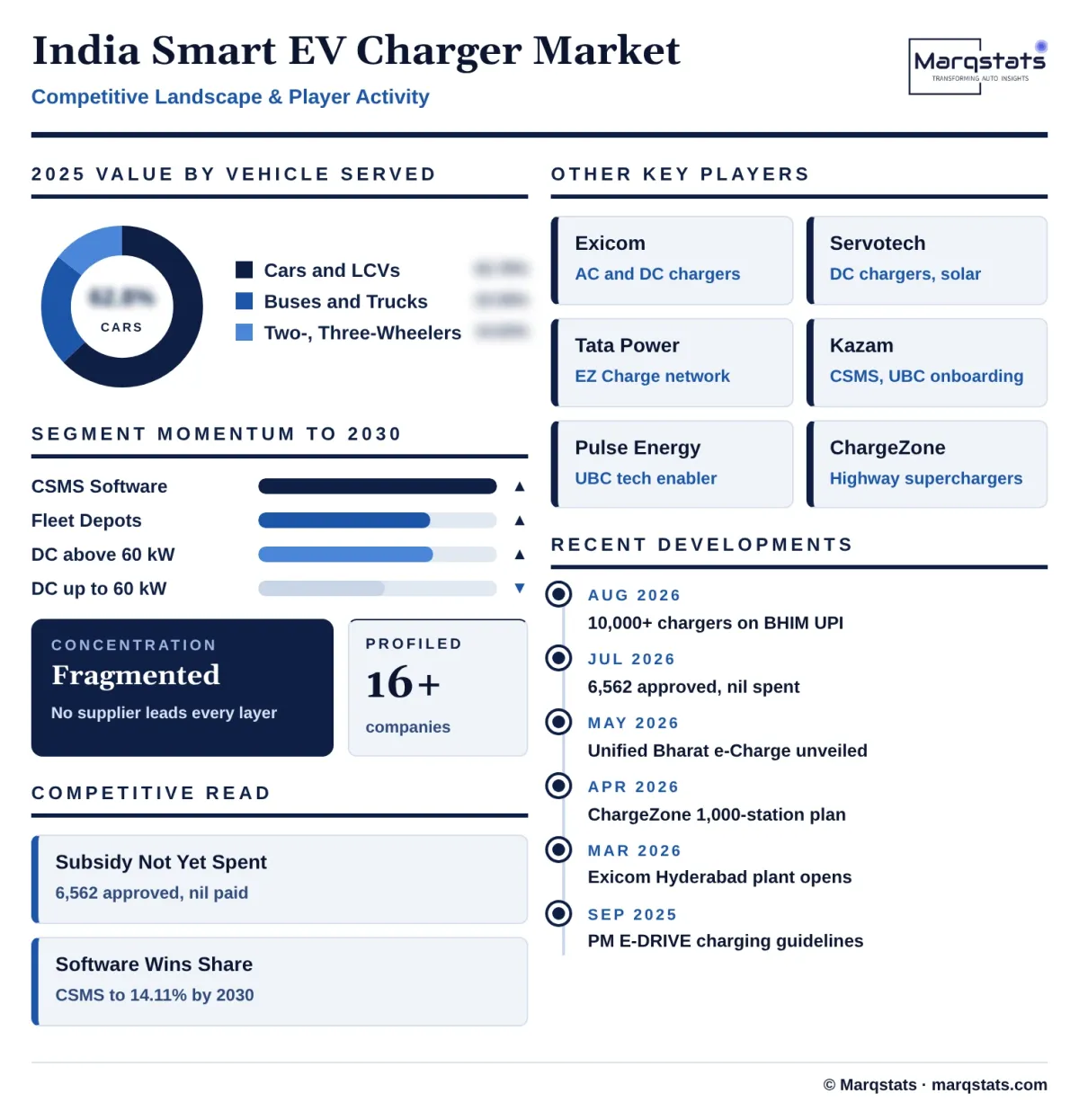
High-power DC chargers above 60 kW account for 37.61% of 2025 value, public and semi-public sites for 49.65% and cars and light commercial vehicles for 62.78%. South India leads with 38.00% of value, while CSMS software grows fastest at 33.99% a year as Unified Bharat e-Charge requires chargers to report live status.
Key Takeaways
Market Overview & Analysis
Report Summary
Marqstats sizes the India smart EV charger market as the value of new connected charging equipment and its management software sold to Indian buyers each year. A charger counts as smart when it connects to a back office over OCPP 1.6J or OCPP 2.0.1, or through a vendor cloud, so that its owner can see its status, start and stop sessions remotely, push firmware and bill users. Hardware is counted at ex-works value, before GST, installation and dealer margins; CSMS software is counted at licence and subscription revenue earned by vendors in India.
India built its public network quickly from a small base. The Ministry of Heavy Industries told the Lok Sabha in December 2025 that 29,151 public charging stations had been installed, 8,805 of them fast chargers and 20,346 slow chargers, with 8,932 set up by the three oil marketing companies. When the Unified Bharat e-Charge platform was unveiled on 12 May 2026, about 67,000 chargers had been mapped, including about 25,000 fast chargers, and a later parliamentary reply reported in July 2026 counted 52,718 public charging stations including 16,561 fast chargers for cars.
Vehicle demand sets the pace. Vahan registration data compiled by EVreporter put 2025 electric vehicle sales at more than 2.36 million, or 8.36% of new registrations, including 1,345,244 electric two-wheelers and 196,724 electric cars, up 85.1%, of which Tata Motors sold 76,899. Electric car buyers usually take a home wallbox, two- and three-wheeler fleets need dense low-power points, and every car on the highway needs a fast charger, so each vehicle class pulls a different charger.
Public money is approved but not yet spent. The PM E-DRIVE scheme, with an outlay of INR 10,900 crore from April 2024 to March 2028, earmarks INR 2,000 crore for about 72,300 public charging stations. Its operational guidelines of 26 September 2025 set benchmark costs of INR 7.25 lakh for a 50 kW CCS-2 charger and INR 11.68 lakh for a 100 kW charger, pay up to 100% of charger cost on government land and 70% at OMC outlets, railway stations, airports and metro stations, and require subsidised chargers to share live data with the national hub. Separately, the Ministry of Power guidelines of September 2024 cap the supply tariff for charging stations at the average cost of supply, at 0.7 times that cost during solar hours and 1.3 times outside them, which rewards chargers whose CSMS can shift sessions in time.
The market grew from an estimated USD 43.10 million in 2021 to USD 86.40 million in 2022, USD 139.50 million in 2023 and USD 180.00 million in 2024, then rose 30.93% to USD 235.68 million in 2025. The 2025 figure equals about INR 2,050.42 crore at the 2025 average rate of INR 87.00 per US dollar and about 48.39% of the USD 487.00 million India EV charging station market that Marqstats publishes, which also counts installation, operations and other services.
India Smart EV Charger Market Size and Forecast
The India smart EV charger market grows from USD 235.68 million in 2025 to USD 673.39 million in 2030, a CAGR of 23.36%. Hardware rises from USD 213.68 million to USD 578.39 million and CSMS software from USD 22.00 million to USD 95.00 million. Units grow at 25.97% a year, from about 190,600 to 604,500 chargers, and value grows more slowly because the average hardware price falls from about USD 1,121 to USD 957 a unit.
The 2025 value is built bottom-up from units and prices. Marqstats estimates about 95,000 connected 7.4 kW to 22 kW AC chargers at about INR 38,000, 70,000 connected 3.3 kW AC points for two- and three-wheelers at INR 11,000, 15,000 light-vehicle DC chargers of 3 kW to 12 kW at INR 1.30 lakh, 6,500 car DC chargers of 30 kW to 60 kW at INR 7.00 lakh, 2,600 DC chargers of 90 kW to 180 kW at INR 13.50 lakh and 1,500 bus and truck depot chargers of 180 kW to 360 kW at INR 28.00 lakh. The 60 kW price sits just below the PM E-DRIVE benchmark of INR 7.25 lakh for 50 kW, because the benchmark is a ceiling, not a market price.
The base is checked against network counts. Shipments of about 25,600 DC chargers in 2025, of which 9,100 for cars, are consistent with fast chargers rising to 8,805 public stations in December 2025 and to about 25,000 mapped fast chargers by May 2026, once captive fleet and depot chargers are added. Tata Power alone reports more than 2.14 lakh home chargers installed to date, and electric car sales of 196,724 in 2025 support home AC volumes of about 95,000 connected units including commercial sites.
Growth to 2030 rests on three volume lines. Marqstats expects car DC chargers of 30 kW to 60 kW to reach 19,000 a year, 90 kW to 180 kW chargers 11,000 and depot chargers 4,500, as the PM E-DRIVE approvals, ChargeZone, Statiq and OMC highway programmes and e-bus tenders turn into installations. Prices fall about 3% to 4% a year in INR terms as Exicom, Servotech, Delta Electronics and others localise power modules under the Phased Manufacturing Programme.
Marqstats tracks four indicators to monitor the forecast: PM E-DRIVE expenditure against the INR 2,000 crore charging allocation, monthly onboarding to Unified Bharat e-Charge, electric car and electric bus registrations on Vahan, and quarterly EV charger revenue disclosed by listed makers such as Exicom Tele-Systems and Servotech Renewable Power System.
Market Dynamics
Key Drivers
Five forces lift spending on connected chargers and the software that runs them in India.
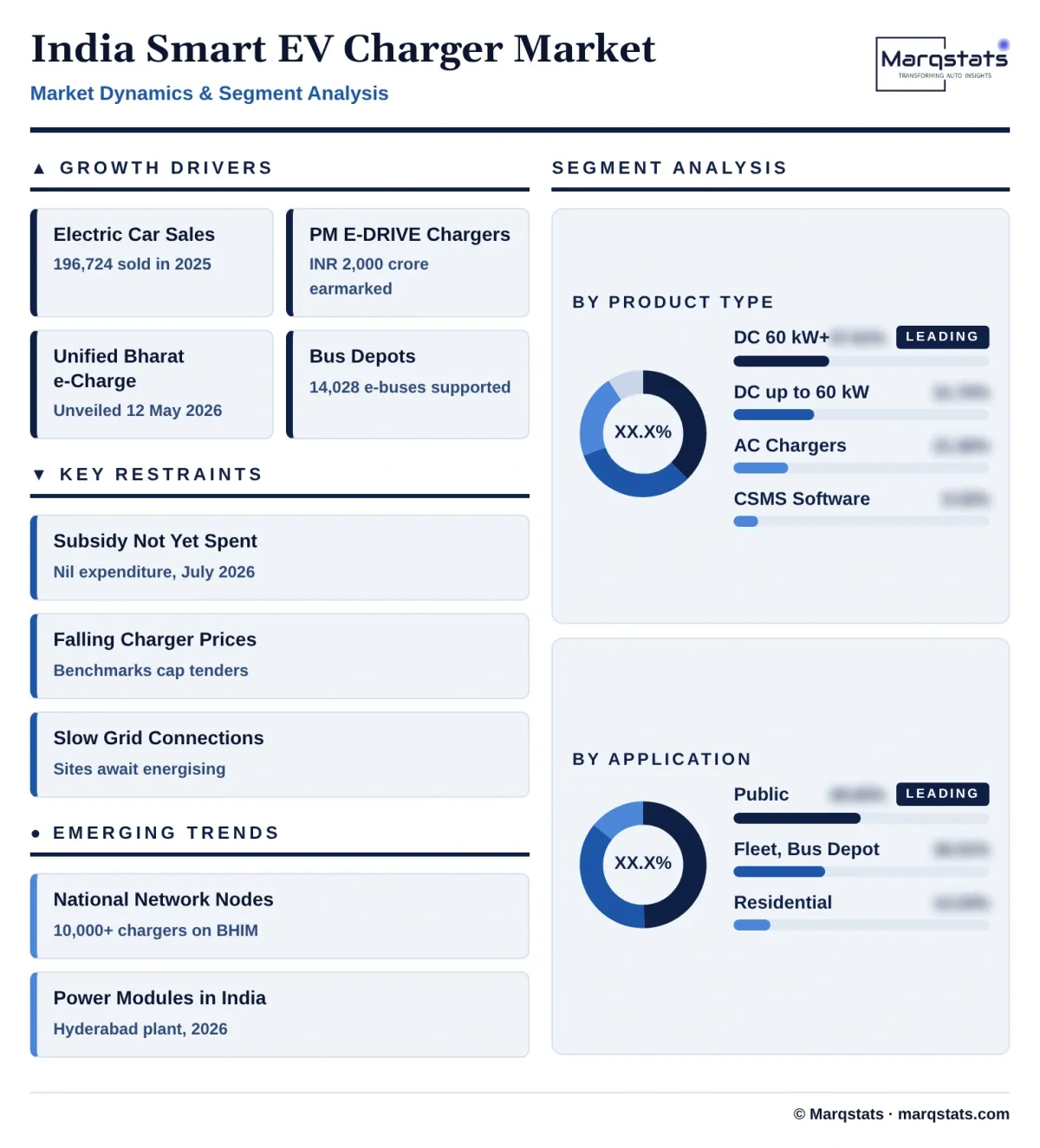
- Electric car sales pull home and fast chargers. Vahan data compiled by EVreporter put 2025 electric car sales at 196,724, up 85.1%, and Exicom reported that four-wheeler EV sales rose about 109% in FY2025 – 26. Each car usually ships with a 3.3 kW or 7.4 kW home wallbox, and every car that travels between cities needs DC charging on the way.
- PM E-DRIVE funds public DC chargers. The scheme earmarks INR 2,000 crore for about 72,300 public stations and pays up to 100% of the INR 7.25 lakh benchmark for a 50 kW charger and the INR 11.68 lakh benchmark for a 100 kW charger on government land. Approvals reached 6,562 chargers worth INR 688.84 crore by 22 July 2026, a backlog of orders that suppliers will ship as sites are energised.
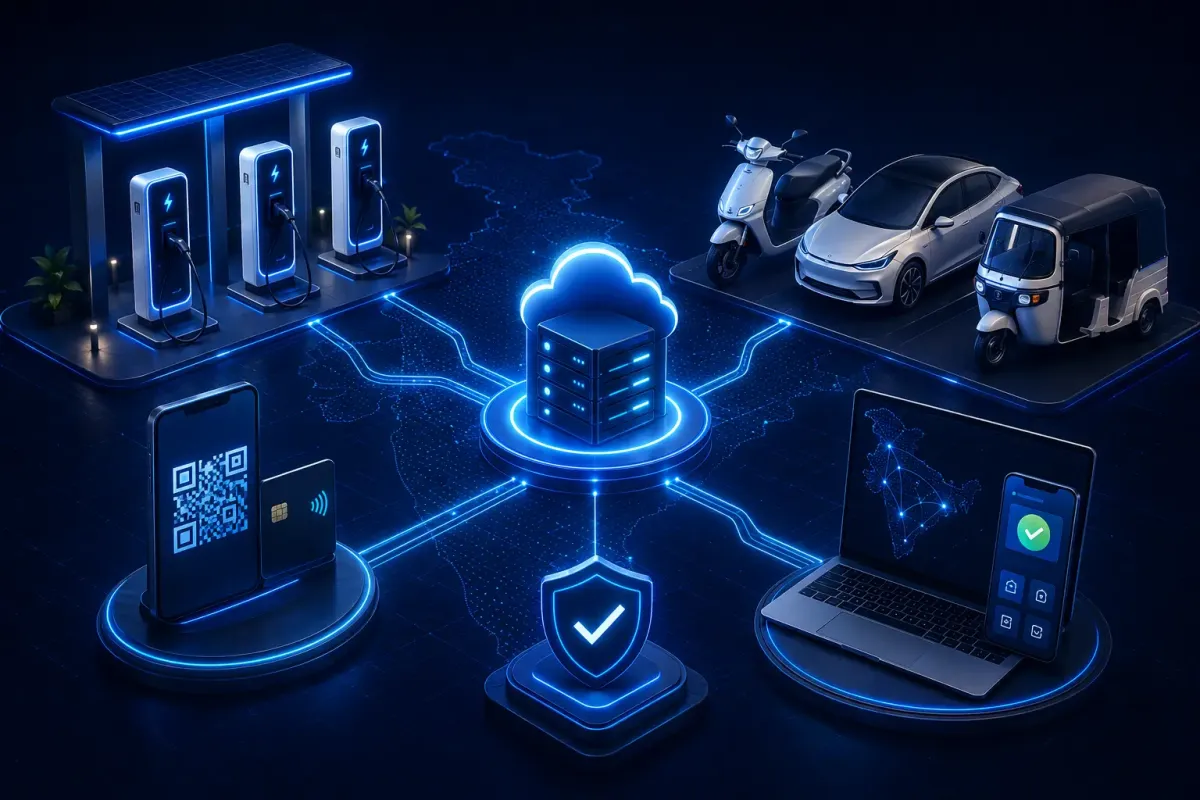
- Unified Bharat e-Charge makes connectivity mandatory in practice. The Ministry of Heavy Industries unveiled the platform on 12 May 2026, with BHEL as project implementation agency and NPCI BHIM Services building the payment layer on the Beckn protocol. A charger that cannot report live status, price and availability cannot be found or paid for through the platform, so unconnected units lose public traffic.
- Bus electrification creates large depot orders. PM e-Bus Sewa covers 10,000 electric buses across 116 cities and PM E-DRIVE supports 14,028 electric buses, while Tata Power reports more than 1,200 e-bus charging points. Each depot needs 180 kW to 360 kW chargers worth about INR 28 lakh each, the most valuable units in the market.
- Charge point operators keep building. Tata Power reports more than 5,800 public, semi-public and fleet points and 1,160 fast-charging points across 254 highway corridors, Statiq more than 8,000 chargers in 70 cities with a target of 20,000, and ChargeZone plans more than 1,000 highway supercharging stations by the end of FY2026 – 27.
Key Restraints
Four constraints hold value growth below unit growth and slow the conversion of approvals into installed chargers.
- Approved subsidies have not been spent. The Rajya Sabha was told on 22 July 2026 that no expenditure had been incurred on the 6,562 chargers approved under PM E-DRIVE, and the Unified Bharat e-Charge launch noted about 1,800 approved sites awaiting grid connection. Until DISCOMs energise these sites, suppliers hold stock and order books rather than revenue.
- Prices fall faster than many makers can cut cost. Benchmarks of INR 7.25 lakh for 50 kW and INR 11.68 lakh for 100 kW cap what public buyers pay, and CPO tenders press prices further, so the average hardware price per unit falls from about USD 1,121 in 2025 to USD 957 in 2030 on Marqstats estimates.
- Utilisation is low at many public sites. Nearly 90% of charging still happens at home or work, as noted at the Unified Bharat e-Charge launch, so many public fast chargers earn little, and operators delay the next order until utilisation improves.
- Grid connections are slow and costly. Upstream benchmark costs under PM E-DRIVE run from INR 6.04 lakh for loads up to 50 kW to INR 24.00 lakh above 150 kW, often more than the charger itself, and connection waits push site openings into later quarters.
Key Trends
Four shifts are changing what a smart charger in India is expected to do and who buys it.
- Chargers become nodes on a national network. Pulse Energy said in August 2026 that more than 10,000 chargers from over 100 CPO partners could be found and paid for through BHIM UPI under Unified Bharat e-Charge, and Kazam opened a seven-day onboarding programme on 14 July 2026.
- Makers sell turnkey bundles. Exicom launched Exicom One in December 2025, combining chargers, AI-based remote management, installation and maintenance, so buyers choose one supplier for hardware and software.
- Power moves up. Exicom reported a record quarter for DC chargers above 120 kW in January to March 2026, TATA.ev opened a MegaCharger hub at Mumbai airport with eight 120 kW chargers in September 2025, and depots move to 240 kW and 360 kW units.
- Power modules are made in India. Exicom inaugurated an integrated plant in Hyderabad in March 2026, investing about INR 216 crore and raising capacity 2.5 times, and it will build Tritium liquid-cooled power modules there, which shortens supply chains for high-power chargers.
Strategic Implications
- For charger makers, the next large order wave comes from the PM E-DRIVE backlog. The 6,562 approved chargers will be ordered through OMCs and state agencies once sites are energised, and makers with PMP certification and stock of 50 kW to 120 kW units win those tenders.
- For CSMS vendors, Unified Bharat e-Charge onboarding is the sales opening. Every CPO that wants its chargers to appear in BHIM UPI and other apps needs a CSMS that reports live status and prices, which favours vendors that can certify a legacy network in days rather than months.
- For charge point operators, smarter software matters more than more chargers. With nearly 90% of charging at home or work, operators improve returns by raising utilisation of the chargers they own, using remote diagnostics to keep uptime high and moving power to busy sites.
- For bus operators and STUs, depot chargers are the largest single charging spend. Tendering chargers with the buses, and specifying OCPP connectivity at the start, avoids paying for retrofits when depots join the national network.
- For OEMs selling electric cars, the home charger is part of the product. Bundling a connected 7.4 kW wallbox with an app, as Tata Power and others offer, gives the buyer a better first charge and gives the OEM data on how the car is used.
Market Segmentation
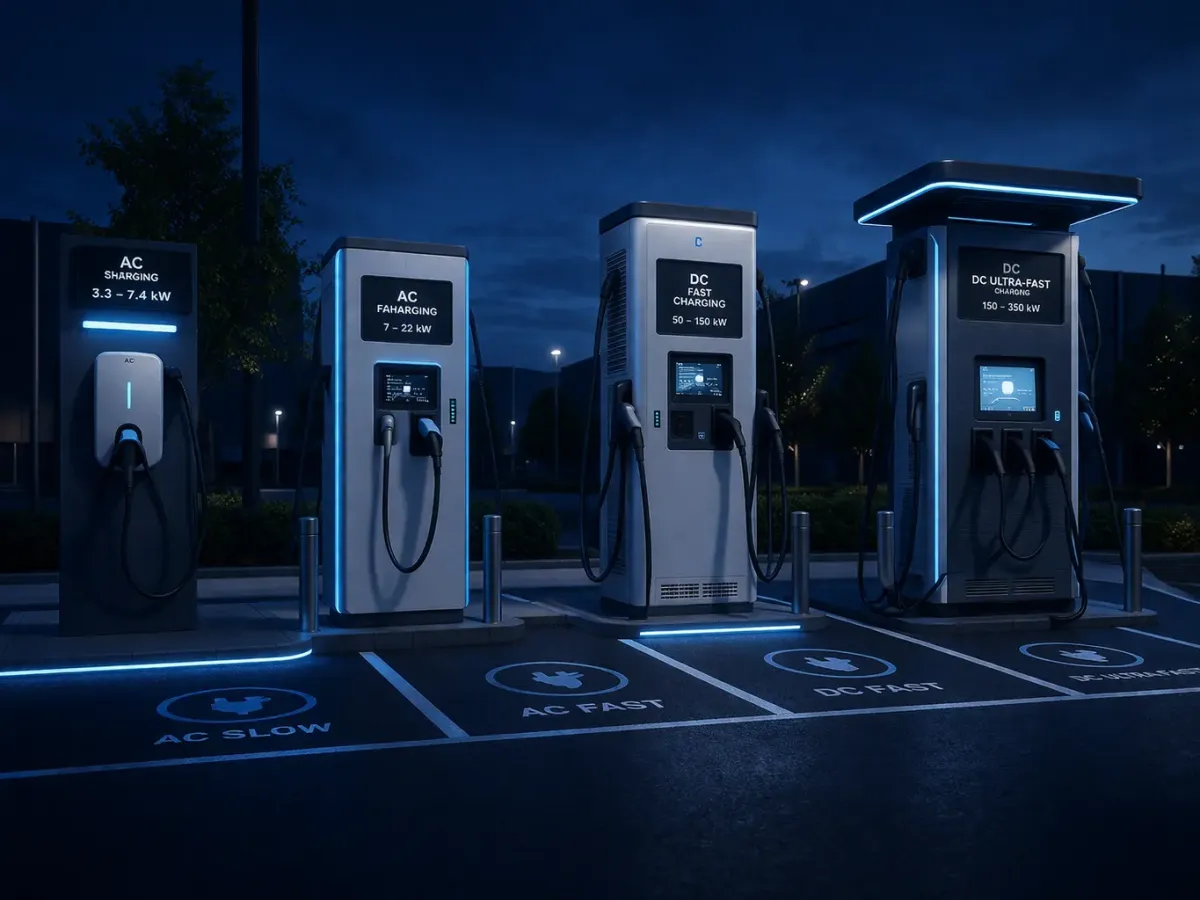
Connected AC chargers of 3.3 kW to 22 kW account for 21.36% of 2025 value, USD 50.34 million, and grow at 22.40% a year to USD 138.28 million. About 165,000 units were shipped in 2025, mainly 7.4 kW wallboxes for car owners and housing societies and 3.3 kW points for two- and three-wheelers, supplied by Exicom, Tata Power, Delta Electronics and many domestic makers.
DC chargers up to 60 kW, including 3 kW to 12 kW light-vehicle DC units, account for 31.70% of 2025 value, USD 74.72 million, and grow at 17.95% a year to USD 170.58 million, the slowest rate of any segment because prices fall fastest. About 21,500 units were shipped in 2025, mostly 30 kW to 60 kW dual-gun CCS-2 units for city sites and fleet yards.
DC chargers above 60 kW account for 37.61% of 2025 value, USD 88.62 million, and grow at 24.92% a year to USD 269.53 million and 40.03% of the market. About 4,100 units were shipped in 2025, including about 1,500 depot chargers of 180 kW to 360 kW for buses and trucks and 2,600 chargers of 90 kW to 180 kW for highways and OMC outlets.
CSMS software accounts for 9.33% of 2025 value, USD 22.00 million, and grows fastest, at 33.99% a year, to USD 95.00 million and 14.11% of the market. It covers OCPP back-office licences and subscriptions for monitoring, remote control, firmware updates, OCPP smart-charging profiles and session billing sold by Kazam, Numocity, Pulse Energy, Exicom and others; on-site dynamic load management controllers and their licences are excluded.
Home and housing-society chargers account for 14.34% of 2025 value, USD 33.79 million, and grow at 23.06% a year to USD 95.37 million. Units are high and prices are low: most are 7.4 kW wallboxes bundled with electric cars, and Tata Power alone has installed more than 2.14 lakh home chargers.
Public and semi-public sites account for 49.65% of 2025 value, USD 117.03 million, and grow at 22.53% a year to USD 323.17 million. They include OMC fuel stations, highway hubs, malls, offices and parking lots, and they carry most CSMS spending because they must bill strangers and appear on Unified Bharat e-Charge.
Fleet and depot chargers account for 36.01% of 2025 value, USD 84.86 million, and grow fastest, at 24.60% a year, to USD 254.85 million and 37.85% by 2030. E-bus depots, ride-hailing and delivery fleets and three-wheeler operators buy high-power chargers in batches and pay for software that schedules charging around duty cycles.
Chargers for two- and three-wheelers account for 14.63% of 2025 value, USD 34.48 million, and grow at 18.42% a year to USD 80.29 million. Volumes are high but units are cheap, and many riders charge from home sockets or swap batteries, which keeps value small.
Chargers for cars and light commercial vehicles account for 62.78% of 2025 value, USD 147.95 million, and grow fastest, at 24.84% a year, to USD 448.57 million and 66.62% of the market, from home wallboxes to 180 kW highway chargers.
Chargers for buses and trucks account for 22.59% of 2025 value, USD 53.25 million, and grow at 22.10% a year to USD 144.53 million. The segment is almost entirely depot DC chargers of 180 kW to 360 kW, ordered with PM e-Bus Sewa, PM E-DRIVE and state transport undertaking bus tenders.
By Geography
South India
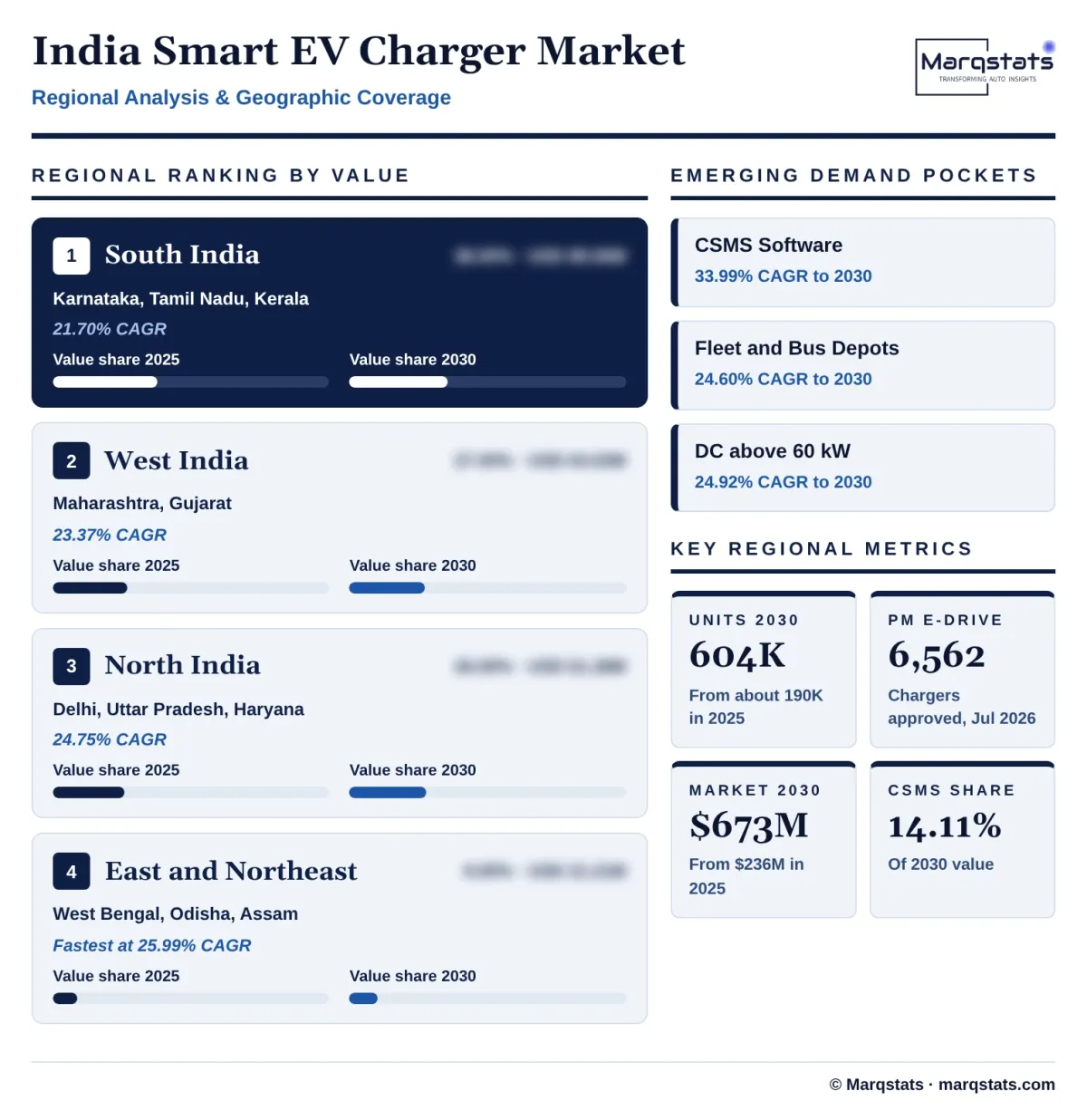
South India accounts for 38.00% of 2025 value, USD 89.56 million, and grows at 21.70% a year to USD 239.05 million by 2030. Karnataka had 6,097 public stations in August 2025, the most of any state, Bengaluru has the largest PM E-DRIVE bus allocation at 4,500 buses, and Tamil Nadu, Kerala, Telangana and Andhra Pradesh add strong car and two-wheeler demand.
West India
West India accounts for 27.00% of 2025 value, USD 63.63 million, and grows at 23.37% a year to USD 181.82 million. Maharashtra had 4,155 public stations in August 2025 and the largest PM E-DRIVE supported vehicle sales of any state, about 428,000, while the Mumbai – Pune and Delhi – Mumbai corridors and Gujarat highways carry high-power DC demand.
North India
North India accounts for 26.00% of 2025 value, USD 61.28 million, and grows at 24.75% a year to USD 185.18 million. Uttar Pradesh had 2,326 public stations and Delhi 1,967 in August 2025, Delhi has an allocation of 2,800 electric buses under PM E-DRIVE, and the Delhi – Agra, Delhi – Jaipur and Delhi – Chandigarh corridors need fast chargers.
East and Northeast India
East and Northeast India account for 9.00% of 2025 value, USD 21.21 million, and grow fastest, at 25.99% a year, to USD 67.34 million. The base is small, but West Bengal, Odisha, Bihar and Assam have large three-wheeler fleets and new state EV policies, and OMC outlets on national highways bring DC charging to cities that had none.
How Competition Is Evolving
The market is fragmented, with no single supplier holding a dominant share across hardware and software. Marqstats reads competition by layer rather than by company share, because makers report Indian charger revenue inside wider segments. The three layers are charger makers, CSMS and platform vendors, and charge point operators and OMCs that buy chargers and often run their own software.
Charger makers compete on price, power and local content. Exicom Tele-Systems reported FY2025 – 26 consolidated revenue of about INR 1,152 crore, inaugurated a Hyderabad plant in March 2026 that lifts capacity 2.5 times, and has sold more than 1,50,000 chargers worldwide. Servotech Renewable Power System reported standalone FY2025 – 26 revenue of INR 641.66 crore across solar and EV charging. Delta Electronics India, ABB India and Tata AutoComp supply high-power and depot chargers, and Ather Energy builds its own Ather Grid fast chargers for two-wheelers.
Software vendors compete on integration speed. Kazam EV Tech, Numocity Technologies, Pulse Energy and Bolt.Earth sell OCPP back offices and white-label apps to CPOs, OEMs and site hosts, and the launch of Unified Bharat e-Charge turned onboarding into a race: Pulse Energy reported more than 10,000 chargers and over 100 CPO partners connected to BHIM UPI in August 2026, and Kazam offered seven-day integration from July 2026.
Operators are the main buyers. Tata Power, Statiq, ChargeZone, Jio-bp pulse and the oil marketing companies IndianOil, Bharat Petroleum and Hindustan Petroleum place the large DC orders, and the PM E-DRIVE approvals route much of the subsidised volume through OMC outlets and state agencies, which favours makers that hold PMP certification.
Companies Covered
Companies covered in the report include:
Recent Market Activity
Table of Contents
Coverage & Segmentation
The study covers the India smart EV charger market, with 2025 as the base year, 2021 – 2025 as the historical period and 2026 – 2030 as the forecast period. It covers new network-connected AC and DC chargers sold to Indian buyers, valued ex-works before GST and installation, and CSMS software licence and subscription revenue, segmented by product type, application, vehicle served and region. Rupee figures use the 2025 average of INR 87.00 per US dollar.
Installation, civil and upstream grid works, charging operations and energy sales, payment, discovery and roaming apps, battery swapping, unconnected chargers and sockets, onboard chargers and exports are excluded. CSMS smart-charging modules that push OCPP charging profiles are counted here; dynamic load management edge controllers, smart meters and CT sensors, DLM licences and DLM integration belong to the Marqstats India EV charging dynamic load management market and are not counted here. The live Marqstats India EV charging station market (USD 487.00 million in 2025) is a broader parent, and the India EV charging payment and interoperability platform, India electric 2W and 3W fast charging equipment and India e-bus charging infrastructure markets overlap this one in part; their figures should not be added to it.