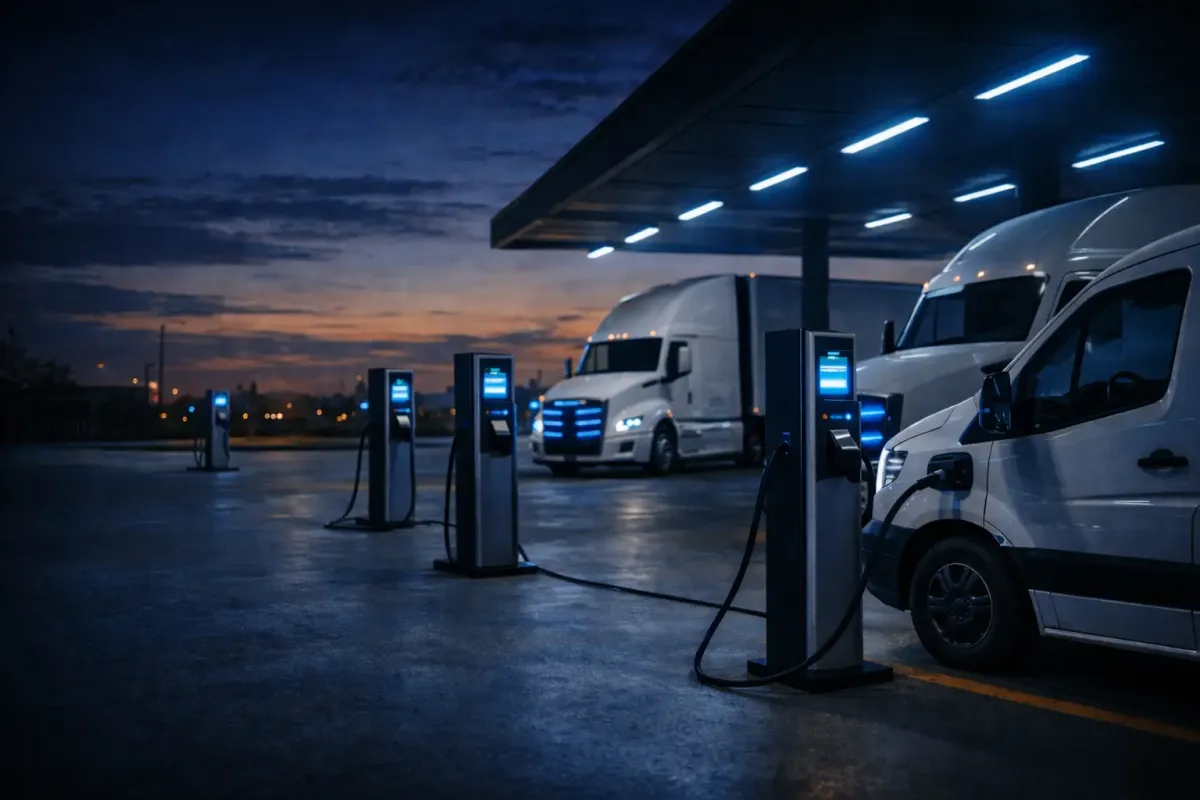
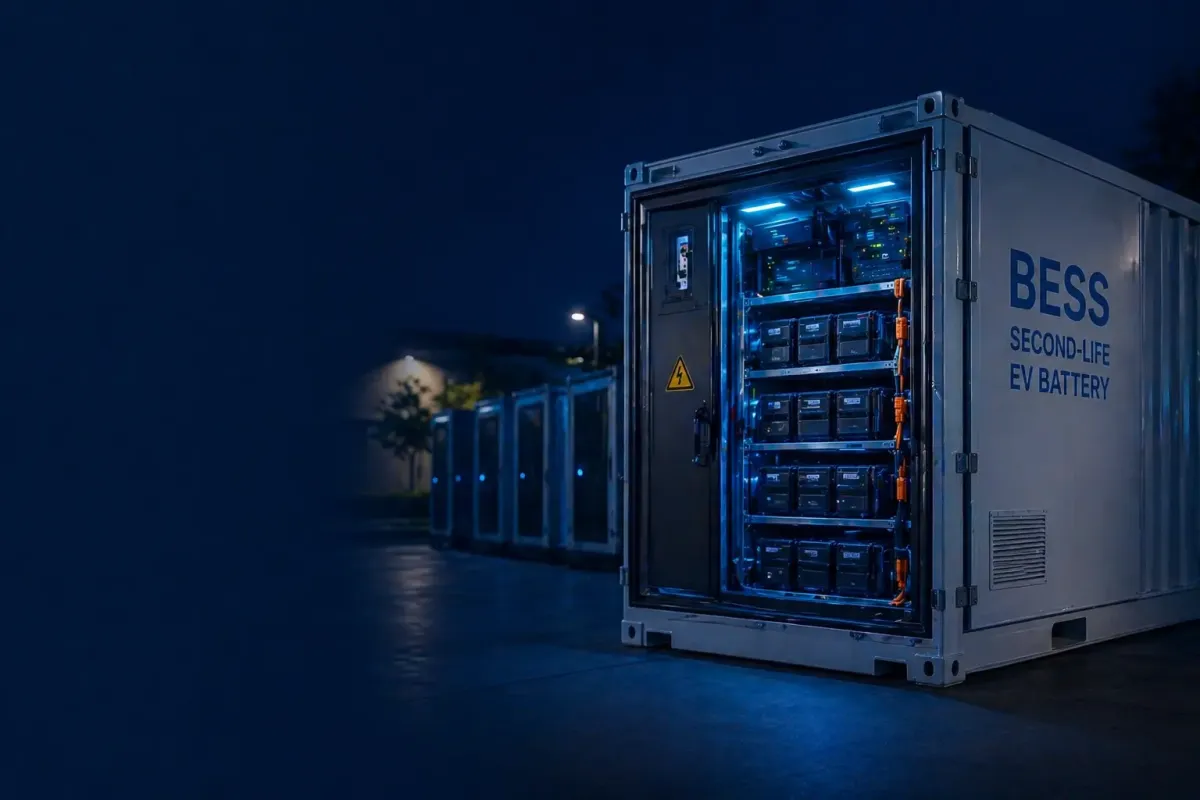
Market Snapshot
Middle bar: base-year value × (1 + CAGR), rounded to two decimals. This is a calculated illustration, not a separately researched annual estimate.
The global off-grid solar EV charger market size is estimated at USD 31.00 million in 2025 and is projected to reach USD 63.40 million by 2030, growing at a CAGR of 15.38% over 2026 – 2030. Marqstats estimates that about 725 standalone solar-and-battery charging units for cars, vans, buses and other four-wheel electric vehicles were sold worldwide in 2025, rising to about 1,848 units by 2030, while the blended price per unit falls from about USD 42,800 to USD 34,300.
The market is recovering from a sharp fall. Value peaked at an estimated USD 63.90 million in 2023, when US federal agencies were buying transportable solar chargers in volume through General Services Administration contracts, and fell 51.49% to USD 31.00 million in 2025 after those orders stopped. Growth from 2026 comes from city and county fleets, commercial property owners and buyers outside the United States, and the 2030 value only just passes the 2023 peak.
North America is the largest region, with an estimated 45.16% of 2025 value, followed by Europe at 22.58%, Asia-Pacific at 17.74%, the Middle East and Africa at 10.32% and Latin America at 4.19%. The study segments the market by vehicle type, format, end user and charging type. Values are in US dollars at constant 2025 exchange rates, with EUR 1 = USD 1.13, and cover ex-works selling prices of complete units excluding sales taxes, installation services and recurring software fees.
Key Takeaways
Market Overview & Analysis
Report Summary
Marqstats sizes the global off-grid solar EV charger market as the ex-works value of complete, standalone charging units that generate their own electricity from on-board or integrated solar panels, store it in batteries and charge cars, vans, buses, trucks or specialist four-wheel vehicles without a connection to the electricity grid. The scope covers transportable units, such as the Beam Global EV ARC and Paired Power PairTree, and fixed off-grid solar-storage charging hubs. Grid-tied solar carports, battery-only mobile chargers without solar generation, battery-swap stations and chargers for bicycles, e-scooters, two-wheelers and three-wheelers are excluded.
The market grew from an estimated USD 12.50 million in 2021 to a peak of USD 63.90 million in 2023, then fell to USD 48.00 million in 2024 and USD 31.00 million in 2025. Over 2021 – 2025 value rose at 25.49% a year, but almost all of that came from US federal orders in 2022 and 2023. When federal EV charging orders ceased, North American value fell 75.65% between 2023 and 2025, while every other region kept growing.
A typical transportable unit combines a solar canopy over a parking space, a battery and one or two Level 2 chargers on a ballast base that needs no foundation or trenching. Beam Global states that the EV ARC uses a tracking solar array that produces up to 25% more energy than a fixed array, is flood-proof to 9.5 feet, is rated for winds of 160 mph and can be installed in minutes. Paired Power lists its PairTree with a 4.6 kW bifacial solar array, up to 42.4 kWh of battery storage, one or two Level 2 chargers and a range of 75 to 230 miles of driving added per day, at base prices of about USD 28,000 to USD 78,000.
The case for off-grid units rests on speed and resilience rather than cost per kWh. A grid-connected charger is cheaper to run, but it can need a utility interconnection, transformer upgrades and trenching that take months and cost more than the charger itself. Off-grid units avoid that work, keep charging during grid outages and can be moved when a site changes, which suits fleet depots, parks, emergency services, remote sites and temporary locations.
The forecast rests on three conditions. City, county and tribal government buyers in the United States keep funding fleet chargers from local budgets and state grants, commercial and international buyers continue to grow as a share of orders, and stationary battery prices stay close to 2025 levels or fall further. Under these conditions unit sales reach about 1,848 in 2030 and market value reaches USD 63.40 million.
Global Off-Grid Solar EV Charger Market Size and Forecast
The global off-grid solar EV charger market grows from USD 31.00 million in 2025 to USD 63.40 million in 2030, a CAGR of 15.38%. The market reaches an estimated USD 35.30 million in 2026, USD 40.40 million in 2027, USD 47.10 million in 2028 and USD 54.70 million in 2029. Growth of 13.87% in 2026 follows two years of decline and comes mainly from Europe, Asia-Pacific and commercial buyers in North America.
Unit sales grow faster than value. Marqstats estimates sales of about 725 units in 2025, of which about 226 were in North America, 183 in Asia-Pacific, 146 in Europe, 133 in the Middle East and Africa and 37 in Latin America. Sales rise to about 1,848 units by 2030, a 20.58% annual rate, with Asia-Pacific overtaking North America as the largest region by units at about 588 against 378.
Prices fall in every region. Marqstats estimates blended ex-works prices in 2025 of about USD 62,000 per unit in North America, USD 48,000 in Europe, USD 35,000 in Latin America, USD 30,000 in Asia-Pacific and USD 24,000 in the Middle East and Africa, falling to about USD 55,000, USD 42,000, USD 30,000, USD 26,000 and USD 20,000 by 2030. The global blended price falls from about USD 42,800 to USD 34,300, both because unit prices fall and because the mix shifts to regions with lower prices.
The 2023 peak was not a normal market. Beam Global revenue reached USD 67.4 million in 2023, mostly from EV ARC sales to federal agencies, and its General Services Administration sales of EV ARC units totalled 906 units worth USD 72.1 million before 2025. In 2025 the same channel delivered 28 units worth USD 4.3 million. Marqstats treats the federal purchase wave as a one-off and does not assume it returns during the forecast period.
The base for recovery is broader than before. In 2025 Beam Global had customers in commercial, state and local government, international and tribal markets, and in the first half of 2026 48% of its revenue came from outside the United States. Smaller suppliers such as Paired Power in California and Sunnoo in New Mexico, and integrators of larger off-grid hubs in Europe and Asia, add volume that does not depend on a single government programme.
Market Dynamics
Key Drivers
Five forces support demand for solar-powered EV chargers that run without a grid connection.
- Charging without grid connections or trenching. Many fleet depots and car parks have no spare electrical capacity, and a new utility connection can take months and require transformer upgrades and trenching. Off-grid solar units skip that work. Long Beach said its six additional EV ARC systems in 2026 expanded fleet charging without utility transformer upgrades or parking lot trenching, and Beam Global states that an EV ARC can be deployed in minutes.
- Resilience and emergency power. Off-grid chargers keep working when the grid goes down, which matters to emergency services, local governments and remote communities. Beam Global states that the EV ARC is flood-proof to 9.5 feet and rated for 160 mph winds, and in October 2026 it reported eight EV ARC deployments for Native American tribal communities in California for blackout-resilient emergency charging, including five units and a mobile trailer at Dry Creek Rancheria funded by a California Energy Commission grant.
- Falling battery storage costs. Industry price surveys show that stationary storage pack prices fell 45% in 2025 to USD 70 per kWh and that average lithium-ion pack prices fell 8% to USD 108 per kWh. Batteries are one of the largest cost items in an off-grid charger, so lower prices let suppliers offer more storage per unit or lower prices, and make larger hubs with DC charging more practical.
- Municipal fleet electrification. Cities and counties are electrifying light-duty fleets and need chargers at yards, parks and depots that are hard to wire. The City of Dallas placed its fourth order, for ten EV ARC systems, in July 2026, and Stanislaus County in California ordered ten EV ARC systems and an ARC Mobility trailer in the second quarter of 2026. Repeat orders from the same buyers show that units are being used rather than tested.
- Cooperative contracts and grants. US public buyers can buy EV ARC systems through the General Services Administration Multiple Award Schedule, which Beam Global holds until 31 October 2030, and through Sourcewell cooperative contracts, without running their own tenders. State programmes such as California Energy Commission grants co-fund units for tribal and local governments, and these channels cut the time and paperwork of buying.
Key Restraints
Four constraints have cut the market from its 2023 peak and still limit how fast it recovers.
- Loss of US federal fleet demand. Federal agencies were the largest buyers of off-grid solar chargers in 2022 and 2023. Beam Global stated that US federal EV charging orders ceased, and its General Services Administration sales of EV ARC units fell from 906 units before 2025 to 28 units in 2025. North American value fell from an estimated USD 57.50 million in 2023 to USD 14.00 million in 2025.
- End of the Section 30C credit. Under the One Big Beautiful Bill Act, the US alternative fuel vehicle refuelling property credit ended for property placed in service after 30 June 2026. Commercial buyers in eligible areas had been able to claim up to 30% of the cost of a charger, so the change raises the net price of a unit in the largest market by up to about USD 18,600 at the 2025 North American average.
- Limited energy per unit. A single solar canopy produces only enough energy for a limited daily distance. Paired Power lists 75 to 230 miles of driving added per day for its PairTree depending on configuration and sunlight, and Beam Global needs four linked EV ARC units to support its 24 kW DC charger. Fleets with high daily mileage or heavy vehicles need several units per vehicle or a grid-connected charger.
- High cost per kWh delivered. Off-grid units cost about USD 25,000 to USD 80,000 each, several times the price of a grid-connected Level 2 charger, and deliver a modest amount of energy each day. Buyers that already have grid capacity rarely choose off-grid units on cost alone, which limits the market to sites where connection is slow or expensive, where resilience is required or where chargers need to move.
Key Trends
Four shifts are changing who buys off-grid solar chargers, where and on what terms.
- International diversification. Suppliers are reducing their reliance on US public buyers. Beam Global formed Beam Europe from its 2023 acquisition of Amiga and owns a 450,000 square foot plant in Kraljevo, Serbia, and 47% of its second-quarter 2026 revenue came from outside the United States. Its Beam Middle East joint venture with Platinum Group in the United Arab Emirates adds a route into the Gulf.
- Sponsorship and rental models. Instead of selling units outright, suppliers are placing chargers in public spaces and recovering the cost through advertising sponsorship and rental fees. Beam Global reported a sponsorship-funded EV ARC rental programme in Serbia in 2026, which gives cities chargers without capital spending and gives the supplier recurring revenue.
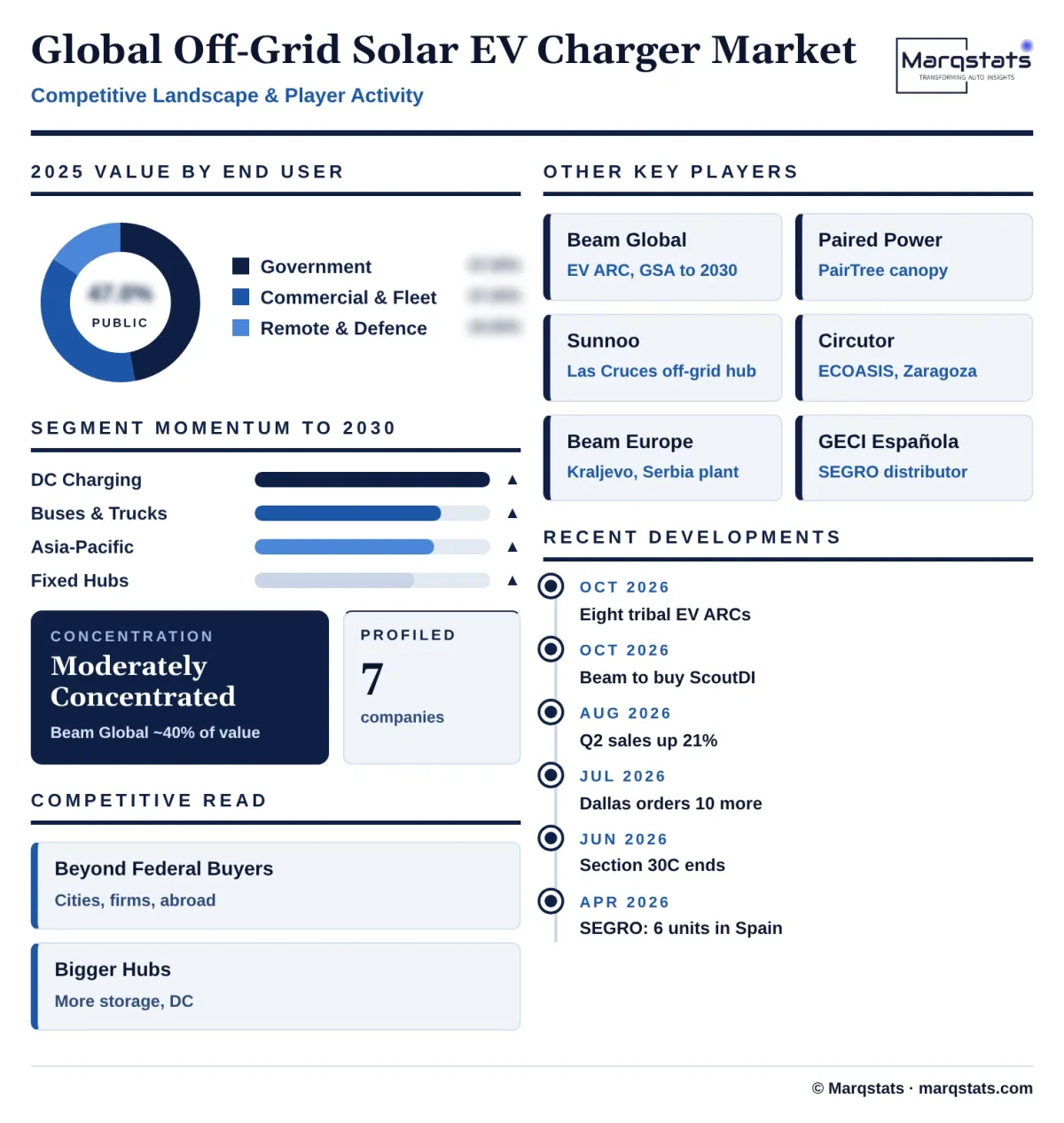
- Larger hubs with DC charging. Off-grid projects are growing from single parking spaces to multi-vehicle hubs. Sunnoo opened a grid-independent station in Las Cruces, New Mexico, in July 2025 with a 6.5 kW bifacial dual-axis tracker, 24 to 100 kWh of storage and dual NACS Level 2 connectors, and Circutor opened the ECOASIS station in Zaragoza in June 2025 with about 220 solar panels, battery storage and hydrogen storage for ultra-fast charging.
- Off-grid platforms for new loads. Suppliers are applying solar-and-storage platforms to loads beyond cars. Paired Power markets the PairPHNXX relocatable solar microgrid, and in October 2026 Beam Global signed a definitive agreement to acquire ScoutDI, a drone company in Trondheim, Norway, to build a US drone platform for industrial and defence markets. Wider use of the same hardware spreads fixed costs over more units.
Strategic Implications
- For manufacturers, the next buyers are local, commercial and international. Federal fleet orders are unlikely to return in the forecast period, so suppliers need dealer and distributor networks in Europe, the Middle East and Asia, such as GECI Española for SEGRO in Spain, and products priced for commercial fleets that no longer receive the Section 30C credit.
- For fleet and site owners, off-grid units fit specific sites. Off-grid chargers make sense where a grid connection is slow, costly or unreliable, where chargers may need to move, or where emergency charging is required. Owners should match daily mileage to the energy a unit can deliver, which is about 75 to 230 miles a day for a single canopy, and add units or grid chargers for heavier duty.
- For utilities and governments, off-grid chargers can fill gaps quickly. Units can be placed at parks, depots and tribal and rural sites without waiting for network upgrades, and grants such as those from the California Energy Commission have funded deployments. Cooperative contracts such as the General Services Administration schedule reduce procurement time for smaller public buyers.
- For battery and solar suppliers, falling storage prices widen the market. Stationary pack prices of about USD 70 per kWh in 2025 make larger batteries affordable in each unit, and DC-capable systems grow at 29.77% a year to 2030. Suppliers that can provide compact, certified battery packs and bifacial or tracking solar arrays will benefit as hub sizes grow.
- For investors, the market is small and dominated by one listed supplier. Beam Global accounts for an estimated four tenths of 2025 value, and the market fell by half when one buyer group stopped ordering. Growth to 2030 depends on a broader customer base, so investors should watch the share of non-government and international revenue rather than headline order announcements alone.
Market Segmentation
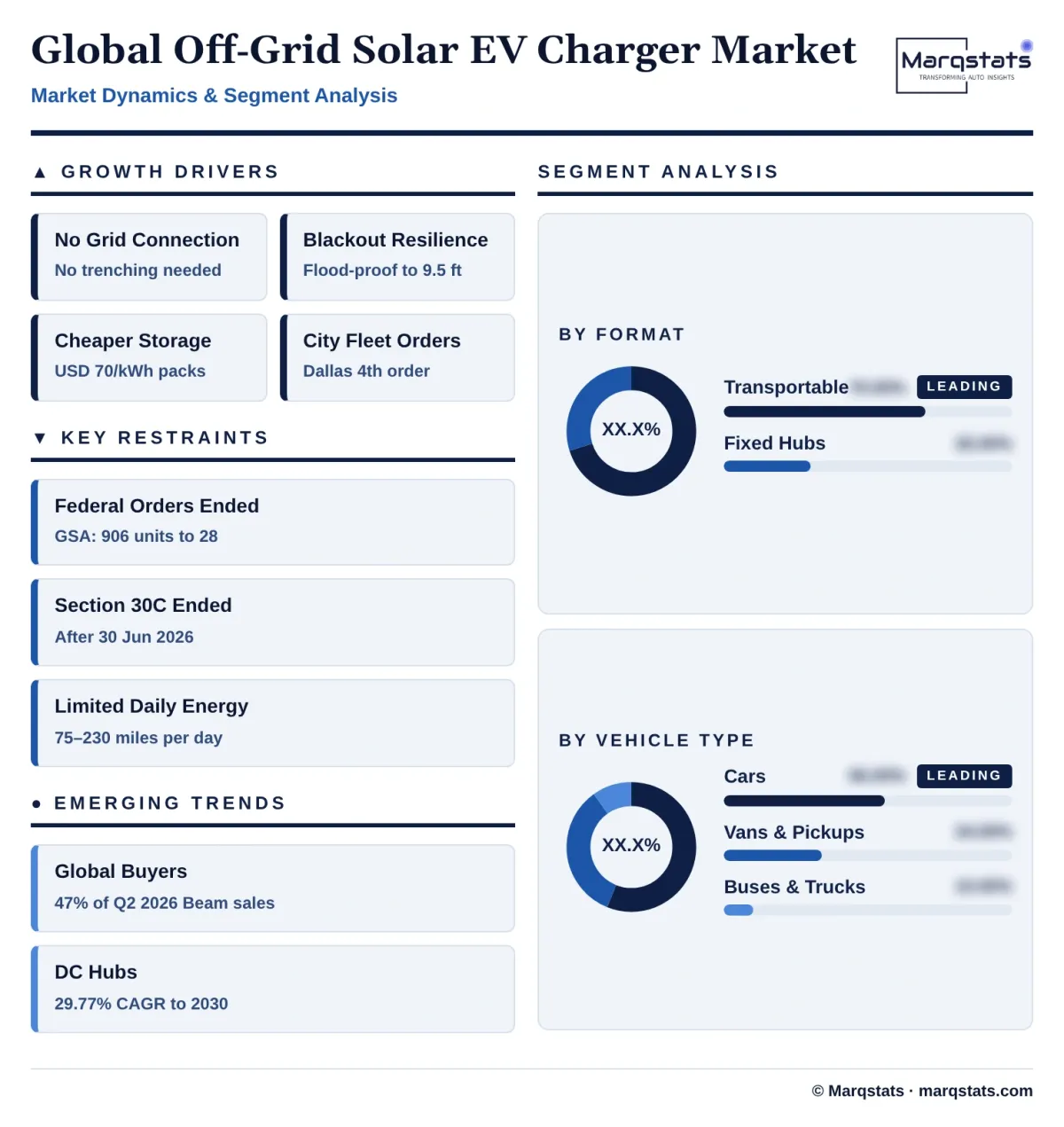
Chargers used mainly for passenger cars and light fleet sedans account for USD 17.36 million in 2025, 56.00% of value, rising to USD 31.70 million by 2030, a 12.80% CAGR, and 50.00% of value. Public car parks, workplace sites and municipal pool cars are the main uses, and most units are single-space Level 2 canopies that add a day of typical commuting range.
Chargers for delivery vans, utility pickups and other light commercial vehicles account for USD 10.54 million in 2025, 34.00% of value, rising to USD 22.82 million by 2030, a 16.71% CAGR, and 36.00% of value. City maintenance fleets, park services, logistics sites and utilities buy units for yards where there is no spare grid capacity, and repeat buyers such as Dallas and Long Beach mostly charge fleet vans and pickups.
Chargers for buses, shuttles, trucks and specialist vehicles such as airport, port and mining vehicles account for USD 3.10 million in 2025, 10.00% of value, and grow fastest by vehicle type, at 23.43% a year, to USD 8.88 million and 14.00% of value by 2030. These buyers need larger hubs, more storage and DC charging, so unit prices are higher and orders are fewer but larger.
Transportable units on ballast bases or trailers that need no foundation or trenching, such as the EV ARC, the ARC Mobility trailer and the PairTree, account for USD 21.70 million in 2025, 70.00% of value, rising to USD 39.94 million by 2030, a 12.98% CAGR, and 63.00% of value. Buyers value fast deployment and the option to move units when sites change.
Permanent off-grid solar-storage charging hubs built on foundations, such as the Sunnoo station in Las Cruces and the ECOASIS station in Zaragoza, account for USD 9.30 million in 2025, 30.00% of value, and grow faster, at 20.33% a year, to USD 23.46 million and 37.00% of value by 2030. Hubs serve several vehicles at once and are more common in Europe, Asia-Pacific and the Middle East.
Federal, state, city, county and tribal government buyers account for USD 14.57 million in 2025, 47.00% of value, rising to USD 23.46 million by 2030, a 10.00% CAGR, and 37.00% of value. Federal demand has largely stopped, so growth comes from cities and counties such as Dallas, Long Beach and Stanislaus County, from tribal governments with state grants and from municipalities in Europe.
Commercial property owners, logistics operators, retailers, utilities and private fleets account for USD 11.47 million in 2025, 37.00% of value, and grow fastest by end user, at 19.99% a year, to USD 28.53 million and 45.00% of value by 2030. SEGRO, which ordered six EV ARC systems for logistics sites in Spain in April 2026, is a typical buyer.
Remote sites, military bases, disaster response agencies, resorts and island communities account for USD 4.96 million in 2025, 16.00% of value, rising to USD 11.41 million by 2030, an 18.13% CAGR, and 18.00% of value. These buyers value resilience and independence from the grid more than cost per kWh.
Units with Level 2 AC chargers account for USD 27.90 million in 2025, 90.00% of value, rising to USD 51.99 million by 2030, a 13.26% CAGR, and 82.00% of value. Level 2 matches the output of a single solar canopy and battery and suits vehicles that park for several hours, such as fleet vehicles overnight or cars at work.
Systems with DC chargers account for USD 3.10 million in 2025, 10.00% of value, and grow fastest of all segments, at 29.77% a year, to USD 11.41 million and 18.00% of value by 2030. DC needs more solar and storage per charger: Beam Global links four EV ARC units to a 24 kW DC charger, and larger hubs such as ECOASIS combine many panels with batteries and hydrogen storage for ultra-fast charging.
By Geography
North America
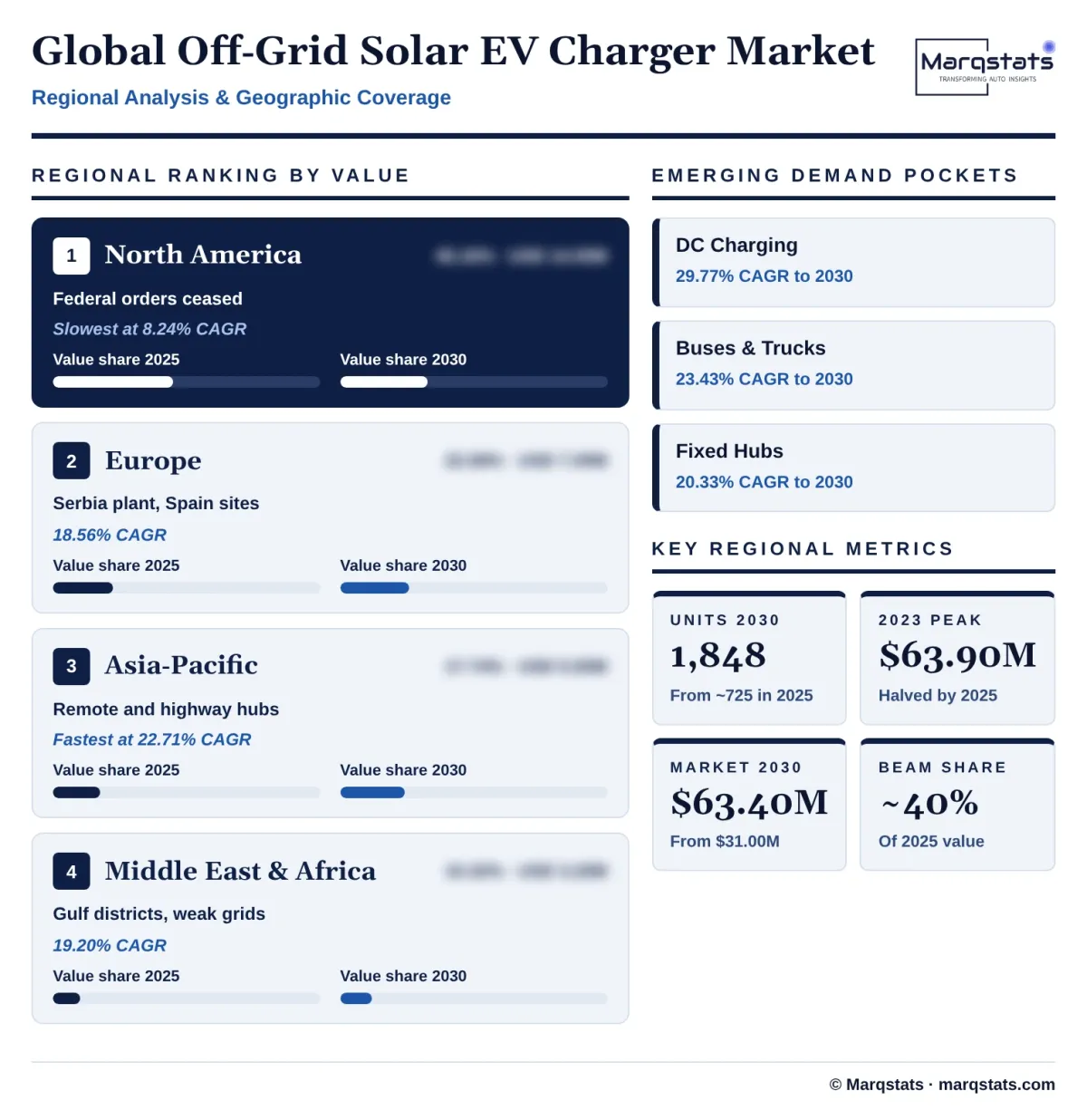
North America is the largest region, with an estimated USD 14.00 million in 2025, 45.16% of value, rising to USD 20.80 million by 2030, an 8.24% CAGR, but its share falls to 32.81%. The United States accounts for almost all regional value. Beam Global, headquartered in San Diego with production moving to Yuma, Arizona, supplies most units, alongside Paired Power and Sunnoo. The region fell from an estimated USD 57.50 million in 2023 after federal orders ceased, and the end of the Section 30C credit after 30 June 2026 slows commercial demand, so growth relies on city, county and tribal buyers and on state grants such as those from the California Energy Commission. Marqstats estimates about 226 units sold in 2025 at about USD 62,000 each, rising to about 378 units by 2030.
Europe
Europe accounts for an estimated USD 7.00 million in 2025, 22.58% of value, rising to USD 16.40 million by 2030, an 18.56% CAGR and 25.87% of value. Beam Europe builds EV ARC units at its plant in Kraljevo, Serbia, and has deployments in Serbia, Spain and Montenegro, including SEGRO logistics sites in Barcelona and Madrid and further orders in both cities and in Montenegro during 2026. Spain also hosts the Circutor ECOASIS hub in Zaragoza. Grid connection queues in many European cities and sponsorship-funded rental models support growth. Marqstats estimates about 146 units sold in 2025, rising to about 390 by 2030.
Asia-Pacific
Asia-Pacific accounts for an estimated USD 5.50 million in 2025, 17.74% of value, and grows fastest, at 22.71% a year, to USD 15.30 million and 24.13% of value by 2030. Demand comes from fixed off-grid hubs on highways and at tourist and remote sites in India, from remote mining and tourism sites in Australia and from island communities in the Pacific and Southeast Asia, where diesel generation is expensive. Prices are lower than in the West, at about USD 30,000 per unit in 2025, and Marqstats estimates sales of about 183 units rising to about 588 by 2030, making the region the largest by units.
Middle East and Africa
The Middle East and Africa account for an estimated USD 3.20 million in 2025, 10.32% of value, rising to USD 7.70 million by 2030, a 19.20% CAGR and 12.15% of value. Gulf states use off-grid solar chargers in new smart city districts, resorts and remote sites, and Beam Global serves the region through Beam Middle East, its joint venture with Platinum Group in the United Arab Emirates. In Africa, weak grids make solar-and-storage hubs attractive for fleets and lodges. Unit prices are the lowest of any region at about USD 24,000, and sales rise from about 133 units to 385 by 2030.
Latin America
Latin America accounts for an estimated USD 1.30 million in 2025, 4.19% of value, rising to USD 3.20 million by 2030, a 19.74% CAGR and 5.05% of value. Demand comes from mining companies, resorts, island authorities and city fleets in Chile, Mexico, Brazil and the Caribbean, where high solar resource and costly or unreliable grid power favour off-grid units. Marqstats estimates about 37 units sold in 2025, rising to about 107 by 2030.
How Competition Is Evolving
The global off-grid solar EV charger market is moderately concentrated. Beam Global is the only listed specialist and the largest supplier, with EV ARC sales of an estimated USD 12.5 million in 2025, about 40% of market value. The rest of the market is shared by smaller specialists such as Paired Power and Sunnoo in the United States, charger and energy companies that build off-grid hubs in Europe, such as Circutor in Spain, and regional integrators in Asia, the Middle East and Latin America.
Beam Global leads with the EV ARC and a broad public procurement position. The company had about 220 employees, revenue of USD 28.2 million in 2025 and a backlog of USD 9.0 million at 31 March 2026. It holds a General Services Administration Multiple Award Schedule contract through 31 October 2030 and a Sourcewell contract, builds in the United States and in Serbia and is moving US production to Yuma, Arizona, which it expects to save about USD 2.7 million. Its second-quarter 2026 revenue rose 21% year on year to USD 8.6 million, and preliminary third-quarter 2026 revenue rose 8%.
Beam Global is also diversifying away from EV charging. EV ARC products made up only about 11% of its backlog at the end of 2025, as the company sells street lighting, energy storage and other products through Beam Europe, and in October 2026 it agreed to acquire the Norwegian drone company ScoutDI. This makes the EV ARC a smaller share of the leader, which may leave room for focused competitors.
Paired Power competes with modular solar canopies and microgrids. Its PairTree combines a 4.6 kW bifacial solar array, up to 42.4 kWh of battery storage and one or two Level 2 chargers, and the company received a patent for its rapid-deployment solar canopy design in August 2025. Its range also includes the PairFleet fleet solution and the PairPHNXX relocatable microgrid. Beam Global names Paired Power and container-based designs as competitors.
Fixed hub builders compete on capacity rather than speed of installation. Sunnoo opened a grid-independent station in Las Cruces in July 2025 with a dual-axis tracker and up to 100 kWh of storage, and Circutor, with the research centre CIRCE and fuel retailer Grupo Zoilo Ríos, opened the ECOASIS off-grid ultra-fast station in Zaragoza in June 2025. These projects compete for highway, retail and destination sites where more vehicles charge each day.
Barriers to entry are moderate. Solar panels, batteries and chargers are widely available, but public buyers prefer suppliers with certified products, cooperative purchasing contracts and a record of units in service. Established suppliers hold an advantage with repeat buyers such as Dallas and Long Beach, while new entrants mostly win local projects and fixed hubs.
Companies Covered
Companies covered in the report include:
Recent Market Activity
Table of Contents
Coverage & Segmentation
The study covers the global off-grid solar EV charger market across North America, Europe, Asia-Pacific, the Middle East and Africa and Latin America, with 2025 as the base year, 2021 – 2025 as the historical period and 2026 – 2030 as the forecast period. Values are in US dollars at constant 2025 exchange rates, with EUR 1 = USD 1.13, and cover ex-works selling prices of complete standalone solar-and-storage charging units and hubs for cars, vans, buses, trucks and specialist four-wheel vehicles, excluding sales taxes, installation, financing and recurring software or sponsorship fees.
Grid-tied solar carports and canopies, battery-only mobile chargers without solar generation, battery-swap stations, portable cable chargers and solar charging racks, docks and lockers for bicycles, e-bikes, e-scooters, two-wheelers and three-wheelers are excluded; micromobility units are covered in the separate Marqstats micromobility docking study. Unit sales, prices, regional and segment splits and supplier shares are Marqstats estimates built from company filings, product specifications and order announcements.