Market Snapshot
The India luxury car market size is estimated at USD 4,049.31 million in 2025 and is projected to reach USD 6,906.32 million by 2030, growing at a CAGR of 11.27% over 2026 – 2030. Sales rise from about 51,550 to 76,000 cars, a 8.07% annual rate, as buyers move up to top-end models.
Marqstats defines the market as the value of new passenger cars sold in India under dedicated luxury marques, such as Mercedes-Benz, Mercedes-Maybach, BMW, MINI, Jaguar, Land Rover, Audi, Volvo, Lexus and Porsche, together with ultra-luxury and premium import brands such as Lamborghini, Rolls-Royce, Bentley, Ferrari and Tesla. Value is the ex-showroom transaction price before GST, road tax, registration and insurance, converted at the 2025 average of INR 87.00 per US dollar. Used cars, mass-market flagship models above INR 50 lakh and two-wheelers are excluded.
Core luxury cars priced from INR 60 lakh to INR 1.25 crore ex-showroom account for 47.97% of 2025 value, SUVs for 66.59% and petrol models for 52.33%. Western India, led by Mumbai, Pune and Ahmedabad, accounts for 33.50% of value, while battery-electric luxury cars grow fastest, at 31.73% a year.
Key Takeaways
Market Overview & Analysis
Report Summary
Marqstats sizes the India luxury car market as the ex-showroom value of new passenger cars sold under dedicated luxury marques, before GST and on-road charges. The market sold about 51,550 cars in 2025, about 1.15% of the 4.47 million passenger vehicles sold in India that year, and generated about INR 35,229 crore, or USD 4,049.31 million, of pre-tax value. The average car sold for about INR 68.34 lakh before GST, or about USD 78,551.
The segment nearly tripled in size between 2020 and 2025, according to Audi India head Balbir Singh Dhillon, but 2025 itself was flat. Retail sales of about 51,200 cars in 2024 grew by only 0.68% to about 51,550 in 2025, a year in which the euro stayed above INR 100, Mercedes-Benz India posted its first annual fall in five years and Audi India sales fell 22.5% to 4,510 cars. The flat year hides a mix shift: Mercedes-Benz India reported its best year for revenue on lower volume.
Policy turned in favour of the segment in the second half of 2025. GST 2.0 replaced the old 28% rate plus compensation cess with a single 40% rate for larger cars from 22 September 2025, cutting ex-showroom prices by INR 2 lakh to INR 30.4 lakh across Mercedes-Benz, BMW, Audi, Volvo and Jaguar Land Rover models. Battery-electric cars kept their 5% rate. Union Budget 2025 then reduced basic customs duty on imported cars priced above USD 40,000 from 125% to 70% but added a 40% Agriculture Infrastructure and Development Cess, so the effective duty stayed at about 110%.
Trade policy is the next lever. India and the European Union concluded free trade agreement talks on 27 January 2026, with duty on EU-built motor vehicles falling in stages from 110% to as low as 10% within a quota of 250,000 vehicles a year. Mercedes-Benz, BMW, Audi, Porsche, Volvo and Lamborghini all build their imported models in Europe, so the agreement mainly affects fully built cars above INR 1.25 crore, the tier that already drives value growth.
Demand recovered in 2026. Mercedes-Benz India sold a record 15,190 cars in January to September 2026, up 8%, BMW Group India sold 9,075 cars in the first half, up 16.74%, and on 16 October 2026 Audi India said it expected the segment to reach about 58,000 cars in 2026. Marqstats estimates 57,000 cars in 2026, up 10.57%, worth USD 4,611.22 million.
India Luxury Car Market Size and Forecast
The India luxury car market grows from USD 4,049.31 million in 2025 to USD 6,906.32 million in 2030, a CAGR of 11.27%. Units contribute less than value: sales rise at 8.07% a year, from about 51,550 to 76,000 cars, while the average pre-tax value per car rises at 2.96% a year, from about USD 78,551 to USD 90,873, as top-end and electric models take more of the mix.
The 2025 value is built bottom-up from three price tiers. Marqstats estimates about 11,350 entry luxury cars below INR 60 lakh ex-showroom at an average of INR 36 lakh before GST, 29,650 core luxury cars from INR 60 lakh to INR 1.25 crore at INR 57 lakh, and 10,550 top-end cars above INR 1.25 crore at INR 1.35 crore. The tier volumes are anchored on Mercedes-Benz India's disclosed mix of 13% entry, 62% core and 25% top-end in 2025, adjusted for the heavier entry weight of BMW, MINI, Audi and Volvo and the top-end weight of Land Rover, Porsche and the ultra-luxury brands.
The unit base is checked against company and registration data. Mercedes-Benz India sold 19,007 cars, BMW 17,271, MINI 730 and Audi India 4,510 in 2025, a combined 41,518. Marqstats estimates about 5,800 Jaguar Land Rover cars, 1,700 Volvo cars, 1,250 Lexus cars, 700 Porsche cars and 582 cars from other luxury and premium import brands, consistent with Vahan registrations for the year to March 2026 of 5,698 for Jaguar Land Rover, 1,647 for Volvo and 697 for Porsche. The total of 51,550 sits inside the industry range of just over 50,000 to about 52,000 cars quoted by brand heads in January and October 2026.
Value grows faster than units because the top of the ladder grows fastest. Top-end cars rise from 10,550 in 2025 to 18,000 in 2030, an 11.28% unit CAGR, core cars from 29,650 to 45,500 at 8.94%, and entry cars from 11,350 to 12,500 at only 1.95%. Pre-tax prices within each tier rise by about 1.6% to 2.1% a year, in line with the 2% to 3% annual price increases Mercedes-Benz and BMW announced for January 2026.
Marqstats tracks four indicators to monitor the forecast: monthly Vahan registrations for the main luxury brands, the euro-rupee rate that drives import-heavy pricing, the entry-into-force date and duty schedule of the India-EU free trade agreement, and any GST Council change to the 5% rate on electric cars, which sets the price gap between electric and ICE luxury models.
Market Dynamics
Key Drivers
Five forces keep India's luxury car buyers spending more per car, even in a year when unit growth stalled.
- Buyers trade up to top-end models. Mercedes-Benz India sales of cars above INR 1.25 crore rose 11% in 2025 to 25% of volume and rose 13% in January to September 2026, and its AMG sales rose 34% in 2025. Each top-end car carries about 2.37 times the pre-tax value of a core car, so a small shift in mix moves the market more than a large change in units.
- GST 2.0 lowered the price of every luxury ICE car. From 22 September 2025 the tax on larger cars fell from 28% plus up to 22% compensation cess to a flat 40%, which cut about 6.67% from the ex-showroom price of an SUV that paid the full 22% cess. Mercedes-Benz cut the S 450 4MATIC by INR 11 lakh and the GLS 450d by INR 10 lakh, and Jaguar Land Rover cut the Range Rover by up to INR 30.4 lakh.
- Local assembly brings top models within reach. Mercedes-Benz assembles the Maybach GLS at Chakan, priced at INR 2.75 crore, about INR 42 lakh below the imported version, and BMW Group India assembles more than 97% of the cars it sells at Chennai. Jaguar Land Rover assembles the Range Rover and Range Rover Sport at the Tata Motors plant in Pune, which avoids the effective 110% duty on fully built cars priced above USD 40,000.
- Electric luxury cars carry a 35-point tax advantage. Battery-electric cars pay 5% GST against 40% for ICE luxury cars, and BMW Group India electric sales rose 78.04% to 2,359 cars in the first half of 2026. Vahan registrations of luxury electric cars reached 975 in September 2026, 60.1% more than a year earlier, led by BMW with 502 and Tesla with 291.
- Wealth is spreading to new buyers and new cities. BMW Group India said 49% of its 2025 buyers were new to the brand, Mercedes-Benz India reported 20% growth in the number of young professionals who can afford a luxury car, and Audi India plans to grow from 28 showrooms to about 40 by the end of 2027 and more than 50 by 2030.
Key Restraints
Four constraints hold the luxury segment near 1% of Indian car sales and slow its move down the price ladder.
- A weak rupee lifts prices faster than incomes. The euro traded at about INR 90 in 2024 and stayed above INR 100 through 2025, reaching INR 104 to 105 in January 2026. Imported kits, engines and fully built cars are priced in euros, and Mercedes-Benz raised prices by up to 2% and BMW by up to 3% from 1 January 2026.
- Entry luxury is losing buyers to mass-market flagships. Mercedes-Benz India entry sales fell 20% in 2025 to about 2,470 cars, and Audi India sales fell 22.5% to 4,510 as its lineup leans on entry and core models. Fully equipped Mahindra, Toyota and Skoda SUVs now sell at prices that overlap the cheapest German models, and they pay the same 40% GST rate.
- Import duty still blocks most fully built cars. Cars priced above USD 40,000 pay 70% basic customs duty plus 40% cess, about 110% in total, so Porsche, Lamborghini, Rolls-Royce and Bentley sell only a few hundred cars each year in India. The India-EU agreement concluded in January 2026 phases this duty down only after it enters into force.
- Brand data is uneven. Vahan records Audi cars assembled at the Skoda Auto Volkswagen India plant under the group entity, so Audi showed only 248 Vahan registrations for the year to March 2026 against 4,510 retail sales in calendar 2025, and luxury is not a registration category. Buyers and lenders therefore rely on company releases that use different calendars and definitions.
Key Trends
Four shifts are changing which luxury cars are built, bought and charged in India.
- Electric models move to the core of the range. Mercedes-Benz India began deliveries of the electrified S-Class in October 2026 and lists the CLA electric among its entry cars, while electric cars made up 20% of its top-end sales in 2025.
- Long-wheelbase sedans keep sedans alive. The E-Class long-wheelbase remains the best-selling luxury car in India, and the BMW 3 Series Gran Limousine and 5 Series long-wheelbase serve chauffeur-driven buyers that other markets no longer have.
- BMW closes on Mercedes-Benz. The Mercedes-Benz lead over BMW Group India narrowed to 1,006 cars in 2025 and BMW India led Vahan registrations in the first quarter of 2026 with 4,944 cars.
- Free trade shifts the import calculation. The India-EU agreement offers duty of as low as 10% on EU-built cars within a 250,000-unit quota, which lets brands weigh fully built imports against local assembly for low-volume top-end models.
Strategic Implications
- For luxury brands, the money is in the top tier. Top-end cars are 20.47% of units and 40.43% of value, so localising one more top-end model, as Mercedes-Benz did with the Maybach GLS, does more for revenue than defending entry volume against Mahindra and Toyota flagships.
- For new entrants, the India-EU agreement changes the business case for fully built imports above INR 1.25 crore, but only once it enters into force. Until then, the Scheme for Promotion of Manufacturing of Electric Passenger Cars, notified in March 2024, offers 15% duty on electric cars with a CIF price of at least USD 35,000 in return for an investment of at least INR 4,150 crore and local value addition.
- For dealers, the next growth comes from cities outside the four metros. Audi India plans about 40 showrooms by 2027 from 28 today, and Eastern and Central India grows fastest on Marqstats estimates, so dealer groups that open in Surat, Indore, Lucknow and Bhubaneswar first will capture buyers new to the segment.
- For financiers and insurers, top-end cars and electric cars both raise the ticket size. A top-end car carries about INR 1.89 crore ex-showroom on Marqstats tier averages, and rising electric shares bring battery warranties and residual value risk that lenders need to price.
- For charging and service providers, luxury buyers are the first adopters of high-power charging at home and on highways. BMW and Tesla together took 81.3% of luxury electric registrations in September 2026, so partnerships with those brands are the fastest route to utilisation.
Market Segmentation
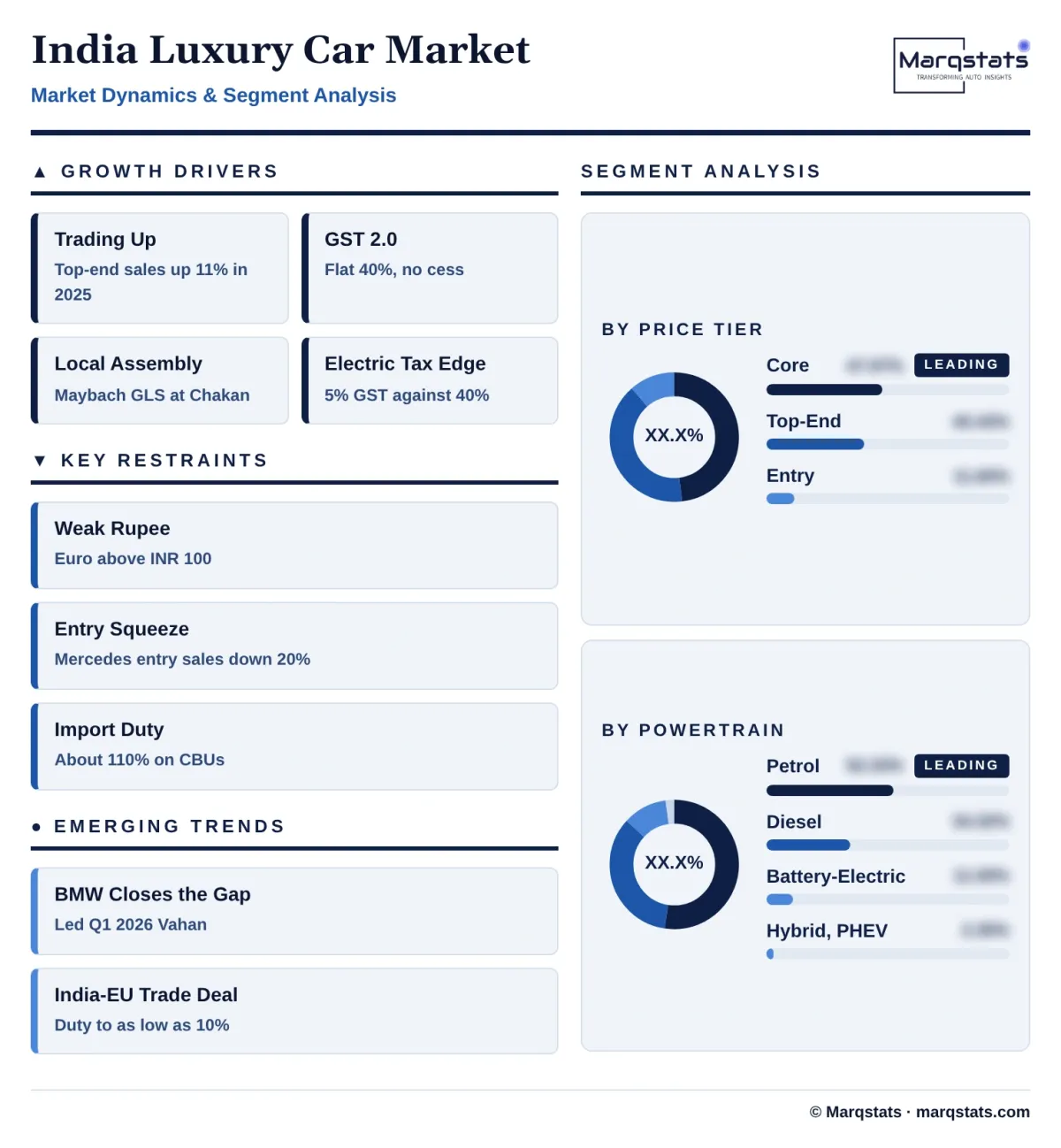
Entry luxury cars below INR 60 lakh ex-showroom account for 11.60% of 2025 value, USD 469.66 million, and grow at 3.59% a year to USD 560.34 million. Marqstats estimates about 11,350 cars in 2025, 22.02% of units, led by the BMW X1 and iX1, Mercedes-Benz GLA and A-Class Limousine, Audi Q3 and A4, MINI Countryman and Volvo EX40. The tier is the slowest-growing because mass-market flagships cover the same price band.
Core luxury cars from INR 60 lakh to INR 1.25 crore account for 47.97% of 2025 value, USD 1,942.58 million, and grow at 10.79% a year to USD 3,242.53 million. About 29,650 cars were sold in 2025, 57.51% of units, including the Mercedes-Benz E-Class long-wheelbase, C-Class, GLC and GLE, the BMW 3 Series Gran Limousine, 5 Series long-wheelbase, X3 and X5, the Audi Q5 and Q7, the Range Rover Evoque and Velar, the Lexus ES and the Volvo XC60 and XC90.
Top-end luxury cars above INR 1.25 crore account for 40.43% of 2025 value, USD 1,637.07 million, and grow fastest among tiers, at 13.65% a year, to USD 3,103.45 million and 44.94% of the market. About 10,550 cars were sold in 2025, including the Mercedes-Benz S-Class, GLS, G-Class and Maybach models, the BMW 7 Series, i7, X7 and XM, the Range Rover, Range Rover Sport and Defender, Porsche models and every Lamborghini, Rolls-Royce and Bentley.
Petrol cars account for 52.33% of 2025 value, USD 2,119.19 million, and grow at 9.23% a year to USD 3,295.77 million, while their share of units falls from 57.38% to 51.32%. Petrol covers all Audi and Volvo ICE models, most BMW cars and the Porsche and supercar range.
Diesel cars account for 34.32% of 2025 value, USD 1,389.58 million, and grow slowly, at 1.31% a year, to USD 1,483.09 million. Diesel made up 43% of Mercedes-Benz India sales in 2025, up from 39%, through the GLE, GLS and G-Class, and Land Rover sells diesel Defender and Range Rover models, but diesel units fall at 1.98% a year as electric models replace them.
Battery-electric cars account for 11.00% of 2025 value, USD 445.26 million, and grow fastest, at 31.73% a year, to USD 1,766.19 million and 25.57% of the market. Marqstats estimates 5,650 luxury electric cars in 2025, 10.96% of units, consistent with industry estimates of 10% to 11% penetration, and 19,000 by 2030. BMW, MINI, Mercedes-Benz, Tesla, Volvo and Porsche supply the segment, which pays 5% GST.
Hybrid and plug-in hybrid cars account for 2.35% of 2025 value, USD 95.28 million, and grow at 30.55% a year to USD 361.27 million. Lexus India self-charging hybrids such as the ES 300h, NX 350h, RX and LM 350h make up most of this segment; plug-in hybrids such as the BMW XM and Range Rover PHEV are a small subset, consistent with the 245 plug-in hybrid registrations across all Indian car brands in 2025.
SUVs account for 66.59% of 2025 value, USD 2,696.26 million, and grow at 12.09% a year to USD 4,771.91 million and 69.10% of the market. Marqstats estimates 32,700 SUVs in 2025, 63.43% of units, led by the BMW X1, Mercedes-Benz GLC, GLE and GLS, Land Rover Defender and Range Rover family, Audi Q-series and every Volvo model.
Sedans and limousines account for 27.00% of 2025 value, USD 1,093.47 million, and grow at 8.69% a year to USD 1,658.44 million. About 16,850 were sold in 2025, 32.69% of units, carried by the E-Class long-wheelbase, the best-selling luxury car in India, and by the BMW 3 Series Gran Limousine, 5 Series long-wheelbase and S-Class bought by chauffeur-driven owners and companies.
Coupes, MPVs and sports cars account for 6.41% of 2025 value, USD 259.58 million, and grow at 12.89% a year to USD 475.97 million. About 2,000 were sold in 2025, including the Porsche 911, Mercedes-AMG GT, BMW M models, Lamborghini Revuelto, the Lexus LM 350h and the Mercedes-Benz V-Class, whose high prices give the group a value share above its unit share.
By Geography
Western India
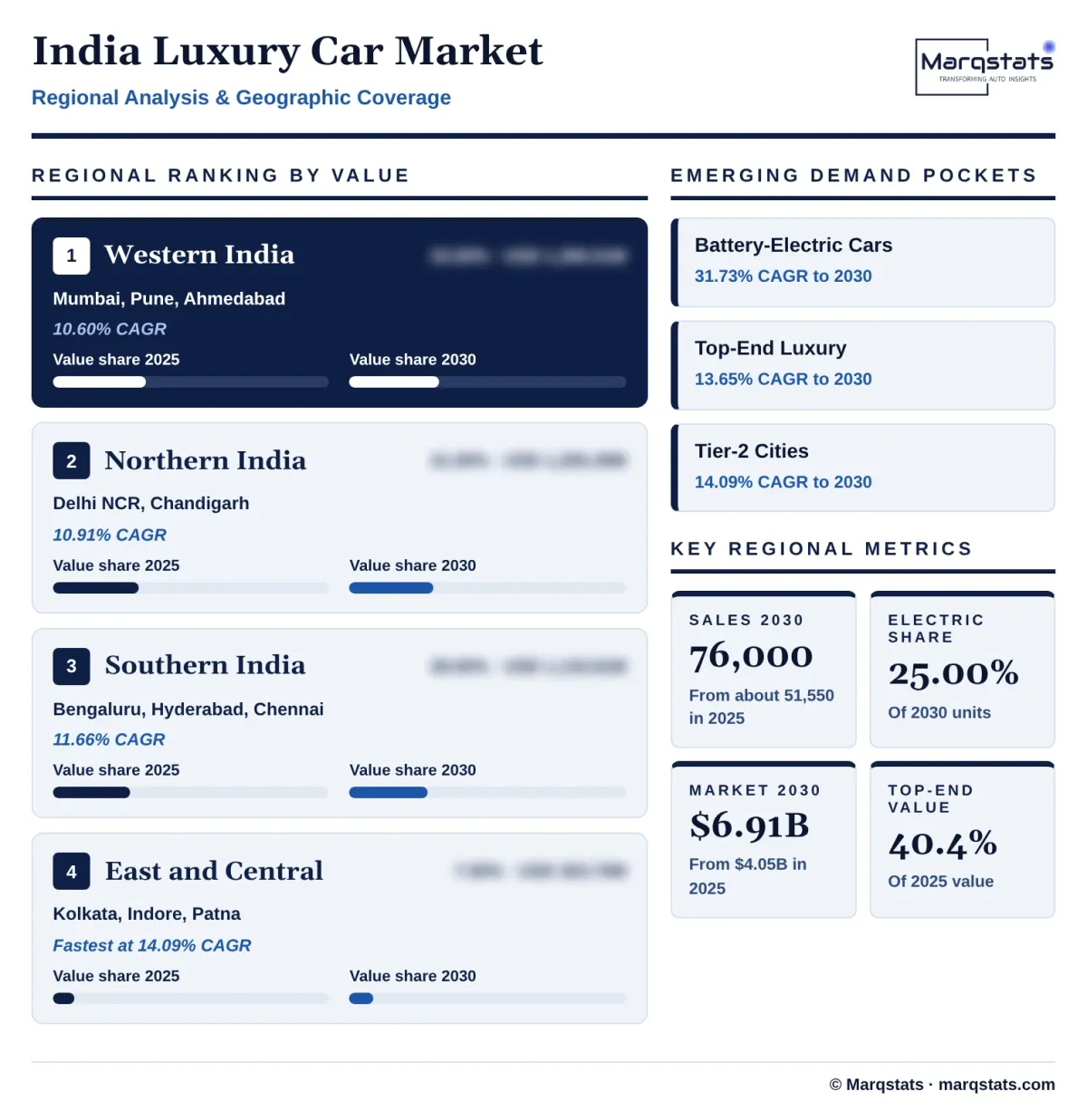
Western India accounts for 33.50% of 2025 value, USD 1,356.51 million, and grows at 10.60% a year to USD 2,244.55 million. Mumbai, Pune, Ahmedabad and Surat hold the largest pool of promoter and corporate buyers, and Maharashtra hosts the Mercedes-Benz plant at Chakan, the Jaguar Land Rover line at Pune and the Audi line at Chhatrapati Sambhaji Nagar. Registration shares can overstate states with lower road tax, because companies register cars where tax is cheapest.
Northern India
Northern India accounts for 31.00% of 2025 value, USD 1,255.29 million, and grows at 10.91% a year to USD 2,106.43 million. Delhi, Gurugram, Noida, Chandigarh, Ludhiana and Jaipur buy large SUVs and long-wheelbase sedans, and the age limits on diesel and petrol cars in Delhi push owners to replace cars sooner and to choose petrol and electric models.
Southern India
Southern India accounts for 28.00% of 2025 value, USD 1,133.81 million, and grows at 11.66% a year to USD 1,968.30 million. Bengaluru, Hyderabad and Chennai combine technology, pharmaceutical and start-up wealth with early electric adoption, and the region holds the BMW plant at Chennai and the Volvo plant at Hoskote near Bengaluru.
Eastern and Central India
Eastern and Central India account for 7.50% of 2025 value, USD 303.70 million, and grow fastest, at 14.09% a year, to USD 587.04 million and 8.50% of the market. Kolkata, Bhubaneswar, Patna, Raipur, Indore and Bhopal start from a small base, and new showrooms from Mercedes-Benz, BMW and Audi bring buyers who used to travel to the metros.
How Competition Is Evolving
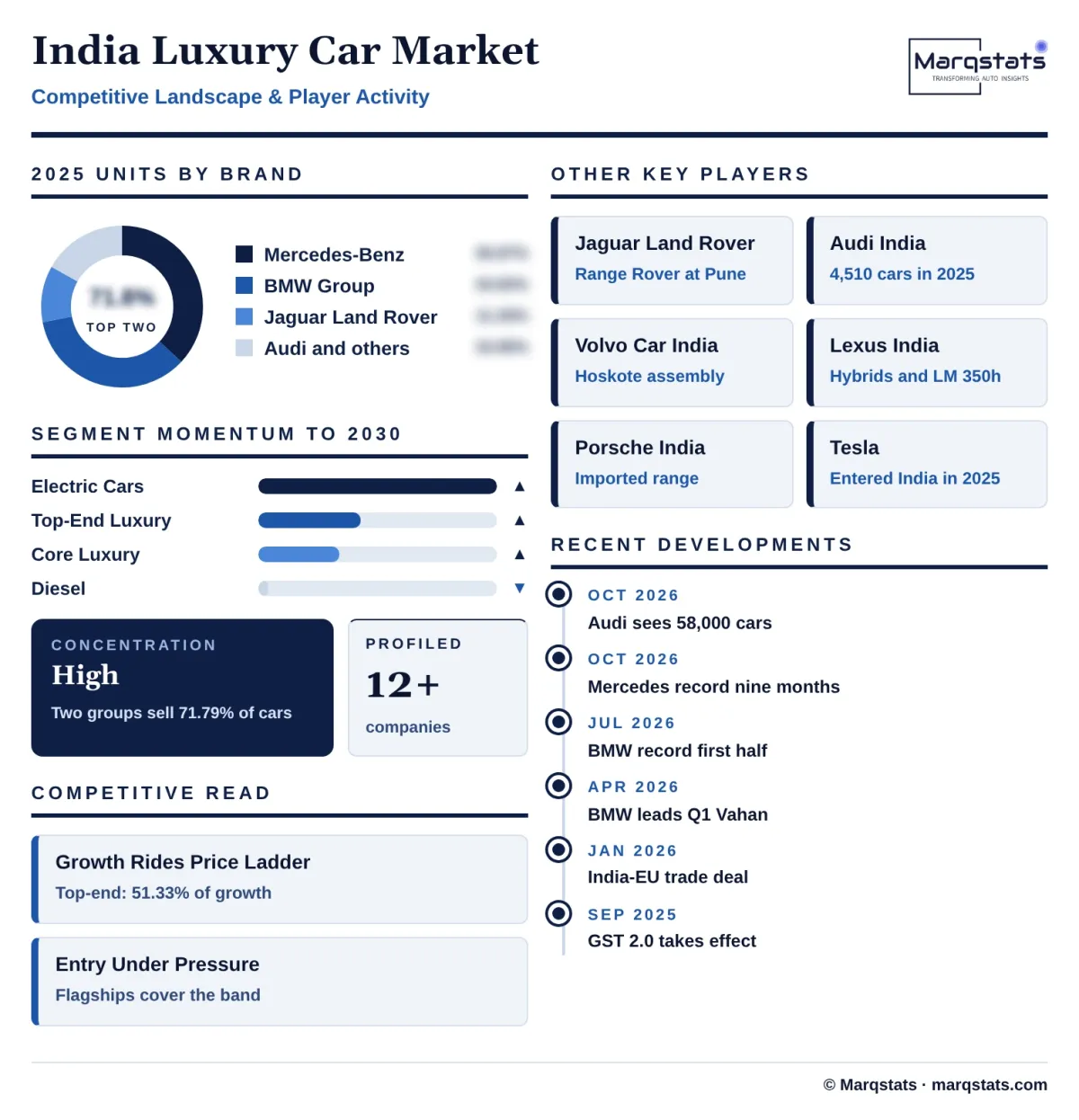
The market is highly concentrated. Mercedes-Benz India sold 36.87% of 2025 luxury cars and BMW Group India, with BMW and MINI, 34.92%, a combined 71.79%. Marqstats estimates Jaguar Land Rover India at about 11.25%, Audi India at 8.75% from its 4,510 retail sales, Volvo Car India at 3.30%, Lexus India at 2.42%, Porsche India at 1.36% and all other brands at 1.13%. Shares for Jaguar Land Rover, Volvo, Lexus and Porsche are Marqstats estimates anchored on Vahan registrations for the year to March 2026.
Mercedes-Benz India competes on mix, not volume. It sold 19,007 cars in 2025, 2.85% fewer than in 2024, but top-end sales rose 11% to 25% of its volume and the company reported its best year for revenue. It assembles models from the A-Class Limousine to the Maybach GLS and the EQS SUV at Chakan, and plans 12 launches in 2026, many of them electric or top-end.
BMW Group India competes on electric cars and new buyers. It sold a record 18,001 cars in 2025, up 14%, including more than 3,753 electric cars, and 9,075 in the first half of 2026. BMW took over 70% of luxury electric sales in the first quarter of 2026, and 49% of its 2025 buyers were new to the brand.
Jaguar Land Rover India and Audi India sit in the second tier with different paths. Jaguar Land Rover grew on the locally assembled Range Rover, Range Rover Sport and the imported Defender and posted 5,698 Vahan registrations in the year to March 2026, while Audi India fell to 4,510 cars in 2025 and aims to double its share in three to five years with new models and more showrooms. Tesla, which began selling in India in 2025, is the newest competitor and took 291 luxury electric registrations in September 2026.
Companies Covered
Companies covered in the report include:
Recent Market Activity
Table of Contents
Coverage & Segmentation
The study covers the India luxury car market, with 2025 as the base year, 2021 – 2025 as the historical period and 2026 – 2030 as the forecast period. It covers new passenger cars sold under dedicated luxury marques and ultra-luxury and premium import brands, segmented by price tier, powertrain, body type and region. Values are ex-showroom transaction prices before GST, road tax, registration and insurance, in US dollars at the 2025 average of INR 87.00 per US dollar.
Used and certified pre-owned luxury cars, mass-market flagship models priced above INR 50 lakh, commercial vehicles and motorcycles are excluded. Segment and regional splits are Marqstats estimates built on company sales releases, Vahan registrations and price lists. Luxury cars are a subset of the live Marqstats India Passenger Car Market, which counts more than 51,000 luxury registrations, and overlap the India Electric Car and India Plug-in Hybrid Electric Vehicle reports; used luxury cars sit in the India Used Car Market. These figures should not be added together.