Market Snapshot
The global car care products market is valued at USD 13.46 billion in 2025 and is projected to reach USD 17.01 billion by 2030, a CAGR of 4.79%. Growth rests on a parc of roughly 1.65 billion four-wheel vehicles, rising appearance spend per vehicle and the shift from paste wax to ceramic chemistry.
Marqstats sizes the market bottom-up, since no directly comparable dollar figure for appearance chemicals is published by any statistical agency. Each region is built as vehicles in operation multiplied by an estimated wholesale spend on appearance chemistry per vehicle per year. The 2025 parc anchors are official: 297.5 million registered vehicles in the United States, 256 million cars, 31.1 million vans and 6.2 million trucks in the European Union as counted by the European Automobile Manufacturers' Association (ACEA), and 366 million automobiles in China as reported by the Ministry of Public Security. The spend coefficients are Marqstats estimates, and the headline is most sensitive to them: a USD 0.50 change in global average spend per vehicle moves the 2025 total by about USD 0.83 billion.
Value is measured at manufacturer wholesale realization, before retailer and installer margins. That is why the figure sits far below the USD 51.70 billion that consumers spend on professional car wash services, which Marqstats sizes separately. Appearance chemistry is an input to that service market. It is not a slice of it.
The defining feature of the market is a spend gap, not a parc gap. A vehicle in North America carries about USD 13.40 of appearance chemistry a year at wholesale; a vehicle in Asia-Pacific carries about USD 5.30. Asia-Pacific already owns the largest share of the world parc, so closing even part of that gap moves the global total more than any product launch in a mature market can.
Product mix is shifting fast. Ceramic and graphene coatings grow at 10.89% a year, against 1.83% for traditional waxes and sealants, and they deliver more new revenue to 2030 than any other category. Regulation reinforces the shift: Regulation (EU) 2024/2462 restricts PFHxA in mixtures sold to the general public from 10 October 2026.
Key Takeaways
Market Overview & Analysis
Report Summary
The global car care products market covers the formulated chemicals people and professionals use to wash, decontaminate, polish, protect and dress a vehicle: shampoos and pre-wash foams, compounds and polishes, waxes and synthetic sealants, ceramic and graphene coatings, interior cleaners and protectants, and wheel and tire products. Marqstats values it at USD 13.46 billion in 2025 at manufacturer wholesale realization, and projects USD 17.01 billion in 2030, a CAGR of 4.79%.
Coverage spans six product categories, six sales channels split between do-it-yourself and do-it-for-me buyers, three vehicle classes and five regions. Every split sums to the headline in both 2025 and 2030, and every share on the page is a share of the same global wholesale total. Lubricants, functional fluids, collision refinish paint, wash equipment and wash service revenue are excluded and sized elsewhere in the Marqstats catalogue.
The central argument is that growth in this market is decided less by how many vehicles exist than by how much appearance chemistry each vehicle receives. Mature markets are close to saturation on spend per vehicle and are trading up in product mix. Asia-Pacific is still climbing the spend curve, and the professional studio model now spreading through India and Southeast Asia is the mechanism that climbs it.
Global Car Care Products Market Size and Forecast
Marqstats estimates the market at USD 11.02 billion in 2021, USD 11.58 billion in 2022, USD 12.21 billion in 2023, USD 12.83 billion in 2024 and USD 13.46 billion in 2025. The 2022 step of 5.08% was price-led: surfactant, silicone and packaging costs rose and brand owners passed them through. The 2023 step of 5.44% was the strongest of the period and coincided with mass-market spray ceramics reaching mainstream retail shelves. Growth then settled near 5%, at 5.08% in 2024 and 4.91% in 2025, as input prices stabilised and volume did more of the work.
The forecast path runs to USD 14.10 billion in 2026, USD 14.78 billion in 2027, USD 15.49 billion in 2028, USD 16.23 billion in 2029 and USD 17.01 billion in 2030. That is a CAGR of 4.79% and an absolute gain of USD 3.55 billion. Two components drive it. The four-wheel parc grows from about 1,652 million to about 1,827 million vehicles, and average wholesale spend per vehicle rises from USD 8.15 to USD 9.31. Spend per vehicle contributes more of the growth than parc expansion does, which is why product mix and channel mix matter more to the forecast than new-vehicle sales.
The forecast is deliberately single-track. The main uncertainty sits in the Asia-Pacific spend coefficient, not in regulation or parc growth, and Marqstats states its most likely value rather than bracketing it. If Asia-Pacific spend per vehicle reached USD 6.00 instead of USD 6.50 in 2030, the global 2030 total would be about USD 0.38 billion lower; that is the single input worth watching.
Spend per Vehicle, Not Parc Size, Decides Regional Value
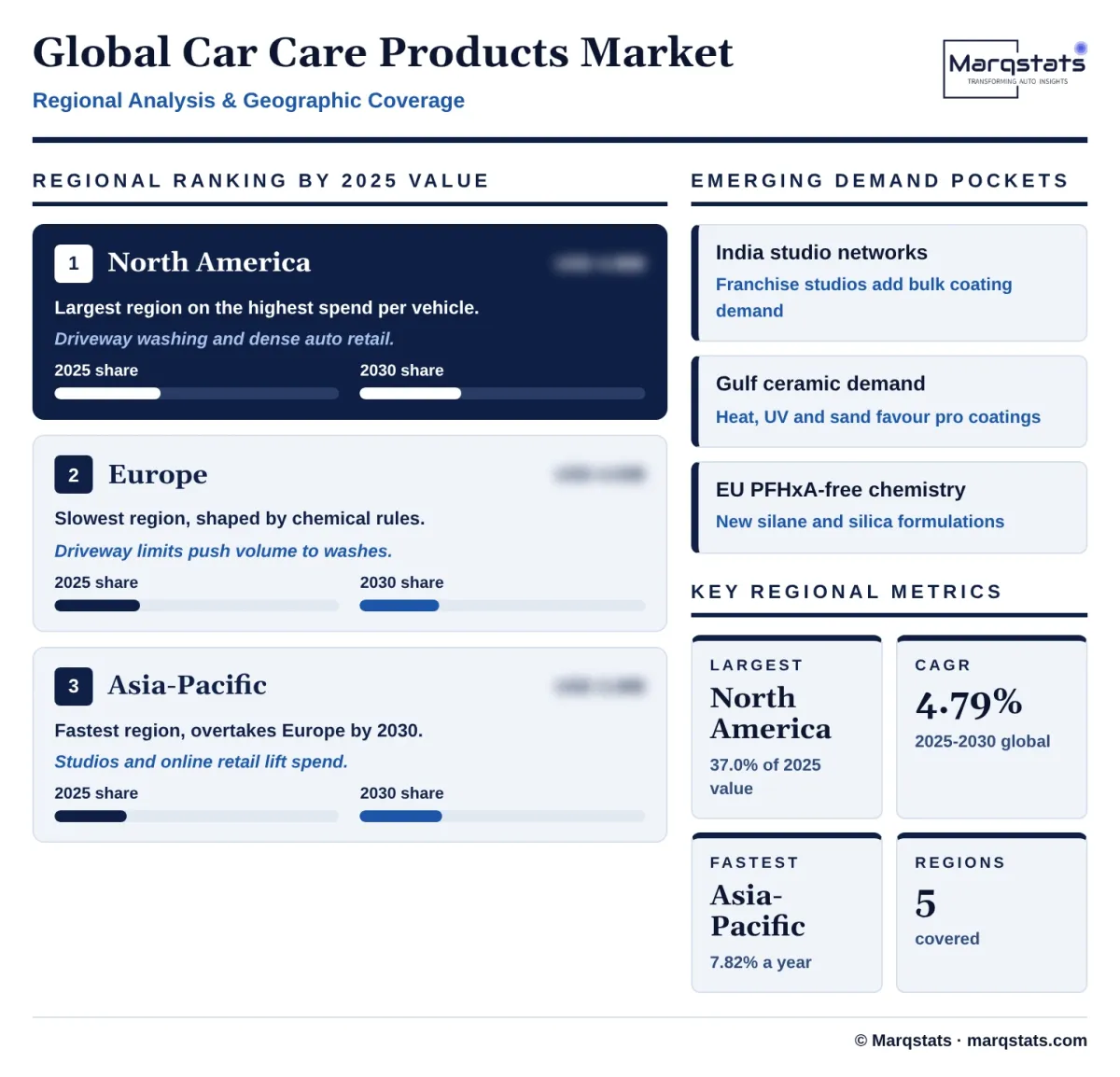
Parc size and car care value are poorly correlated across regions. North America holds 22.5% of the 2025 four-wheel parc and 37.0% of value. Asia-Pacific holds 38.7% of the parc and 25.2% of value. The difference is wholesale spend per vehicle: USD 13.40 in North America, USD 9.60 in Europe, USD 5.80 in Latin America, USD 5.30 in Asia-Pacific and USD 3.70 in the Middle East and Africa. Each coefficient is a Marqstats estimate, built from channel checks on shelf price, pack size and purchase frequency, and cross-checked against published company revenue where it exists.
Three things explain the gap. Driveway washing is normal in suburban North America and rare in dense Asian cities. Older vehicles attract restorative products, and the United States parc is old. And retail shelf density, from big-box merchants to auto parts chains, puts car care products in front of North American buyers every week. None of these is fixed. Asia-Pacific spend per vehicle rises to an estimated USD 6.50 by 2030, through studio networks and online retail rather than through the driveway habit, and that change alone is worth more than USD 0.75 billion of 2030 value at the 2030 parc.
The conclusion for suppliers is direct. A brand that wins share in a mature market fights for a pool growing at 3.08% to 3.83% a year. A brand that raises spend per vehicle in Asia-Pacific participates in a pool growing at 7.82% a year, and does so through channels that did not exist at scale five years ago.
Ceramic Chemistry Is Replacing Wax, Not Adding to It
Ceramic and graphene coatings are the only product category whose share rises sharply, from 14.5% in 2025 to 19.2% in 2030. Waxes and sealants fall from 18.0% to 15.6%. Read together, the two lines show substitution. The same buyer who bought a paste wax every spring now buys a silica spray sealant that lasts longer and applies in less time. Turtle Wax, Inc. built its Hybrid Solutions range around that switch and launched Hybrid Solutions Pure Bead in India in October 2026 as a spray-on, wipe-off coating that needs no professional bay.
The economics favour the switch for brand owners as well as buyers. A spray ceramic sells at a higher price per millilitre than a liquid wax, and a professional ceramic coating sells as part of a multi-year protection package. Marqstats therefore treats ceramic growth as value growth first: the category adds USD 1.32 billion to 2030 while the units it displaces in the wax aisle shrink only slowly.
Regulation pushes in the same direction. Regulation (EU) 2024/2462 restricts PFHxA, its salts and PFHxA-related substances in mixtures sold to the general public from 10 October 2026, at 25 ppb for PFHxA and its salts and 1,000 ppb for related substances. Fluorinated additives once used to boost water beading in some sprays and glass treatments must be reformulated for the European Union, and silane, siloxane and silica chemistry is the natural replacement. Products already placed on the market before that date are covered by a derogation, so the effect shows up in new formulations through 2027 rather than as a shelf clearance.
Market Dynamics
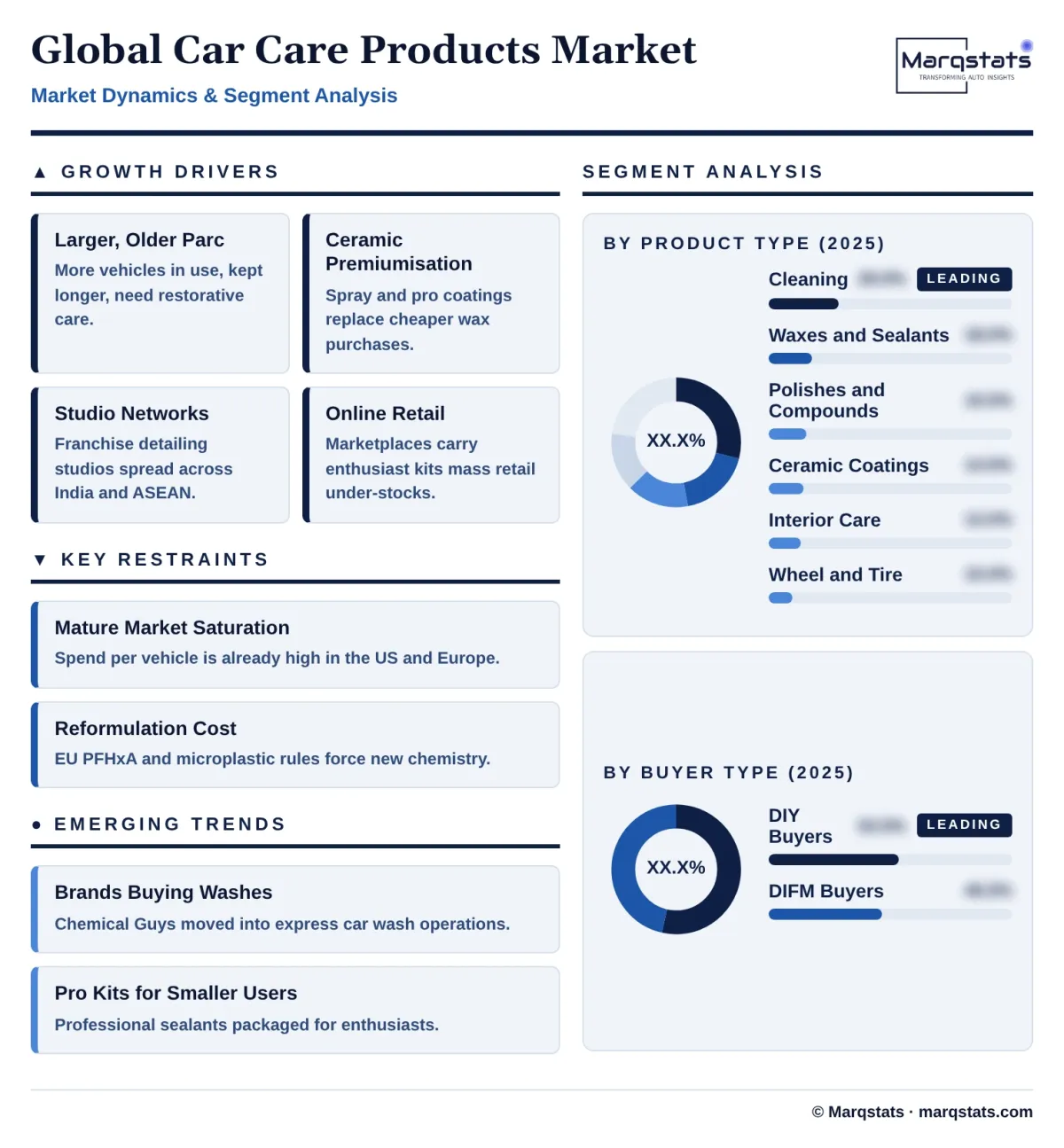
Key Drivers
Four forces lift wholesale value from USD 13.46 billion in 2025 to USD 17.01 billion in 2030.
- A larger and older parc: the four-wheel parc rises from about 1,652 million to about 1,827 million vehicles by 2030; China alone counted 366 million automobiles at the end of 2025 according to the Ministry of Public Security, and the European Union truck fleet averages 14 years according to ACEA. Older vehicles need restorative polish, trim dressing and headlight products.
- Premiumisation through ceramic chemistry: ceramic and graphene coatings grow at 10.89% a year and lift average spend per vehicle from USD 8.15 to USD 9.31, because a ceramic spray or professional coating replaces a cheaper wax rather than adding a new purchase.
- Professional studio networks in emerging markets: Turtle Wax, Inc. reported more than 110 co-branded Car Care Studios in India in September 2026 and planned at least 50 more; each studio consumes bulk compounds, coatings and interior chemistry at far higher intensity than a retail buyer.
- Online and direct-to-consumer retail: e-commerce and brand storefronts grow at 9.03% a year, from USD 1.48 billion to USD 2.28 billion, and carry enthusiast products such as snow foams, iron removers and ceramic kits that mass retail shelves under-stock.
Key Restraints
Three constraints keep the global rate below 5% a year.
- Saturated spend in mature markets: North America and Europe hold 66.9% of 2025 value but grow at only 3.83% and 3.08% a year, because spend per vehicle there is already high and the parc grows slowly.
- Chemical regulation adds reformulation cost: Regulation (EU) 2024/2462 on PFHxA, Commission Regulation (EU) 2023/2055 on intentionally added synthetic polymer microparticles, and the California Air Resources Board Consumer Products Regulation in Title 17 of the California Code of Regulations all force formulation changes that small brands find hard to fund.
- Professional washes cannibalise home use: a household that buys a wash membership buys fewer shampoos and quick detailers; commercial car wash chemistry grows at only 2.69% a year, and Marqstats sizes wash service revenue separately at USD 51.70 billion in 2025.
Key Trends
Three trends reshape where the value sits, rather than how much there is.
- Brand owners buying wash sites: Chemical Guys acquired Fast5Xpress, a Southern California express car wash platform owned by Clark Investment Group, in August 2026, putting a retail appearance brand directly into the tunnel and membership channel.
- Coating kits for the do-it-yourself buyer: Koch-Chemie GmbH presented its KCx Protection Unit, a three-part sealing set of Ceramic Neo, Ceramic Glass and Plast Shield, at Automechanika Frankfurt from 8 to 12 September 2026, a sign that professional ceramic chemistry is being packaged for smaller users.
- Cabin materials changing interior chemistry: synthetic leather, piano-black trim and large touchscreens need water-based, non-greasy, matte cleaners, so interior care holds a steady 13.0% share while its product content turns over.
Strategic Implications
- For entrants: the open door is Asia-Pacific professional supply, not the mature-market retail shelf. Asia-Pacific grows at 7.82% a year and studio networks there buy on technical support and training, where an entrant can compete without a decades-old consumer brand.
- For incumbents: protect value by moving wax buyers to ceramic sprays before a competitor does; waxes and sealants grow at 1.83% a year while ceramic and graphene coatings grow at 10.89%, so a portfolio that stays wax-heavy loses share even if it holds its customers.
- For suppliers and investors: European Union formulations need PFHxA-free and microplastic-free chemistry now, and the 10 October 2026 application date makes silane, siloxane and silica intermediates the growth line for raw-material suppliers; investors should value car care brands on channel position in do-it-for-me networks as much as on retail share.
Market Segmentation
Cleaning and washing products, including shampoos, pre-wash snow foams, bug and tar removers and glass cleaners, are the largest category at USD 3.90 billion in 2025, 29.0% of the market. They grow to USD 4.73 billion in 2030 at 3.93% a year, below the market rate, so their share eases to 27.8%.
The category is large because every vehicle owner washes, and slow because the wash is moving out of the driveway and into professional sites whose chemistry is sized in the commercial car wash channel. Hyper-concentrated retail shampoos, such as the Turtle Wax Hyper Concentrate range, protect margin per bottle but reduce the number of bottles bought.
Polishes and compounds account for USD 2.09 billion in 2025, 15.5% of value, and reach USD 2.55 billion by 2030 at 4.06% a year. Demand comes from paint correction before a ceramic coating, from used-vehicle reconditioning at dealers and from older vehicles in North America and Europe.
Professional machine polishing grows faster than retail polishing, because modern clear coats are thin and owners increasingly leave correction to detailers. Products such as the Meguiar's M111 Heavy Hitter compound and Koch-Chemie heavy-cut compounds sell mainly into that professional bay.
Waxes and sealants are worth USD 2.42 billion in 2025, 18.0% of value, and grow to only USD 2.65 billion in 2030 at 1.83% a year. Their share falls to 15.6%, the steepest decline of any category.
The decline is substitution, not abandonment. Carnauba paste waxes and polymer sealants still sell to enthusiasts and in value-tier markets such as Latin America, but the mainstream buyer has moved to spray ceramics that last longer and apply faster. Brands that defined the wax aisle, including Nu Finish from Energizer Holdings, Inc., now carry ceramic or hybrid lines alongside it.
Ceramic and graphene coatings are the fastest-growing category, rising from USD 1.95 billion in 2025 to USD 3.27 billion in 2030, a CAGR of 10.89%. Share rises from 14.5% to 19.2%, and the category adds USD 1.32 billion, more absolute growth than any other product type.
The category spans consumer spray sealants based on silica chemistry, professional multi-layer coatings sold only through certified installers, such as XPEL FUSION PLUS from XPEL, Inc., and graphene-infused coatings marketed to enthusiasts. Professional coatings carry the highest value per vehicle in the market, because they sell as part of a protection package priced per car rather than per bottle.
Interior care, covering cleaners, protectants, leather conditioners and odour products, is worth USD 1.75 billion in 2025, 13.0% of the market, and USD 2.21 billion in 2030 at 4.78% a year, holding its share exactly.
Product content is turning over even though share is stable. Silicone-heavy protectants are giving way to matte, water-based formulas safe on screens and synthetic leather. Armor All and Lexol from Energizer Holdings, Inc. and the Meguiar's interior range from 3M Company dominate the retail shelf in North America.
Wheel and tire care accounts for USD 1.35 billion in 2025, 10.0% of value, and USD 1.60 billion in 2030 at 3.46% a year, easing to 9.4%. Acid-free and colour-changing iron removers are replacing harsh acid wheel cleaners, and water-based tire dressings are replacing solvent gels.
Growth is held back by the professional wash, where tire shine is applied automatically in the tunnel and sold inside a membership rather than as a retail bottle. SONAX GmbH, which reported record 2025 revenue, is one of the stronger wheel-care brands in Europe.
Mass retail merchandisers such as Walmart, Target and Carrefour sell USD 3.37 billion of car care products at wholesale in 2025, 25.0% of value, the largest single channel. The channel grows at 2.86% a year to USD 3.88 billion in 2030, and its share falls to 22.8%.
Mass retail rewards multi-category brand owners with distribution scale. Energizer Holdings, Inc. is the clearest example. Its Auto Care segment, which includes Armor All, reported USD 620.0 million of net sales in fiscal 2025, and the channel is where that scale counts most.
Auto parts retailers such as AutoZone, O'Reilly Auto Parts, Advance Auto Parts and Halfords account for USD 2.36 billion in 2025, 17.5%, rising to USD 2.77 billion in 2030 at 3.26% a year.
These stores are the destination for enthusiasts who want compounds, clay bars and machine polishing supplies. Their growth tracks parc age in North America and Europe more than any other channel.
E-commerce marketplaces and brand storefronts sell USD 1.48 billion in 2025, 11.0% of value, and USD 2.28 billion in 2030. At 9.03% a year this is the fastest-growing do-it-yourself channel, and its share rises to 13.4%.
The channel suits products that need explanation, such as ceramic kits and multi-step decontamination systems, and suits launches timed to sales events. Turtle Wax launched Hybrid Solutions Pure Bead in India exclusively on Amazon India during the Great Indian Festival in October 2026.
Independent and franchise detailing studios consume USD 2.89 billion of products at wholesale in 2025, 21.5% of value, rising to USD 4.00 billion in 2030 at 6.72% a year. Share rises to 23.5%, making it the largest channel by 2030.
Studios buy bulk compounds, professional coatings and interior chemistry, and they sell protection packages that carry the highest product value per vehicle in the market. Franchise networks are spreading fastest in India and Southeast Asia, led by the Turtle Wax Car Care Studio network.
Dealership preparation bays, used-vehicle reconditioning centres and fleet depots buy USD 1.95 billion in 2025, 14.5% of value, and USD 2.47 billion in 2030 at 4.84% a year, holding a 14.5% share.
Demand follows used-vehicle turnover and rental fleet rotation. Buyers value speed per vehicle over finish, so fast glazes, rapid interior cleaners and degreasers dominate this channel.
Tunnel, in-bay and self-service car washes buy USD 1.41 billion of chemistry in 2025, 10.5% of value, rising to USD 1.61 billion in 2030 at 2.69% a year. Share eases to 9.5%.
The channel is slow in value even though wash volume grows, because tunnel chemistry is sold in concentrated drums and totes at the lowest price per wash in the market. The 2025 figure equals about 2.7% of the USD 51.70 billion that Marqstats sizes for global car wash services. Brand-led wash programmes, such as the partnership between Chemical Guys and National Carwash Solutions and the Chemical Guys purchase of Fast5Xpress, aim to lift value per wash by selling branded protection steps.
Passenger cars and light SUVs account for USD 9.83 billion in 2025, 73.0% of value, and USD 12.50 billion in 2030 at 4.92% a year, the fastest of the three vehicle classes. Nearly all ceramic coating demand and almost all retail do-it-yourself purchasing sit here.
Light commercial vehicles and vans account for USD 2.49 billion in 2025, 18.5%, and USD 3.10 billion in 2030 at 4.48% a year. Demand is dominated by traffic film removers, alkaline pre-soaks and trim dressings bought by fleets and rental operators. The European Union van fleet alone counts 31.1 million units according to ACEA.
Heavy trucks, buses and coaches account for USD 1.14 billion in 2025, 8.5%, and USD 1.41 billion in 2030 at 4.34% a year. Truck wash bays buy aluminium brighteners, chassis degreasers and rinse aids in bulk. The European Union truck fleet of 6.2 million units averages 14 years in age, which keeps restorative demand steady.
By Geography
North America
North America is the largest region at USD 4.98 billion in 2025, 37.0% of global value, and reaches USD 6.01 billion in 2030 at 3.83% a year. Its share eases to 35.3%. Marqstats builds the region on about 372 million vehicles in operation, including the 297.5 million registered vehicles in the United States and 26.8 million in Canada, at an estimated USD 13.40 of wholesale appearance spend per vehicle, the highest in the world.
Spend is high because driveway washing is common, because auto parts and big-box retail put car care on the shelf in every town, and because an old parc buys restorative products. The California Air Resources Board Consumer Products Regulation sets volatile organic compound limits by product category, and national brands formulate to it so that one product ships to all states. North America remains the largest region in 2030, but it delivers only 29.0% of growth.
Europe
Europe is worth USD 4.03 billion in 2025, 29.9% of value, and USD 4.69 billion in 2030 at 3.08% a year, the slowest of the five regions. Its share falls to 27.6%. The region rests on about 420 million vehicles, including the European Union fleet of 256 million cars, 31.1 million vans and 6.2 million trucks reported by ACEA in January 2026, at an estimated USD 9.60 per vehicle.
Growth is restrained by regulation and by the wash pattern. Many municipalities restrict washing on private driveways, which moves volume into professional washes where chemistry is cheaper per vehicle. Regulation (EU) 2024/2462 on PFHxA and Commission Regulation (EU) 2023/2055 on synthetic polymer microparticles add reformulation cost. Germany is the technical centre of the European market, home to SONAX GmbH, Koch-Chemie GmbH and Adolf Wurth GmbH & Co. KG.
Asia-Pacific
Asia-Pacific is worth USD 3.39 billion in 2025, 25.2% of value, and USD 4.94 billion in 2030 at 7.82% a year, the fastest of the five regions. Its share rises to 29.0%, and it overtakes Europe as the second-largest region before 2030. The region holds about 640 million vehicles in 2025, including 366 million automobiles in China, but spends only about USD 5.30 per vehicle.
Dense housing limits home washing, so spend per vehicle rises through professional studios and online retail rather than the driveway. Turtle Wax, Inc. entered India in 2019, reported more than 110 co-branded Car Care Studios there in September 2026, and appointed Ashutosh Saxena as Managing Director for India and ASEAN in October 2026. SOFT99 Corporation is the leading domestic brand in Japan. Asia-Pacific delivers USD 1.55 billion, or 43.7%, of global growth to 2030.
Latin America
Latin America is worth USD 0.67 billion in 2025, 5.0% of value, and USD 0.85 billion in 2030 at 4.87% a year, holding a 5.0% share. Marqstats builds the region on about 115 million vehicles at an estimated USD 5.80 per vehicle.
Brazil and Mexico account for most of the value. Older vehicles and price-sensitive buyers favour value-tier waxes, polishes and protectants, and local brands compete closely with international ones in mass retail.
Middle East and Africa
The Middle East and Africa is worth USD 0.39 billion in 2025, 2.9% of value, and USD 0.52 billion in 2030 at 5.92% a year, rising to a 3.1% share. The region holds about 105 million vehicles at an estimated USD 3.70 per vehicle, the lowest coefficient in the world.
Two very different markets sit inside the region. Gulf states combine high UV exposure, sand and premium vehicles, which supports professional ceramic coating and paint protection demand. Most of Africa remains a value market for basic shampoos and polishes.
How Competition Is Evolving
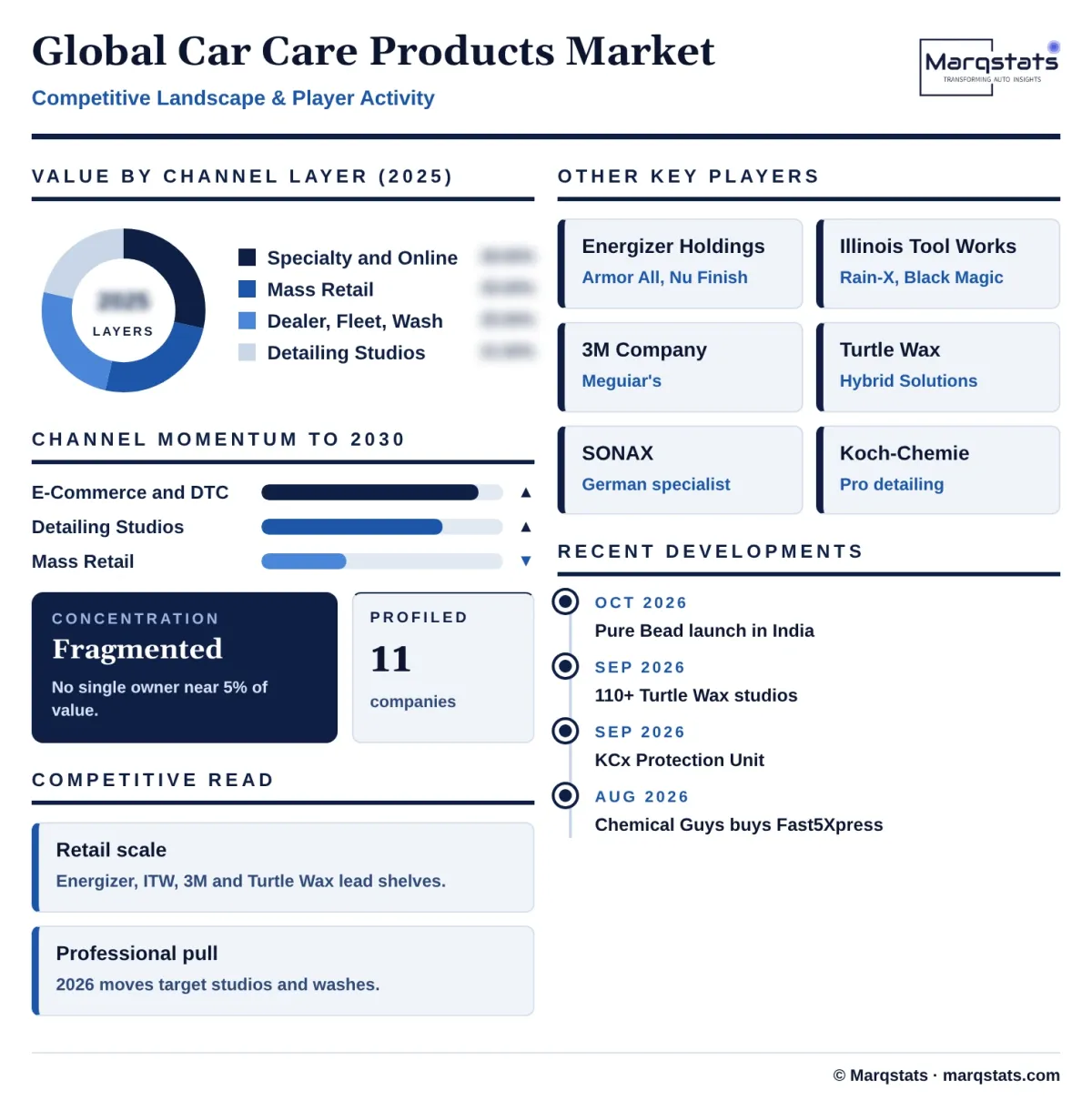
The market is fragmented. The largest brand owner with a published car care figure, Energizer Holdings, Inc., reported USD 620.0 million of Auto Care net sales in fiscal 2025, and that segment also includes performance chemicals and air-conditioning recharge products alongside appearance brands such as Armor All, Nu Finish, Refresh Your Car! and Lexol. Even taken whole, it equals less than 5% of the USD 13.46 billion global total. SONAX GmbH reported record revenue of EUR 172.5 million (USD 194.93 million) for 2025, up about 7%.
Most other leaders do not publish car care revenue. Illinois Tool Works Inc. reports Rain-X, Gumout and Black Magic inside its Polymers and Fluids segment within USD 16.04 billion of 2025 group revenue. 3M Company reports Meguiar's inside its consumer business. Turtle Wax, Inc. is family owned. Marqstats therefore does not publish company market shares and describes competition by layer instead.
Four layers compete. Mass-market consumer brands, led by Energizer, Illinois Tool Works, 3M through Meguiar's and Turtle Wax, win on retail distribution. European technical specialists such as SONAX, Koch-Chemie and Adolf Wurth GmbH & Co. KG win in professional workshops and premium retail. Enthusiast and direct-to-consumer brands such as Chemical Guys and Adam's Polishes win online. Professional coating specialists such as XPEL, Inc. sell only through certified installers. Measured by the channel each layer depends on, specialty and online retail take 28.5% of 2025 value, mass retail 25.0%, dealer, fleet and wash buyers 25.0%, and detailing studios 21.5%.
The competitive moves of 2026 point in one direction: toward the professional channel. Chemical Guys bought a car wash platform, Turtle Wax expanded studios in India, and Koch-Chemie packaged professional sealing chemistry for smaller users. The brands that control professional consumption points will capture the faster-growing half of the market.
Companies Covered
Companies covered in the report include:
Recent Market Activity
Table of Contents
Coverage & Segmentation
Coverage includes formulated appearance chemicals for four-wheel road vehicles: washing and cleaning products, polishes and compounds, waxes and sealants, ceramic and graphene coatings, interior care and wheel and tire care, sold through retail, online, detailing studio, dealer and fleet, and commercial car wash channels. Value is measured at manufacturer wholesale realization in USD at 2025 exchange rates (EUR 1 = USD 1.13), base year 2025, forecast 2026-2030, history 2021-2025.
Excluded are engine oils, transmission fluids, coolants, brake fluids, refrigerants and fuel additives; collision refinish paint and primers; paint protection film; polishers, pressure washers and wash equipment; microfibre cloths and other accessories; and service revenue earned by washes and detailers. Two-wheelers are excluded.
Sibling boundaries: the Global Car Wash Services Market (USD 51.70 billion in 2025) measures wash service revenue and excludes chemical sales, so the two figures must not be added. The Global Car Wash Equipment Market (USD 7.80 billion in 2025) covers wash hardware, chemical dosing systems and hardware consumables; wash chemistry purchased by operators sits here, in the commercial car wash channel, and must not be added to the equipment figure.