Market Snapshot
The India heavy-duty automotive aftermarket market is valued at USD 2.28 billion (about INR 19,836 crore) in 2025 and is projected to reach USD 3.23 billion (about INR 28,101 crore) by 2030, a CAGR of 7.21% and absolute growth of USD 0.95 billion. Marqstats estimates the operating parc of medium and heavy commercial vehicles above 7.5 tonnes gross vehicle weight at 4.47 million in 2025, rising to 5.30 million by 2030 (3.47% a year). Spend per vehicle does the rest. Exhaust aftertreatment and sensors, at 9.0% of 2025 value, deliver 19.2% of the growth.
The figure is a Marqstats construction, built bottom-up as operating M&HCV parc multiplied by annual replacement-parts spend per vehicle, on a calendar-year basis and at net trade value excluding GST. Marqstats builds the parc from cumulative Society of Indian Automobile Manufacturers (SIAM) domestic M&HCV wholesales less age-based retirements, and checks the result against the Automotive Component Manufacturers Association of India (ACMA) FY25 all-vehicle aftermarket of INR 99,948 crore. On a like-for-like April 2024 to March 2025 basis, the heavy-duty layer equals about 18.9% of that ACMA figure. The estimate is most sensitive to spend per vehicle; a 5% change in that input moves the 2025 value by about USD 0.11 billion.
Two dated policy changes reset the economics in under a year. The GST Council moved every auto part to a uniform 18% rate, and trucks and buses from 28% to 18%, effective 22 September 2025. The Central Motor Vehicles (Second Amendment) Rules, 2026, notified on 20 January 2026, block fitness renewal, ownership transfer and national permits for vehicles with unpaid toll dues. Both push heavy-vehicle maintenance toward documented, invoiced channels.
The parc itself is changing composition. Marqstats estimates that roughly 41% of the 2025 M&HCV parc was sold after the national Bharat Stage VI mandate of 1 April 2020, and that share passes 60% by 2028. Those trucks carry diesel particulate filters, selective catalytic reduction systems, urea dosing units and nitrogen-oxide sensors that BS-IV trucks never had, and from 1 April 2023 on-board diagnostics that derate the engine when emissions hardware fails. That is why the fastest-growing category grows at 13.56% while the market grows at 7.21%.
Key Takeaways
Market Overview & Analysis
Report Summary
India's heavy-truck aftermarket is becoming a diagnostics business. For two decades the money sat in leaf springs, brake linings and clutch plates sold through roadside retailers on 30 to 60 days of credit. That business still exists. It still holds the majority of value. What changed is the vehicle. Every M&HCV registered since 1 April 2020 carries BS-VI aftertreatment, and every one since 1 April 2023 carries OBD-II monitoring under real driving emission rules. The first large BS-VI cohorts are now three to five years old, past their warranty, and failing in ways a roadside mechanic cannot fix without a scan tool.
The measure is annual spend on replacement parts for medium and heavy commercial vehicles above 7.5 tonnes gross vehicle weight, covering goods trucks, tippers and buses, at net trade value excluding GST, on a calendar-year basis. It includes new and remanufactured parts sold through OES dealers, independent distributors and retailers, digital B2B platforms and direct fleet contracts. It excludes tyres, starter and traction batteries, lubricants and coolants, diesel exhaust fluid, workshop labour, used parts recovered from scrapped vehicles, and all light commercial vehicles at or below 7.5 tonnes. ACMA puts the FY25 all-vehicle aftermarket at INR 99,948 crore; the heavy-duty layer is about 18.9% of it.
Four readers use the analysis. Tier-1 suppliers deciding whether to build an aftertreatment remanufacturing line or a mechanic-loyalty programme need the category and channel split. Commercial vehicle OEMs pricing annual maintenance contracts need the shift from independent to OES channels. Distributors and B2B platforms choosing which states to stock need the regional ranking. Investors in listed component companies need to know which product lines carry the growth and which only carry volume.
India Heavy-Duty Automotive Aftermarket Market Size and Forecast
Marqstats estimates the market at USD 1.66 billion in 2021, USD 1.91 billion in 2022, USD 2.02 billion in 2023, USD 2.13 billion in 2024 and USD 2.28 billion in 2025. The forecast runs to USD 2.44 billion in 2026, USD 2.62 billion in 2027, USD 2.81 billion in 2028, USD 3.01 billion in 2029 and USD 3.23 billion in 2030, a CAGR of 7.21%. All values convert at a constant INR 87.00 per USD, so the dollar series moves only with rupee-denominated demand.
The build has two inputs. Operating parc is the primary series: Marqstats estimates 4.47 million M&HCVs in service at the end of 2025, up from 3.95 million in 2021, and 5.30 million by 2030. Annual parts spend per vehicle is derived: INR 44,350 in 2025, rising to INR 53,100 by 2030, a 3.67% annual increase. Multiplying the two gives about INR 19,825 crore for 2025, which rounds to the published USD 2.28 billion. The spend-per-vehicle series is a Marqstats estimate, not a published statistic. It is the input to watch. The per-vehicle figure is an average across the whole parc, including idle and seasonal vehicles; an active multi-axle long-haul tractor consumes several times that amount, a city bus on a short route much less.
The history explains the slope. Value rose 15.06% in 2022 as freight volumes recovered and deferred maintenance from 2020 and 2021 came back into workshops. Growth slowed to 5.76% in 2023 and 5.45% in 2024 as M&HCV truck wholesales flattened; Autocar Professional reported M&HCV truck sales down about 4% in FY25 while bus sales rose about 15%. Growth in 2025 recovered to 7.04%, helped by the record FY26 commercial vehicle cycle: SIAM reported domestic CV wholesales of about 10.8 lakh units in FY26, up 12.6%.
Value grows faster than parc because of mix, not inflation alone. BS-VI aftertreatment assemblies, common-rail injectors and electronic brake components carry far higher unit prices than the BS-IV parts they replace. Marqstats holds the underlying part-price inflation near 2% a year and attributes the remaining spend-per-vehicle increase to the rising BS-VI share of the parc.
The BS-VI Warranty Cliff Moves Value Into the Exhaust Pipe
Aftertreatment is the one category where volume, price and urgency rise together. Marqstats sizes exhaust aftertreatment and sensors at USD 205.2 million in 2025, 9.0% of the market, growing to USD 387.6 million by 2030, 12.0% of the market, at a 13.56% CAGR. That USD 182.4 million increase is 19.2% of all growth in the market.
The mechanism is a cohort effect. Bharat Stage VI took effect nationally on 1 April 2020, and Phase 2, with on-board diagnostics and real driving emissions monitoring, on 1 April 2023. Marqstats estimates that about 41% of the 2025 parc is BS-VI, built from cumulative SIAM domestic M&HCV wholesales since April 2020. The FY21 and FY22 cohorts are now past typical OEM warranty terms. Contaminated diesel fouls particulate filters; poor-quality urea crystallises in dosing units; sensors fail from heat. When the OBD system flags a fault, the engine derates. A fleet owner cannot drive around it. The truck stops earning.
The consequence is a category that rewards technical depth over distribution reach. Replacement filters, dosing modules and nitrogen-oxide sensors need calibration and a fault-code reset. That moves the transaction toward OES dealers and toward Tier-1 suppliers that train independent workshops on their own diagnostic tools. A supplier without a remanufacturing or cleaning offer for particulate filters will lose that part of the market.
GST Harmonisation and Toll-Linked Compliance Formalise the Channel
Two rules changed the arithmetic of buying a cash part. Before 22 September 2025, brake linings, steering gear and suspension parts sat largely in the 28% GST slab, while some general engineering parts sat at 18%. The GST Council moved all auto parts to a uniform 18%, irrespective of HSN code, and cut trucks and buses from 28% to 18% on the same date. An invoiced brake kit now carries 10 points less tax. That matters. For a fleet that claims input tax credit, the invoiced part was already cheaper; for a small operator paying cash, the saving from an uninvoiced counterfeit fell by more than a third.
The Central Motor Vehicles (Second Amendment) Rules, 2026, notified on 20 January 2026, link unpaid toll and user fees to the vehicle record. A truck with outstanding FASTag dues cannot get a no-objection certificate, a renewed fitness certificate or a national permit. That ties regulatory standing to a digital trail. Fleet operators that need clean records are more likely to keep invoices for maintenance as well.
Marqstats does not treat either rule as a sudden shift in value. The effect is a slow reallocation inside the total, visible in the channel split: the independent aftermarket falls from 53.5% to 45.0% of value, while OES and digital B2B channels gain. Total value is measured net of GST, so the rate cut does not mechanically lower the market size.
Fitness Testing Is the Enforcement Lever Still Waiting to Bite
Automated fitness testing is the largest single policy variable for friction, suspension and steering demand, and its timing keeps slipping. The Ministry of Road Transport and Highways notified mandatory testing of transport vehicles through Automated Testing Stations under G.S.R. 272(E) of 5 April 2022. The start date has been extended repeatedly; in September 2023 the ministry moved it to 1 October 2024 for heavy goods and passenger vehicles. In April 2026 the Centre allowed manual fitness tests to continue until October 2026 where stations were not ready, according to reports from Maharashtra.
States are catching up. Maharashtra's chief minister has directed a fast rollout of 53 automated stations, and Kerala announced 28 stations in June 2026. Roller brake testers, suspension testers and play detectors do not accept a worn lining or a cracked leaf that a visual check might pass. Marqstats forecast assumes phased enforcement through 2030 rather than a single national switch-on; a faster rollout would lift braking and suspension demand above the published path.
Market Dynamics
Key Drivers
Four drivers carry the forecast, each tied to a dated rule or a measurable fleet change.
- BS-VI parc ageing: about 41% of the 2025 M&HCV parc was sold after the 1 April 2020 BS-VI mandate (Marqstats estimate), and the share passes 60% by 2028. Each such vehicle carries aftertreatment hardware worth several times a BS-IV silencer, and OBD-II derating since 1 April 2023 makes failed parts non-deferrable.
- Fleet growth after a record sales year: SIAM reported FY26 domestic CV wholesales of about 10.8 lakh units, up 12.6%, and ICRA Limited noted in May 2026 that M&HCV trucks passed their FY2019 peak. Marqstats expects the M&HCV parc to grow from 4.47 million to 5.30 million by 2030.
- Tax and toll formalisation: uniform 18% GST on all auto parts from 22 September 2025, and the CMVR (Second Amendment) Rules, 2026 linking toll dues to fitness and permits from January 2026, both reward invoiced purchases from documented channels.
- OEM uptime programmes: Tata Motors Limited reported in June 2026 that its Fleet Edge platform covers more than one million connected trucks and buses, and ZF Commercial Vehicle Control Systems India Limited reported onboarding more than 188,000 connected vehicles to its SCALAR platform in FY25. Telematics turns a breakdown into a scheduled dealer visit.
Key Restraints
Three restraints slow value growth without reversing it.
- Counterfeit and spurious parts: friction materials, filters and bearings remain the most copied categories, and single-truck owners buying on retailer credit choose on price. The 18% GST rate narrows but does not close that gap.
- Delayed automated fitness testing: the mandate under G.S.R. 272(E) has been extended several times, and in April 2026 manual testing was allowed to continue until October 2026 in areas without stations, which keeps marginal brake and suspension replacements deferrable.
- Electrification of closed-loop fleets: PM E-DRIVE support of INR 500 crore for 5,643 electric trucks, notified on 10 July 2025, requires a scrappage certificate. Each electric truck that replaces a diesel truck removes demand for engine, exhaust and clutch parts. The effect stays small before 2030: NITI Aayog put 2025 heavy electric truck sales in India at about 800 units.
Key Trends
Three trends change how parts reach the vehicle rather than how many are bought.
- Remanufacturing goes mainstream: OEM exchange programmes such as Tata Motors Prolife sell factory-reconditioned engines, cylinder heads and turbochargers at a discount to new parts. Marqstats includes remanufactured units in the market at their sale value.
- Digital B2B ordering: platform orders by workshops and retailers grow from 8.5% to 12.0% of value between 2025 and 2030, a 14.87% CAGR, because catalogue matching and GST invoices come built in.
- Mechanic-led brand loyalty: Tier-1 suppliers such as Jamna Auto Industries Limited and Bosch Limited run technician networks and app-based warranty checks to keep their brands in independent workshops as diagnostics move toward OES dealers.
Strategic Implications
- For entrants: the open lane is aftertreatment service, not another brake-lining brand. Particulate filter cleaning, dosing-unit repair and calibrated sensor supply are the categories growing fastest, with the fewest established independent suppliers.
- For incumbents: OEM spares divisions should price annual maintenance contracts against a 37.0% OES share by 2030, and use telematics fault data to book the repair before the truck reaches an independent garage.
- For suppliers and investors: growth concentrates in braking and pneumatics, aftertreatment and the OES channel. Engine and powertrain parts keep the second-largest pool of value but grow only 5.24% a year, so listed component makers with high engine-overhaul exposure will lag the market.
Market Segmentation
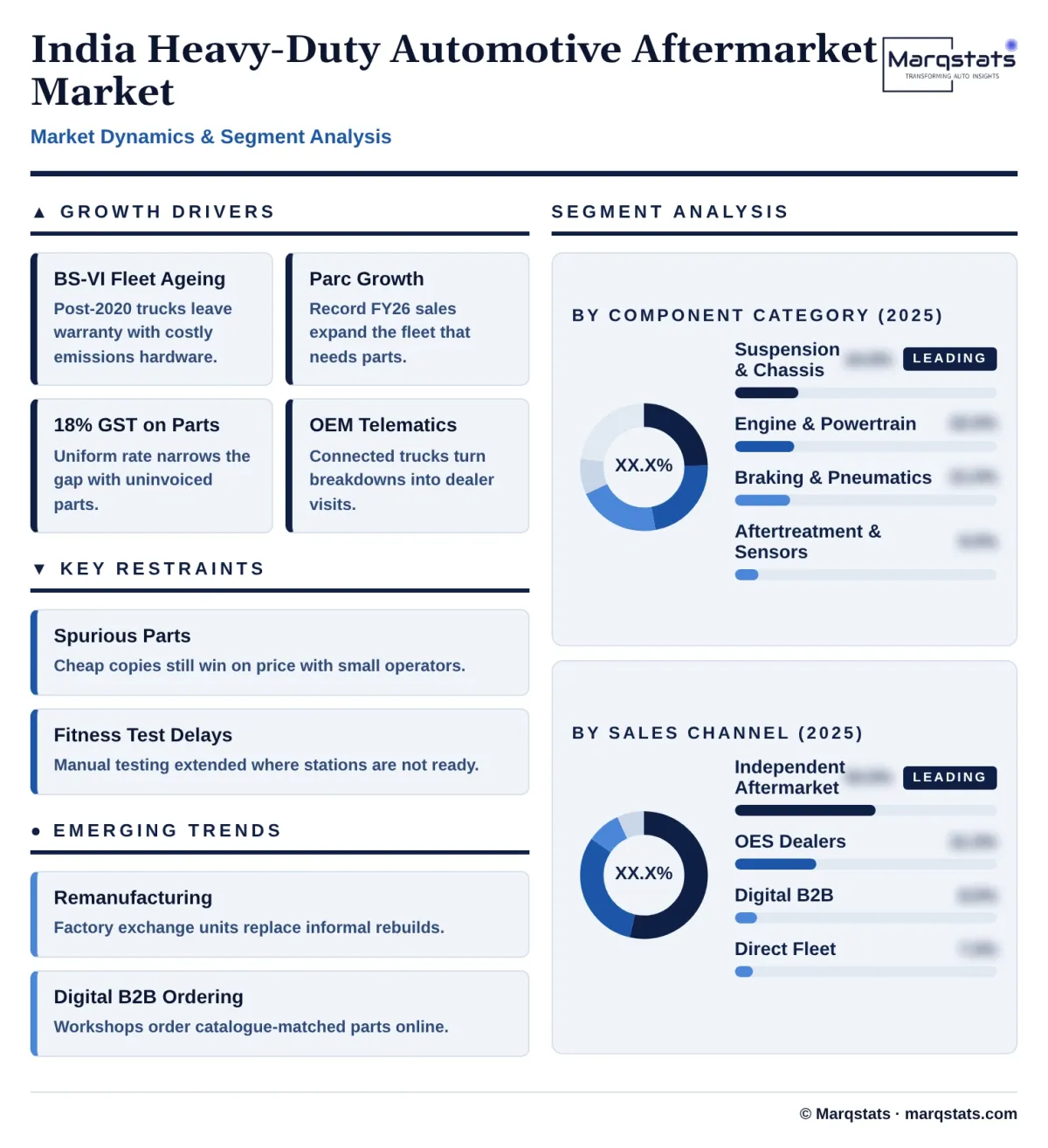
Suspension, steering and chassis parts form the largest category at USD 558.6 million in 2025, 24.5% of the market, growing to USD 759.1 million by 2030, 23.5% of the market, at a 6.33% CAGR. Overloading on feeder roads and mining corridors fatigues leaf springs, torque rods and bushes. The shift from multi-leaf to parabolic springs raises the ticket size, because a fatigued parabolic leaf is replaced as an assembly rather than re-arched. Share slips slightly because aftertreatment grows faster, not because demand weakens.
Engine and powertrain parts are worth USD 513.0 million in 2025, 22.5% of the market, and USD 662.2 million by 2030, 20.5% of the market, at a 5.24% CAGR. Overhaul kits, pistons, liners, turbochargers and fuel-injection parts sit here. BS-VI common-rail systems running above 2,000 bar push injector service to authorised diesel centres, and remanufactured engines substitute for some new-part overhauls, which keeps value growth below the market rate.
Braking and pneumatic parts are worth USD 478.8 million in 2025, 21.0% of the market, rising to USD 694.4 million by 2030, 21.5% of the market, at a 7.72% CAGR. Linings, drums, slack adjusters, air dryers, valves and compressors wear fastest on high-speed expressway duty. Automated roller brake testing, as it spreads state by state, removes the option of passing fitness with an unbalanced axle.
Transmission and driveline parts are worth USD 330.6 million in 2025 and USD 468.3 million by 2030, holding 14.5% of the market in both years at a 7.21% CAGR. Clutch assemblies, propeller shafts, gear sets and axle parts track ton-kilometres closely. Automated manual transmissions on newer tractors add actuator and control-module demand from the late 2020s.
Exhaust aftertreatment and sensors are worth USD 205.2 million in 2025, 9.0% of the market, and USD 387.6 million by 2030, 12.0% of the market, at a 13.56% CAGR, the fastest of any category. Particulate filters, catalysts, urea dosing units and nitrogen-oxide, temperature and pressure sensors are all BS-VI-era parts. On-board diagnostics derate the engine when they fail, so replacement cannot wait for the next service.
Electricals and electronics are worth USD 193.8 million in 2025, 8.5% of the market, and USD 258.4 million by 2030, 8.0% of the market, at a 5.92% CAGR. Alternators, starter motors, lighting, wiring and control modules are included; starter batteries are excluded. Long service lives on rotating electricals keep growth below the market average.
Independent distributors, stockists and retailers hold USD 1,219.8 million in 2025, 53.5% of the market, and USD 1,453.5 million by 2030, 45.0% of the market, growing at 3.57% a year. They serve older vehicles and single-truck owners through credit and local reach, and remain the default for springs, linings and bearings.
Authorised OEM dealer and service networks hold USD 706.8 million in 2025, 31.0% of the market, rising to USD 1,195.1 million by 2030, 37.0% of the market, at an 11.08% CAGR. Diagnostic access, annual maintenance contracts and telematics-booked service visits take the BS-VI repair work.
Digital B2B ordering platforms account for USD 193.8 million in 2025, 8.5% of the market, and USD 387.6 million by 2030, 12.0% of the market, at a 14.87% CAGR. Workshops order catalogue-matched parts with GST invoices and next-day delivery, which suits the post-September 2025 tax structure.
Direct supply contracts with large fleets and state transport undertakings hold USD 159.6 million in 2025, 7.0% of the market, and USD 193.8 million by 2030, 6.0% of the market, at a 3.96% CAGR. Captive depots buy in bulk under service-level agreements, but the segment grows slowly as large fleets shift maintenance to OEM contracts.
Rigid and articulated haulage trucks account for USD 1,413.6 million in 2025, 62.0% of the market, and USD 1,970.3 million by 2030, 61.0% of the market, at a 6.87% CAGR. Multi-axle rigids and tractor-trailers on national corridors run the highest annual mileage and carry most of the BS-VI aftertreatment demand.
Tippers and construction trucks account for USD 478.8 million in 2025, 21.0% of the market, and USD 726.8 million by 2030, 22.5% of the market, at an 8.71% CAGR, the fastest vehicle class. Mining, aggregates and infrastructure duty cycles break springs, drums and driveline parts several times faster than highway haulage.
Medium and heavy buses account for USD 387.6 million in 2025, 17.0% of the market, and USD 533.0 million by 2030, 16.5% of the market, at a 6.58% CAGR. State transport fleet renewal lowers average age, and electric buses in city fleets remove some engine and exhaust demand, so the share eases slightly.
By Geography
North India
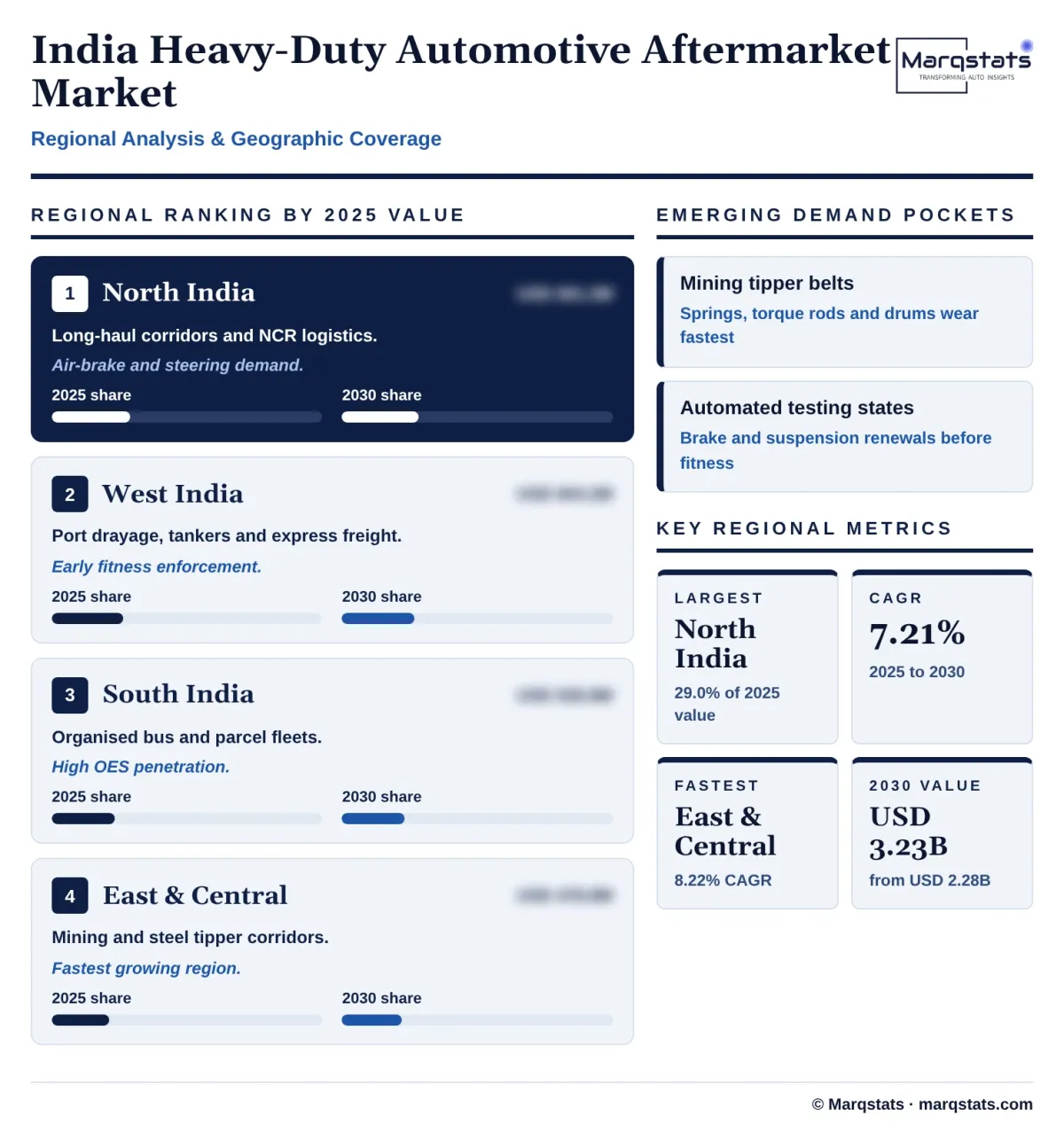
North India is the largest region at USD 661.2 million in 2025, 29.0% of the market, reaching USD 920.5 million by 2030, 28.5% of the market, at a 6.84% CAGR. The Delhi NCR logistics belt, Haryana warehousing and Punjab and Uttar Pradesh agricultural routes run long-haul multi-axle trucks and inter-state buses. Air-brake valves, steering linkages and dryer cartridges dominate demand. Marqstats allocates value by where vehicles operate, not where they are registered.
West India
West India holds USD 604.2 million in 2025, 26.5% of the market, and USD 855.9 million by 2030, also 26.5%, at a 7.21% CAGR. Maharashtra and Gujarat combine port drayage around Jawaharlal Nehru Port and Mundra, chemical and fuel tankers, and express freight. Maharashtra's push to build 53 automated testing stations makes it the likeliest early enforcement market for braking and suspension parts.
South India
South India accounts for USD 535.8 million in 2025, 23.5% of the market, and USD 742.9 million by 2030, 23.0% of the market, at a 6.75% CAGR. Tamil Nadu, Karnataka, Telangana and Andhra Pradesh run car-carrier, parcel and organised intercity bus fleets with high OES penetration. Kerala's 28 planned automated stations add fitness-led demand as they open.
East and Central India
East and Central India is worth USD 478.8 million in 2025, 21.0% of the market, and USD 710.6 million by 2030, 22.0% of the market, at an 8.22% CAGR, the fastest region. Iron-ore, coal and steel corridors in Odisha, Jharkhand, Chhattisgarh and Madhya Pradesh run 8x4 and 10x4 tippers round the clock. Spring packs, torque rods, cast drums and drive axles wear out at well above the national per-vehicle rate.
How Competition Is Evolving
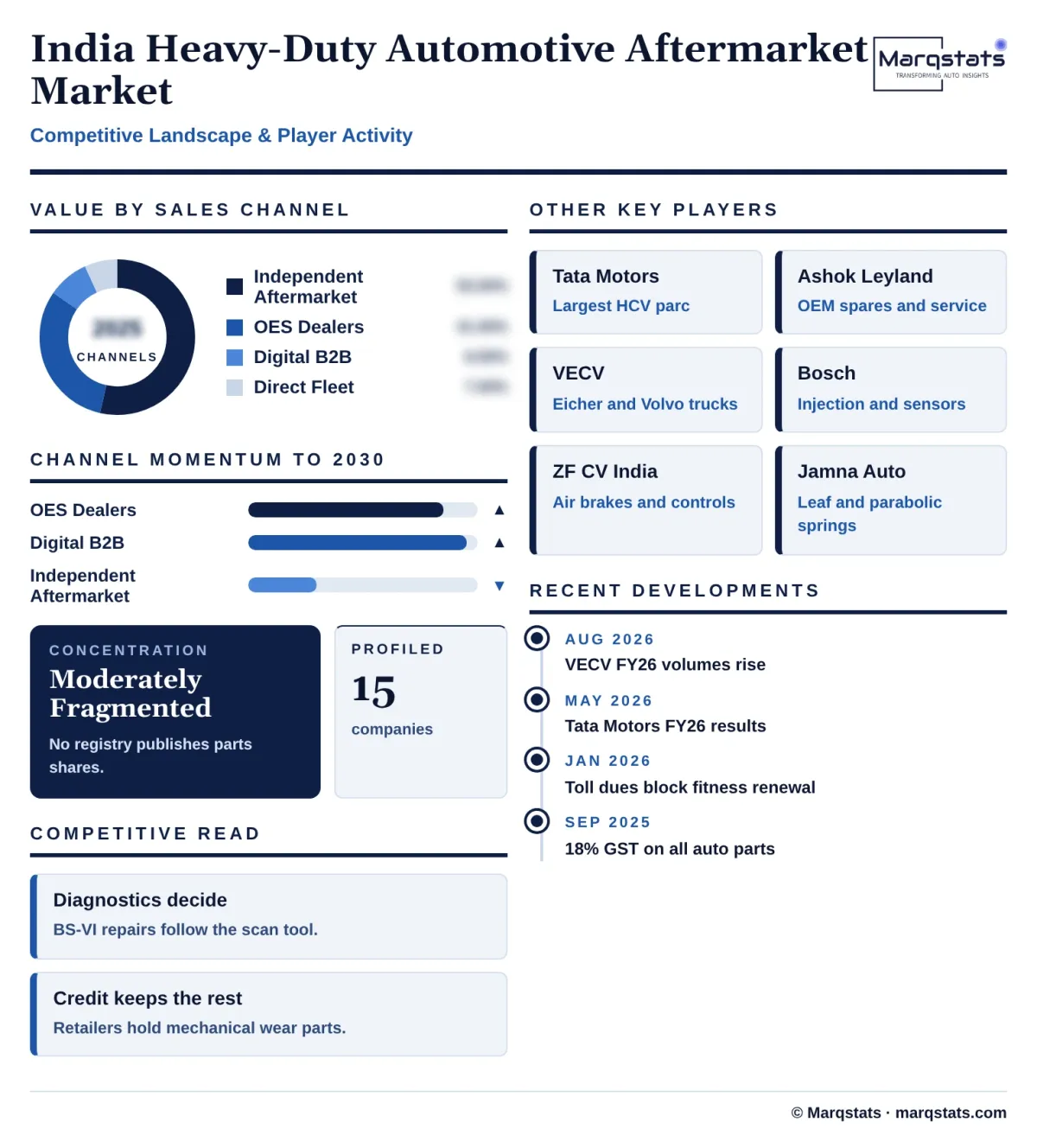
The market is moderately fragmented and no registry publishes company shares of parts sales, so Marqstats describes competition by layer. The channel split shown here is a Marqstats estimate. Vehicle OEM spares divisions, Tier-1 component makers selling under their own brands, and thousands of regional distributors and private-label importers compete for the same repair. Tata Motors Limited reported a 55.0% VAHAN share in HCVs with its FY26 results, which makes its parts business the largest single OES channel by installed base. Ashok Leyland Limited, VE Commercial Vehicles Limited and Daimler India Commercial Vehicles Private Limited follow on parc.
Competition runs on three axes: diagnostic access, credit and availability. OEMs win the BS-VI electronic and aftertreatment repair because their dealers hold the software to clear fault codes and calibrate injectors. Independent distributors win the mechanical repair because they extend 30 to 60 days of credit to retailers and stock parts in every district. Tier-1 suppliers such as Bosch Limited, ZF Commercial Vehicle Control Systems India Limited and Jamna Auto Industries Limited sit in both channels, supplying OE fitment and their own branded replacement lines.
The structural shift is toward OEM-controlled demand. Autocar Professional reported on 2 January 2026 that Ashok Leyland aftermarket revenue, covering spares and maintenance services, grew 11% year on year, and that non-truck businesses now provide about half of its income. Telematics, remanufactured exchange units and annual maintenance contracts give OEMs a reason to call the fleet before the truck breaks down. That is the main reason the OES share rises six points by 2030. Price matters less each year.
Companies Covered
Companies covered in the report include:
Recent Market Activity
Table of Contents
Coverage & Segmentation
The market covers annual spend on replacement parts for medium and heavy commercial vehicles above 7.5 tonnes gross vehicle weight in India: goods trucks, tippers and construction trucks, and buses. Value is measured at net trade value excluding GST, on a calendar-year basis, with 2025 as base year, 2021 to 2025 as history and 2026 to 2030 as forecast. New and remanufactured parts are included across OES dealer networks, independent distributors and retailers, digital B2B platforms and direct fleet contracts.
Excluded: tyres, starter and traction batteries, lubricants, coolants and diesel exhaust fluid, workshop labour and service fees, used parts recovered from scrapped vehicles, accessories, and all vehicles at or below 7.5 tonnes. Fiscal-year sources (ACMA, SIAM, company filings) are cited with their FY label. Marqstats converts them to calendar years by weighting: calendar 2025 takes one quarter of FY25 (January to March 2025) and three quarters of FY26 (April to December 2025).
Related Marqstats pages and boundaries. India Automotive Lubricants Aftermarket covers oils and fluids; do not add. India Vehicle Scrappage Infrastructure Market sizes gross realised value at authorised scrapping facilities, including reusable parts recovered at about 30% of that value; those used parts are excluded here, so do not add the two. Africa Commercial Vehicle Aftermarket Market (USD 5.10 billion in 2025) and Saudi Arabia Commercial Vehicle Aftermarket Market (USD 1.55 billion in 2025) include light commercial vehicles, tyres and service, so they are broader in scope and not directly comparable with the India parts-only figure.