Market Snapshot
The India bus market size is estimated at USD 4,216.14 million in 2025 and is projected to reach USD 5,879.54 million by 2030, growing at a CAGR of 6.88% over 2026 – 2030. Sales rise from about 127,089 to 154,000 buses a year, while electric buses lift the average value per bus to about USD 38,179.
Marqstats defines the market as the value of new buses sold in India for domestic use across all powertrains: light buses and minibuses up to 7.5 tonnes gross vehicle weight, medium buses of 7.5 to 12 tonnes, heavy buses above 12 tonnes and electric buses. Value is counted as the complete bus, chassis plus body, before Goods and Services Tax (GST), at USD 1 = INR 87.00. Exports, used buses, three-wheelers, cars used as taxis and goods vehicles are excluded.
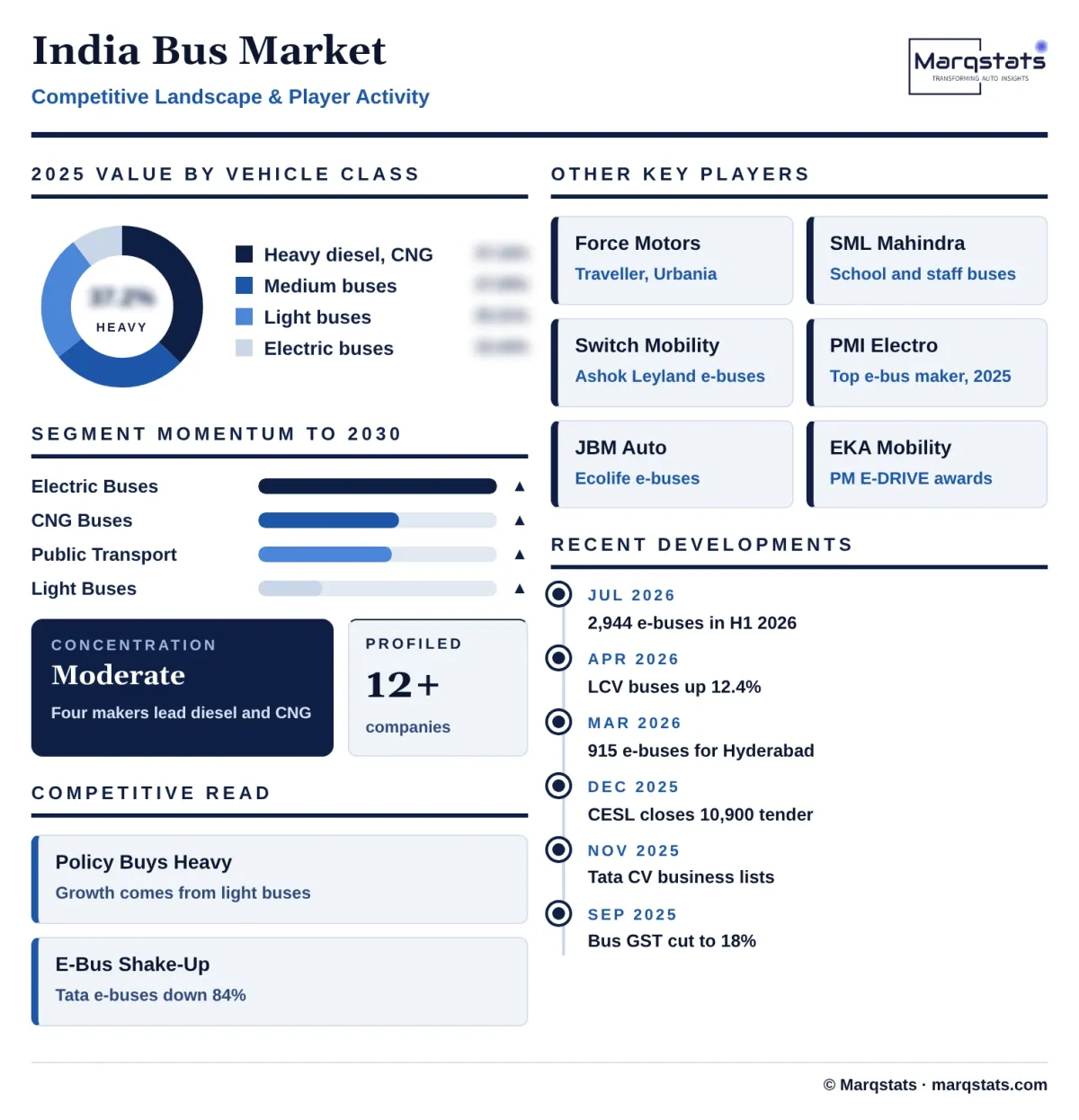
Heavy diesel and CNG buses account for 37.16% of 2025 value, diesel buses for 82.30% and intercity and tourist coaches for 34.02%. Electric buses are 3.49% of 2025 units but 10.44% of value, and they grow fastest, at 21.19% a year. South India leads with 30.00% of value.
Key Takeaways
Market Overview & Analysis
Report Summary
Marqstats sizes the India bus market as the value of new buses bought for use in India each year, across diesel, CNG and electric powertrains. It counts light buses and minibuses up to 7.5 tonnes gross vehicle weight, such as the Force Motors Traveller, the Tata Motors Winger and light school buses; medium buses of 7.5 to 12 tonnes, such as the Eicher Skyline and Tata Starbus school and staff buses; heavy buses above 12 tonnes, such as the Ashok Leyland Viking and 12 metre intercity coaches; and electric buses from PMI Electro Mobility Solutions, Olectra Greentech, Switch Mobility, JBM Auto, EKA Mobility and others.
The base is SIAM wholesale data. SIAM reports domestic sales of M&HCV buses of 67,307 in FY2025 and 67,149 in FY2026, and of LCV buses of 54,807 and 61,597. Together these give 122,114 buses in FY2025 and 128,746 in FY2026, a rise of 5.43%. Marqstats converts the fiscal years to calendar 2025 by weighting one quarter of FY2025 and three quarters of FY2026, which gives about 67,189 M&HCV buses and 59,900 LCV buses, or 127,089 buses in all.
That rebuild replaces a figure of 118,450 that circulates as the 2025 bus total. That number is a residual of all commercial passenger carriers left after goods vehicles are deducted from national commercial vehicle retail, and it mixes the definition of a bus with whatever falls out of the subtraction. The SIAM bus series names buses directly, splits them by weight and reconciles with the 67,149 M&HCV bus figure that the live Marqstats India Bus Body Building page also uses.
Electric buses are counted from VAHAN registrations. The Ministry of Road Transport and Highways registration platform recorded 4,441 electric buses in 2025, up 19% from 3,730 in 2024, with PMI Electro Mobility Solutions at 1,041, Olectra Greentech at 990, Switch Mobility at 950, JBM Auto at 698, Pinnacle Mobility Solutions at 310 and Tata Motors at 223. Marqstats places all 4,441 inside the SIAM-based total, which makes electric buses 6.61% of the M&HCV bus figure for the year.
The market stands at about INR 36,680.42 crore before GST in 2025. The GST Council cut the rate on motor vehicles for ten or more persons from 28% to 18% from 22 September 2025, and electric buses stay at 5%, so the tax gap that once favoured state-run buses over private coaches has narrowed. Values in this analysis are before tax, so the cut lowers what operators pay without changing the value Marqstats counts.
India Bus Market Size and Forecast
The India bus market grows from USD 4,216.14 million in 2025 to USD 5,879.54 million in 2030, a CAGR of 6.88%. Volume adds less than half of that growth: sales rise at 3.92% a year, from about 127,089 to 154,000 buses, while the average value per bus rises at 2.85% a year, from about USD 33,175 to USD 38,179, because electric buses that cost two to two and a half times a diesel city bus take a larger share.
The 2025 value is built from units and prices by class. Marqstats estimates 59,900 light buses at about INR 15.5 lakh each, 35,482 medium buses at INR 28.0 lakh, 27,266 heavy diesel and CNG buses at INR 50.0 lakh and 4,441 electric buses at about INR 86.20 lakh, or USD 99,077. Prices are complete-bus values, chassis and body, before GST. The medium and heavy split applies the FY2025 SIAM ratio, in which buses of 7.5 to 12 tonnes were 34,632 of 65,580 buses above 7.5 tonnes.
The electric slice is taken from the live Marqstats India Electric Bus page, which sizes 2025 at USD 440 million for 4,441 buses and 2030 at USD 1.15 billion. Marqstats keeps those values and adds unit estimates: about 6,000 electric buses in 2026, consistent with the 2,944 registered in the first half of 2026, and about 12,300 in 2030 as CESL contracts under PM E-DRIVE and PM-eBus Sewa reach delivery. The implied price per electric bus falls from about USD 99,077 to USD 93,496 as 12 metre non-AC buses and local battery packs take hold.
Light buses grow faster than heavy ones. Marqstats expects light bus sales to rise from 59,900 to 72,000, a 3.75% annual rate, medium buses from 35,482 to 40,500 and heavy diesel and CNG buses only from 27,266 to 29,200, because tendered electric buses take the city routes that heavy diesel buses used to serve. CNG buses rise from about 10,800 to 18,000 units.
Marqstats tracks four indicators to monitor the forecast: monthly SIAM M&HCV and LCV bus dispatches, VAHAN electric bus registrations against the 10,900 buses CESL tendered in December 2025, letters of award and depot power connections in Bengaluru, Delhi, Hyderabad, Ahmedabad and Surat, and fare and fleet decisions of the larger state transport undertakings, which set replacement demand for diesel buses.
Market Dynamics
Key Drivers
Five forces lift demand for new buses in India, and each one acts on a different part of the fleet.
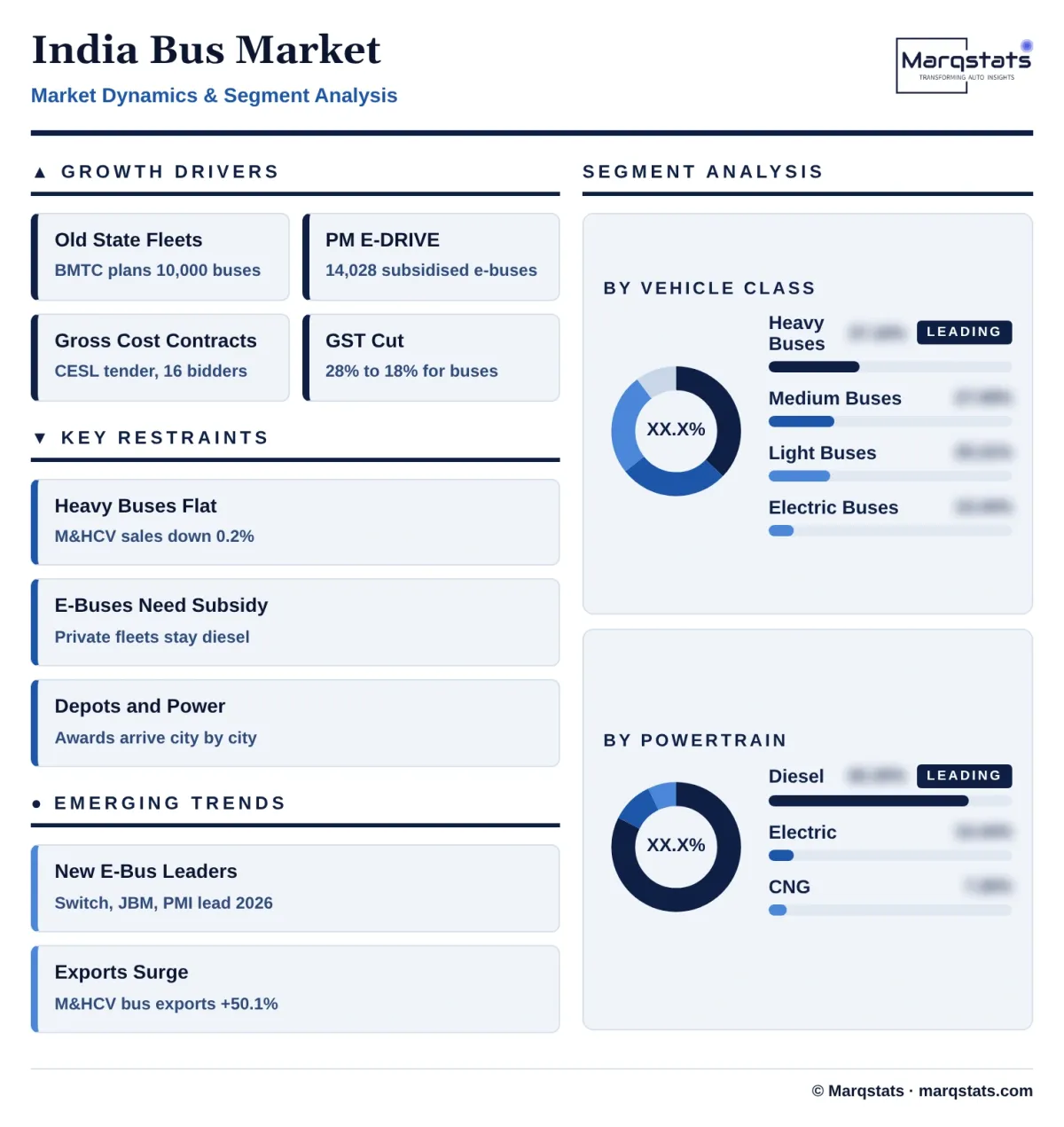
- State transport fleets are old and short of buses. Bangalore Metropolitan Transport Corporation (BMTC) runs 6,740 buses, including about 1,700 electric buses, and plans 10,000 within two years. Other state undertakings face similar gaps between ageing diesel fleets and ridership, which keeps replacement demand for heavy buses steady even when private demand slows.
- Central schemes pay for electric city buses. PM E-DRIVE sets aside about INR 4,391 crore of subsidy for 14,028 electric buses in nine cities with more than four million people, with caps of INR 35 lakh for a 10 to 12 metre bus, INR 25 lakh for 8 to 10 metres and INR 20 lakh for 6 to 8 metres, and only buses with an ex-factory price below INR 2 crore qualify. PM-eBus Sewa adds 10,000 electric buses for smaller cities with central support of INR 20,000 crore.
- Gross cost contracts move the capital off city balance sheets. Under the CESL model the operator buys, runs and maintains the bus and builds the depot chargers, and the city pays a fixed fee per kilometre. That structure let CESL close a tender for 10,900 electric buses in December 2025 with 16 bidders and 14 financial bids, a scale no single city could fund.
- The GST cut lowers the price of every diesel and CNG bus. From 22 September 2025 buses for ten or more persons moved from 28% to 18% GST, a cut of ten percentage points on the bill of every private coach, school and staff bus operator, while electric buses stay at 5%.
- School, staff and rural transport switch to factory-built minibuses. LCV bus sales rose 12.4% to 61,597 in FY2026, and Force Motors reported a 20% rise in domestic sales for the year, as schools, factories and technology parks buy Traveller and Winger type minibuses instead of hired vans.
Key Restraints
Four constraints hold volume growth near four percent a year and slow the shift of private fleets to electric buses.
- Heavy-bus demand outside tenders has stalled. Domestic M&HCV bus sales fell 0.2% to 67,149 in FY2026 after a strong FY2025, and Ashok Leyland, the largest maker of heavy diesel buses, reported a contraction in bus sales in March 2026. With fewer state orders for diesel buses, heavy-bus volumes depend on private coaches.
- Electric buses still need public money. Private coach and staff fleets buy almost no electric buses because a 12 metre electric bus costs about two to two and a half times a diesel bus and needs a depot charger, and PM E-DRIVE subsidies only reach city fleets under CESL contracts, so the electric share outside city transport stays small.
- Depots, power and payment slow deliveries. Each gross cost contract needs depot land and a high-tension grid connection, and operators are exposed to late payment by city transport undertakings. PM-eBus Sewa introduced a payment security mechanism, but the 10,900-bus tender concluded in December 2025 was still being awarded city by city in March 2026, so tenders turn into registrations slowly.
- Diesel CNG and electric rules differ by city. Delhi city buses run only on CNG and electricity, most other cities have no such rule, and CNG networks are thin outside the gas grid. Operators with routes across states keep diesel as the common choice, which slows a broad switch to cleaner buses.
Key Trends
Four shifts are changing who buys Indian buses, how they pay and what they buy.
- New entrants win the electric tenders. PMI Electro Mobility Solutions, Switch Mobility and JBM Auto led electric registrations in 2025 and 2026, while Tata Motors fell from 1,462 electric buses in 2024 to 223 in 2025, and EKA Mobility with partners won awards for 1,750 buses in Bengaluru and 915 in Hyderabad.
- Bus makers sell kilometres, not buses. Under gross cost contracts the winner is often a consortium of a bus maker and an operator, such as EKA Mobility with Chartered Speed in Bengaluru or with GreenCell Mobility in Hyderabad, so a bus order becomes a ten- to twelve-year service contract.
- Exports grow faster than the home market. SIAM M&HCV bus exports rose 50.1% to 16,874 in FY2026 while domestic M&HCV bus sales were flat, giving Indian bus makers a second outlet for diesel bus capacity.
- Ownership of the old makers is changing. Tata Motors listed its commercial vehicle business on 12 November 2025 after the demerger took effect on 1 October 2025, and Mahindra and Mahindra took control of SML Isuzu in August 2025 and renamed it SML Mahindra.
Strategic Implications
- For bus makers, the volume opportunity outside tenders is in light and medium buses for schools, staff transport and rural routes. These buyers pay cash or bank loans, not per-kilometre fees, and the 12.4% rise in LCV bus sales in FY2026 shows they respond to price, finance and the GST cut.
- For electric bus makers and operators, the CESL pipeline is large but slow to turn into registrations. Winning a share of the 10,900 buses tendered in December 2025 is only half the task; securing depot power and delivering on time decides revenue in 2026 – 2028.
- For diesel and CNG bus makers, the city route is shrinking and the private coach is the core. Heavy diesel and CNG bus value grows only 3.70% a year, so long-wheelbase sleeper and seater coaches, CNG city buses for towns outside the PM E-DRIVE cities and exports carry the business.
- For lenders and lessors, gross cost contracts need project finance, not vehicle loans. The payment security mechanism under PM-eBus Sewa reduces the risk of city payment delays, and lenders that price that risk well can finance the operators that win CESL contracts.
- For component and body suppliers, the shift to factory-built light buses and electric city buses reduces the share of buses bodied by independent coach builders. Suppliers of seats, HVAC, doors and battery packs should sell to the bus makers and the gross cost contract consortia directly.
Market Segmentation
Light buses and minibuses up to 7.5 tonnes account for 25.31% of 2025 value, USD 1,067.18 million, and grow at 5.68% a year to USD 1,406.90 million. About 59,900 units were sold in 2025, the largest unit class, led by the Force Motors Traveller and Urbania, the Tata Motors Winger and Starbus light school buses and SML Mahindra school and staff buses. Their share of value falls slightly to 23.93% only because electric buses grow faster.
Medium buses of 7.5 to 12 tonnes account for 27.09% of 2025 value, USD 1,141.95 million, and grow at 4.79% a year to USD 1,443.10 million. About 35,482 units were sold in 2025, mainly 30 to 50 seat school, staff and route buses such as the Eicher Skyline and Starline and the Tata Starbus. VE Commercial Vehicles alone sold 13,647 medium buses in FY2025, up 16%.
Heavy diesel and CNG buses above 12 tonnes account for 37.16% of 2025 value, USD 1,567.01 million, the largest class, and grow at 3.70% a year to USD 1,879.54 million. About 27,266 were sold in 2025, from state transport city buses on Ashok Leyland and Tata Motors chassis to Volvo, Eicher and BharatBenz intercity coaches. Growth is slow because electric buses take the city routes.
Electric buses account for 10.44% of 2025 value, USD 440.00 million from 4,441 buses, and grow at 21.19% a year to USD 1,150.00 million and 19.56% of the market. Almost all are 9 and 12 metre city buses bought under gross cost contracts. This slice matches the live Marqstats India Electric Bus page and must not be added to it.
Diesel buses account for 82.30% of 2025 value, USD 3,470.23 million, and 88.01% of units. They grow at 3.78% a year to USD 4,176.81 million, while their share of value falls to 71.04%. Private coaches, school and staff buses and state undertakings outside the electric programmes keep diesel the default.
CNG buses account for 7.26% of 2025 value, USD 305.91 million, from about 10,800 buses, and grow at 12.56% a year to USD 552.73 million. City fleets in Delhi, Gujarat, Maharashtra and Uttar Pradesh and light buses in towns on the gas grid buy CNG because it cuts fuel cost without a depot charger.
Electric buses account for 10.44% of 2025 value, USD 440.00 million, and grow at 21.19% a year to USD 1,150.00 million, rising from 3.49% to 7.99% of units. The pace depends on CESL deliveries under PM E-DRIVE and PM-eBus Sewa, not on private demand.
State transport undertakings and city bus operators account for 30.54% of 2025 value, USD 1,287.68 million, and grow fastest, at 11.28% a year, to USD 2,196.90 million and 37.37% of the market. Marqstats estimates about 22,000 buses in 2025, including all 4,441 electric buses, rising to 33,000 in 2030.
Intercity and tourist coaches account for 34.02% of 2025 value, USD 1,434.48 million, the largest end use, and grow at 5.39% a year to USD 1,864.94 million. About 24,000 coaches were sold in 2025, from 12 metre seaters to multi-axle sleepers on routes such as Bengaluru to Hyderabad and Delhi to Jaipur, almost all diesel.
School and institutional buses account for 19.63% of 2025 value, USD 827.59 million, and grow at 3.62% a year to USD 988.51 million. About 36,000 buses were sold in 2025, mainly light and medium diesel and CNG buses bought before the April to June academic year start.
Staff transport and shared mobility account for 15.81% of 2025 value, USD 666.39 million, and grow at 4.47% a year to USD 829.19 million. About 45,089 buses were sold in 2025, mostly monocoque minibuses and light buses for factory and technology park shifts, rural shared routes and hotel and airport transfers.
By Geography
South India
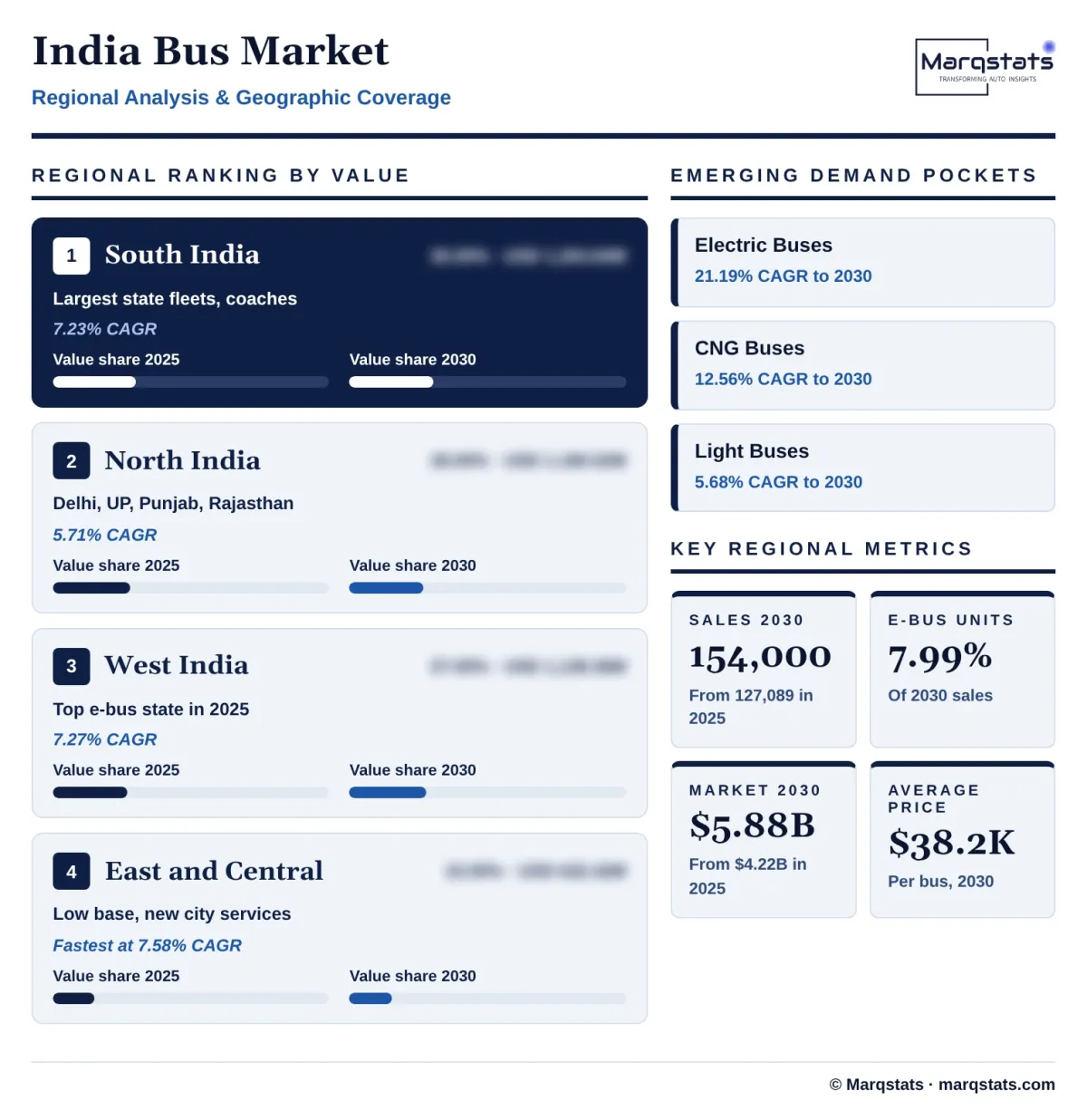
South India accounts for 30.00% of 2025 value, USD 1,264.84 million, and grows at 7.23% a year to USD 1,793.26 million and 30.50% by 2030. Karnataka, Tamil Nadu, Andhra Pradesh, Telangana and Kerala run some of the largest state bus fleets and the densest private coach network in India. Karnataka registered 445 electric buses in 2025, up from 53 in 2024, Tamil Nadu 398, and Bengaluru and Hyderabad hold 6,500 of the 10,900 buses CESL tendered in December 2025.
West India
West India accounts for 27.00% of 2025 value, USD 1,138.36 million, and grows at 7.27% a year to USD 1,616.87 million. Maharashtra became the largest electric bus market in 2025 with 1,442 registrations, ahead of Delhi, through the Maharashtra State Road Transport Corporation, Brihanmumbai Electric Supply and Transport and Pune Mahanagar Parivahan Mahamandal. Gujarat added 116 electric buses, and Ahmedabad and Surat share 1,600 buses in the CESL tender.
North India
North India accounts for 28.00% of 2025 value, USD 1,180.52 million, and grows at 5.71% a year to USD 1,558.08 million, the slowest region, because Delhi has already electrified much of its city fleet. Delhi registered 1,382 electric buses in 2025 and holds 2,800 buses in the CESL tender, while Uttar Pradesh, Haryana, Punjab and Rajasthan buy diesel and CNG buses for state undertakings and private coaches.
East, Central and North-East India
East, Central and North-East India account for 15.00% of 2025 value, USD 632.42 million, and grow fastest, at 7.58% a year, to USD 911.33 million. West Bengal, Odisha, Bihar, Madhya Pradesh, Chhattisgarh and Assam have fewer buses per person, and PM-eBus Sewa and new state bus services in smaller cities start from a low base.
How Competition Is Evolving
The market is moderately concentrated and split into two contests. In diesel and CNG buses, Tata Motors, Ashok Leyland, VE Commercial Vehicles and Force Motors hold most of the market through dealer networks, finance and service across the country. In electric buses, specialist makers win gross cost contracts through consortia with operators, and the established makers hold small shares.
Tata Motors and Ashok Leyland lead heavy and medium buses. Tata Motors, whose commercial vehicle business listed on 12 November 2025 after the demerger, reported passenger carrier growth of 17% in FY2025. Ashok Leyland reported a 19% rise in M&HCV bus sales in FY2025 and runs its electric buses through its subsidiary Switch Mobility, which registered 950 electric buses in 2025 and 830 in the first half of 2026. VE Commercial Vehicles sold 13,647 medium buses in FY2025 and sells Volvo coaches in the premium segment.
Force Motors and SML Mahindra lead light buses. Force Motors reported a 20% rise in domestic sales in FY2026 on its Traveller and Urbania ranges, and SML Mahindra, controlled by Mahindra and Mahindra since August 2025, sold 11,220 buses in FY2026 against 10,006 a year earlier, mainly school and staff buses.
Electric buses have a different set of leaders. On VAHAN registrations PMI Electro Mobility Solutions led 2025 with 1,041 buses, ahead of Olectra Greentech with 990, Switch Mobility with 950, JBM Auto with 698, Pinnacle Mobility Solutions with 310 and Tata Motors with 223. In the first half of 2026 Switch Mobility led with 830, followed by JBM Auto with 635 and PMI with 574, while Olectra fell to 280. EKA Mobility, part of Pinnacle, won the first PM E-DRIVE awards in Bengaluru and Hyderabad.
Companies Covered
Companies covered in the report include:
Recent Market Activity
Table of Contents
Coverage & Segmentation
The study covers the India bus market, with 2025 as the base year, 2021 – 2025 as the historical period and 2026 – 2030 as the forecast period. It covers new buses sold for domestic use across diesel, CNG and electric powertrains, segmented by vehicle class, powertrain, end use and region. Values are complete-bus values, chassis plus body, before GST, in US dollars at USD 1 = INR 87.00, and units are SIAM domestic bus sales converted to calendar 2025, with electric buses from VAHAN.
Exports, used buses, three-wheelers, cars and vans registered as taxis below the SIAM LCV bus category, goods vehicles and after-sale body work are excluded. The live Marqstats India Electric Bus page sizes the electric slice of this market and the live India Bus Body Building page sizes the body value inside it; both overlap with this market and their figures must not be added to it. Goods vehicles are covered separately in the India truck market, which uses the same SIAM base.