Market Snapshot
The global trailer electronic braking system (TEBS) module market size is estimated at USD 147.10 million in 2025 and is projected to reach USD 232.10 million by 2030, growing at a CAGR of 9.55% over 2026 – 2030. Module shipments rise from about 245,750 to 379,070 units, while Europe holds 73.05% of 2025 value.
Marqstats defines the market as the value of electronic braking control modules fitted to air-braked heavy trailers, meaning the electronic control unit, the electro-pneumatic modulator block and the wheel speed and pressure sensing set that comes with it. It covers factory fitment on semi-trailers, centre-axle trailers and drawbar trailers above 3.5 tonnes, and replacement modules sold through aftermarket channels. Tractor-unit braking, anti-lock-only valves, brake actuators, air disc brakes, telematics hardware and trailer bodies are excluded.
Original equipment fitment accounts for 83.80% of 2025 value and the 4S/2M configuration for 55.00%. Europe leads with 73.05% of value, while North America grows fastest at 18.08% a year. The study segments the market by sales channel, system configuration, trailer type and region.
Key Takeaways
Market Overview & Analysis
Report Summary
Marqstats sizes the trailer electronic braking system module market as the value of electronic brake control modules fitted to air-braked heavy trailers. In 2025 about 245,750 modules were shipped worldwide, worth an estimated USD 147.10 million at an average price of about USD 599 per module including its sensing set.
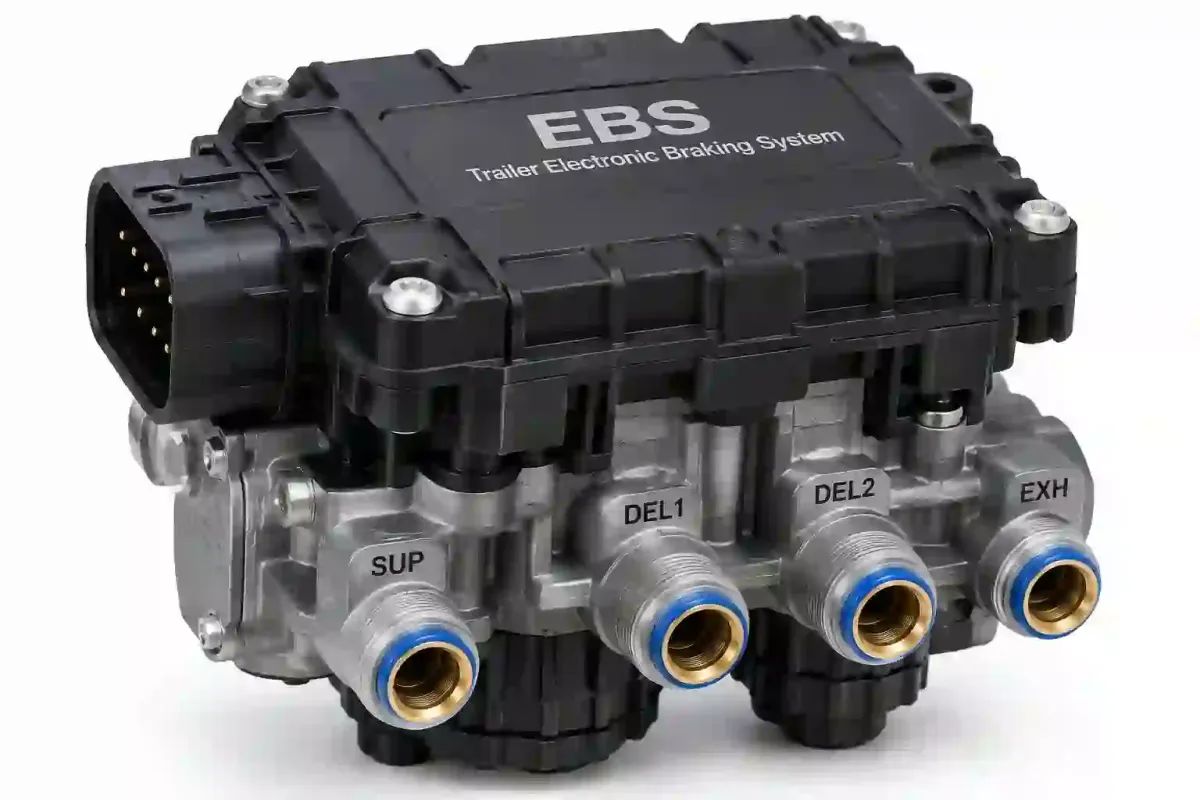
A trailer EBS module is the control point of the trailer brake system. It receives the brake demand from the tractor, calculates the braking force for each axle, and opens or closes electro-pneumatic valves that set the air pressure in the brake chambers. Wheel speed sensors tell it when a wheel is about to lock, pressure sensors confirm what the chambers are doing, and many units also read axle load, control a lift axle and report faults to the tractor and to the fleet telematics unit.
The difference from a conventional anti-lock trailer system is the way the brake demand arrives. A conventional system receives the demand as air pressure travelling down the coupling hose, then reacts only when a wheel slips. A TEBS module also receives the demand as a digital message over the ISO 11992 communication link carried through the seven-pin ISO 7638 connector, so the trailer brakes can be applied in step with the tractor and the module can run stability functions such as roll stability support. Anti-lock-only systems remain on a large share of trailers worldwide and are outside the market sized here.
Three configurations are sold. A 2S/2M system has two wheel speed sensors and two modulators and suits single and tandem axle trailers. A 4S/2M system has four sensors and two modulators, which is the standard layout for tri-axle semi-trailers with side-to-side load sensing. Systems with three or more modulators, or master and slave units, serve multi-axle low-loaders, road trains and tank trailers. Haldex describes its EB+ 4.0 platform as scaling from a 2S/2M standard to 8S/4M with slave modules, for example on a ten-axle low-loader.
Demand is shaped by rules more than by trailer output. Europe has required a stability function on new air-suspended semi-trailers and heavy trailers since July 2011, Australia requires roll-over control under ADR 38/05 on new heavy trailers since November 2019, and the United States requires anti-lock brakes only. Marqstats estimates that 1,384,000 air-braked heavy trailers were built worldwide in 2025 and that 15.23% of them were fitted with a TEBS module, so fitment can rise sharply wherever a rule or a fleet decision changes the specification.
Global Trailer Electronic Braking System (TEBS) Module Market Size and Forecast
The global trailer EBS module market grows from USD 147.10 million in 2025 to USD 232.10 million in 2030, a CAGR of 9.55%. Marqstats expects value of USD 161.80 million in 2026, USD 177.57 million in 2027, USD 194.50 million in 2028 and USD 212.65 million in 2029. Shipments rise from about 245,750 modules to 269,500 in 2026, 294,610 in 2027, 321,200 in 2028, 349,330 in 2029 and 379,070 in 2030, a 9.05% annual rate.
Prices move slowly because two effects offset each other. The average price per module rises from about USD 599 in 2025 to about USD 612 in 2030 as multi-modulator systems and software functions add content, but the fastest unit growth comes from lower-priced regions such as China and India, which holds the average down. A new WABCO TEBS-E modulator is listed at EUR 824.60 including VAT on a German parts marketplace, about USD 783 before VAT at EUR 1 = USD 1.13, and Marqstats uses a trade price about 18% below that level for aftermarket sales.
The base is built from trailers, not from the brake market above it. Marqstats estimates 1,384,000 air-braked heavy trailers built in 2025: about 190,000 in Europe, 215,000 in North America, 650,000 in China, 110,000 in India, 80,000 in Latin America and the rest in Australia, other Asia-Pacific and the Middle East and Africa. Multiplying each regional build by an estimated TEBS fitment rate and a regional price gives 210,750 factory-fitted modules worth USD 123.27 million, and an aftermarket layer of 35,000 replacement modules worth USD 23.83 million.
The forecast moves three inputs. Heavy trailer builds grow from 1,384,000 to 1,574,600, recovering from the 2025 downturn in North America and Europe and rising with Indian and Chinese demand. Fitment rises from 15.23% to 20.53% of builds as fleets in North America, China and India specify stability and data functions. Aftermarket replacement rises from 2.0% to 2.4% of modules in service each year as the installed base ages and workshops adopt platforms such as Haldex EB+ 4.0.
Marqstats tracks four indicators to monitor the forecast: heavy trailer output by region, fitment rate on new trailers in North America and China, software update compliance under UN Regulation No. 156, and the share of replacement modules bought by independent workshops rather than OEM dealers.
Market Dynamics
Key Drivers
Five forces are lifting trailer EBS fitment beyond the regions where it is already compulsory.
- Stability rules in Europe and Australia. The European requirement for a stability function on new air-suspended trailers has applied since July 2011, and ADR 38/05 requires roll-over control on new heavy trailers in Australia from November 2019, so a TEBS module is the default way to meet the rule in both markets.
- Fitment catch-up in low-penetration regions. Fewer than one in ten new heavy trailers carries a TEBS module in North America, China and India, so large fleets that adopt EBS as a safety and data standard add far more modules than output growth alone would.
- Software and cybersecurity rules. UN Regulation No. 156 covers category O trailers and applies in the European Union to all new complete vehicles from 7 July 2026, which pushes trailer makers to specify modules that can be updated securely, such as the Haldex EB+ 4.0 platform prepared for that rule.
- Brake and tyre data for fleets. SAF-HOLLAND launched the Haldex BrakeSight pad and rotor wear sensor at the 2026 Technology and Maintenance Council meeting, sending wear data over the CAN bus to fleet telematics, and such functions are easier to add when the trailer already carries a TEBS module.
- Multi-axle and high-capacity combinations. Road trains, B-doubles and low-loaders need more sensors and modulators, and the Haldex EB+ 4.0 platform scales to 8S/4M for these trailers, which raises content per trailer.
Key Restraints
Four constraints slow the spread of trailer EBS modules in the regions that do not require them.
- Trailer output cycles. North American trailer builders cut output sharply in 2025, with Hyundai Translead down 29% to 39,887 units, Great Dane down 32% to 24,525 and Wabash down 29% to 22,770, and SAF-HOLLAND expects subdued North American trailer conditions in 2026, which delays fitment growth where it matters most.
- Anti-lock brakes meet the rule at lower cost. FMVSS No. 121 requires anti-lock brakes on air-braked trailers in the United States and no federal rule requires a stability function on trailers, so most fleets keep the lower-cost system unless their insurers or customers ask for more.
- Long product life slows replacement. A TEBS module on a trailer that runs for twelve years or more is rarely replaced, and reconditioned units and independent repair reduce the number of new modules bought in the aftermarket.
- Trailer makers are under cost pressure. European Union Regulation 2024/1610 sets emission targets for new trailers from 2030, the Court of Justice dismissed a challenge to it on 1 October 2026, and trailer makers answer by pressing suppliers on the price of every fitted component.
Key Trends
Four shifts are changing what a trailer EBS module contains and how it is serviced.
- Fewer parts per trailer. Knorr-Bremse introduced its iTEBS X in December 2023 in ECO, PLUS and LAC versions, with the lift-axle valve built into the LAC unit, so the module replaces separate valves and pipes and trailer makers save assembly time.
- One platform for every trailer. Haldex EB+ 4.0 combines EBS, ABS and ABS with roll-over protection in one modular platform, built to remain the core Haldex trailer braking platform for the next 10 to 15 years.
- The module becomes a data gateway. Trailer braking modules now pass brake pressure, wear and fault data to telematics units, and suppliers sell diagnostic and configuration tools through their service networks.
- Redundancy for driverless trucks. Knorr-Bremse announced on 15 July 2026 that it will start series production of a redundant braking system for Level 4 commercial vehicles in 2027, which will require trailers pulled by driverless tractors to meet matching redundancy requirements.
Strategic Implications
- For trailer makers, standardising one TEBS platform across all models cuts parts, wiring and software variants. Makers such as Schmitz Cargobull, Krone and Wielton that already fit EBS as standard can use the same platform to meet the software update rule without redesigning each trailer.
- For brake suppliers, the growth is outside Europe. Suppliers that offer a lower-cost 2S/2M system with a path to full EBS can win large volumes in North America, China and India, while premium multi-modulator systems protect margin in Europe and Australia.
- For fleet buyers, the case for TEBS rests on data and stability rather than on the rule. Fleets in North America that haul liquids, double trailers or high-value loads can justify the extra cost through insurance terms, brake wear monitoring and fewer unplanned stops.
- For aftermarket distributors, replacement modules need coding and configuration tools as well as parts. Distributors that can supply a pre-configured module and the diagnostic software have an advantage over those that sell parts alone.
- For investors, fitment is the figure to watch. A one-point change in North American or Chinese fitment moves the module count more than a change in European output, so fleet specification data is a better leading indicator than trailer order books.
Market Segmentation
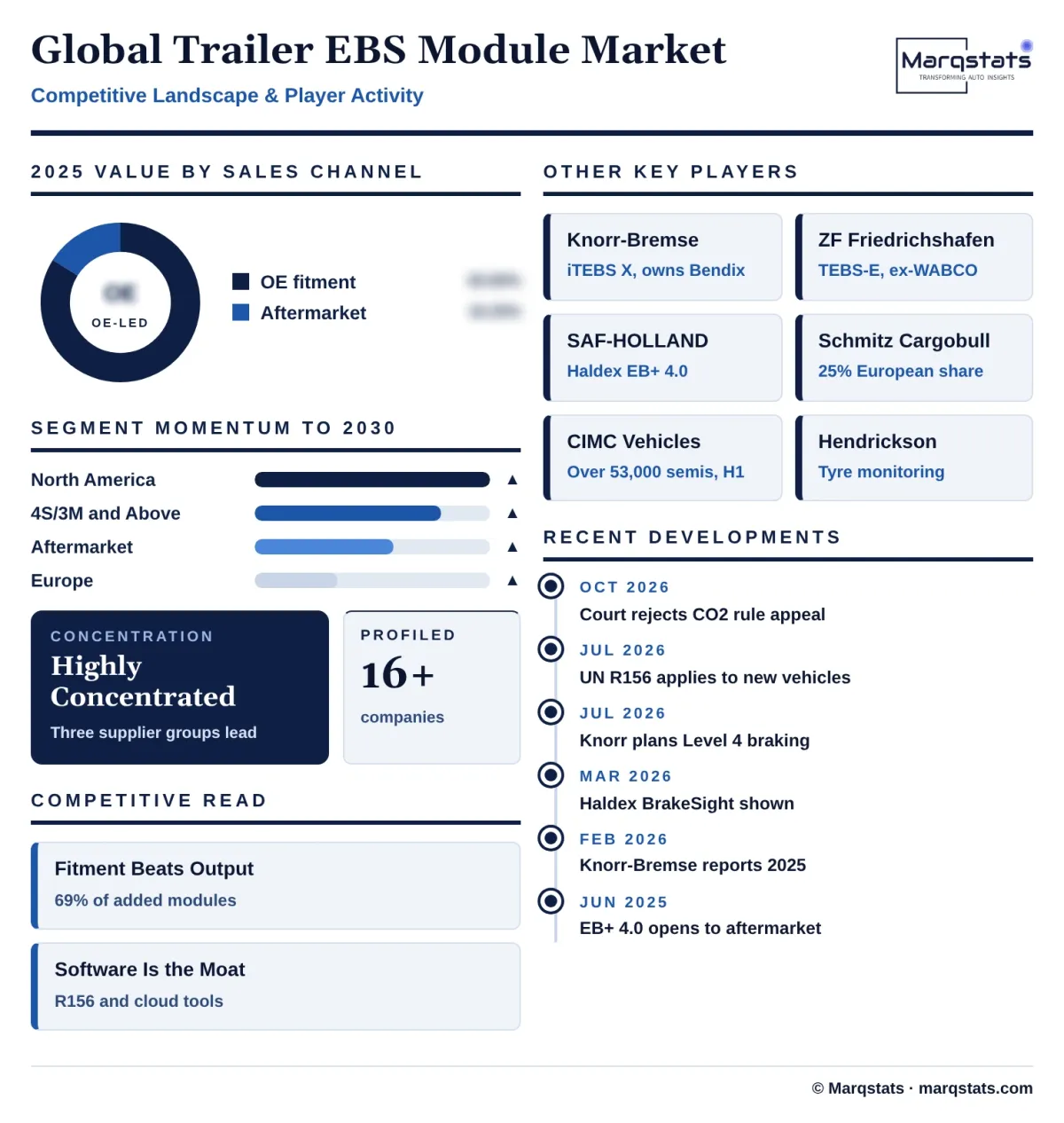
Factory fitment accounts for 83.80% of 2025 value, USD 123.27 million and about 210,750 modules, rising to USD 192.52 million and 323,340 modules by 2030, a 9.33% CAGR. Trailer makers specify the module at the design stage and parameterise it on the line, so supplier choice follows long supply agreements with makers such as Schmitz Cargobull, Krone, Wielton, Wabash, Great Dane, Hyundai Translead and CIMC Vehicles.
Replacement and retrofit sales account for 16.20% of 2025 value, USD 23.83 million and about 35,000 modules, and grow at 10.68% a year to USD 39.58 million by 2030. Demand comes from damaged or failed modules in an installed base Marqstats estimates at 1.75 million units, and from fleets that replace anti-lock systems with EBS to gain brake data. Haldex released its EB+ 4.0 platform to the aftermarket on 12 June 2025.
Two-sensor, two-modulator systems account for 24.00% of 2025 value, USD 35.30 million, and reach USD 46.42 million by 2030, a 5.63% CAGR, while their share falls to 20.00%. They suit single and tandem axle trailers and cost-sensitive regions, and are the entry system in markets where fitment is rising from a low base, such as India and China.
Four-sensor, two-modulator systems are the largest group at 55.00% of 2025 value, USD 80.91 million, rising to USD 125.33 million by 2030, a 9.15% CAGR. They are the standard layout for tri-axle semi-trailers in Europe, with sensors on two axles and one modulator for each side, and they carry the stability function that European and Australian rules require.
Systems with three or more modulators, or master and slave units, account for 21.00% of 2025 value, USD 30.89 million, and grow fastest at 14.33% a year to USD 60.35 million and 26.00% of the market by 2030. Road trains, B-doubles, low-loaders and liquid tankers need the extra sensors and valves, and Haldex EB+ 4.0 scales to eight sensors and four modulators.
Dry freight vans and curtainsiders account for 39.00% of 2025 value, USD 57.37 million, and reach USD 85.88 million by 2030, a 8.40% CAGR. They are the highest-volume trailer type in Europe and North America and the main platform for 4S/2M systems.
Refrigerated trailers account for 18.00% of 2025 value, USD 26.48 million, rising to USD 44.10 million by 2030, a 10.74% CAGR. Cold-chain fleets already buy telematics, so a TEBS module that shares data over the CAN bus is a natural fit.
Tank and bulk trailers account for 13.00% of 2025 value, USD 19.12 million, and grow at 11.97% a year to USD 33.65 million. Liquid cargo raises the roll-over risk, so tank trailers use the stability function and more modulators than dry freight trailers.
Tipper and vocational trailers account for 14.00% of 2025 value, USD 20.59 million, rising to USD 31.33 million by 2030, a 8.76% CAGR. Many of these trailers keep anti-lock-only systems, so fitment depends on fleet specification rather than on rules.
Flatbed, low-loader and chassis trailers account for 16.00% of 2025 value, USD 23.54 million, and reach USD 37.14 million by 2030, a 9.55% CAGR. Low-loaders raise content per trailer through multi-axle layouts, while container chassis in ports and rail yards favour rugged 2S/2M systems.
By Geography
Europe
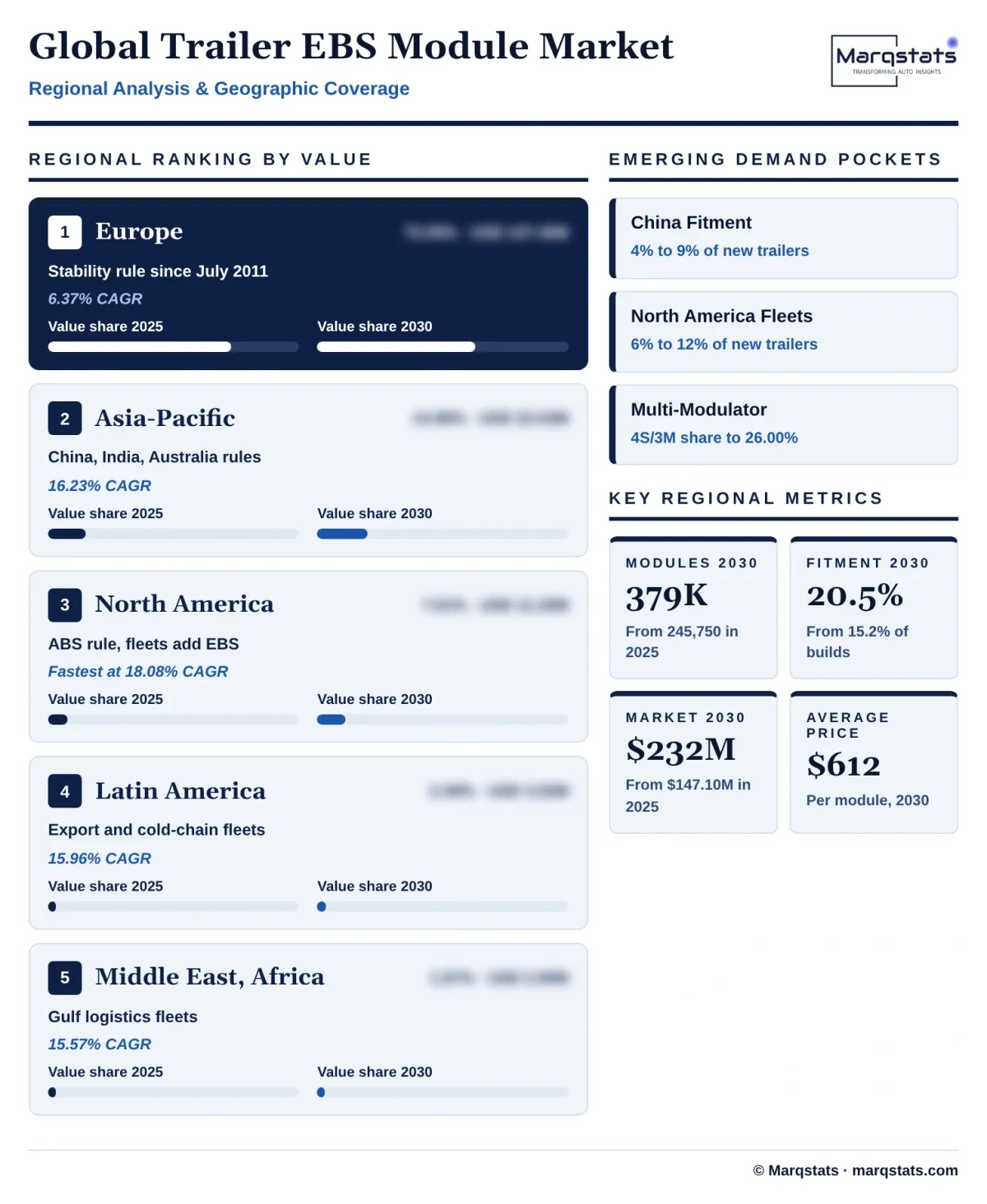
Europe accounts for 73.05% of 2025 value, USD 107.45 million and about 172,300 modules, rising to USD 146.29 million by 2030, a 6.37% CAGR, while its share falls to 63.03%. Marqstats estimates 190,000 heavy trailers built in 2025 across the European Union, the United Kingdom, EFTA states and Türkiye and a TEBS fitment rate of about 77%, because the stability function required on new air-suspended trailers since July 2011 can be met with an EBS module or with anti-lock systems that add roll stability, and tippers and some drawbar trailers keep the simpler system. Schmitz Cargobull produced 42,353 trailers in its 2024/25 financial year, down 6.5%, and states a 25% share of a declining European market, which points to a market of about 170,000 units for its reference range. Poland recorded 19,900 new trailers and semi-trailers in 2025, up 12.2%. Value growth comes from content, not volume, as UN Regulation No. 156 makes secure software updates a requirement for all new complete vehicles from 7 July 2026.
North America
North America accounts for 7.61% of 2025 value, USD 11.20 million and about 14,600 modules, and grows fastest, at 18.08% a year, to USD 25.71 million and 11.08% of the market by 2030. Marqstats estimates about 215,000 heavy trailers built in 2025 in the United States, Canada and Mexico, after output fell sharply at Hyundai Translead, Great Dane and Wabash. FMVSS No. 121 requires anti-lock brakes on air-braked trailers but FMVSS No. 136 requires electronic stability control only on heavy truck tractors, so a tractor can detect instability and still send its demand to the trailer as air pressure. Fitment is estimated at 6% in 2025 and 12% in 2030 as large truckload, refrigerated and tank fleets adopt EBS for stability, brake data and insurance terms. SAF-HOLLAND expects subdued trailer conditions in 2026, so Marqstats places the fitment gain in the later years of the forecast.
Asia-Pacific
Asia-Pacific accounts for 14.98% of 2025 value, USD 22.03 million and about 47,350 modules, and grows at 16.23% a year to USD 46.74 million and 20.14% of the market by 2030. China is the largest source of volume: Marqstats estimates about 650,000 heavy trailers built in 2025 and fitment of about 4%, rising to 9%, with CIMC Vehicles reporting more than 53,000 semi-trailers manufactured and sold worldwide in the first half of 2025 and domestic sales up 12%. Australia and New Zealand build about 9,000 heavy trailers and fit about 85%, because ADR 38/05 requires roll-over control and anti-lock braking on new heavy trailers, applying to new models from 1 July 2019 and to all new vehicles from 1 November 2019. India builds about 110,000 heavy trailers with fitment near 3%, and SAF-HOLLAND names India as the main driver of its Asia-Pacific outlook for 2026.
Latin America
Latin America accounts for 2.39% of 2025 value, USD 3.52 million and about 6,100 modules, rising to USD 7.38 million by 2030, a 15.96% CAGR. Marqstats estimates about 80,000 air-braked heavy trailers built in 2025, mainly in Brazil and Argentina, and Marqstats expects the fitment of about 6% to be concentrated in refrigerated, tank and export-oriented fleets that follow European or North American specifications.
Middle East and Africa
The Middle East and Africa account for 1.97% of 2025 value, USD 2.90 million and about 5,400 modules, and grow at 15.57% a year to USD 5.98 million by 2030. Marqstats estimates about 60,000 heavy trailers built in 2025, with fitment of about 7% concentrated in Gulf Cooperation Council logistics fleets, port operators and international tank and refrigerated carriers. Growth depends on fleet specification rather than on rules.
How Competition Is Evolving
The trailer EBS module market is concentrated in three supplier groups. Knorr-Bremse AG designs the iTEBS X range and owns Bendix Commercial Vehicle Systems, which serves North America. ZF Friedrichshafen AG owns the former WABCO trailer business, whose TEBS-E modulator is sold through parts marketplaces. SAF-HOLLAND SE owns Haldex AB and its EB+ range, and sells it alongside axles and suspensions. Marqstats judges that these three groups supply the large majority of modules fitted in Europe, North America and Australia, while domestic brake makers supply much of the lower-priced volume in China.
Marqstats describes competition by layer, since suppliers report the module inside wider brake and truck divisions. Factory fitment, at 83.80% of 2025 value, is won through multi-year agreements with trailer makers, which usually standardise one platform across their models. The aftermarket, at 16.20%, is won through parts distribution, workshop tools and the ability to supply a module already configured for the trailer.
The group results show how small the module is inside each business. Knorr-Bremse reported 2025 group revenue of EUR 7,817.3 million, with its Truck Division at EUR 3,503.5 million, down 8.8%. SAF-HOLLAND reported group sales of EUR 1,734.4 million, down 7.6%, with aftermarket at 39.7% of sales. ZF Group reported 2025 sales of EUR 38.8 billion. None of the three reports the trailer module separately.
Competition will be decided by software and data rather than by valve design. Suppliers differ on cybersecurity readiness for UN Regulation No. 156, on cloud configuration tools, on the number of sensors and modulators they support, and on how easily the module passes data to telematics platforms such as the one from Samsara. Trailer makers value one platform that covers every model, a service network in each region, and a clear path to Level 4 redundancy.
New entrants face high barriers. A module must pass type approval under UN Regulation No. 13 and its stability annex, be built to a functional safety standard, support the ISO 11992 interface and meet the software update rule, and trailer makers rarely switch platform within a model cycle. Entrants therefore focus on sensors and monitoring devices that connect to existing modules over the CAN bus, such as wear sensors and tyre monitors from Hendrickson.
Companies Covered
Companies covered in the report include:
Recent Market Activity
Table of Contents
Coverage & Segmentation
The study covers the global trailer electronic braking system module market, with 2025 as the base year and 2026 – 2030 as the forecast period. Values are in US dollars at the module level: the electronic control unit, the electro-pneumatic modulator block and the wheel speed and pressure sensing set, sold as original equipment to trailer makers and as replacement modules through aftermarket channels. The market is segmented by sales channel, system configuration, trailer type and region.
Tractor-unit braking systems, anti-lock-only valves and controllers, relay and trailer control valves sold on their own, brake actuators and air disc brakes, axles and suspensions, telematics hardware and trailer bodies are excluded. Trailer modules fitted to tipper and container chassis trailers are components of those trailers and are not added to the Marqstats Tipper Trailer or Skeletal and Container Chassis Trailer reports. Euro values use EUR 1 = USD 1.13 and splits and the forecast are Marqstats estimates.