Market Snapshot
Middle bar: base-year value × (1 + CAGR), rounded to two decimals. This is a calculated illustration, not a separately researched annual estimate.
The global motorcycle tire pressure monitoring system market size is estimated at USD 81.50 million in 2025 and is projected to reach USD 127.70 million by 2030, growing at a CAGR of 9.40% over 2026 – 2030. Marqstats estimates about 6.63 million motorcycle tyre pressure sensors were shipped in 2025, rising to about 11.83 million in 2030, a 12.28% annual rate, as the average value per sensor falls.
Marqstats defines the market as the wholesale value of tyre pressure monitoring hardware for powered two-wheelers: sensors and receiver integration fitted by motorcycle makers on the production line, original-equipment replacement sensors sold through dealer networks, and aftermarket kits with valve-cap or valve-stem sensors and a display or smartphone app. Car, truck and trailer TPMS, bicycle and e-bike pressure gauges, manual gauges, inflators, sealants and smart tyres with embedded sensors are excluded.
OEM line-fit accounts for an estimated 43.80% of 2025 value and aftermarket kits for 43.19%, with original-equipment replacement sensors making up the remaining 13.01%. Internal valve-stem sensors account for 69.82% of value and bikes above 500cc for 61.72%. Europe accounts for 39.26% of 2025 value and Asia-Pacific grows fastest. The study segments the market by sales channel, sensor type, vehicle class and region.
Key Takeaways
Market Overview & Analysis
Report Summary
Marqstats sizes the motorcycle tire pressure monitoring system market as the wholesale value of tyre pressure sensing hardware sold for powered two-wheelers in 2025. The market was worth an estimated USD 81.50 million, made up of USD 35.70 million of OEM line-fit, USD 10.60 million of original-equipment replacement sensors and USD 35.20 million of aftermarket kits. Marqstats estimates about 6.63 million sensors were shipped across the three channels.
Tyre pressure matters more on a motorcycle than on a car. A motorcycle rides on two small contact patches, so an under-inflated tyre changes steering, braking distance and cornering grip, and a sudden loss of pressure at speed can cause a crash. Riders often check pressures less often than they should because checking requires a gauge, a stop and access to valves between brake discs and spokes. A TPMS sensor reports pressure and usually temperature for each wheel and warns the rider when pressure drops.
Two hardware designs are used. Internal sensors are mounted on the valve stem or the rim inside a tubeless tyre, protected from weather, theft and impact, and are the standard choice for OEM fitment. They are fitted when the tyre is changed, and their battery normally lasts five to ten years. External sensors replace the valve cap and can be fitted by the rider in minutes, but they add mass outside the wheel, can be stolen and suit lower riding speeds better. Most aftermarket kits use external sensors paired with a handlebar display or a smartphone app.
Motorcycles have no direct equivalent of car indirect TPMS. Car systems that infer pressure loss from wheel speed and ABS signals, used on tens of millions of cars, depend on comparing four wheels and on suspension and tyre behaviour that motorcycles do not share. Every motorcycle system in production in 2025 therefore uses direct pressure sensors, and Marqstats includes no indirect system revenue.
TPMS sits in the option list of most premium motorcycles. BMW Motorrad offers tyre pressure control on its boxer and touring range, which accounted for its best-selling models in 2025, the R 1300 GS Adventure with 33,570 deliveries and the R 1300 GS with 32,555. Ducati fits TPMS as standard on the Multistrada V4 S Grand Tour, deliveries of which began in February 2024, and KTM, Triumph, Harley-Davidson, Honda and other makers offer it on large touring, adventure and sport-touring models.
Regulation explains why the market is small. US FMVSS No. 138 requires TPMS on passenger cars, multipurpose vehicles, trucks and buses up to 4,536 kg, and UN Regulation No. 141, applied through the EU General Safety Regulation, covers M and N category vehicles. China GB 26149-2017 applies to passenger cars and India requires TPMS on new passenger cars. None covers L-category motorcycles, so motorcycle TPMS is sold only where makers see a premium feature or riders want it.
The market grew from an estimated USD 52.00 million in 2021 to USD 58.50 million in 2022, USD 66.00 million in 2023 and USD 74.00 million in 2024, as adventure bike sales grew and BMW Motorrad, KTM and Ducati widened TPMS availability. Aftermarket kits grew strongly as Bluetooth and phone-app kits replaced older kits with dedicated displays.
Prices vary widely by channel. Marqstats estimates an OEM sensor sold to a motorcycle maker costs about USD 15 in 2025, plus about USD 10 per bike for receiver hardware, software and dashboard integration. A dealer replacement sensor sells to the workshop at about USD 24, and an aftermarket kit with two sensors and a display or app wholesales at about USD 16 for external valve-cap kits and more for internal kits. Retail prices to riders are roughly twice wholesale.
Global Motorcycle Tire Pressure Monitoring System Market Size and Forecast
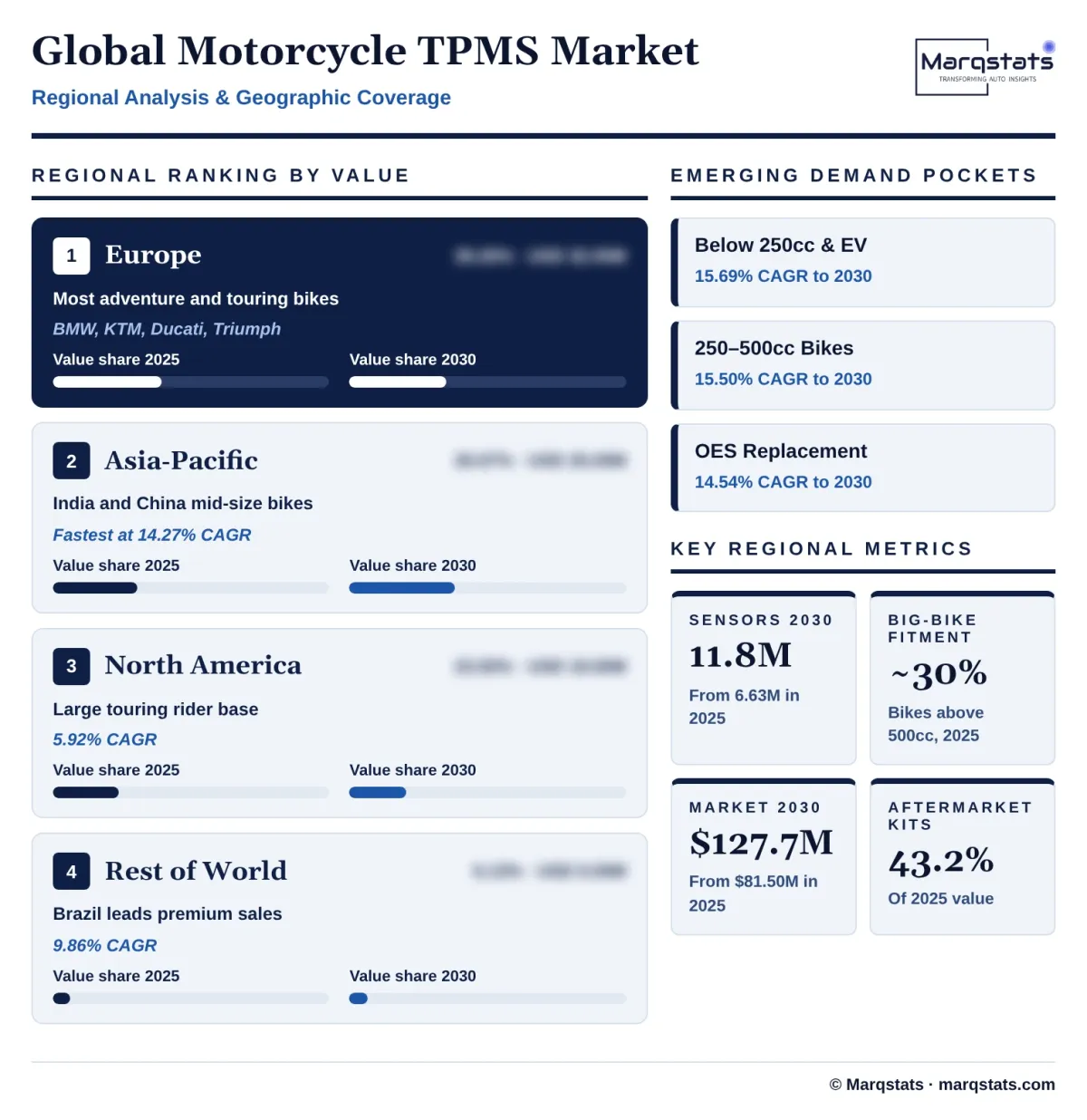
The global motorcycle TPMS market grows from USD 81.50 million in 2025 to USD 127.70 million in 2030, a CAGR of 9.40%. Marqstats expects the market to reach about USD 87.90 million in 2026, USD 95.60 million in 2027, USD 105.00 million in 2028 and USD 115.80 million in 2029.
Volume grows faster than value. Sensor shipments rise from about 6.63 million in 2025 to 11.83 million in 2030, a 12.28% annual rate, because the wholesale price of an OEM sensor falls from about USD 15 to USD 11 and the cost of receiver integration per bike from about USD 10 to USD 7 as Bluetooth sensors replace dedicated radio receivers.
OEM line-fit grows from USD 35.70 million to USD 60.60 million, an 11.16% CAGR. Marqstats estimates factory-fitted bikes rise from about 0.89 million in 2025 to 2.09 million in 2030: about 0.92 million bikes above 500cc at 45% fitment, 0.65 million mid-size bikes at 12% and 0.52 million commuter and electric two-wheelers at about 0.9%.
Original-equipment replacement grows from USD 10.60 million to USD 20.90 million, a 14.54% CAGR. The installed base of TPMS-equipped bikes rises from about 5.5 million to about 9.5 million, carrying about 19 million sensors by 2030, and the annual replacement rate rises from about 4% to 5.5% of sensors as early fleets age.
Aftermarket kits grow from USD 35.20 million to USD 46.20 million, a 5.59% CAGR, from about 2.2 million to 3.3 million kits a year, while the average wholesale kit price falls from about USD 16 to USD 14. Aftermarket growth is slower than OEM growth because each new factory-fitted bike removes a potential kit buyer.
The channel mix shifts toward the factory. OEM line-fit rises from 43.80% to 47.45% of value and original-equipment replacement from 13.01% to 16.37%, while aftermarket kits fall from 43.19% to 36.18%. Internal sensors rise from 69.82% to 76.51% of value. Bikes above 500cc fall from 61.72% to 49.60% of value as mid-size and electric bikes grow, and Asia-Pacific rises from 30.67% to 38.14% to overtake Europe.
Marqstats tracks four indicators to monitor the forecast: factory fitment rates on new mid-size models, launches of Bluetooth sensors and their wholesale price, premium motorcycle sales in Europe and the United States, and electric scooter dashboard and app features in India and China.
Market Dynamics
Key Drivers
Five forces are lifting tyre pressure monitoring from a touring-bike option to a wider motorcycle feature.
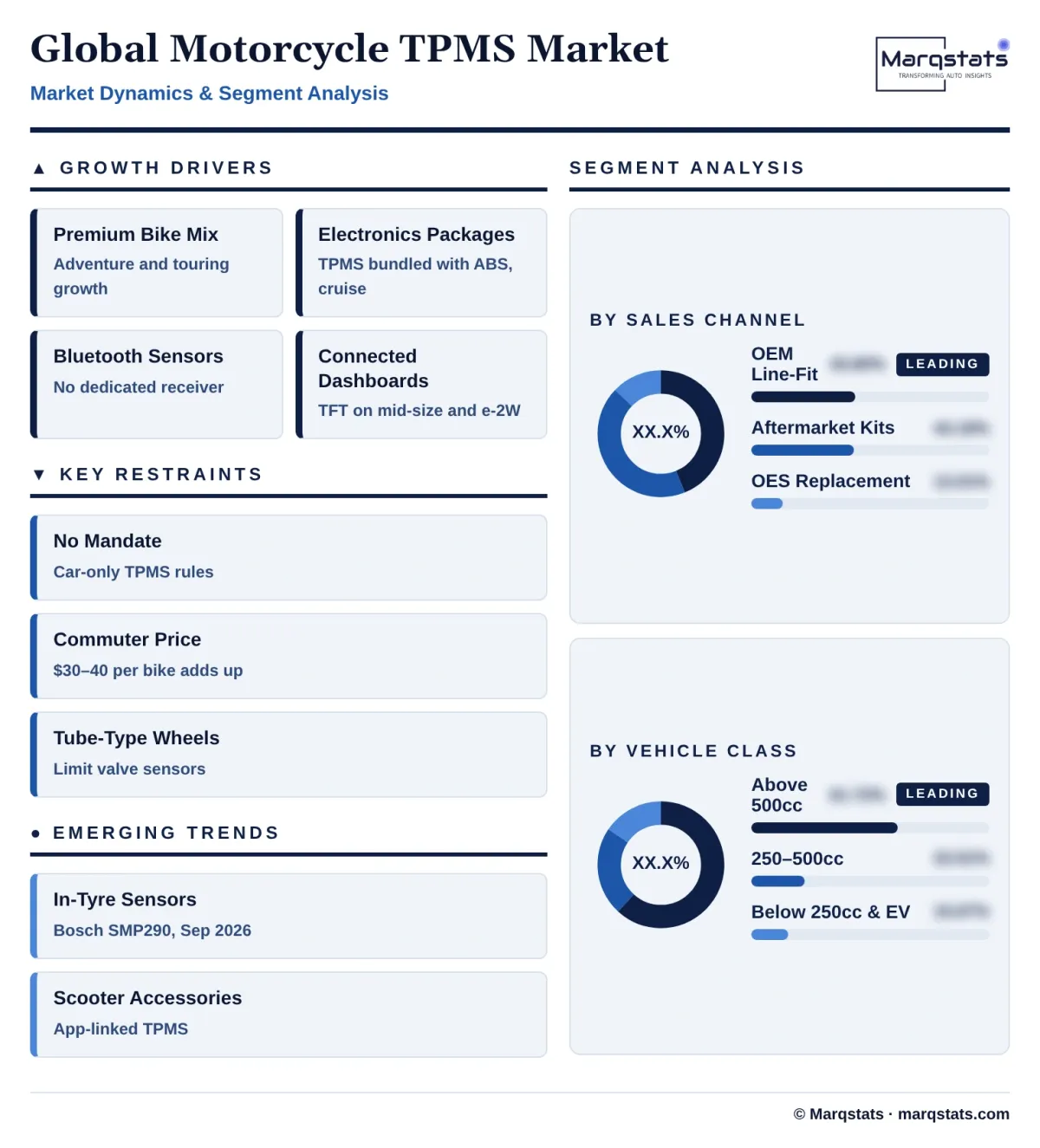
- Premium motorcycle mix. Adventure, touring and sport-touring bikes, the categories most likely to carry TPMS, take a growing share of sales in Europe, and sport and small adventure bikes grew in the United States in 2025 while touring and cruiser sales fell.
- Electronics packages on big bikes. Makers bundle TPMS with cornering ABS, traction control, cruise control and connectivity in comfort or touring packages, so every rider who buys a package also buys pressure monitoring.
- Cheaper Bluetooth sensors. Single-chip sensors such as the Bosch SMP290 combine sensing, processing and a Bluetooth Low Energy radio, letting the bike dashboard or a phone receive data without a separate receiver.
- Connected dashboards on mid-size and electric bikes. TFT dashboards with smartphone connectivity on mid-size motorcycles and premium electric scooters make TPMS a software feature that needs only two sensors.
- Rider safety awareness. Rider training, motorcycle media and tyre makers emphasise pressure checks, and affordable aftermarket kits give owners of older bikes the same warning without buying a new motorcycle.
Key Restraints
Four constraints keep motorcycle TPMS a fraction of the car TPMS business.
- No mandate. US FMVSS No. 138, UN Regulation No. 141 and the Chinese and Indian TPMS rules apply to cars and commercial vehicles, so motorcycle fitment depends entirely on maker and rider choice.
- Price sensitivity in commuter segments. Most of the roughly 60 million two-wheelers sold each year are commuter motorcycles and scooters where an added USD 30 to 40 of sensor and integration cost is a large share of the bike price.
- Tube-type and spoked wheels. Many commuter and off-road motorcycles use inner tubes or spoked rims that do not suit valve-stem sensors, limiting fitment to cast or tubeless spoked wheels.
- Battery life and service. Internal sensors need the tyre removed to replace a battery or sensor, and external sensors can be stolen or damaged, which deters some riders.
Key Trends
Four shifts are changing how motorcycle tyre pressure sensors are built, fitted and sold.
- Bluetooth replaces dedicated radios. New sensors transmit over Bluetooth Low Energy to the bike dashboard or a phone, replacing 315 MHz and 433 MHz receivers and making one sensor usable across several brands.
- In-tyre sensors. Bosch made the SMP290 available for mounting inside the tyre in September 2026, moving sensing away from the valve and opening the way for tyre condition data beyond pressure.
- Factory accessories for scooters. Electric scooter makers sell TPMS as an accessory linked to the scooter dashboard and app, a model Ather Energy introduced in India at Rs 4,999.
- OE replacement sensors in the aftermarket. Schrader, a Sensata Technologies brand, sells original-equipment replacement motorcycle sensors for Kawasaki and Indian models through independent workshops.
Strategic Implications
- For motorcycle makers, TPMS is a low-cost feature that lifts package take-rates. A two-sensor Bluetooth system linked to an existing TFT dashboard costs about USD 30 to 40 at 2025 prices and supports premium pricing on mid-size models.
- For sensor suppliers, the growth path is mid-size and electric bikes in Asia. Suppliers that can deliver small, light Bluetooth sensors at about USD 10 to 11 and support Indian and Chinese makers locally will win the largest volume gains.
- For aftermarket brands, app quality and theft resistance decide sales. Riders choose kits that pair quickly with phones and navigation units, keep batteries running for years and resist theft.
- For dealers and tyre shops, replacement sensors are a growing service line. A rising installed base of factory-fitted sensors means more battery and sensor replacements at tyre changes.
- For regulators, motorcycle TPMS remains voluntary. A future requirement, even for large motorcycles only, would sharply raise OEM fitment, but no such rule is in force or proposed in a major market.
- For tyre makers, pressure data is the first step toward connected tyres. Sensors that move inside the tyre can report temperature, load and wear as well as pressure, a link between motorcycle TPMS and smart tyre development.
- For electric two-wheeler makers, TPMS improves range as well as safety. Correct tyre pressure reduces rolling resistance, so app-linked pressure alerts help riders get the range shown on the dashboard, a selling point for premium electric scooters in India and China.
Market Segmentation
Sensors and receiver integration fitted by motorcycle makers on the production line account for 43.80% of 2025 value, USD 35.70 million, covering about 1.79 million sensors on 0.89 million bikes. The segment grows at 11.16% a year to USD 60.60 million and 47.45% of 2030 value as fitment spreads from large touring and adventure bikes to mid-size models.
Kits sold to riders through motorcycle accessory retailers, online marketplaces and tyre shops account for 43.19% of 2025 value, USD 35.20 million and about 2.2 million kits. The segment grows at 5.59% a year to USD 46.20 million, and its share falls to 36.18% as more bikes leave the factory with TPMS.
Original-equipment replacement sensors sold through motorcycle dealers and workshops account for 13.01% of 2025 value, USD 10.60 million and about 0.44 million sensors. The segment grows fastest, at 14.54% a year, to USD 20.90 million as the installed base of factory-fitted sensors ages.
Sensors mounted on the valve stem or rim inside the tyre account for 69.82% of 2025 value, USD 56.90 million, including all OEM and replacement sensors and USD 10.60 million of aftermarket internal kits. The segment grows at 11.42% a year to USD 97.70 million and 76.51% of 2030 value.
Sensors that replace the valve cap, sold almost entirely in aftermarket kits, account for 30.18% of 2025 value, USD 24.60 million, and grow at 4.05% a year to USD 30.00 million. They are cheap and easy to fit but are exposed to theft and damage.
Bikes above 500cc, including large adventure, touring, sport-touring and cruiser models, account for 61.72% of 2025 value, USD 50.30 million, and grow at 4.72% a year to USD 63.34 million. Fitment on this class is already about 30% at the factory.
Mid-size bikes account for 22.61% of 2025 value, USD 18.43 million, and grow at 15.50% a year to USD 37.89 million and 29.67% of 2030 value, as Indian, Chinese and European makers add TPMS to mid-size adventure and touring models with TFT dashboards.
Commuter motorcycles, scooters and electric two-wheelers account for 15.67% of 2025 value, USD 12.77 million, and grow fastest, at 15.69% a year, to USD 26.47 million. Premium electric scooters with app-linked dashboards lead adoption.
By Geography
Europe
Europe is the largest market, with 39.26% of 2025 value, USD 32.00 million, rising to USD 45.00 million by 2030, a 7.06% CAGR, while its share falls to 35.24%. Europe has the highest share of large adventure and touring bikes, and BMW Motorrad, KTM, Ducati and Triumph offer TPMS across much of their large-bike ranges. Registrations of motorcycles in the five largest European markets fell 12.9% in 2025 to 1,002,848, with Italy at 331,634 and Spain up 8.3% to 242,580, while Germany fell 35.7%.
Asia-Pacific
Asia-Pacific accounts for 30.67% of 2025 value, USD 25.00 million, and grows fastest, at 14.27% a year, to USD 48.70 million and 38.14% of the market by 2030, becoming the largest region. China produced 22.11 million motorcycles and sold 21.97 million in 2025, including 13.37 million exports, India sold more than 20 million two-wheelers, and Japan and Australia have large premium bike fleets. Growth comes from mid-size Indian and Chinese motorcycles, premium electric scooters and Asian aftermarket kit makers that also supply riders worldwide.
North America
North America accounts for 23.93% of 2025 value, USD 19.50 million, and grows at 5.92% a year to USD 26.00 million. New motorcycle and scooter sales in the United States fell 7.6% in 2025, with touring down 13% and cruisers down 6%, while sport bikes rose 13% and adventure bikes under 600cc rose 10%. Harley-Davidson retail sales in North America fell 13% to 89,132 motorcycles. A large touring and adventure rider base keeps aftermarket kit sales high.
Rest of the World
Latin America, the Middle East and Africa account for 6.13% of 2025 value, USD 5.00 million, and grow at 9.86% a year to USD 8.00 million. Brazil is the largest market, where BMW Motorrad delivered 14,488 motorcycles in 2025, and most of the rest of the region buys commuter motorcycles with tube-type tyres and little TPMS fitment.
How Competition Is Evolving
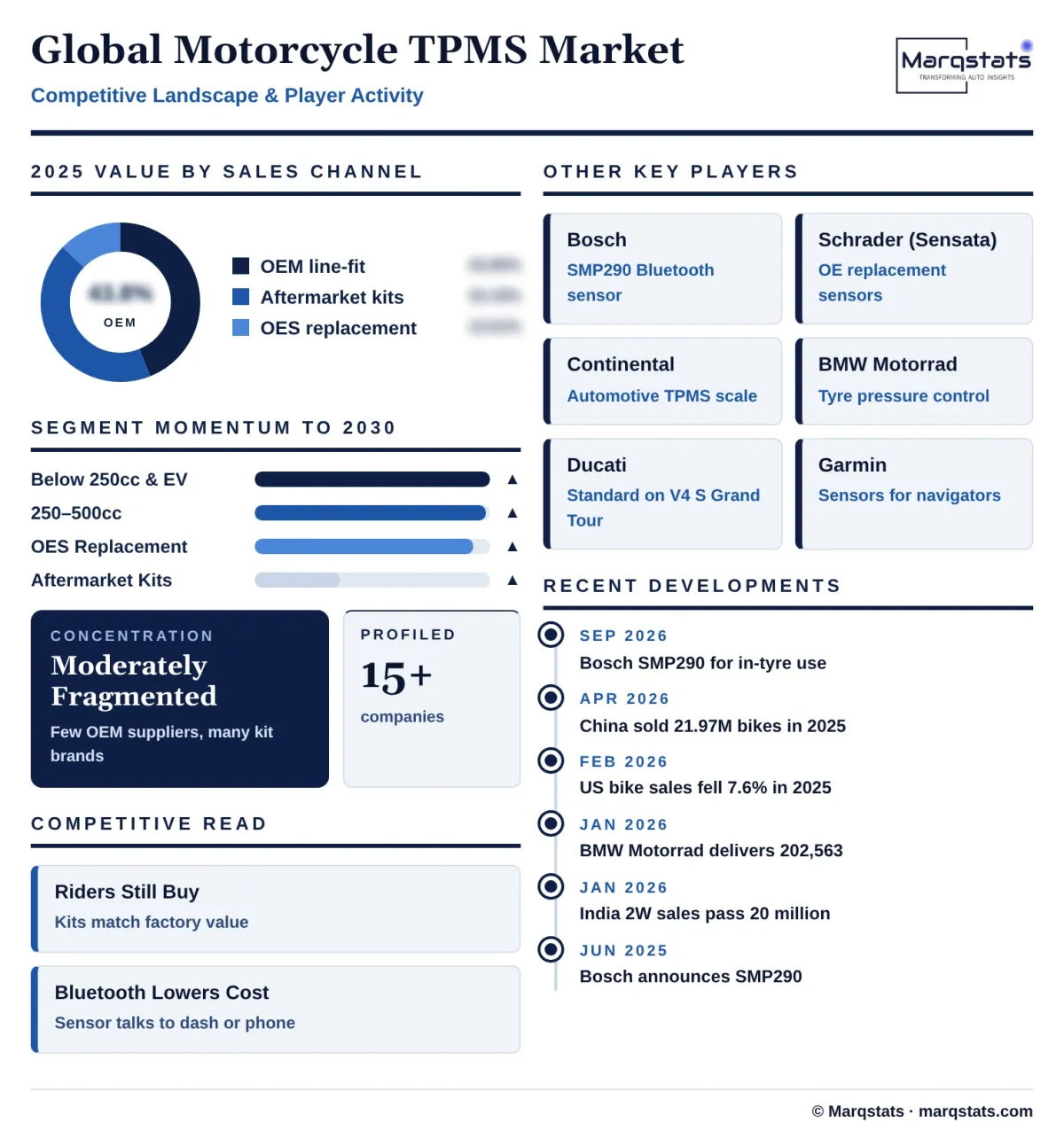
The motorcycle TPMS market is moderately fragmented. In OEM line-fit, a small number of automotive sensor suppliers supply motorcycle makers, while the aftermarket includes dozens of kit brands, many of them based in China and Taiwan and sold online worldwide.
Motorcycle makers decide what is fitted. BMW Motorrad, KTM, Ducati, Triumph, Harley-Davidson, Honda and other makers specify sensors and integrate warnings into their dashboards, and they sell replacement sensors through their own parts networks.
Automotive sensor suppliers bring scale. Bosch, Sensata Technologies through its Schrader brand, and Continental make car TPMS sensors in tens of millions of units, and Bosch is applying its SMP290 Bluetooth sensor to two-wheelers through work with Indian TPMS companies.
Aftermarket competition is on price, app quality and compatibility. Kit brands sell external valve-cap kits and internal kits with handlebar displays or phone apps, and navigation makers such as Garmin sell sensors that display on their motorcycle navigators.
Supply is moving toward Bluetooth and Asia. Bosch announced the SMP290 in June 2025, made it available for in-tyre use in September 2026 and appointed Millennium Semiconductors to distribute it in India, while Indian electric scooter makers such as Ather Energy sell TPMS as an app-linked accessory. Marqstats expects mid-size Indian and Chinese motorcycles to be the main new OEM fitment opportunity to 2030.
Companies Covered
Companies covered in the report include:
Recent Market Activity
Table of Contents
Coverage & Segmentation
The study covers the global motorcycle tire pressure monitoring system market, with 2025 as the base year, 2021 – 2025 as the historical period and 2026 – 2030 as the forecast period. Values are in US dollars at wholesale prices, and volumes are sensors shipped. The market is segmented by sales channel, sensor type, vehicle class and region. Prices quoted in other currencies are converted at fixed 2025 average rates of INR 87.00, EUR 0.885 and CNY 7.18 per US dollar.
Car, light commercial vehicle, truck, bus and trailer TPMS, covered in the Marqstats Asia-Pacific automotive TPMS report, are excluded, as are bicycle and e-bike pressure sensors, three-wheelers, manual gauges, inflators, sealants and smart tyres with embedded sensors. Segment and regional splits are Marqstats estimates built on two-wheeler sales and registration data, motorcycle maker disclosures, supplier announcements and price benchmarks.