Market Snapshot
Middle bar: base-year value × (1 + CAGR), rounded to two decimals. This is a calculated illustration, not a separately researched annual estimate.
The global in-cabin ANC microphone market size is estimated at USD 264.60 million in 2025 and is projected to reach USD 734.39 million by 2030, growing at a CAGR of 22.65% over 2026 – 2030. Annual shipments rise from about 41.40 million microphone modules to 127.84 million, a 25.29% annual rate, while the average Tier-1 ex-factory price falls from about USD 6.39 to USD 5.75 per module.
Marqstats defines the market as the Tier-1 ex-factory value of packaged, automotive-grade microphone modules mounted inside the passenger compartment, in the headliner, overhead console, pillars, door trim and seat headrests, that act as error and residual-noise sensors for road noise cancellation, engine order cancellation and headrest sound-zone systems. A module includes the MEMS or electret transducer, its readout chip, protective membrane, housing and connector or bus interface. Chassis-mounted accelerometers, digital signal processors, amplifiers, loudspeakers, software licences and microphones used only for hands-free calls, voice assistants or emergency calls are excluded.
Road noise cancellation systems account for an estimated 56.33% of 2025 value and digital MEMS microphones for 58.00%. China accounts for 42.00% of 2025 value. The study segments the market by system type, microphone technology, mounting location, powertrain and region.
Key Takeaways
Market Overview & Analysis
Report Summary
Marqstats sizes the in-cabin ANC microphone market as the Tier-1 ex-factory value of packaged microphone modules that measure residual noise inside the passenger cabin for active noise control. In 2025 about 9.20 million light vehicles were built with engine order cancellation, road noise cancellation or headrest sound-zone systems. Together they used about 41.40 million cabin error microphones worth an estimated USD 264.60 million at an average price of about USD 6.39 per module.
Active noise control works like noise-cancelling headphones scaled up to a whole cabin. Engine order cancellation tracks engine speed and plays an inverted sound through the car loudspeakers to cancel the low boom of a four-cylinder or cylinder-deactivated engine. Road noise cancellation is harder because tyre and suspension noise is random. Accelerometers on the suspension sense vibration as it enters the body, a digital signal processor calculates an anti-noise signal within about two milliseconds, and microphones near the occupants' heads tell the processor how much noise is left so it can keep adjusting. Hyundai Motor Group, which co-developed the first production road noise system with HARMAN for the Genesis GV80, says the system halves perceived road noise, a reduction of about 3 dB.
The cabin microphones in these systems are different from the microphones used for phone calls and voice assistants. Voice microphones filter out sound below about 100 Hz because rumble spoils speech recognition. Error microphones for noise control must do the opposite. They must respond flatly down to 10 Hz or lower, keep their phase stable across temperature, tolerate door slams and window buffeting above 130 dB sound pressure without clipping, and survive 15 years in a headliner that can reach 105°C in summer sun. Infineon's IM68A130A, launched in June 2023 for automotive active noise control, is an example: a 68 dB(A) signal-to-noise ratio, 130 dB SPL acoustic overload point, 10 Hz low-frequency roll-off and AEC-Q103-003 qualification.
Engine order cancellation was the first large application. Honda, Toyota, General Motors, Ford and Nissan used two to four overhead microphones to quieten engines running on fewer cylinders, often with Bose or in-house software. Road noise cancellation followed from 2019, first on Genesis and Hyundai models with HARMAN HALOsonic and then on German premium cars and Chinese electric vehicles. Headrest systems, which put a pair of microphones and speakers close to each occupant's ears, are the newest layer.
The market grew from about 13.6 million microphones worth USD 98.40 million in 2021 to 24.6 million worth USD 168.20 million in 2023 and 31.9 million worth USD 212.40 million in 2024, driven by electric vehicle growth in China and the spread of road noise systems across Korean, European and Chinese platforms. Marqstats expects about 52.6 million microphones worth USD 330.10 million in 2026.
Light vehicle production sets the ceiling. OICA reports 96.4 million motor vehicles built worldwide in 2025, up 3.9%, including 34.53 million in China, 10.24 million in the United States, 8.41 million in Japan and 6.49 million in India. Marqstats estimates about 92.0 million of these were light vehicles, of which about one in ten had active cabin noise control.
Regulation shapes the market indirectly. No rule requires active noise control, but several rules push carmakers toward it. AEC-Q103-003 sets the qualification tests for automotive MEMS microphones. UN Regulation No. 51.03 tightens exterior drive-by noise limits, so carmakers encapsulate engines and smooth underbodies, which leaves tyre noise as the main sound inside the cabin. Electric vehicles must emit warning sounds at low speed under UN Regulation No. 138, which adds external speakers but does nothing for cabin quietness. EU fleet CO2 targets under Regulation (EU) 2019/631 reward weight savings, which favours active control over heavy passive damping.
The bill of materials for a cabin microphone module is small but specialised. Marqstats estimates the MEMS die and readout chip account for roughly half of a module's ex-factory price, with the remainder in the acoustic membrane, housing, connector, calibration and, for digital nodes, the share of bus interface electronics. The bare MEMS layer is therefore worth about USD 130 million to 140 million in 2025, while system-level value, including processors, accelerometers, software and integration, is several times the microphone market.
Global In-Cabin ANC Microphone Market Size and Forecast
The global in-cabin ANC microphone market grows from USD 264.60 million in 2025 to USD 734.39 million in 2030, a CAGR of 22.65%. Marqstats expects about 66.3 million microphones worth USD 405.80 million in 2027, 82.4 million worth USD 491.50 million in 2028 and 102.8 million worth USD 595.60 million in 2029, before reaching 127.84 million microphones in 2030.
Two multipliers drive volume. The share of light vehicles with active noise control rises from 10.00% of about 92.0 million vehicles in 2025 to about 21% of 101.0 million in 2030, and the number of microphones per equipped vehicle rises from 4.50 to 6.03. Equipped vehicles therefore grow at 18.17% a year but microphones at 25.29%.
System mix explains the rise in microphones per car. Marqstats estimates engine order systems use about 3.0 microphones per vehicle, road noise systems about 6.0 rising to 6.4, and headrest sound-zone systems about 8.0 rising to 9.0. Road noise vehicles rise from about 3.6 million to 13.6 million and headrest vehicles from 0.6 million to 3.0 million, while engine order vehicles fall from 5.0 million to 4.6 million.
Prices fall steadily. The average module price falls from about USD 7.30 in 2021 to USD 6.39 in 2025 and USD 5.75 in 2030. Engine order modules fall from about USD 5.40 to USD 4.70, road noise modules from USD 6.90 to USD 5.80 and headrest modules from USD 7.20 to USD 6.10, as MEMS silicon moves to larger wafer volumes and transceivers are integrated into the microphone node.
Marqstats tracks four indicators to monitor the forecast: road noise cancellation fitment announcements on new electric platforms, the number of microphones specified per cabin, adoption of A²B 2.0 and Ethernet audio networks, and the average contract price for automotive MEMS microphone modules.
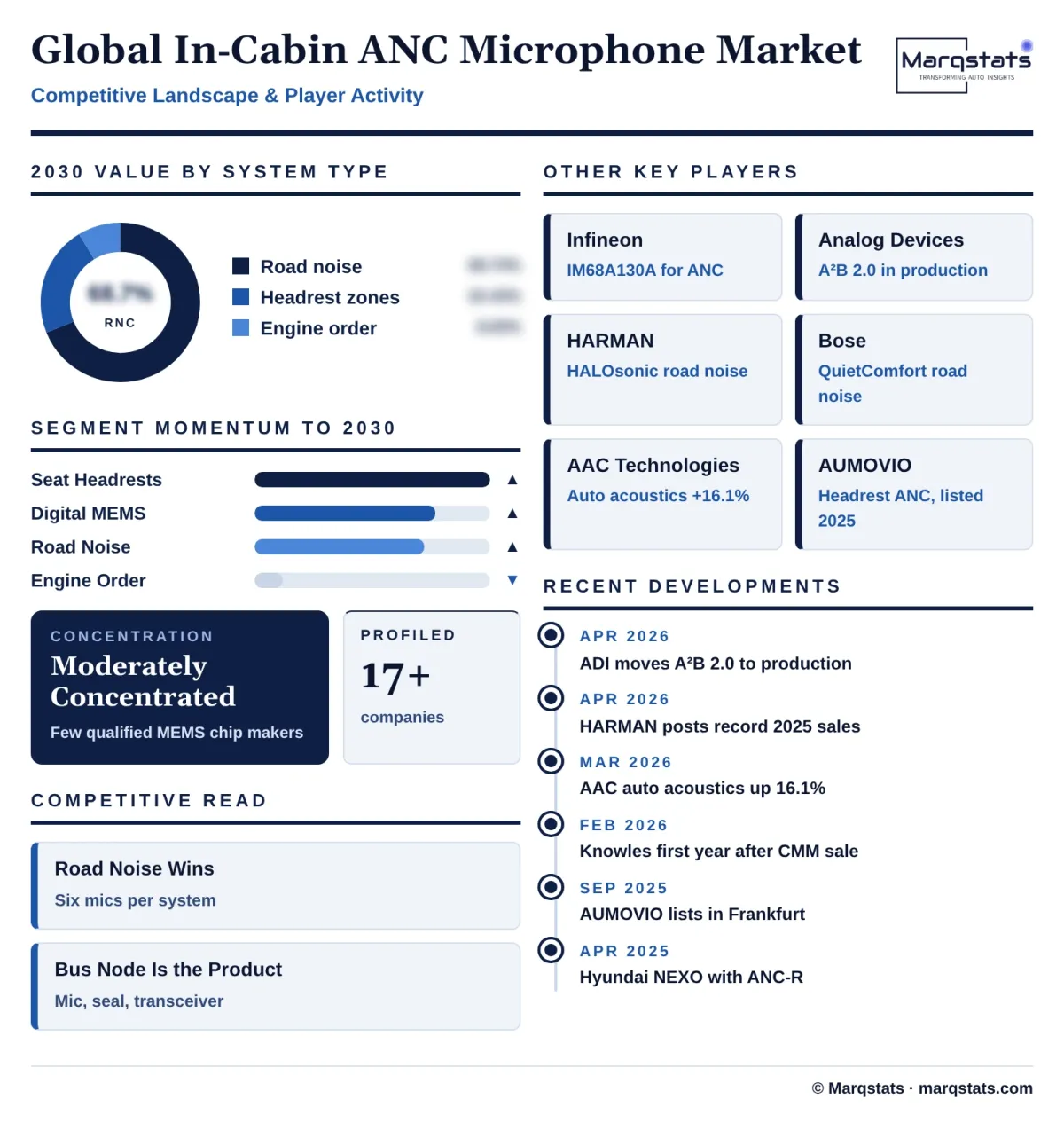
The mix changes over the forecast. Road noise cancellation rises from 56.33% to 68.74% of value, headrest systems from 13.06% to 22.43%, and engine order cancellation falls from 30.61% to 8.83%. Headrest microphones rise from 18.00% to 33.00% of value, digital MEMS from 58.00% to 76.00%, and battery-electric vehicles from 36.00% to 50.00%. China's share rises from 42.00% to 44.00% and the rest of the world from 5.00% to 7.00%, while Europe, North America and Japan and South Korea lose share despite growing above 19% a year.
Market Dynamics
Key Drivers
Five forces are putting more noise-cancelling microphones into each car cabin.
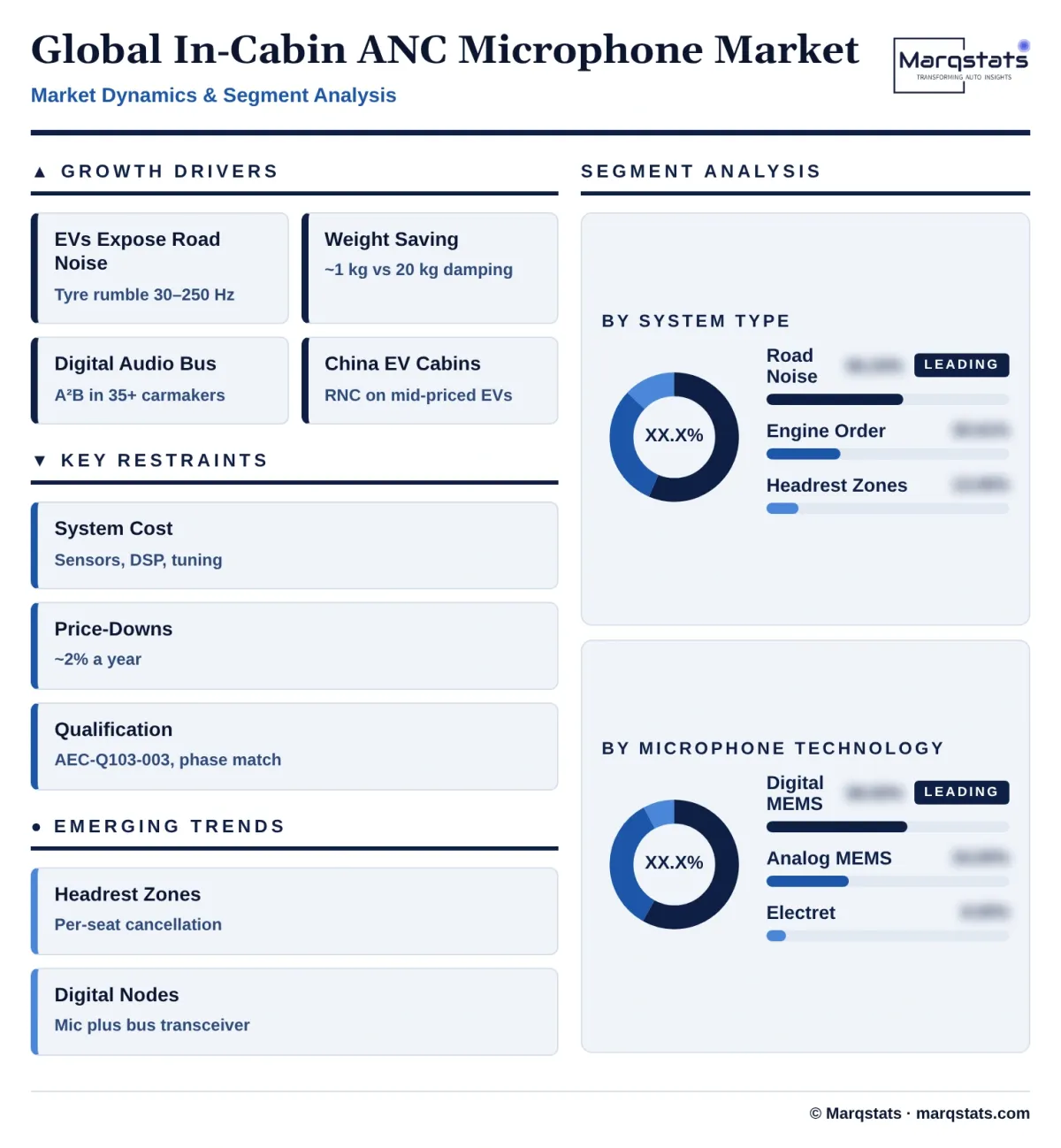
- Electric cars expose road noise. Without an engine to mask it, tyre cavity resonance and suspension rumble between 30 Hz and 250 Hz dominate the cabin of an electric car, and these long wavelengths are hard to absorb with lightweight foam.
- Active control saves weight. Damping low-frequency rumble passively needs heavy bitumen pads, mass-loaded barriers and thicker glass. Marqstats estimates a road noise system with four to eight microphones and four to eight accelerometers on a single bus weighs about a kilogram, against 20 kg or more of passive treatment for a similar effect, which protects driving range.
- Digital audio buses make extra microphones cheap to add. Analog Devices' A²B daisy-chains microphones, accelerometers and speakers over one unshielded twisted pair with deterministic latency, and has been adopted by more than 35 vehicle makers.
- Chinese electric vehicle makers compete on cabin quietness. Brands such as Li Auto, NIO, Xiaomi, Zeekr and BYD's premium lines market quiet, theatre-like cabins and fit road noise cancellation on vehicles priced well below Western luxury cars.
- Shared microphones serve several functions. A high-performance headliner microphone can act as an error sensor for noise cancellation and also feed in-car communication and voice systems, so a single higher-specification part replaces several cheaper ones.
- Rising cabin quality expectations in Asia. Buyers in China, Korea and India compare interior quietness in reviews and showrooms, and carmakers use road noise cancellation to match premium refinement without a premium body structure.
Key Restraints
Four constraints hold back adoption and squeeze supplier margins.
- System cost and tuning effort. A road noise system needs accelerometers, a dedicated processor or processor capacity, software licences and weeks of vehicle-specific calibration, so it remains confined to mid-size and premium vehicles in most markets.
- Price pressure from carmakers. Annual price-downs and Chinese MEMS supply push module prices down by about 2% a year, squeezing Tier-1 assemblers that do not add bus electronics or software.
- Strict qualification. AEC-Q103-003 testing, phase-matching requirements and 15-year durability targets lengthen development cycles and limit the number of qualified suppliers.
- Falling engine order demand. Lower production of petrol engines with cylinder deactivation shrinks the oldest application, which still accounted for 30.61% of value in 2025.
Key Trends
Four shifts are changing how cabin microphones are designed, connected and bought.
- Headrest sound zones. Seat makers and audio suppliers put microphone pairs and small speakers in headrests to cancel noise and deliver separate audio to each occupant.
- From analog lines to digital nodes. Digital MEMS microphones with integrated bus transceivers replace analog microphones wired back to the amplifier.
- Higher-bandwidth audio networks. A²B 2.0, released to production in April 2026, supports up to 119 audio channels in each direction, enough for dense microphone arrays and future cancellation across the whole cabin.
- Software-defined acoustics. Noise control moves from dedicated amplifiers into zonal and cockpit domain controllers, so microphone specifications are set by the vehicle software team rather than the audio supplier alone.
- Calibration moves upstream. Suppliers deliver microphones pre-calibrated for sensitivity and phase so carmakers can install them without matching parts on the line, which reduces tuning time for road noise systems.
Strategic Implications
- For MEMS chip makers, automotive noise control is a higher-value niche than consumer audio. Low-frequency response, phase stability and overload performance across -40°C to 105°C command premium prices and long design-ins.
- For Tier-1 module suppliers, the bus node is the product. Combining the microphone, environmental protection and bus transceiver in one calibrated housing protects margins as bare MEMS prices fall.
- For audio and acoustic software companies, microphone count is the opportunity. Every extra seat zone multiplies the number of error sensors and channels the software must manage.
- For carmakers, active noise control is a weight and range decision as much as a comfort feature. Deciding early to use road noise cancellation lets body engineers remove passive damping and design microphone positions into the headliner and seats.
- For investors, growth is tied to electric vehicle platforms in China, Korea and Europe. Suppliers with design wins on high-volume electric SUVs gain more than those exposed to engine order systems on petrol cars.
- For regulators and consumer test bodies, cabin noise is becoming a measurable quality attribute. If interior noise or speech intelligibility were added to consumer rating protocols, active control would spread faster into lower-priced electric cars and lift microphone counts across the market.
Market Segmentation
Road noise cancellation systems account for 56.33% of 2025 value, USD 149.04 million and about 21.6 million microphones on 3.6 million vehicles, and grow at 27.63% a year to USD 504.83 million and 68.74% of 2030 value. Each system uses about six cabin microphones alongside suspension accelerometers. HARMAN HALOsonic on Hyundai and Genesis models, Bose QuietComfort Road Noise Control and in-house systems at Chinese electric vehicle makers lead the segment.
Engine order cancellation accounts for 30.61% of 2025 value, USD 81.00 million and about 15.0 million microphones on 5.0 million vehicles, and declines at 4.35% a year to USD 64.86 million by 2030. Two to four overhead microphones cancel engine harmonics on petrol and hybrid cars from Honda, Toyota, General Motors, Ford and Nissan.
Headrest and personal sound-zone systems account for 13.06% of 2025 value, USD 34.56 million and about 4.8 million microphones on 0.6 million vehicles, and grow fastest among system types, at 36.65% a year, to USD 164.70 million and 22.43% of 2030 value as premium electric SUVs add per-seat cancellation.
Digital MEMS microphones with PDM, TDM or bus interfaces account for 58.00% of 2025 value, USD 153.47 million, and grow at 29.46% a year to USD 558.14 million and 76.00% of 2030 value as digital audio networks spread.
Analog MEMS microphones account for 34.00% of 2025 value, USD 89.96 million, and grow at 12.42% a year to USD 161.57 million. They remain in architectures where conversion happens in a nearby zonal module or amplifier, and Infineon's IM68A130A is a reference part.
Electret condenser microphones account for 8.00% of 2025 value, USD 21.17 million, and decline at 7.06% a year to USD 14.68 million as legacy engine order programmes end.
Microphones in the headliner and overhead console account for 68.00% of 2025 value, USD 179.93 million, and grow at 17.12% a year to USD 396.57 million, falling to 54.00% of value as more microphones move into seats.
Headrest microphones account for 18.00% of 2025 value, USD 47.63 million, and grow fastest, at 38.46% a year, to USD 242.35 million and 33.00% of 2030 value.
Microphones in pillars and door trim account for 14.00% of 2025 value, USD 37.04 million, and grow at 20.85% a year to USD 95.47 million, used where rear-seat coverage is needed without headrest integration.
Battery-electric vehicles account for 36.00% of 2025 value, USD 95.26 million, and grow at 30.98% a year to USD 367.19 million and 50.00% of 2030 value, because road noise dominates their cabins.
Plug-in and range-extended hybrids account for 22.00% of 2025 value, USD 58.21 million, and grow at 22.65% a year to USD 161.57 million. They often combine engine order and road noise cancellation to hide the start of the engine.
Petrol, diesel and full hybrid vehicles account for 42.00% of 2025 value, USD 111.13 million, and grow at 13.10% a year to USD 205.63 million, with growth coming from road noise systems on hybrids as engine order demand declines.
By Geography
China
China is the largest market, with 42.00% of 2025 value, USD 111.13 million, rising to USD 323.13 million by 2030, a 23.80% CAGR, and 44.00% of the market. China built 34.53 million vehicles in 2025, including 16.626 million new energy vehicles, and its electric vehicle makers fit road noise cancellation and multi-speaker acoustic systems on mid-priced models. Local acoustic suppliers such as AAC Technologies, whose automotive acoustics revenue rose 16.1% to RMB 4.12 billion in 2025, and Goertek give carmakers low-cost sources of microphones and modules.
Europe
Europe accounts for 20.00% of 2025 value, USD 52.92 million, and grows at 21.40% a year to USD 139.53 million and 19.00% of the market by 2030. German premium brands fit road noise cancellation across electric models, and exterior noise limits under UN Regulation No. 51.03 together with fleet CO2 targets push carmakers to quieten powertrains and cut weight, which exposes tyre noise and favours active control over heavy damping.
North America
North America accounts for 18.00% of 2025 value, USD 47.63 million, and grows at 21.26% a year to USD 124.85 million by 2030. Large pickup and three-row SUV cabins have strong low-frequency modes, engine order cancellation remains common on petrol trucks with cylinder deactivation, and electric pickups and SUVs add road noise systems. The United States built 10.24 million vehicles in 2025.
Japan and South Korea
Japan and South Korea account for 15.00% of 2025 value, USD 39.69 million, and grow at 19.19% a year to USD 95.47 million. Hyundai Motor Group introduced the first production road noise cancellation on the Genesis GV80 and fits it across Genesis models and the all-new NEXO unveiled in April 2025, while Japanese makers use engine order cancellation widely on petrol and hybrid cars. Japan built 8.41 million vehicles in 2025.
Rest of the World
The rest of the world accounts for 5.00% of 2025 value, USD 13.23 million, and grows fastest, at 31.19% a year, to USD 51.41 million and 7.00% of 2030 value. India, which built 6.49 million vehicles in 2025, leads growth as premium SUVs and electric models add cabin noise control, followed by export assembly plants in Mexico, Brazil, Turkey and Thailand.

How Competition Is Evolving
The in-cabin ANC microphone market is moderately concentrated. A handful of MEMS chip makers supply most automotive-grade transducers, while Tier-1 module makers, audio system suppliers and carmakers decide how they are packaged and where they are placed.
Three layers compete. At the chip layer, Infineon, STMicroelectronics, TDK InvenSense, Goertek and AAC Technologies supply MEMS dies and packaged microphones, with Hosiden among electret suppliers. At the module layer, suppliers such as Bury, Gentex and Molex package microphones with seals, housings and bus electronics for the headliner, mirror and console. At the system layer, HARMAN, Bose, Silentium and AUMOVIO, the former Continental automotive business listed in Frankfurt in September 2025, supply the software and system integration that set microphone specifications.
Bus suppliers shape the field. Analog Devices' A²B is the most widely used audio network for cabin microphones, and a supplier whose module carries a qualified A²B node can be added to a vehicle network with little extra wiring.
Portfolio changes are reshaping suppliers. Knowles sold its consumer MEMS microphone business to Syntiant in December 2024 to focus on precision devices and medical and specialty audio, while AAC Technologies expanded its automotive acoustics business through acquisitions in 2025.
Competition is decided by low-frequency performance, phase matching, durability and cost. Suppliers that can deliver flat response below 10 Hz, tight phase matching between microphones and 15-year headliner durability at falling prices will win the largest programmes.
Capacity and design wins move with electric vehicle platforms. HARMAN reached record revenue of KRW 15.78 trillion in 2025, AAC Technologies grew automotive acoustics revenue 16.1% to RMB 4.12 billion, about USD 574 million, and Analog Devices moved A²B 2.0 into full production in April 2026 to support OEM and Tier-1 programme ramps. Chinese suppliers are expected to win a growing share of domestic electric vehicle programmes on price, while European, Japanese and US chip makers defend premium programmes on low-frequency performance and qualification history.
Companies Covered
Companies covered in the report include:
Recent Market Activity
Table of Contents
Coverage & Segmentation
The study covers the global in-cabin ANC microphone market, with 2025 as the base year, 2021 – 2025 as the historical period and 2026 – 2030 as the forecast period. Values are in US dollars at Tier-1 ex-factory prices for packaged microphone modules, and volumes are microphone modules shipped for light vehicle production. The market is segmented by system type, microphone technology, mounting location, powertrain and region. RMB figures are converted at CNY 7.18 per USD, the 2025 annual average.
Suspension accelerometers, signal processors, amplifiers, loudspeakers, headrest exciters, software licences, microphones used only for hands-free calls, voice assistants, emergency calls or exterior siren detection, aftermarket kits and heavy commercial vehicles are excluded. The broader in-vehicle infotainment market and tyre noise reduction foam are covered in separate Marqstats studies and should not be added to this total. Segment and regional splits are Marqstats estimates built on vehicle production data, system fitment by platform, microphones per system and module price benchmarks.