Market Snapshot
Key Takeaways
Market Overview & Analysis
Report Summary
The automotive intelligent fragrance system market covers the full spectrum of in-cabin scent management: (1) OEM-integrated intelligent fragrance systems factory-installed as part of the cockpit wellness/comfort package, controlled via central display, voice assistant, or coordinated wellness modes; (2) HVAC-integrated fragrance modules where scent delivery is a sub-function of the vehicle’s climate control system with algorithmic open/close logic to maintain aroma intensity; and (3) aftermarket smart diffusers with app control, motion/ignition sensing, cartridge ecosystems, and software-defined intensity management. The scope explicitly separates intelligent fragrance systems (this report) from basic passive car air fresheners (excluded), focusing on systems with active control, electronic actuation, and/or software management. The market covers hardware (diffuser modules, cartridges, actuators, HVAC integration components), software (scent selection, intensity control, scheduling, wellness coordination), and consumables/refills (cartridge replacement, subscription models).
The market exists at the intersection of three automotive megatrends. First, the vehicle-as-third-space concept: as commuters spend more time in vehicles and autonomous features reduce cognitive load, the cabin becomes a living/wellness space where multi-sensory experiences—including olfaction—add commercial value. Second, the software-defined cockpit: Lincoln is already delivering new wellness scent themes via OTA updates, and aftermarket devices use app-based control, scheduling, and cartridge recognition—meaning scent management is software-upgradeable, not static. Third, air quality as a compliance and wellness driver: EU 2025 VOC limits push low-emission fragrance chemistry, China’s GB/T 27630-2011 sets cabin air-quality concentration limits for benzene, toluene, formaldehyde, and other compounds, and ISO 12219-1 provides VOC measurement methodology. Fragrance systems must now prove they improve perceived cabin quality without degrading measurable air quality—making IFRA compliance, low-VOC dry diffusion, and REACH conformance essential technical requirements.
Market Dynamics
Key Drivers
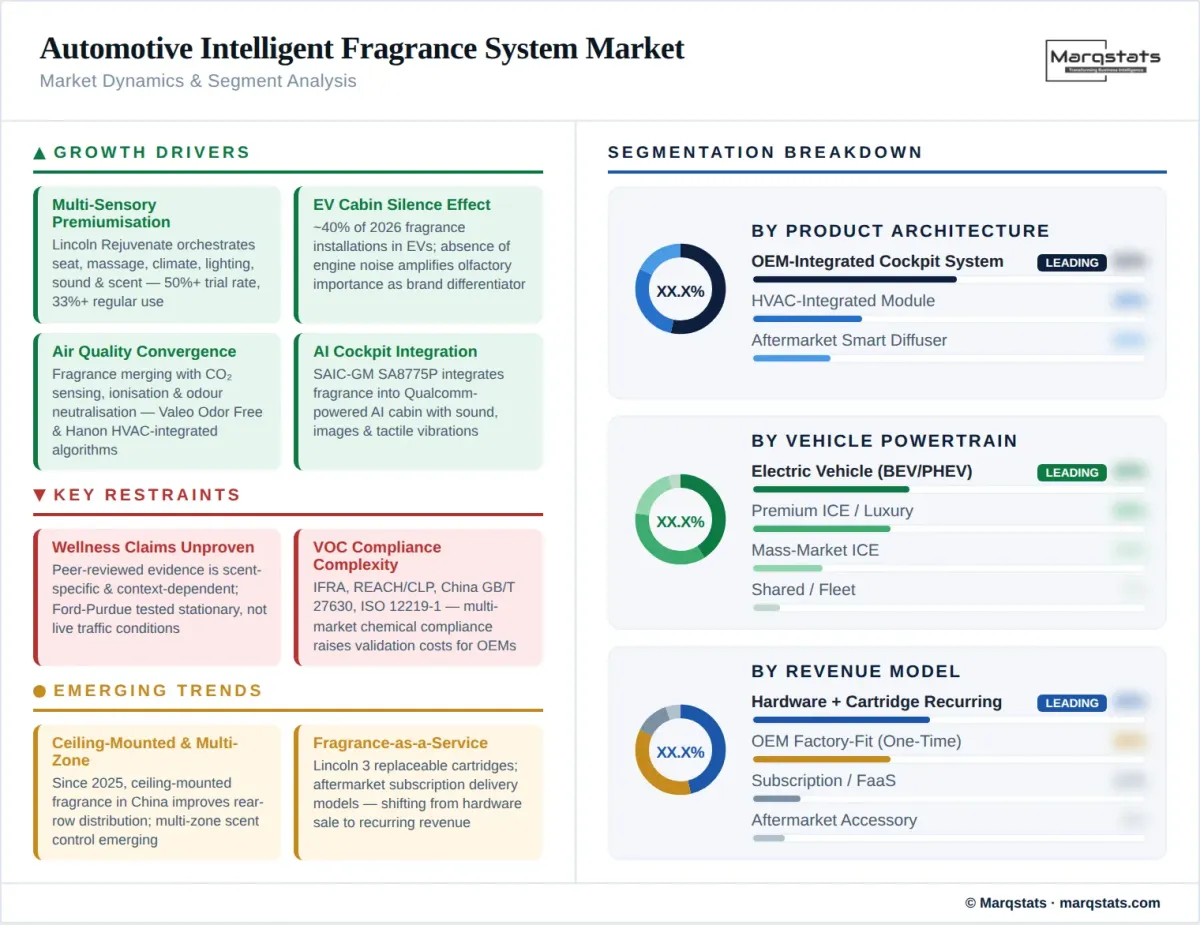
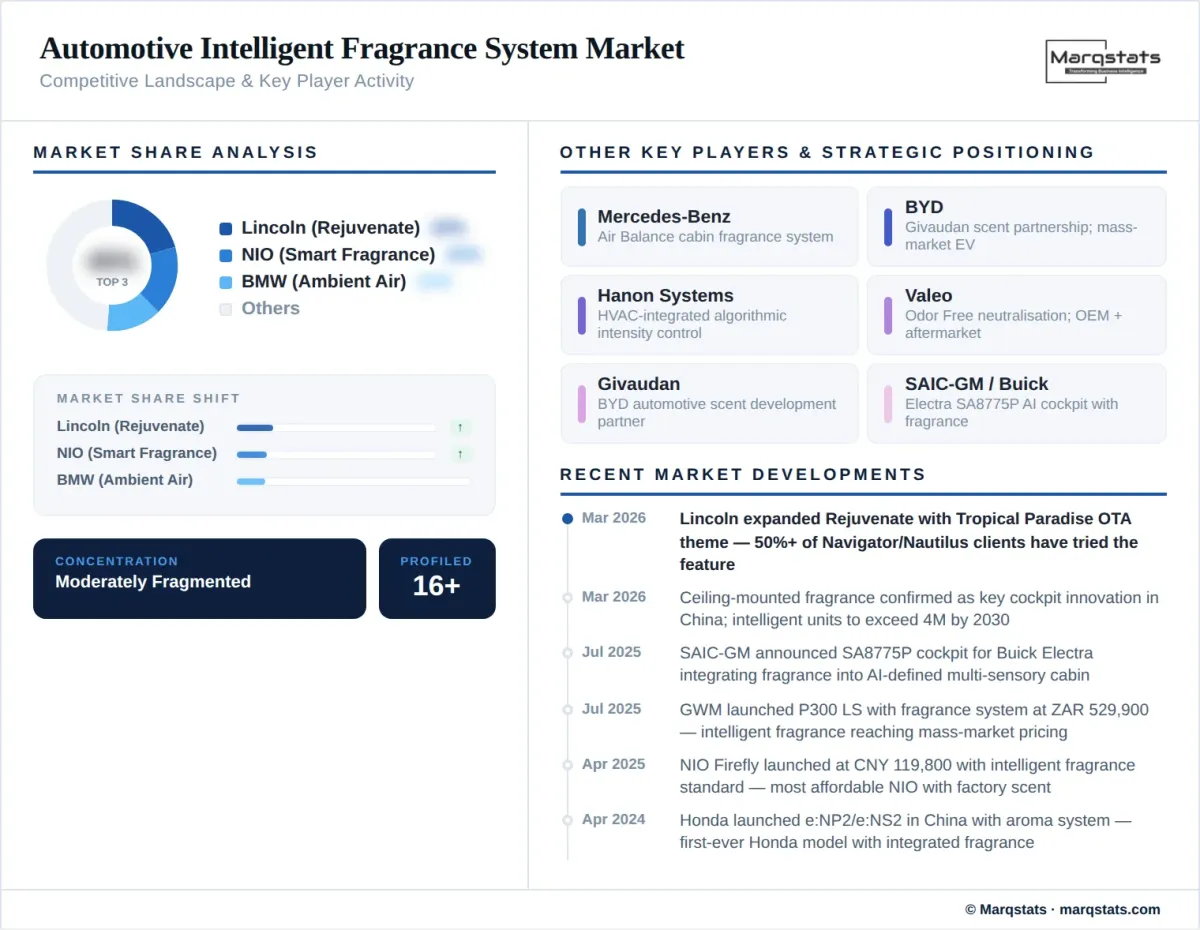
- Premiumisation and multi-sensory cabin personalisation: The vehicle cabin is evolving from a transportation enclosure to a personalised wellness space. Lincoln’s Rejuvenate orchestrates seat position, massage, climate, ambient lighting, sound, and digital scents across five themes (with Tropical Paradise added via OTA in March 2026). Over 50% of equipped Navigator and Nautilus clients have tried the feature, with over one-third using it regularly—unusually direct evidence that a sensory cockpit feature is being actively used, not merely specified. NIO controls fragrance selection and concentration adjustment through NOMI or the centre display, tying scent to the smart-cabin intelligence layer. This premiumisation is the clearest near-term demand driver for OEM-integrated systems.
- EV cabin silence amplifying olfactory importance: In electric vehicles, the absence of engine noise makes all cabin sensory inputs more noticeable—including scent. Approximately 40% of new 2026 fragrance system installations are expected in electric vehicles, where fragrance serves as both a wellness feature and a brand-identity differentiator replacing the engine-sound signature of ICE vehicles. NIO’s smart fragrance across the ES6, EC6, and ET7 lineup, and BYD’s partnership with Givaudan for scent development, demonstrate how EV brands are treating fragrance as core brand DNA rather than an optional accessory.
- Convergence of fragrance with air quality and odour management: Fragrance is broadening from “pleasant smell” to perceived air quality, perceived cleanliness, and emotional comfort. Hanon Systems describes its fragrance system as installed on the HVAC with integrated control algorithms for intermittent open/close to maintain aroma intensity, positioned alongside CO₂ sensing and photocatalyst purification. Valeo’s Odor Free system uses a “neutral” fragrance to suppress cognitive perception of bad smells—targeting not just private cars but shared mobility, fleets, rental cars, buses, and used vehicles. This convergence means fragrance systems are being sold as part of a broader in-cabin environmental control architecture, not a standalone amenity.
- Software-defined cockpit enabling OTA scent themes and personalisation: Lincoln is already updating wellness themes via OTA, and aftermarket products use app-based control, scheduling, cartridge recognition, and adjustable intensity. This transforms the fragrance system from static hardware to a software-upgradeable platform with recurring content potential. The olfactory cockpit experience becomes part of the same software-defined vehicle architecture that manages infotainment, ADAS, and energy management.
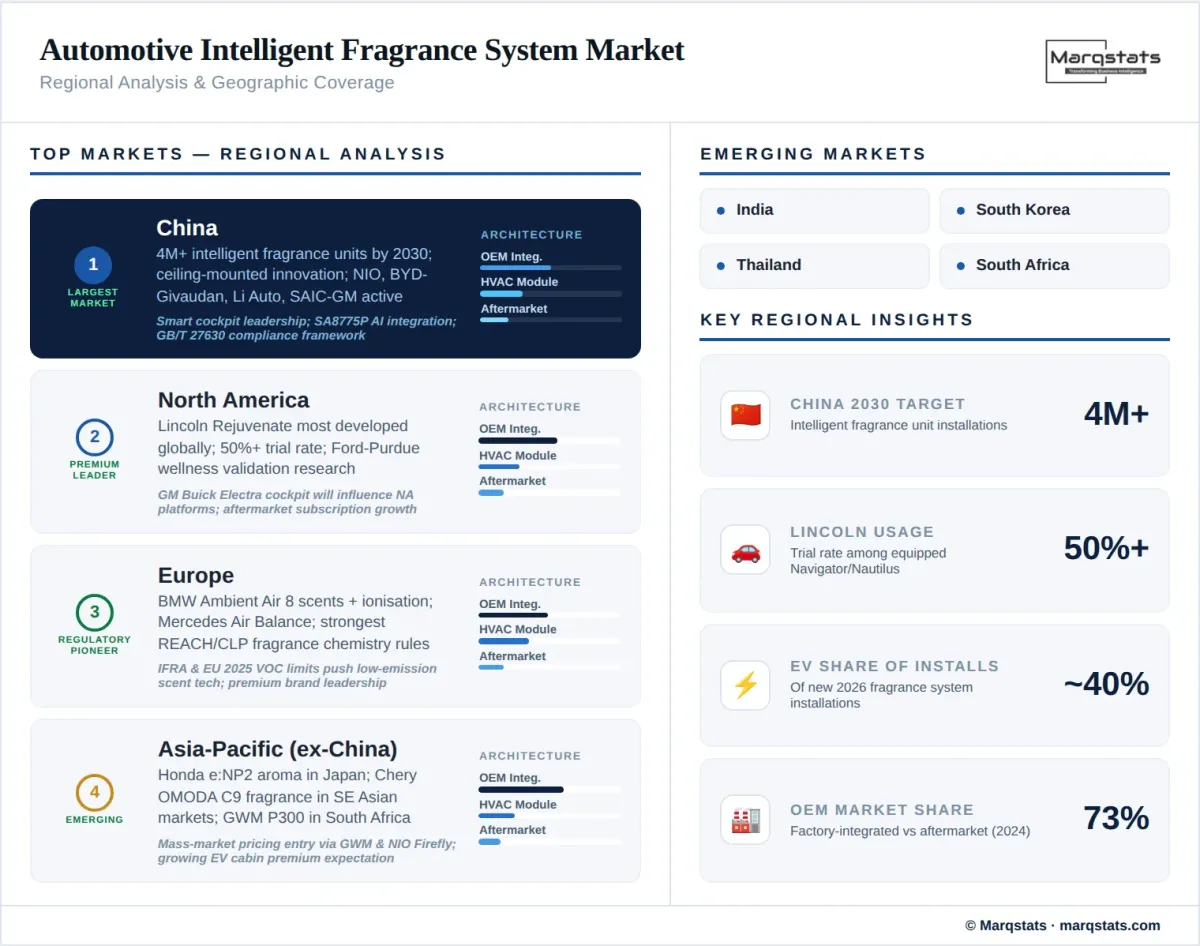
- China market driving the most aggressive OEM integration cadence: Industry analyses indicate intelligent fragrance equipment in China is expected to exceed 4 million units by 2030. Since 2025, ceiling-mounted fragrance has become a new cockpit innovation point for rear-row scent distribution, deployed independently or integrated with ceiling A/C outlets. Chinese OEMs including NIO, BYD, Li Auto, and Chery (OMODA C9 with integrated fragrance system) are integrating fragrance across a wider price range than European/American OEMs, which still concentrate the feature in premium trims.
Key Restraints
- Evidence for wellness and driver-performance claims remains mixed: While olfactory stimuli can affect fatigue, alertness, and perceived stress—peer-reviewed studies in 2024 found peppermint, grapefruit, and lavender interventions significantly alleviated driving fatigue—the evidence is scent-specific, context-dependent, and not uniform enough to justify sweeping safety claims. Lincoln’s Ford–Purdue collaboration tested a relaxation system combining massage, lighting, sounds, and scent in a stationary vehicle and showed measurable stress reduction, but this is not the same as proving scent alone improves driving safety in live traffic. Direct health or safety claims need tighter substantiation; the safest commercial positioning remains premium comfort and personalisation.
- VOC and chemical compliance complexity across markets: Fragrance systems must comply with IFRA safety standards globally, REACH and CLP in Europe, China’s GB/T 27630-2011 cabin air-quality limits, and ISO 12219-1 VOC measurement methodology. EU 2025 VOC limits push low-emission fragrance technology—any scent cartridge or diffuser that introduces benzene, toluene, formaldehyde, or other restricted compounds risks non-compliance. This multi-market compliance burden creates barriers for smaller suppliers and raises validation costs for OEMs sourcing scent cartridges from fragrance houses.
- Price sensitivity constraining integration below premium segments: OEM-integrated fragrance systems add USD 50–200 to BOM depending on integration depth (standalone diffuser vs HVAC-integrated vs multi-zone). While premium brands absorb this cost within high-margin trims, mass-market vehicles face BOM pressure. The aftermarket addresses this gap, but aftermarket devices cannot access HVAC airflow management, limiting scent distribution quality versus factory-integrated systems.
Key Trends
- Multi-zone scent management and ceiling-mounted delivery emerging: Since 2025, ceiling-mounted fragrance has become a key cockpit innovation in China, improving rear-row scent distribution that HVAC-channel systems struggle to reach. Multi-zone scent management—separately controlling front and rear cabin scent profiles—represents the next technical step, analogous to multi-zone climate control. This addresses the challenge that HVAC-integrated systems primarily serve the front cabin, leaving rear passengers with diluted or delayed scent delivery.
- Fragrance-as-a-service: recurring cartridge and subscription models: Both OEM and aftermarket segments are adopting consumable-cartridge economics. Lincoln’s Rejuvenate uses three replaceable scent cartridges housed in the centre armrest. Aftermarket devices use plug-and-play cartridges with app-based cartridge recognition and subscription delivery models. This shifts fragrance from a one-time hardware sale to a recurring-revenue stream—hardware + refill subscriptions + app-managed retention—making the market more SaaS-like than traditional automotive accessories.
- SAIC-GM SA8775P intelligent cockpit integrating fragrance into AI-defined cabin: SAIC-GM’s Qualcomm SA8775P-based intelligent cockpit domain controller for Buick’s Electra explicitly integrates feedback from sound, images, tactile vibrations, and intelligent fragrance into a unified AI-defined cabin experience. This represents the architectural destination: fragrance as one modality in a multi-sensory AI-orchestrated cockpit, not a standalone HVAC add-on.
- Odour neutralisation expanding addressable market beyond private cars: Valeo’s Odor Free system targets shared mobility, fleets, cabs, rental cars, buses, and used vehicles—segments where perceived cleanliness directly affects customer satisfaction and vehicle residual value. This is commercially important because it expands the addressable market from “premium cabin perfume” to “fleet/shared-mobility cabin-condition management,” which is a much larger installed base.
Market Segmentation
Factory-installed systems coordinated with the smart cockpit wellness stack. Lincoln’s Rejuvenate is the deepest public example: five multisensory themes, three replaceable scent cartridges in the centre armrest, OTA-delivered theme updates, and coordination with seat, massage, climate, lighting, and audio. NIO’s smart fragrance integrates scent selection and concentration via NOMI/centre display alongside air-quality monitoring. BMW’s Ambient Air Package combines air ionisation with eight individually selectable scents. SAIC-GM’s Buick Electra integrates intelligent fragrance into its SA8775P AI cockpit domain controller. OMODA C9 (Chery) includes an integrated fragrance system even in its AWD variant. This segment holds approximately 73% of the market and commands the highest ASP per vehicle.
Fragrance as a sub-function of the vehicle’s climate control system. Hanon Systems describes its architecture as installed on the HVAC with integrated control algorithms that intermittently open and close the fragrance device to maintain selected aroma intensity, positioned alongside CO₂ sensing and cabin air-quality solutions. This architecture is attractive for OEM serial production because it embeds into existing climate modules rather than adding a separate system. MAHLE and Denso represent additional Tier 1 HVAC suppliers with capability to integrate fragrance into thermal management modules. Ceiling-mounted integration with A/C outlets is the newest deployment approach, targeting rear-row coverage.
The fastest-evolving segment by feature innovation. Leading products use dry-air diffusion (low VOC, IFRA-compliant), plug-and-play cartridges, smartphone app control for scent selection and scheduling, automatic start/stop using motion/ignition detection, and subscription-based cartridge refill delivery. This segment serves the massive global installed base of vehicles without factory-integrated fragrance, creating a USD 300M+ addressable market. The aftermarket is structurally different from OEM: brands monetise through device sales + refill subscriptions + app-managed retention, making the economics more SaaS-like than traditional accessories.
The current volume core for OEM-integrated systems. Lincoln (Navigator, Nautilus), BMW (Ambient Air), Mercedes-Benz (Air Balance), NIO (ES6, EC6, ET7), and Li Auto deploy fragrance as part of the premium cabin proposition. Premium vehicles absorb the USD 100–200 BOM cost within high-margin trim levels and use scent as a brand-identity differentiator.
The fastest-growing vehicle segment for intelligent fragrance, with approximately 40% of new 2026 installs expected in EVs. Silent electric powertrains amplify olfactory perception, and EV brands use scent as brand DNA (NIO smart fragrance, BYD/Givaudan, NIO’s Firefly 4,003mm hatchback with intelligent fragrance system standard). The EV in-cabin wellness scent market represents the intersection of electrification and premiumisation trends.
An emerging opportunity driven by Chinese OEMs integrating fragrance across wider price ranges. Chery’s OMODA C9 (from ZAR 785,900 in South Africa) and GWM P300 LS (from ZAR 529,900 with fragrance system) demonstrate fragrance systems appearing in segments previously considered too cost-sensitive. SAIC-GM’s Buick Electra intelligent cockpit with fragrance targets the premium-mass crossover. Cost reduction through HVAC integration and standardised cartridge modules will accelerate mass-market adoption.
Valeo’s Odor Free system specifically targets shared mobility, fleets, rental cars, cabs, buses, and used vehicles for odour neutralisation and perceived cleanliness. This segment values perceived cabin condition for customer satisfaction and residual value preservation rather than luxury personalisation, creating a distinct value proposition and pricing model.
By Geography
China
The world’s most aggressive market for automotive fragrance innovation. Intelligent fragrance equipment installations are expected to exceed 4 million units by 2030. Ceiling-mounted fragrance has emerged since 2025 as a key innovation for rear-row scent distribution. NIO, BYD (Givaudan partnership for scent development), Li Auto, Chery/OMODA, and SAIC-GM/Buick are all actively deploying intelligent fragrance systems. The market benefits from China’s smart cockpit leadership: the SA8775P intelligent cockpit domain controller for Buick Electra integrates fragrance into AI-defined multi-sensory cabin experiences. China’s GB/T 27630-2011 sets cabin air-quality limits that fragrance systems must comply with.
North America
Premium OEM wellness integration leads the market. Lincoln’s Rejuvenate is the most developed public example globally, with five OTA-delivered multisensory themes and the strongest published usage data (50%+ trial rate, 33%+ regular use among equipped owners). The Ford–Purdue collaboration provides the clearest OEM-linked wellness validation evidence. GM’s SAIC-GM Buick Electra intelligent cockpit (SA8775P) will eventually influence North American GM platforms. The aftermarket smart diffuser segment is growing through app-controlled, subscription-model devices.
Europe
Premium brand leadership combined with the strongest regulatory framework for fragrance chemistry. BMW’s Ambient Air Package and Mercedes-Benz’s Air Balance system are established premium features. REACH governs fragrance chemicals, CLP covers labelling, and EU 2025 VOC limits push low-emission fragrance technology—creating a regulatory tailwind for suppliers offering IFRA-compliant, low-VOC dry diffusion. Valeo’s Odor Free (headquartered in France) positions odour neutralisation for both OEM and aftermarket across private and shared mobility. Hanon Systems’ HVAC-integrated fragrance architecture serves European OEM platforms.
Asia-Pacific (Excluding China)
Japan’s NIO-influenced smart cockpit trends and South Korea’s Hyundai/Kia Genesis luxury positioning drive regional growth. Honda’s e:NP2/e:NS2 EV sedans (China-market) adopted an aroma system for the first time among Honda models, with occupants using the Display Audio or smartphone app to select and diffuse fragrances. South African market launches (OMODA C9 with integrated fragrance, GWM P300 LS with fragrance system) demonstrate the feature’s expansion into emerging markets.
Rest of World
GWM’s P300 LS launch in South Africa with a fragrance system at ZAR 529,900 and OMODA C9 with integrated fragrance at ZAR 785,900 demonstrate that intelligent fragrance is expanding beyond premium-only positioning into middle-market segments in Africa and emerging markets. The feature’s presence in vehicles sold below USD 50,000 signals broader global addressability.
How Competition Is Evolving
The automotive intelligent fragrance system market features four competitive layers. At the OEM experience layer, Lincoln (Rejuvenate, five multisensory themes), NIO (smart fragrance with NOMI), BMW (Ambient Air with ionisation), Mercedes-Benz (Air Balance), BYD (Givaudan scent partnership), and Li Auto are the most visible brands using intelligent fragrance as a cabin differentiator. Chinese OEMs are deploying fragrance across a wider price range than Western peers, while Lincoln leads in published usage data and multi-sensory coordination depth.
At the Tier 1 / HVAC integration layer, Hanon Systems provides the clearest public description of HVAC-integrated fragrance architecture with algorithmic intensity control. Valeo positions odour neutralisation (Odor Free) for both OEM and aftermarket across private and shared mobility. MAHLE, Denso, and Faurecia (Forvia) represent additional HVAC and interior suppliers with capability to integrate fragrance into thermal management and cockpit comfort modules. BASF and Givaudan represent the fragrance chemistry and scent-development side, with Givaudan’s BYD partnership being the most visible automotive-specific fragrance-house engagement.
At the aftermarket smart-diffuser layer, leading products offer app control, motion/ignition sensing, dry-air diffusion (low VOC, IFRA-compliant), plug-and-play cartridge ecosystems, and subscription refill models. The aftermarket serves the massive global installed base without factory-integrated fragrance, with economics structured around device + subscription + app retention rather than one-time hardware sale.
Companies Covered
The report profiles 20+ companies with full strategy and financials analysis, including:
Recent Market Activity
Table of Contents
Coverage & Segmentation
This report provides a comprehensive analysis of the global automotive intelligent fragrance system market covering the historical period (2021–2025) and forecast period (2026–2030), with 2025 as the base year. The study examines market size in USD across product architecture (OEM-integrated, HVAC-integrated, aftermarket smart diffusers), vehicle type (premium/luxury, EV, mass-market, shared mobility/fleet), integration model (cockpit wellness, HVAC sub-function, standalone, ceiling-mounted), and geography (China, North America, Europe, Asia-Pacific, Rest of World — covering 15+ countries). Company profiling covers 20+ players across OEM brands, Tier 1 HVAC integrators, fragrance chemistry houses, and aftermarket device manufacturers. Regulatory analysis covers IFRA fragrance safety standards, REACH/CLP chemical regulation, GB/T 27630-2011 Chinese cabin air quality, ISO 12219-1 VOC measurement, and EU 2025 VOC emission limits.
Research methodology combines bottom-up modelling from OEM configuration data, HVAC supplier integration disclosures, fragrance equipment installation estimates, and aftermarket device and cartridge sales tracking. Primary research encompasses 40+ interactions with OEM cockpit and interior teams, HVAC Tier 1 suppliers, fragrance chemistry companies, aftermarket device manufacturers, and regulatory specialists. The Marqstats automotive AI box market report and global sensor market report provide complementary coverage of the smart cockpit compute and sensing architecture enabling intelligent fragrance system integration.