Market Snapshot
Middle bar: base-year value × (1 + CAGR), rounded to two decimals. This is a calculated illustration, not a separately researched annual estimate.
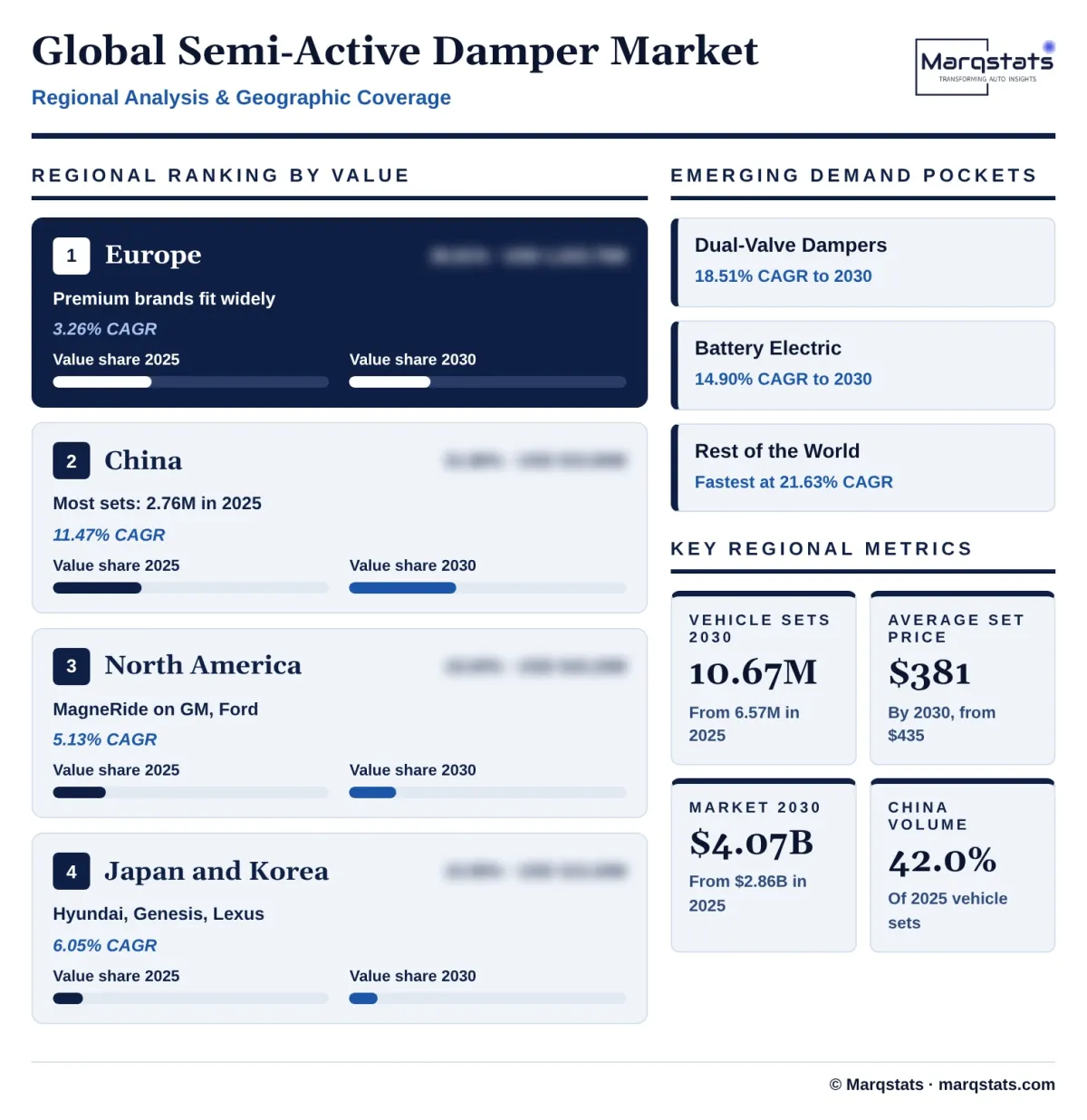
The global semi-active damper market size is estimated at USD 2,858.95 million in 2025 and is projected to reach USD 4,068.16 million by 2030, growing at a CAGR of 7.31% over 2026 – 2030. Fitment rises from about 6.57 million vehicle sets of four dampers to 10.67 million, a 10.18% annual rate, while the average OEM price per set falls from about USD 435 to USD 381.
Marqstats defines the market as the original equipment value of electronically controlled semi-active shock absorbers and struts delivered to vehicle makers, counted as four-corner vehicle sets. It covers solenoid-valve dampers with one or two electro-hydraulic valves, such as continuous damping control (CDC), CVSAe, CVSA2 and DampTronic systems, and magnetorheological dampers such as MagneRide, including the valves, coils and damper-mounted sensors. Passive shock absorbers, fully active force-generating actuators, air springs and compressors, standalone suspension control units and software, and aftermarket replacement dampers are excluded.
Single-valve solenoid dampers account for 62.50% of 2025 value and SUVs and crossovers for 58.00%. Europe is the largest region by value with 35.81%, while China fits the most dampers, with 2.76 million vehicle sets or 42.01% of global volume. The study segments the market by damper technology, propulsion type, vehicle type and region.
Key Takeaways
Market Overview & Analysis
Report Summary
A semi-active damper changes how much resistance it gives as the wheel moves, many times a second, but does not push the wheel or body itself. A solenoid damper does this by opening or closing an electro-hydraulic valve that controls oil flow. A magnetorheological damper does it by passing current through a coil that thickens a fluid containing iron particles. In both cases a control unit reads acceleration, wheel travel and driver inputs and adjusts each corner within milliseconds.
Marqstats estimates that about 6.57 million new vehicles worldwide were fitted with semi-active dampers in 2025, worth USD 2,858.95 million at OEM damper-set prices. That is roughly 7% of the light vehicles built worldwide. Fully active systems that use motors or pumps to generate force at each wheel, such as those on the Nio ET9, BYD Yangwang models and Porsche Active Ride, fitted only about 35,000 vehicles in 2025 and are measured separately.
Three types of damper make up the market. Single-valve solenoid dampers, such as most CDC and CVSAe systems, use one valve to adjust damping in both directions and remain the volume choice. Dual-valve solenoid dampers, such as CVSA2 and DampTronic Sky, control rebound and compression separately and are spreading quickly in Chinese electric SUVs and premium vehicles. Magnetorheological dampers such as MagneRide have no valves, respond fastest and are used on high-performance cars and large SUVs.
The market has grown steadily. Marqstats estimates the market at USD 1,952.70 million in 2021 on 4.10 million vehicle sets, USD 2,060.19 million in 2022, USD 2,371.54 million in 2023 and USD 2,620.30 million in 2024 on 5.86 million sets. Growth came mainly from China, where fitment rose from about 0.80 million vehicle sets in 2021 to 2.76 million in 2025 as domestic brands made electronic suspension a standard feature on electric SUVs.
Chinese installation data show how dominant solenoid dampers are. From January to October 2025, Chinese passenger cars were fitted with 2,151,383 CDC damper sets, 98.3% of all electronically controlled dampers fitted, against 11,458 magnetorheological sets. Many of these cars pair CDC dampers with air springs; China fitted about 1.27 million air suspension sets in 2025.
Regulation does not require semi-active dampers. Vehicle safety rules in Europe, the United States and China set requirements for braking, stability control and driver assistance, but leave the choice of damper to carmakers. Demand comes instead from ride and handling targets, the extra weight of electric vehicles, and competition on comfort and features, particularly in China.
Global Semi-Active Damper Market Size and Forecast
The global semi-active damper market grows from USD 2,858.95 million in 2025 to USD 4,068.16 million in 2030, a CAGR of 7.31%. Marqstats expects USD 3,034.16 million in 2026, USD 3,275.22 million in 2027, USD 3,530.32 million in 2028 and USD 3,797.50 million in 2029.
Volume grows faster than value. Vehicle sets rise from 6.57 million in 2025 to 7.18 million in 2026, 7.98 million in 2027, 8.82 million in 2028, 9.73 million in 2029 and 10.67 million in 2030. The average price per set falls from about USD 476 in 2021 and USD 435 in 2025 to USD 381 in 2030, because China, where sets are cheapest, takes a growing share of volume and its own prices keep falling.
Prices differ widely by region. Marqstats estimates average OEM prices per four-damper set in 2025 of about USD 330 in China, USD 525 in Europe, USD 560 in North America, USD 435 in Japan and South Korea and USD 400 in the rest of the world. Magnetorheological sets cost about USD 600 to 650, and dual-valve solenoid sets about 30% more than single-valve sets because of the extra valve.
The forecast assumes that China raises fitment from about 2.76 million to 5.50 million vehicle sets by 2030, Europe from 1.95 million to 2.38 million, North America from 0.97 million to 1.28 million, Japan and South Korea from 0.72 million to 1.01 million and the rest of the world from 0.17 million to 0.50 million. Fully active suspension takes some of the most expensive vehicles in China and Europe, which limits growth at the top of the market.
Marqstats tracks four indicators to monitor the forecast: monthly CDC and air suspension installation data in China, semi-active fitment on new electric SUV platforms in Europe and North America, the price gap between single-valve and dual-valve sets, and fully active suspension launches that replace semi-active dampers on flagship models.
Currency conversions use 2025 annual average rates of USD 1.13 per euro and CNY 7.18 per US dollar.
The mix changes over the forecast. Dual-valve dampers rise from 28.30% to 46.50% of value, battery electric vehicles from 27.00% to 38.00%, SUVs and crossovers from 58.00% to 63.00%, and China from 31.86% to 38.53%. Europe remains a large market but its share falls from 35.81% to 29.54% as growth shifts to China, India and other emerging markets.
Market Dynamics
Key Drivers
Five forces are pushing semi-active dampers from luxury options into mainstream SUVs and electric vehicles.
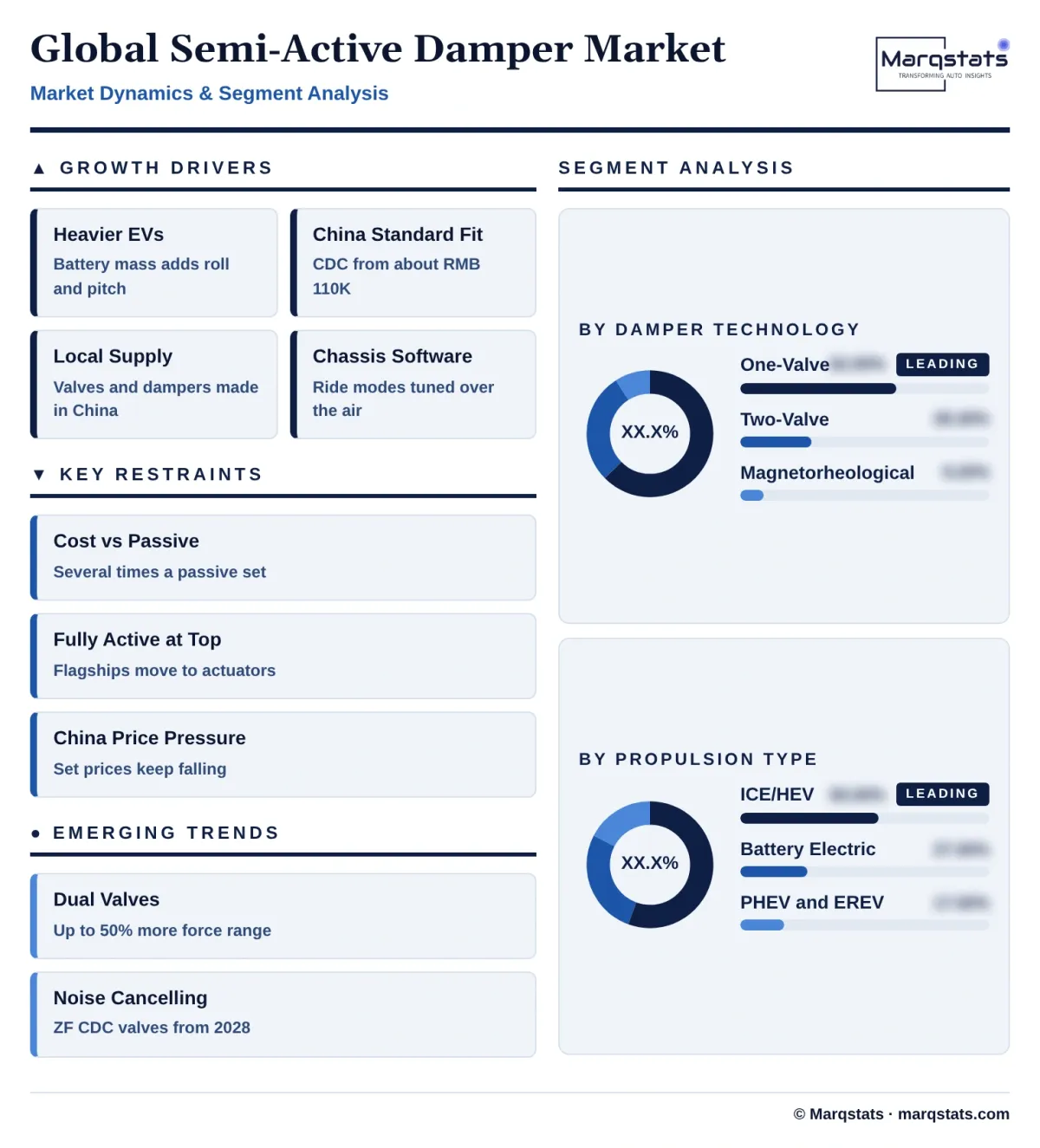
- Heavier electric vehicles. Battery packs add several hundred kilograms, raising body roll, pitch and damper heat. Semi-active dampers let carmakers keep a comfortable ride and stable handling without stiffer springs, which is why most new electric SUVs from Li Auto, Nio, Xiaomi, BYD, Mercedes-Benz and BMW offer them.
- Chinese brands make electronic suspension standard. Domestic Chinese carmakers fit CDC dampers, often with air springs, to electric SUVs and saloons as a selling point, and CDC has now reached cars priced from about RMB 110,000.
- Lower costs from local supply. Tenneco makes CVSA2 dampers in Changzhou, ZF and Bilstein have expanded Chinese production, and Chinese companies such as XunBo began mass production of CDC solenoid valves in October 2026, reducing the cost of each set.
- Software-defined chassis control. Central chassis software such as ZF cubiX coordinates dampers with braking and steering, lets carmakers tune ride modes in software and add features by over-the-air update, and increases the value of having electronically controlled dampers.
- Premium and performance launches. New models such as the Polestar 5 with MagneRide, the Ram 1500 Rumble Bee 392 Track Pack with Bilstein DampTronic Sky dampers and the Mahindra BE 6 and XEV 9e with Monroe CVSAe keep adding semi-active dampers to new segments and countries.
Key Restraints
Four constraints slow how far and how fast semi-active dampers spread.
- Cost compared with passive dampers. A semi-active set costs several times as much as a passive set, so carmakers in India, Southeast Asia and Latin America still fit them mainly to top trims, and mechanical frequency-selective dampers such as Tenneco's DaVinci DCx offer part of the benefit at a fraction of the price.
- Fully active suspension at the top end. Flagship models from Nio, BYD, Porsche, Li Auto and Mercedes-Benz are moving to fully active corner actuators, which removes semi-active dampers from some of the highest-priced vehicles.
- Price pressure in China. Intense competition among Chinese carmakers and new local suppliers pushes damper prices down, limiting value growth even as volume rises.
- Repair cost and complexity. Electronically controlled dampers cost more to replace than passive ones, which can deter buyers of used vehicles and fleet operators.
Key Trends
Four shifts are changing how semi-active dampers are designed, controlled and sourced.
- From single to dual valves. Dual-valve dampers control rebound and compression separately and can raise damping force range by up to 50%. Tenneco launched a steel-tube CVSA2 for Chinese carmakers in April 2025 and in Europe in June 2026.
- Dampers used for more than ride. ZF plans to use CDC damper valves to cancel tyre cavity noise of around 200 Hz, with series production expected in 2028, turning the damper into an active noise control device.
- Magnetorheological dampers move into electric vehicles. BWI Group supplies MagneRide to the Polestar 5 and the Changan Deepal L06, and General Motors has extended MagneRide from petrol models to electric SUVs and pickups.
- Local supply chains in China. Chinese suppliers are building solenoid valve, damper and air spring capacity, and the share held by foreign suppliers, about 70% of electronically controlled damper supply in China in 2024, is expected to fall.
- Mechanical alternatives for lower-priced cars. Frequency-selective mechanical dampers such as Tenneco DaVinci DCx give part of the comfort benefit without sensors or electronics, offering carmakers a cheaper option for mass-market models.
Strategic Implications
- For damper makers, dual-valve capacity is the growth priority. Dual-valve dampers grow at 18.51% a year and command about 30% higher prices than single-valve units.
- For carmakers, semi-active dampers are the cheapest way to make heavy electric vehicles ride well. Fitting them across mid-priced electric SUVs, rather than only on flagships, helps differentiate ride quality without the cost of fully active systems.
- For Chinese suppliers, valve technology is the entry point. Solenoid valves and control electronics are the parts most dependent on foreign suppliers, so local valve production gives the largest cost advantage.
- For software and chassis integrators, dampers are a data and control point. Linking damper control with braking, steering and noise cancellation through central chassis software adds value that standalone damper makers cannot capture alone.
- For investors, the market is a volume story with falling prices. Fitment grows at 10.18% a year while the average set price falls about 12%, so returns depend on scale and cost reduction rather than price.
- For carmakers in India and Southeast Asia, semi-active dampers are becoming a differentiator in mid-priced electric SUVs. Local assembly of dampers or valves would bring set prices closer to Chinese levels and widen fitment beyond top trims.
Market Segmentation
Single-valve solenoid dampers account for 62.50% of 2025 value, USD 1,786.84 million, through ZF CDC, Tenneco CVSAe, FAW-Tokico and most Chinese CDC programmes. Their value is nearly flat at USD 1,830.67 million by 2030, a 0.49% CAGR, as carmakers move to dual-valve designs, and their share falls to 45.00%.
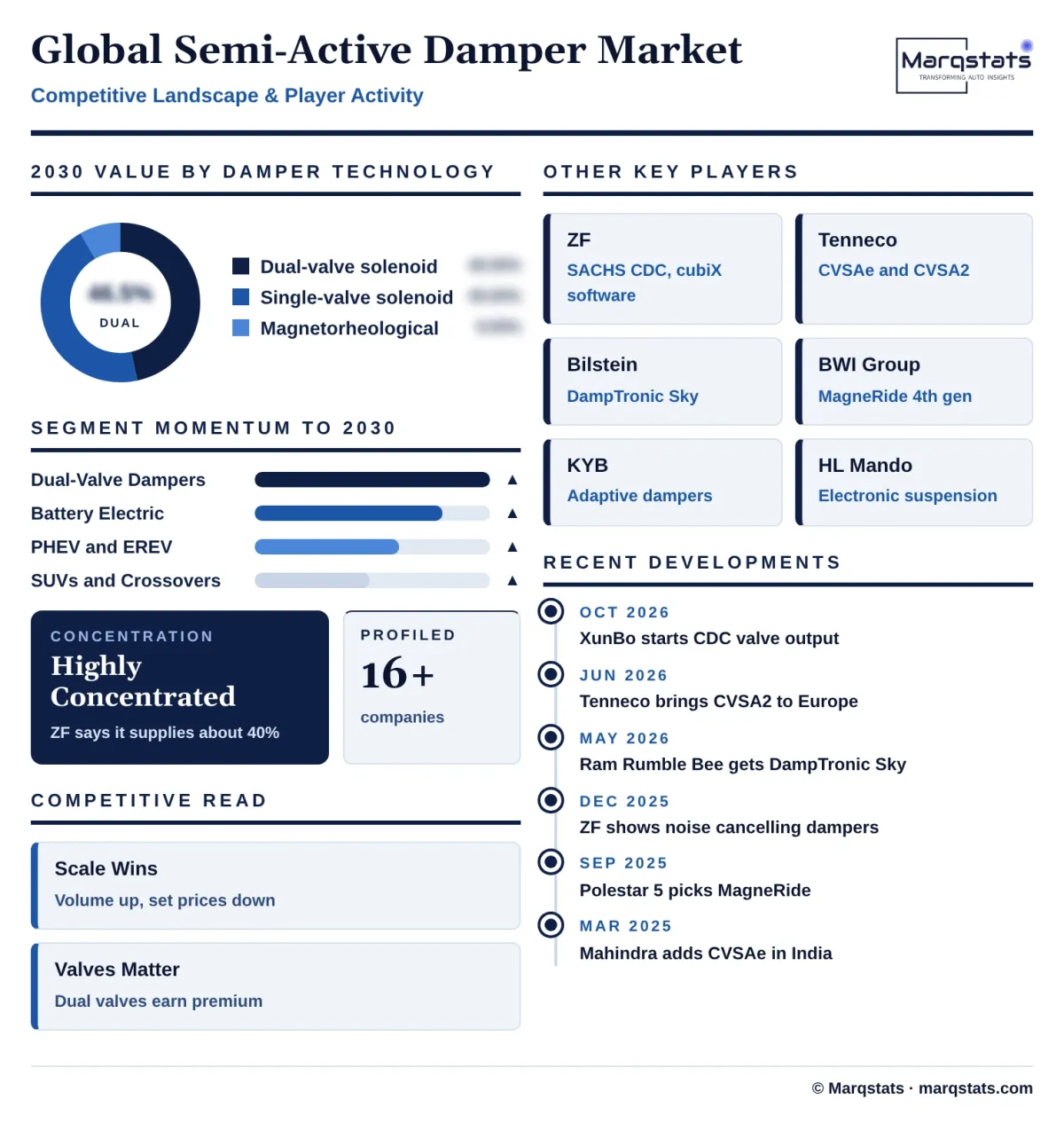
Dual-valve solenoid dampers account for 28.30% of 2025 value, USD 809.08 million, and grow fastest, at 18.51% a year, to USD 1,891.69 million and 46.50% of the market by 2030. Tenneco CVSA2, Bilstein DampTronic Sky and ZF dual-valve CDC lead the segment, which is used on large electric SUVs, off-road vehicles and performance pickups such as the Ram 1500 Rumble Bee 392 Track Pack.
Magnetorheological dampers account for 9.20% of 2025 value, USD 263.03 million, and grow at 5.62% a year to USD 345.80 million by 2030. BWI Group supplies MagneRide to General Motors, Ferrari, Polestar and Chinese carmakers, and produced its 11 millionth MagneRide damper at its Krosno plant in Poland.
Petrol, diesel and conventional hybrid vehicles account for 55.50% of 2025 value, USD 1,586.72 million, and stay nearly flat at USD 1,667.95 million by 2030, a 1.00% CAGR, as carmakers shift new platforms to electric drive. Their share falls to 41.00%.
Battery electric vehicles account for 27.00% of 2025 value, USD 771.92 million, and grow at 14.90% a year to USD 1,545.90 million and 38.00% of the market by 2030. Heavy battery packs and quiet cabins make ride control a priority for brands such as Nio, Xiaomi, Polestar, Mercedes-Benz and Mahindra.
Plug-in hybrid and range-extended vehicles account for 17.50% of 2025 value, USD 500.31 million, and grow at 11.29% a year to USD 854.31 million by 2030, led by Chinese large SUVs from Li Auto, AITO and BYD that fit CDC dampers with air springs as standard on upper trims.
SUVs and crossovers account for 58.00% of 2025 value, USD 1,658.19 million, and grow at 9.10% a year to USD 2,562.94 million and 63.00% of the market by 2030, because tall, heavy vehicles gain most from controlling body roll and pitch.
Saloons, hatchbacks, coupés and estates account for 33.50% of 2025 value, USD 957.75 million, and grow at 3.53% a year to USD 1,139.08 million by 2030, with demand concentrated in premium and performance models.
Pickups and light commercial vehicles account for 8.50% of 2025 value, USD 243.01 million, and grow at 8.54% a year to USD 366.14 million by 2030, led by performance and off-road pickups in North America and electric pickups such as the Rivian R1T.
By Geography
Europe
Europe is the largest region by value, with 35.81% of 2025 value, USD 1,023.75 million on about 1.95 million vehicle sets, rising to USD 1,201.90 million by 2030, a 3.26% CAGR. BMW, Mercedes-Benz, Audi, Porsche, Volkswagen, Volvo and Jaguar Land Rover fit adaptive dampers widely on premium and performance models, and set prices are high at about USD 525. Growth is slower than elsewhere because fitment is already high and fully active suspension takes some flagship models. ZF, Bilstein and Tenneco produce in Germany, Spain and Eastern Europe.
China
China accounts for 31.86% of 2025 value, USD 910.80 million, but the largest volume, about 2.76 million vehicle sets. It grows at 11.47% a year to USD 1,567.50 million and 38.53% of the market by 2030, overtaking Europe in 2027. Chinese passenger cars were fitted with 2,151,383 CDC sets from January to October 2025, and domestic brands such as Li Auto, AITO, Nio, Xiaomi, Zeekr and BYD fit CDC with air springs on electric SUVs. ZF, Tenneco, FAW-Tokico and Bilstein supply most dampers, while Chinese firms are localising valves and assemblies.
North America
North America accounts for 19.00% of 2025 value, USD 543.20 million on about 0.97 million vehicle sets, and grows at 5.13% a year to USD 697.60 million by 2030. General Motors is the largest user of MagneRide across Cadillac, Corvette and large SUVs and pickups, Ford uses MagneRide on the Mustang, Tesla fits adaptive dampers to the Model S and X, Rivian uses Tenneco CVSA2, and Ram offers Bilstein DampTronic Sky on the 2027 Rumble Bee 392 Track Pack.
Japan and South Korea
Japan and South Korea account for 10.95% of 2025 value, USD 313.20 million, and grow at 6.05% a year to USD 420.16 million by 2030. Hyundai and Genesis use electronic control suspension from HL Mando, while Toyota, Lexus and Nissan fit adaptive variable suspension from KYB and other suppliers on premium and performance models.
Rest of the World
The rest of the world accounts for 2.38% of 2025 value, USD 68.00 million, and grows fastest, at 21.63% a year, to USD 181.00 million and 4.45% of the market by 2030. India leads this growth after Mahindra launched the BE 6 and XEV 9e with Monroe CVSAe in 2025, the first electronic suspension offered in India, while Brazil, Turkey, Southeast Asia and the Middle East add fitment through imported and locally assembled premium vehicles.
How Competition Is Evolving
The semi-active damper market is highly concentrated. ZF says it supplies about 40% of semi-active dampers worldwide through its SACHS CDC range and has produced more than 35 million CDC dampers since the mid-2000s. Tenneco's Monroe Ride Solutions, thyssenkrupp Bilstein, BWI Group, KYB, HL Mando, Marelli and FAW-Tokico make up most of the remainder.
In China, ZF held about 35% of electronically controlled damper supply in 2024, Tenneco 19%, FAW-Tokico 18% and Bilstein 17%, together almost 89%. Tenneco has delivered more than 1 million CVSAe damper sets to Chinese carmakers, and Chinese companies such as Kaihui, Baolong and Tuopu, already leaders in air springs, are developing CDC dampers and valves.
Competition is moving from hardware alone to hardware plus software. ZF links its dampers to its cubiX chassis software, Tenneco offers a range from CVSAe to dual-valve CVSA2 and its hydraulic Kinetic system, and BWI sells MagneRide on its fast response and tuning flexibility. Suppliers that can provide valves, dampers, sensors and control software together are best placed with carmakers building central chassis computers.
Price competition is strongest in China, where local carmakers expect lower costs every year. Global suppliers respond by producing locally, as Tenneco does in Changzhou, and by offering dual-valve designs that command higher prices.
Magnetorheological dampers form a smaller niche led by BWI Group, which added 600,000 units a year of fourth-generation MagneRide capacity in 2025 and won a programme of about 400,000 vehicles over its life with a leading carmaker.
New entrants face high barriers. Carmakers require years of durability testing, valve calibration and functional safety work before awarding a damper programme, and the leading suppliers already hold long-term contracts on major platforms. Chinese air spring makers are the most likely new competitors because they already supply the same carmakers with suspension modules.
Companies Covered
Companies covered in the report include:
Recent Market Activity
Table of Contents
Coverage & Segmentation
The study covers the global semi-active damper market, with 2025 as the base year, 2021 – 2025 as the historical period and 2026 – 2030 as the forecast period. Values are in US dollars at OEM supplier prices for complete four-corner damper sets, and volumes are vehicle sets fitted to new vehicles. The market is segmented by damper technology, propulsion type, vehicle type and region.
Passive shock absorbers, fully active force-generating suspension actuators, air springs, compressors and valve blocks, standalone suspension control units and software, and aftermarket replacement dampers are excluded. Fully active systems are covered in the Marqstats study of fully active suspension actuators and are not added to these figures. Segment and regional splits are Marqstats estimates built on installation data, supplier disclosures, vehicle production and price benchmarks.