Market Snapshot
Middle bar: base-year value × (1 + CAGR), rounded to two decimals. This is a calculated illustration, not a separately researched annual estimate.
The global electric parking brake actuator market size is estimated at USD 2,390.64 million in 2025 and is projected to reach USD 2,877.85 million by 2030, growing at a CAGR of 3.78% over 2026 – 2030. Actuator shipments rise from about 124.68 million to 159.08 million units, a 4.99% annual rate, while the blended ex-factory price falls from about USD 19.17 to USD 18.09 per actuator.
Marqstats defines the market as the ex-factory value of the electromechanical units that apply and release a vehicle's parking brake: motor-on-caliper motor-gear units with their spindle drive, actuators built into drum brakes, and cable-puller units, sold to brake system suppliers and carmakers for new light vehicles or sold as replacement parts. Brake calipers, discs, drums, pads, electronic control units, cabin switches and brake-by-wire service-brake actuators are excluded.
Motor-on-caliper actuators account for 85.27% of 2025 value, China builds 44.33% of actuators but earns 30.20% of value, and North America, India and the rest of the world deliver 59.22% of the growth to 2030. The study segments the market by actuator type, sales channel, vehicle type and region.
Key Takeaways
Market Overview & Analysis
Report Summary
Marqstats sizes the market from the vehicles built each year and the actuators each needs. OICA reports 96.4 million motor vehicles produced in 2025, up 3.9%, of which Marqstats estimates about 92.4 million were light vehicles. About 59.13 million of them, or 64.00%, were fitted with an electric parking brake, and most carry two actuators, one on each rear wheel. Together with about 8.88 million replacement units, 124.68 million actuators were shipped in 2025, worth USD 2,390.64 million at an average of USD 19.17 each.
An electric parking brake actuator is a small electric motor, a multi-stage gear reduction and a screw drive. In a motor-on-caliper design the motor-gear unit bolts to the back of the rear caliper and turns a spindle inside the piston, pushing the pads against the disc in less than a second. The spindle is self-locking, so clamping force stays in place with no power applied, which meets the requirement of UN Regulation 13-H and FMVSS 135 that a parking brake holds a laden vehicle on a 20% gradient by mechanical means.
The electric parking brake replaced the hand lever because it does more than park. It frees space in the centre console, releases automatically when the driver pulls away, holds the car in traffic with auto-hold, and can slow the vehicle with wheel-slip control if the hydraulic brake fails. For driver assistance and automated driving it lets the vehicle secure itself at the end of an automatic stop without the driver.
There are three main designs. Motor-on-caliper units account for 85.27% of 2025 value and 102.24 million factory units. Actuators built into rear drum brakes, such as the EPB-Si unit Continental developed for the Volkswagen Group's MEB electric platform, account for 9.26% of value. Cable-puller units, which sit under the body and pull conventional parking brake cables, account for 5.47% of value but serve only about 2.47 million new vehicles. ZF also builds a front-axle electric parking brake for small cars that keep simple rear drums.
The market grew from about USD 1,712.40 million in 2021 to USD 1,928.60 million in 2022, USD 2,174.30 million in 2023 and USD 2,296.10 million in 2024, as Chinese carmakers made the electric parking brake standard across new energy vehicles and global light vehicle output recovered. Marqstats expects USD 2,480.99 million in 2026.
The value chain is concentrated at the brake system level. ZF, which introduced the motor-on-caliper parking brake about 25 years ago, had built more than 250 million electric parking brake units by October 2024 and now supplies its sixth generation. Continental's automotive business, now AUMOVIO, Bosch, Hitachi Astemo, ADVICS, HL Mando and Bethel Automotive Safety Systems supply most of the rest, and most buy or build their own motor-gear units from specialist motor and gear makers.
Regulation supports fitment without requiring it. No regulator mandates an electric parking brake, but UN Regulation 13-H and FMVSS 135 set the holding requirements, Euro NCAP and other consumer tests reward automatic functions after a crash, and the US FMVSS 127 rule requires automatic emergency braking, including pedestrian detection, on new light vehicles from 1 September 2029. In March 2026 the US Department of Transportation said it was preparing a proposal to give carmakers two more years for parts of that rule.
Actuator count per vehicle depends on the design. A motor-on-caliper or drum system uses two actuators, one per rear wheel, while a cable puller uses one unit for the whole axle. Marqstats estimates that 88% of Chinese, 82% of European and 85% of North American equipped vehicles used motor-on-caliper actuators in 2025, and that cable pullers were most common in North America, at about 11% of equipped vehicles, because of pickups and body-on-frame SUVs with drum-in-hat rear parking brakes.
Price per actuator differs mainly by where it is built. Marqstats estimates the 2025 ex-factory price of a motor-on-caliper actuator at about USD 12 in China, USD 15 in India, USD 16 in other emerging markets, USD 19 in Japan and South Korea, USD 22 in Europe and USD 24 in North America, where heavier vehicles need higher clamping force. A drum-integrated actuator costs about USD 1 more than a caliper unit, and a cable puller USD 38 to 55. A replacement actuator sells for about twice the factory price.
The parking brake actuator is a durability part. It runs only a few seconds per stop, but it must work after years of heat, water, road salt and vibration, and for auto-hold it may cycle many thousands of times a year. Common failures are water getting into the motor, worn plastic gear teeth and seized spindles, which usually appear after six to eight years and drive the replacement market.
Global Electric Parking Brake Actuator Market Size and Forecast
The global electric parking brake actuator market grows from USD 2,390.64 million in 2025 to USD 2,877.85 million in 2030, a CAGR of 3.78%. Marqstats expects about USD 2,574.76 million in 2027, USD 2,672.06 million in 2028 and USD 2,773.05 million in 2029.
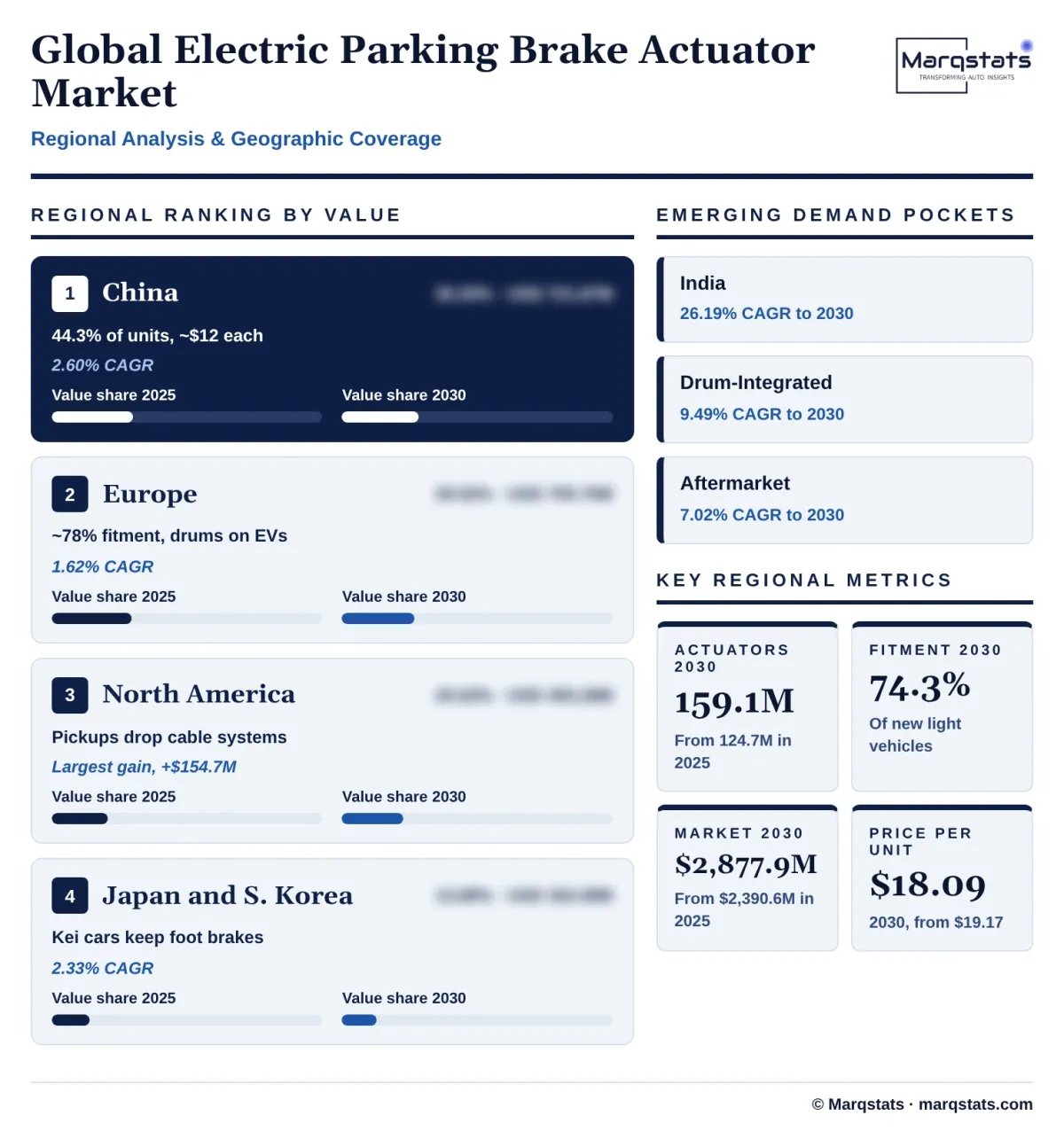
Volume grows faster than value. Marqstats expects light vehicle production to reach about 99.0 million in 2030 and electric parking brake fitment to reach 74.32%, so about 73.58 million new vehicles carry one, up from 59.13 million in 2025. Factory actuator units rise from 115.80 million to 145.60 million and replacement units from 8.88 million to 13.48 million.
Prices fall slowly. The motor-on-caliper actuator price falls from about USD 12.00 to USD 11.20 in China and from USD 22.00 to USD 20.80 in Europe between 2025 and 2030, in line with the annual price reductions carmakers set for brake system suppliers. The blended price per actuator falls from USD 19.17 to USD 18.09, as low-cost Chinese and Indian units take a larger share of volume.
Brake-by-wire takes some demand away. Brembo put its Sensify brake-by-wire system into series production in May 2026, and Bethel started mass production of an all-electric wheel brake in the first half of 2026. These systems apply the parking brake through the same electric wheel actuator used for normal braking, so a dedicated parking brake actuator is no longer needed on that axle. Marqstats assumes about 1.5 million vehicles use this design for the rear axle in 2030, removing about 3.0 million actuators, or about USD 45 million, from the market.
China's share of value falls from 30.20% to 28.52% and Europe's from 29.52% to 26.58%, while North America rises from 20.63% to 22.52%, India from 1.19% to 3.16% and the rest of the world from 4.57% to 6.27%.
Marqstats tracks four indicators: electric parking brake fitment on Indian, Southeast Asian and Latin American compact SUVs, parking brake design choices on new North American pickups and large SUVs, the share of rear drum brakes on new electric platforms, and the number of production programmes using brake-by-wire wheel actuators.
The mix changes slowly. Motor-on-caliper actuators move from 85.27% to 84.83% of value, drum-integrated actuators rise from 9.26% to 12.11% and cable pullers fall from 5.47% to 3.06%. The aftermarket rises from 14.20% to 16.56% of value and light commercial vehicles from 14.00% to 15.20%.
The pack figure for this market combined complete parking brake systems and brake-by-wire wheel actuators. Marqstats sizes only the dedicated parking brake actuator, which is why the market is smaller and grows more slowly; brake-by-wire actuators are a separate and faster-growing market that partly replaces this one.
Market Dynamics
Key Drivers
Five forces keep adding electric parking brake actuators to new vehicles and to the replacement market.
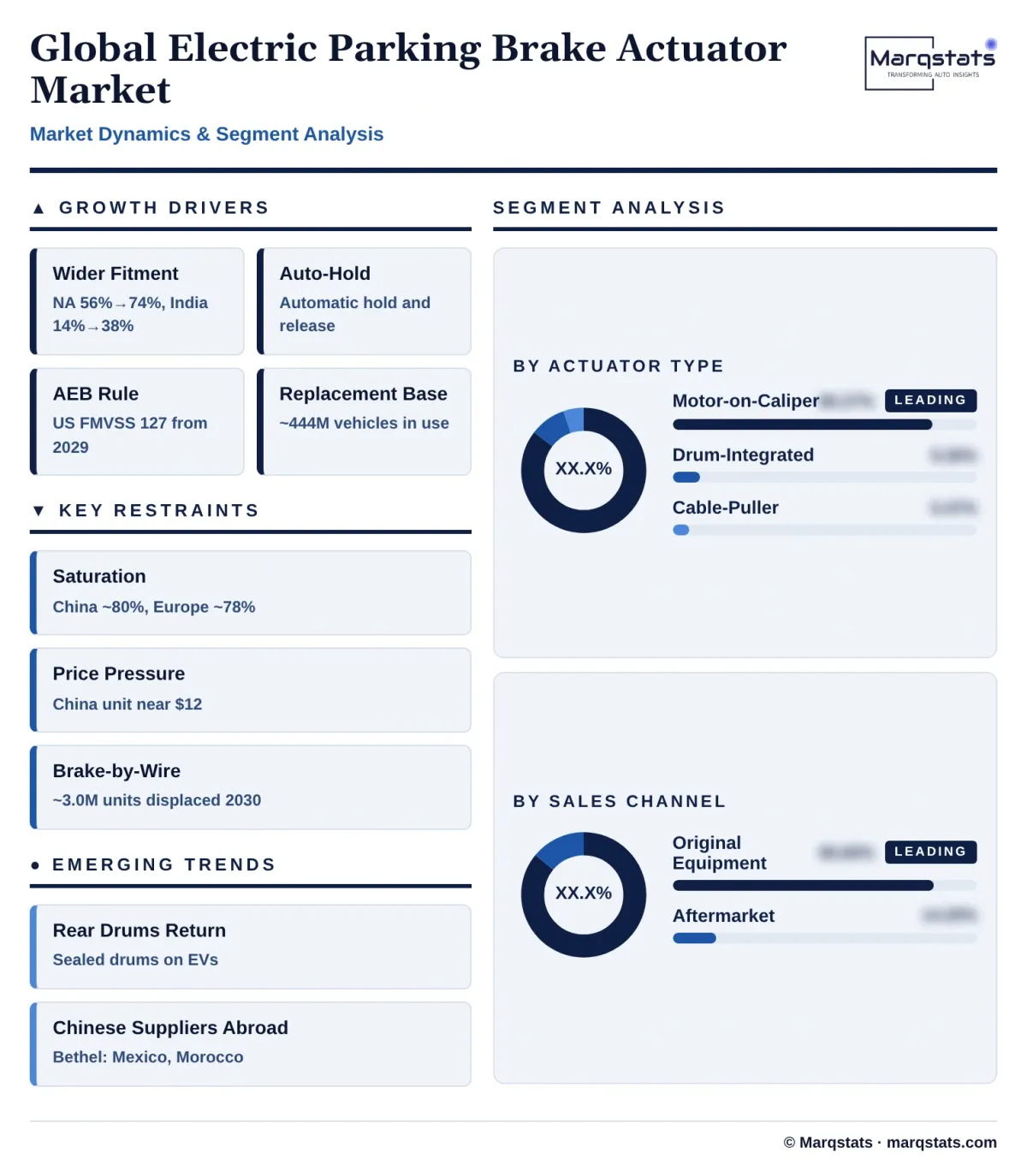
- Higher fitment outside China and Europe. Fitment in North America rises from about 56% to 74% of new light vehicles, in India from 14% to 38% and in the rest of the world from 30% to 47%.
- Automatic driving functions. Auto-hold, automatic release and automatic securing of the vehicle after an automated stop need an electric parking brake rather than a hand lever.
- Automatic emergency braking rules. FMVSS 127 requires automatic emergency braking on new US light vehicles from September 2029, and an electric parking brake lets the vehicle hold itself after an automatic stop.
- Cabin packaging. Removing the hand lever frees the centre console for storage, screens and wireless charging, which carmakers use in compact SUVs and electric vehicles.
- A growing replacement base. About 444 million vehicles with an electric parking brake were in use in 2025, and motors, gears and seals start to fail after six to eight years.
- Local production in India. ZF began producing electric parking brakes in India in July 2025, which cuts cost and lead time for Indian carmakers.
Key Restraints
Four constraints hold back value growth for actuator suppliers.
- Saturation in China and Europe. About 80% of Chinese and 78% of European light vehicles already have an electric parking brake, so growth there follows vehicle output.
- Price pressure. Carmakers ask for annual price reductions and Chinese suppliers sell motor-on-caliper actuators for about USD 12.
- Cost in entry-level vehicles. In India, Southeast Asia and Latin America a hand lever and cable cost much less, so many entry-level cars keep them.
- Brake-by-wire. Electric wheel brakes that also park the vehicle remove the need for a separate actuator on that axle.
- Cable system inertia on pickups. Some pickups and body-on-frame SUVs keep drum-in-hat brakes with cable systems until their next platform redesign.
Key Trends
Four shifts are changing what a parking brake actuator is and where it sits.
- Rear drums return on electric vehicles. Sealed drum brakes with built-in electric parking actuators avoid corrosion on rear brakes that are rarely used because of regenerative braking.
- Control moves into the stability control unit. The separate parking brake control unit is disappearing as the drive electronics move into the electronic stability control unit or a central vehicle computer.
- Chinese suppliers go abroad. Bethel won its largest overseas order in April 2026 and is building plants in Mexico and Morocco.
- Brake-by-wire merges parking and service braking. Electromechanical wheel brakes from Brembo, Bethel and others apply the parking brake with the same actuator used for normal braking.
- Higher-force actuators for heavier vehicles. Heavy electric SUVs and pickups need actuators that hold more weight, raising force and price per unit.
Strategic Implications
- For actuator and brake suppliers, growth to 2030 is in North America, India and emerging markets, so local production and cost-reduced designs for compact vehicles matter more than features.
- For incumbents in China and Europe, the market grows with vehicle output, so margin depends on cutting actuator cost and winning replacement volume.
- For motor and gear makers, drum-integrated actuators and brake-by-wire wheel actuators are the growth products, while cable pullers decline.
- For carmakers, an electric parking brake supports auto-hold, automated stopping and cleaner cabins at a cost of about USD 25 to 50 per vehicle in actuators.
- For the aftermarket, the replacement base grows by about 9% a year, which supports remanufactured motor-gear units and independent replacement brands.
- For investors, the dedicated parking brake actuator is a mature, slow-growing product, so returns depend on share gains in North America and India, the aftermarket and a credible brake-by-wire product.
Market Segmentation
Motor-gear units fitted to rear disc calipers account for 85.27% of 2025 value, USD 2,038.42 million, including most replacement units, and grow at 3.67% a year to USD 2,441.35 million. About 102.24 million factory units were shipped in 2025, two per vehicle on most designs.
Electric actuators built into rear drum brakes account for 9.26% of 2025 value, USD 221.45 million, and grow fastest, at 9.49% a year, to USD 348.40 million and 12.11% of 2030 value, as electric vehicle platforms adopt sealed rear drums.
Single electromechanical units that pull conventional parking brake cables account for 5.47% of 2025 value, USD 130.77 million, and fall at 7.60% a year to USD 88.10 million as remaining pickup and body-on-frame platforms are redesigned.
Actuators fitted to new vehicles account for 85.80% of 2025 value, USD 2,051.28 million, and grow at 3.20% a year to USD 2,401.36 million.
Replacement and remanufactured actuators account for 14.20% of 2025 value, USD 339.36 million, from about 8.88 million units, and grow at 7.02% a year to USD 476.49 million. A replacement unit sells for about twice the factory price.
Passenger cars and SUVs account for 86.00% of 2025 value, USD 2,055.95 million, and grow at 3.49% a year to USD 2,440.42 million.
Vans, pickups and other light commercial vehicles account for 14.00% of 2025 value, USD 334.69 million, and grow at 5.50% a year to USD 437.43 million as new pickups and vans adopt electric parking brakes.
By Geography
China
China is the largest market, with 30.20% of 2025 value, USD 721.87 million, from about 55.27 million actuators, 44.33% of world volume, and grows at 2.60% a year to USD 820.87 million by 2030. About 80% of Chinese light vehicles already have an electric parking brake, and Chinese suppliers sell motor-on-caliper actuators for about USD 12, about half the European price.
Europe
Europe accounts for 29.52% of 2025 value, USD 705.75 million, and grows at 1.62% a year to USD 764.90 million by 2030. About 78% of European light vehicles have an electric parking brake, and drum-integrated actuators are rising on electric platforms such as Volkswagen's MEB.
North America
North America accounts for 20.63% of 2025 value, USD 493.28 million, and grows at 5.61% a year to USD 647.96 million by 2030, the largest gain of any region. Pickups and large SUVs that still use cable systems move to caliper actuators, and heavier vehicles need higher-force units at about USD 24 each.
Japan and South Korea
Japan and South Korea account for 13.89% of 2025 value, USD 332.08 million, and grow at 2.33% a year to USD 372.63 million by 2030. Japanese kei cars still mostly use foot-operated parking brakes, which holds fitment near 62% today.
India
India accounts for 1.19% of 2025 value, USD 28.46 million, and grows fastest, at 26.19% a year, to USD 91.06 million by 2030. Fitment rises from about 14% to 38% of new light vehicles as compact SUVs adopt auto-hold and ZF, which began producing electric parking brakes in India in July 2025, and other suppliers localise production.
Rest of World
Southeast Asia, Latin America, the Middle East and Africa account for 4.57% of 2025 value, USD 109.20 million, and grow at 10.56% a year to USD 180.43 million by 2030, led by Brazil, Mexico-built export models, Turkey and Thailand.
How Competition Is Evolving
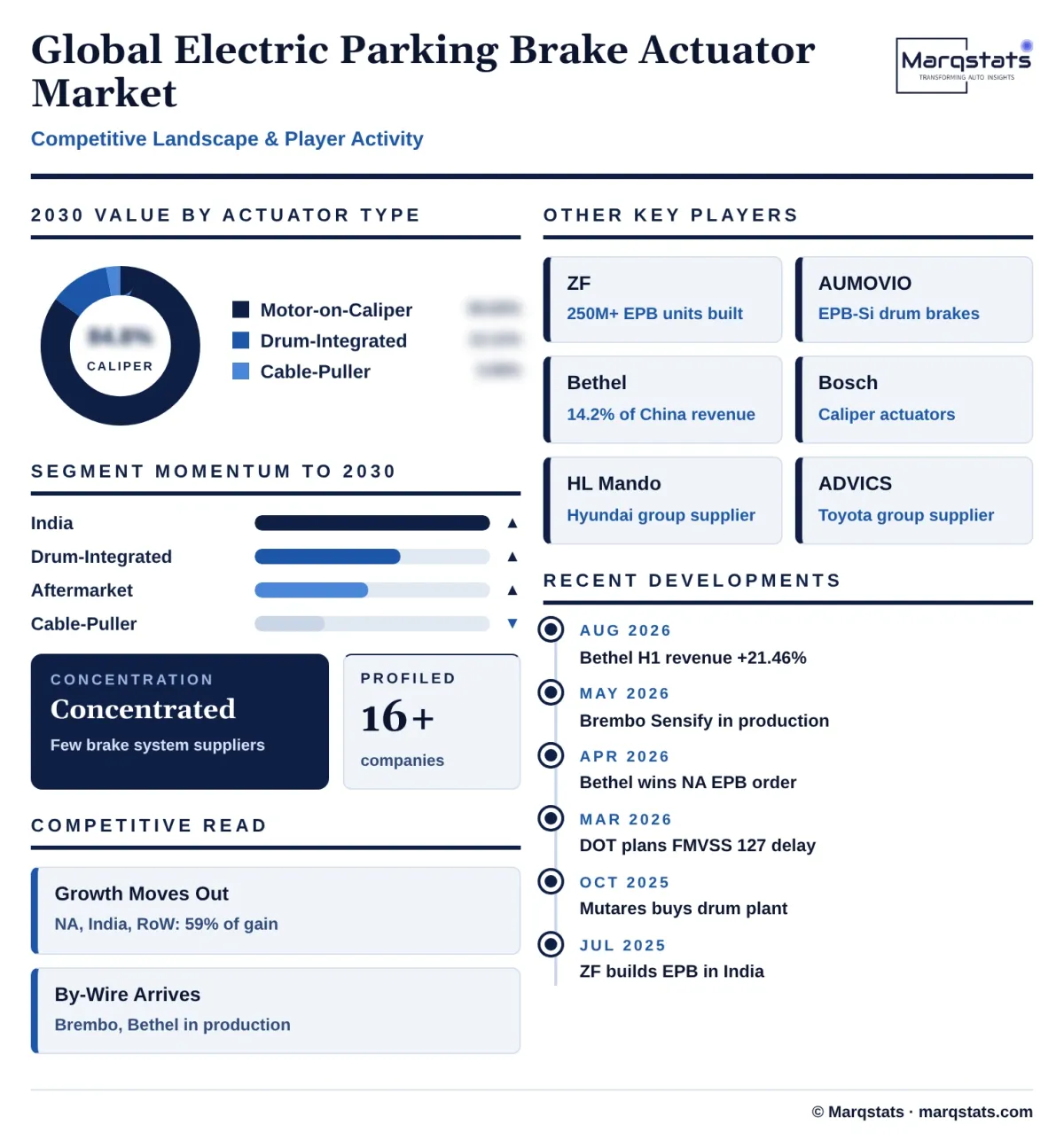
The electric parking brake actuator market is concentrated. Brake system suppliers sell the actuator as part of the caliper or brake corner, and a handful of them supply most of the world's vehicles: ZF, AUMOVIO (the former Continental automotive business), Bosch, Hitachi Astemo, ADVICS, HL Mando and Bethel Automotive Safety Systems. Many motor-gear units are built by specialist suppliers of small motors and plastic or metal gears.
ZF is the largest supplier. It introduced the motor-on-caliper electric parking brake about 25 years ago, passed 250 million units by October 2024 and offers a front-axle electric parking brake for small cars with rear drum brakes. It began producing electric parking brakes in India in July 2025.
Chinese suppliers are gaining share. Bethel Automotive Safety Systems reported 2025 revenue of RMB 12.01 billion, up 20.91%, and first-half 2026 revenue of RMB 6.27 billion, up 21.46%. Its Hong Kong listing document reports a 14.2% share of China's electric parking brake market by revenue in 2025, third overall and first among Chinese suppliers, and more than 20 million electric parking brake sets built since mass production began in 2012. In April 2026 it won its largest overseas order, front calipers and rear electric parking brake calipers for about 2.335 million vehicles over six years for a leading global carmaker in North America, and it is building plants in Mexico and Morocco.
European suppliers are restructuring. Continental spun off its automotive business as AUMOVIO in September 2025, and in October 2025 Mutares completed the purchase of AUMOVIO's Cairo Montenotte drum brake plant in Italy, which makes EPB-Si drum parking brakes and expected about EUR 100 million of 2025 revenue with about 400 employees. HL Mando reported second-quarter 2026 revenue of KRW 2,495.3 billion, up 3.9%, and operating profit of KRW 107.0 billion, up 2.8%.
Brake-by-wire adds new competition. Brembo, which is better known for performance calipers, put its Sensify brake-by-wire system into series production in May 2026, fitted as standard on every vehicle in its launch programme, and Bethel delivered its first all-electric wheel brakes in March 2026. Suppliers that control both the wheel actuator and the braking software will decide how the parking function is supplied in the 2030s.
Competition is decided by cost, durability and software. Brake suppliers that make their own motor-gear units, hold long carmaker programmes and integrate parking brake control into the stability control unit win most business, while specialist motor makers compete on cost per unit and on quiet, compact designs.
Companies Covered
Companies covered in the report include:
Recent Market Activity
Table of Contents
Coverage & Segmentation
The study covers the global electric parking brake actuator market, with 2025 as the base year, 2021 – 2025 as the historical period and 2026 – 2030 as the forecast period. Values are in US dollars at ex-factory prices, whether the actuator is bought from a specialist or built in house by the brake supplier. Volumes are actuator units, counting each motor-on-caliper or drum actuator separately and each cable puller once. The market covers factory fitment on new light vehicles and replacement actuators, segmented by actuator type, sales channel, vehicle type and region, with regions defined by where the vehicle is built or the replacement is sold.
Brake calipers, carriers, discs, drums and pads, electronic control units and control software, cabin switches, wiring, hydraulic modulators, and electromechanical brake-by-wire wheel actuators that also provide service braking are excluded, as are pneumatic spring brake chambers on heavy trucks. Fitment rates, unit counts, prices and splits are Marqstats estimates built on vehicle production data, supplier disclosures and price benchmarks. Euro conversions use EUR 1 = USD 1.13 and yuan conversions CNY 7.18 per USD, the 2025 averages.