Market Snapshot
Middle bar: base-year value × (1 + CAGR), rounded to two decimals. This is a calculated illustration, not a separately researched annual estimate.
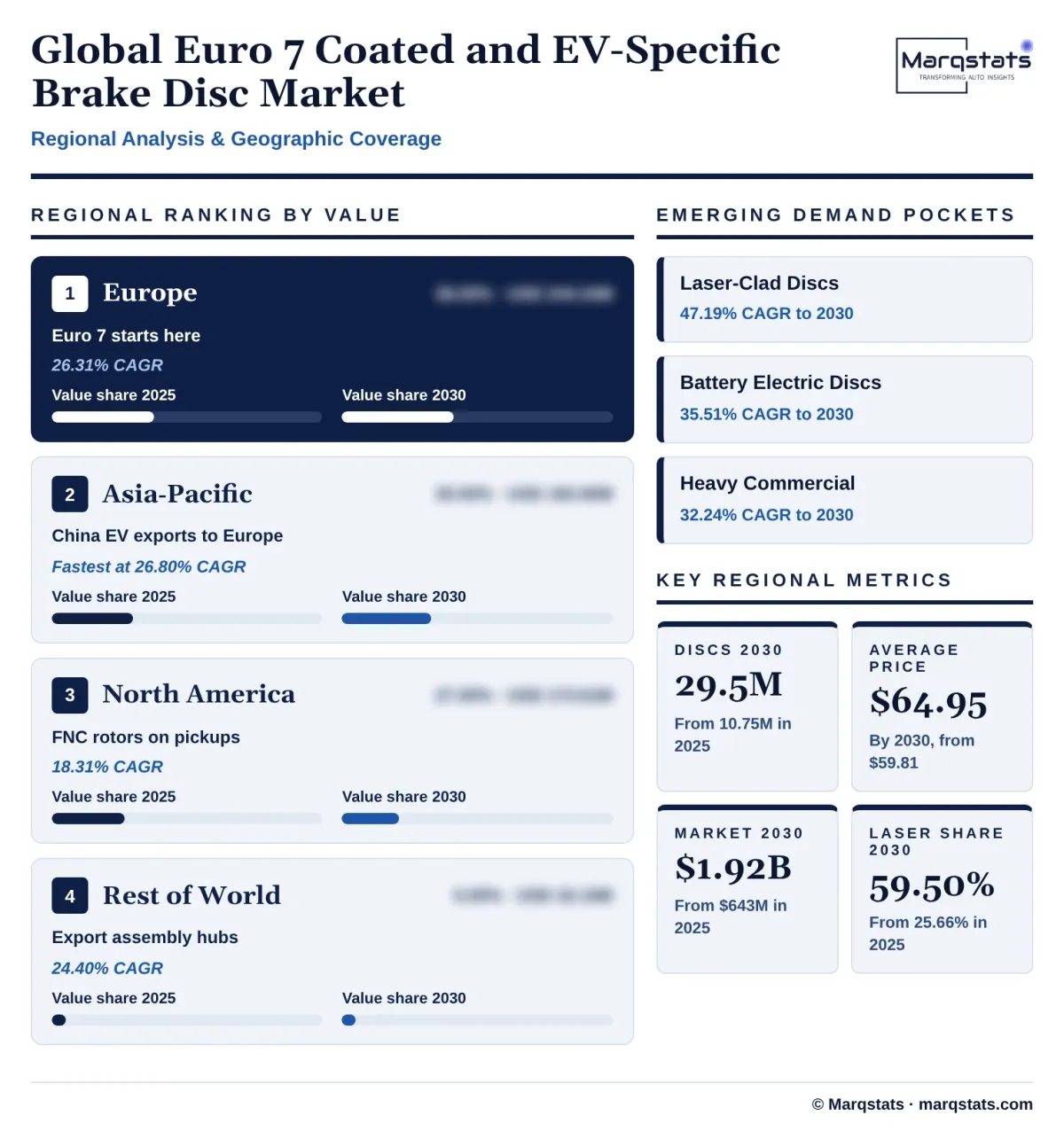
The global Euro 7 coated and EV-specific brake disc market size is estimated at USD 643.00 million in 2025 and is projected to reach USD 1,916.00 million by 2030, growing at a CAGR of 24.40% over 2026 – 2030. Annual shipments rise from about 10.75 million discs to 29.50 million, a 22.37% annual rate, while the average selling price rises gently from about USD 59.81 to USD 64.95 per disc as the mix shifts toward laser-clad discs.
Marqstats defines the market as the ex-factory value of brake discs whose friction surfaces are hardened or coated to cut wear, brake dust and corrosion, sold to carmakers as original equipment and to the aftermarket as replacement parts. It covers discs treated by ferritic nitrocarburizing (FNC), discs with thermally sprayed carbide coatings, discs with laser-clad metal-matrix coatings applied by high-speed laser metal deposition, and nitrided or stainless steel discs. Standard uncoated grey cast iron discs, discs with only painted or zinc-flake anti-corrosion finishes, carbon-ceramic discs, drum brakes, pads, calipers and workshop repair services are excluded.
Ferritic nitrocarburized discs account for 39.20% of 2025 value, passenger cars for 76.00% and original equipment for 82.00%. Europe accounts for 38.00% of 2025 value and Asia-Pacific for 30.00%. The study segments the market by coating technology, vehicle type, powertrain, sales channel and region.
Key Takeaways
Market Overview & Analysis
Report Summary
Marqstats sizes the Euro 7 coated and EV-specific brake disc market as the ex-factory value of brake discs with engineered friction surfaces. In 2025 about 10.75 million such discs were shipped worldwide, worth an estimated USD 643.00 million at an average of about USD 59.81 per disc, a small but fast-growing part of a global brake disc market that Marqstats estimates at about USD 18 billion.
For decades a brake disc has been a grey cast iron casting, machined flat and sold on price. Cast iron is cheap, conducts heat well and damps vibration, but it wears steadily, sheds iron-rich dust onto wheels and roads, and rusts quickly when it is wet and cold. Brake wear has become one of the largest sources of particle emissions from road traffic as exhaust emissions have fallen, and electric cars, which slow mostly through their motors, leave their discs idle long enough to rust.
Euro 7, Regulation (EU) 2024/1257, is the first vehicle emission standard in the world to set limits on brake particles. It caps PM10 brake emissions at 3 mg/km for battery electric cars and 7 mg/km for other cars until 2034, with 3 mg/km applying to all cars from 2035, and sets 5 mg/km for electric vans and 11 mg/km for other vans. The limits apply to new car and van types from 29 November 2026 and to all new cars from 29 November 2027, measured on a brake dynamometer under the harmonized UN Global Technical Regulation No. 24 test cycle.
Suppliers have developed four ways to meet these limits at the disc. Ferritic nitrocarburizing diffuses nitrogen and carbon into the iron surface in a furnace, forming a hard, corrosion-resistant layer a few microns deep. Thermal spraying fires carbide powder onto the disc at high speed, as on Porsche discs with tungsten carbide coatings. High-speed laser metal deposition melts a stainless or metal-matrix powder onto the disc in two layers, a bonding layer and a hard wear layer, and then grinds it smooth. Nitrided stainless steel discs, still in development, replace cast iron altogether.
The market grew from an estimated USD 410.00 million in 2021 to USD 505.00 million in 2023 and USD 566.00 million in 2024, an 11.91% CAGR over 2021 – 2025, driven by FNC discs on mainstream North American and European cars and carbide-coated discs on premium models. Marqstats expects USD 768.00 million in 2026, rising faster from 2027 as Euro 7 applies to all new cars.
Global Euro 7 Coated and EV-Specific Brake Disc Market Size and Forecast
The global Euro 7 coated and EV-specific brake disc market grows from USD 643.00 million in 2025 to USD 1,916.00 million in 2030, a CAGR of 24.40%. Marqstats expects the market to reach USD 768.00 million in 2026, USD 945.00 million in 2027, USD 1,195.00 million in 2028 and USD 1,520.00 million in 2029, with annual shipments of about 12.70 million discs in 2026, 15.50 million in 2027, 19.30 million in 2028 and 24.10 million in 2029.
Growth accelerates after 2027. Annual growth rises from 19.44% in 2026 to 23.05% in 2027 and 26.46% in 2028 as the 29 November 2027 deadline brings every new car registered in the European Union under the brake particle limits, then settles at about 26% a year through 2030 as laser cladding spreads to front axles on mainstream models in Europe and China.
The average selling price rises slowly because of mix, not because individual discs get dearer. Marqstats estimates the average at about USD 59.81 per disc in 2025, rising steadily to USD 60.47 in 2026, USD 61.92 in 2028 and USD 64.95 in 2030. Within each technology prices fall as laser cells run faster and powder use improves, but the share of high-value laser-clad discs rises from about 10% of units in 2025 to about 41% in 2030.
Prices differ sharply by technology. Marqstats estimates FNC-treated passenger car discs at about USD 26 to 28 each, laser-clad discs at about USD 150 in 2025 falling to about USD 95 by 2030, and thermally sprayed carbide discs for premium and performance cars at about USD 320 to 380. The coating adds roughly USD 8 to 15 per disc for FNC and USD 35 to 60 for laser cladding over an uncoated casting, Marqstats estimates.
Regulation and electric vehicle volumes set the pace. Marqstats tracks four indicators to monitor the forecast: European new car type approvals under Euro 7, the share of new electric platforms specified with coated discs, laser cladding cell installations at foundries and disc makers, and the final rules for replacement brake parts in the independent aftermarket.
Market Dynamics
Key Drivers
Five forces are turning the brake disc from a plain iron casting into a surface-engineered part.
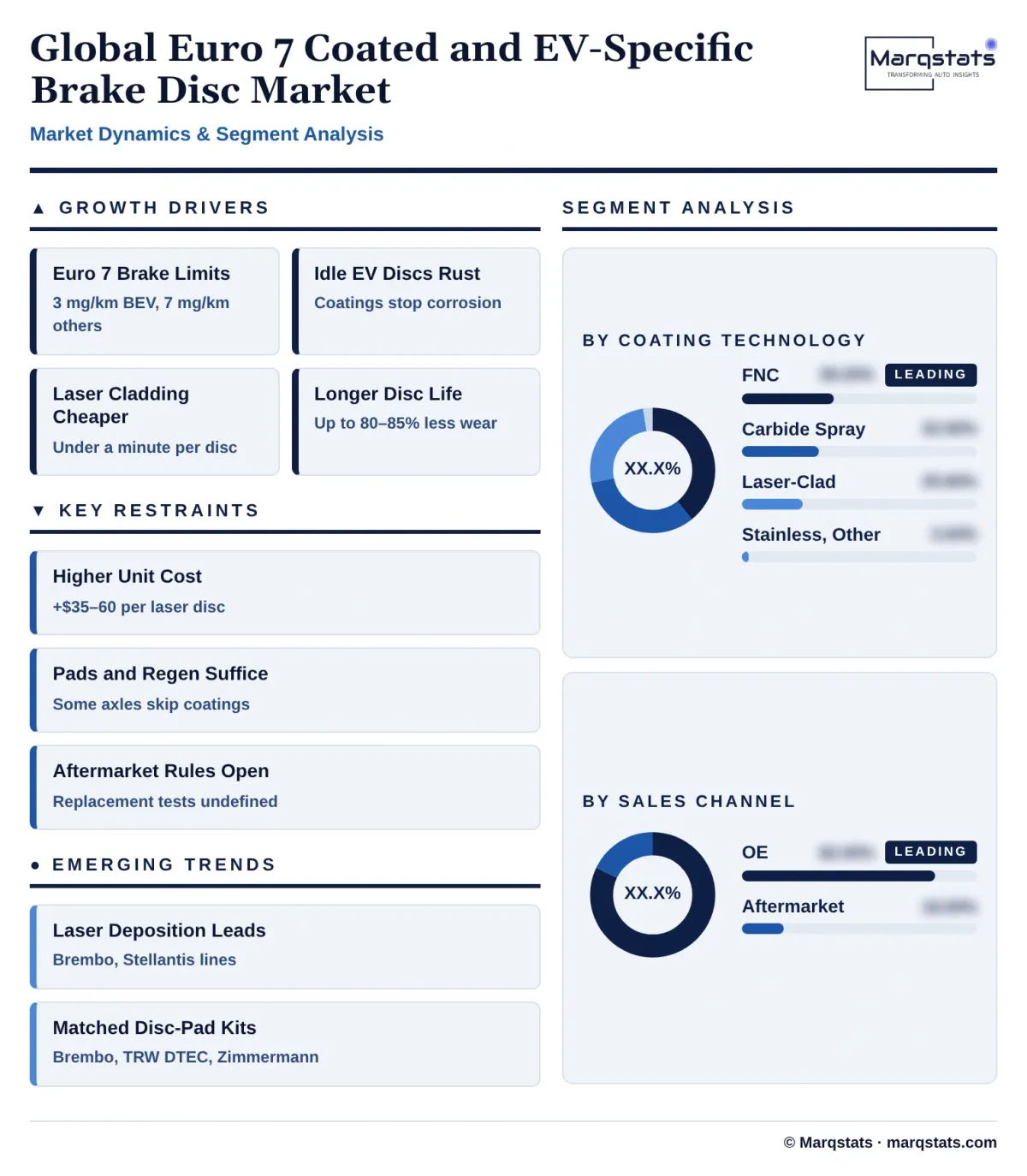
- Euro 7 brake particle limits. From 29 November 2026 new car and van types must meet PM10 brake limits of 3 mg/km for electric cars and 7 mg/km for other cars, and from 29 November 2027 all new cars must comply, making low-dust discs and pads a type-approval requirement.
- Corrosion on electric car discs. Regenerative braking leaves cast iron discs cold and idle, so they rust; coated and nitrocarburized discs resist corrosion and keep the friction surface smooth, which helps electric cars pass roadworthiness tests and stay within particle limits over their life.
- Falling cost of laser cladding. Automated cells such as the Comau and Prima Additive Rapid Coating system and laser sources from TRUMPF and Laserline have cut cycle times to well under a minute per disc, bringing laser-clad discs within reach of mainstream platforms.
- Longer disc life. Coated and stainless discs wear far less than cast iron; Fraunhofer IWU reported more than 85% less wear for its nitrided stainless steel disc, and Brembo reports up to 80% lower disc wear for its laser-coated Greenance Plus discs, which lowers lifetime cost for fleets.
- Premium and electric platform specification. Carmakers are specifying coated discs on new electric and premium platforms to combine low dust, clean wheels and corrosion resistance, and early programs set the reference for later mass-market models.
Key Restraints
Four constraints limit how fast coated and EV-specific brake disc revenue can grow.
- Higher unit cost. Laser cladding adds an estimated USD 35 to 60 per disc over a plain casting, a large increase for discs that sell for a few tens of dollars, which makes cost-sensitive carmakers look for cheaper routes to compliance.
- Compliance through pads and regeneration. Many cars, especially electric models that brake mostly through their motors, can meet Euro 7 limits with new low-emission pads and software that increases regenerative braking, which reduces the need for coated discs on some axles.
- Undefined aftermarket rules. Final Euro 7 requirements for replacement brake parts sold to independent workshops are still under discussion, and parts makers face high testing costs, which slows investment in aftermarket coated disc ranges.
- Pad and disc matching. A hard coating only works with a pad formulated for it; mismatched pairs can transfer wear to the pad, raise noise and increase fine particles, so each disc needs a validated pad partner and dynamometer testing.
Key Trends
Four shifts are changing how suppliers, carmakers and the aftermarket design, coat and sell brake discs.
- Laser metal deposition becomes the main route. Brembo applies a nickel-free, two-layer coating by laser metal deposition on its Greentell and Greenance Plus discs, and Stellantis scheduled an automated laser cladding line at its Sept-Fons plant in France.
- Matched low-dust disc and pad kits. Brembo, ZF Aftermarket with TRW DTEC and Otto Zimmermann sell or develop discs and pads as matched pairs, tested on in-house brake particle dynamometers, so workshops can fit complete low-emission sets.
- Brake-by-wire and smart blending. Brembo is localizing its Sensify brake-by-wire system in China with Ningbo Huaxiang, and electronic control of when the friction brakes act lets carmakers combine regeneration and coated discs to keep brake particles low.
- Stainless and lightweight discs. Formed, nitrided stainless steel discs developed by Fraunhofer IWU, ElringKlinger and partners save up to 5 kg per set of four and target lifetime durability, pointing to discs that may never need replacing.
Strategic Implications
- For disc makers and foundries, coating capacity is the new bottleneck. Adding laser cladding cells at the foundry exit turns a commodity casting into a higher-value part, and suppliers that install capacity before 2027 will win the first Euro 7 platform awards.
- For carmakers, the disc and pad must be specified together. Choosing a coating, a pad compound and a regenerative braking strategy as one system is the cheapest way to meet the 3 mg/km and 7 mg/km limits without overspending on every axle.
- For laser and equipment suppliers, brake discs are a high-volume application. Discs need fast, repeatable two-layer cladding and grinding, so lasers, optics, powder recovery and inspection systems designed for this job have a growing market.
- For aftermarket distributors and workshops, coated replacement discs need care. Coated discs must be fitted with the matching pad and checked with suitable tools, and distributors that stock complete low-dust kits will be ready when replacement rules are finalized.
- For commercial vehicle makers, heavy-duty coated rotors are coming. ZF plans production of the MAXX Uniper brake from 2027, and fleets will weigh lower dust and longer rotor life against higher purchase prices.
Market Segmentation
Ferritic nitrocarburized discs account for 39.20% of 2025 value, USD 252.07 million, on about 9.0 million discs, and grow at 10.54% a year to USD 416.00 million, while their share falls to 21.71% by 2030. The furnace treatment forms a hard iron nitride layer with an oxide cap that resists rust and wear at low cost, and North American carmakers including General Motors have used FNC rotors on many models to stop corrosion.
Thermally sprayed carbide discs account for 32.50% of 2025 value, USD 208.97 million, on about 0.55 million discs, and grow at 6.63% a year to USD 288.00 million and 15.03% by 2030. High-velocity spraying of tungsten carbide or chromium carbide powders gives a very hard surface, used on premium and performance cars such as Porsche models with surface-coated brakes, but the process uses more powder and costs more than laser cladding.
Laser-clad discs account for 25.66% of 2025 value, USD 165.00 million, on about 1.10 million discs, and grow fastest, at 47.19% a year, to USD 1,140.00 million and 59.50% by 2030. High-speed laser metal deposition welds a bonding layer and a hard wear layer onto the disc in under a minute, cutting brake dust by up to 90% in supplier tests, and becomes the main route to Euro 7 compliance on front axles.
Nitrided stainless steel, PVD-coated and other engineered discs account for 2.64% of 2025 value, USD 16.96 million, and grow at 33.53% a year to USD 72.00 million and 3.76% by 2030. Formed stainless discs such as the one developed by Fraunhofer IWU and ElringKlinger remain at an early stage, so most value in this group comes from low-volume specialist programs.
Passenger cars account for 76.00% of 2025 value, USD 488.68 million, and grow at 23.74% a year to USD 1,417.84 million and 74.00% by 2030. They are the first vehicles covered by Euro 7 brake limits and the main users of FNC, carbide and laser-clad discs.
Light commercial vehicles account for 12.00% of 2025 value, USD 77.16 million, and grow at 27.37% a year to USD 258.66 million and 13.50% by 2030. Vans face limits of 5 mg/km for electric models and 11 mg/km for others, and their heavy loads and stop-start use reward long-life coated discs.
Trucks and buses account for 7.00% of 2025 value, USD 45.01 million, and grow at 32.24% a year to USD 182.02 million and 9.50% by 2030. Euro 7 applies to new heavy-duty types from 2028, and coated air disc brake rotors such as the ZF MAXX Uniper enter production from 2027.
Motorcycles and scooters account for 5.00% of 2025 value, USD 32.15 million, and grow at 12.32% a year to USD 57.48 million, while their share falls to 3.00% by 2030. Coated and stainless discs are already common on motorcycles, but they are not yet covered by brake particle limits, so growth is slower.
Discs for combustion-engine vehicles account for 52.00% of 2025 value, USD 334.36 million, and grow at 11.44% a year to USD 574.80 million, while their share falls to 30.00% by 2030. FNC discs on mainstream combustion cars and pickups make up most of this value.
Discs for battery electric vehicles account for 30.00% of 2025 value, USD 192.90 million, and grow at 35.51% a year to USD 881.36 million and 46.00% by 2030. The 3 mg/km limit and rust on idle discs push new electric platforms toward laser-clad and nitrocarburized discs.
Discs for hybrids and plug-in hybrids account for 18.00% of 2025 value, USD 115.74 million, and grow at 31.77% a year to USD 459.84 million and 24.00% by 2030. These vehicles face the 7 mg/km limit but use their friction brakes more than electric cars.
Original equipment discs fitted on new vehicles account for 82.00% of 2025 value, USD 527.26 million, and grow at 23.17% a year to USD 1,494.48 million, while their share eases to 78.00% by 2030. Euro 7 type approval makes the factory specification the main driver of demand.
Replacement coated discs sold to workshops and parts distributors account for 18.00% of 2025 value, USD 115.74 million, and grow at 29.50% a year to USD 421.52 million and 22.00% by 2030. Brembo, ZF Aftermarket and Otto Zimmermann are building low-dust ranges as the first Euro 7 cars reach replacement age.
By Geography
Europe
Europe is the largest market, with 38.00% of 2025 value, USD 244.34 million, rising to an estimated USD 785.56 million by 2030, a 26.31% CAGR, lifting its share to 41.00%. Euro 7 brake limits apply to new types from 29 November 2026 and to all new cars from 29 November 2027, and the region hosts the leading developers of coated discs and laser cladding equipment, including Brembo, ZF, Otto Zimmermann, TRUMPF, Comau and Prima Additive.
Asia-Pacific
Asia-Pacific accounts for 30.00% of 2025 value, USD 192.90 million, and grows fastest, at an estimated 26.80% a year, to USD 632.28 million and 33.00% of the market by 2030. China builds most of the world's electric cars, and its carmakers and disc makers are adding coated discs to models exported to Europe, while Brembo is localizing Sensify brake-by-wire in China with Ningbo Huaxiang.
North America
North America accounts for 27.00% of 2025 value, USD 173.61 million, and grows at an estimated 18.31% a year to USD 402.36 million, while its share falls to 21.00% by 2030. FNC rotors on mainstream cars and pickups make the region a large user of nitrocarburized discs, but it has no federal brake particle limit, so laser-clad discs spread more slowly than in Europe.
Rest of World
The rest of the world accounts for 5.00% of 2025 value, USD 32.15 million, and grows at an estimated 24.40% a year to USD 95.80 million by 2030, keeping a 5.00% share. Demand comes from vehicles assembled for export to Europe in Latin America, Türkiye and Morocco and from imported premium and electric models in the Gulf states.
How Competition Is Evolving
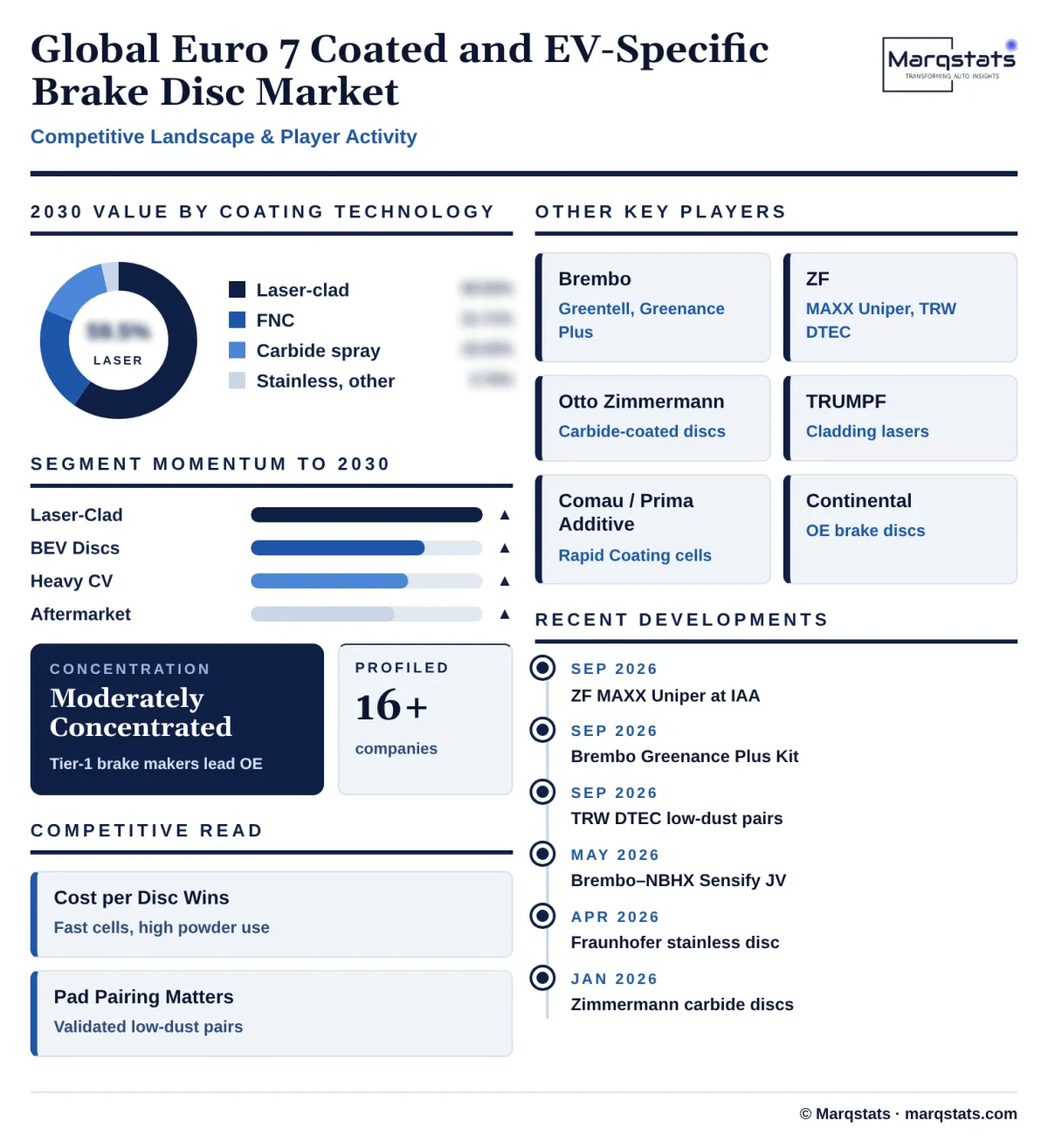
The coated and EV-specific brake disc market is moderately concentrated. Brembo, Continental, ZF, Bosch through Buderus Guss, Aisin and its braking affiliate ADVICS, Hitachi Astemo and a group of specialist disc makers account for most original equipment supply, while Otto Zimmermann, Brembo and ZF Aftermarket lead coated replacement discs.
Equipment suppliers shape the cost curve. TRUMPF and Laserline supply laser sources, Comau and Prima Additive supply automated cladding cells, Nagel supplies cladding and grinding systems, Oerlikon supplies coating powders and thermal spray services, and Nitrex supplies nitrocarburizing furnaces, so the price of a coated disc depends on how fast and how efficiently these lines run.
Carmakers decide where coatings are used. Stellantis has invested in its own laser cladding line, Porsche has used surface-coated brakes for years, and electric carmakers choose between coated discs and heavier use of regenerative braking to meet the limits.
Competition will be decided by cost per disc and by proven pad pairs. Suppliers that can coat a disc in under a minute, with high powder efficiency, and supply a matched pad that passes the Euro 7 test will win most platform awards.
Companies Covered
Companies covered in the report include:
Recent Market Activity
Table of Contents
Coverage & Segmentation
The study covers the global Euro 7 coated and EV-specific brake disc market, with 2025 as the base year, 2021 – 2025 as the historical period and 2026 – 2030 as the forecast period. Values are in US dollars at ex-factory prices, and volumes are discs shipped. The market is segmented by coating technology, vehicle type, powertrain, sales channel and region.
The study sizes new discs only. Workshop repair of corroded brakes on electric vehicles, including skimming and workshop-applied anti-corrosion treatments, is covered in the separate Marqstats study of the EV brake corrosion repair market, and the two markets should not be added together. Uncoated grey cast iron discs, discs with only painted or zinc-flake finishes, carbon-ceramic discs, pads, calipers and drum brakes are excluded. Segment splits, regional values, unit volumes and prices are Marqstats estimates built on supplier disclosures, regulatory timelines and vehicle production data.