Market Snapshot
Middle bar: base-year value × (1 + CAGR), rounded to two decimals. This is a calculated illustration, not a separately researched annual estimate.
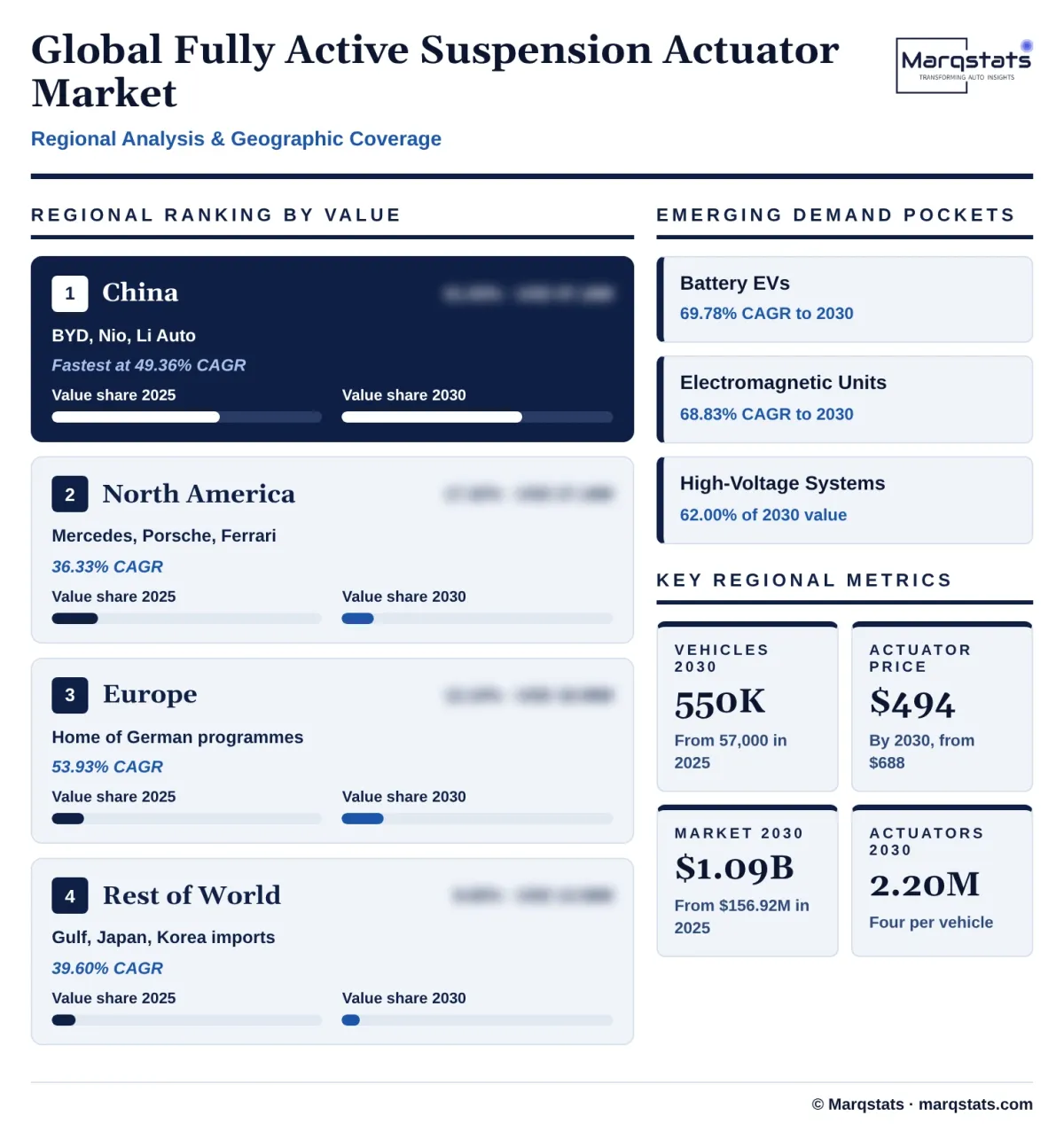
The global fully active suspension actuator market size is estimated at USD 156.92 million in 2025 and is projected to reach USD 1,086.40 million by 2030, growing at a CAGR of 47.25% over 2026 – 2030. Actuator shipments rise from about 228,000 units on 57,000 vehicles to 2.20 million units on 550,000 vehicles, a 57.36% annual rate, while the average price per corner actuator falls from about USD 688 to USD 494.
Marqstats defines the market as the original equipment value of the force-generating corner actuators in fully active suspension systems, meaning the electro-hydraulic motor-pump units or electromechanical and electromagnetic actuators that push and pull each wheel independently of road input, together with their integrated motor drive electronics. Semi-active dampers that only vary damping resistance, passive dampers, air springs and compressors, active anti-roll bar actuators, chassis domain controllers, preview cameras and the rest of the vehicle are excluded.
Electro-hydraulic actuators account for an estimated 89.91% of 2025 value and high-voltage systems for 51.73%. China accounts for 61.93% of 2025 value and North America for 17.32%. The study segments the market by actuator technology, power supply voltage, vehicle powertrain and region.
Key Takeaways
Market Overview & Analysis
Report Summary
Marqstats sizes the fully active suspension actuator market as the original equipment value of the corner actuators that let a vehicle control the vertical force at each wheel. In 2025 about 57,000 vehicles worldwide were built with fully active suspension, carrying about 228,000 corner actuators worth an estimated USD 156.92 million at an average of about USD 688 per actuator.
A fully active suspension differs from a semi-active one in a simple way. A semi-active damper can only resist motion, by changing how easily oil flows through its valves. A fully active actuator adds energy: an electric motor drives a pump or a screw that pushes the wheel down or pulls it up, so the system can hold the body flat in corners, lean into a bend, lift a wheel over a pothole seen by a camera, or cancel pitch under braking. Because each corner is controlled separately, several fully active systems remove the anti-roll bars altogether.
Two actuator designs are in production. Electro-hydraulic units pair a small electric motor and pump with a hydraulic damper at each corner, as in Porsche Active Ride, Mercedes-Benz E-Active Body Control, ClearMotion SkyRide on Nio vehicles, BYD DiSus-P active hydraulic body control on Fangchengbao and Yangwang models, and the Multimatic TrueActive Spool Valve dampers on the Ferrari Purosangue. Electromechanical and electromagnetic units use a motor and gearbox or a linear motor to apply force directly, as in the Audi A8 predictive active suspension and the BYD Yangwang U7 DiSus-Z system.
Power supply is the other design choice. Most early systems run from a 48-volt network: Nio SkyRide, Mercedes-Benz E-Active Body Control, Audi and Ferrari use 48 volts. Porsche Active Ride draws power from the 400-volt system of the Panamera hybrid and, through a converter, from the 800-volt Taycan battery, and Li Auto calls the L9 Livis system an 800-volt fully independent active suspension.
The market grew from about 6,500 equipped vehicles in 2021, worth USD 24.96 million, to 8,000 in 2022, 15,000 in 2023 and 34,000 in 2024, worth USD 100.44 million, as the Ferrari Purosangue, BYD DiSus-P on Yangwang and Fangchengbao models, and Porsche Active Ride entered production. Marqstats expects about 125,000 equipped vehicles and USD 310.00 million of actuator value in 2026 as the Nio ES9 and Li Auto L9 Livis add volume.
Regulation shapes design rather than demand. No regulator requires fully active suspension. Actuators that can move the body under software control must, however, meet ISO 26262 functional safety rules, the cybersecurity and software update requirements of UN Regulations 155 and 156 in markets that apply them, China's GB 44495-2024 vehicle cybersecurity standard, and high-voltage electrical safety rules when they run from the traction battery.
The 2025 market is a mix of mature and new programmes. Mercedes-Benz has offered E-Active Body Control on the GLE and GLS since 2019, Audi has offered predictive active suspension on the A8 since 2019, and Ferrari fitted Multimatic TrueActive Spool Valve dampers as standard to the Purosangue from 2023. The newest and fastest-growing programmes are Chinese: BYD introduced DiSus systems on the Yangwang U8 in 2023 and the electromagnetic DiSus-Z on the U7 in 2025, Nio fitted SkyRide to the ET9 from 2025, and Li Auto added the L9 Livis in 2026.
Global Fully Active Suspension Actuator Market Size and Forecast
The global fully active suspension actuator market grows from USD 156.92 million in 2025 to USD 1,086.40 million in 2030, a CAGR of 47.25%. Marqstats expects about 200,000 equipped vehicles worth USD 456.00 million in 2027, 290,000 worth USD 620.60 million in 2028 and 405,000 worth USD 826.20 million in 2029, before reaching 550,000 vehicles in 2030.
Prices fall as Chinese volume takes over. The average price per corner actuator falls from about USD 960 in 2021 and USD 739 in 2024 to USD 688 in 2025, USD 620 in 2026, USD 570 in 2027 and USD 494 in 2030. Shipments therefore grow at 57.36% a year while value grows at 47.25%.
The 2025 base is built programme by programme. Marqstats estimates about 22,000 BYD Fangchengbao Bao 5 and Bao 8 vehicles with DiSus-P, 9,000 Mercedes-Benz vehicles with E-Active Body Control, 8,000 Nio ET9s with SkyRide, 6,900 BYD Yangwang U7, U8, U8L and U9 vehicles with DiSus systems, 5,300 Porsche Panamera and Taycan cars with Active Ride, 2,500 Ferrari Purosangues, 1,800 Audi A8s and about 1,500 other vehicles. Porsche delivered 27,701 Panameras and 16,339 Taycans in 2025, and Active Ride is an option on most versions and standard on the most powerful ones.
Corner actuator prices differ widely by programme. Marqstats estimates about USD 450 per corner for DiSus-P on Fangchengbao models, USD 600 for Nio SkyRide, USD 650 to 800 for BYD Yangwang systems, USD 900 to 950 for Mercedes-Benz and Audi, about USD 1,050 for Porsche and about USD 1,250 for the low-volume Ferrari units. The actuator is only part of the system price: preview cameras, a central controller, wiring and software take total system content to roughly USD 4,000 to 8,000 per vehicle.
Marqstats tracks four indicators to monitor the forecast: monthly deliveries of the Nio ES9 and ET9, Li Auto L9 Livis and BYD Yangwang models; announcements of fully active suspension on vehicles priced below RMB 300,000; the share of programmes using high-voltage power; and quoted corner actuator prices from Chinese suppliers.
The mix of vehicles changes over the forecast. Battery electric vehicles rise from 27.00% to 55.00% of value, high-voltage systems from 51.73% to 62.00% and electromechanical and electromagnetic actuators from 10.09% to 20.00%. China rises from 61.93% to 66.50% of value, Europe rises from 12.10% to 15.10% and North America falls to 11.78% as North American demand grows more slowly than Chinese and European demand.
The forecast assumes adoption stays concentrated in vehicles priced above about USD 70,000 until 2028. China installed about 20,800 sets of active hydraulic suspension on BYD Fangchengbao and Yangwang models in January to October 2025, according to industry installation data, and Marqstats expects Chinese demand to reach about 430,000 vehicles by 2030 as fully active systems spread from flagships to vehicles priced between RMB 250,000 and 400,000. European and North American volumes grow more slowly because fully active suspension remains an option costing several thousand dollars, and Marqstats assumes take rates on Porsche, Mercedes-Benz and Audi models rise only gradually. The main risk to the forecast is price: if corner actuators fall below USD 400 faster than expected, fitment on vehicles priced between USD 40,000 and 70,000 could start before 2030.
Market Dynamics
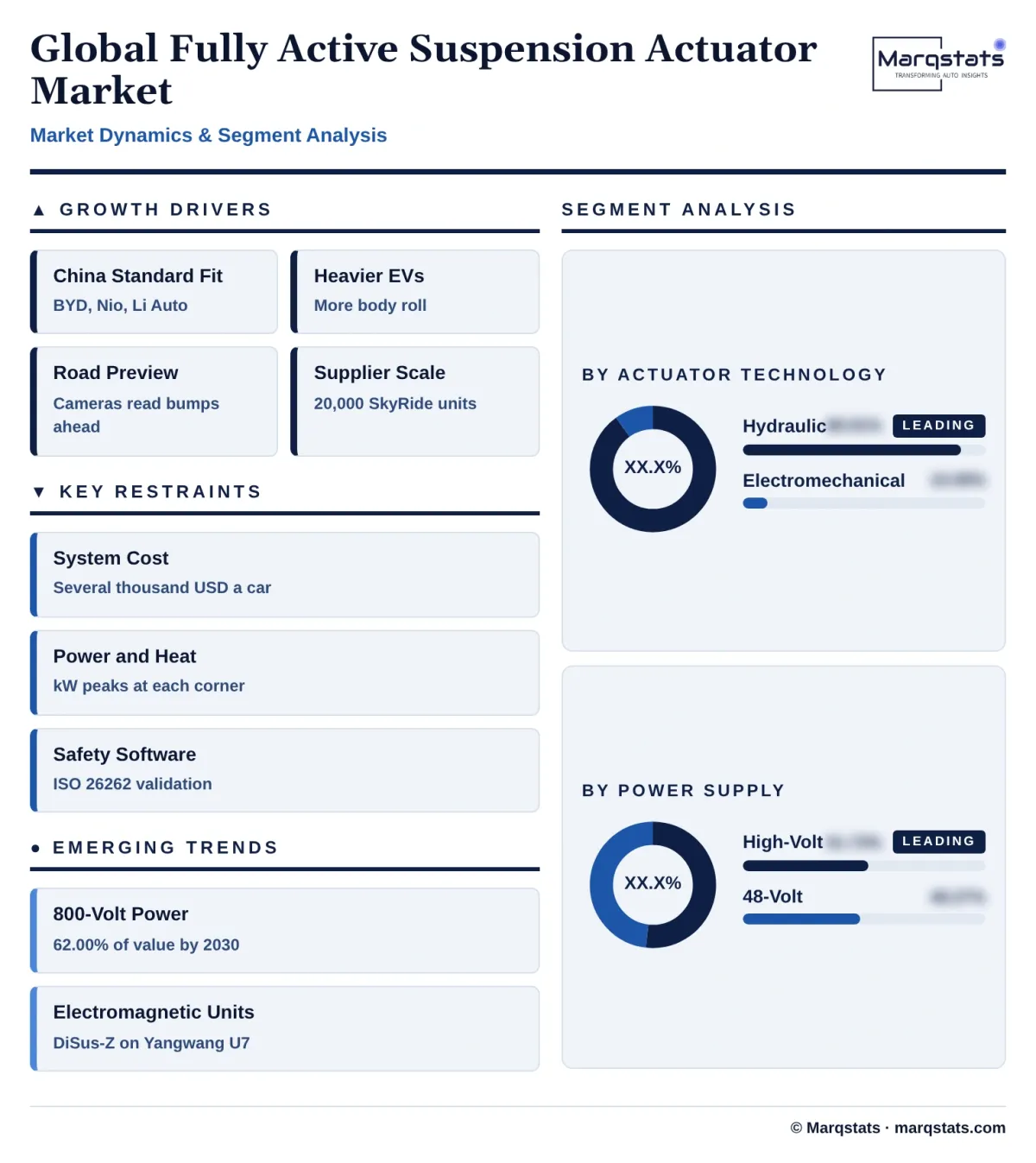
Key Drivers
Five forces are moving fully active suspension from a rare luxury option to standard equipment on premium electric vehicles.
- Chinese flagship electric vehicles make it standard. Nio fits ClearMotion SkyRide actuators to the ET9 and ES9, BYD fits DiSus systems across Yangwang and Fangchengbao models and Li Auto made 800-volt fully active suspension standard on the L9 Livis in May 2026, using ride comfort as a key selling point against German luxury brands.
- Heavier electric vehicles need better body control. Large battery packs add several hundred kilograms, raising body roll and pitch, and fully active corners can hold the body flat without the stiff springs and anti-roll bars that spoil ride comfort.
- Preview sensing gives the actuators something to do. Cameras and maps that read the road ahead let the system prepare for a bump before the wheel reaches it, which turns a technical capability into a ride difference passengers notice.
- Automated driving raises comfort expectations. When the driver becomes a passenger, motion sickness from pitch and roll matters more, and active control of body motion becomes part of the premium cabin experience.
- Suppliers are building volume capacity. ClearMotion reported 20,000 units of SkyRide output for the ET9 and ES9 by September 2026, showing that fully active actuators can be built at automotive volumes rather than in boutique quantities.
Key Restraints
Four constraints limit how fast fully active corner actuators can spread beyond flagship models.
- High cost. Four corner actuators, a controller, preview cameras and wiring cost several thousand dollars per vehicle, so the technology is limited to vehicles priced above about USD 70,000.
- Power and heat. Each corner can draw several kilowatts in short peaks, so 48-volt systems need heavy cables and careful thermal design, while high-voltage systems need insulation and safety measures.
- Functional safety and software risk. A system that can move the body under software control must be designed to fail safely under ISO 26262, with redundant sensing and validated fallback behaviour, which lengthens development.
- Packaging and weight. Motor-pump units, hydraulic lines and electronics must fit at each corner, adding unsprung or near-wheel mass that engineers must offset elsewhere.
Key Trends
Four shifts are changing how fully active suspension actuators are designed, powered and sold.
- Move to high voltage. Porsche and Li Auto power their systems from the traction battery, and Marqstats expects high-voltage systems to rise from 51.73% to 62.00% of actuator value by 2030.
- Electromagnetic actuators. BYD Yangwang DiSus-Z uses linear electromagnetic motors at each corner and can recover energy from road motion, an alternative to hydraulic units.
- No anti-roll bars. Porsche Active Ride and the Ferrari Purosangue system replace anti-roll bars with independent corner control, simplifying the chassis once fully active corners are fitted.
- Chassis software. Carmakers increasingly coordinate suspension, steering and braking in one central chassis controller, and sell ride modes and comfort features through software rather than hardware alone.
Strategic Implications
- For actuator suppliers, cost per corner decides volume. Suppliers that can bring a high-voltage corner actuator towards USD 400 will open vehicles priced between USD 40,000 and 70,000, where volumes are many times larger.
- For carmakers, fully active suspension is a brand signature. Chinese premium brands are using standard fitment to compete with German luxury cars, and European brands must decide whether to keep it as an expensive option or fit it more widely.
- For damper and air suspension suppliers, active corners change content. Fully active systems still use dampers and often air springs, but more of the value moves into motors, pumps and power electronics.
- For semiconductor and motor suppliers, the corner actuator is a new socket. Each vehicle needs four motor drives with automotive safety ratings, adding content for power semiconductor and motor makers.
- For investors, the market is small but fast-growing. Value rises about sevenfold by 2030, but it depends on a handful of programmes, so supplier concentration and programme wins matter more than total market size.
- For regulators and safety bodies, active chassis systems are a new test area. As more vehicles can move their bodies under software control, functional safety assessment and cybersecurity rules for chassis software will matter more than any rule on the suspension hardware itself.
Market Segmentation
Electro-hydraulic actuators account for 89.91% of 2025 value, USD 141.08 million and about 52,200 vehicles, rising to USD 869.12 million by 2030, a 43.85% CAGR, while their share falls to 80.00%. Porsche Active Ride, Mercedes-Benz E-Active Body Control, Nio SkyRide, BYD DiSus-P on Fangchengbao and Yangwang models and the Ferrari Purosangue system use this approach.
Actuators that apply force directly through a motor and gearbox or a linear motor account for 10.09% of 2025 value, USD 15.84 million and about 4,800 vehicles, and grow at 68.83% a year to USD 217.28 million and 20.00% of the market by 2030. The Audi A8 predictive active suspension and the BYD Yangwang U7 DiSus-Z system are the main programmes.
Systems powered from a 48-volt network account for 48.27% of 2025 value, USD 75.74 million, through Mercedes-Benz, Nio, Audi and Ferrari programmes, and grow at 40.37% a year to USD 412.83 million, while their share falls to 38.00% by 2030.
Systems powered from the traction battery account for 51.73% of 2025 value, USD 81.18 million, through Porsche Active Ride and BYD Fangchengbao and Yangwang programmes, and grow at 52.68% a year to USD 673.57 million and 62.00% of 2030 value as Li Auto and other Chinese makers adopt 800-volt designs.
Battery electric vehicles account for 27.00% of 2025 value, USD 42.36 million, through the Nio ET9, Yangwang U7 and U9 and Porsche Taycan, and grow fastest, at 69.78% a year, to USD 597.52 million and 55.00% of the market by 2030.
Plug-in and range-extended hybrids account for 40.03% of 2025 value, USD 62.82 million, through the Fangchengbao Bao 5 and Bao 8, Yangwang U8 and U8L and Porsche Panamera E-Hybrid, and grow at 41.67% a year to USD 358.51 million and 33.00% of 2030 value as Li Auto range-extended models add volume.
Combustion and mild hybrid vehicles account for 32.97% of 2025 value, USD 51.74 million, through Mercedes-Benz GLE and GLS, Audi A8 and Ferrari Purosangue, and grow at 20.30% a year to USD 130.37 million, falling to 12.00% of the market by 2030.
By Geography
China
China is the largest market, with 61.93% of 2025 value, USD 97.18 million and about 41,800 equipped vehicles, rising to USD 722.40 million and 66.50% of the market by 2030, a 49.36% CAGR. BYD Fangchengbao and Yangwang, Nio and Li Auto fit fully active suspension as standard on flagship models, and imported or locally built Porsche, Mercedes-Benz and Audi models add further volume. Nio delivered 326,028 vehicles across its brands in 2025, and the ES9 launched in May 2026 at RMB 498,000 with SkyRide as standard.
North America
North America accounts for 17.32% of 2025 value, USD 27.18 million and about 6,900 vehicles, and grows at 36.33% a year to USD 128.00 million and 11.78% of the market by 2030. Demand comes from Mercedes-Benz GLE and GLS, Porsche and Ferrari buyers, and growth depends on European programmes and on whether Chinese brands or new US programmes adopt the technology.
Europe
Europe accounts for 12.10% of 2025 value, USD 18.98 million and about 4,700 vehicles, and grows at 53.93% a year to USD 164.00 million and 15.10% of the market by 2030. Porsche, Mercedes-Benz, Audi and Ferrari engineer and build the main programmes, and Porsche showed Active Ride on the Cayenne Electric prototype at the Goodwood Festival of Speed in July 2025.
Rest of the World
The rest of the world, mainly the Middle East, Japan, South Korea and Australia, accounts for 8.65% of 2025 value, USD 13.58 million and about 3,600 vehicles, and grows at 39.60% a year to USD 72.00 million and 6.62% of the market by 2030, supported by BYD Yangwang exports and luxury imports.
How Competition Is Evolving
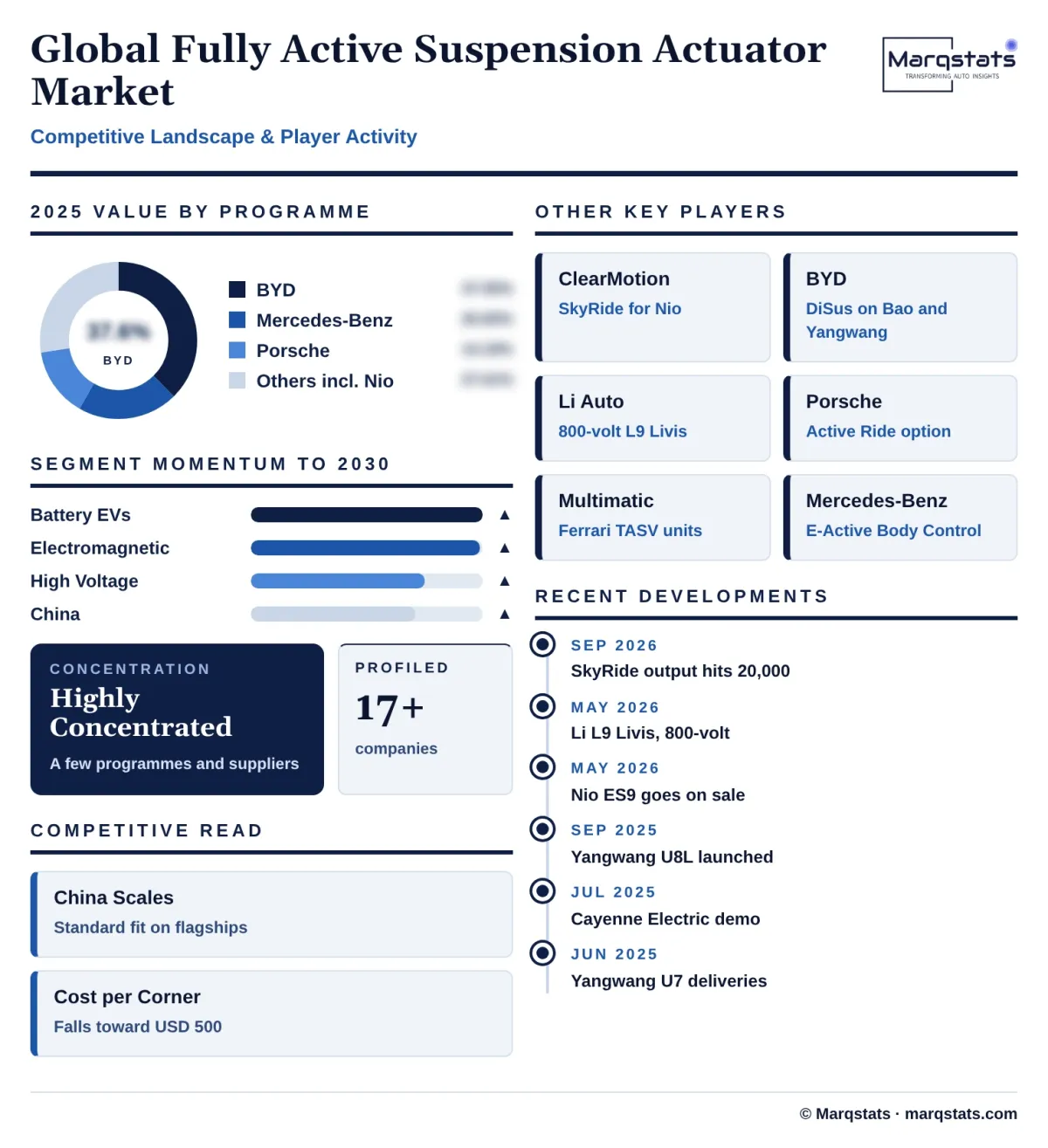
The fully active suspension actuator market is highly concentrated. A small number of vehicle programmes account for almost all demand, and each uses one actuator supplier or an in-house design: ClearMotion for Nio, BYD in-house DiSus systems across Yangwang and Fangchengbao, Multimatic for Ferrari, and the suppliers working with Porsche, Mercedes-Benz and Audi.
Two supply models compete. Specialist suppliers such as ClearMotion and Multimatic design actuators and control software and sell them to carmakers, while vertically integrated carmakers such as BYD develop their own systems. Large chassis suppliers including ZF, Continental, Schaeffler, KYB, HL Mando, Hitachi Astemo, BWI Group and Thyssenkrupp Bilstein supply dampers, air springs or actuator components and are developing their own fully active products.
BYD programmes across Fangchengbao and Yangwang account for an estimated 37.55% of 2025 actuator value, Mercedes-Benz for 20.65% and Porsche for 14.19%, with Nio, Ferrari, Audi and others making up the remaining 27.61%. By 2030 Chinese programmes dominate as Nio, Li Auto, BYD and other makers extend fitment to more models.
Competition will be decided by cost per corner, power density and software. Suppliers that can deliver compact high-voltage actuators at lower cost, with proven functional safety and tuning software, will win the next wave of Chinese and European programmes.
Volumes are moving to China. Nio delivered 326,028 vehicles across its three brands in 2025 and launched the SkyRide-equipped ES9 in May 2026, Li Auto made fully active suspension standard on its top L9 version, and BYD extended DiSus systems across the Yangwang and Fangchengbao ranges. European carmakers continue to sell fully active suspension as an option on high-end models, which keeps their volumes lower but their price per corner higher.
Companies Covered
Companies covered in the report include:
Recent Market Activity
Table of Contents
Coverage & Segmentation
The study covers the global fully active suspension actuator market, with 2025 as the base year, 2021 – 2025 as the historical period and 2026 – 2030 as the forecast period. Values are in US dollars at original equipment supplier prices, and volumes are corner actuators and equipped vehicles built each year. The market is segmented by actuator technology, power supply voltage, vehicle powertrain and region.
Semi-active solenoid and magnetorheological dampers, passive dampers, air springs and compressors, active anti-roll bar actuators, ride-height levelling systems, BYD DiSus-C damping control, chassis controllers, preview cameras, software licences and aftermarket replacement parts are excluded. Vehicle and actuator counts by programme, prices and all splits are Marqstats estimates built on carmaker and supplier disclosures, delivery data and technical descriptions.