Market Snapshot
Key Takeaways
Market Overview & Analysis
Report Summary
The global investment casting market comprises precision lost-wax casting of ferrous, nickel-superalloy, titanium, and select non-ferrous metals using ceramic shell molds, serving aerospace and defense, automotive, energy, medical, and industrial applications. This study segments the market by material, application, and alloy type, with a 2025 base year, historical coverage from 2021 to 2025, and forecasts to 2030. Market size is stated as foundry sales revenue in United States dollars, covering cast components sold to end-user manufacturers and their Tier-1 suppliers.
Demand drivers differ meaningfully by end market, distinguishing investment casting from more single-industry-dependent categories in Marqstats' materials and components coverage. Aerospace and defense demand tracks aircraft production schedules and military modernization budgets on multi-year cycles, automotive demand tracks vehicle production and the specific mix of components suited to casting versus stamping or forging, and medical demand tracks device approval and adoption cycles largely independent of industrial capital-spending trends. This diversification gives the overall market a smoother demand profile than any single end market would produce alone, since a downturn concentrated in one end market, such as a slowdown in commercial aircraft deliveries, does not necessarily coincide with a downturn in the market's other major applications.
Process economics favour investment casting specifically where part geometry is complex enough that machining from forged or stamped stock would waste substantial material or require extensive multi-axis machining time. Turbine blades, structural aerospace brackets, and medical implants are canonical examples where the process's near-net-shape capability delivers a genuine cost and performance advantage over alternative metal-forming processes, rather than investment casting competing on cost alone against higher-volume processes better suited to simpler geometries. This economic logic explains why the process has resisted substitution even as additive manufacturing has matured: printing a finished superalloy turbine component directly remains slower and, at current production volumes, more expensive than casting the same part and machining only the critical surfaces, though additive methods are increasingly used upstream in the casting process itself for rapid pattern and tooling production. This upstream application of additive manufacturing, rather than direct part printing, is where the technology is having its most immediate commercial impact on the investment casting industry today.
Market Dynamics
Key Drivers
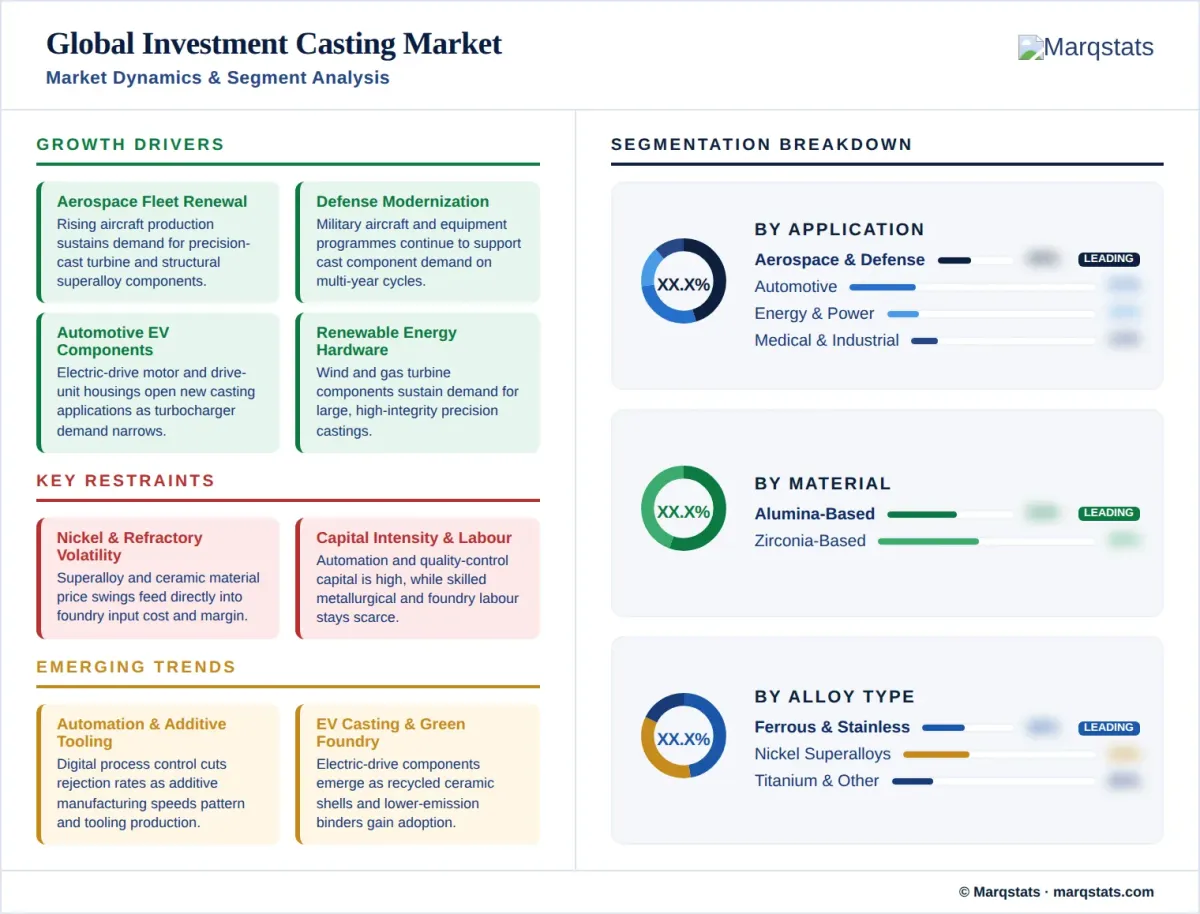
- Aerospace fleet renewal and rising aircraft production volumes are sustaining demand for precision-cast turbine and structural components.
- Defense modernization programmes continue to support cast component demand for military aircraft and equipment.
- Automotive lightweighting and electric-drive component adoption are expanding casting applications in turbochargers and motor housings.
- Renewable energy infrastructure, including wind turbine components, is sustaining demand for large precision castings.
- Medical implant and surgical instrument demand continues to expand as a smaller, steadily growing application.
Key Restraints
- Nickel and refractory ceramic material price volatility directly affects foundry input cost and margin.
- The process requires substantial capital investment in automation and quality-control systems relative to simpler casting methods.
- A persistent shortage of skilled metallurgical and foundry labour constrains capacity expansion in several established production regions.
Key Trends
- Automation and digital process control are improving casting consistency and reducing rejection rates across foundry operations.
- Additive manufacturing is increasingly used for rapid pattern and tooling production rather than replacing the casting process itself.
- Electric vehicle motor and drive components are emerging as a distinct automotive casting application alongside traditional turbocharger housings.
- Environmental regulation is accelerating adoption of recycled ceramic shell materials and lower-emission foundry binders.
- Foundries with concentrated aerospace superalloy qualification are commanding widening margin premiums as customers increasingly prioritise supplier reliability and delivery consistency over unit cost alone.
Market Segmentation
Alumina-based ceramic shell systems hold roughly 54% of revenue, the larger of the two major mold-material categories, reflecting superior refractoriness and chemical stability for casting stainless steel, titanium, and superalloys at the high temperatures these materials require. This material category dominates the highest-value aerospace superalloy segment specifically, where shell integrity at extreme pouring temperatures is a non-negotiable quality requirement rather than a cost trade-off.
Zirconia-based ceramic shell systems represent the remaining major share, typically specified for applications requiring the highest dimensional precision and surface finish, particularly in aerospace turbine and medical implant casting where tolerance requirements are most demanding. The material commands a cost premium over alumina-based systems, which limits its use to applications where the precision benefit justifies the additional shell cost relative to the finished part's overall value.
Aerospace and defense represents the largest application by revenue, spanning turbine blades, structural brackets, and engine components for both commercial and military aircraft programmes, where the process's near-net-shape precision directly reduces machining time and material waste on high-value superalloy components. Demand in this application follows multi-year aircraft production and defense procurement cycles rather than the shorter-cycle demand patterns seen in automotive and industrial applications, giving foundries with a concentrated aerospace customer base a more predictable, if less flexible, revenue profile.
Automotive applications, including turbocharger housings, fuel system components, and increasingly electric-drive motor housings, represent a significant secondary application, with demand shaped by which specific components a given vehicle architecture requires that favour casting's geometric flexibility over stamping or forging. Electric vehicle production is introducing new casting opportunities in motor housings and select drive-unit components, a category largely absent from internal-combustion vehicle architectures, even as some traditional cast components such as turbocharger housings decline in relevance for battery-electric vehicles specifically.
Energy and power applications, spanning gas turbine components and wind turbine hardware, sustain steady demand tied to power-generation capital-spending cycles and the ongoing renewable energy buildout. Gas turbine components for power generation draw on much of the same superalloy metallurgy and foundry capability as aerospace engine casting, giving foundries serving both applications a degree of demand diversification within the same core technical capability.
Medical applications, including surgical instruments and implants, represent a smaller, steadily growing category, while industrial applications spanning pumps, valves, and general machinery components round out the remaining demand base. Medical casting demand is shaped more by device approval cycles and material biocompatibility requirements than by the production-volume and cost considerations that dominate industrial and automotive casting decisions, giving this application a distinct, specialised supplier base within the broader market.
Ferrous and stainless steel castings represent the largest alloy category by volume, spanning industrial, medical, and select automotive and aerospace structural applications where superalloy performance is not required. This category carries the widest foundry supplier base of any alloy type, since ferrous and stainless steel casting capability is more broadly distributed globally than the specialised superalloy and titanium casting capability concentrated among a smaller number of qualified foundries.
Nickel superalloy castings command the highest per-unit value of any alloy category, concentrated almost entirely in aerospace turbine and high-temperature energy applications where their heat and stress resistance properties are irreplaceable by lower-cost alternatives. Qualification to cast nickel superalloys to aerospace specification typically takes several years and represents one of the most significant barriers to entry in the entire investment casting industry, concentrating this alloy category among a comparatively small number of established foundries.
Titanium castings serve weight-critical aerospace and medical implant applications, commanding a substantial cost premium over both steel and nickel alloys, while other specialty alloys serve smaller, application-specific niches across the remaining end markets. Titanium's biocompatibility makes it the material of choice for load-bearing medical implants specifically, a smaller-volume, high-value-per-unit application distinct from titanium's weight-driven aerospace use case.
By Geography
Asia-Pacific
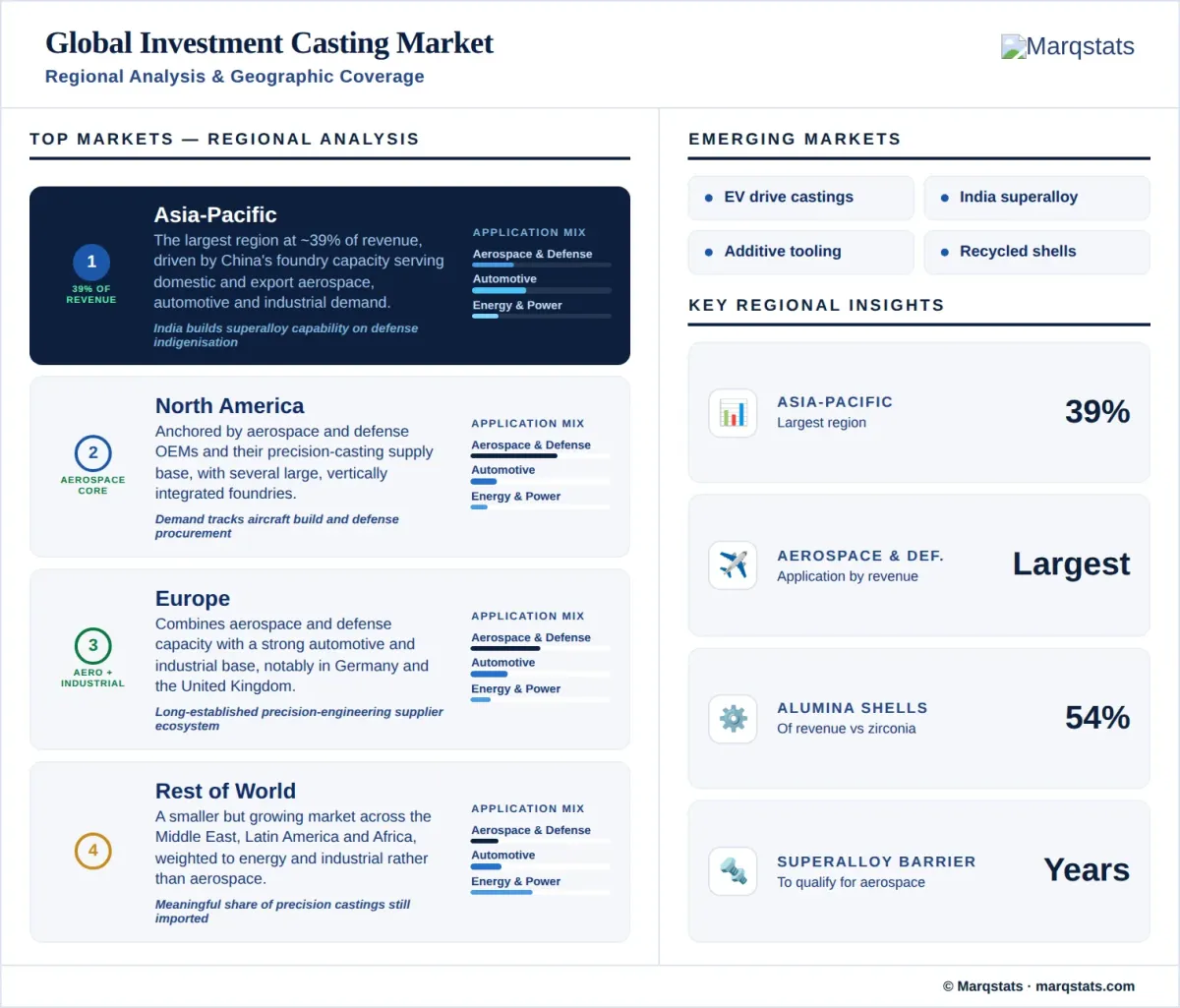
Asia-Pacific holds roughly 39% of global revenue, the largest of any region, driven primarily by China's extensive foundry capacity serving both domestic and export-oriented aerospace, automotive, and industrial demand. India and Southeast Asian markets are expanding capacity, supported by rising domestic manufacturing and increasing integration into global aerospace and automotive supply chains. India in particular is building out specialised superalloy casting capability tied to its domestic aerospace and defense manufacturing programmes, moving beyond the industrial and automotive casting capacity that has historically dominated the region's output, a shift supported by government-backed defense indigenisation initiatives that favour qualified domestic precision-casting suppliers.
North America
North America remains a critical market anchored by its concentration of aerospace and defense original equipment manufacturers and their associated precision-casting supply base, with demand closely tied to commercial aircraft production schedules and defense procurement budgets. The region is home to several of the industry's largest and most vertically integrated foundries, reflecting decades of qualified-supplier relationships built around the concentrated North American aerospace engine and airframe manufacturing base, with several of these operating as wholly owned captive casting divisions within larger diversified aerospace and industrial conglomerates.
Europe
Europe combines substantial aerospace and defense casting capacity with a strong automotive and industrial base, particularly in Germany and the United Kingdom, supported by a long-established precision engineering and metallurgical supplier ecosystem. The region's foundries serve both civil aerospace programmes and a substantial defense-sector customer base, giving European casting capacity a demand profile broadly similar in structure to North America's, though weighted somewhat more toward industrial and automotive applications.
Rest of World
The Middle East, Latin America, and Africa represent a smaller but growing market, with demand concentrated in energy and industrial applications tied to regional infrastructure and power-generation investment rather than the aerospace-led demand pattern seen in the largest regional markets. Foundry capacity in these regions remains limited relative to demand, with a meaningful share of precision castings still imported from the larger established production regions rather than manufactured domestically.
How Competition Is Evolving
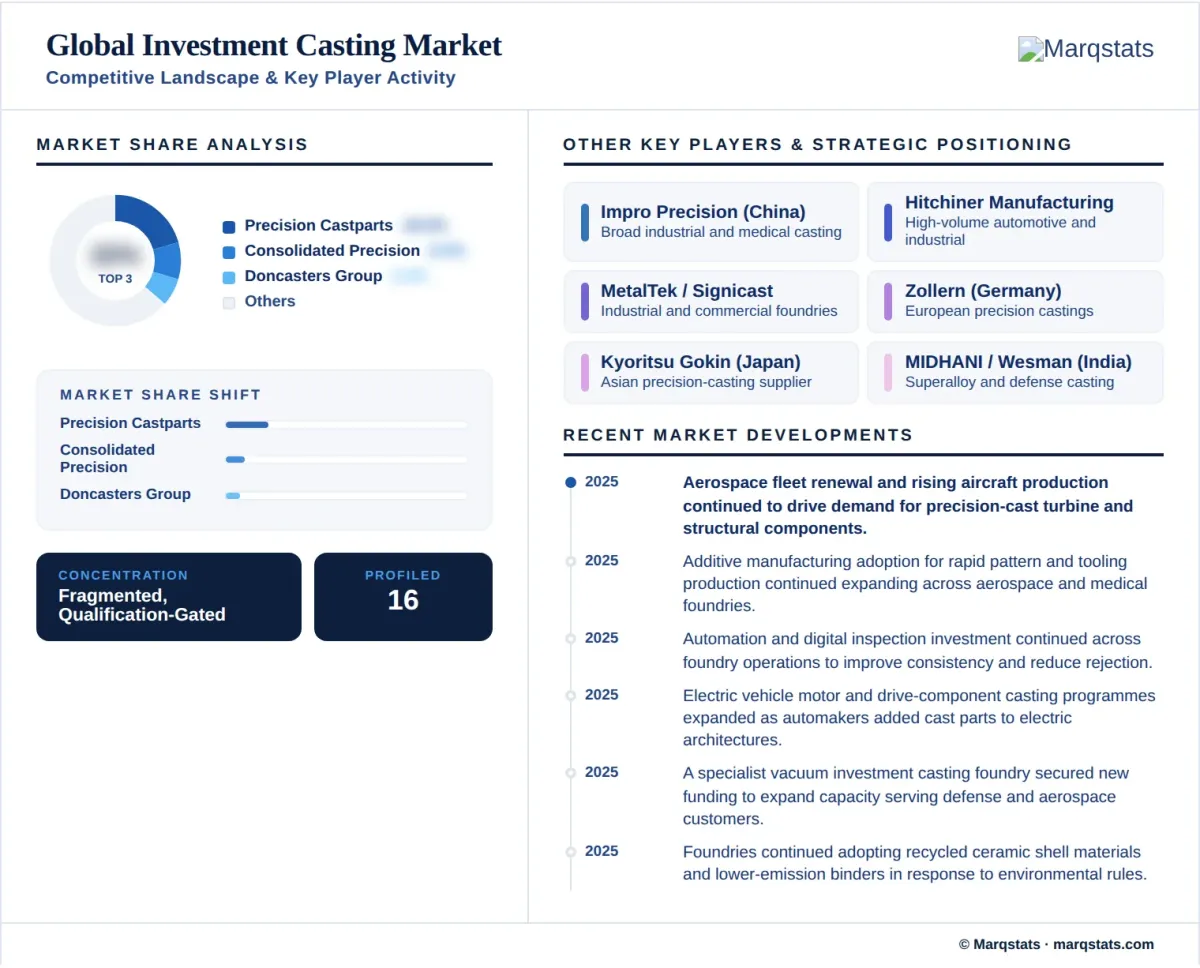
The market is moderately fragmented, with a small number of large, vertically integrated foundries serving the highest-value aerospace superalloy segment alongside a much larger population of mid-sized and regional foundries serving automotive, industrial, and medical applications. The largest aerospace-focused foundries typically operate as qualified suppliers to a limited number of engine and airframe manufacturers, a relationship that takes years to establish and creates significant switching costs once qualified. This qualification barrier is the single most important structural feature separating the aerospace superalloy segment from the rest of the market, since a new entrant cannot simply compete on price to win aerospace business the way it can in industrial or automotive casting. Once qualified, a foundry's relationship with an engine or airframe manufacturer typically spans the multi-decade production life of the aircraft platform involved, giving qualified aerospace suppliers a degree of revenue visibility uncommon elsewhere in the broader casting market.
Competitive strategy differs by segment: aerospace-focused foundries compete on metallurgical qualification depth, process consistency, and long-term supplier relationships with engine manufacturers, while foundries serving automotive, industrial, and medical applications compete more directly on cost, lead time, and production flexibility across a broader part-mix. Automation and digital quality-control investment is becoming a competitive requirement across both segments, as customers increasingly demand tighter tolerances and lower rejection rates than manual process control can consistently deliver. Consolidation activity has been more visible among mid-sized industrial and automotive foundries than in the aerospace segment, where the qualification barrier limits the pool of realistic acquisition targets and acquirers alike. Private equity investment has been an active force behind this mid-market consolidation, aggregating smaller regional foundries into larger platforms that offer customers broader capability and geographic coverage than any single facility provides alone.
Companies Covered
The report profiles 16+ companies with full strategy and financials analysis, including:
Recent Market Activity
Table of Contents
Coverage & Segmentation
This report provides a comprehensive assessment of the global investment casting market across a 2025 base year, historical data from 2021 to 2025, and forecasts spanning 2026 to 2030. Market size is stated as foundry sales revenue in United States dollars, covering cast components sold to end-user manufacturers and their Tier-1 suppliers. Segmentation covers three dimensions: material, application, and alloy type, alongside regional analysis spanning Asia-Pacific, North America, Europe, and the rest of world. Application-level detail is presented across five end markets, aerospace and defense, automotive, energy and power, medical, and industrial, reflecting the genuinely cross-sector nature of this market relative to most other categories in Marqstats' automotive and materials coverage.
The scope covers precision lost-wax casting of ferrous, nickel-superalloy, titanium, and select non-ferrous metals using ceramic shell molds, across aerospace and defense, automotive, energy, medical, and industrial applications. The study excludes sand casting, die casting, and casting for general consumer goods, as well as non-metal investment-like processes such as lost-PLA rapid prototyping, each of which involves a different process and supplier base. Die casting in particular is covered separately by Marqstats, since it is a distinct high-pressure process serving a different, typically higher-volume and lower-geometric-complexity part population than investment casting, despite both processes competing for some overlapping automotive applications. Country-level detail beyond the four-region split covered here is available under customization, alongside deeper cuts by material, application, or alloy type.