Market Snapshot
Middle bar: base-year value × (1 + CAGR), rounded to two decimals. This is a calculated illustration, not a separately researched annual estimate.
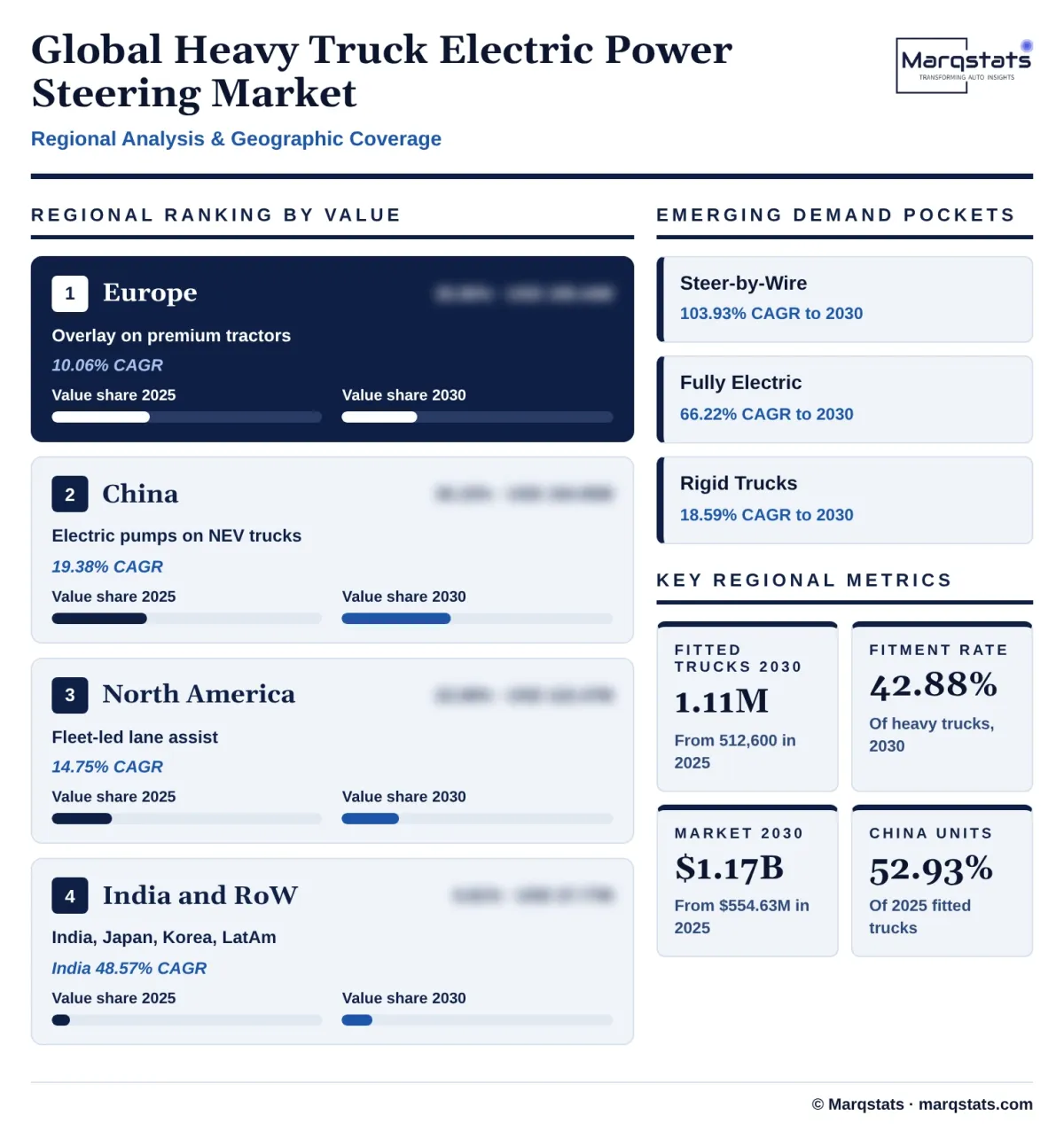
The global heavy truck electric power steering market size is estimated at USD 554.63 million in 2025 and is projected to reach USD 1,170.70 million by 2030, growing at a CAGR of 16.12% over 2026 – 2030. The number of heavy trucks built with electrically assisted steering rises from about 512,600 to about 1,110,500 a year, lifting the share of heavy trucks equipped from about 22.12% to about 42.88% of global production.
Marqstats defines the market as the ex-works supplier value of electrically assisted steering systems fitted to new heavy trucks above about 15 tonnes gross vehicle weight, covering electrically powered hydraulic steering driven by an electric pump, electro-hydraulic torque overlay steering such as Volvo Dynamic Steering, Bosch Servotwin and ZF ReAX, fully electric power steering without hydraulic fluid, and steer-by-wire. Conventional steering driven by an engine-mounted hydraulic pump, medium-duty trucks, buses, trailers and aftermarket repairs are excluded.
Electro-hydraulic torque overlay accounts for 68.24% of 2025 value and Europe for 35.96%, just ahead of China at 35.15%. Steer-by-wire is the fastest-growing architecture from a very small base, at 103.93% a year, and fully electric steering grows at 66.22% a year as electric trucks and automated freight move to oil-free systems.
Key Takeaways
Market Overview & Analysis
Report Summary
Marqstats sizes the heavy truck electric power steering market as the value that steering suppliers and in-house truck maker units earn on electrically assisted steering systems installed in new heavy trucks. A heavy truck front axle can carry 7 to 9 tonnes, so turning the wheels at standstill needs very high force. For decades this has been supplied by a recirculating ball steering gear and a hydraulic pump driven by the engine, which runs whenever the engine runs.
Electric assistance enters heavy trucks in four forms. An electrically powered hydraulic system keeps the hydraulic gear but drives the pump with an electric motor, which is necessary on battery-electric and fuel cell trucks that have no engine. A torque overlay system adds an electric motor and control unit to the hydraulic gear or steering column, so software can add or remove steering torque for lane keeping, crosswind correction and low-speed manoeuvring. Fully electric power steering drops the hydraulic circuit and supplies all force from electric motors. Steer-by-wire removes the steering column and links the steering wheel to the road wheels electronically.
Torque overlay is already common on premium European and North American tractors. Volvo Trucks introduced Volvo Dynamic Steering in 2013 and launched an upgraded version in June 2025 that helps hold the truck on course after a front tyre puncture and cuts low-speed steering force by about 75%. Bosch Servotwin and ZF ReAX supply other truck makers, and Freightliner offers Active Lane Assist 2, which counter-steers when the truck drifts toward an occupied lane.
Regulation affects the market unevenly. In the EU, the General Safety Regulation made several driver assistance systems mandatory, but emergency lane keeping with active steering applies to cars and light commercial vehicles, while heavy trucks must meet rules such as blind spot information and lane departure warning that do not require a steering actuator. In China, GB 17675-2025, issued on 2 December 2025 and in force from 1 July 2026, replaces GB 17675-2021 and removes the requirement for a mechanical emergency link, opening the way to steer-by-wire on vehicles of categories M, N and O.
The market grew from an estimated USD 165.00 million in 2021 to USD 554.63 million in 2025 as China moved quickly to electric heavy trucks and as more European and North American tractors were ordered with lane keeping and active steering. Marqstats estimates that about 22.12% of the roughly 2.32 million heavy trucks built worldwide in 2025 had some form of electrically assisted steering.
Global Heavy Truck Electric Power Steering Market Size and Forecast
The global heavy truck electric power steering market grows from USD 554.63 million in 2025 to USD 1,170.70 million in 2030, a CAGR of 16.12%. Growth comes almost entirely from volume: fitted units rise at 16.72% a year, from about 512,600 to about 1,110,500, while the average value per truck eases from about USD 1,082 to about USD 1,054 as Chinese systems take a larger share and prices for torque overlay units fall by roughly 6% to 9%.
The 2025 value is built bottom-up from heavy truck output, fitment and price by region. Marqstats estimates heavy truck output of about 270,000 units in Europe, 1,137,000 in China, 255,000 in North America, 280,000 in India and 375,000 in the rest of the world. Torque overlay systems are fitted to about 120,000 European trucks, 75,000 North American trucks, 52,000 Chinese trucks, 22,000 trucks in the rest of the world and 2,500 in India. Electrically powered hydraulic systems are fitted to about 215,000 Chinese trucks, mostly new energy models, and about 20,000 elsewhere.
Average system prices are Marqstats estimates at supplier level. A complete torque overlay system, including the hydraulic gear, electric motor and control unit, is estimated at about USD 1,550 in Europe and North America, USD 1,200 in India and the rest of the world and USD 900 in China. Electrically powered hydraulic systems are estimated at about USD 1,300 in Europe and North America and USD 650 in China, fully electric systems at USD 1,800 to USD 2,900 and steer-by-wire systems at USD 4,000 to USD 6,500 per truck.
The 2030 forecast assumes heavy truck output of about 2.59 million units, with China at about 1.25 million and new energy trucks reaching about 40% of Chinese sales in line with the national target. Marqstats expects torque overlay to reach about 175,000 European and 140,000 North American trucks, fully electric steering about 87,000 trucks worldwide and steer-by-wire about 18,500 trucks, most of them in China after GB 17675-2025 takes effect.
Marqstats tracks four indicators to monitor the forecast: monthly Chinese new energy heavy truck sales and their share of the total, the start of series production of fully electric heavy truck steering in Europe from 2027, take rates of lane centring packages on new Class 8 tractors in North America, and the first type approvals of heavy trucks with steer-by-wire under GB 17675-2025.
Market Dynamics
Key Drivers
Five forces are moving heavy truck steering from engine-driven hydraulics to electrically assisted and electronically controlled systems.
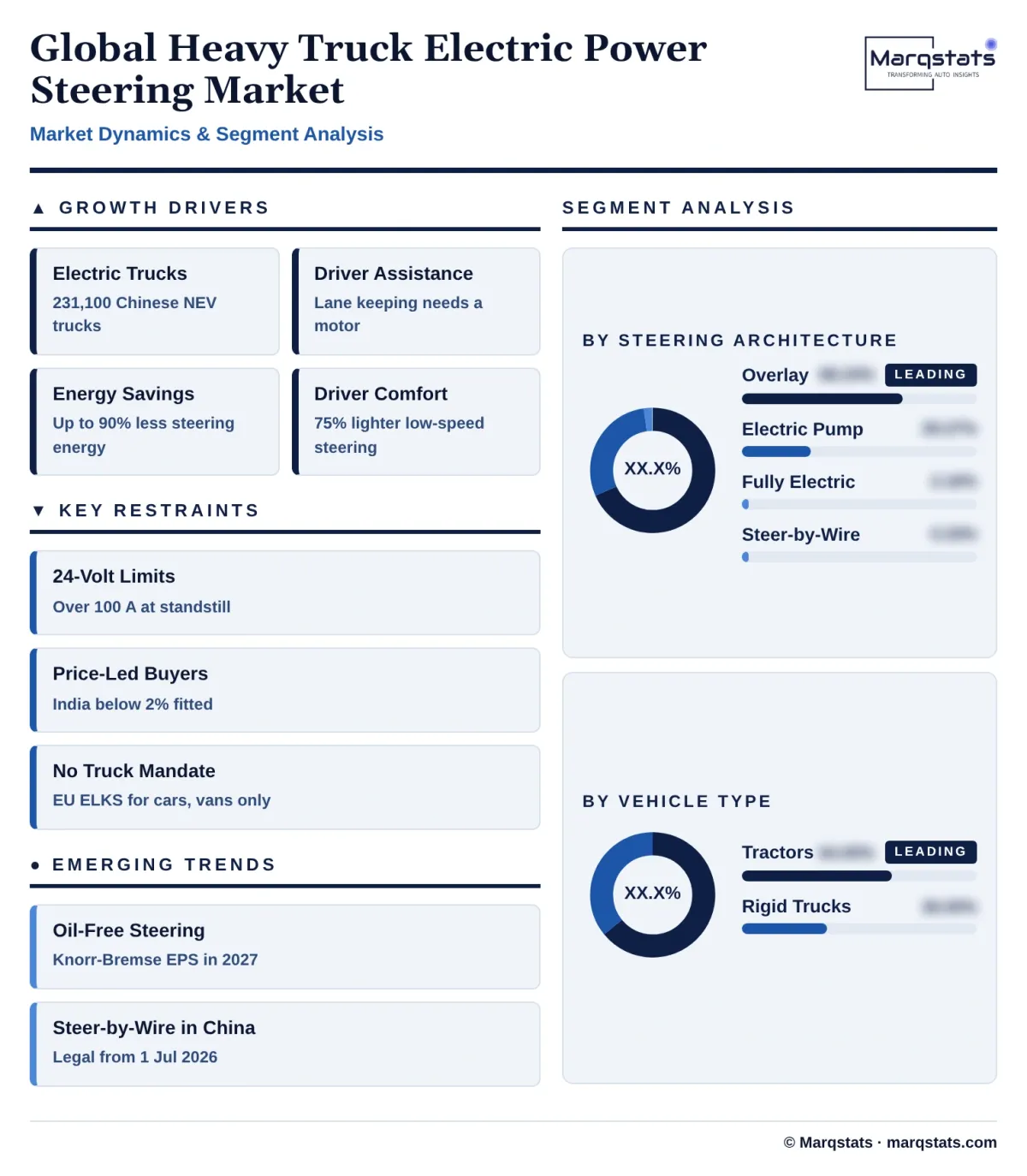
- Electric trucks need electric steering. A battery-electric or fuel cell truck has no engine to drive a hydraulic pump, so every one needs an electric pump or a fully electric system. China sold 231,100 new energy heavy trucks in 2025, up 182% and about 29% of heavy truck sales, rising to 54% in December 2025, which makes electric trucks the largest single source of demand.
- Driver assistance needs a steering actuator. Lane keeping, lane centring, crosswind compensation and evasive steering all need a motor that software can command. Volvo Pilot Assist, Mercedes-Benz Active Drive Assist and Freightliner Active Lane Assist are built on electric steering, so every truck ordered with these packages adds to the market.
- Fuel and energy savings. A hydraulic pump driven by the engine circulates fluid all the time, while an electric system uses energy only when the driver steers. Knorr-Bremse says its power-on-demand electric steering cuts steering energy use by up to 90% compared with conventional systems, which matters for fuel use on diesel trucks and for range on electric trucks.
- Driver comfort and retention. Torque overlay can lighten steering at low speed, damp road shocks and stop the steering wheel kicking back. Volvo says its upgraded Dynamic Steering cuts low-speed steering force by about 75%, and fleets use features like this to reduce driver fatigue and strain injuries.
- Automated freight needs redundant steering. Driverless trucks need steering that keeps working after a single fault. ZF supplies redundant steering for automated truck developers, and Knorr-Bremse previewed a redundant electric steering system at IAA Transportation 2026 alongside a redundant brake control system planned for series production in 2027.
Key Restraints
Four constraints slow the shift away from conventional hydraulic steering on heavy trucks.
- High force on a 24-volt network. Steering a loaded front axle at standstill needs several kilowatts of power, which on a 24-volt truck network means current of well over 100 amperes. This needs heavy wiring and careful heat management, so fully electric steering waits for 48-volt or high-voltage supplies on electric trucks.
- Cost-sensitive buyers in emerging markets. In India and much of the rest of the world, fleets buy on purchase price and keep conventional hydraulic steering, which is cheaper and easier to repair. Marqstats estimates that less than 2% of Indian heavy trucks had electrically assisted steering in 2025.
- No steering mandate for heavy trucks in Europe or the US. The EU General Safety Regulation requires active emergency lane keeping only for cars and light commercial vehicles, and in the US lane keeping on trucks remains voluntary, so take-up depends on fleet choices and truck maker packages.
- Freight cycles delay orders. North American Class 8 demand was weak through 2024 and 2025 and European truck registrations fell in 2025, so fleets delayed new truck purchases and optional assistance packages.
Key Trends
Four shifts are changing how heavy truck steering is designed, powered and sold.
- Oil-free steering for electric trucks. Suppliers are moving from electric pumps that keep the hydraulic gear toward fully electric systems. Knorr-Bremse plans a market launch of its electric steering in 2027, and Bosch and ZF offer fully electric systems for heavy trucks.
- Steering becomes part of chassis software. Steering is now controlled together with braking and driver assistance through central vehicle computers, which lets truck makers update steering features over the air and coordinate them with lane keeping and emergency braking.
- China opens the door to steer-by-wire. GB 17675-2025 removes the mechanical emergency link requirement from 1 July 2026, as long as makers prove redundant power, sensors and control units. This allows truck makers to remove the steering column on new designs.
- Safety features for tyre blowouts and crosswinds. New overlay systems add functions such as holding course after a front tyre puncture, introduced in Volvo Dynamic Steering in June 2025, and counter-steering against tyre blowouts in Freightliner trucks.
Strategic Implications
- For steering suppliers, China is now the volume market and Europe the value market. Suppliers need low-cost electric pump and overlay systems for Chinese truck makers and premium redundant systems for European and North American automated trucks.
- For truck makers, electric steering is the base for driver assistance packages. Fitting overlay steering as standard on tractors makes it easier to sell lane centring and automated driving features later through software.
- For electric truck makers, moving from electric pumps to fully electric steering saves energy and removes hydraulic fluid and hoses. The gain is largest on trucks with 48-volt or high-voltage supplies, so steering choice should be part of the electrical architecture.
- For fleets, the value of electric steering comes from lower driver fatigue, fewer lane-departure incidents and, on electric trucks, longer range. Fleets should compare the cost of assistance packages with insurance and driver retention savings.
- For investors and component makers, demand will shift toward high-power motors, power electronics and safety-rated control units. These parts take a larger share of value as hydraulic gears are replaced or reduced in size.
Market Segmentation
Torque overlay systems account for 68.24% of 2025 value, USD 378.45 million, and grow at 11.61% a year to USD 655.45 million, while their share falls to 55.99% by 2030. They keep the hydraulic recirculating ball gear for main steering force and add an electric motor and control unit that software can command, as in Volvo Dynamic Steering, Bosch Servotwin and ZF ReAX. They suit diesel tractors and are the basis for lane keeping and lane centring on European and North American trucks.
Electrically powered hydraulic systems account for 29.27% of 2025 value, USD 162.35 million, and grow at 12.92% a year to USD 298.00 million and 25.45% by 2030. The hydraulic pump is driven by an electric motor instead of the engine, which is the simplest way to steer a battery-electric or fuel cell truck. Most units go into Chinese new energy heavy trucks, where low system prices keep the segment value modest compared with its volume.
Fully electric systems account for 2.16% of 2025 value, USD 11.98 million, and grow at 66.22% a year to USD 152.00 million and 12.98% by 2030. They drop hydraulic fluid and supply all force from electric motors, using energy only when the driver steers. Knorr-Bremse plans a market launch in 2027, and the segment grows mainly on electric trucks in Europe and China.
Steer-by-wire accounts for 0.33% of 2025 value, USD 1.85 million, and is the fastest-growing segment, at 103.93% a year, reaching USD 65.25 million and 5.57% by 2030. It removes the steering column and needs redundant motors, sensors, power supplies and control units. China leads adoption once GB 17675-2025 takes effect on 1 July 2026, and automated freight trucks provide early demand in North America.
Tractor units account for 64.00% of 2025 value, USD 354.96 million, and grow at 14.63% a year to USD 702.42 million and 60.00% by 2030. Long-haul tractors spend long hours on motorways, where lane keeping and crosswind correction bring the most benefit, so torque overlay and assistance packages are most often ordered on tractors.
Rigid trucks, including distribution, construction and refuse chassis, account for 36.00% of 2025 value, USD 199.67 million, and grow faster, at 18.59% a year, to USD 468.28 million and 40.00% by 2030. Electric rigid trucks on fixed city and regional routes are among the first to use fully electric steering, and low-speed manoeuvring assistance is valued by drivers who turn often.
By Geography
Europe
Europe accounts for 35.96% of 2025 value, USD 199.44 million, and grows at 10.06% a year to USD 322.05 million and 27.51% by 2030. Marqstats estimates that about 120,000 of the roughly 270,000 heavy trucks built for Europe in 2025 had torque overlay steering, led by Volvo, Mercedes-Benz and other premium tractors. Europe has the highest value per truck, but growth is slower than in China because penetration is already high and the EU does not require active lane keeping on heavy trucks. Electric trucks, 4.2% of EU truck registrations in 2025, add demand for electric pump and fully electric systems.
China
China accounts for 35.15% of 2025 value, USD 194.95 million, and grows fastest among the large regions, at 19.38% a year, to USD 472.70 million and 40.38% by 2030, becoming the largest market. Heavy truck sales reached about 1.137 million units in 2025, up 26.0%, and new energy heavy trucks reached 231,100 units. Marqstats estimates about 215,000 electrically powered hydraulic systems and 52,000 overlay systems were fitted in 2025. GB 17675-2025 allows steer-by-wire from 1 July 2026, and the national target of 40% new energy penetration by 2030 lifts fully electric and steer-by-wire demand.
North America
North America accounts for 22.08% of 2025 value, USD 122.47 million, and grows at 14.75% a year to USD 243.70 million and 20.82% by 2030. Adoption is driven by fleets rather than federal rules: Volvo Dynamic Steering, Freightliner Active Lane Assist and ZF ReAX on Kenworth and Peterbilt tractors are ordered to reduce driver fatigue and lane-departure crashes. Automated freight developers on Texas and Sun Belt corridors need redundant steering, which supports early steer-by-wire and fully electric demand.
India
India accounts for 0.95% of 2025 value, USD 5.25 million, and grows fastest, at 48.57% a year, to USD 38.00 million and 3.24% by 2030 from a very small base. Most Indian heavy trucks still use conventional hydraulic steering, but electric trucks for ports, mines and city logistics and premium tractors from Tata Motors, Ashok Leyland and Volvo Eicher are beginning to use electrically assisted systems.
Rest of World
The rest of the world accounts for 5.86% of 2025 value, USD 32.52 million, and grows at 23.72% a year to USD 94.25 million and 8.05% by 2030. Japan and South Korea build heavy trucks with lane keeping assistance, Hyundai sells the Xcient fuel cell truck, and Latin America and the Middle East import European and Chinese trucks with overlay or electric pump systems.
How Competition Is Evolving
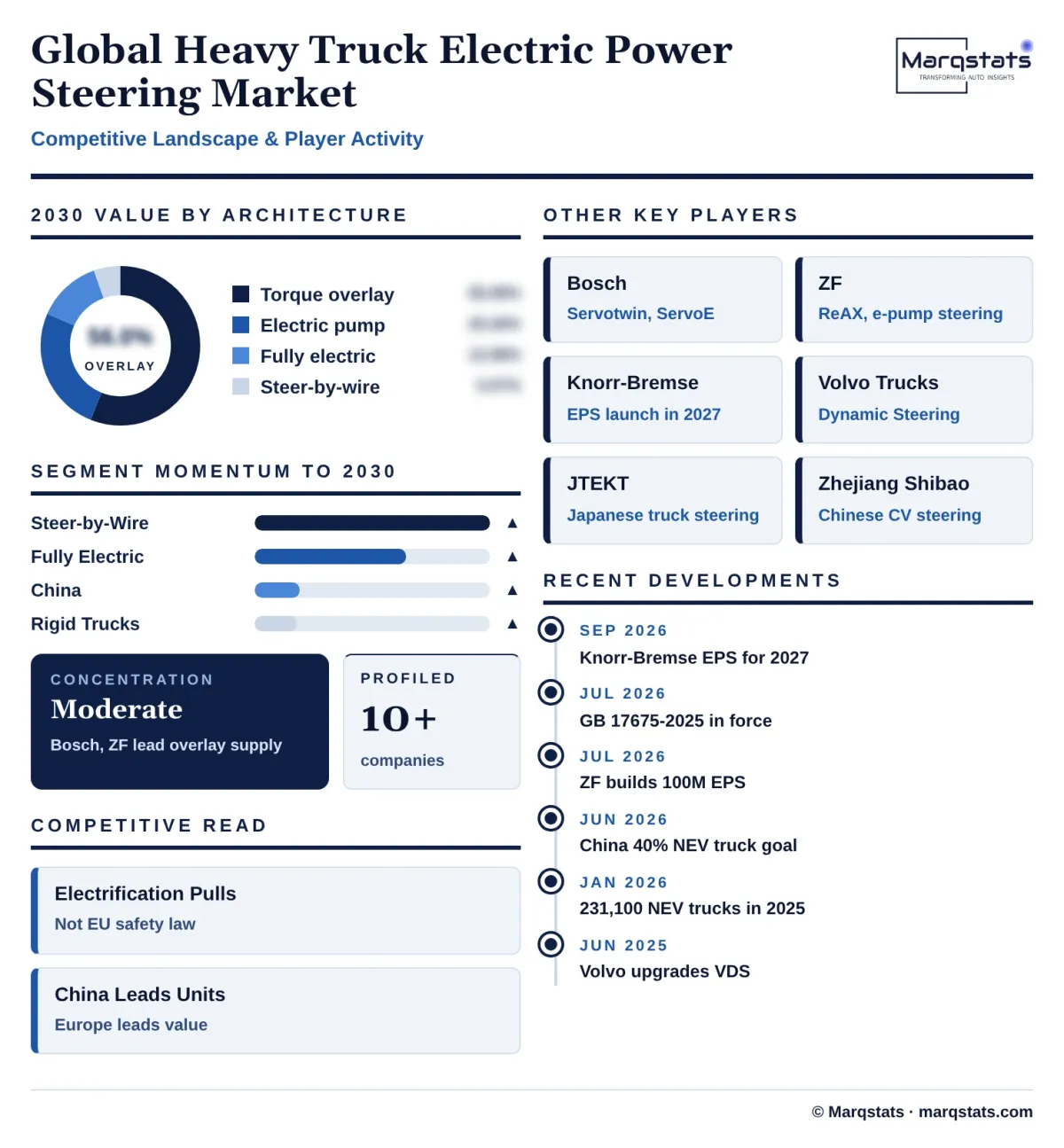
The market is moderately concentrated. Bosch and ZF supply most of the torque overlay systems sold to independent truck makers in Europe and North America, Volvo Group designs Volvo Dynamic Steering in-house, and Knorr-Bremse, which owns the steering business of R.H. Sheppard in North America, supplies hydraulic gears and is preparing electric steering. In China, the market for electric pumps and overlay systems is more fragmented, with domestic steering suppliers competing with local units of the global groups.
Bosch offers Servotwin electro-hydraulic steering, the fully electric ServoE and steer-by-wire technology. At IAA Transportation 2026, Bosch said it aims to double sales in heavy-duty commercial vehicles by the mid-2030s from more than EUR 4 billion today, about USD 4.52 billion at EUR 1 to USD 1.13.
ZF offers ReAX gear-mounted and column-mounted overlay steering, an electrically powered hydraulic system used on electric trucks from Iveco, VDL and other makers, a fully electric commercial steering system and redundant steering for automated trucks. ZF built its 100 millionth electric power steering system in July 2026, mainly for cars and light commercial vehicles, which gives it scale in motors and electronics.
Knorr-Bremse previewed electric steering and redundant electric steering at IAA Transportation 2026, with market launch of the electric system planned for 2027. JTEKT and HL Mando supply Japanese and Korean truck makers, and Chinese suppliers such as Zhejiang Shibao and Hubei Tri-Ring supply domestic heavy truck makers.
Companies Covered
Companies covered in the report include:
Recent Market Activity
Table of Contents
Coverage & Segmentation
The study covers the global heavy truck electric power steering market, with 2025 as the base year, 2021 – 2025 as the historical period and 2026 – 2030 as the forecast period. It covers electrically assisted steering systems fitted to new heavy trucks above about 15 tonnes gross vehicle weight, including EU category N3, North American Class 8 and equivalent trucks, segmented by steering architecture, vehicle type and region across Europe, China, North America, India and the rest of the world. Values are ex-works supplier values in US dollars, and euro figures are converted at EUR 1 to USD 1.13.
Conventional hydraulic steering driven by an engine-mounted pump, medium-duty trucks below about 15 tonnes, buses and coaches, trailers, steering systems for cars and light commercial vehicles, and aftermarket repairs and replacement parts are excluded.