Market Snapshot
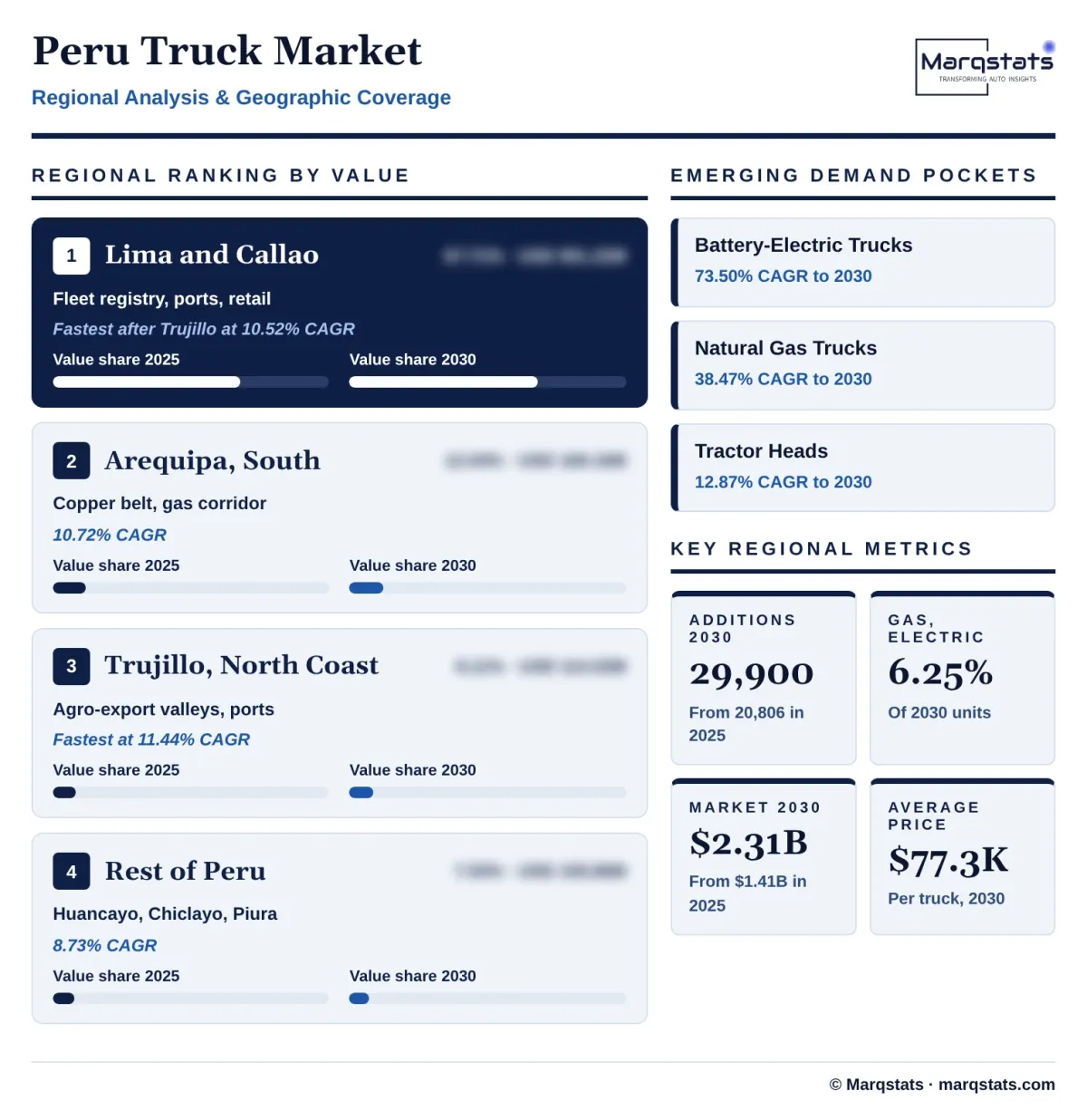
The Peru truck market size is estimated at USD 1,405.09 million in 2025 and is projected to reach USD 2,312.11 million by 2030, growing at a CAGR of 10.47% over 2026 – 2030. Registrations of new trucks and tractor heads rise from 20,806 to 29,900 units, a 7.52% annual rate, while the average value per truck climbs from about USD 67,533 to USD 77,328 as heavy rigid trucks and tractor heads take a larger share of the mix.
Marqstats defines the market as the wholesale value of new goods trucks above 3.5 tonnes gross vehicle weight registered in Peru, counted from the registration series of the Asociación Automotriz del Perú (AAP) built on the Superintendencia Nacional de los Registros Públicos (SUNARP) register. It covers rigid trucks of 3.5 to 8 tonnes, 8 to 16 tonnes and above 16 tonnes, and road tractor heads, including Isuzu, Hino, Fuso, JAC, Foton, Sinotruk, Shacman, Volvo, Scania, Mercedes-Benz and International models. Value is counted at the importer gate in US dollars, before the 18% general sales tax. Pickups, vans, buses, used trucks, trailers and off-highway mining haulers are excluded.
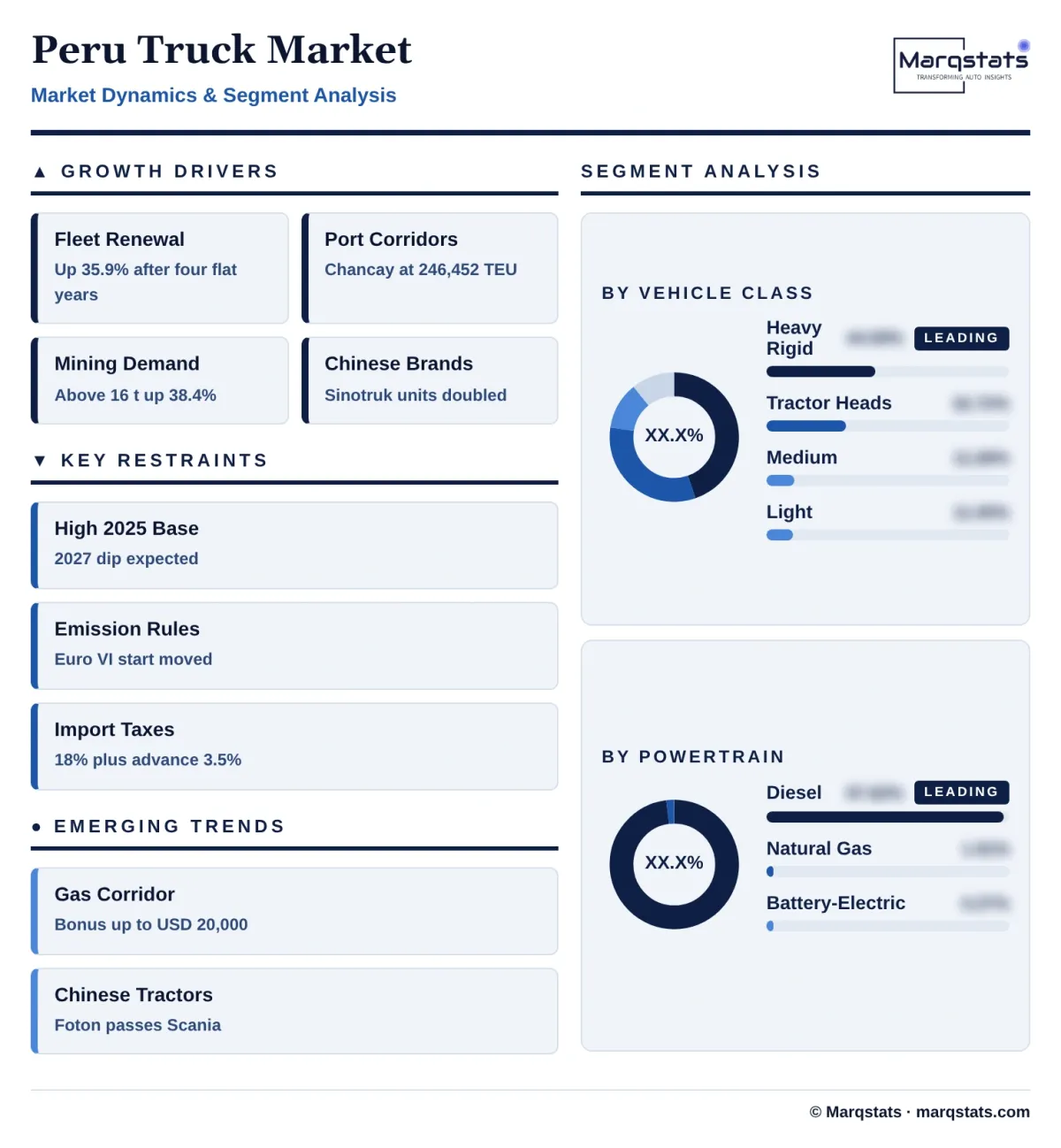
Heavy rigid trucks above 16 tonnes account for 44.59% of 2025 value, tractor heads for 32.72% and diesel trucks for 97.82%. Lima and Callao account for 67.71% of value, while Trujillo and the North Coast, which links the northern agro-export valleys with the ports, grows fastest among regions at 11.44% a year.
Key Takeaways
Market Overview & Analysis
Report Summary
Marqstats sizes the Peru truck market as the wholesale value of new goods trucks above 3.5 tonnes gross vehicle weight registered each year. It follows the AAP classes: light rigid trucks of 3.5 to 8 tonnes, medium rigid trucks of 8 to 16 tonnes, heavy rigid trucks above 16 tonnes, and road tractor heads (remolcadores). The Reglamento Nacional de Vehículos places 3.5 to 12 tonnes in category N2 and above 12 tonnes in category N3, so the AAP classes cut across the legal categories, and Marqstats follows the AAP classes because they are the registration series buyers and lenders use. Pickups, vans and buses (minibuses and omnibuses, 3,989 units in 2025) are excluded.
Imports dominate supply: China ships the largest volume, and Argentina and Brazil serve as assembly platforms mainly for European brands under the ACE 58 and MERCOSUR agreements, before units are registered through SUNARP. The AAP counted 211,776 new vehicles of all types in 2025, up 25% and the first time the market passed 200,000 units, and heavy vehicles reached 24,795 units, of which 20,806 were trucks and tractor heads (16,549 rigid trucks and 4,257 tractor heads). Customs data compiled by Datasur from the D-Comex database show import values of USD 483.95 million for diesel goods vehicles above 20 tonnes and USD 138.56 million for those of 5 to 20 tonnes, with ad valorem duties of 0% to 6%, so cost, not tariff, separates brands.
The market sat on a plateau before 2025. AAP series show 12,348 trucks and tractor heads in 2019, a fall to 10,773 in 2020 and then 15,680 in 2021, 15,311 in 2022, 15,095 in 2023 and 15,308 in 2024. The 2025 total of 20,806 is 35.92% above 2024 and 32.69% above the previous peak of 2021. Every class grew by 34% to 38%: units of 3.5 to 8 tonnes rose 34.0% to 5,503, units of 8 to 16 tonnes 34.9% to 3,558, units above 16 tonnes 38.4% to 7,420, and tractor heads 35.0% to 4,253.
Demand is tied to private investment rather than state budgets. The AAP links truck demand to mining, hydrocarbons, manufacturing, construction and commerce, and the registry shows it: Arequipa, the base of the southern copper belt, registered 2,166 trucks in 2025 (up 40.6%), and Trujillo, the hub for agro-export valleys, registered 1,731 (up 68.7%). Lima registers 68.70% of the national total, partly because lessors and corporate buyers register fleets at head offices.
The market grew from an estimated USD 993.77 million in 2021 to USD 1,017.51 million in 2024 at constant mix, then rose 38.09% to USD 1,405.09 million in 2025, equal to about PEN 5,014.06 million at the 2025 average rate of PEN 3.5685 per US dollar. Marqstats expects 2026 to reach about 28,300 units and USD 1,963.51 million, then a fall in units of 6.01% in 2027 as the Chancay-led and replacement purchases are absorbed.
Peru Truck Market Size and Forecast
The Peru truck market grows from USD 1,405.09 million in 2025 to USD 2,312.11 million in 2030, a CAGR of 10.47%. Volume supplies about two thirds of the growth: registrations rise at 7.52% a year, from 20,806 to 29,900 trucks, and the average value per truck rises at 2.75% a year, from about USD 67,533 to USD 77,328, as tractor heads and heavy rigid trucks take a larger share and gas and electric models carry price premiums.
The 2025 value is built bottom-up from AAP registrations and importer prices. Marqstats estimates 5,520 light trucks at about USD 28,000 each, 3,570 medium trucks at USD 46,000, 7,459 heavy rigid trucks at USD 84,000 and 4,257 tractor heads at USD 108,000. Prices are chassis-cab or tractor-head values at the importer gate, before the 18% general sales tax and before bodies fitted locally. The tractor head price sits between the USD 50,000 entry price and the USD 200,000 price for specialised units that Tracto Camiones USA quoted in August 2026.
The base is checked against customs data. D-Comex import values compiled by Datasur show USD 622.51 million of diesel goods vehicles of 5 tonnes and above, in the lines for 5 to 20 tonnes and above 20 tonnes, and Marqstats values medium and heavy rigid trucks of 8 tonnes and above at USD 790.77 million, or 1.27 times the customs value, in line with duties of 0% to 6%, importer margin and delivery cost. Off-highway mining dump trucks, which the same customs table values at USD 249.77 million, are not registered as road trucks and are excluded.
The 2026 estimate rests on registrations to date. The AAP counted 13,478 trucks and tractor heads in the first half of 2026 (up 42.7%), 18,491 in January to August (up 43.3%) and 21,366 in January to September (up 42.7%). Applying a gain of 18.88% to the fourth quarter, after 5,833 units in the fourth quarter of 2025, gives 28,300 units and USD 1,963.51 million for the year. Marqstats then expects a 6.01% fall in units in 2027 and growth of 4.14%, 3.97% and 3.82% in 2028, 2029 and 2030.
Gas and electric trucks add value faster than volume. Marqstats expects gas trucks to rise from 320 units in 2025 to 1,450 in 2030 and battery-electric trucks from 30 to 420, so their combined share of units grows from 1.68% to 6.25%. Gas trucks are priced at about 1.25 times and electric trucks at about 1.90 times a diesel truck of the same class, which lifts their share of value to 8.52% in 2030.
Marqstats tracks four indicators to monitor the forecast: monthly AAP registrations by weight class and registry office, container volumes at Chancay and Callao, the date and scope of the Euro VI diesel standard, and orders under the Camisea natural gas programmes.
Market Dynamics
Key Drivers
Five forces are lifting registrations of new trucks in Peru well above the 15,000-unit plateau of 2021 to 2024.
- Fleets are re-equipping after four flat years. Registrations stood at 15,680 in 2021, 15,311 in 2022, 15,095 in 2023 and 15,308 in 2024, then rose 35.9% to 20,806 in 2025, with every weight class up by 34% to 38%. Buying across all classes at once points to renewal of ageing fleets, not to one project, and the AAP expects growth to moderate only gradually as the low 2025 base fades.
- Ports and corridors need more tractors. The Chancay terminal handled 231,478 TEU in 2025 and 246,452 TEU in January to July 2026, up 74.8%, and the Lima Chamber of Commerce projects more than 422,000 TEU for 2026. Callao still handles about 3.3 million TEU, so the port effect is real but modest, and it adds demand for 6x4 tractors on the Lima, Huacho and Trujillo routes.
- Mining and construction buy heavy rigid trucks. Units above 16 tonnes rose 38.4% to 7,420 in 2025 and 44.4% in the first nine months of 2026 to 7,896, and Arequipa, the base of the southern copper belt, registered 2,166 trucks, up 40.6%. Contractors use 6x4 and 8x4 tippers and mixers at altitudes above 4,000 metres where buyers pay for engine power and brake performance.
- Chinese brands widen the buyer base. Sinotruk rigid truck registrations more than doubled from 778 in 2024 to 1,700 in 2025 and reached 2,231 in January to September 2026, while Foton tractor heads rose from 307 to 556. Tracto Camiones USA quoted entry prices of about USD 50,000 for heavy tractors in August 2026, which lets smaller operators buy new trucks instead of keeping old ones.
- Natural gas incentives lower the cost of switching. Consorcio Camisea has put more than S/ 150 million into six gas programmes, more than 1,400 heavy transport vehicles have been acquired through them, and the Corredor Camisea GNL offers bonuses of up to USD 20,000 per truck, which supports gas tractors on the Arequipa, Juliaca and Cusco routes.
Key Restraints
Four constraints keep growth below the pace of 2025 and 2026 and slow the shift to cleaner trucks.
- The 2025 base is high. Scotiabank expects total new vehicle sales to grow only about 3% in 2026 because of the high 2025 base, and warns that the general election could delay big-ticket purchases. Marqstats expects registrations to fall 6.01% in 2027 after the 2026 peak, because fleets that bought in 2025 and 2026 will not need to buy again at the same pace.
- Emission rules are unsettled. Euro IV has been the standard for new vehicles since April 2018, and Decreto Supremo N° 003-2024-EM moved the start of Euro VI from 1 January 2024 to 1 October 2025, with exceptions, because Euro VI needs diesel with no more than 10 parts per million of sulphur. Importers and buyers cannot plan engine specifications with certainty while the start date and exceptions can move again.
- Import taxes tie up cash. Duties run from 0% to 6%, but importers pay 18% in general sales tax and municipal promotion tax, and the tax authority SUNAT collects an advance perception of 3.5% for regular importers and 10% for a first import, so a distributor that imports ahead of sales carries a large tax balance until the trucks are sold.
- Fuel and charging networks are thin. The Corredor Camisea GNL has five supply points at Mala, Nazca, La Joya, Imata and Espinar, only 120 additional trucks were targeted when the two newest points were announced in April 2025, and Marqstats estimates battery-electric trucks at only about 30 units in 2025, mainly light distribution trucks in Lima.
Key Trends
Four shifts are changing which trucks are bought, where they are registered and what they burn.
- Chinese brands move up the weight range. Sinotruk led registrations above 16 tonnes in the first half of 2026 with 1,237 units, ahead of Volvo at 756 and Shacman at 714, and Foton overtook Scania among tractor heads in January to August 2026, 579 against 550, and again in January to September, 671 against 619.
- Natural gas moves from pilot to corridor. Servosa Gas added 14 GNV tractors after buying 38 GNL units in the previous two years, more than 500,000 vehicles of all types run on GNV or GNL in Peru, and the Corredor Camisea GNL gives heavy trucks a range above 1,500 kilometres on the Arequipa to Juliaca, Arequipa to Cusco and Lima to Puno routes.
- Longer combinations enter the rulebook. The AAP Heavy Vehicles Committee is working on technical standards for bitrenes and rodotrenes of up to 90 tonnes, and the Ministry of Transport and Communications has opened a revision of the Reglamento Nacional de Vehículos through Resolución Ministerial 555-2025-MTC, covering active and passive safety requirements.
- Growth reached the provinces first. Trujillo registered 1,731 trucks in 2025, up 68.7%, Cusco 614 (up 55.4%) and Juliaca 270 (up 57.0%), against Lima at 14,293 (up 31.6%), although Lima regained share in 2026, at 70.27% of registrations in January to August against 68.70% in 2025.
Strategic Implications
- For truck makers and importers, the Peruvian market now rewards breadth over loyalty. Isuzu leads with 2,862 rigid trucks, but Chinese brands supplied almost half of the 2025 increase, so a manufacturer that sells only premium trucks gives up the 3.5 to 16 tonne classes where 43.7% of units sit, and a manufacturer that sells only low-price trucks stays out of mining workshops that need uptime guarantees.
- For distributors, stock and cash decide results. With 21,366 registrations in nine months and a 2026 total near 28,300, a distributor that orders on the 2026 run rate meets a 2027 fall of about 6%, so orders should be tied to confirmed fleet contracts, and financing partners should be lined up before import taxes of 18% and an advance perception of 3.5% to 10% fall due.
- For fleet operators, the choice is between price and certainty. Entry tractors at about USD 50,000 cut the entry barrier, while Volvo, Scania and Mercedes-Benz sell on service networks near mines, so operators on coastal and Chancay routes can buy lower-priced tractors, while operators above 4,000 metres should pay for workshop coverage and spare parts.
- For gas and energy suppliers, the first customers are tractor fleets on fixed southern routes. Bonuses of up to USD 20,000 per truck and five supply points make gas viable for operators that run the same Arequipa, Juliaca and Cusco legs every week, and every new supply point lifts the number of trucks that can switch.
- For financiers and insurers, the 2025 and 2026 wave of purchases creates a large book of equipment loans that will season together, so lenders that track repayment by weight class and by registry office can spot stress in mining and agro-export freight early.
Market Segmentation
Light rigid trucks of 3.5 to 8 tonnes account for 11.00% of 2025 value, USD 154.56 million, and grow at 6.23% a year to USD 209.07 million. The AAP recorded 5,503 units in the class in 2025, up 34.0%, and Marqstats estimates 5,520 after allocating unclassified units, led by Isuzu, Fuso, Hino and JAC trucks sold to distributors, food firms and city delivery operators in Lima.
Medium rigid trucks of 8 to 16 tonnes account for 11.69% of 2025 value, USD 164.22 million, and grow at 5.45% a year to USD 214.14 million. About 3,570 units were registered in 2025, mainly Isuzu F-series, JAC, Hino and Sinotruk models used for regional distribution, and this is the slowest-growing class.
Heavy rigid trucks above 16 tonnes account for 44.59% of 2025 value, USD 626.55 million, and grow at 10.80% a year to USD 1,046.50 million and 45.27% of the market. About 7,459 units were registered in 2025, mostly six-wheel and eight-wheel tippers, mixers and cargo trucks from Sinotruk, Volvo, Shacman, Mercedes-Benz and FAW bought by mining contractors, quarries and construction firms.
Tractor heads for semi-trailers account for 32.72% of 2025 value, USD 459.76 million, and grow fastest, at 12.87% a year, to USD 842.40 million and 36.43% of the market. About 4,257 units were registered in 2025, led by Volvo with 902, Scania with 762 and Foton with 556, for container, bulk and concentrate haulage.
Diesel trucks account for 97.82% of 2025 value, USD 1,374.39 million, and grow at 9.00% a year to USD 2,115.12 million, while their share falls to 91.48%. Nearly every truck registered in Peru runs on diesel B5, and the Euro IV standard in force since April 2018 keeps this segment dominant.
Gas trucks account for 1.91% of 2025 value, USD 26.87 million, and grow at 38.47% a year to USD 136.77 million and 5.92% of the market. Marqstats expects about 1,450 gas trucks a year by 2030, mostly tractors on the southern corridor, supported by Camisea bonuses of up to USD 20,000 per truck.
Battery-electric trucks account for 0.27% of 2025 value, USD 3.83 million, and grow at 73.50% a year to USD 60.22 million and 2.60% of the market. They are light and medium trucks for depot-based delivery in Lima, while mining haulers such as the LGMG RTH100 hybrid, delivered in a first batch of 68 units in September 2025, run off the road register and sit outside the market.
Mining and construction account for 34.05% of 2025 value, USD 478.50 million, and grow at 10.44% a year to USD 786.18 million. Tippers, mixers and heavy cargo trucks serve copper and polymetallic mines, quarries and public works, and this end use carries the highest average price because buyers pay for severe-duty chassis.
Commerce and urban distribution account for 27.57% of 2025 value, USD 387.35 million, and grow at 6.24% a year to USD 524.25 million. Light and medium trucks move food, beverages, retail goods and parcels from Lima, Arequipa and Trujillo, and this is the slowest-growing end use.
Logistics and container haulage account for 29.33% of 2025 value, USD 412.12 million, and grow fastest among end uses, at 14.00% a year, to USD 793.62 million and 34.33% of the market. Tractor heads and heavy rigid trucks serve Callao, Chancay, Paita and the dry ports, and the northern and southern corridors.
Agriculture and food account for 9.05% of 2025 value, USD 127.12 million, and grow at 10.36% a year to USD 208.06 million. Medium trucks and tractors with refrigerated trailers carry grapes, avocados, asparagus, fishmeal and grain from the coastal valleys of La Libertad, Ica and Piura to ports and cities.
By Geography
Lima and Callao
Lima and Callao account for 67.71% of 2025 value, USD 951.22 million, and grow at 10.52% a year to USD 1,568.84 million and 67.84% by 2030. The Lima registry recorded 14,293 trucks in 2025, 68.70% of units and up 31.6%. Registration shares overstate the capital because lessors, banks and logistics firms register fleets at head offices, while trucks work on provincial corridors. Marqstats allocates value by registration, as buyers and lenders do.
Arequipa and the Southern Mining Belt
Arequipa and the southern mining belt account for 12.04% of 2025 value, USD 169.16 million, and grow at 10.72% a year to USD 281.51 million. The Arequipa registry recorded 2,166 trucks in 2025, up 40.6%, and the region is the base for copper concentrate haulage, quarries and the Camisea GNL corridor stations at La Joya and Imata.
Trujillo and the North Coast
Trujillo and the North Coast account for 8.11% of 2025 value, USD 114.02 million, and grow fastest among regions, at 11.44% a year, to USD 195.99 million and 8.48% by 2030. The Trujillo registry recorded 1,731 trucks in 2025, up 68.7%, driven by agro-export valleys, fishing and the northern ports, although its share of registrations eased to 7.09% in January to August 2026 from 8.32% in 2025, a risk to the forecast.
Cusco, Juliaca and Southern Highlands
Cusco, Juliaca and the southern highlands account for 4.61% of 2025 value, USD 64.83 million, and grow at 10.11% a year to USD 104.91 million. Cusco registered 614 trucks in 2025 (up 55.4%) and Juliaca 270 (up 57.0%), and the Espinar gas station and the Arequipa to Juliaca and Arequipa to Cusco gas routes support tractor demand.
Rest of Peru
The rest of Peru accounts for 7.53% of 2025 value, USD 105.86 million, and grows at 8.73% a year to USD 160.86 million. It includes the registry offices at Huancayo (347 trucks), Chiclayo (337), Piura (215), Tacna (197) and Cajamarca (196), and the Amazon departments, where light and medium trucks serve local distribution and public works.
How Competition Is Evolving
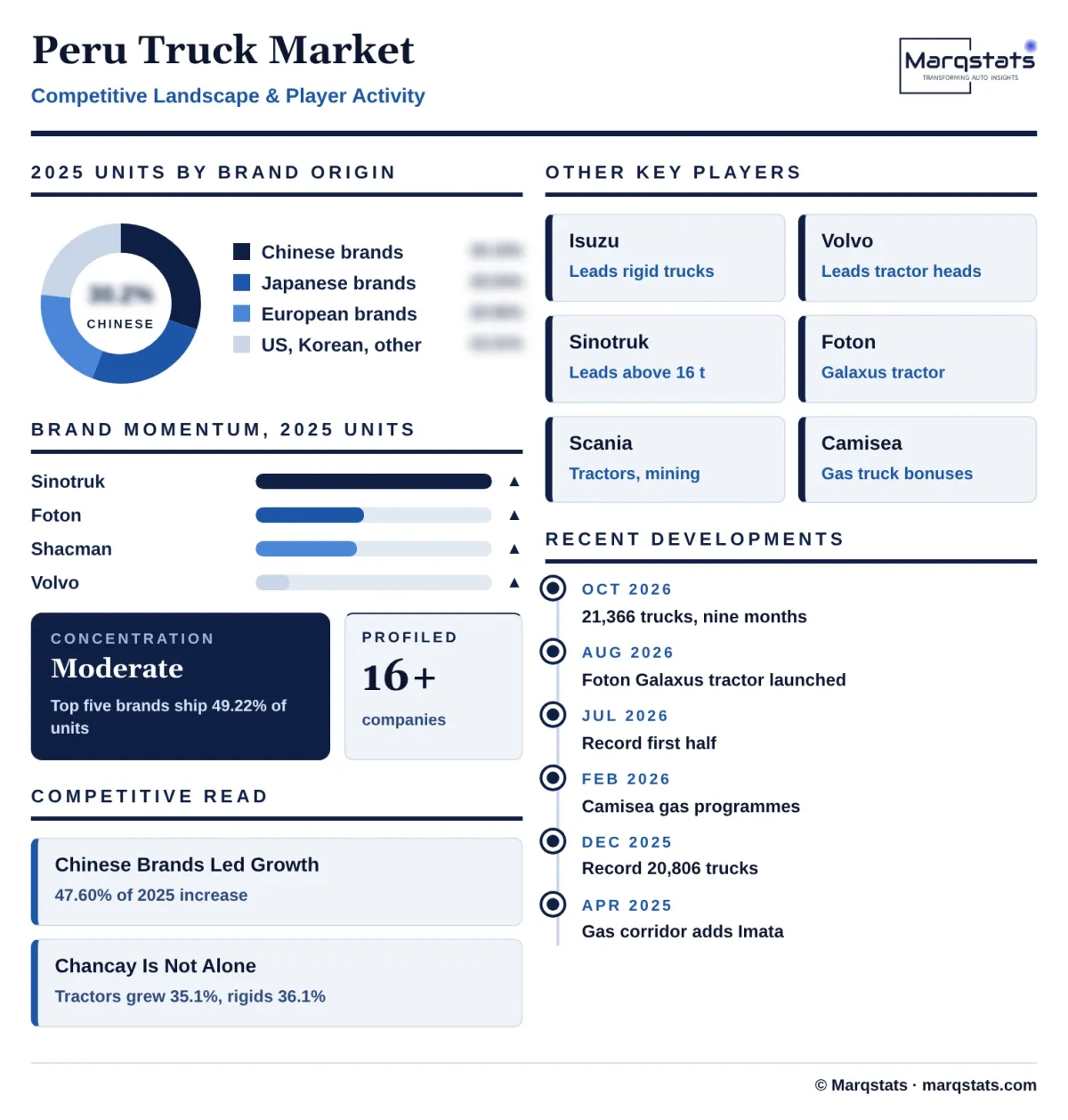
The market is moderately concentrated and no brand holds more than a seventh of registrations. Marqstats combines AAP top-ten rigid truck and tractor head lists and finds Isuzu at 2,862 units (13.76%), Volvo at 2,414 (11.60%), Sinotruk at 1,870 (8.99%), Foton at 1,810 (8.70%) and Hino at 1,248 (6.00%). The top three brands hold 34.35% and the top five 49.22% of 2025 units.
Chinese brands are the growth engine. Marqstats counts Sinotruk, Foton, JAC, Shacman and FAW at 6,281 units, 30.19% of 2025 registrations and up from 3,664 units and 23.94% in 2024, which is a floor because other Chinese brands sit outside the AAP top-ten lists. The ALADDA balance report for Peru, built on AAP data, puts Chinese brands at 38% of heavy vehicle sales in 2025, including buses, against 19% in 2017. Sinotruk registrations, rigid and tractor heads combined, rose 117.44% in 2025, from 860 to 1,870, and Shacman rose from 855 to 1,284.
European and Japanese brands hold the service-sensitive end. Volvo leads tractor heads with 902 units and 20.6% of the class in the first eleven months of 2025, Scania follows with 762, and Mercedes-Benz sold 1,184 rigid trucks and tractors. Isuzu leads rigid trucks with 2,862 units, Hino sold 1,248 and Fuso 1,203, and Grupo Santa Clara reported nine consecutive years as the leading Isuzu dealer. Marqstats estimates origin groups at 30.19% Chinese (named brands), 25.54% Japanese, 20.96% European and 23.31% United States, Korean and other brands.
Competition is shifting from price to coverage. Foton passed Scania among tractor heads in 2026, Tracto Camiones USA introduced the Galaxus tractor in August 2026 for long, steep and high-altitude routes and projected 3,600 units for the year, and buyers now weigh safety, fuel use, telematics, parts availability, financing and total cost per kilometre as much as price, so dealers with workshops near mines and ports win repeat orders.
Companies Covered
Companies covered in the report include:
Recent Market Activity
Table of Contents
Coverage & Segmentation
The study covers the Peru truck market, with 2025 as the base year, 2021 – 2025 as the historical period and 2026 – 2030 as the forecast period. It covers new goods trucks above 3.5 tonnes gross vehicle weight, as the Asociación Automotriz del Perú counts them in its camiones y tractocamiones series, segmented by vehicle class, powertrain, end use and region. The weight boundary is 3.5 tonnes at the lower end, with the AAP classes of 3.5 to 8, 8 to 16 and above 16 tonnes, and there is no upper limit. Values are wholesale values at the importer gate in US dollars, before the 18% general sales tax, and sol figures use the 2025 average of PEN 3.5685 per US dollar.
Pickups and vans up to 3.5 tonnes, minibuses and omnibuses, used trucks, trailers and locally built bodies, agricultural tractors and off-highway mining haulers are excluded. Segment and regional splits are Marqstats estimates built on AAP registrations, customs values and price benchmarks. Live Marqstats reports on the Mexico Electric Truck and Brazil Electric Truck markets cover other countries, and the Global Electric Mining Equipment report covers off-highway machines that the Peru truck analysis excludes. Their figures should not be added to this market.
