Market Snapshot
The global roadside assistance market is worth USD 34.69 billion in 2025 and reaches USD 45.78 billion by 2030, a 5.70% CAGR. Dispatch volumes grow only 3.22% a year, so most of the gain comes from revenue per job: more flatbed recoveries, older vehicles and dearer labour.
Marqstats sizes the market as dispatches multiplied by programme revenue per dispatch, region by region. The base is 180.5 million roadside jobs in 2025, anchored on operator disclosures: more than 27 million calls handled by the American Automobile Association (AAA) in 2024, about 13 million annual service events at Agero, Inc., 3,691,813 callouts by the Allgemeiner Deutscher Automobil-Club (ADAC) in 2025, 2,309,716 rescues by the Japan Automobile Federation (JAF) in fiscal 2025 and 8.1 million breakdown and towing missions recorded by the French Union des Assisteurs for 2024. Average programme revenue per dispatch is USD 192.19 in 2025, rising to USD 216.45 in 2030.
The headline counts money paid for roadside service: motor club dues attributable to breakdown cover, insurer and assistance-company roadside programmes, OEM roadside warranty contracts, fleet contracts and pay-per-use jobs. It does not count collision repair, repossession, police-rotation and impound towing, or the workshop repair that follows a tow. Those sit downstream and would double count the same incident.
Key Takeaways
Market Overview & Analysis
Report Summary
Roadside assistance is a mature, contract-driven service whose growth is set by three numbers: the size and age of the vehicle parc, how often those vehicles fail, and what each job costs to fulfil. We model all three. The result is a market that grows faster than its volumes, which is the opposite of the view that better vehicles and electric drivetrains are shrinking the business.
Revenue reaches the market through four channels. Motor clubs such as AAA, ADAC, The AA and JAF sell memberships; insurers and assistance companies such as Allianz Partners, Europ Assistance and AXA Partners embed cover in motor policies; vehicle manufacturers fund roadside programmes during warranty; and fleets and on-demand platforms buy jobs per event. In nearly every case the physical work is subcontracted to independent towing and patrol operators, so programme revenue sits above the operator payout in the value chain. We size at the programme level, the price paid by the end customer or the sponsoring insurer or manufacturer.
The page covers 2021 to 2030 with 2025 as the base year. Every value is a Marqstats estimate in constant 2025 US dollars, converted at fixed 2025 average rates: EUR 1 = USD 1.13, GBP 1 = USD 1.32, AUD 1 = USD 0.6451 and JPY 149.6 per US dollar.
Global Roadside Assistance Market Size and Forecast
Marqstats estimates the market at USD 28.10 billion in 2021, USD 29.85 billion in 2022, USD 31.60 billion in 2023, USD 33.15 billion in 2024 and USD 34.69 billion in 2025, a 5.41% CAGR over the historical period. The forecast runs to USD 36.55 billion in 2026, USD 38.60 billion in 2027, USD 40.80 billion in 2028, USD 43.20 billion in 2029 and USD 45.78 billion in 2030, a 5.70% CAGR and an increase of USD 11.09 billion.
Volumes grow more slowly. Global dispatches rise from 165.5 million in 2021 to 180.5 million in 2025 and 211.5 million in 2030, a forecast CAGR of 3.22%. Programme revenue per dispatch rises from USD 192.19 to USD 216.45, a 2.41% annual increase. The two compound to the 5.70% value rate. The 2021 to 2023 period ran faster than trend as post-pandemic mileage recovered and repair-cost inflation fed through to tow and patrol rates; we treat that as a one-off step, not a new trend.
The dispatch count is the anchor because it is the figure operators publish. AAA handled more than 27 million calls in 2024, of which about 13 million were tows and about 7 million battery jobs. Agero, Inc. reports about 13 million service events a year across more than 150 million vehicle coverage points. ADAC patrols attended 3,691,813 breakdowns in 2025, up 1.6%. The AA assisted with 3.5 million breakdowns in 2025. JAF carried out 2,309,716 rescues in the fiscal year to March 2026. NRMA patrols in New South Wales and the Australian Capital Territory answered 1.5 million call-outs in fiscal 2025. Marqstats builds the rest of the 180.5 million from vehicle parc and a regional call-out rate. The global dispatch total is a Marqstats construction, since operators publish their own volumes but no body consolidates them; roughly a third of the 2025 base traces directly to the named disclosures above.
We hold the forecast to a single trajectory. Ageing fleets in Europe, North America and Japan keep call-out rates firm; China and India add parc; and the price of each job rises with flatbed mix and technician wages. A sharp recession would cut discretionary membership renewals before it cut breakdowns, but nothing in 2026 data points that way: ADAC volumes rose, Agero is consolidating rather than retreating, and Roadzen Inc. reported 24% revenue growth for its fiscal year to March 2026.
Value Outgrows Volume Because the Job Mix Is Getting Heavier
Revenue per dispatch, not dispatch count, carries more than 40% of forecast growth. Of the 5.70% annual value gain, 3.22 points come from volume and the remainder from price per job. That split matters for anyone underwriting a fixed-fee programme.
The cheapest jobs are the ones that are falling. A jump-start or a wheel change by a patrol van typically finishes in one visit. Towing needs a second asset, a destination and often a second leg. ADAC data shows the direction: electric cars in the four-year age band broke down at 6.5 per 1,000 vehicles in 2025, against 12.5 for combustion cars, and high-voltage drive components caused under 3% of breakdowns. Fewer faults per vehicle is a volume headwind.
But many electric and all-wheel-drive vehicles cannot be towed with driven wheels on the ground, and manufacturers specify flatbed transport or wheel dollies in their owner manuals. In France, the Union des Assisteurs reported that in nearly 45% of summer 2025 cases the driver could continue without a tow, which leaves more than half of jobs ending on a truck. We model flatbed and dolly share of light-vehicle tows rising through 2030, which lifts average revenue per job even as patrol fix rates hold.
The conclusion is plain. Programmes priced on 2023 dispatch costs are underpriced for a 2030 fleet. Marqstats sees operators that renegotiate per-job rates, or that add their own flatbeds, capturing most of the growth.
Battery Failure Remains the Core Demand Line Across Drivetrains
The 12-volt battery is still the single largest cause of breakdown, in every large dataset we checked. ADAC attributed 45.4% of its 3,691,813 callouts in 2025 to the starter battery, roughly 1.68 million jobs, and stated the share applies regardless of drive type. JAF recorded 792,392 over-discharged battery jobs and 204,724 damaged or degraded battery jobs in fiscal 2025, together 43.17% of its 2,309,716 rescues. AAA counted about 7 million battery calls in 2024.
Electric vehicles do not remove this demand. Their low-voltage battery powers the control units and closes the high-voltage contactors, so a flat 12-volt battery immobilises the car. That keeps the battery service line growing at 5.56% a year, close to the market rate, and it explains why motor clubs keep battery replacement stock on patrol vans rather than cutting it.
Dispatch Platforms Are Consolidating Into Scaled Administrators
Software alone has not made roadside dispatch profitable. Urgent.ly Inc. reported 2025 revenue of USD 129.2 million, down 10% from USD 142.9 million, on about 768,000 dispatches, with a GAAP operating loss of USD 8.9 million. On 13 March 2026 it agreed to be acquired by Agero, Inc. for USD 5.50 a share in cash through a tender offer, and Tow Times reported completion on 1 May 2026. The combined business covers more than 150 million vehicles.
The lesson Marqstats draws is that dispatch density beats app features. A platform pays the same independent tow operator as a motor club does, so margin depends on volume, routing and contract terms with insurers. Roadzen Inc. is growing, with fiscal 2026 revenue of USD 55.0 million, up 24%, but it sells claims, inspection and roadside services together rather than roadside alone.
Market Dynamics
Key Drivers
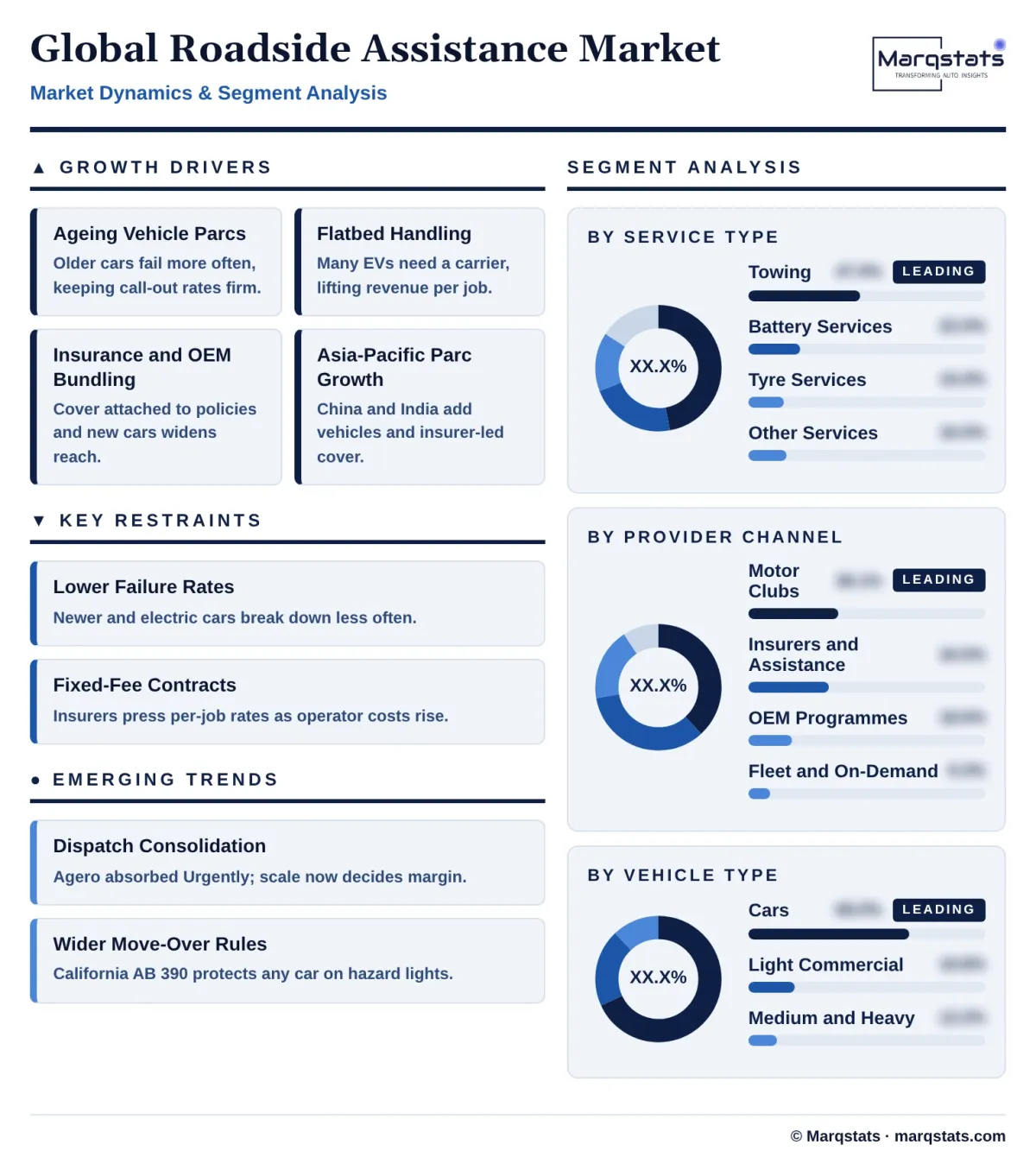
Four forces lift roadside spend, each tied to a published operator metric or regulation.
- Ageing vehicle parcs: the average vehicle attended by ADAC patrols in 2025 was just under 14 years old, and older cars fail more often; ADAC callouts still rose 1.6% in 2025 despite better new-car reliability, which keeps per-vehicle call-out rates firm in Europe, North America and Japan.
- Flatbed and dolly handling for electric and all-wheel-drive vehicles: manufacturer towing instructions restrict wheel-lift towing for many electric models, so a larger share of tows needs a flatbed, lifting programme revenue per dispatch from USD 192.19 in 2025 to USD 216.45 in 2030.
- Bundling into insurance and OEM programmes: insurers and assistance companies grow from USD 11.80 billion to USD 16.30 billion and OEM programmes from USD 6.45 billion to USD 9.10 billion by 2030, because cover attached to a policy or a new car reaches drivers who would never buy a club membership.
- Parc growth in Asia-Pacific: Asia-Pacific dispatches rise from 68.0 million to 86.0 million between 2025 and 2030 in Marqstats estimates, driven by China and India parc expansion and insurer-led roadside cover, making it the fastest-growing region at 7.55% a year.
Key Restraints
Three pressures cap how fast programme revenue can rise.
- Lower failure rates on newer and electric vehicles: ADAC measured 6.5 breakdowns per 1,000 four-year-old electric cars against 12.5 for combustion cars in 2025, so electrification slows dispatch growth to 3.22% a year even as the parc expands.
- Fixed-fee contracts and insurer pricing power: Urgent.ly Inc. revenue fell 10% in 2025 to USD 129.2 million even as fourth-quarter revenue grew 4%, showing that enterprise buyers press platform rates when tow operator costs are rising.
- Technician and tow-operator capacity: patrol and towing work is labour-intensive and seasonal; the French June 2025 heatwave drove a record 16% jump in breakdown jobs, and peaks of that kind strain subcontracted networks and push up rates paid to operators faster than programme prices adjust.
Key Trends
Three shifts change how roadside jobs are sold and delivered.
- Scale consolidation at the dispatch layer: Agero, Inc. completed its acquisition of Urgent.ly Inc. in spring 2026, combining coverage of more than 150 million vehicles, and Marqstats expects further tuck-ins as smaller platforms struggle to fund growth.
- Motor clubs acting as wholesale fulfilment partners: clubs increasingly run roadside service for insurers and carmakers under white-label contracts, which raises dispatch volume per patrol but lowers revenue per covered vehicle compared with a direct paid membership.
- Roadside safety rules widen: California AB 390 took effect in January 2026, requiring drivers to move over or slow down for any stationary vehicle showing hazard lights, extending protection that earlier covered mainly police, ambulance and tow vehicles, and adding training and equipment cost for roadside crews.
Strategic Implications
- For entrants: compete for enterprise contracts with insurers, fleets and OEMs rather than consumers. Dispatch density is the economic moat, and Urgently shows that an app with 768,000 annual jobs cannot carry public-company costs on its own.
- For incumbents: reprice multi-year programmes around job mix, not job count. Revenue per dispatch rises 2.41% a year in Marqstats estimates, driven by flatbed share and wages; a contract fixed on 2023 costs loses margin every year it runs.
- For suppliers and investors: the equipment opportunity sits in flatbed carriers, wheel dollies, 12-volt battery inventory and patrol diagnostics, all of which grow with the electric and ageing parc. Mobile charging remains a niche line inside the USD 2.09 billion winching, EV support and other segment.
- For carmakers: roadside programmes are moving from a cost line to a retention tool, with OEM programme value rising from USD 6.45 billion to USD 9.10 billion by 2030. Connected-car breakdown alerts that feed a dispatch partner directly shorten response time and keep the customer in the brand network after the tow.
Market Segmentation
Towing and recovery is the largest and most capital-heavy line, worth USD 16.30 billion in 2025 (47.0%) and USD 21.40 billion in 2030, a 5.60% CAGR. AAA put tows at about 13 million of its more than 27 million calls in 2024, close to half. Value share is held up by flatbed handling: each tow of an electric or all-wheel-drive vehicle needs a carrier rather than a wheel-lift, and motorway jobs end on a truck far more often than urban ones.
Marqstats expects the share to stay near 46.7% in 2030. Fewer mechanical faults per vehicle cut the number of tows, but a higher price per tow offsets it.
Battery jump-starts, testing and replacement account for USD 7.63 billion in 2025 (22.0%) and USD 10.00 billion in 2030, a 5.56% CAGR. ADAC attributes 45.4% of its callouts to the starter battery, and JAF data puts battery-related rescues at 43.17% of jobs. Value share is lower than job share because battery jobs are short and often finish in one patrol visit. Replacement batteries sold at the roadside raise revenue per job and are the fastest-growing part of the line.
Tyre changes, puncture repair and tyre-related recovery are worth USD 5.20 billion in 2025 (15.0%) and USD 6.70 billion in 2030, a 5.20% CAGR. JAF recorded 482,696 tyre jobs in fiscal 2025, 20.90% of rescues, a higher share than in Europe because spare wheels have largely given way to repair kits that cannot fix sidewall damage. The same shift is pushing tyre jobs toward towing where no spare is carried.
Lockout and key services represent USD 2.43 billion in 2025 (7.0%) and USD 2.95 billion in 2030, a 3.95% CAGR. JAF recorded 103,858 lock-in jobs in fiscal 2025. Growth trails the market because connected cars increasingly unlock remotely through manufacturer apps, removing the need for a patrol visit.
Roadside fuel delivery is the smallest and slowest line at USD 1.04 billion in 2025 (3.0%) and USD 1.10 billion in 2030, a 1.13% CAGR. JAF logged 40,880 out-of-fuel rescues in fiscal 2025, 1.77% of jobs. Electrification and better range warnings cap this line.
Winching, extrication, mobile EV charging, minor on-site repair and other services total USD 2.09 billion in 2025 (6.0%) and USD 3.63 billion in 2030, an 11.67% CAGR, the fastest of any service line. The growth comes mainly from electric-vehicle support jobs, out-of-charge recovery and specialist handling, which Marqstats models from regional electric parc and call-out rates. The split of this line is a Marqstats estimate, built from electric parc and call-out rates rather than a published operator breakdown. Mobile charging vans stay a small part of the line because a short flatbed hop to a public charger is often the cheaper fix.
Motor clubs earn USD 13.20 billion in 2025 (38.1%), the largest channel, rising to USD 15.40 billion in 2030 at a 3.13% CAGR. AAA, ADAC (22.7 million members), The AA, RAC (15 million members at mid-2025), JAF and NRMA (3.4 million members) anchor it. Clubs grow below market because direct paid membership is saturated in mature markets; their volume gains increasingly come from white-label work for insurers and carmakers, which Marqstats books in those channels.
Insurers and assistance companies earn USD 11.80 billion in 2025 (34.0%) and USD 16.30 billion in 2030, a 6.67% CAGR, overtaking motor clubs by 2030. Allianz Partners, Europ Assistance, AXA Partners, MAPFRE Asistencia and Inter Mutuelles Assistance run roadside cover bundled into motor policies; in France alone, the members of the Union des Assisteurs carried out 8.1 million breakdown and towing missions in 2024.
Manufacturer-funded roadside programmes are worth USD 6.45 billion in 2025 (18.6%) and USD 9.10 billion in 2030, a 7.13% CAGR. Warranty-period cover is standard on new cars in Europe and North America and is spreading in China and India. Programmes are delivered by administrators such as Agero and by club consortia such as ARC Europe.
Fleet contracts, pay-per-use jobs and digital on-demand platforms generate USD 3.24 billion in 2025 (9.3%) and USD 4.98 billion in 2030, an 8.98% CAGR, the fastest channel. Roadzen Inc., HONK Technologies and similar platforms sell per-event dispatch to fleets, rental companies and gig-economy drivers. The channel grows fast from a small base, but Urgently's sale to Agero shows platforms need scale to stay independent.
Passenger cars account for USD 23.60 billion in 2025 (68.0%) and USD 30.40 billion in 2030, a 5.19% CAGR. They supply most jobs and nearly all club and OEM programme revenue.
Vans and pickups generate USD 6.85 billion in 2025 (19.7%) and USD 9.40 billion in 2030, a 6.53% CAGR. Delivery fleets run high mileage and pay for fast response because downtime costs revenue, which lifts revenue per job above passenger-car levels.
Trucks, buses and coaches account for USD 4.24 billion in 2025 (12.2%) and USD 5.98 billion in 2030, a 7.12% CAGR. Job counts are small, but heavy recovery with rotators and load transfer costs many times a car tow, and fleet telematics is pulling more of this work into contracted programmes.
By Geography
North America
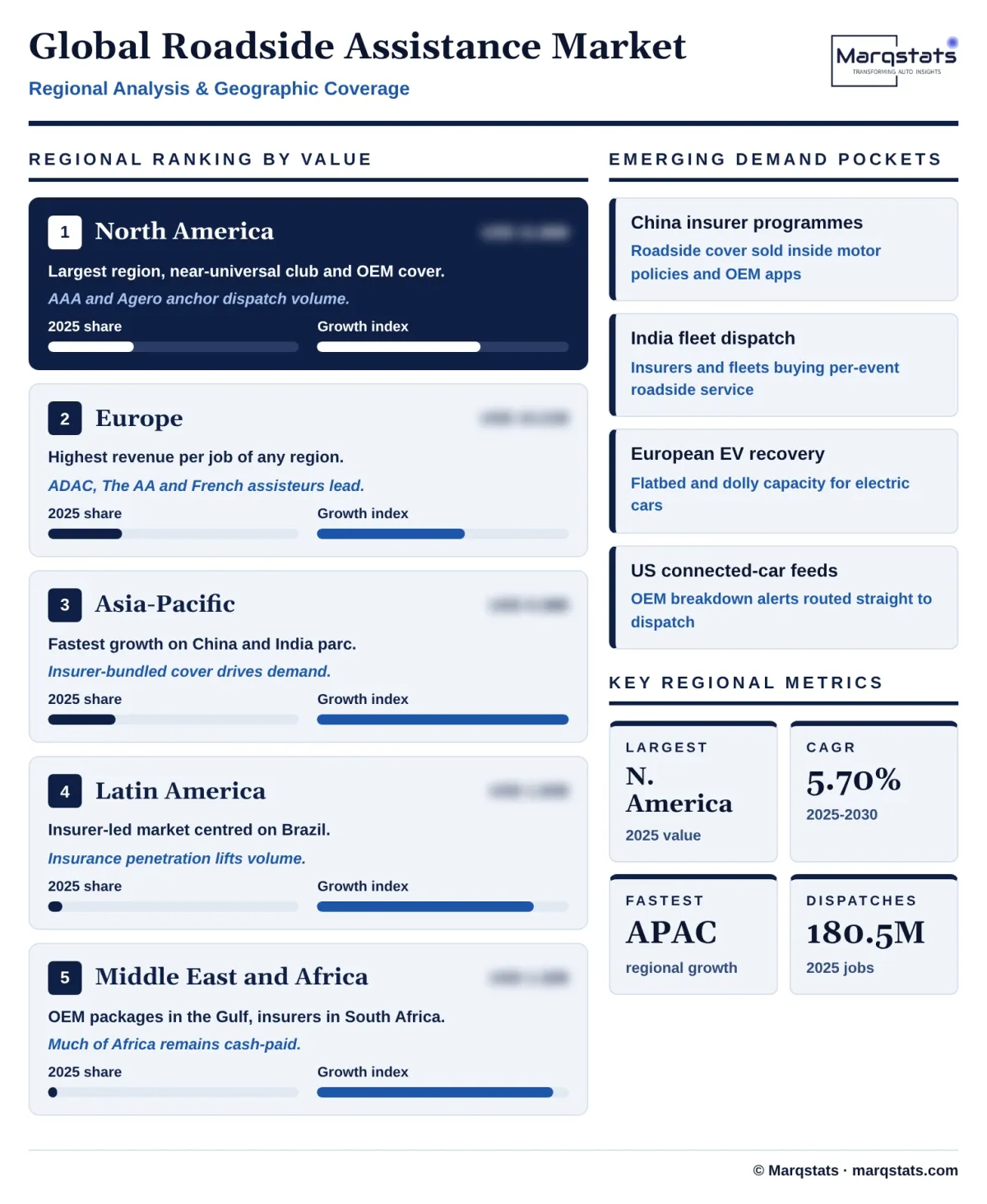
North America is the largest region at USD 11.86 billion in 2025 (34.2%), rising to USD 15.07 billion in 2030 at a 4.91% CAGR. Marqstats estimates 52.0 million dispatches in 2025 at USD 228 programme revenue per job. AAA handled more than 27 million calls in 2024 and Agero about 13 million service events a year; insurers, OEM programmes, the Canadian Automobile Association clubs and on-demand platforms supply the rest.
Growth is slower than the global rate because membership and OEM cover are already near universal. The upside lies in price per job and in safety rules: California AB 390, effective January 2026, widened move-over protection to any stationary vehicle with hazard lights.
Europe
Europe generates USD 10.21 billion in 2025 (29.4%) and USD 12.72 billion in 2030, a 4.49% CAGR, on 40.5 million dispatches in 2025 at USD 252 per job. Germany, the United Kingdom and France anchor it: ADAC attended 3,691,813 breakdowns in 2025, The AA 3.5 million, and the French Union des Assisteurs members 8.1 million missions in 2024.
Europe has the highest revenue per job because patrol labour costs more and motorway jobs end in a tow more often. Next-generation eCall under Commission Delegated Regulation (EU) 2024/1180, applying to new types from January 2026, adds an automated incident feed that assistance companies are wiring into dispatch.
Asia-Pacific
Asia-Pacific is worth USD 9.38 billion in 2025 (27.0%) and is the fastest-growing region, reaching USD 13.50 billion in 2030 at 7.55% a year. Marqstats estimates 68.0 million dispatches in 2025 at USD 138 per job, the lowest price of any large region. Japan supplies a mature base, with JAF performing 2,309,716 rescues in fiscal 2025 alongside insurer road services. NRMA answered 1.5 million call-outs in New South Wales and the Australian Capital Territory.
China drives the growth. Roadside cover there is bundled into motor insurance and OEM apps rather than sold as club membership, and India follows the same insurer-led path, with Roadzen Inc. building dispatch for insurers and fleets.
Latin America
Latin America accounts for USD 1.92 billion in 2025 (5.5%) and USD 2.63 billion in 2030, a 6.50% CAGR, on 12.0 million dispatches at USD 160 per job. Brazil leads, with insurers such as Porto Seguro S.A. running large assistance operations, and MAPFRE Asistencia active across the region. Growth comes from insurance penetration rather than club membership.
Middle East and Africa
The Middle East and Africa total USD 1.32 billion in 2025 (3.8%) and USD 1.86 billion in 2030, a 7.10% CAGR, on 8.0 million dispatches at USD 165 per job. Gulf states lean on OEM and dealer roadside packages for new cars, while South Africa has a mature insurer-led market; much of the rest of Africa remains cash-paid and informal, which Marqstats captures through parc-based call-out rates.
How Competition Is Evolving
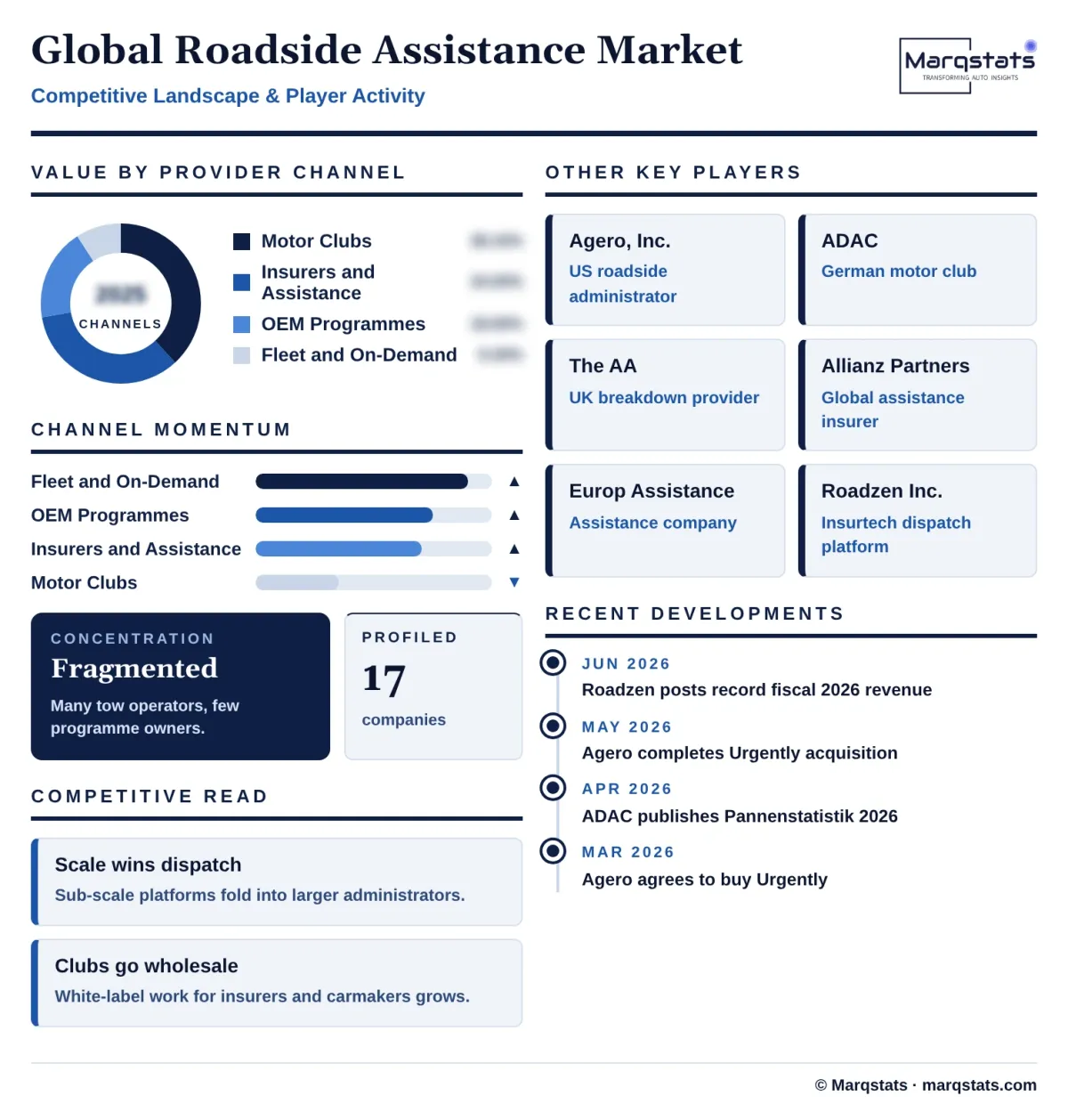
The market is fragmented at the delivery layer and moderately concentrated at the programme layer. Tens of thousands of independent tow and patrol operators do the physical work, while a few dozen clubs, assistance companies and administrators hold the contracts. No registry publishes company shares for roadside revenue, so Marqstats describes competition by channel and by named, dated actions rather than inventing a share table.
Motor clubs compete on brand and patrol quality; ADAC, The AA and RAC run their own patrol fleets and report fix rates as a selling point. Assistance companies compete on price and on breadth of bundled cover, selling to insurers, banks and carmakers. Administrators such as Agero compete on dispatch density and network management. The 2026 Agero and Urgently deal shows where pressure is heaviest: a sub-scale dispatch platform folded into a larger administrator rather than fight for insurer contracts on price.
Marqstats expects the programme layer to concentrate further through 2030. Electric and connected vehicles favour players who can integrate with manufacturer data and own flatbed capacity, and both need scale.
Companies Covered
Companies covered in the report include:
Recent Market Activity
Table of Contents
Coverage & Segmentation
Inclusions: programme revenue for roadside breakdown service to light and heavy road vehicles worldwide, comprising towing and recovery, battery services, tyre services, lockout, fuel delivery, winching, mobile EV charging and minor on-site repair. Revenue is counted at the programme level: the share of motor club dues attributable to breakdown cover, insurer and assistance-company roadside programmes, OEM roadside warranty contracts, fleet contracts and pay-per-use jobs.
Exclusions: collision repair and the workshop repair that follows a tow, police-rotation, impound and parking-enforcement towing, repossession, salvage logistics, scheduled maintenance, travel and home assistance, and replacement-car hire supplied under assistance policies. Payments from programmes to subcontracted tow operators are inside the headline and must not be added again.
Sibling boundary: the Marqstats Global EV Maintenance Market page (USD 50.24 billion in 2025) covers workshop servicing of electric vehicles and has no roadside or towing segment, so the two pages do not overlap; do not add roadside value to it. The Global Car Wash Services Market and Global Automotive Lubricants Aftermarket pages are adjacent aftermarket services with no shared revenue.