Market Snapshot
Middle bar: base-year value × (1 + CAGR), rounded to two decimals. This is a calculated illustration, not a separately researched annual estimate.
The global aftermarket parking sensor kits market size is estimated at USD 844.17 million in 2025 and is projected to reach USD 1,010.37 million by 2030, growing at a CAGR of 3.66% over 2026 – 2030. Annual shipments rise from about 25.39 million kits to 29.00 million, a 2.69% annual rate, while the average ex-factory price edges up from about USD 33.25 to USD 34.84 per kit as buyers move towards wireless, display and fleet-grade systems.
Marqstats defines the market as the ex-factory value of ultrasonic, electromagnetic and radar-hybrid proximity sensor kits sold after the vehicle leaves the factory to detect obstacles when parking or reversing, through installers, automotive retailers, online marketplaces and fleet or dealer channels. Sensors fitted at the factory, direct replacement sensors for failed original-equipment systems, camera-only kits, blind-spot radar and fitting labour are excluded.
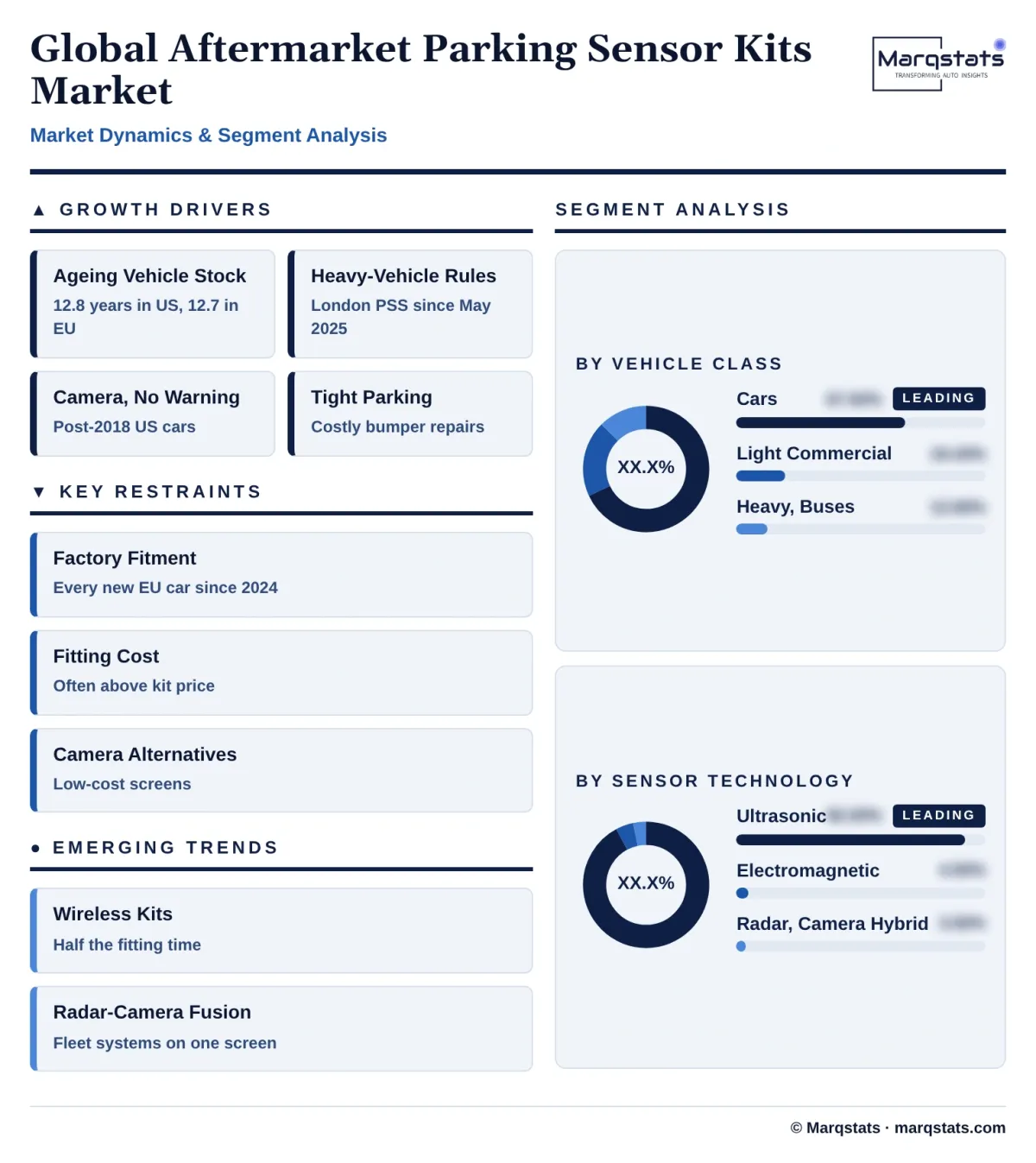
Passenger cars take 67.92% of 2025 value, but heavy vehicles and buses grow fastest, at 8.82% a year. Asia-Pacific holds 37.52% of value and Middle East and Africa grows fastest among regions. The study segments the market by sensor technology, transmission type, vehicle class, sales channel and region.
Key Takeaways
Market Overview & Analysis
Report Summary
Marqstats sizes the aftermarket parking sensor kits market as the ex-factory value of retrofit proximity sensing kits for vehicles already on the road. In 2025 about 25.39 million kits were shipped worldwide, worth an estimated USD 844.17 million at an average ex-factory price of about USD 33.25.
A parking sensor kit has three parts: the sensors that detect obstacles, a control unit that measures distance and decides when to warn, and an alert, which may be a buzzer, a row of lights, a display or a voice. Ultrasonic sensors send a burst of sound, usually between 40 and 58 kilohertz, and time the echo, so they measure distance directly. Electromagnetic kits stick an antenna strip to the inside of a plastic bumper and sense changes in an electric field, so no holes are drilled, but they warn only while the vehicle or the obstacle is moving. Radar and camera-hybrid kits, mostly sold for lorries, buses and construction vehicles, combine radar sensing with a monitor.
The kit is only part of what the buyer pays. Hardwired kits need bumper holes drilled, wires run to the cabin and a connection to the reversing light, which takes about two to three and a half hours. Marqstats estimates that a fitted rear four-sensor kit for a car costs a buyer roughly USD 190 to 205 in markets with high labour rates, of which fitting is often more than half. This is why wireless kits that remove the cabin wiring, and kits designed for do-it-yourself fitting, win share.
The market grew from USD 709.64 million and about 22.60 million kits in 2021 to USD 744.87 million in 2022, USD 779.22 million in 2023 and USD 810.16 million in 2024, a 4.44% annual rate over four years, as the world car parc aged and fewer buyers replaced vehicles after the pandemic. Marqstats expects about 26.07 million kits worth USD 874.65 million in 2026.
Rules explain the shape of demand. In the United States, the rear-visibility standard FMVSS 111 required a rear camera on all new light vehicles from 1 May 2018 but did not require parking sensors, so many cars from 2018 onwards have a camera and no audible distance warning. In the European Union, the General Safety Regulation (EU) 2019/2144 requires a reversing detection system on new vehicles, from July 2022 for new types and July 2024 for all new registrations, and UN Regulation 158 sets the performance rules for such devices. These rules fit sensors to new vehicles and so reduce the stock of unequipped vehicles over time, but they do not change vehicles already built.
Global Aftermarket Parking Sensor Kits Market Size and Forecast
The global aftermarket parking sensor kits market grows from USD 844.17 million in 2025 to USD 1,010.37 million in 2030, a CAGR of 3.66%. Marqstats expects shipments of about 26.07 million kits worth USD 874.65 million in 2026, 26.77 million worth USD 906.16 million in 2027, 27.49 million worth USD 938.78 million in 2028 and 28.23 million worth USD 973.94 million in 2029, before reaching 29.00 million kits in 2030.
Prices per kit rise slowly. The average ex-factory price was about USD 31.40 in 2021 and USD 32.80 in 2024, reaches USD 33.25 in 2025 and rises to about USD 34.84 in 2030, a 0.94% annual increase. Falling component costs for chips and transducers hold down the price of simple kits, while the shift towards wireless, display and fleet-grade kits, and a higher share of vehicles in the mix, lift the average.
The forecast is built from vehicle stock. Marqstats estimates the number of vehicles in use in each region that left the factory without parking sensors, about 820 million in 2025, and multiplies it by the share that buy a kit each year. That rate is about 3.40% in Asia-Pacific, 3.30% in Latin America, 3.00% in the Middle East and Africa, 2.90% in Europe and 2.60% in North America, or 3.10% worldwide. Each region's unit volume is then multiplied by an ex-factory price for that region.
The stock of unequipped vehicles shrinks as old cars are scrapped, but it is refilled as buyers keep cars longer. Marqstats assumes that rising car ages, with 12.8 years in the United States and 12.7 years in the European Union, offset scrappage, so the number of kits rises by 2.69% a year rather than falling.
Three indicators are tracked to monitor the forecast: national vehicle age and scrappage statistics, reversing-detection and heavy-vehicle safety rules and their enforcement, and the results of listed suppliers with aftermarket exposure.
The mix shifts towards higher-value products. Wireless kits rise from 26.00% to 33.50% of value, radar and camera-hybrid kits from 3.50% to 5.20%, heavy vehicles and buses from 12.65% to 16.13%, and e-commerce from 30.00% to 35.50%, while passenger cars fall from 67.92% to 63.20% and installers from 44.00% to 40.50%.
Market Dynamics
Key Drivers
Five forces keep demand for aftermarket parking sensor kits growing even as new vehicles leave the factory with sensors fitted.
- An ageing vehicle stock. The average light vehicle in the United States is 12.8 years old, and the average car in the European Union is 12.7 years old, so a very large stock of vehicles was built before parking sensors became standard and stays on the road for years.
- Rules for heavy vehicles. London's Direct Vision Standard requires lorries over 12 tonnes with a rating below three stars to fit a Progressive Safe System, with enforcement starting on 4 May 2025 after a grace period, and the median cost was put at GBP 1,500 per vehicle, creating a clear market for sensor, camera and warning kits.
- Rear cameras without distance warning. Millions of vehicles built since the 2018 US rear-visibility rule have a camera but no audible distance alert, which supports hybrid kits that add sensors to an existing screen.
- Parking in tight spaces. Wider vehicles in narrow streets and car parks, and the cost of repairing bumpers and paint, make a kit costing less than a small repair easy to justify.
- Used-vehicle imports. In Africa, the Middle East, Latin America and parts of Asia, large volumes of used vehicles arrive from Japan, Europe and North America with missing or damaged sensors, creating recurring demand for universal kits.
Key Restraints
Four constraints hold back how fast aftermarket parking sensor kits sell and how much buyers pay.
- Sensors on every new vehicle. Every new car sold in the European Union since July 2024 must have a reversing detection system, and similar fitment is near universal in other mature markets, so the pool of unequipped vehicles grows more slowly each year.
- Cost and difficulty of fitting. Drilling bumpers, matching paint and wiring into the reversing light puts off many buyers, and professional fitting often costs more than the kit.
- Cameras and phone-based aids. Low-cost reversing cameras and screens, and systems that show a camera view with distance lines, compete for the same spending.
- Quality gaps in the low-price tier. Poor sealing, false alarms and weak warranties on unbranded kits sold online raise return rates and put some buyers off the category.
Key Trends
Four shifts are changing how aftermarket parking sensor kits are designed, fitted and sold.
- Wireless kits. Trunk-mounted control units that send alerts to a plug-in display by radio remove the need to run wires through the cabin and cut fitting time by roughly 40% to 60%.
- Non-drilling designs. Adhesive electromagnetic strips and bumper-mounted sensors that clip into existing holes appeal to owners of cars with paintwork they do not want to cut.
- Radar and camera fusion for fleets. Brigade launched Backsense Radar OSD in May 2026, showing radar detection on the same screen as camera views, and similar systems are spreading from mining and construction to lorries and buses.
- Smart-phone and display alerts. Kits that send distance warnings to an app or an existing infotainment screen replace separate dashboard displays, and use short-range radio rather than wires.
Strategic Implications
- For kit makers, the fitting problem is the product problem. Wireless, non-drilling and plug-in designs lower the total cost for the buyer and win share from wired kits.
- For heavy-vehicle suppliers, rules are the main growth driver. Systems that meet London's Progressive Safe System and similar requirements, with IP-rated sensors, 12 and 24 volt supply and a clear alert for cyclists and pedestrians, command prices several times higher than car kits.
- For distributors and marketplaces, branded kits with warranty and clear fitment guidance protect margins against unbranded imports.
- For installers, bundling a sensor kit with a camera, a dash camera or a service visit raises the value of each job as simple fitting becomes less profitable.
- For component suppliers, integrated ultrasonic driver chips and low-cost microcontrollers with diagnostics lower the cost of simple kits and make premium features cheaper to add.
- For investors, fleet-compliance products are the more defensible profit pool because buyers are required to fit them, while consumer car kits depend on price and online visibility.
Market Segmentation
Ultrasonic kits account for 92.00% of 2025 value, USD 776.64 million, and grow at 3.18% a year to USD 908.32 million, falling to 89.90% of the market by 2030. They are the standard choice because the technology is cheap, familiar and measures distance directly, with a detection range of roughly 0.1 to 1.7 metres and a blind zone of 10 to 25 centimetres close to the sensor. Valeo, Steelmate and Brandmotion lead in cars and vans.
Electromagnetic kits account for 4.50% of 2025 value, USD 37.99 million, and grow at 5.44% a year to USD 49.51 million. An adhesive antenna strip inside a plastic bumper senses obstacles without drilling, so the kits appeal to owners of sports and classic cars. The system must be moving to warn and does not work with metal bumpers, which limits the market. Proxel is the best-known specialist.
Radar and camera-hybrid kits account for 3.50% of 2025 value, USD 29.54 million, and are the fastest growing technology, at 12.21% a year to USD 52.54 million. They combine radar sensors with camera views on one monitor and are sold mainly for lorries, buses, mining and construction vehicles. Brigade is the best-known supplier.
Wired kits account for 74.00% of 2025 value, USD 624.69 million, and grow at 1.47% a year to USD 671.90 million, falling to 66.50% of the market. They remain standard for fleets and professional fitting because shielded cables resist interference and weather, but fitting takes two to three and a half hours.
Wireless radio-frequency kits account for 26.00% of 2025 value, USD 219.48 million, and grow at 9.05% a year to USD 338.47 million, rising to 33.50% of the market. Rear sensors connect to a trunk-mounted control unit that sends alerts to a display powered from a socket or fuse, cutting fitting time by about half. The risk is radio interference in crowded urban areas.
Passenger cars account for 67.92% of 2025 value, USD 573.36 million, on about 20.30 million kits at an average price of about USD 28, and grow at 2.18% a year to USD 638.56 million. Demand comes from older cars and base trims without sensors, and the segment is the most price-sensitive.
Light commercial vehicles such as vans and pickups account for 19.43% of 2025 value, USD 164.02 million, on about 4.10 million kits at an average price of about USD 40, and grow at 4.95% a year to USD 208.84 million, supported by delivery fleets that want to reduce reversing damage and claims.
Heavy vehicles and buses account for 12.65% of 2025 value, USD 106.79 million, on about 0.99 million kits at an average price of about USD 108, and are the fastest growing class, at 8.82% a year to USD 162.97 million. Kits are sealed to IP68 or IP69K, run on 12 and 24 volts, and cover blind spots on sides and rear.
Independent garages, auto electricians and mobile fitters account for 44.00% of 2025 value, USD 371.43 million, and grow at 1.96% a year to USD 409.20 million. They remain the largest route because fitting is hard to do at home.
Automotive parts chains and mass retailers account for 19.00% of 2025 value, USD 160.39 million, and grow at 1.97% a year to USD 176.81 million, offering branded kits for do-it-yourself and trade buyers.
Online marketplaces and brand websites account for 30.00% of 2025 value, USD 253.25 million, and grow at 7.21% a year to USD 358.68 million, rising to 35.50% of the market, as buyers choose pre-wired and wireless kits they can fit themselves.
Direct sales to fleets, dealers and vehicle converters account for 7.00% of 2025 value, USD 59.10 million, and grow at 2.13% a year to USD 65.68 million, mainly for commercial vehicles specified by fleet safety programmes.
By Geography
Asia-Pacific
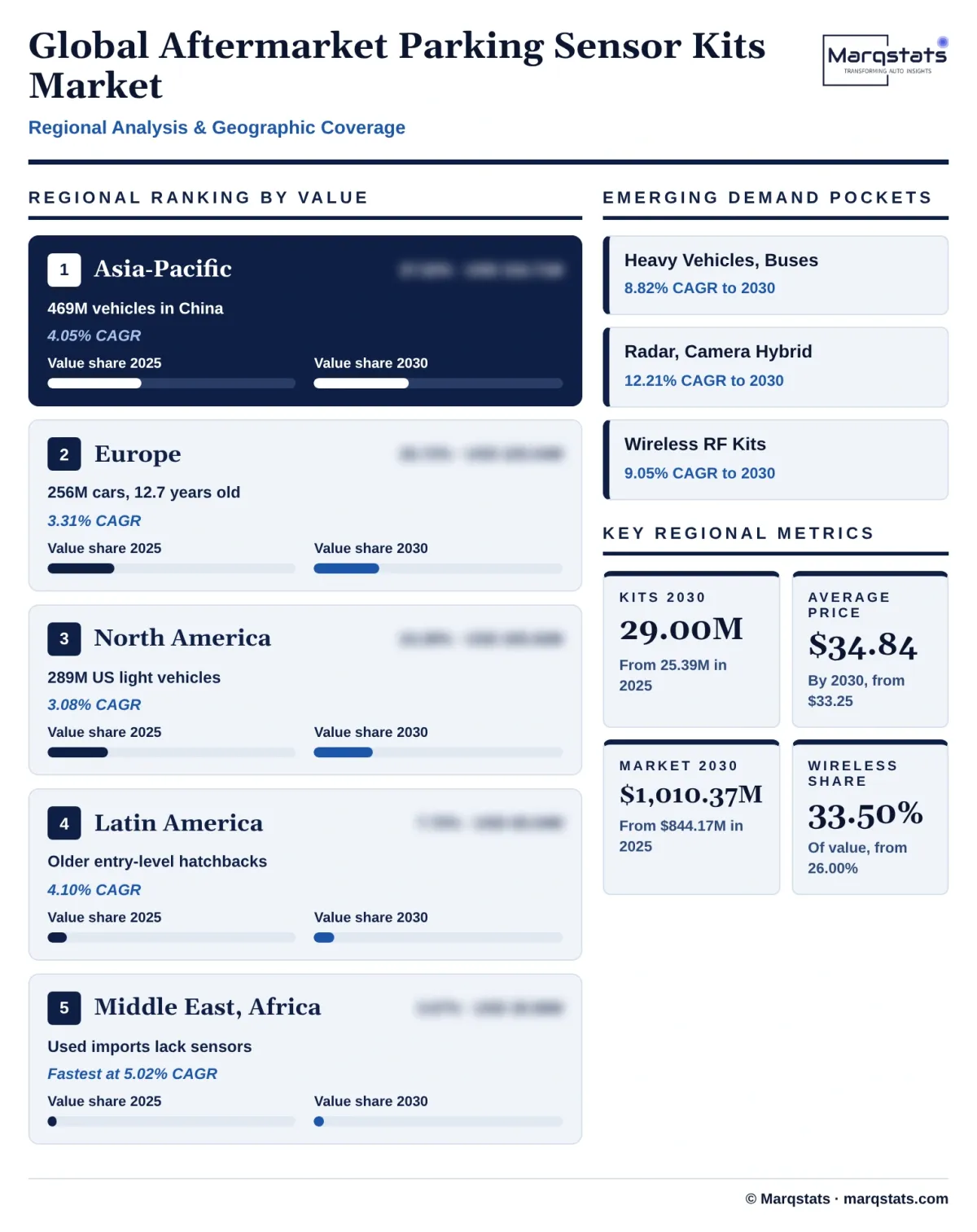
Asia-Pacific is the largest market, with 37.52% of 2025 value, USD 316.71 million, and 46.20% of kits, about 11.73 million, rising to USD 386.24 million by 2030, a 4.05% CAGR. China's Ministry of Public Security reported 469 million motor vehicles at the end of 2025, and India, Indonesia, Thailand and Vietnam have large stocks of compact cars sold without sensors. Prices are the lowest of any large region, about USD 27 per kit, because local manufacturers in southern China supply low-cost kits and dealers and garages fit them as accessories.
Europe
Europe accounts for 26.72% of 2025 value, USD 225.54 million, and 21.15% of kits, about 5.37 million, and grows at 3.31% a year to USD 265.37 million. ACEA reported 256 million cars in the European Union in 2024 with an average age of 12.7 years, and Greece, Italy and Spain have older fleets. Average prices are about USD 42 per kit, supported by branded display kits and by heavy-vehicle systems sold in response to London's Direct Vision Standard.
North America
North America accounts for 24.39% of 2025 value, USD 205.92 million, and 16.90% of kits, about 4.29 million, and grows at 3.08% a year to USD 239.70 million. US vehicle-parc data released in May 2025 put the number of light vehicles in operation at 289 million, with an average age of 12.8 years. Demand is strongest in older pickups, sport utility vehicles and cargo vans, and for kits that add distance warnings to vehicles with a rear camera. Average prices are the highest, about USD 48 per kit.
Latin America
Latin America accounts for 7.70% of 2025 value, USD 65.04 million, and 10.67% of kits, about 2.71 million, and grows at 4.10% a year to USD 79.50 million. Brazil and Mexico have the largest fleets of older entry-level hatchbacks and pickups sold without sensors, and installers fit low-cost four-sensor kits.
Middle East and Africa
Middle East and Africa accounts for 3.67% of 2025 value, USD 30.96 million, and 5.08% of kits, about 1.29 million, and grows fastest, at 5.02% a year, to USD 39.56 million. Used-vehicle imports from Japan, Europe and North America often arrive without working sensors, and Gulf buyers fit kits to sport utility vehicles and pickups.
How Competition Is Evolving
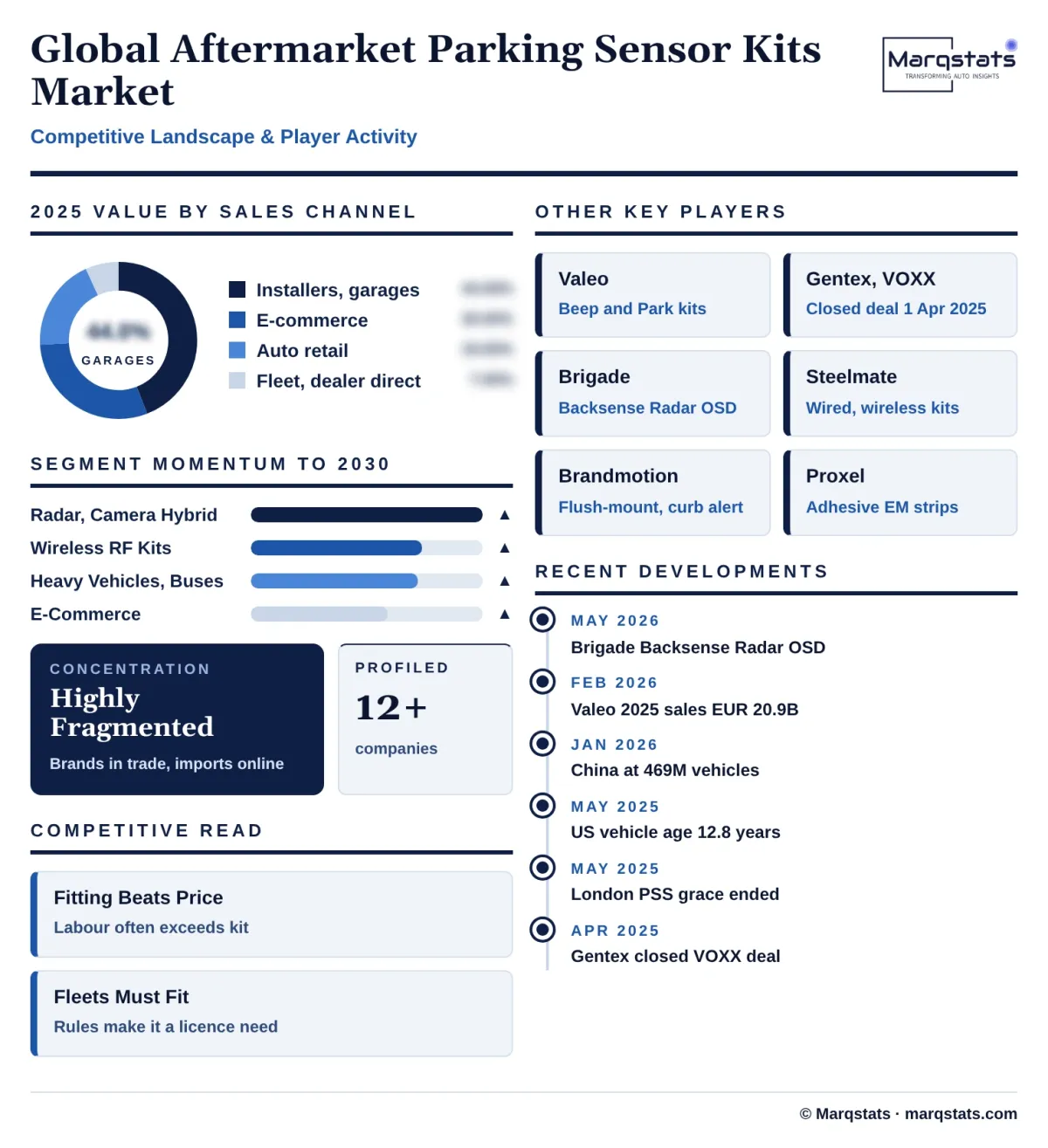
The aftermarket parking sensor kits market is highly fragmented. A small number of branded suppliers sell through trade and retail channels, while a long tail of contract manufacturers in southern China supplies unbranded kits through online marketplaces, which account for most of the units.
Automotive groups hold the strongest brands. Valeo sells Beep and Park kits through Valeo Service and reported 2025 sales of EUR 20.9 billion for the group. Gentex completed the acquisition of VOXX International on 1 April 2025 at USD 7.50 per share, adding VOXX's automotive electronics business, including the Audiovox and Rosen brands, to a group known for automatic-dimming mirrors and camera systems.
Specialists compete on application. Brigade supplies ultrasonic, radar and camera systems for heavy vehicles, plant and buses, Steelmate supplies a wide range of ultrasonic and wireless kits through distributors, Brandmotion supplies flush-mount kits and curb-alert sensors for fleets and dealers, and Proxel supplies adhesive electromagnetic strips.
Chip suppliers shape the cost base. Texas Instruments and Elmos sell integrated ultrasonic driver and signal-processing chips, and Murata and Nicera supply ultrasonic transducers, so a kit maker can build a working control unit from a handful of parts.
Competition is moving from price per sensor to cost of ownership. Suppliers that cut fitting time, supply vehicle-specific brackets and sensor housings, and back kits with clear warranties defend prices, while unbranded sellers compete on listing position and delivery speed.
Heavy-vehicle buyers choose differently from car owners. Fleet operators buy on sensor sealing, approvals and support, and often specify products under safety programmes, which favours established suppliers such as Brigade.
Companies Covered
Companies covered in the report include:
Recent Market Activity
Table of Contents
Coverage & Segmentation
The study covers the global aftermarket parking sensor kits market, with 2025 as the base year, 2021 – 2025 as the historical period and 2026 – 2030 as the forecast period. Values are in US dollars at ex-factory prices, meaning the net price kit makers and brand owners charge distributors, installers and marketplaces before channel margins, sales tax and fitting, and volumes are annual shipments of complete kits. The market is segmented by sensor technology, transmission type, vehicle class, sales channel and region. Euro and pound figures are converted at EUR 1 = USD 1.13 and GBP 1 = USD 1.32, the 2025 averages.
Sensors fitted at the factory, direct replacement sensors for failed original-equipment systems sold through dealers and parts distributors, camera-only kits, blind-spot radar, tyre pressure monitors and fitting labour are excluded. Blind-spot detection and wider advanced driver assistance systems are covered separately, so the figures here should not be added to those totals. Segment and regional splits are Marqstats estimates built on vehicle stock, vehicle age, supplier disclosures and price benchmarks.