Market Snapshot
Middle bar: base-year value × (1 + CAGR), rounded to two decimals. This is a calculated illustration, not a separately researched annual estimate.
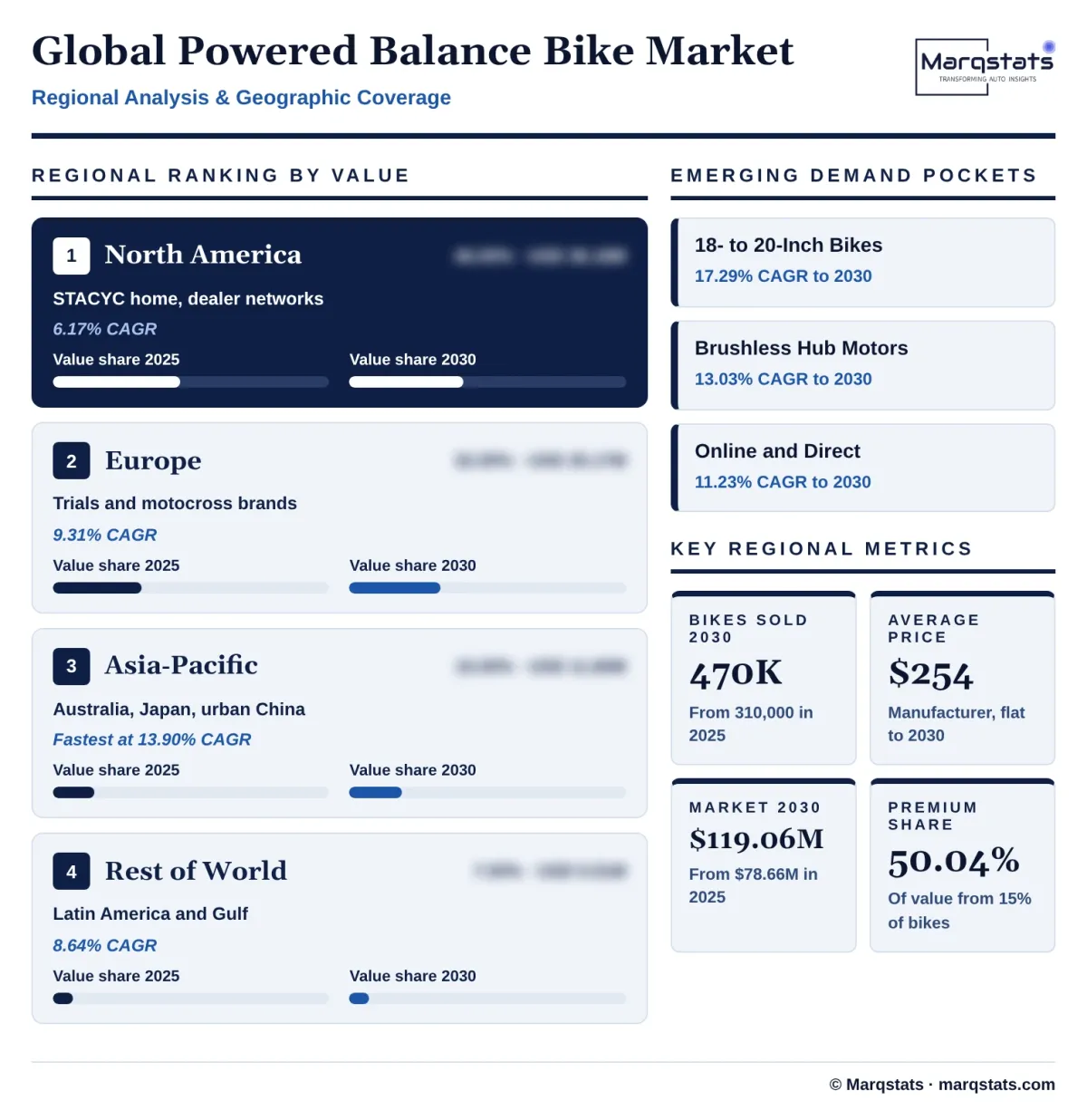
The global powered balance bike market size is estimated at USD 78.66 million in 2025 and is projected to reach USD 119.06 million by 2030, growing at a CAGR of 8.64% over 2026 – 2030. Annual sales rise from about 310,000 bikes to 470,000, an 8.68% annual rate, while the average manufacturer selling price stays close to USD 254 per bike.
Marqstats defines the market as the manufacturer selling value, wholesale to dealers and retailers plus net direct-to-consumer sales, of battery-electric balance bikes for children aged about 2 to 12. These are pedal-less two-wheelers with 12- to 20-inch wheels, a low seat and a throttle-controlled hub or frame motor, sold under powersports, specialist and mass-market brands. Non-powered balance bikes, pedal bicycles and e-bikes with pedals, youth electric dirt bikes and mini motocross bikes with full suspension and motorcycle-style footpegs, ride-on toys with three or four wheels, parts, accessories and protective gear are excluded.
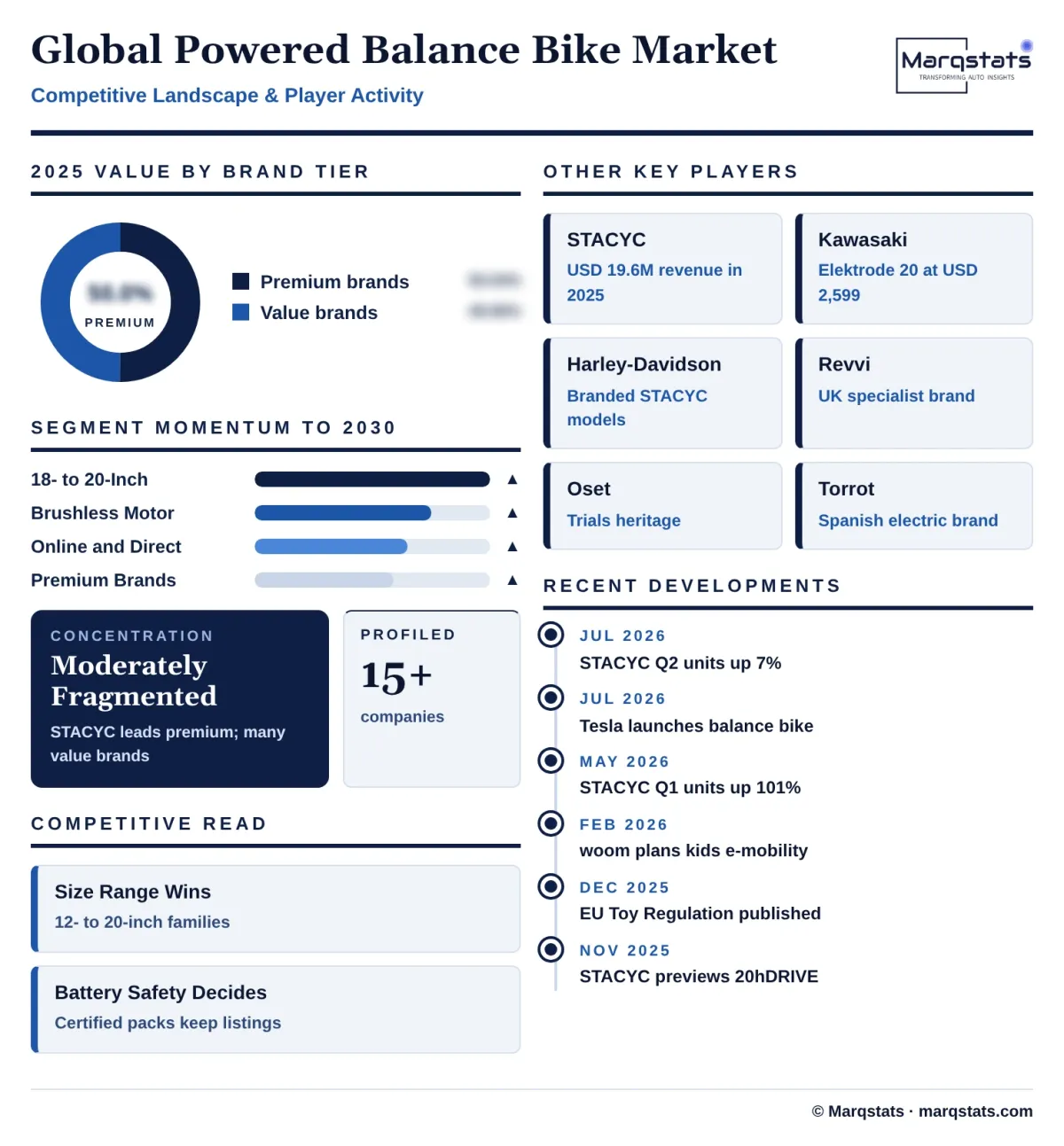
Premium powersports and specialist brands account for an estimated 50.04% of 2025 value from about 15% of the bikes sold, and brushless hub motors for 64.00%. North America accounts for 46.00% of 2025 value and Europe for 32.00%. The study segments the market by brand tier, wheel size, motor type, sales channel and region.
Key Takeaways
Market Overview & Analysis
Report Summary
Marqstats sizes the powered balance bike market as the manufacturer selling value of battery-electric, pedal-less balance bikes for young children. In 2025 about 310,000 bikes were sold worldwide, worth an estimated USD 78.66 million at an average manufacturer selling price of about USD 254. At typical retail markups the same bikes are worth roughly USD 130 million to USD 140 million at the till.
A powered balance bike is a balance bike with a motor. The child first learns to balance and steer with the motor off, then a parent unlocks low, medium and high speed modes as the child gains control. Most models have a twist-grip throttle, a hand brake, a removable lithium-ion battery and footrests or a foot deck, but no pedals or chain. Top speeds range from about 8 km/h in the slowest mode of a 12-inch bike to about 38 km/h on the fastest setting of a 20-inch model.
The category was created by STACYC, founded in 2016 and bought by Harley-Davidson in 2019. Its 12eDRIVE and 16eDRIVE became the entry bikes for children of motocross families, and the company built bikes for other brands, including KTM, Husqvarna and GasGas, as well as Harley-Davidson-branded models. STACYC is now a segment of LiveWire Group and says more than 250,000 young riders have used its bikes since launch.
Two very different markets share the category. Premium bikes from STACYC, Kawasaki and European specialists such as Revvi, Oset, Torrot and Kuberg list at about USD 800 to USD 2,600, use brushless motors and aluminium frames, and are sold through powersports dealers, bicycle and trials shops and brand websites. Value bikes from mass-market and online brands list at about USD 150 to USD 450, often use brushed motors and steel frames, and are sold through Amazon, Walmart, Target and similar retailers.
The market grew from an estimated USD 72.40 million in 2021 to USD 84.00 million in 2022 as home and outdoor spending peaked, fell to USD 81.50 million in 2023 and USD 71.20 million in 2024 as dealer inventories were cut and STACYC volume dropped 42%, and recovered to USD 78.66 million in 2025. Marqstats expects about 336,000 sales worth USD 86.10 million in 2026.
Regulation treats powered balance bikes as consumer products rather than vehicles. They need no registration or licence and cannot be ridden on public roads in most countries. In the United States they fall under Consumer Product Safety Commission oversight, and retailers increasingly ask for batteries certified to UL 2272 or similar standards after lithium-ion fires in e-bikes and e-scooters. In the European Union, bikes for young children are often sold under the EN 71 toy safety standards, batteries fall under the EU Battery Regulation (EU) 2023/1542, and the new Toy Safety Regulation (EU) 2025/2509, published on 12 December 2025, replaces the Toy Safety Directive from 1 August 2030 and requires a digital product passport for every toy model.
Prices show the gap between the two tiers. STACYC lists its 12eDRIVE at USD 799, the 16eDRIVE Brushless at USD 1,049 and the 20eDRIVE at USD 2,599 before discounts, and Kawasaki lists the Elektrode 20, with a 750 W brushless hub motor, a 50.4 V battery and a top speed of about 38 km/h, at USD 2,599. Value bikes on online marketplaces list from about USD 150 for a 12-inch brushed-motor model to about USD 450 for a 16-inch brushless model.
Global Powered Balance Bike Market Size and Forecast
The global powered balance bike market grows from USD 78.66 million in 2025 to USD 119.06 million in 2030, a CAGR of 8.64%. Marqstats expects sales of about 365,000 bikes worth USD 94.00 million in 2027, 400,000 worth USD 102.30 million in 2028 and 434,000 worth USD 110.60 million in 2029, before reaching 470,000 bikes in 2030. From the 2026 estimate the market grows at 8.44% a year.
Value and volume grow at almost the same rate because two price moves cancel out. Larger 20-inch bikes and brushless motors raise the average price of premium bikes, while competition among online brands and cheaper lithium battery packs pull down the price of value bikes. Marqstats estimates the premium average stays near USD 780 to USD 820 and the value average falls from about USD 150 to USD 142, keeping the blended average near USD 254.
Premium volume is set by a handful of brands. STACYC reported 32,113 units in 2023, 18,549 in 2024 and 21,633 in 2025, with revenue of USD 26.5 million, USD 18.3 million and USD 19.6 million. Its 2025 figures include electric bikes and related products as well as balance bikes. Marqstats estimates premium brands together sold about 48,000 bikes in 2025 and will sell about 82,000 in 2030.
Value volume is set by price and safety. Value brands sold about 262,000 bikes in 2025, and Marqstats expects about 388,000 in 2030. Growth depends on retailers continuing to stock low-cost bikes as battery safety enforcement tightens, which favours sellers with certified battery packs.
Marqstats tracks four indicators to monitor the forecast: STACYC quarterly unit sales reported by LiveWire, new 20-inch launches and price changes from Kawasaki and other powersports brands, marketplace prices and ratings for value-brand bikes, and battery safety recalls and rule changes in the United States and the European Union.
The mix changes over the forecast. Premium brands rise from 50.04% to 53.53% of value, 18- to 20-inch bikes from 15.00% to 22.00%, brushless motors from 64.00% to 78.00% and online sales from 40.00% to 45.00%. North America remains the largest region but its share falls from 46.00% to 41.00% as Europe rises to 33.00% and Asia-Pacific to 19.00%.
Market Dynamics
Key Drivers
Five forces are pulling young riders from push bikes onto powered balance bikes.
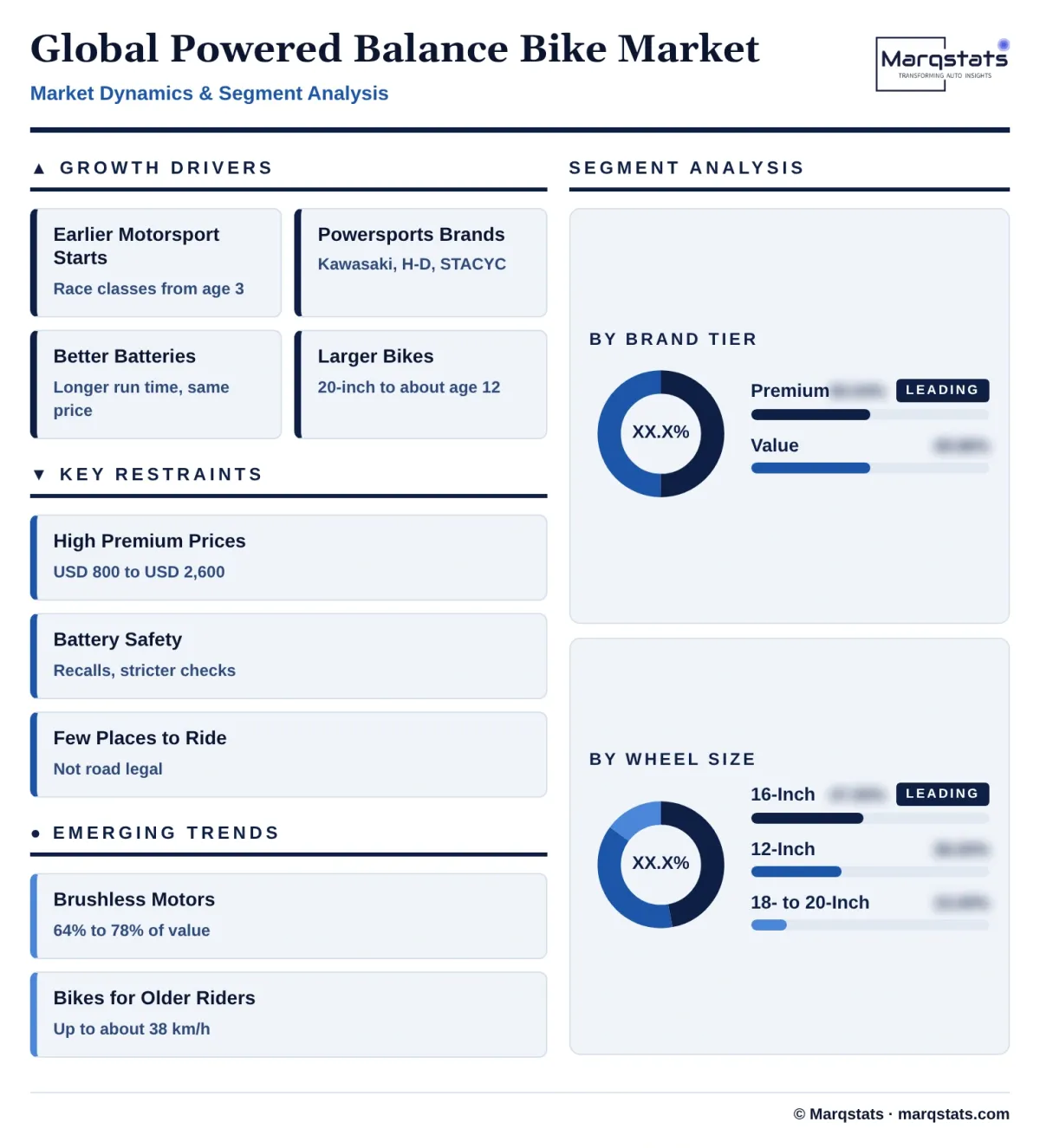
- Earlier starts in motorsport. Motocross, enduro and trials families use powered balance bikes as the first step before youth electric and petrol dirt bikes, and race series run dedicated balance bike classes for riders as young as three.
- Powersports brands want young customers. Harley-Davidson, Kawasaki, KTM, Husqvarna, GasGas and Honda use youth electric bikes to bring families into their dealers years before the child buys a motorcycle.
- Cheaper, better batteries. Falling lithium-ion pack costs let brands fit larger batteries and brushless motors at the same price, extending run time to an hour or more on premium models.
- Larger bikes extend the age range. 18- and 20-inch models such as the Kawasaki Elektrode 20 and STACYC 20eDRIVE keep children on balance bikes until about 12, adding a second purchase per child.
- Easy online buying. Direct-to-consumer websites and online marketplaces put bikes in front of parents who never visit a powersports dealer, widening the market beyond motorsport families.
- New interest from outside powersports. woom, which sold 390,000 children's bikes in 2025, plans children's e-mobility launches in 2026, and Tesla's July 2026 balance bike shows car brands see children's two-wheelers as a way to reach families.
Key Restraints
Four constraints hold back powered balance bike sales and margins.
- High prices for premium bikes. List prices of USD 800 to USD 2,600 limit premium models to enthusiast families, and children outgrow each size within two to three years.
- Battery safety concerns. Lithium-ion fires in e-bikes and e-scooters have led to recalls and stricter enforcement, raising compliance costs and making parents wary of uncertified low-cost bikes.
- Few places to ride. Powered balance bikes are not road legal, and many parks and pavements ban motorised riding, so use depends on private land, tracks and trails.
- Tariffs and supply costs. Most frames, motors and batteries come from China, so US tariffs and freight costs raise landed costs; STACYC reported USD 0.5 million of tariff recoveries in the second quarter of 2026.
Key Trends
Four shifts are changing how powered balance bikes are designed, priced and sold.
- Move to brushless motors. Brushless hub motors give longer run time and less heat than brushed motors, and are spreading from premium bikes into mid-priced models.
- Bikes for older riders. 20-inch models with suspension forks, disc brakes and speeds up to about 38 km/h blur the line between balance bikes and youth electric dirt bikes.
- Car and bike brands enter the category. Tesla launched a USD 225 non-powered balance bike in July 2026 and woom plans children's e-mobility launches in 2026, signalling interest from brands outside powersports.
- Parent controls and connected features. Speed modes locked by the parent, remote speed limiting and app-based settings are becoming selling points for premium bikes.
Strategic Implications
- For powersports brands, balance bikes are a customer acquisition tool. Matching the bike to the brand's youth dirt bike range and offering trade-in programmes as children grow keeps families in the dealer network.
- For specialist brands, the gap between USD 450 and USD 800 is open. Certified brushless bikes in this range can win parents who want better quality than value brands but will not pay premium powersports prices.
- For value brands, battery certification is becoming a condition of sale. Marketplaces and retailers are tightening rules after battery fires, so certified packs and clear safety labelling protect listings.
- For retailers and dealers, larger sizes add repeat sales. Stocking 12-, 16- and 20-inch sizes and offering battery upgrades lets one family buy two or three bikes over a child's early years.
- For investors, volume swings are large. STACYC's 42% unit drop in 2024 and 101% rise in the first quarter of 2026 show that inventory cycles and brand partnerships can move results more than end demand.
- For new entrants from outside powersports, the children's bike route is open. Brands with strong family recognition, such as woom and Tesla, can extend non-powered balance bikes into powered models if they solve battery safety and after-sales service.
Market Segmentation
Premium brands account for 50.04% of 2025 value, USD 39.36 million from about 48,000 bikes at an average manufacturer price of about USD 820, rising to USD 63.73 million by 2030, a 10.12% CAGR, and 53.53% of the market. STACYC, the Kawasaki Elektrode range, Harley-Davidson-branded STACYC models and European specialists such as Revvi, Oset, Torrot and Kuberg make up this tier, sold through powersports dealers, specialist shops and brand websites.
Value brands account for 49.96% of 2025 value, USD 39.30 million from about 262,000 bikes at an average of about USD 150, and grow at 7.08% a year to USD 55.33 million, 46.47% of 2030 value. These bikes sell for about USD 150 to USD 450 at retail through online marketplaces and mass retailers, and most use brushed motors and steel frames.
16-inch bikes are the largest size, with 47.00% of 2025 value, USD 36.97 million, rising to USD 53.58 million by 2030, a 7.70% CAGR, while their share falls to 45.00%. The STACYC 16eDRIVE, Kawasaki Elektrode 16 and most specialist brands' core models sit here.
12-inch bikes account for 38.00% of 2025 value, USD 29.89 million, and grow at 5.62% a year to USD 39.29 million, 33.00% of 2030 value. Most value-brand sales are 12-inch first bikes, which keeps unit share high but average prices low.
18- to 20-inch bikes account for 15.00% of 2025 value, USD 11.80 million, and grow fastest, at 17.29% a year, to USD 26.19 million and 22.00% of 2030 value. The Kawasaki Elektrode 20, STACYC 20eDRIVE and 20hDRIVE extend balance biking to older children at list prices up to about USD 2,600.
Bikes with brushless hub motors account for 64.00% of 2025 value, USD 50.34 million, rising to USD 92.87 million by 2030, a 13.03% CAGR, and 78.00% of the market. All premium bikes and a growing share of mid-priced value models use brushless motors, which run cooler and longer per charge.
Bikes with brushed motors account for 36.00% of 2025 value, USD 28.32 million, and shrink at 1.55% a year to USD 26.19 million, 22.00% of 2030 value, as falling brushless motor costs remove their price advantage.
Online marketplaces and brand websites account for 40.00% of 2025 value, USD 31.46 million, and grow fastest, at 11.23% a year, to USD 53.58 million and 45.00% of 2030 value. Value brands sell almost entirely online, and STACYC and Kawasaki also sell direct with home delivery.
Powersports dealers account for 38.00% of 2025 value, USD 29.89 million, and grow at 6.25% a year to USD 40.48 million, 34.00% of 2030 value. Dealers sell most premium bikes, often alongside youth dirt bikes and riding gear.
Mass retailers, toy stores and bicycle shops account for 22.00% of 2025 value, USD 17.31 million, and grow at 7.64% a year to USD 25.00 million, 21.00% of 2030 value, led by seasonal holiday sales of 12-inch value bikes.
By Geography
North America
North America is the largest region, with 46.00% of 2025 value, USD 36.18 million, rising to USD 48.81 million by 2030, a 6.17% CAGR, while its share falls to 41.00%. STACYC is based in the United States, Kawasaki and Harley-Davidson sell through large powersports dealer networks, and youth motocross and supercross events run balance bike classes. Value brands sell heavily through Amazon, Walmart and Target, and US tariffs on Chinese components raise landed costs.
Europe
Europe accounts for 32.00% of 2025 value, USD 25.17 million, and grows at 9.31% a year to USD 39.29 million and 33.00% of 2030 value. Trials and motocross traditions in the UK, France, Spain and Italy support specialist brands such as Revvi, Oset and Torrot, and STACYC says its expansion in Europe and the UK accelerated in 2025, with the 20hDRIVE planned for European launch in 2026. Where electric balance bikes are sold as toys, they must meet EN 71 standards, and the new EU Toy Safety Regulation (EU) 2025/2509, published in December 2025, applies from August 2030 with a digital product passport.
Asia-Pacific
Asia-Pacific accounts for 15.00% of 2025 value, USD 11.80 million, and grows fastest, at 13.90% a year, to USD 22.62 million and 19.00% of 2030 value. Australia has a strong youth motocross scene and STACYC distribution, Japan supports Kawasaki and domestic brands, and China is both the main manufacturing base and a growing urban market for low-cost bikes.
Rest of World
The Rest of World accounts for 7.00% of 2025 value, USD 5.51 million, and grows at 8.64% a year to USD 8.33 million by 2030, led by Latin America and the Gulf states, where premium bikes are imported through powersports distributors.
How Competition Is Evolving
The powered balance bike market is moderately concentrated at the premium end and fragmented at the value end. STACYC, with about a quarter of total value, and Kawasaki lead premium sales, followed by European specialists, while dozens of online brands compete on price for 12-inch first bikes.
Two business models compete. Powersports brands sell bikes as part of a family journey into motorcycling, through dealers, race sponsorships and youth series. Value brands sell a toy-like product through marketplaces, competing on price, delivery speed and reviews.
Brand partnerships shape premium volume. STACYC built bikes for third-party brands, and its 2024 unit drop came partly from lower sales to its third-party branded distributor. Pierer Mobility, owner of KTM, Husqvarna and GasGas, said in 2025 it would leave the bicycle and e-bike business and in November 2025 agreed to sell Felt, ending its bicycle activities, which leaves fewer brand partners in the category.
Competition will be decided by price per size, battery safety and dealer reach. Brands that offer certified brushless bikes across all sizes, keep prices within reach of non-motorsport families and support dealers with demo programmes will win share.
Premium brands compete on size range and dealer support. STACYC offers 12-, 16- and 20-inch bikes, Harley-Davidson-branded models and a 20hDRIVE for Europe, and has grown dealer partnerships in the United States, Canada, Australia and Europe. Kawasaki sells the Elektrode 16 and 20 through its dealers and online with home delivery. European specialists such as Revvi, Oset, Torrot and Kuberg compete on trials and off-road heritage and on lighter frames.
Value brands compete on price and listings. Mass-market and online brands, many supplied by Chinese contract manufacturers, sell 12- and 16-inch bikes through marketplaces and big-box stores, where reviews, delivery times and battery certification decide visibility and returns.
Companies Covered
Companies covered in the report include:
Recent Market Activity
Table of Contents
Coverage & Segmentation
The study covers the global powered balance bike market, with 2025 as the base year, 2021 – 2025 as the historical period and 2026 – 2030 as the forecast period. Values are in US dollars at manufacturer selling prices, wholesale to dealers and retailers plus net direct-to-consumer sales, and volumes are annual bikes sold. The market is segmented by brand tier, wheel size, motor type, sales channel and region.
Non-powered balance bikes, pedal bicycles, e-bikes with pedals, youth electric dirt bikes and mini motocross bikes with full suspension and footpegs, ride-on toys with three or four wheels, parts, accessories, protective gear and retail markups are excluded. Youth electric dirt bikes are covered by the Marqstats electric motorcycle tyre and off-highway work rather than here, and the figures should not be added to other Marqstats light electric vehicle reports. Segment and regional splits are Marqstats estimates built on company financial results, product price lists, dealer and marketplace checks and trade data.