Market Snapshot
Middle bar: base-year value × (1 + CAGR), rounded to two decimals. This is a calculated illustration, not a separately researched annual estimate.
The global electric unicycle market size is estimated at USD 246.80 million in 2025 and is projected to reach USD 378.00 million by 2030, growing at a CAGR of 8.90% over 2026 – 2030. Annual sales rise from about 150,000 to 210,000 wheels, a 6.96% annual rate, while the average selling price climbs from about USD 1,645 to USD 1,800 as riders trade up to high-voltage, long-range performance wheels.
Marqstats defines the market as the retail value of new self-balancing electric unicycles, single-wheel personal vehicles that the rider balances by leaning forward and back, sold to consumers and to a small number of commercial users. It covers commuter wheels, mid-performance wheels and high-performance suspension wheels from all brands. Hoverboards, two-wheel self-balancing scooters, one-wheel boards such as the Onewheel, electric scooters, spare parts, protective gear and used wheels are excluded.
Mid-performance wheels of 100.8 to 134.4 volts account for 47.73% of 2025 value, wheels of 17 to 20 inches for 49.00% and specialist dealers and importers for 58.00%. Europe accounts for 38.00% of 2025 value and North America for 27.00%. The study segments the market by performance tier, wheel size, sales channel and region.
Key Takeaways
Market Overview & Analysis
Report Summary
Marqstats sizes the electric unicycle market as the retail value of new self-balancing single-wheel electric vehicles sold worldwide. In 2025 about 150,000 electric unicycles were sold, worth an estimated USD 246.80 million at an average retail price of about USD 1,645. The rider base is small and loyal: most buyers already own one wheel and buy a second or third as new models add range, suspension and power.
An electric unicycle has one wheel with a hub motor, a battery pack inside the shell, pedals on either side and a control board that keeps the wheel upright using gyroscopes and accelerometers. The rider accelerates by leaning forward and brakes by leaning back, so the motor must always keep a power margin above what the rider asks for. If the rider demands more torque than the motor and battery can deliver, the wheel cannot stay balanced and the rider falls. That safety margin is the main reason makers keep raising battery voltage and motor power, and it shapes the whole product range.
Four Chinese makers dominate supply. InMotion, founded in Shenzhen in December 2012, sells the V-series and the new P6. KingSong, also founded in 2012, operates more than 20,000 square meters of factory space in Shenzhen, sells in more than 50 countries and holds more than 100 patents. Begode, formerly known as Gotway, focuses on high-power wheels such as the Master, the EX series and the Race. LeaperKim sells under the Veteran brand, with the Sherman, Patton, Lynx and Oryx families. Smaller brands include Nosfet and Extreme Bull, while Segway-Ninebot and Inventist, the maker of the Solowheel, retain a minor presence in commuter wheels.
Flagship specifications rose sharply in 2025. The LeaperKim Veteran Oryx, launched in July 2025, runs a 176.4-volt system with a 4,700 Wh battery, a 4,200 W rated motor, 90 mm of suspension travel and a 22-inch wheel, and weighs about 57 kg. The Begode Race, launched in September 2025, moved to a 210-volt system with 50S battery packs of 3,800 Wh and a 5,000 W motor, priced below USD 3,000. In October 2025 InMotion unveiled the P6, with a 235-volt system, 4,200 Wh of Samsung 50S cells, a 20 kW peak motor, a rated top speed of 150 km/h and a US price of USD 4,999, and it showed the wheel again at CES in January 2026.
The market grew from an estimated USD 180.00 million in 2021 to USD 210.00 million in 2023 and USD 228.00 million in 2024, an 8.21% CAGR over 2021 – 2025, as suspension wheels and 134- and 151-volt systems replaced 84-volt commuter wheels in the enthusiast segment. Marqstats expects about 160,000 wheels worth USD 268.00 million to be sold in 2026.
Global Electric Unicycle Market Size and Forecast
The global electric unicycle market grows from USD 246.80 million in 2025 to USD 378.00 million in 2030, a CAGR of 8.90%. Marqstats expects the market to reach USD 268.00 million in 2026, USD 291.00 million in 2027, USD 316.00 million in 2028 and USD 345.00 million in 2029, with sales of about 172,000 wheels in 2027, 184,000 in 2028 and 197,000 in 2029.
The 2025 value is built bottom-up from model tiers and retail prices. Marqstats estimates about 60,000 commuter wheels of up to 84 volts at an average of about USD 750, mostly 14- and 16-inch wheels from InMotion, KingSong and Segway-Ninebot; about 62,000 mid-performance wheels of 100.8 to 134.4 volts at about USD 1,900; and about 28,000 high-performance wheels of 151.2 volts and above at about USD 3,000. Together these give USD 246.80 million.
The base is calibrated against the capacity and reach of the four leading makers. KingSong, InMotion, Begode and LeaperKim each sell tens of thousands of wheels a year at most, through dealer networks in Europe, North America and Asia and through their own web stores, and together account for most of the market. Customs data cannot isolate electric unicycles, because they share tariff headings with hoverboards, electric scooters and other personal transporters, so Marqstats does not use trade totals to size the market.
The average selling price rises from about USD 1,645 in 2025 to USD 1,800 in 2030, a 1.81% annual increase. Mix drives the change: high-performance wheels rise from 18.67% to 26.19% of units, while commuter wheel prices fall slightly as Chinese makers compete on 16-inch models. Prices within each tier stay broadly flat because larger batteries and stronger motors offset lower cell costs.
Marqstats tracks four indicators to monitor the forecast: launch and delivery dates of 176- to 235-volt flagship wheels, the outcome of USITC investigation 337-TA-1488 and any exclusion order affecting US imports, changes to light electric vehicle rules in the United Kingdom, Germany and France, and the price of 21700 lithium-ion cells used in wheel battery packs.
Market Dynamics
Key Drivers
Five forces keep enthusiast riders buying new, larger and faster electric unicycles.
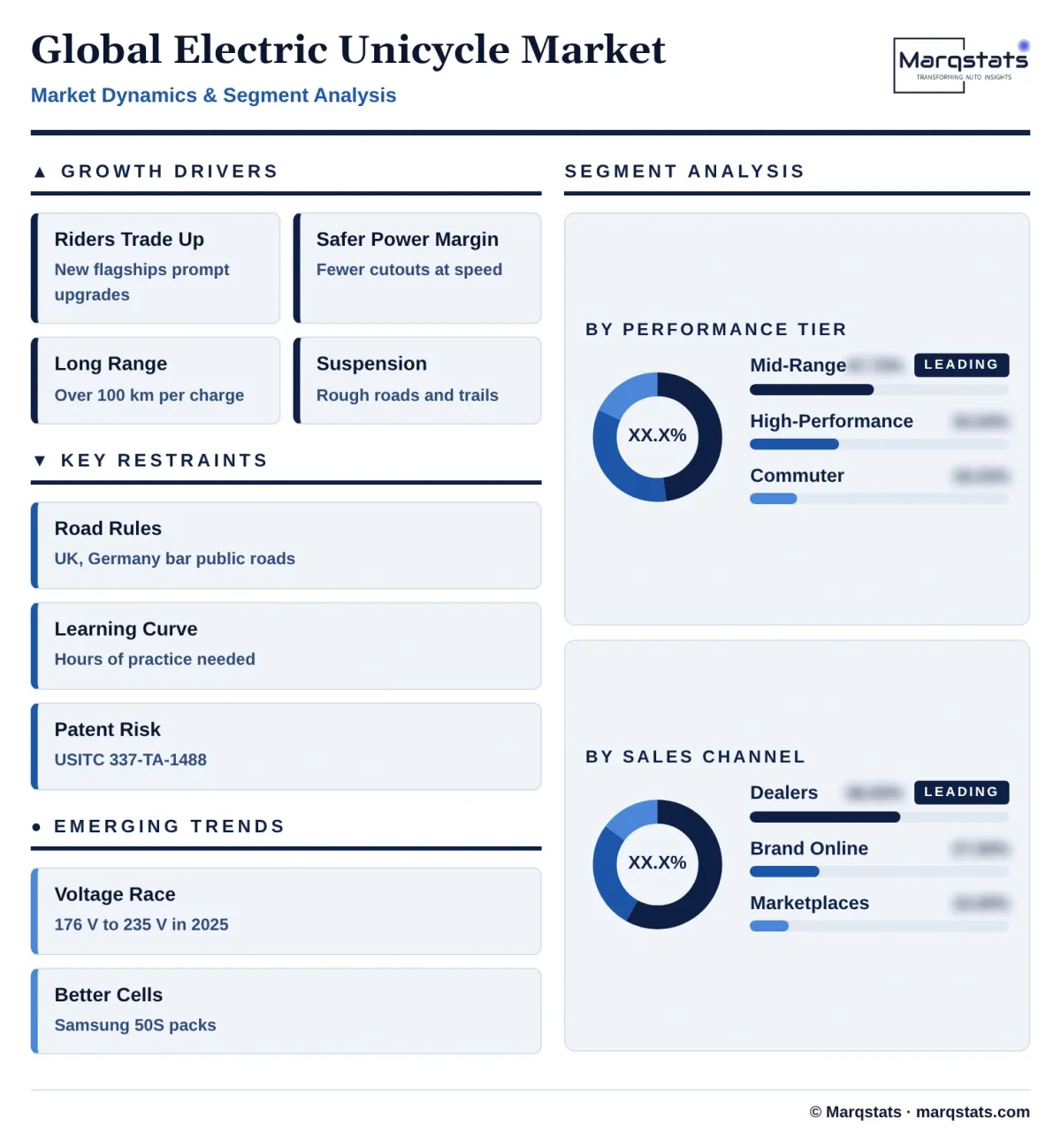
- Riders trade up to faster wheels. Most electric unicycle buyers already own a wheel, and each new flagship, from 134.4-volt to 151.2-, 176.4-, 210- and 235-volt systems, prompts experienced riders to upgrade for more range, more power margin and better suspension.
- More power means a safer margin. Higher voltage and stronger motors reduce the risk of a cutout, when the wheel cannot deliver the torque needed to stay balanced, which makes high-voltage wheels attractive even to riders who do not ride at top speed.
- Long range replaces the car for some trips. Wheels with 3,000 to 4,700 Wh of battery can cover more than 100 km on one charge, letting enthusiasts use them for commuting and touring rather than short rides.
- Suspension widens the riding area. Suspension travel of 90 mm or more, as on the Veteran Oryx, lets riders cross rough roads, gravel and forest trails, which expands the use of wheels in rural areas and off-road riding.
- Strong rider communities. Group rides, online forums and video reviewers spread new models quickly and give makers direct feedback, which keeps demand high among a small but committed rider base.
Key Restraints
Four constraints keep the electric unicycle a niche vehicle with a small rider base.
- Road rules exclude most electric unicycles. The United Kingdom treats them as powered transporters that may only be used on private land, Germany allows only vehicles with handlebars under its eKFV rules, and France caps personal motorized devices at 25 km/h with mandatory insurance and fines of up to EUR 1,500 for removing speed limits.
- A steep learning curve. Riders need several hours of practice to balance and steer, which limits the pool of new buyers and slows growth beyond enthusiast groups.
- Weight and size limit portability. High-performance wheels weigh 40 to 57 kg, too heavy to carry onto trains or up stairs, and most public transport operators do not allow them.
- Patent and trade risk in the United States. USITC investigation 337-TA-1488 targets imports from LeaperKim, Begode, KingSong and Nosfet, and an exclusion order could restrict US supply of their wheels.
Key Trends
Four shifts are changing how electric unicycles are built, priced and sold.
- The voltage race. Flagship systems moved from 151.2 volts to 176.4 volts with the Veteran Oryx, 210 volts with the Begode Race and 235 volts with the InMotion P6 within about four months in 2025.
- Larger and better cells. Makers are moving to high-capacity 21700 cells, such as the Samsung 50S used in the InMotion P6 and the Begode Race, to raise power output without making packs much heavier.
- Refreshed mid-range lines. KingSong launched four new Pro models on 29 November 2025, the 14D Pro, 16S Pro, 16X Pro and 18XL Pro, bringing features from flagship wheels into lower-priced models.
- Own service networks. InMotion runs a US service center and makers are expanding direct online sales, warranty handling and spare parts supply rather than relying only on importers.
Strategic Implications
- For wheel makers, the next gains come from safety, not top speed. Better cutout protection, tire choices, lighting and braking feedback reach a wider group of riders than further voltage increases, and they support the case for clearer road rules.
- For importers and dealers, setup and repair are the competitive edge. Riders pay a premium for local test rides, firmware support, tire changes and battery service on wheels that cost USD 2,000 to 5,000.
- For US sellers, patent clearance matters. The settlement between InMotion and the complainants in 337-TA-1488 shows that licensing can protect US supply, and other makers face the same choice before any exclusion order.
- For regulators, electric unicycles need a clear category. Wheels already sell in volume in countries where they have no road status, and clear rules on speed, lighting and insurance would let riders use them legally on public roads.
- For battery and component suppliers, high-voltage packs need their own designs. Packs of 50 to 56 cells in series require reliable battery management systems, strong connectors and cooling for motors that peak at 10 to 20 kW.
Market Segmentation
Commuter wheels of up to 84 volts account for 18.23% of 2025 value, USD 45.00 million, and grow slowly, at 1.72% a year, to USD 49.00 million, while their share falls to 12.96% by 2030. They are mostly 14- and 16-inch wheels weighing under 25 kg, such as the KingSong 14D Pro and 16S Pro and the InMotion V5 and V8 families, and they sell to new riders and to commuters who carry the wheel onto public transport. They hold the largest share of units, about 40.00% in 2025, but their low price of about USD 750 keeps their value share small.
Mid-performance wheels of 100.8 to 134.4 volts account for 47.73% of 2025 value, USD 117.80 million, and grow at 5.37% a year to USD 153.00 million and 40.48% by 2030. They include the KingSong 16X Pro and 18XL Pro, the InMotion V12 and V13 families and Begode and Veteran models with 2,000 to 3,000 Wh batteries, and they appeal to daily riders who want range and power without the weight of a flagship wheel.
High-performance wheels of 151.2 volts and above account for 34.04% of 2025 value, USD 84.00 million, and grow fastest, at 15.94% a year, to USD 176.00 million and 46.56% by 2030. They include suspension wheels such as the LeaperKim Veteran Sherman and Oryx, the Begode Race and EX series and the InMotion P6, with batteries of 3,000 to 4,700 Wh, weights of 40 to 57 kg and prices of USD 2,500 to 5,000.
Wheels of up to 16 inches account for 30.00% of 2025 value, USD 74.04 million, and grow at 5.83% a year to USD 98.28 million, while their share falls to 26.00% by 2030. Small wheels are lighter and easier to carry, so they lead among commuters and new riders.
Wheels of 17 to 20 inches account for 49.00% of 2025 value, USD 120.93 million, and grow at 7.53% a year to USD 173.88 million and 46.00% by 2030. Most mid-performance and many high-performance wheels use 18- to 20-inch tires, which balance stability at speed with agility in traffic.
Wheels of 22 inches and above account for 21.00% of 2025 value, USD 51.83 million, and grow fastest, at 15.35% a year, to USD 105.84 million and 28.00% by 2030. Large wheels such as the Veteran Oryx, with its 22-inch 3.50-16 tire, give better stability over rough ground and at high speed, which suits long-range touring and off-road riding.
Specialist dealers and importers account for 58.00% of 2025 value, USD 143.14 million, and grow at 7.36% a year to USD 204.12 million, while their share falls to 54.00% by 2030. They offer test rides, setup, repair and warranty handling, which matters for expensive high-performance wheels.
Brand-owned web stores account for 27.00% of 2025 value, USD 66.64 million, and grow fastest, at 11.95% a year, to USD 117.18 million and 31.00% by 2030, as InMotion and KingSong sell directly and support buyers through their own service centers.
Online marketplaces, consumer electronics chains and general retailers account for 15.00% of 2025 value, USD 37.02 million, and grow at 8.90% a year to USD 56.70 million, keeping a 15.00% share by 2030. Most of their sales are commuter and mid-performance wheels.
By Geography
Europe
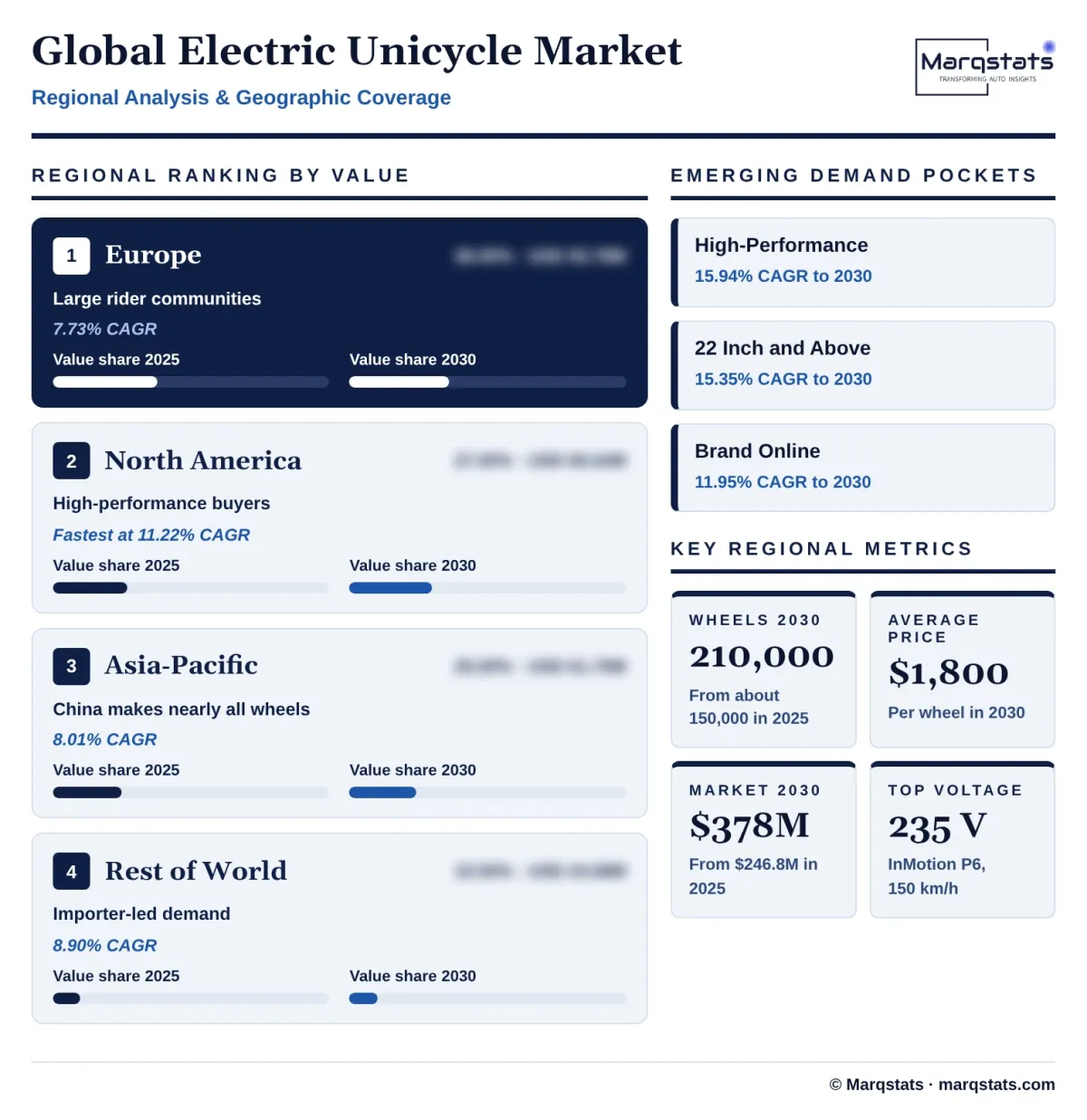
Europe is the largest market, with 38.00% of 2025 value, USD 93.78 million, rising to an estimated USD 136.08 million by 2030, a 7.73% CAGR, while its share falls to 36.00%. France, Germany, Poland, Spain, Italy and the Benelux have large rider communities and dense dealer networks, even though the United Kingdom restricts electric unicycles to private land, Germany excludes them from the eKFV rules for vehicles with handlebars and France limits personal motorized devices to 25 km/h for riders aged 14 and over with mandatory insurance.
North America
North America accounts for 27.00% of 2025 value, USD 66.64 million, and grows fastest, at an estimated 11.22% a year, to USD 113.40 million and 30.00% by 2030. US buyers favor high-performance wheels, and InMotion launched the USD 4,999 P6 with a US service center behind it. USITC investigation 337-TA-1488, instituted in March 2026, is the main risk to the forecast for the region.
Asia-Pacific
Asia-Pacific accounts for 25.00% of 2025 value, USD 61.70 million, and grows at an estimated 8.01% a year to USD 90.72 million and 24.00% by 2030. China is both the production base for nearly all wheels and a large home market, with further demand in South Korea, Japan, Australia and Southeast Asia.
Rest of World
The rest of the world accounts for 10.00% of 2025 value, USD 24.68 million, and grows at an estimated 8.90% a year to USD 37.80 million, keeping a 10.00% share by 2030. Russia, Ukraine, Israel, the Gulf states and Latin America have active rider groups served mainly by importers.
How Competition Is Evolving
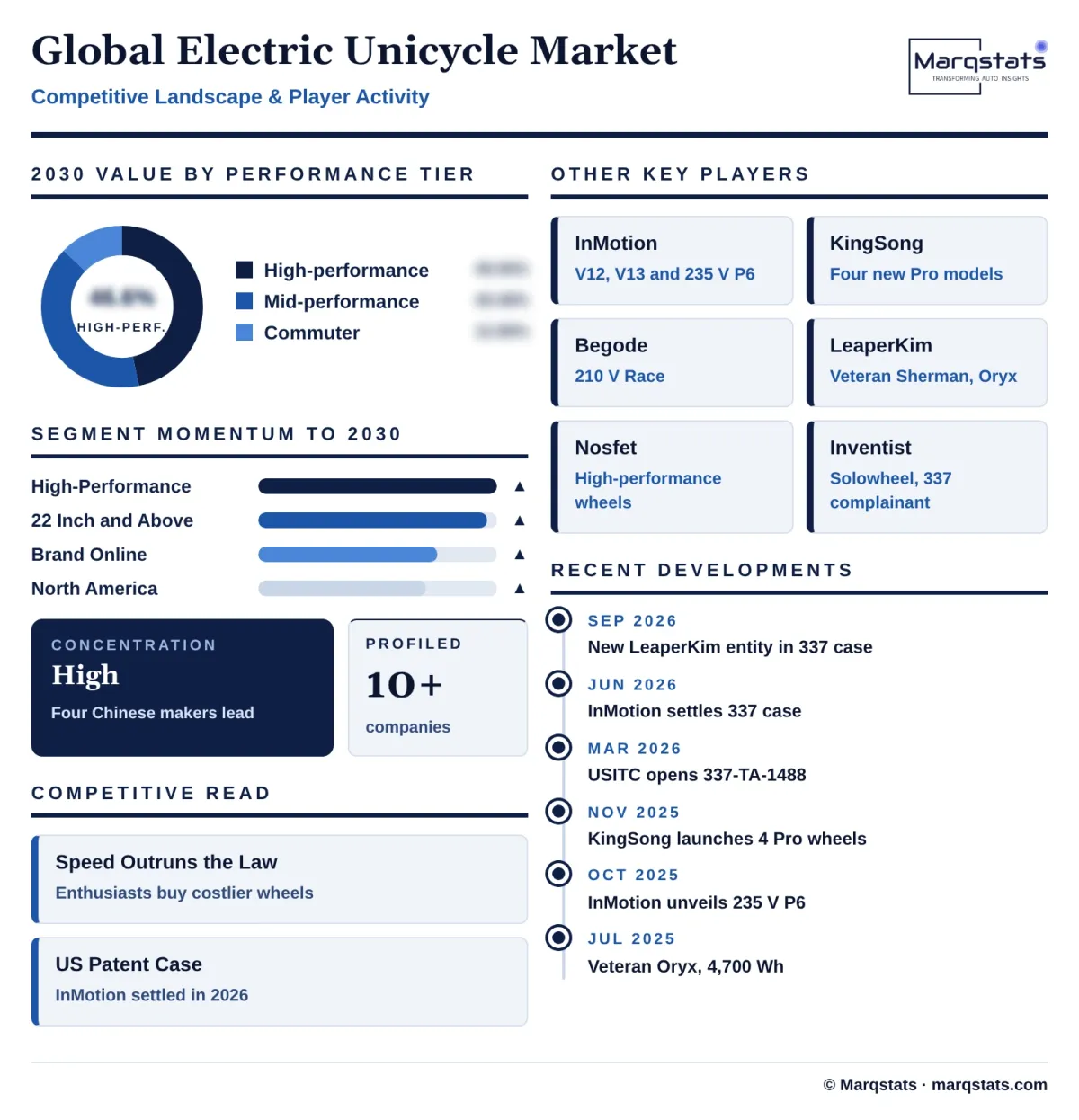
The market is highly concentrated. InMotion, KingSong, Begode and LeaperKim, all based in China, account for most of global value, and Marqstats estimates that the four together supply more than 85% of wheels sold. Nosfet and Extreme Bull compete in high-performance wheels, while Segway-Ninebot, Inventist and Airwheel retain small shares in commuter wheels.
InMotion has the broadest range, from small commuter wheels to the V12 and V13 families and the 235-volt P6, and it is building its own US service network. KingSong, founded in 2012, operates more than 20,000 square meters of factory space in Shenzhen, sells in more than 50 countries and holds more than 100 patents; its four Pro models launched in November 2025 refresh its 14- to 18-inch range.
Begode and LeaperKim lead the high-performance tier. Begode moved to 210 volts with the Race, priced below USD 3,000, and LeaperKim moved to 176.4 volts with the Veteran Oryx, a 4,700 Wh suspension wheel. Their wheels are popular with experienced riders who value power and suspension over portability.
Patent litigation is reshaping the US market. In USITC investigation 337-TA-1488, Inventist and Alien Technology Group, doing business as Alien Rides, accuse LeaperKim, Begode, InMotion, KingSong and Nosfet of infringing US patents 8,807,250 and D729,698 and seek exclusion and cease and desist orders. InMotion settled and was terminated from the investigation in 2026, while the case continues against the other respondents.
Companies Covered
Companies covered in the report include:
Recent Market Activity
Table of Contents
Coverage & Segmentation
The study covers the global electric unicycle market, with 2025 as the base year, 2021 – 2025 as the historical period and 2026 – 2030 as the forecast period. Values are in US dollars at retail prices, and volumes are new wheels sold. Euro figures are converted at the 2025 average rate of EUR 1 = USD 1.13. The market is segmented by performance tier, wheel size, sales channel and region, covering Europe, North America, Asia-Pacific and the rest of the world.
Hoverboards and other two-wheel self-balancing scooters, one-wheel skateboards such as the Onewheel, electric kick scooters, electric bicycles, seated self-balancing vehicles, used and refurbished wheels, spare parts, tires, protective gear and rental or sharing revenue are excluded. Electric unicycles fall outside the Marqstats Global Low-Speed Electric Vehicle study, which covers four-wheel neighborhood and utility vehicles.