Market Snapshot
Middle bar: base-year value × (1 + CAGR), rounded to two decimals. This is a calculated illustration, not a separately researched annual estimate.
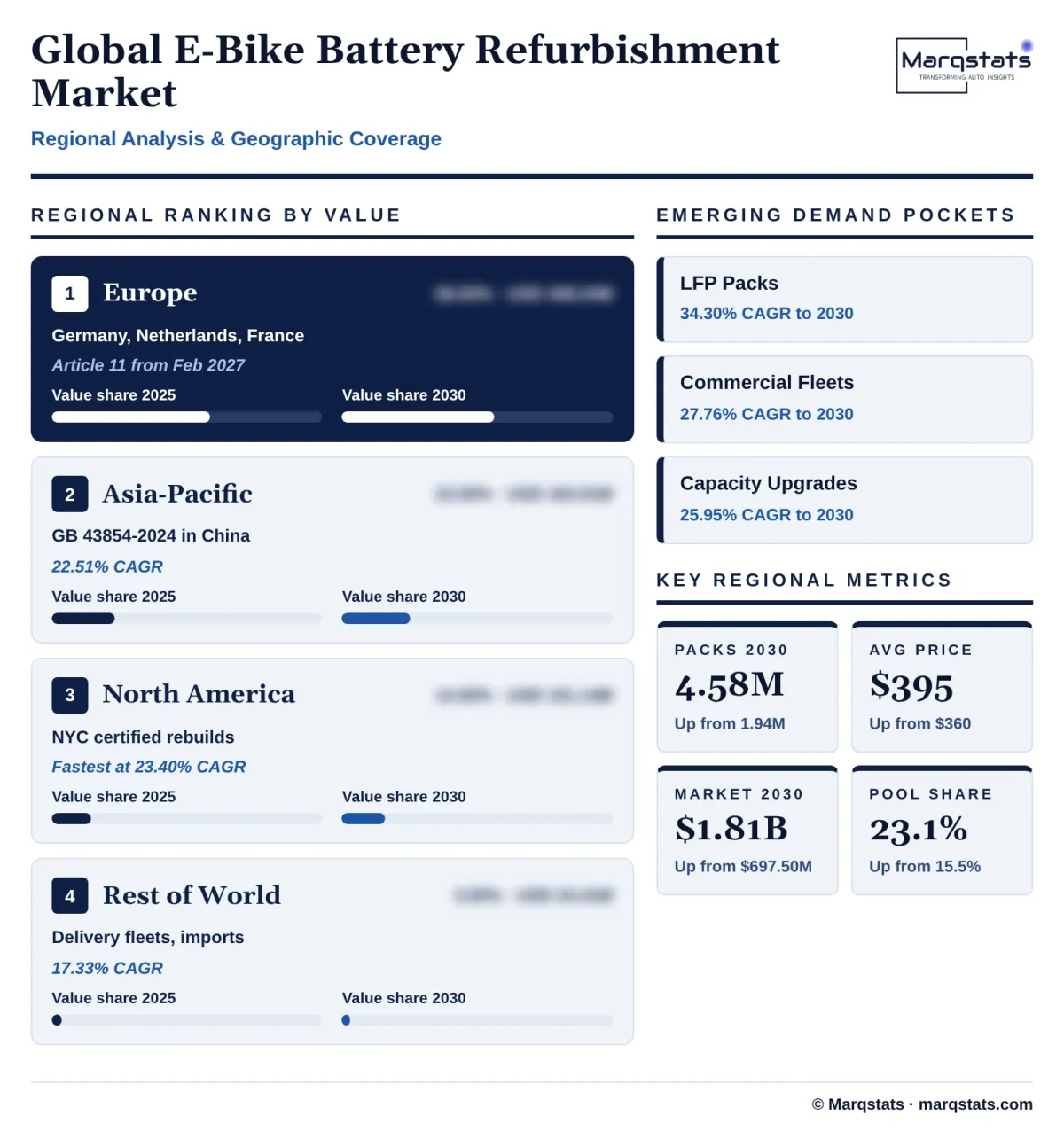
The global e-bike battery refurbishment market size is estimated at USD 697.50 million in 2025 and is projected to reach USD 1,809.10 million by 2030, growing at a CAGR of 21.00% over 2026 – 2030. The number of packs serviced rises from about 1.94 million to 4.58 million, an 18.77% annual rate, while the average service price rises from USD 360 to USD 395 per pack.
Marqstats defines the market as the value of professional services that extend the life of lithium-ion e-bike battery packs: full cell replacement (recelling), battery management system (BMS) diagnostics and repair, capacity upgrades, and casing, connector and thermal rework. Values are final workshop and commercial service billings. New original equipment and third-party replacement packs, recycling of spent cells for metal recovery, sales of loose cells without a service, and complete second-hand e-bike refurbishment are excluded.
Full cell replacement accounts for an estimated 74.00% of 2025 value and NMC chemistry packs for 82.50%. Europe accounts for 58.50% of 2025 value and direct-to-consumer services for 58.00%. The study segments the market by service type, battery chemistry, customer channel and region.
Key Takeaways
Market Overview & Analysis
Report Summary
Marqstats sizes the e-bike battery refurbishment market as the value of professional services that restore worn or faulty lithium-ion e-bike battery packs. In 2025 about 1.94 million packs were serviced worldwide, worth an estimated USD 697.50 million at an average service price of USD 360 across all service types.
Most e-bike batteries are sealed packs of 40 to 60 cylindrical cells, typically 18650 or 21700 formats, wired to a battery management system inside an aluminium or plastic case. After about 800 full charge cycles, or roughly four to five years of normal use, capacity falls to the point where the rider notices shorter range. A new original pack often costs USD 500 to 1,000 or more, and many older packs are no longer sold. Refurbishment keeps the case, wiring, connectors and often the BMS, and replaces the worn cells with new, matched Grade-A cells.
Marqstats estimates the global fleet of lithium-ion e-bikes in use reached about 62 million in 2025, including about 32 million in Europe, 22 million in Asia-Pacific excluding the much larger lead-acid fleet in China, 5.8 million in North America and 2.2 million in the rest of the world. Germany alone has more than 15 million e-bikes in use, and e-bikes have made up more than half of German bicycle sales since 2023. About 12.50 million packs reached the end of their useful life in 2025. New original and third-party packs replaced 84.50% of them and refurbishment 15.50%.
The market grew from USD 331.50 million in 2021 to USD 400.33 million in 2022, USD 479.55 million in 2023 and USD 577.28 million in 2024, a 20.44% annual rate, as bikes sold in the 2020 to 2022 boom left warranty and their batteries began to fade. Marqstats expects the market to reach USD 839.04 million in 2026.
Refurbishment is cheaper and lower in carbon than a new pack. Reusing the case and electronics typically saves 30% to 60% of the cost of a new original pack and avoids most of the emissions of making a new housing and BMS. Industrial refurbishers in Europe offer 12 to 24 month warranties, similar to or longer than the warranty on a new replacement pack, and send the removed cells to licensed recyclers.
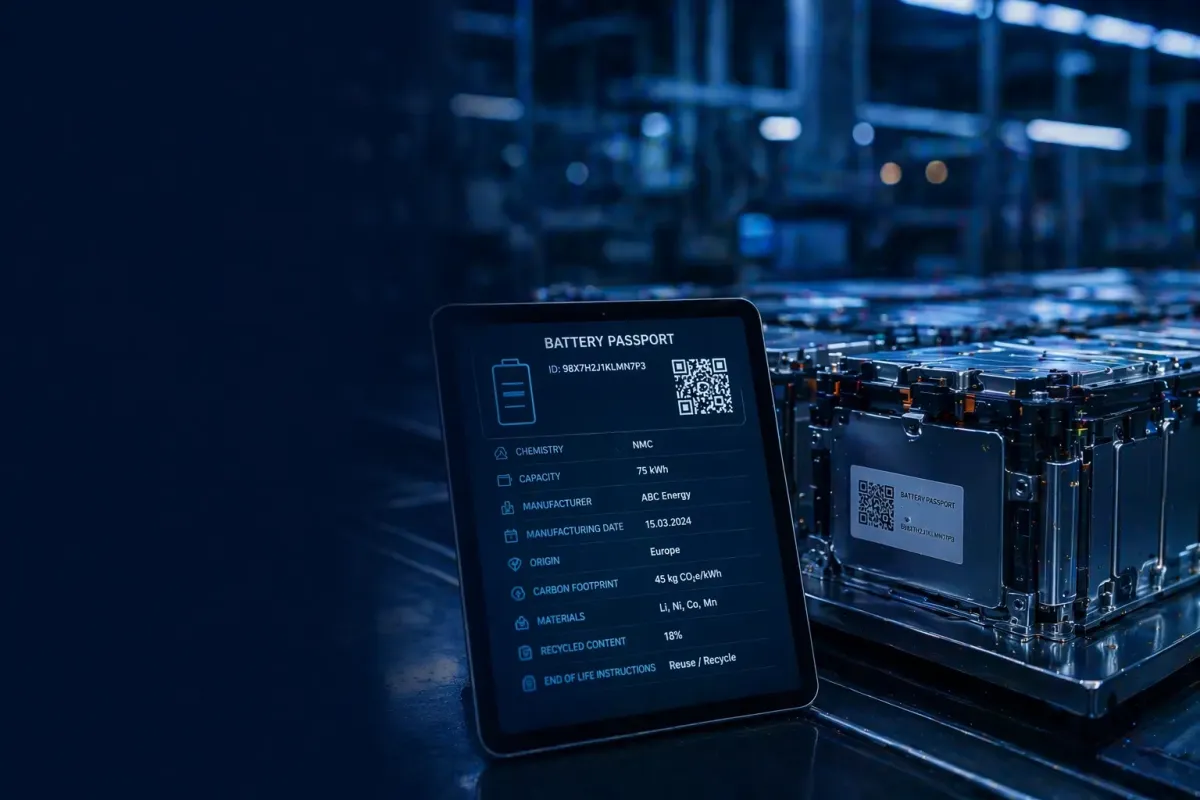
Regulation is splitting the market into two models. The EU is opening access: Article 11 of Regulation 2023/1542 requires light means of transport batteries to be replaceable by independent professionals from 18 February 2027, and the battery passport under Article 77 will give each new battery a digital record. New York City has taken a fire safety approach, requiring certified batteries and banning packs rebuilt from used cells, which pushes the market towards industrial rebuilders that use new cells and documented processes. China's GB 43854-2024 standard sets mandatory safety requirements for e-bike lithium-ion batteries and is moving repair from informal shops to certified operators.
Global E-Bike Battery Refurbishment Market Size and Forecast
The global e-bike battery refurbishment market grows from USD 697.50 million in 2025 to USD 1,809.10 million in 2030, a CAGR of 21.00%. Marqstats expects the market to reach USD 1,020.00 million in 2027, USD 1,241.50 million in 2028 and USD 1,501.56 million in 2029. Serviced packs rise from 1,937,500 in 2025 to 2,720,000 in 2027, 3,250,000 in 2028, 3,870,000 in 2029 and 4,580,000 in 2030.
Value grows faster than volume because the average job gets bigger. The average service price rises from USD 325 in 2021 to USD 360 in 2025 and USD 395 in 2030, a 1.87% annual rate, as more customers choose higher-capacity cells, as dealers sell full rebuilds rather than simple repairs, and as BMS work on encrypted systems takes more time and equipment.
Refurbishment takes a growing share of worn-out packs. Marqstats estimates refurbishment served 12.00% of the replacement pool in 2021, 15.50% in 2025, 18.25% in 2027 and 23.10% in 2030. Because the replacement pool is large, each percentage point of share is worth about 125,000 packs and USD 45 million of annual revenue, making share of the pool the most important variable in the forecast.
Cost of a rebuild versus a new pack decides customer choice. Marqstats estimates a full rebuild of a 500 Wh pack with new cells costs USD 316 to 534 in Europe, depending on cell grade and capacity, against USD 600 to 1,000 for many new original packs. Fleets add a second calculation: a rebuild with long-life LFP or high-capacity NMC cells can extend useful life by two to three years at a lower cost per kilometre than a new pack.
Marqstats tracks four indicators to monitor the forecast: how drivetrain makers open diagnostic access ahead of the February 2027 Article 11 deadline, the number of certified rebuilders approved under UL 2271 in the United States, cell prices for 18650 and 21700 formats, and e-bike fleet growth in Germany, the Netherlands, France and the United States.
The mix of services and customers changes over the forecast. Capacity upgrades rise from 9.00% to 11.00% of value, LFP from 9.50% to 16.00%, and commercial fleets from 16.00% to 21.00%. Direct-to-consumer services remain the largest channel but fall from 58.00% to 50.00% as dealers and fleets take more volume. Europe remains the largest region, easing from 58.50% to 56.00%, while Asia-Pacific rises to 25.00% and North America to 16.00%.
Market Dynamics
Key Drivers
Five forces are pushing e-bike owners, dealers and fleets to rebuild battery packs instead of buying new ones.
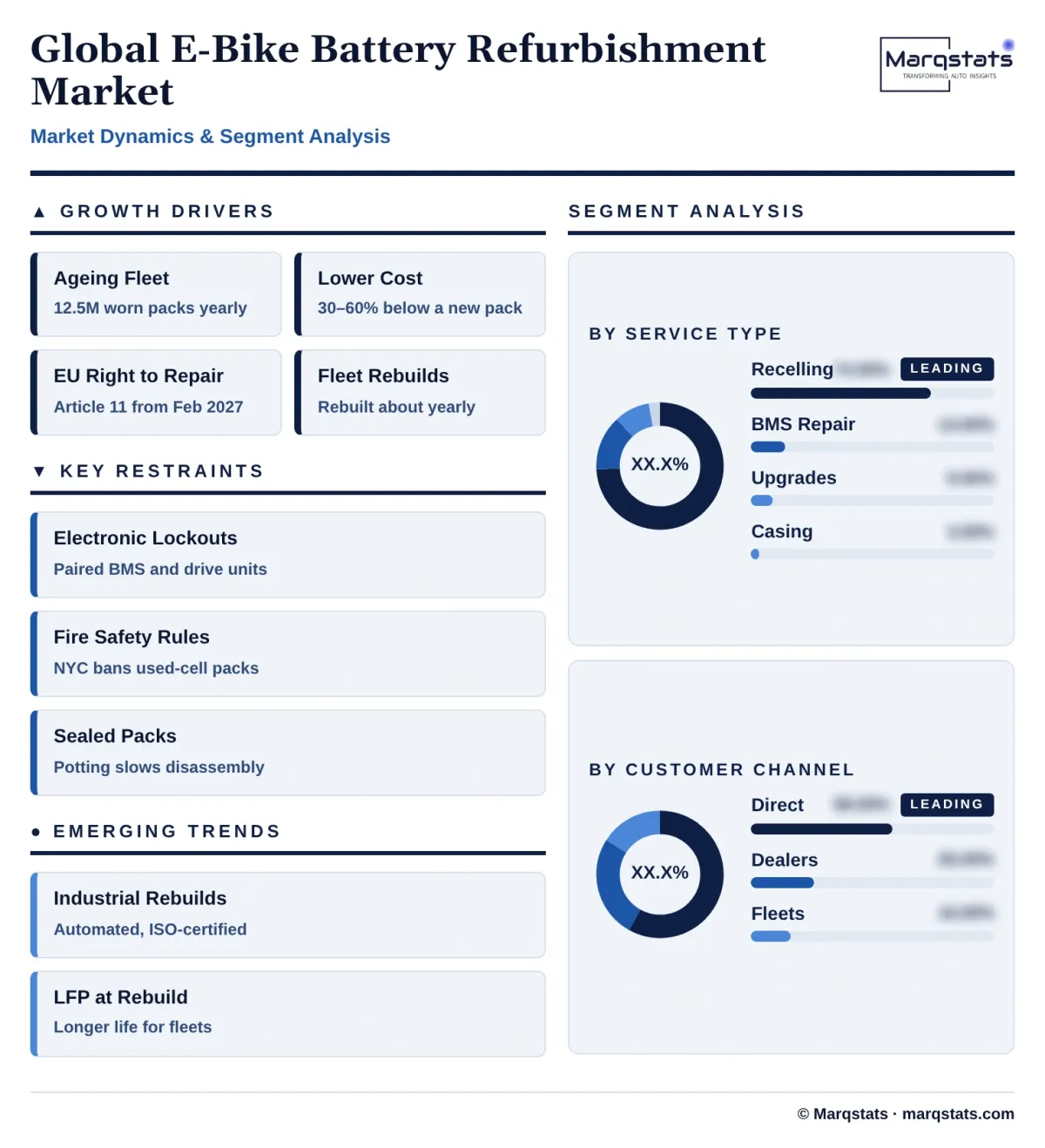
- A large fleet of ageing batteries. E-bikes sold during the 2020 to 2022 boom are now past warranty, and their batteries are reaching about 800 cycles. The replacement pool of about 12.50 million packs a year keeps growing as fleets expand in Europe, North America and Asia.
- Lower cost than a new pack. Recelling typically costs 30% to 60% less than a new original pack and is often the only option for discontinued battery models, giving owners and dealers a clear reason to repair.
- EU right to repair for batteries. From 18 February 2027, Article 11 of EU Regulation 2023/1542 requires batteries in light means of transport to be replaceable by independent professionals, with replaceability extending to individual cells for these batteries. Commission guidance published in August 2026 sets out how manufacturers should meet the rule.
- Fleets need annual rebuilds. Delivery, cargo and leasing fleets ride far more than private owners and wear out packs in about a year, so scheduled rebuild programmes with certified refurbishers cut fleet battery costs.
- Investment in industrial capacity. VoltR, R3 Robotics and Liofit are adding automated disassembly, welding and testing capacity, which lowers rebuild costs and improves quality consistency.
Key Restraints
Four constraints limit how fast professional battery refurbishment can scale.
- Electronic lockouts. Drive systems from Bosch, Shimano, Yamaha and others pair the battery to the motor and display through proprietary communication. Some packs lock themselves if the cells are disconnected, and Bosch states that damaged products that cannot be repaired safely are replaced rather than repaired, which forces refurbishers to keep the BMS powered during the rebuild or to design compatible replacement boards.
- Fire safety rules. New York City Local Law 39 of 2023 requires e-bikes and batteries sold or rented in the city to be certified to UL 2849 or UL 2271, and Local Law 40 bans the sale of batteries assembled or reconditioned with cells taken from used batteries, closing the informal repair trade and raising compliance costs for legitimate rebuilders.
- Product liability. Battery fires in homes lead to costly claims, and in the United States liability can reach every business in the supply chain, so dealers and insurers are cautious about uncertified rebuilds.
- Sealed pack designs. Potting resin, sonic welding and glued cases protect packs from water but make them slow and risky to open, increasing labour time and the chance of damaging cells during disassembly.
Key Trends
Four shifts are changing how e-bike batteries are rebuilt, tested and sold.
- Certified industrial rebuilds. Refurbishment is moving from small workshops to industrial sites with automated spot welding, cell matching, cycling chambers and ISO 9001 quality systems, often offering 24 month warranties.
- Dealer referral networks. Independent bicycle dealers collect packs and send them to central refurbishers through online portals, selling the rebuild under their own name rather than turning customers away.
- LFP and higher-capacity cells. Fleets switch to LFP cells for longer cycle life, while private owners upgrade to 3.5 Ah 18650 or 5.0 Ah 21700 cells for 30% to 60% more range from the same case.
- Repairable pack designs and digital passports. Designs such as the Gouach Infinite Battery hold cells mechanically rather than welding them, and the EU battery passport from February 2027 will record battery data that refurbishers can use to plan rebuilds.
Strategic Implications
- For refurbishers, scale and certification now decide who wins. Automated welding, cell matching and testing, dangerous goods logistics and ISO 9001 processes cut cost per rebuild and give dealers, fleets and insurers the confidence to choose refurbishment over a new pack.
- For drivetrain and battery makers, authorised refurbishment is a revenue opportunity. Opening diagnostic access ahead of the February 2027 Article 11 deadline and certifying partner rebuilders lets manufacturers earn service revenue and protect brand safety rather than lose the aftermarket to independents.
- For bicycle dealers, battery rebuilds are a retention tool. Partnering with a certified refurbisher lets dealers keep customers whose battery is out of production and earn margin on a service that would otherwise go online.
- For fleet operators, battery life is a major cost line. Scheduled rebuild contracts and a switch to LFP cells at rebuild can cut battery cost per kilometre and reduce fire risk in depots and riders' homes.
- For investors, the best opportunities sit in enabling technology. Automated disassembly, repairable pack designs, cell matching software and battery data platforms scale across many markets, while single-site repair shops remain local.
- For regulators and insurers, clear rebuild certification is the missing piece. A recognised test and certification route for packs rebuilt with new cells would separate safe industrial rebuilds from informal repairs and could lift refurbishment share of the replacement pool well above today's 15.50%.
Market Segmentation
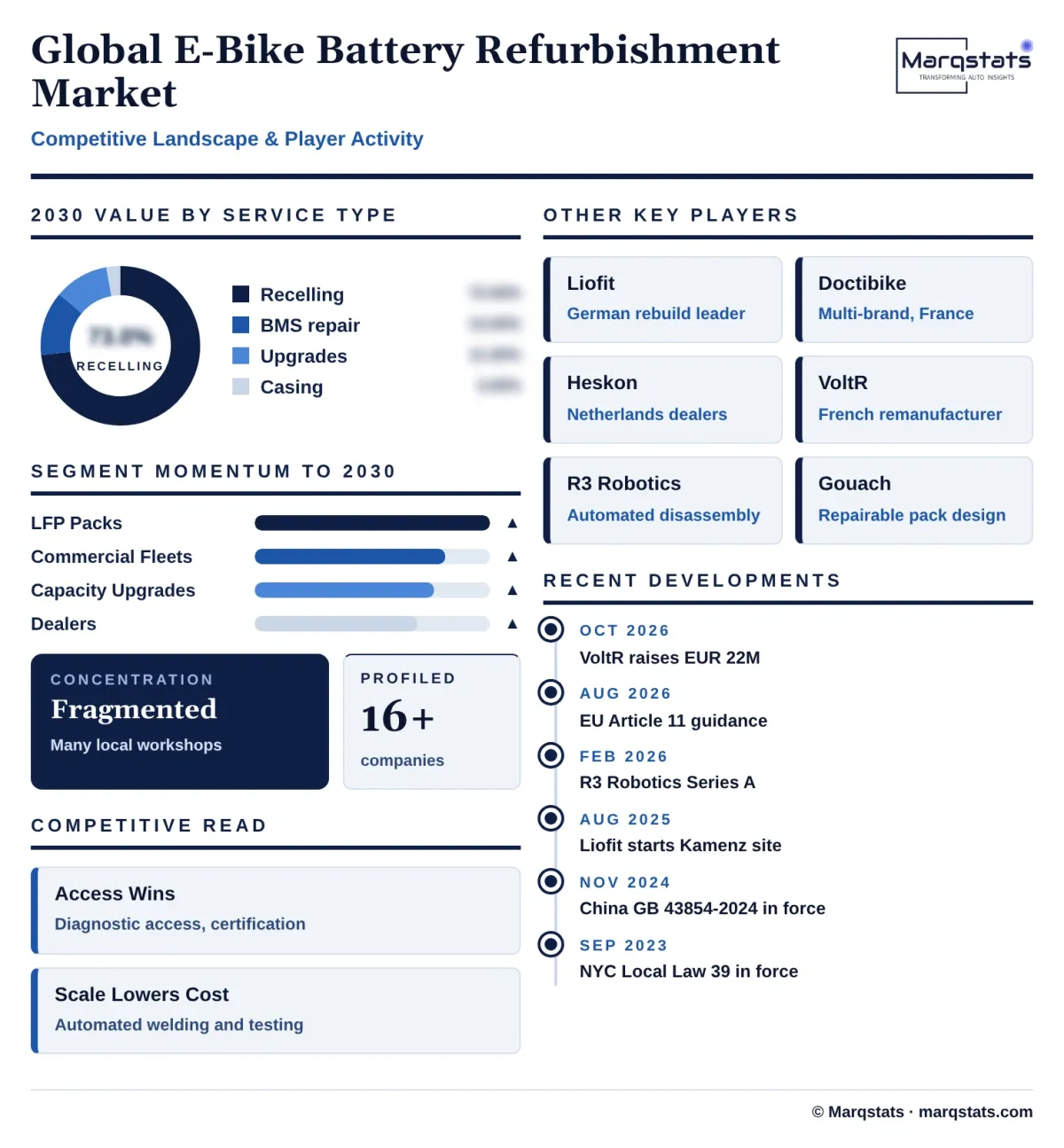
Full cell replacement accounts for 74.00% of 2025 value, USD 516.15 million, and reaches USD 1,320.66 million by 2030, a 20.67% CAGR, while its share eases to 73.00%. The worn cell block is removed and sent to a licensed recycler, and a new matched block of 40 to 60 Grade-A cylindrical cells is spot-welded with nickel strip and fixed into the original case.
BMS diagnostics and repair account for 14.00% of 2025 value, USD 97.65 million, and grow at 19.22% a year to USD 235.18 million by 2030. Typical jobs fix failed discharge MOSFETs, faulty balancing circuits and packs that will not wake after deep discharge.
Capacity upgrades account for 9.00% of 2025 value, USD 62.78 million, and grow fastest among services, at 25.95% a year, to USD 198.99 million and 11.00% of 2030 value. Replacing old 2.2 to 2.5 Ah cells with 3.5 Ah or 5.0 Ah cells gives riders 30% to 60% more range from the same case.
Casing, connector and thermal rework accounts for 3.00% of 2025 value, USD 20.93 million, and grows at 20.99% a year to USD 54.27 million, covering cracked housings, worn terminals, broken locks and replacement thermal barriers.
Nickel manganese cobalt packs account for 82.50% of 2025 value, USD 575.44 million, and reach USD 1,411.09 million by 2030, a 19.65% CAGR, while their share falls to 78.00%. NMC's high energy density makes it standard on European and North American trekking, mountain and commuter bikes.
Lithium iron phosphate packs account for 9.50% of 2025 value, USD 66.26 million, and grow fastest, at 34.30% a year, to USD 289.46 million and 16.00% of 2030 value. LFP lasts 2,000 to 3,000 full cycles against 800 to 1,000 for NMC and resists thermal runaway, which appeals to delivery and cargo fleets.
NCA and other chemistries account for 8.00% of 2025 value, USD 55.80 million, and grow at 14.23% a year to USD 108.55 million, while their share falls to 6.00% as older Japanese and Taiwanese pack designs leave the fleet.
Private owners who send packs directly to refurbishers account for 58.00% of 2025 value, USD 404.55 million, and reach USD 904.55 million by 2030, a 17.46% CAGR, while their share falls to 50.00%. Packs are shipped in UN 3480 dangerous goods packaging to central workshops.
Dealers that collect packs and resell rebuilds account for 26.00% of 2025 value, USD 181.35 million, and grow at 23.67% a year to USD 524.64 million and 29.00% of 2030 value, using refurbisher portals and testing tools such as the Doctibike tester.
Delivery, cargo, sharing and leasing fleets account for 16.00% of 2025 value, USD 111.60 million, and grow fastest, at 27.76% a year, to USD 379.91 million and 21.00% of 2030 value, as heavy daily use requires a rebuild about once a year.
By Geography
Europe
Europe is the largest market, with 58.50% of 2025 value, USD 408.04 million, rising to USD 1,013.10 million by 2030, a 19.95% CAGR, while its share eases to 56.00%. Germany is the largest national market, with more than 15 million e-bikes in use and e-bikes accounting for more than half of bicycle sales. Liofit in Kamenz, Doctibike in France and Heskon in the Netherlands lead industrial rebuilding, and VoltR is doubling its factory in western France. Article 11 of EU Regulation 2023/1542 makes cell-level replaceability of light means of transport batteries a legal requirement from 18 February 2027, and France supports repair through its anti-waste and circular economy (AGEC) law.
Asia-Pacific
Asia-Pacific accounts for 23.50% of 2025 value, USD 163.91 million, and grows at 22.51% a year to USD 452.28 million and 25.00% of the market by 2030. In China, the mandatory GB 43854-2024 safety standard for e-bike lithium-ion batteries, in force since 1 November 2024, sets cell and pack requirements that push repair from informal shops to battery makers and certified service networks. Japan and South Korea have closed dealer service networks around domestic system and cell makers such as Yamaha, Panasonic and Samsung SDI, while Taiwan and Australia have growing independent repair sectors.
North America
North America accounts for 14.50% of 2025 value, USD 101.14 million, and grows fastest, at 23.40% a year, to USD 289.45 million and 16.00% of the market by 2030. New York City is the centre of activity: its tens of thousands of app-based delivery workers wear out packs quickly, and after a spike in battery fires the city required UL 2849 and UL 2271 certification from September 2023 and banned packs rebuilt from used cells. FDNY recorded 268 lithium-ion battery fires and 18 deaths in 2023 and 277 fires and 6 deaths in 2024. Certified rebuilds using new cells, battery swap services for couriers and pre-owned e-bike platforms such as Upway are replacing the informal trade.
Rest of World
The rest of the world accounts for 3.50% of 2025 value, USD 24.41 million, and grows at 17.33% a year to USD 54.27 million by 2030. Demand comes mainly from urban delivery fleets and premium e-bike owners in Latin America, the Middle East and South Africa, where a lack of original replacement packs for imported models makes rebuilding attractive.
How Competition Is Evolving
The e-bike battery refurbishment market is fragmented. Thousands of local workshops and bicycle dealers carry out repairs, but a small group of industrial refurbishers, led by Liofit in Germany, Doctibike in France and Heskon in the Netherlands, handles a growing share of volume through dealer networks, fleet contracts and online sales.
Five groups shape competition. Industrial refurbishers run certified rebuild lines and offer multi-brand warranties. Technology companies such as R3 Robotics, VoltR and Gouach develop automated disassembly, second-life remanufacturing and repairable pack designs. Drivetrain and pack makers such as Bosch, Shimano, Yamaha, Brose, Bafang and BMZ control access to battery electronics. Cell suppliers such as Samsung SDI, LG Energy Solution, Panasonic, Murata, BYD and Gotion supply new cells. Recyclers and take-back schemes such as Accurec, Screlec, GRS Batterien and Call2Recycle handle the removed cells.
Industrial refurbishers compete on model coverage, warranty and turnaround. Leaders support hundreds of pack models, use automated spot welding and cell matching, and offer warranties of 12 to 24 months, while smaller workshops compete on price and local service.
Competition will be decided by access and certification. Refurbishers that secure diagnostic access to major drive systems, meet UL 2271 or equivalent standards, and build dealer and fleet contracts will take share from both new packs and informal repairers.
Capital is flowing into the sector. VoltR announced EUR 22 million in October 2026, made up of EUR 16 million in equity from investors including Decathlon's PULSE fund and a Bpifrance-managed fund and EUR 6 million in grants, to double its factory in Verrières-en-Anjou and raise capacity about six-fold in two years. R3 Robotics, formerly Circu Li-ion, raised a EUR 14 million Series A co-led by HG Ventures and Suma Capital plus EUR 6 million in EU grants in February 2026. Liofit laid the foundation stone for a new site in Kamenz in August 2025 that roughly doubles its capacity, and Green Riders acquired Doctibike in December 2021.
Original equipment makers are starting to respond. Some drive system makers now run certified pre-owned and remanufacturing programmes for motors and complete bikes, and authorised battery reconditioning is a logical next step as the February 2027 deadline approaches. Manufacturers that keep electronic locks risk losing the aftermarket to independent rebuilders that design their own compatible BMS boards.
Companies Covered
Companies covered in the report include:
Recent Market Activity
Table of Contents
Coverage & Segmentation
The study covers the global e-bike battery refurbishment market, with 2025 as the base year, 2021 – 2025 as the historical period and 2026 – 2030 as the forecast period. Values are in US dollars at final workshop and commercial service prices, converted at constant 2025 exchange rates, and volumes are packs serviced each year. The market is segmented by service type, battery chemistry, customer channel and region.
New original and third-party replacement packs, recycling of spent cells for metal recovery, sales of loose cells or cases without a service, refurbishment of complete second-hand e-bikes, and lead-acid e-bike batteries are excluded. Segment and regional splits are Marqstats estimates built on fleet data, wear-out rates, refurbisher price lists and disclosures, and regulatory timelines.