Market Snapshot
Middle bar: base-year value × (1 + CAGR), rounded to two decimals. This is a calculated illustration, not a separately researched annual estimate.
The global electric scooter tire market size is estimated at USD 1,224.84 million in 2025 and is projected to reach USD 1,716.33 million by 2030, growing at a CAGR of 6.98% over 2026 – 2030. Tire volume rises from about 362.19 million units to 422.86 million, a 3.15% annual rate, while the average ex-factory price climbs from about USD 3.38 to USD 4.06 per tire as tubeless designs replace tubed tires and demand grows fastest outside China.
Marqstats defines the market as the ex-factory value of tire casings fitted to new electric scooters at the factory and sold as replacements. It covers step-through electric scooters and mopeds of every power class, including Chinese new-standard electric bicycles built in scooter form, and standing electric kick-scooters. Tires for straddle-type electric motorcycles, electric bicycles and pedelecs on bicycle-size wheels of 20 inches and above, electric three-wheelers, separately sold inner tubes, wheels and labour are excluded.
Replacement tires account for an estimated 66.69% of 2025 value and tubeless tires for 71.81%. China accounts for 76.36% of 2025 value and about 87% of tire units. The study segments the market by vehicle type, tire construction, sales channel and region.
Key Takeaways
Market Overview & Analysis
Report Summary
Marqstats sizes the electric scooter tire market as the ex-factory value of tires fitted to step-through electric scooters, mopeds and kick-scooters, both on new vehicles and as replacements. In 2025 about 362.19 million tires were sold worldwide, worth an estimated USD 1,224.84 million at an average ex-factory price of about USD 3.38 per tire. About 135.00 million were fitted at the factory to 67.50 million new vehicles, and about 227.19 million were sold as replacements.
Electric scooter tires are small and cheap. Most Chinese electric bicycles of scooter form run on 14 to 16 inch tires that leave the factory for about USD 2.45 to USD 2.95 each. Faster electric mopeds and scooters use 10 to 14 inch tubeless tires on alloy wheels, and kick-scooters use 8 to 10 inch pneumatic or solid tires. The tires are mostly bias-ply nylon casings, so material cost, mould count and logistics decide price more than technology does.
Electric drive changes what a scooter tire must do. Hub motors deliver full torque from standstill, batteries add weight over the rear wheel, and regenerative braking puts extra load through the rear tire. Riders and fleet owners also want low rolling resistance to extend range. Tire makers respond with harder-wearing rear compounds, reinforced casings for higher loads, silica-rich treads for lower rolling resistance and tread patterns designed to clear water on smooth city roads.
China dominates volume. Marqstats estimates about 52.90 million scooter-form electric two-wheelers were sold in China in 2025, about 90% of the 58.8 million electric two-wheelers sold in the country. Of these, about 38.10 million were new-standard electric bicycles limited to 25 km/h and 14.80 million were electric mopeds and step-through electric motorcycles. Yadea alone sold 16.27 million vehicles, including 11.45 million electric bicycles and 4.82 million electric scooters, Ninebot sold about 4.1 million electric two-wheelers and NIU about 1.2 million.
Outside China the market is smaller in units but worth far more per tire. India sold 1,279,951 electric two-wheelers in 2025, almost all scooters, with an average Marqstats estimated seated scooter tire price of about USD 10.37, against about USD 2.95 in China and USD 21.28 in Europe. Kick-scooters add about 10.50 million new vehicles a year, most of them built in China and sold in Europe and North America.
Marqstats estimates the market was worth about USD 1,060 million in 2023 and USD 1,115 million in 2024, before China's pre-deadline buying rush lifted factory fitment in 2025. Marqstats expects the market to reach USD 1,271.39 million in 2026, with replacement tires growing while factory-fitted volume falls.
Regulation shapes tire demand in each market. China's GB 17761-2024 standard limits electric bicycles to 25 km/h, caps vehicle weight and the share of plastic parts, and requires CCC certification, and from December 2025 only new-standard vehicles may be sold. In India, tires must meet BIS standards and electric two-wheeler buyers have received central demand incentives under the PM E-DRIVE scheme. In Europe, scooters and mopeds need L-category type approval and their tires must meet UNECE Regulation 75, while kick-scooters are regulated city by city and country by country.
Global Electric Scooter Tire Market Size and Forecast
The global electric scooter tire market grows from USD 1,224.84 million in 2025 to USD 1,716.33 million in 2030, a CAGR of 6.98%. Marqstats expects USD 1,271.39 million in 2026, USD 1,365.71 million in 2027, USD 1,469.37 million in 2028 and USD 1,585.18 million in 2029. Tire volume moves from 362.19 million units in 2025 to 361.00 million in 2026, then rises each year to 422.86 million by 2030.
Replacement tires are the core of the market. Replacement value grows from USD 816.83 million in 2025 to USD 1,168.46 million in 2030, a 7.42% CAGR, raising its share from 66.69% to 68.08%. Factory-fitted value grows from USD 408.01 million to USD 547.88 million, a 6.07% CAGR, after a dip in 2026. Marqstats estimates the replacement rate ranges from about 0.24 tires per vehicle a year for privately owned kick-scooters to 0.72 for Indian scooters, which cover long daily distances on rough roads. Each replacement rate is a Marqstats construction built from typical tire life, daily riding distance and the share of vehicles in commercial use, and the split between private and commercial riders remains a construction based on delivery platform and fleet operator disclosures.
Price per tire rises faster than volume. The average ex-factory price rises from about USD 3.38 in 2025 to USD 4.06 in 2030. Three effects drive this: the shift from tubed to tubeless tires, a growing share of demand from India, Southeast Asia and Europe, where tires sell for several times the Chinese price, and higher-grade compounds and reinforced casings for heavier, faster scooters.
China grows slowly. The Chinese parc of about 342 million scooter-form vehicles is a Marqstats estimate derived from the national electric bicycle fleet less bicycle-form and straddle models. Marqstats estimates the parc rises only from about 342 million to 361 million vehicles by 2030, because sales mostly replace older vehicles. New-standard electric bicycle sales fall from 38.10 million in 2025 to about 33.80 million in 2026 before recovering to 38.40 million by 2030, so Chinese tire value grows at 3.90% a year, helped mainly by vacuum tires and replacement demand from delivery riders.
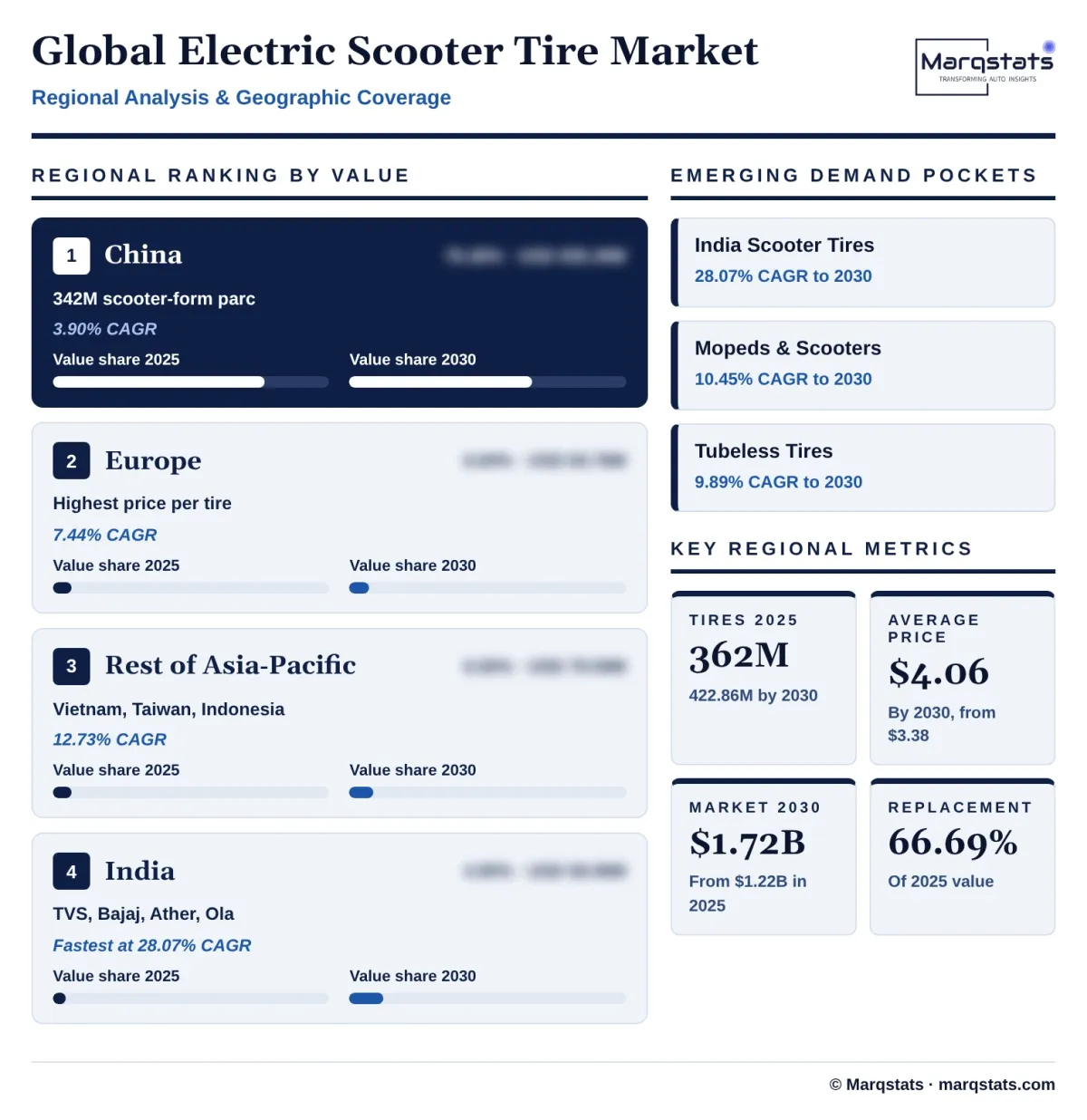
India and other emerging markets supply most of the new growth. India adds USD 146.72 million of tire value between 2025 and 2030, the Rest of Asia-Pacific USD 65.33 million and the Rest of World USD 28.52 million. Together these regions account for 49.0% of the absolute gain in market value, even though they represent less than 7% of 2025 tire units.
The mix of the market changes over the forecast. Electric mopeds and scooters rise from 38.99% to 45.74% of value, tubeless tires from 71.81% to 82.10%, and India from 4.90% to 12.04%. Chinese new-standard electric bicycles fall from 49.61% to 42.84% and tubed tires from 19.99% to 8.70%. Marqstats tracks four indicators to monitor the forecast: Chinese electric two-wheeler sales after the new standard, Indian electric two-wheeler retail data, European motorcycle and scooter replacement tire sales, and kick-scooter shipments by the leading brands.
Kick-scooter tires grow steadily. Marqstats estimates new kick-scooter sales rise from about 10.50 million in 2025 to 13.23 million by 2030 and the parc from about 32.85 million to 41.70 million, while the share of solid and airless tires on these vehicles rises. Kick-scooter tire value grows at 7.01% a year, from USD 139.68 million to USD 195.97 million, with Europe the largest market for these tires.
Market Dynamics
Key Drivers
Five forces keep demand for electric scooter tires rising even when new vehicle sales slow.
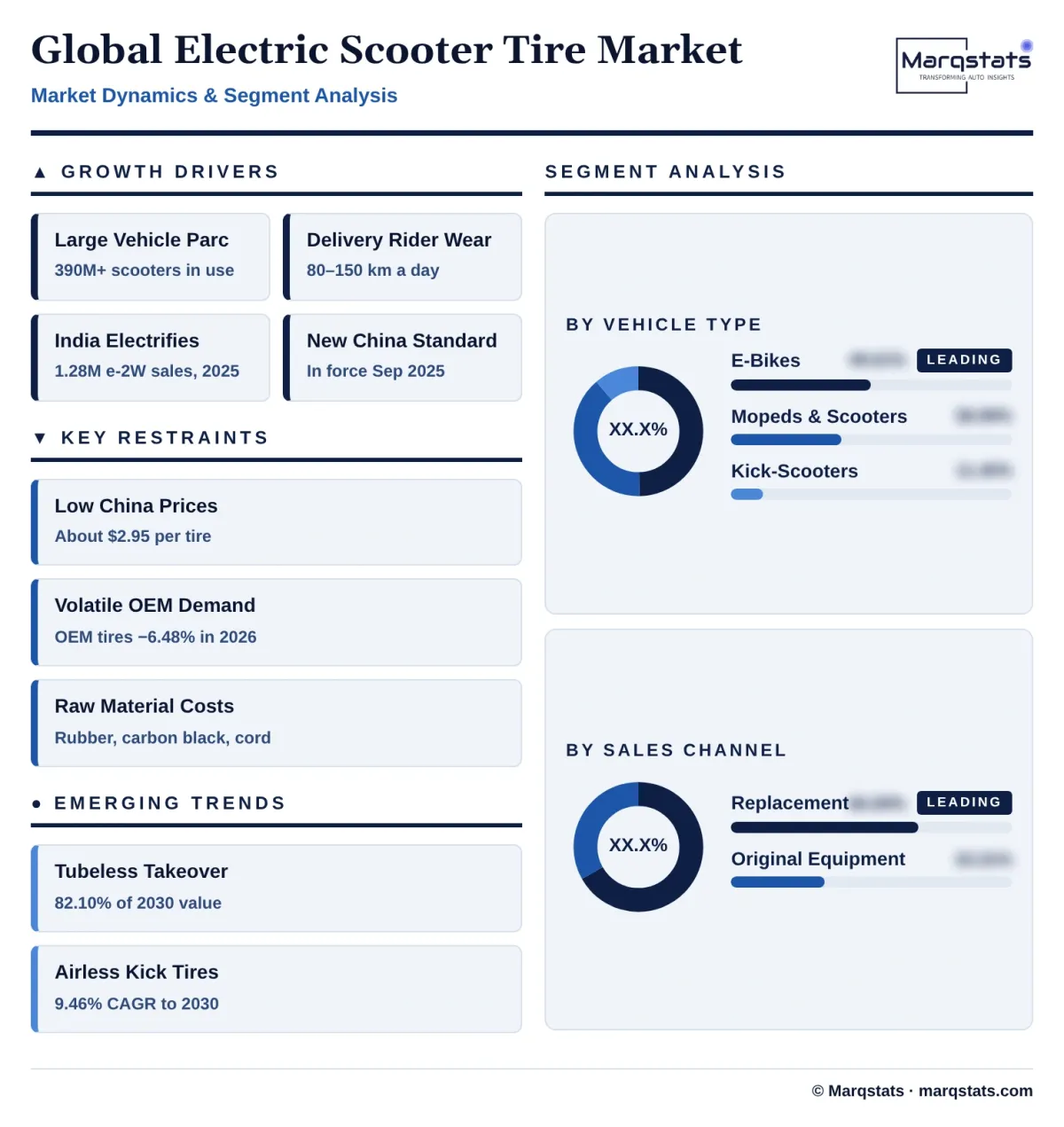
- A large vehicle parc. Marqstats estimates more than 390 million step-through electric scooters, mopeds and kick-scooters were in use worldwide in 2025, and each needs new tires every few years regardless of new vehicle sales.
- Delivery and ride-hailing riders wear tires faster. Food and parcel delivery riders in China, India and Southeast Asia cover 80 to 150 km a day, wearing out rear tires in months rather than years and lifting replacement demand per vehicle.
- Electrification of two-wheelers outside China. India sold 1,279,951 electric two-wheelers in 2025, up 11.36%, with TVS, Bajaj, Ather, Ola Electric and Hero Vida leading, and every new Indian electric scooter is fitted with tubeless tires that sell for several times the Chinese price.
- Stricter Chinese vehicle standards. GB 17761-2024 took effect on 1 September 2025, and old-standard electric bicycles could be sold only until 30 November 2025. Together with a trade-in programme that saw more than 12.5 million electric bicycles sold in 2025, the rule replaced older vehicles with new ones fitted with new tires.
- Range-focused tire design. Low rolling resistance compounds help electric scooters travel further on each charge, so scooter makers and riders pay more for EV-specific tires such as CEAT EnergyRide EV and TVS Eurogrip ranges.
Key Restraints
Four constraints hold back value growth in electric scooter tires.
- Very low prices in China. Chinese electric bicycle tires leave the factory for about USD 2.45 to USD 3.25, so the largest market by volume adds little value even when volumes are high.
- New vehicle sales are volatile. Rule changes and subsidy deadlines, such as the 2025 rush before China's old-standard sales cut-off, cause sharp swings in factory fitment, and Marqstats estimates factory-fitted tire volume falls 6.48% in 2026.
- Rising raw material costs. Natural rubber, synthetic rubber, carbon black and nylon cord account for most of the cost of a small bias-ply tire, and price rises are hard to pass on to cost-focused scooter makers.
- Long tire life on privately owned vehicles. Many privately owned electric bicycles and kick-scooters travel only a few kilometres a day, so their tires can last three to five years, limiting replacement demand outside commercial fleets.
Key Trends
Four shifts are changing how electric scooter tires are designed, made and sold.
- Tubeless tires replace tubed tires. Chinese electric bicycle makers are moving to vacuum tires on new-standard models, and Indian and European scooters already use tubeless tires on alloy wheels, so tubed tires fall from 19.99% to 8.70% of value by 2030.
- Airless tires for kick-scooters. Solid and honeycomb airless tires remove punctures on 8 to 10 inch wheels and grow to 9.20% of 2030 market value, mostly on shared and consumer kick-scooters.
- EV-specific tire ranges. Tire makers sell tires designed for electric scooters, with lower rolling resistance, stronger rear casings for hub-motor torque and quieter tread patterns.
- Capacity growth in India. TVS Srichakra approved up to Rs 220 crore for its Madurai plants in May 2026 and a further Rs 49.2 crore of debottlenecking in October 2026, as Indian tire makers add capacity for electric two-wheelers.
Strategic Implications
- For tire makers, replacement is where the margin is. Replacement tires carry 66.69% of value, sell for about 20% more than factory-fitted tires and are bought through dealer networks that reward brand and availability, so building retail reach matters more than winning large OEM contracts.
- For Chinese suppliers, the next step is higher value tires. With domestic volume growing slowly, vacuum tires, EV-specific compounds and exports to India, Southeast Asia and Europe offer the best route to higher revenue per tire.
- For Indian tire makers, electric scooters are a fast-growing line. Indian electric scooter tire value rises at 28.07% a year, and supplying OEMs such as TVS, Bajaj, Ather and Hero Vida builds a base for later replacement sales.
- For scooter makers, tire choice affects range and warranty cost. Low rolling resistance tires add range without a larger battery, and puncture-resistant tires reduce warranty and roadside claims.
- For shared fleet operators, tire durability affects fleet cost. Solid or airless tires reduce downtime from punctures, but they need suspension and frame designs that cope with a firmer ride.
- For investors, the market is steady rather than fast-growing. It grows at 6.98% a year, with most value growth coming from higher prices per tire and from India, not from higher volume in China.
- For distributors and retailers, delivery riders are the key customer. Riders who cover 80 to 150 km a day replace rear tires several times a year, so service points near delivery hubs, quick fitting and fleet accounts with delivery platforms win repeat business.
Market Segmentation
Scooter-form electric bicycles built to China's GB 17761 standard, limited to 25 km/h and usually fitted with 14 to 16 inch tires, account for 49.61% of 2025 value, USD 607.60 million and about 218.88 million tires. They grow at 3.89% a year to USD 735.29 million by 2030, while their share falls to 42.84%, because vehicle sales mostly replace older vehicles and tires sell for only about USD 2.45 to USD 3.25 each.
Step-through electric mopeds and scooters faster than 25 km/h, including Chinese electric mopeds and step-through electric motorcycles, Indian electric scooters and European L1e-B and L3e scooters, account for 38.99% of 2025 value, USD 477.56 million and about 112.40 million tires. They grow fastest, at 10.45% a year, to USD 785.07 million and 45.74% of value by 2030, as India and Southeast Asia electrify.
Standing electric kick-scooters account for 11.40% of 2025 value, USD 139.68 million and about 30.91 million tires, and grow at 7.01% a year to USD 195.97 million by 2030. Most new kick-scooters are built in China and sold in Europe and North America, and shared fleets replace tires much more often than private owners.
Tubeless tires account for 71.81% of 2025 value, USD 879.48 million, and grow at 9.89% a year to USD 1,409.09 million and 82.10% of value by 2030. They are standard on Indian, European and most Chinese electric mopeds and are spreading quickly to Chinese electric bicycles.
Tubed tires account for 19.99% of 2025 value, USD 244.90 million, and decline at 9.42% a year to USD 149.35 million and 8.70% of value by 2030, as they remain mainly on low-cost Chinese electric bicycles, replacement tires for older vehicles and entry-level kick-scooters.
Solid and honeycomb airless tires account for 8.20% of 2025 value, USD 100.46 million, and grow at 9.46% a year to USD 157.89 million and 9.20% of value by 2030, used mainly on kick-scooters where puncture-free operation matters more than ride comfort.
Replacement tires account for 66.69% of 2025 value, USD 816.83 million and about 227.19 million tires, and grow at 7.42% a year to USD 1,168.46 million and 68.08% of value by 2030. They are sold through tire dealers, scooter service shops, online stores and fleet maintenance contracts.
Factory-fitted tires account for 33.31% of 2025 value, USD 408.01 million and about 135.00 million tires, and grow at 6.07% a year to USD 547.88 million by 2030, after falling 1.99% in value in 2026 as China's pre-deadline sales rush unwinds.
By Geography
China
China is the largest market, with 76.36% of 2025 value, USD 935.39 million and about 315.85 million tires, rising to USD 1,132.65 million by 2030, a 3.90% CAGR, while its share falls to 66.00%. China sold 58.8 million electric two-wheelers in 2025, up 16.6%, and has a parc that Marqstats estimates at about 342 million scooter-form vehicles. Yadea, Ninebot, Aima, Tailg, Luyuan and NIU buy tires from domestic producers such as Zhongce Rubber, Cheng Shin Rubber's China plants, Shandong Linglong and many smaller makers. GB 17761-2024 and the 2025 trade-in programme pulled vehicle purchases forward into 2025, so factory fitment falls in 2026 before recovering.
Rest of Asia-Pacific
The Rest of Asia-Pacific, led by Vietnam, Taiwan, Indonesia, Thailand and the Philippines, accounts for 6.50% of 2025 value, USD 79.59 million, and grows at 12.73% a year to USD 144.92 million and 8.44% of value by 2030. Vietnam has a large electric scooter parc and VinFast is expanding production, Taiwan has Gogoro battery-swap scooters, and Indonesia is promoting electric two-wheelers with local assembly. Cheng Shin Rubber's Maxxis brand is strong in this region's motorcycle and scooter replacement market.
Europe
Europe accounts for 6.84% of 2025 value, USD 83.78 million, and grows at 7.44% a year to USD 119.91 million by 2030. It is the largest market for kick-scooter tires and has the highest prices for seated scooter tires, at about USD 21.28 per tire. Motorcycle and scooter replacement tire sales by Tyres Europe members rose 4% to 9.345 million units in 2025, the strongest segment in a weak replacement market. Michelin, Pirelli, Continental, Bridgestone, Dunlop, Heidenau and Mitas lead in seated scooter tires.
India
India accounts for 4.90% of 2025 value, USD 59.99 million and about 5.96 million tires, and grows fastest, at 28.07% a year, to USD 206.71 million and 12.04% of value by 2030. Electric two-wheeler retail sales reached 1,279,951 units in 2025, led by TVS with 298,881, Bajaj with 269,847, Ather with 200,797, Ola Electric with 199,318 and Hero Vida with 109,168. TVS Srichakra, MRF, CEAT, Apollo Tyres and Ralco supply factory-fitted and replacement tires.
North America
North America accounts for 3.31% of 2025 value, USD 40.50 million, and grows at 7.46% a year to USD 58.03 million by 2030. Kick-scooters dominate, with Segway-Ninebot the leading brand and shared fleets run by operators such as Lime and Bird.
Rest of World
Latin America, the Middle East and Africa account for 2.09% of 2025 value, USD 25.59 million, and grow at 16.16% a year to USD 54.11 million and 3.15% of value by 2030, as delivery riders in Brazil, Mexico and Colombia and commuters in Africa and the Middle East switch to electric scooters.
How Competition Is Evolving
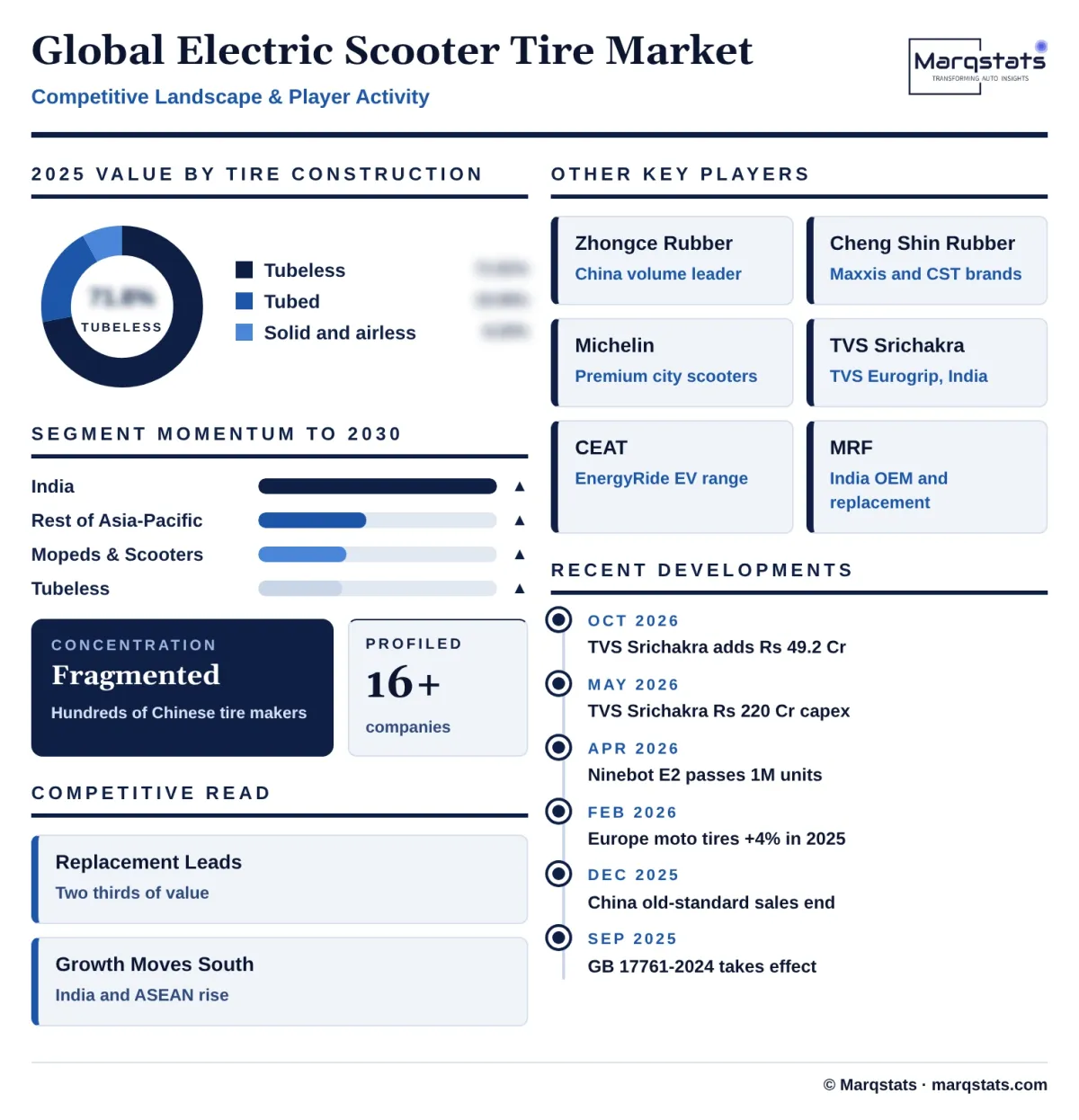
The electric scooter tire market is fragmented. Hundreds of Chinese tire makers supply small bias-ply tires for electric bicycles and mopeds, while a small group of international and Indian companies compete for higher-value tubeless tires in India, Southeast Asia and Europe. Marqstats estimates the ten largest suppliers account for less than half of global value.
Two groups compete. Chinese producers such as Zhongce Rubber, Shandong Linglong, Cheng Shin Rubber's China plants and many regional makers compete on price, mould range and delivery speed to vehicle makers in Zhejiang, Jiangsu and Tianjin. International and Indian producers, including Michelin, Pirelli, Continental, Bridgestone, Sumitomo Rubber, MRF, CEAT, TVS Srichakra and Apollo Tyres, compete on brand, compound quality and retail reach.
Original equipment contracts are won on cost and supply security. Large scooter makers such as Yadea, Ninebot, Aima, TVS, Bajaj and Ather buy from several suppliers and negotiate hard on price, so OEM supply gives volume but low margins. Replacement sales give higher margins but need wide dealer and service networks.
Competition will be decided by tubeless and EV-specific products, presence in India and Southeast Asia, and retail reach. Suppliers that combine low-cost Chinese manufacturing with branded replacement sales in growth markets will gain share.
Capacity is being added where growth is fastest. TVS Srichakra approved up to Rs 220 crore for its Madurai plants in May 2026 and a further Rs 49.2 crore in October 2026 to raise two- and three-wheeler tire capacity from about 34 to 35 million tires a year. Indian tire makers have launched EV-specific two-wheeler ranges, such as CEAT EnergyRide EV, and Chinese makers are expanding vacuum tire output for new-standard electric bicycles.
Companies Covered
Companies covered in the report include:
Recent Market Activity
Table of Contents
Coverage & Segmentation
The study covers the global electric scooter tire market, with 2025 as the base year, 2021 – 2025 as the historical period and 2026 – 2030 as the forecast period. Values are in US dollars at ex-factory prices, and volumes are tire casings sold in the year, both fitted to new vehicles and sold as replacements. Local currency values are converted at 2025 annual average rates of INR 87.00, CNY 7.18 and EUR 1 to USD 1.13, held constant over the forecast. The market is segmented by vehicle type, tire construction, sales channel and region.
Tires for straddle-type electric motorcycles, electric bicycles and pedelecs on bicycle-size wheels of 20 inches and above, electric three-wheelers and petrol scooters are excluded, as are separately sold inner tubes, wheels, fitting labour and retread services. Segment and regional splits are Marqstats estimates built on vehicle sales and parc data, company disclosures, trade association statistics and tire price benchmarks.