Market Snapshot
Middle bar: base-year value × (1 + CAGR), rounded to two decimals. This is a calculated illustration, not a separately researched annual estimate.
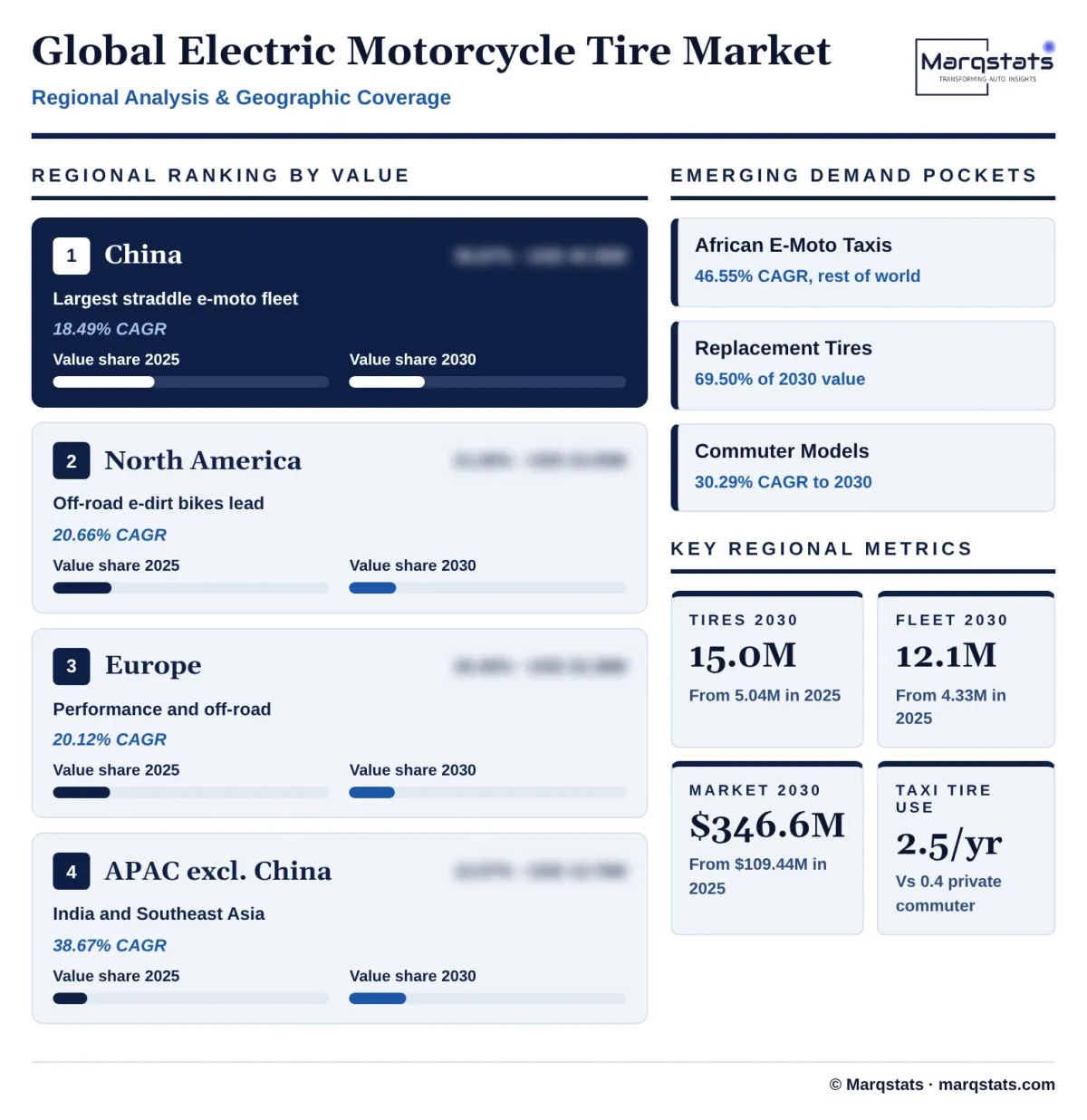
The global electric motorcycle tire market size is estimated at USD 109.44 million in 2025 and is projected to reach USD 346.63 million by 2030, growing at a CAGR of 25.93% over 2026 – 2030. Annual tire sales rise from about 5.04 million units to 14.98 million, a 24.34% annual rate, and the average selling price edges up from about USD 21.71 to USD 23.14 per tire.
Marqstats defines the market as the value, at tire-maker selling prices, of tires fitted to new straddle-type electric motorcycles on the assembly line and of replacement tires bought for electric motorcycles already in use. It covers commuter electric motorcycles, including motorcycle taxis and delivery bikes, electric off-road and dirt bikes, and high-performance road electric motorcycles. Step-through electric scooters and mopeds, kick-scooters, electric bicycles, children’s balance bikes, three-wheelers, inner tubes, fitting labour and retail mark-ups are excluded.
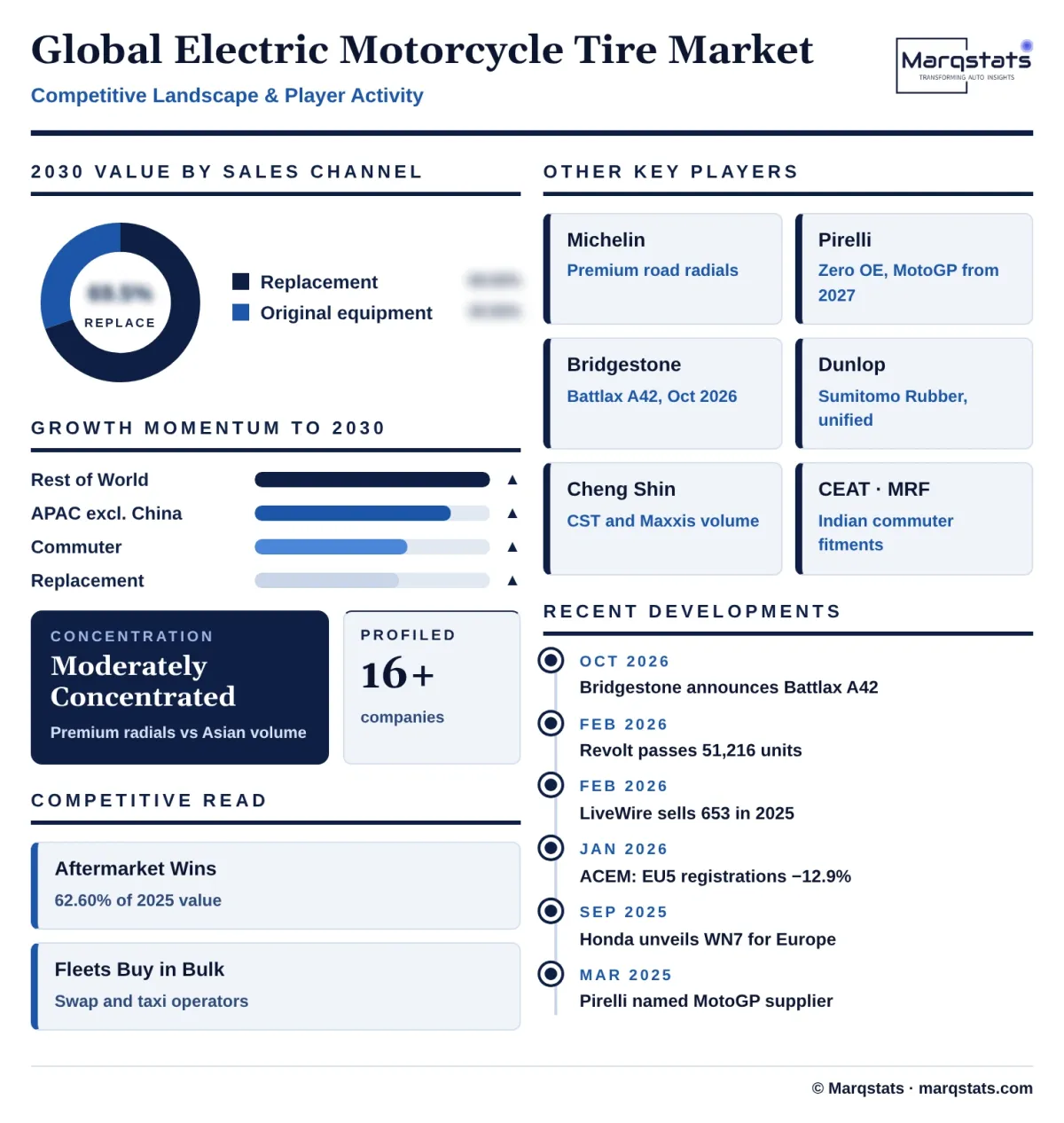
Replacement tires account for an estimated 62.60% of 2025 value and commuter electric motorcycles for 44.47%. China accounts for 36.87% of 2025 value and North America for 21.06%. The study segments the market by vehicle class, sales channel and region.
Key Takeaways
Market Overview & Analysis
Report Summary
Marqstats sizes the electric motorcycle tire market as the value of tires sold for straddle-type electric two-wheelers, the step-over frame motorcycles on which the rider sits astride the battery and frame. In 2025 about 1.28 million such motorcycles were sold worldwide and about 4.33 million were in use on average during the year. They consumed about 5.04 million tires, 2.56 million fitted on new vehicles and 2.48 million bought as replacements, worth an estimated USD 109.44 million at an average tire-maker selling price of about USD 21.71.
The market is far smaller than the electric two-wheeler market as a whole. Most electric two-wheelers sold in China, India, Vietnam and Europe are step-through scooters and mopeds with 10- to 14-inch wheels, which Marqstats covers in a separate electric scooter tire study. Straddle-type electric motorcycles, with 17- to 19-inch wheels on road models and 16- to 21-inch spoked wheels on off-road models, are a minority of electric two-wheeler sales in almost every country. In India, for example, electric motorcycles from Revolt, Ola Electric, Oben, Ultraviolette and Matter accounted for only a few percent of the record 1.28 million electric two-wheelers retailed in 2025.
Three vehicle classes make up the market. Commuter electric motorcycles of up to about 11 kW, such as the Revolt RV400, Ola Roadster X, Spiro Ekon, Roam Air and Chinese straddle-type models, run on bias-ply 17-inch tires that sell to OEMs for about USD 11.50 each. Off-road electric dirt bikes run on knobby tube-type tires on 16- to 21-inch spoked rims. High-performance road electric motorcycles from Zero Motorcycles, LiveWire, Kawasaki, Honda, Ultraviolette and others run on tubeless radial sport and touring tires from Pirelli, Michelin, Bridgestone and Dunlop.
Electric motorcycles place different demands on tires than petrol motorcycles of the same size. Battery packs add weight, so tires need higher load ratings. Electric motors deliver full torque from standstill, which strains the casing and wears the rear tire faster. Riders and OEMs want low rolling resistance to extend range, and with no engine noise, tread pattern noise becomes noticeable. Regenerative braking also shifts more braking load to the rear tire. Tire makers respond with silica-rich compounds, reinforced casings and quieter tread patterns that they increasingly market to both electric and petrol riders.
Marqstats expects tire value of about USD 137.82 million in 2026, as electric motorcycle fleets in Africa and Asia expand and off-road electric dirt bikes keep selling in North America and Europe.
Standards set the minimum requirements. In Europe, motorcycle tires are approved under UN ECE Regulation No. 75, which covers load, speed and dimensional requirements; in the United States, motorcycle tires must meet FMVSS No. 119 and carry DOT markings; India requires BIS certification of two-wheeler tires; and China sets requirements in its GB motorcycle tire standards. None of these standards defines a separate class for electric motorcycles, so tires marketed as electric-ready are approved like any other motorcycle tire, and the electric benefit is a matter of design rather than regulation.
The market grew from an estimated USD 33.80 million in 2021 to USD 49.60 million in 2022, USD 66.90 million in 2023 and USD 86.70 million in 2024, as off-road electric dirt bikes took off in North America and Europe, Chinese straddle-type electric motorcycle fleets grew and Indian electric motorcycles from Revolt, Ola Electric and others entered the market. The expansion of battery-swap motorcycle taxis in East Africa from 2023 added a new source of high-intensity replacement demand.
Global Electric Motorcycle Tire Market Size and Forecast
The global electric motorcycle tire market grows from USD 109.44 million in 2025 to USD 346.63 million in 2030, a CAGR of 25.93%. Marqstats expects tire value of about USD 173.56 million in 2027, USD 218.57 million in 2028 and USD 275.25 million in 2029. Tire volume rises from about 5.04 million units in 2025 to 14.98 million in 2030, a 24.34% annual rate.
Two engines drive the forecast. New straddle-type electric motorcycle sales rise from about 1.28 million in 2025 to 3.07 million in 2030, a 19.12% annual rate, lifting original-equipment tire demand from about 2.56 million to 6.14 million units. The average fleet in use grows faster, from about 4.33 million to 12.13 million vehicles, 22.88% a year, lifting replacement tire demand from about 2.48 million to 8.84 million units, 28.94% a year.
Replacement demand depends on how hard each motorcycle is used. Marqstats assumes a privately owned commuter electric motorcycle in China uses about 0.40 replacement tires a year and one in Europe about 0.45, while delivery and gig-work fleets in India and Southeast Asia raise the Asia-Pacific average from about 0.60 to 0.70 tires a year by 2030. Battery-swap motorcycle taxis in East and West Africa, which run 150 to 200 km a day, use about 2.5 tires a year, pulling the average for Africa, Latin America and the Middle East from about 1.39 tires a year in 2025 to 1.85 in 2030 as taxis become a bigger share of the fleet. Off-road electric dirt bikes use about 0.9 replacement tires a year and performance electric motorcycles about 0.8.
Prices rise slowly. Marqstats estimates the average original-equipment price of a commuter electric motorcycle tire rises from about USD 11.50 in 2025 to USD 13.00 in 2030 as OEMs move to tubeless tires and higher load ratings, while the average replacement price rises from about USD 16.00 to USD 18.00. Off-road tire prices rise from about USD 22 to USD 24 at OE and from about USD 38 to USD 41 in the replacement channel. Performance radial prices ease slightly, from about USD 85 to USD 82 at OE and from USD 135 to USD 130 in the replacement channel, as larger volumes of mid-priced models such as the Honda WN7 and Kawasaki Ninja e-1 dilute the premium mix. The overall average price per tire rises from about USD 21.71 to USD 23.14.
Marqstats tracks four indicators to monitor the forecast: monthly electric motorcycle registrations by country, the size of battery-swap motorcycle taxi fleets in Africa and Asia, off-road electric dirt bike imports into North America and Europe, and tire price lists from leading two-wheeler tire makers.
The mix of demand changes over the forecast. Commuter electric motorcycles rise from 44.47% to 52.71% of value as fleets grow in Asia and Africa, while off-road electric dirt bikes fall from 35.92% to 29.42% and performance electric motorcycles from 19.61% to 17.87%. China remains the largest region, but its share falls from 36.87% to 27.19% as Asia-Pacific excluding China rises to 20.36% and Africa, Latin America and the Middle East to 19.31%. Replacement tires rise from 62.60% to 69.50% of value.
The electric motorcycle tire market is a small but fast-growing part of the global motorcycle tire business. Hundreds of millions of motorcycle tires are sold each year for petrol motorcycles, and straddle-type electric motorcycles account for only a small fraction of that volume in 2025. Their share rises through 2030 as electric commuter motorcycles gain ground in Asia and Africa, but petrol motorcycle tires remain the bulk of tire maker volume, which is why most makers adapt existing ranges rather than building separate electric lines.
Market Dynamics
Key Drivers
Five forces are lifting demand for tires on electric motorcycles.
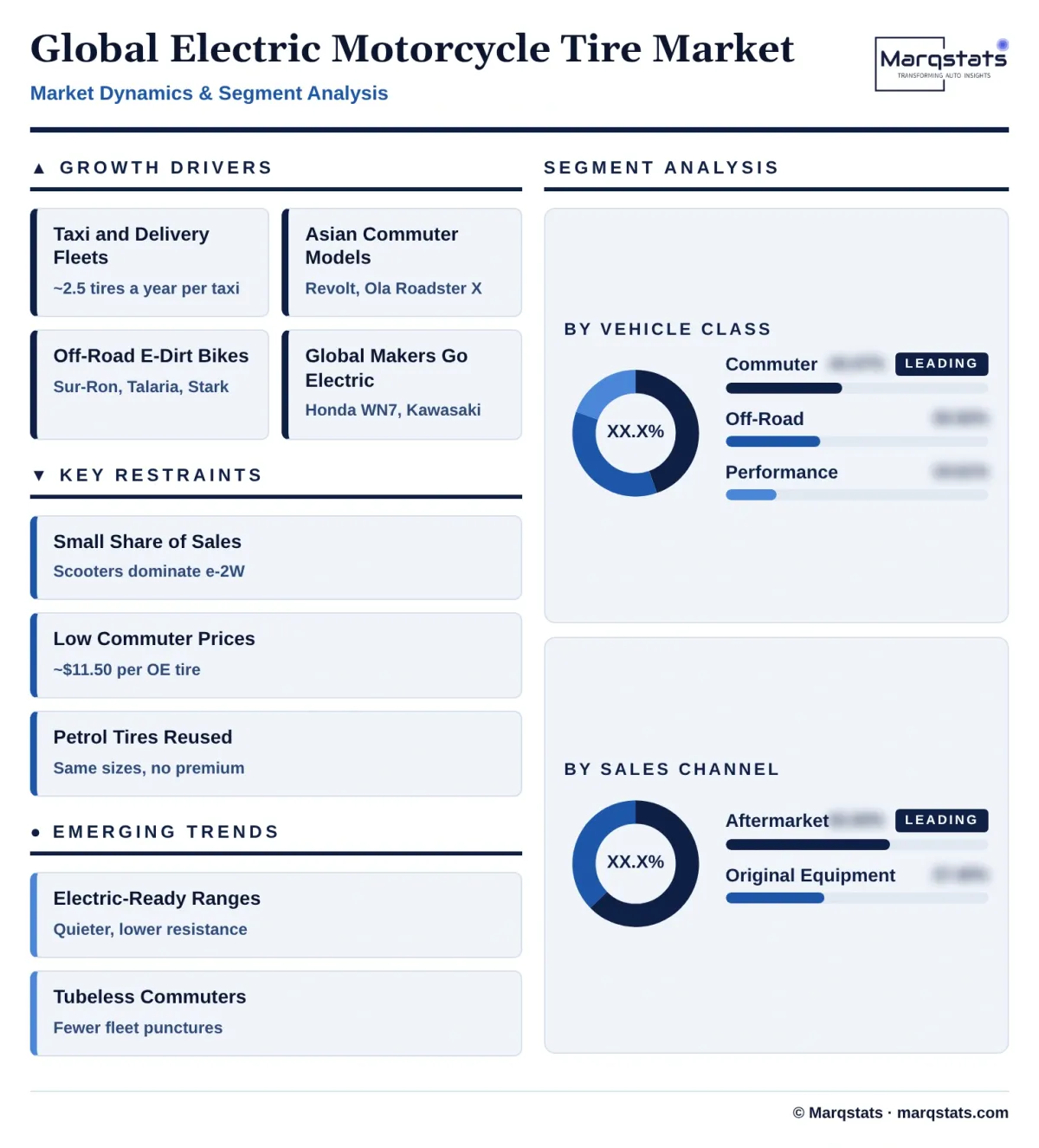
- Fleets of electric motorcycle taxis and delivery bikes. Battery-swap operators such as Spiro, Roam, Ampersand and others are putting tens of thousands of electric motorcycles into taxi and delivery service in Kenya, Uganda, Rwanda, Nigeria and other African markets. Marqstats estimates about 65,450 electric motorcycle taxis were delivered in Africa in 2025, rising to about 425,000 in 2030. Each taxi covers 150 to 200 km a day and needs about 2.5 replacement tires a year.
- Electric motorcycles reach mass-market prices in Asia. Revolt sold 11,019 electric motorcycles in India in calendar 2025 and passed 51,216 cumulative units by February 2026, Ola Electric began deliveries of the Roadster X in May 2025, and Chinese, Indonesian, Vietnamese and Thai makers sell straddle-type commuter models priced close to petrol motorcycles of similar size.
- Off-road electric dirt bikes stay popular. Light electric dirt bikes from Sur-Ron, Talaria and E Ride Pro sell in large numbers in North America, Europe and Australia, and full-size electric motocross bikes such as the Stark Varg compete with petrol machines. Their knobby tires wear quickly, creating steady replacement demand.
- Global motorcycle makers add electric models. Honda unveiled the WN7, its first full-size electric motorcycle for Europe, in September 2025, Kawasaki sells the Ninja e-1 and Z e-1, LiveWire sold 653 electric motorcycles in 2025, and Zero Motorcycles uses Pirelli as an original-equipment supplier. Each new model is a fitment contract for a radial tire maker.
- Higher tire specifications per vehicle. Heavier batteries, instant torque and the need for low rolling resistance push OEMs toward tubeless tires, higher load ratings and better compounds, raising the value of each tire fitted.
- Delivery and gig-work fleets in Asia. Food delivery, parcel and ride-hailing riders in India, Indonesia, Vietnam and the Philippines increasingly use electric motorcycles, often leased from fleet operators. These riders cover long daily distances, raising replacement rates above those of private commuters.
Key Restraints
Four constraints hold back the value of electric motorcycle tires.
- Electric motorcycles remain a small share of motorcycle sales. In most countries step-through electric scooters dominate electric two-wheeler sales and petrol motorcycles dominate straddle-type sales, so the base for electric motorcycle tires is still small. ACEM reported that registrations of all motorcycles in the five largest European markets fell 12.9% in 2025, to 1,002,848 units, weakening demand for new models.
- Low prices for commuter tires. Commuter electric motorcycle tires use standard bias-ply sizes made in high volumes by Chinese, Indian and Taiwanese makers, so OEM prices are low and margins are thin, especially where large vehicle makers hold strong buying power.
- Fragile electric motorcycle start-ups. Several electric motorcycle makers have failed or paused production in recent years, and others depend on venture funding, so tire makers face the risk of fitment contracts that never reach planned volumes.
- Use of petrol motorcycle tires in the aftermarket. Many owners replace worn tires on electric motorcycles with standard petrol motorcycle tires of the same size, which limits demand for higher-priced tires marketed specifically for electric motorcycles.
- Rubber and raw material costs. Prices of natural rubber, synthetic rubber and carbon black affect tire maker margins, and makers selling low-priced commuter tires have limited room to pass cost increases on to OEMs and fleet buyers.
Key Trends
Four shifts are changing how electric motorcycle tires are designed, fitted and sold.
- Electric-ready labels on mainstream ranges. Rather than launching electric-only lines, most tire makers mark existing ranges as suitable for electric motorcycles and add load, noise and rolling-resistance improvements that suit both electric and petrol riders. Pirelli, for example, applies its Elect technology to EV tires, and Bridgestone presents the Battlax Adventure A42 as quieter and longer-lasting than the A41.
- Tubeless tires on commuter models. OEMs in India, Southeast Asia and Africa are moving commuter electric motorcycles from tube-type to tubeless tires to cut roadside punctures, which matters most for taxi and delivery fleets.
- Fleet tire contracts. Battery-swap and taxi operators that own or finance thousands of motorcycles buy tires in bulk and schedule replacements, giving tire makers a new type of large customer in the aftermarket.
- Racing and premium technology moves into road tires. Pirelli will supply MotoGP from 2027, and Bridgestone, Michelin and Dunlop are transferring racing compounds and casing technology into road sport tires that suit high-torque electric motorcycles.
Strategic Implications
- For tire makers, the aftermarket is the bigger prize. Replacement tires account for 62.60% of 2025 value and 69.50% by 2030, so distribution through dealers, fleet contracts with taxi and delivery operators, and availability of the right sizes in Africa and Asia matter more than OEM fitment alone.
- For electric motorcycle makers, tire choice affects range and running cost. Low rolling resistance tires can add useful range, and long-wearing, puncture-resistant tubeless tires cut downtime for fleet customers.
- For fleet and battery-swap operators, tires are a major running cost. A taxi that uses about 2.5 tires a year spends more on tires than many private owners, so bulk purchasing and tire-wear monitoring improve fleet economics.
- For Indian and Chinese tire makers, commuter volume is the growth path. Low-cost bias-ply and tubeless tires for commuter electric motorcycles in India, Southeast Asia and Africa offer the fastest volume growth.
- For premium tire makers, performance electric motorcycles are a showcase. Original-equipment contracts with Zero, LiveWire, Honda, Kawasaki and other makers of high-performance electric motorcycles build brand presence even though volumes are small.
- For investors, fleet growth in Africa and Asia is the key assumption. Replacement tires make up most of the market, so the number of electric motorcycle taxis and delivery bikes in service, and how far they run each day, decide market value more than new vehicle launches do.
Market Segmentation
Commuter electric motorcycles of up to about 11 kW, including taxi and delivery bikes, account for 44.47% of 2025 value, USD 48.67 million and about 3.58 million tires, and grow at 30.29% a year to USD 182.70 million and 52.71% of the market by 2030. China, India, Southeast Asia and Africa account for almost all of this demand, and bias-ply 17-inch tires dominate.
Electric off-road and dirt bikes account for 35.92% of 2025 value, USD 39.31 million and about 1.28 million tires, and grow at 21.00% a year to USD 101.97 million, 29.42% of 2030 value. North America and Europe lead, and knobby tube-type tires on 16- to 21-inch spoked rims wear quickly.
High-performance road electric motorcycles account for 19.61% of 2025 value, USD 21.46 million, from only about 0.19 million tires, and grow at 23.62% a year to USD 61.96 million, 17.87% of 2030 value. Radial sport and touring tires from Pirelli, Michelin, Bridgestone and Dunlop dominate.
Replacement tires account for 62.60% of 2025 value, USD 68.51 million and about 2.48 million tires, and grow at 28.59% a year to USD 240.90 million and 69.50% of the market by 2030, as the fleet in use grows from about 4.33 million to 12.13 million vehicles and taxi fleets wear tires quickly.
Tires fitted on new electric motorcycles account for 37.40% of 2025 value, USD 40.93 million and about 2.56 million tires, and grow at 20.90% a year to USD 105.73 million and 30.50% of 2030 value, as new vehicle sales rise from about 1.28 million to 3.07 million.
By Geography
China
China is the largest market, with 36.87% of 2025 value, USD 40.35 million, from about 665,000 new straddle-type electric motorcycles and an average fleet of about 2.76 million, and grows at 18.49% a year to USD 94.25 million, while its share falls to 27.19% by 2030. China is also the main production base for commuter electric motorcycles and light electric dirt bikes sold abroad, and Chinese and Taiwanese tire makers such as Zhongce Rubber and Cheng Shin supply most commuter fitments. The China Motorcycle Chamber of Commerce reported that motorcycle production and sales rose more than 10% in 2025, with Yadea, Luyuan and Zongshen the leading electric motorcycle makers.
North America
North America accounts for 21.06% of 2025 value, USD 23.05 million, and grows at 20.66% a year to USD 58.94 million and 17.00% of the market by 2030. About 140,000 of the 150,000 straddle-type electric motorcycles sold in 2025 were off-road and light electric dirt bikes from Sur-Ron, Talaria, E Ride Pro and others. On the road, LiveWire sold 653 electric motorcycles in 2025, against 612 in 2024, and holds most of the US market for road electric motorcycles of more than 50 hp, alongside Zero Motorcycles and Can-Am.
Europe
Europe accounts for 20.45% of 2025 value, USD 22.38 million, and grows at 20.12% a year to USD 55.96 million and 16.14% of the market by 2030. Performance road models from Zero, Kawasaki and Honda, full-size off-road machines such as the Stark Varg, and light electric dirt bikes make Europe the largest market for performance electric motorcycle tires. Total motorcycle registrations in the five largest European markets fell 12.9% in 2025, but Honda launched the WN7 for European riders, and replacement demand grows as the fleet ages.
Asia-Pacific excl. China
Asia-Pacific excluding China accounts for 12.57% of 2025 value, USD 13.76 million, and grows at 38.67% a year to USD 70.56 million and 20.36% of the market by 2030. India sold about 40,000 electric motorcycles in 2025, led by Revolt and Ola Electric, and Indonesia, Vietnam, Thailand, the Philippines and Australia add commuter and off-road models. Indian tire makers CEAT, MRF, TVS Srichakra and Apollo Tyres supply most Indian fitments, and delivery and gig-work fleets raise replacement rates.
Rest of World
Africa, Latin America and the Middle East account for 9.05% of 2025 value, USD 9.90 million, and grow fastest, at 46.55% a year, to USD 66.92 million and 19.31% of the market by 2030. Battery-swap motorcycle taxis in Kenya, Uganda, Rwanda and Nigeria use about 2.5 replacement tires a year each, and Latin American markets such as Brazil, Colombia and Mexico add electric commuter motorcycles. New sales across the region rise from about 146,000 to 594,000 vehicles a year.
How Competition Is Evolving
The electric motorcycle tire market is moderately concentrated. Global premium makers Michelin, Bridgestone, Pirelli and Sumitomo Rubber, owner of the Dunlop motorcycle brand, lead in performance radial tires, while Asian high-volume makers including Cheng Shin (CST and Maxxis), Kenda, Zhongce Rubber, CEAT, MRF, TVS Srichakra and IRC lead in commuter and off-road tires.
Competition differs by vehicle class. Performance electric motorcycles are won through original-equipment approval with makers such as Zero, LiveWire, Honda and Kawasaki. Commuter electric motorcycles are won on price, delivery and local production close to vehicle plants in China, India and Southeast Asia. Off-road electric dirt bikes are won in the aftermarket, where riders upgrade the factory tires fitted by Chinese makers to branded knobby tires.
Corporate moves are reshaping the premium end. In January 2025 Sumitomo Rubber agreed to acquire the Dunlop brand rights in Europe, North America and Oceania from Goodyear for about USD 701 million, bringing Dunlop motorcycle tires worldwide under one owner, and Pirelli will become the sole tire supplier to MotoGP from 2027.
Competition will be decided by distribution and fleet relationships. Tire makers that stock the right sizes in Africa and Asia, offer tubeless puncture-resistant tires for taxi and delivery fleets and secure bulk contracts with battery-swap operators will capture the fastest-growing part of the market.
Chinese vehicle makers shape the off-road and commuter segments. Most light electric dirt bikes and many commuter electric motorcycles sold in Africa, Latin America and Southeast Asia are built in China and fitted with tires from Chinese and Taiwanese makers such as Cheng Shin, Kenda and Zhongce Rubber. Branded tire makers win these riders mainly in the replacement channel, through dealers and online retailers, when factory tires wear out.
Indian tire makers hold strong positions at home. CEAT, MRF, TVS Srichakra and Apollo Tyres supply most two-wheeler tires fitted in India and are developing tubeless and low rolling resistance ranges for electric two-wheelers, including CEAT Energy Ride EV tires. As Indian electric motorcycle sales grow, these makers are well placed to win both original-equipment and replacement demand, and to export to Africa and Southeast Asia.
Companies Covered
Companies covered in the report include:
Recent Market Activity
Table of Contents
Coverage & Segmentation
The study covers the global electric motorcycle tire market, with 2025 as the base year, 2021 – 2025 as the historical period and 2026 – 2030 as the forecast period. Values are in US dollars at tire-maker selling prices to OEMs and to the replacement trade, and volumes are tires sold. The market is segmented by vehicle class, sales channel and region. Local-currency prices are converted at 2025 annual average rates, including INR 87.00, CNY 7.18 and JPY 149.6 per US dollar and USD 1.13 per euro.
The study covers tires for straddle-type, step-over frame electric motorcycles of all power classes, including commuter, taxi and delivery electric motorcycles, electric off-road and dirt bikes, and high-performance road electric motorcycles. Step-through electric scooters and mopeds of all power classes, including maxi-scooters, electric kick-scooters, electric bicycles, children’s electric balance bikes and three-wheelers are excluded and covered in separate Marqstats studies. Inner tubes, fitting labour and retail mark-ups are excluded. Segment and regional splits are Marqstats estimates built on vehicle sales and fleet data, replacement rates and tire price benchmarks.