Market Snapshot
Middle bar: base-year value × (1 + CAGR), rounded to two decimals. This is a calculated illustration, not a separately researched annual estimate.
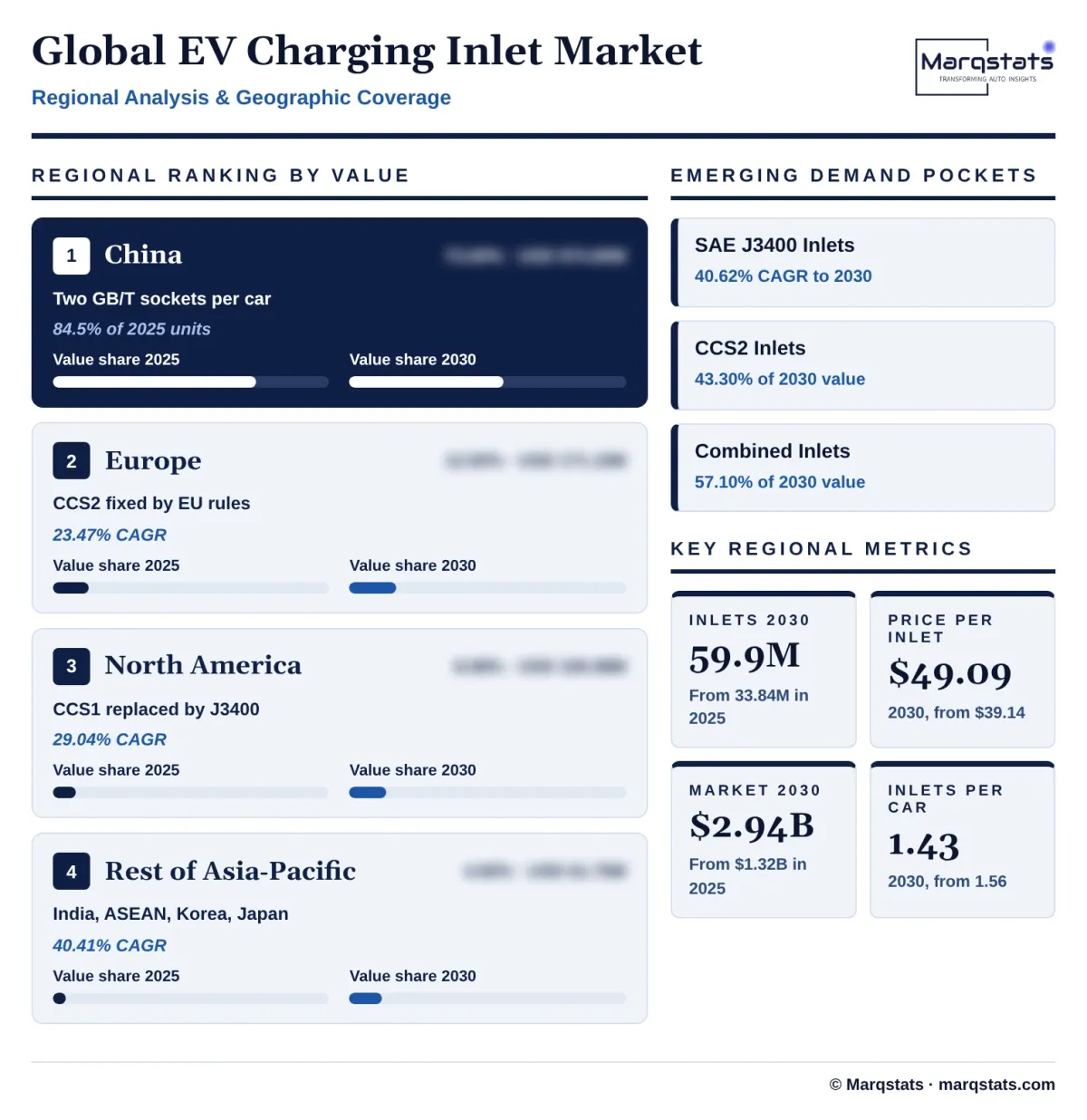
The global EV charging inlet market size is estimated at USD 1,324.40 million in 2025 and is projected to reach USD 2,940.30 million by 2030, growing at a CAGR of 17.29% over 2026 – 2030. Inlet shipments rise from about 33.84 million to 59.90 million units, a 12.10% annual rate, while the blended ex-factory price rises from about USD 39.14 to USD 49.09 per inlet.
Marqstats defines the market as the tier-1 ex-factory value of vehicle-side charging inlets fitted as original equipment to plug-in electric vehicles, covering battery electric and plug-in hybrid passenger cars, light commercial vehicles, trucks and buses. An inlet includes the moulded housing, AC and DC power contacts, signal pins, temperature sensors, the electric locking actuator and the rear cable or busbar termination. Off-board charging cables and plugs, charging stations, adapters, charge port doors and flaps, and high-voltage wiring behind the inlet are excluded.
Chinese GB/T and ChaoJi inlets account for an estimated 62.57% of 2025 value and combined AC/DC inlets for 35.32%. China accounts for 73.60% of 2025 value and Europe for 12.92%. The study segments the market by charging standard, inlet architecture, vehicle type and region.
Key Takeaways
Market Overview & Analysis
Report Summary
Marqstats sizes the EV charging inlet market as the ex-factory value of vehicle-side charging sockets fitted on the production line to plug-in electric vehicles. In 2025 about 21.75 million plug-in vehicles were built worldwide, fitted with about 33.84 million inlets worth an estimated USD 1,324.40 million, an average of 1.56 inlets per vehicle and USD 39.14 per inlet.
The inlet is the vehicle's half of the charging connection. It must carry up to several hundred amperes of direct current for 20 to 40 minutes at a time, survive 10,000 mating cycles, road salt, pressure washing and temperature swings from minus 40°C to above 85°C, lock the plug in place while current flows and report pin temperatures to the vehicle so charging can be slowed before plastics overheat. Carmakers validate inlets against connector durability tests such as LV 214, USCAR-21 and ISO 16750, which take 18 to 24 months before a new design enters production.
Regional standards decide the shape of the inlet. China requires separate inlets for AC charging under GB/T 20234.2 and DC charging under GB/T 20234.3. Europe uses the CCS2 combined inlet, which places three-phase AC pins above two DC pins in one housing under EN 62196-3. North America is moving from CCS1 to SAE J3400, which uses the same two large pins for AC and DC. Japan still uses CHAdeMO on some models, with a separate DC inlet.
Not every plug-in vehicle carries two inlets in China. Most Chinese battery electric vehicles and a growing share of plug-in hybrids and extended-range vehicles have both an AC and a DC socket, but low-cost mini cars and some entry plug-in hybrids are AC only. Marqstats estimates that 82% of Chinese-specification plug-in vehicles built in 2025 had both sockets, rising to 85% by 2030, and that about 2.03 million vehicles built in China for export were fitted with CCS2 inlets instead.
The market grew from about USD 373.64 million and 9.92 million inlets in 2021 to USD 602.55 million in 2022, USD 828.17 million in 2023 and USD 1,038.62 million and 26.57 million inlets in 2024, tracking plug-in vehicle production of 6.5 million, 10.2 million, 13.8 million and 17.1 million vehicles. Marqstats expects about 38.60 million inlets worth USD 1,571.20 million in 2026.
Regulation shapes inlet demand as much as vehicle sales do. The EU Alternative Fuels Infrastructure Regulation (EU) 2023/1804 fixes Type 2 and CCS2 as the standard connectors for public charging in Europe, SAE published J3400/2 in May 2025 to set dimensions, latching and temperature limits for J3400 inlets and connectors, and China's market regulator made China Compulsory Certification mandatory for EV charging equipment from 1 August 2026, tightening the safety regime around the charging connection even though vehicle inlets are approved with the vehicle.
Thermal design is the core engineering problem. Resistive heating at a contact rises with the square of current, so a DC pin with 0.2 milliohms of extra resistance after wear and oxidation generates about 50W of heat at 500A inside a plastic housing usually rated to 120°C to 150°C. Suppliers manage this with silver-based plating, multi-contact spring designs, temperature sensors placed within a few millimetres of the pins and heavy copper busbars that conduct heat away, which allows about 300A to 350A continuous without liquid cooling. Above about 500A continuous, inlets need a cold plate connected to the vehicle's cooling circuit, which adds 40% to 65% to the price.
Global EV Charging Inlet Market Size and Forecast
The global EV charging inlet market grows from USD 1,324.40 million in 2025 to USD 2,940.30 million in 2030, a CAGR of 17.29%. Marqstats expects about 43.90 million inlets worth USD 1,861.40 million in 2027, 49.40 million worth USD 2,191.80 million in 2028 and 54.60 million worth USD 2,552.60 million in 2029, before reaching 59.90 million inlets in 2030.
Value grows faster than volume because the mix moves to more expensive inlets. Marqstats estimates an AC-only inlet sells for about USD 21.50 in 2025, falling to USD 19.00 by 2030, a Chinese GB/T DC inlet for about USD 41.50, rising to USD 44.00 as ChaoJi and higher-current designs spread, and a combined AC/DC inlet for about USD 72.00, rising to USD 80.00. Heavy commercial inlets add about USD 48.00 million of value in 2025 and USD 153.00 million in 2030.
Inlets per vehicle fall from about 1.56 in 2025 to 1.43 in 2030. China's two-socket design keeps its own ratio near 1.82 to 1.85, but its share of plug-in vehicle production falls from about 76% to 62% as exports, Europe, North America, India and Southeast Asia grow, and almost all vehicles outside China use a single combined inlet.
Vehicle production is the main volume driver. The IEA reported that electric car sales topped 20 million in 2025, about a quarter of new car sales, and the China Association of Automobile Manufacturers reported 16.626 million new energy vehicles produced in China. Marqstats estimates global plug-in vehicle production, including commercial vehicles, at about 21.75 million in 2025 and expects 42.00 million in 2030.
Marqstats tracks four indicators to monitor the forecast: plug-in vehicle production by region and powertrain, the share of Chinese plug-in hybrids fitted with DC charging, the pace of J3400 conversion across North American and Japanese model lines, and the share of 800V vehicles charging above 400A continuous.
North American demand is less tied to retail sales than to tooling programmes. The US clean vehicle tax credits under Sections 30D and 45W ended on 30 September 2025, which slowed retail EV sales in the fourth quarter of 2025, but carmakers continued converting their 2026 and 2027 model year programmes to J3400 inlets, so inlet value in North America grows at 29.04% a year even as vehicle growth is slower than in Asia.
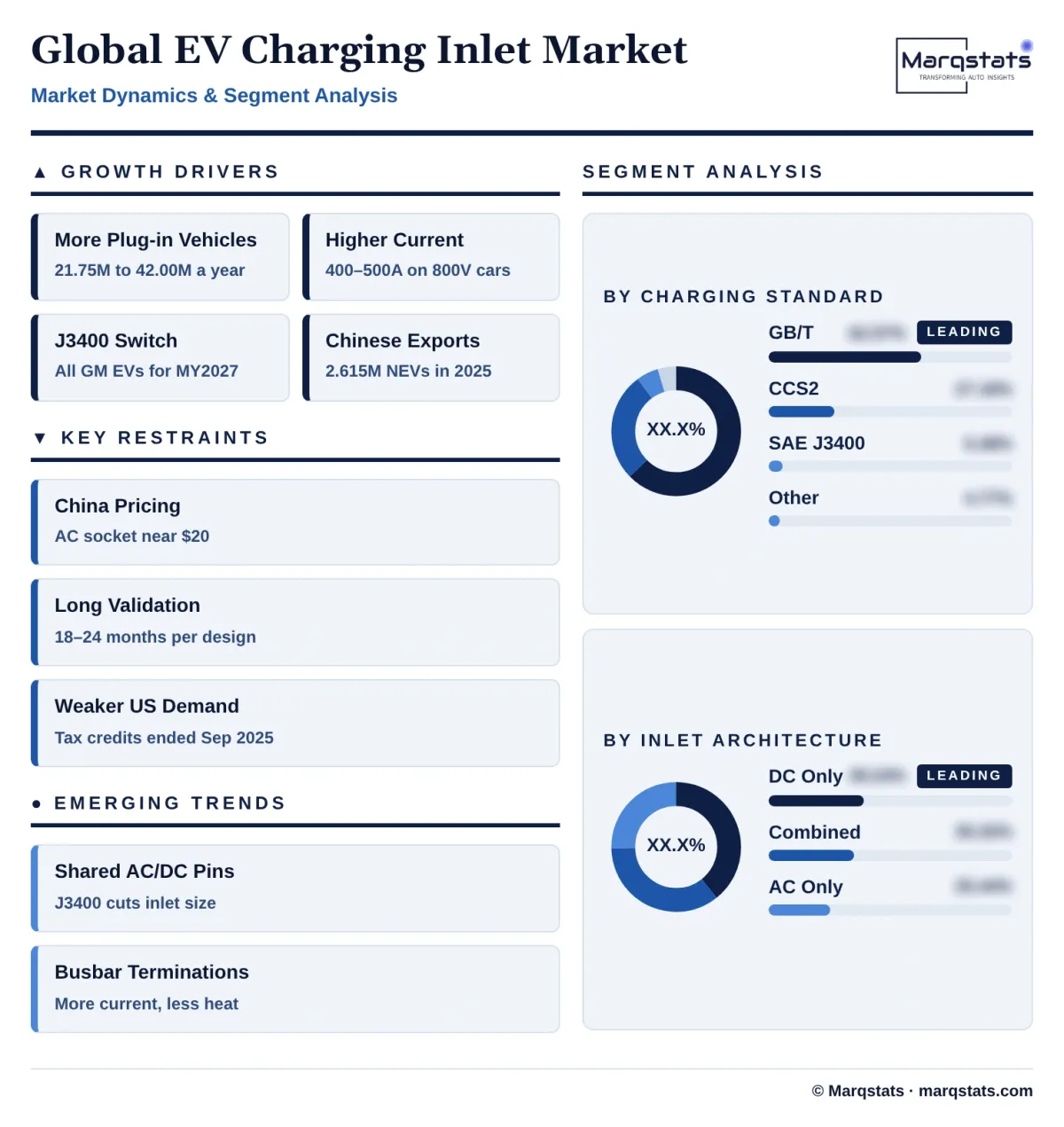
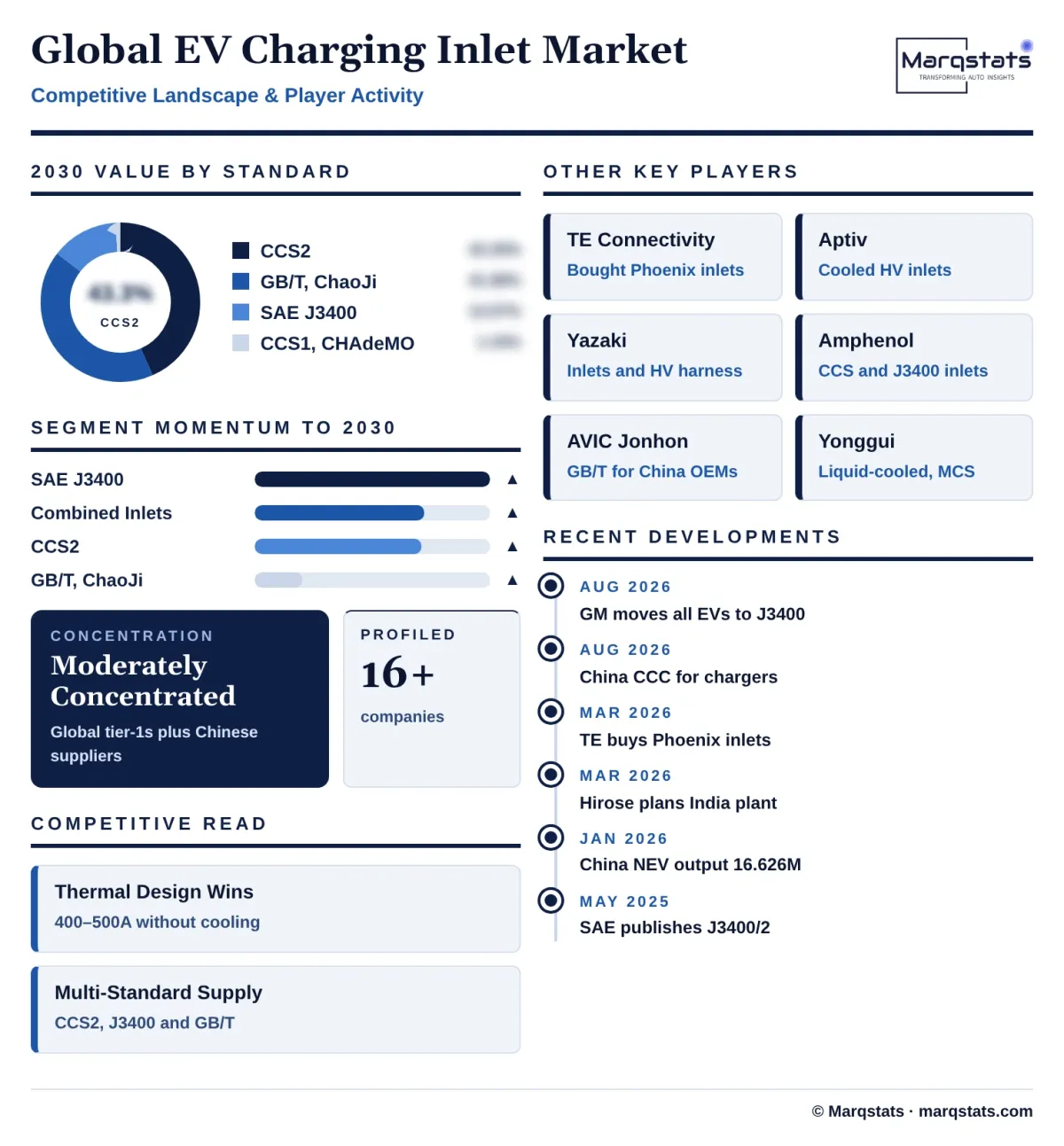
The mix of standards changes sharply over the forecast. GB/T and ChaoJi fall from 62.57% to 41.98% of value, CCS2 rises from 27.18% to 43.30%, J3400 from 5.48% to 13.57%, and CCS1 and CHAdeMO fall to a combined 1.15%. By architecture, combined AC/DC inlets rise from 35.32% to 57.10% of value, DC-only inlets fall from 39.24% to 28.49% and AC-only inlets from 25.44% to 14.41%.
Market Dynamics
Key Drivers
Five forces are lifting demand for vehicle-side charging inlets and the value of each inlet.
- Rising plug-in vehicle production. Every plug-in vehicle needs at least one inlet, and global plug-in production of about 21.75 million vehicles in 2025 rises to about 42.00 million by 2030.
- Higher charging power per inlet. 800V platforms charging at 400A to 500A need heavier contacts, extra temperature sensors and busbars, raising content per inlet.
- The switch to SAE J3400. North American carmakers are replacing CCS1 inlets with J3400 inlets, and GM confirmed native J3400 ports across all 12 of its electric models for model year 2027.
- Chinese exports. China exported 2.615 million new energy vehicles in 2025, most fitted with CCS2 inlets that cost more than domestic GB/T sockets.
- Electric trucks and buses. Megawatt Charging System and high-current CCS inlets for commercial vehicles sell for several times the price of a passenger car inlet.
- Higher plug-in hybrid DC fitment. A growing number of Chinese plug-in hybrids and extended-range vehicles add a DC socket to support fast charging of larger batteries, raising inlets per vehicle.
Key Restraints
Four constraints limit volume and pricing for charging inlet suppliers.
- Price pressure in China. Chinese carmakers buy GB/T inlets in very large volumes from domestic suppliers, keeping AC inlet prices near USD 20 and DC inlet prices near USD 40.
- Long validation cycles. New inlet designs need 18 to 24 months of durability and safety testing, limiting how quickly new suppliers can win programmes.
- Weaker US demand. The end of US clean vehicle tax credits on 30 September 2025 and the repeal of US vehicle greenhouse gas standards in February 2026 reduce the pace of North American EV adoption.
- Thermal limits. Contact wear and oxidation raise resistance over the inlet's life, and inlet housings limit how much current can be carried without active cooling.
- Standard changes strand tooling. The switch from CCS1 to J3400 in North America and from CHAdeMO in Japan leaves suppliers with tooling and validation costs on older designs that are being retired.
Key Trends
Four shifts are changing how charging inlets are designed, specified and bought.
- Shared AC and DC pins. J3400 uses the same two pins for AC and DC charging, cutting inlet size and mass but moving switching contactors into the battery junction box.
- Busbar terminations. Bolted copper busbars are replacing crimped cables behind DC pins, carrying more current and drawing heat away from the contacts.
- Smart inlets. Suppliers are adding charge control electronics, extra temperature sensors and diagnostics to the inlet housing.
- ChaoJi in China. GB/T 20234.4-2023 defines the ChaoJi DC interface for up to 1,500V and 600A, giving premium Chinese vehicles a smaller, higher-power DC inlet that can be adapted to existing chargers.
- Megawatt inlets for trucks. Electric heavy trucks are adopting Megawatt Charging System inlets alongside CCS, adding a high-current inlet with integrated cooling to the vehicle.
Strategic Implications
- For carmakers, a modular inlet mounting design lets one vehicle platform take J3400, CCS2 or GB/T inlets without changing the body or battery enclosure, simplifying exports.
- For inlet suppliers, thermal design is the main source of value. Inlets that carry 400A to 500A continuously without liquid cooling, using busbars and silver-based plating, will win 800V programmes.
- For harness makers, the inlet is becoming part of a high-voltage subsystem. Supplying the inlet, the pigtail or busbar and the junction box connection together simplifies validation for carmakers.
- For Chinese suppliers, exports are the growth opportunity. Suppliers that qualify CCS2 and J3400 inlets for Chinese export models can sell higher-priced inlets than GB/T sockets.
- For commercial vehicle makers, Megawatt Charging System inlets need early integration with battery cooling and vehicle structure, so inlet selection should be made at platform design stage.
- For investors, the shift from China's low-priced dual sockets to higher-priced combined inlets means market value can grow faster than vehicle production even as Chinese prices stay low, provided suppliers win export and North American programmes.
Market Segmentation
Chinese GB/T AC and DC inlets and ChaoJi DC inlets account for 62.57% of 2025 value, USD 828.64 million, and about 26.57 million inlets on 14.60 million Chinese-specification vehicles, rising to USD 1,234.40 million by 2030, an 8.30% CAGR, while their share falls to 41.98%. Low domestic prices and the gradual move of plug-in hybrids to DC charging shape the segment.
CCS2 combined inlets and Type 2 AC inlets account for 27.18% of 2025 value, USD 359.98 million, and grow at 28.74% a year to USD 1,273.00 million, the largest share of 2030 value at 43.30%. European production, Chinese exports and new EV production in India, Southeast Asia and Latin America drive growth.
J3400 inlets account for 5.48% of 2025 value, USD 72.56 million, and grow fastest, at 40.62% a year, to USD 399.00 million and 13.57% of 2030 value as North American carmakers complete the switch from CCS1.
CCS1 and J1772 inlets account for 4.12% of 2025 value, USD 54.58 million, and fall at 11.40% a year to USD 29.80 million by 2030, remaining mainly on South Korean domestic models.
CHAdeMO DC inlets and Japanese Type 1 AC inlets account for 0.65% of 2025 value, USD 8.64 million, and fall at 13.85% a year to USD 4.10 million as Japanese carmakers move to CCS2 and J3400.
Single-housing inlets for both AC and DC charging account for 35.32% of 2025 value, USD 467.76 million and 6.08 million units, and grow at 29.12% a year to USD 1,679.00 million and 57.10% of 2030 value.
Separate DC inlets, mainly Chinese GB/T and ChaoJi sockets, account for 39.24% of 2025 value, USD 519.74 million and 12.09 million units, and grow at 10.01% a year to USD 837.60 million.
Separate AC inlets, including the AC socket on dual-port Chinese vehicles and the only inlet on many plug-in hybrids, account for 25.44% of 2025 value, USD 336.90 million and 15.67 million units, and grow at 4.69% a year to USD 423.70 million as prices fall.
Battery electric cars account for 67.39% of 2025 value, USD 892.50 million, and grow at 16.35% a year to USD 1,903.00 million by 2030.
Plug-in hybrid and extended-range cars account for 23.95% of 2025 value, USD 317.20 million, and grow at 18.73% a year to USD 748.30 million as more Chinese models add DC charging.
Electric vans, trucks and buses account for 8.66% of 2025 value, USD 114.70 million, and grow fastest, at 20.30% a year, to USD 289.00 million as high-current and Megawatt Charging System inlets spread.
By Geography
China
China is the largest market, with 73.60% of 2025 value, USD 974.80 million, from about 16.63 million plug-in vehicles and 28.60 million inlets, rising to USD 1,634.40 million by 2030, a 10.89% CAGR, while its share falls to 55.59%. Value per vehicle is low because domestic GB/T sockets are cheap, but exports fitted with CCS2 inlets, about 2.03 million vehicles in 2025 and 5.0 million by 2030, lift the average.
Europe
Europe accounts for 12.92% of 2025 value, USD 171.15 million, from about 2.45 million plug-in vehicles, and grows at 23.47% a year to USD 491.20 million by 2030. CCS2 is fixed by regulation, so suppliers compete on thermal performance, integration and price rather than on standards, and electric trucks add Megawatt Charging System inlets.
North America
North America accounts for 8.08% of 2025 value, USD 106.98 million, from about 1.55 million plug-in vehicles, and grows at 29.04% a year to USD 382.80 million by 2030 as J3400 replaces CCS1. The end of federal clean vehicle tax credits in September 2025 slowed retail demand, but carmaker tooling programmes for J3400 continued.
Rest of Asia-Pacific
The rest of Asia-Pacific accounts for 4.66% of 2025 value, USD 61.75 million, and grows at 40.41% a year to USD 336.95 million by 2030, led by new EV production in India, Thailand, Indonesia and South Korea and Japan's move from CHAdeMO toward CCS2 and J3400.
Rest of World
Latin America, the Middle East and Africa account for 0.74% of 2025 value, USD 9.72 million, and grow fastest, at 57.75% a year, to USD 94.95 million by 2030 as local assembly of electric vehicles begins in Brazil, Mexico, Turkey and the Gulf.
How Competition Is Evolving
The EV charging inlet market is moderately concentrated. Outside China, a small group of global connector and harness suppliers led by TE Connectivity, Aptiv, Yazaki, Sumitomo Wiring Systems and Amphenol supply most combined AC/DC inlets, while Chinese suppliers such as AVIC Jonhon and Yonggui supply large volumes of GB/T inlets to domestic carmakers. BYD and Tesla make some charging components in house.
Consolidation is under way. TE Connectivity finalised an asset deal for Phoenix Contact E-Mobility's charging inlet business in March 2026; Phoenix Contact keeps charging cables and plugs and its subsidiary withdraws from supplying carmakers. The deal shows that inlets, which follow automotive qualification rules, and charging cables, which follow infrastructure rules, are separating into different businesses.
Competition is decided by validated designs for several standards, thermal performance and global production. Suppliers that can deliver CCS2, J3400 and GB/T inlets from plants in China, Europe, Mexico and India and prove 400A to 500A continuous ratings without active cooling win the largest programmes.
Asian suppliers are expanding. Hirose Electric announced an INR 1 billion connector plant in Tamil Nadu in March 2026 for automotive and EV applications, and Chinese suppliers are qualifying CCS2 and J3400 inlets for export models and for foreign carmakers' plants in China.
Prices differ widely by region. A Chinese GB/T AC socket sells for about USD 20, a combined CCS2 inlet with motorised lock and temperature sensors for USD 70 to 75, an actively cooled high-current inlet for USD 100 to 125, and a Megawatt Charging System inlet for USD 180 to 350.
Liquid-cooled and megawatt designs are the next frontier. Aptiv offers actively cooled high-voltage inlets, HUBER+SUHNER supplies high-power charging connection systems, and Yonggui presented a liquid-cooled connector and vehicle inlet system compatible with CCS, J3400 and the Megawatt Charging System in November 2025. These designs carry far higher prices and are first used on premium cars, electric trucks and buses.
Companies Covered
Companies covered in the report include:
Recent Market Activity
Table of Contents
Coverage & Segmentation
The study covers the global EV charging inlet market, with 2025 as the base year, 2021 – 2025 as the historical period and 2026 – 2030 as the forecast period. Values are in US dollars at tier-1 ex-factory prices paid by carmakers, and volumes are inlets fitted to new plug-in vehicles. The market is segmented by charging standard, inlet architecture, vehicle type and region, with regions defined by where the vehicle is built.
Off-board charging cables, plugs and charging guns, charging stations, adapters, charge port doors and flaps, high-voltage wiring and busbars beyond the inlet termination, and two- and three-wheeler charging sockets are excluded. Charging station and Megawatt Charging System infrastructure markets are covered in separate Marqstats reports and should not be added to this market. Segment and regional splits, inlets per vehicle and prices are Marqstats estimates built on vehicle production data, standards and supplier price benchmarks.