Market Snapshot
Middle bar: base-year value × (1 + CAGR), rounded to two decimals. This is a calculated illustration, not a separately researched annual estimate.
The global EV brake corrosion repair market size is estimated at USD 1,769.00 million in 2025 and is projected to reach USD 7,639.50 million by 2030, growing at a CAGR of 33.99% over 2026 – 2030. Annual service interventions rise from about 7.22 million to 27.78 million, a 30.93% annual rate, while the average ticket rises from about USD 245 to USD 275 per job.
Marqstats defines the market as workshop revenue from reconditioning brake systems on battery electric cars, plug-in hybrids and electric light commercial vehicles that have corroded, pitted, glazed or seized through underuse. It covers on-car rotor skimming and resurfacing, pad de-glazing and galvanized pad fitment, caliper guide-pin and parking brake actuator rebuilds, and anti-corrosion coatings, including parts fitted during these jobs. Sales of new replacement rotors in scrap-and-replace jobs, an adjacent hardware market of about USD 3,450.00 million in 2025, routine pad replacement for wear, brake fluid changes and brake work on combustion vehicles are excluded.
On-car rotor skimming accounts for 39.00% of 2025 value, battery electric vehicles for 67.00% and independent workshops for 62.00%. Europe accounts for 48.00% of 2025 value and North America for 27.00%. The study segments the market by service type, powertrain, workshop channel and region.
Key Takeaways
Market Overview & Analysis
Report Summary
Marqstats sizes the EV brake corrosion repair market as the revenue workshops earn from restoring brakes on electrified vehicles that have deteriorated through lack of use rather than wear. In 2025 about 7.22 million such interventions were carried out worldwide, worth an estimated USD 1,769.00 million at an average ticket of about USD 245.
On a combustion car, the friction brakes do all the work of slowing the vehicle. Every stop heats the discs, which dries off moisture, burns away road salt and scrubs off the thin layer of rust that forms overnight, so the disc surface stays bright and smooth. On an electric car, the motor works as a generator when the driver lifts off the accelerator, feeding energy back into the battery. In normal and one-pedal driving, regenerative braking handles most everyday slowing, and the hydraulic brakes engage mainly in hard stops, at very low speeds or when the battery is full and cannot accept more charge.
Because the discs are still made of grey cast iron, which is cheap and conducts heat well, they rust when they are not used. Moisture and de-icing salt sit on the cold disc faces and between the pad and disc. Over months, surface rust turns into thicker scale and pits, the contact pattern between pad and disc narrows, guide pins in single-piston floating calipers seize in their brackets, and moisture rusts the steel backing plates of conventional pads, which can lift the friction material off the plate. The result is uneven braking force, noise, pedal pulsation and failed roadworthiness tests, often on cars with plenty of pad material left.
Periodic inspections turn these problems into paid repairs. Under EU Directive 2014/45/EU, inspectors check the condition of discs and measure braking force at each wheel on a roller tester. Heavy corrosion of the swept area or a large imbalance between wheels on one axle is recorded as a significant defect, and the car must be repaired and presented again. The TÜV Report 2026, published in November 2025, ranked the Tesla Model Y last of 110 models in the two-to-three-year age group with a significant defect rate of 17.3%, the highest in that age group in ten years, and the Tesla Model 3 third from last at 13.1%. Brake discs were among the defects listed for the Model Y, and the TÜV association advised electric car drivers to brake firmly from time to time.
The market grew from an estimated USD 240.80 million in 2021, when about 1.12 million interventions were carried out on a fleet of about 16.5 million electric vehicles, to USD 754.40 million in 2023 and USD 1,228.08 million in 2024, a 64.63% CAGR over 2021 – 2025, as the first large cohorts of electric cars reached their first inspections. Marqstats expects about 9.56 million interventions worth USD 2,425.00 million in 2026.
Global EV Brake Corrosion Repair Market Size and Forecast
The global EV brake corrosion repair market grows from USD 1,769.00 million in 2025 to USD 7,639.50 million in 2030, a CAGR of 33.99%. Marqstats expects the market to reach USD 2,425.00 million in 2026, about USD 3,230.73 million in 2027, USD 4,304.16 million in 2028 and USD 5,734.25 million in 2029, with annual interventions of about 12.48 million in 2027, 16.30 million in 2028 and 21.28 million in 2029.
The forecast is built from the fleet. Marqstats estimates the global fleet of battery electric cars, plug-in hybrids and electric vans at about 76 million vehicles at the end of 2025, consistent with electric car sales of more than 20 million in 2025 reported by the International Energy Agency, and projects 248 million by 2030, a 26.69% annual rate. The share of the fleet needing a corrosion repair each year rises from 9.5% to 11.2% as more vehicles pass the age of three, when first inspections and the first serious corrosion appear.
The average ticket rises slowly. Marqstats estimates the average revenue per intervention at about USD 245 in 2025, rising to USD 275 in 2030, a 2.34% annual rate. Labour rates rise, and more jobs include galvanized pads and coatings, but competition from independent workshops and the shift from replacement to skimming keep prices in check.
Repairs fall into three cost tiers. Marqstats estimates a basic clean, de-glaze and slide-pin lubrication at USD 160 to 220 in an independent garage and USD 320 to 450 at a dealer. Single-axle skimming with new galvanized pads costs USD 280 to 380 independent and USD 550 to 750 at a dealer. A full axle job including caliper rebuild and coatings costs USD 480 to 680 independent and USD 850 to 1,300 at a dealer. Full disc and pad replacement at a dealer costs USD 850 to 1,300 per axle, against USD 180 to 300 for on-car skimming, a saving of more than 65% when the disc is still above its minimum thickness.
Growth depends on climate and inspections as much as on fleet size. Electric cars in dry regions without periodic inspections, such as California and Arizona, rarely need corrosion repair, while those in salt-belt regions with annual or biennial inspections, such as Germany, Scandinavia, the UK, Pennsylvania, New York and Ontario, need it regularly. Marqstats tracks four indicators to monitor the forecast: electric vehicle fleet age by region, inspection failure rates for brake items, the share of new models with enclosed rear drum brakes or coated discs, and on-car lathe installations in workshops.
Market Dynamics
Key Drivers
Five forces are turning brake corrosion into the main brake service need on electric vehicles.
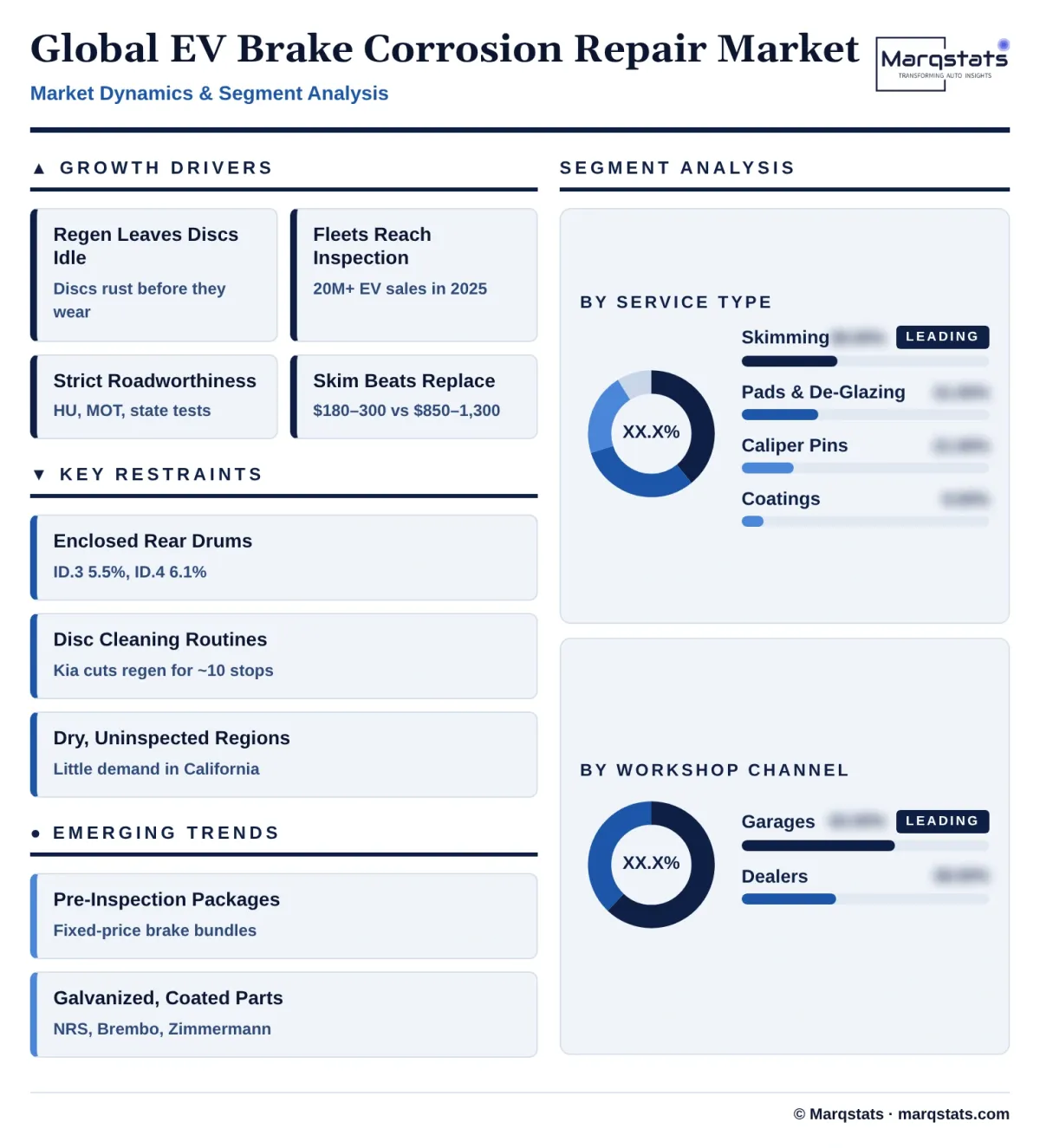
- Regenerative braking leaves discs unused. Electric vehicles slow mainly through the motor, so cast-iron discs stay cold and wet, rust forms, and pads and caliper pins seize long before they wear out.
- Electric fleets reach inspection age. Electric car sales passed 20 million in 2025, and the large cohorts sold in 2021 to 2023 are now reaching first and second periodic inspections, where corroded discs and uneven braking force cause failures.
- Strict roadworthiness testing. EU Directive 2014/45/EU, the UK MOT, German HU and state inspections in Pennsylvania, New York and other jurisdictions check disc condition and braking balance, forcing repairs before a vehicle can pass.
- Repair is far cheaper than replacement. On-car skimming at about USD 180 to 300 per axle costs a fraction of dealer replacement at USD 850 to 1,300, so out-of-warranty owners, leasing companies and fleets choose reconditioning when the disc thickness allows.
- Road salt and coastal humidity. De-icing salt in Northern Europe, Canada and the northern United States and salt spray in coastal regions speed up rust on cold discs, creating spring peaks in repair demand ahead of inspections.
Key Restraints
Four constraints limit how fast EV brake corrosion repair revenue can grow.
- Enclosed drum brakes on new models. Volkswagen MEB models such as the ID.3, ID.4 and Audi Q4 e-tron use sealed rear drum brakes, and these models record lower inspection defect rates, reducing rear-axle corrosion work on part of the fleet.
- Carmaker software routines. Kia owner manuals describe a Brake Disc Cleaning function that limits regenerative braking for about ten stops so the friction brakes clean off surface rust, and similar routines reduce light corrosion before it becomes a defect.
- Discs below minimum thickness must be replaced. Discs with deep pits can only be skimmed if enough material remains, so a share of jobs moves to the excluded replacement hardware market.
- Low corrosion in dry, uninspected regions. Large electric vehicle markets such as California, where annual safety inspections are not required for passenger cars, generate little corrosion repair demand.
Key Trends
Four shifts are changing how workshops, suppliers and carmakers deal with corroded EV brakes.
- Fixed-price pre-inspection packages. Independent garages and fast-fit chains sell bundled EV brake services, combining skimming, cleaning, slide-pin lubrication and a bedding-in drive, timed before periodic inspections.
- Galvanized and coated parts. NRS Brakes sells galvanized pads for Tesla, Kia and Hyundai models, Brembo shows an EV KIT aimed at corrosion resistance and noise reduction, and Otto Zimmermann is developing carbide-coated discs for Euro 7.
- Driver education. The TÜV association and UK fleet advisers recommend that electric car drivers brake firmly from time to time to keep discs clean, and leasing companies add brake checks to EV service schedules.
- Brake particle limits. Euro 7 limits brake particle emissions from November 2026 for new types, pushing suppliers toward copper-free pads, coated discs and smoother friction surfaces.
Strategic Implications
- For independent workshops, on-car lathes pay back quickly. Marqstats estimates a computerized on-car lathe costs about USD 10,000 to 19,500 and pays for itself in 8 to 12 months for a workshop handling three to four electric vehicles a week at USD 200 to 250 per axle.
- For dealers, routine replacement of lightly corroded discs drives customers away. Offering approved skimming as an alternative keeps out-of-warranty electric vehicle owners in the dealer network and protects service revenue.
- For friction and parts suppliers, corrosion resistance is now a selling point. Galvanized backing plates with mechanical retention, coated discs and copper-free compounds suited to infrequent, low-temperature braking match how electric vehicles actually use their brakes.
- For fleet and leasing companies, preventive care lowers costs. Regular firm braking, scheduled cleaning cycles and coatings in salt-belt regions cut inspection failures and vehicle downtime at lease return.
- For carmakers, brake design affects reputation. Inspection rankings published each year show which models fail most often, and enclosed drums, coated discs and automatic cleaning routines can lift a model in these rankings.
Market Segmentation
On-car rotor skimming and resurfacing accounts for 39.00% of 2025 value, USD 689.91 million, and grows at 35.34% a year to USD 3,132.20 million and 41.00% of the market by 2030. A lathe mounted on the wheel hub machines the disc true to the hub, removes rust scale and grooves and restores a flat, parallel surface without taking the disc off the car, avoiding the runout errors that can follow bench machining and refitting.
Pad de-glazing and galvanized pad fitment accounts for 31.00% of 2025 value, USD 548.39 million, and grows at 32.21% a year to USD 2,215.46 million and 29.00% by 2030. Jobs include removing glazed layers from pads that have been used only lightly, and replacing pads whose painted steel backing plates have rusted with galvanized pads designed for electric vehicles.
Caliper guide-pin and parking brake rebuilds account for 21.00% of 2025 value, USD 371.49 million, and grow at 32.69% a year to USD 1,527.90 million and 20.00% by 2030. Technicians remove seized slide pins, clean and hone the bores, fit new boots and lubricant, and service electronic parking brake actuators, fixing the binding brakes that UK inspection data identifies as a common EV brake failure.
Anti-corrosion coatings account for 9.00% of 2025 value, USD 159.21 million, and grow fastest, at 36.84% a year, to USD 763.95 million and 10.00% by 2030. High-temperature zinc-flake and ceramic barrier coatings protect disc hats, edges and caliper brackets from de-icing salt, and are sold mainly to fleets and owners in salt-belt and coastal regions.
Battery electric vehicles account for 67.00% of 2025 value, USD 1,185.23 million, and grow at 35.93% a year to USD 5,500.44 million and 72.00% by 2030. One-pedal driving and high regenerative braking leave their friction brakes idle for long periods, making them the main source of disc corrosion failures.
Plug-in hybrids account for 23.00% of 2025 value, USD 406.87 million, and grow at 27.58% a year to USD 1,375.11 million and 18.00% by 2030. Their smaller batteries reach charge limits sooner, so friction brakes are used more often than on battery electric cars, which reduces but does not remove corrosion.
Electric vans account for 10.00% of 2025 value, USD 176.90 million, and grow at 33.99% a year to USD 763.95 million by 2030, keeping a 10.00% share. Stop-start delivery work uses the friction brakes more, but depot washing, road salt and long parking periods cause slide-pin and parking brake seizure.
Independent garages and fast-fit chains account for 62.00% of 2025 value, USD 1,096.78 million, and grow at 36.49% a year to USD 5,194.86 million and 68.00% by 2030. They have invested in on-car lathes and sell skimming at lower labour rates to owners whose vehicles are out of warranty.
Franchised dealers account for 38.00% of 2025 value, USD 672.22 million, and grow at 29.46% a year to USD 2,444.64 million, while their share falls to 32.00% by 2030. Dealers have tended to replace discs and pads rather than resurface them, but customer resistance to large bills is pushing more of them to offer skimming.
By Geography
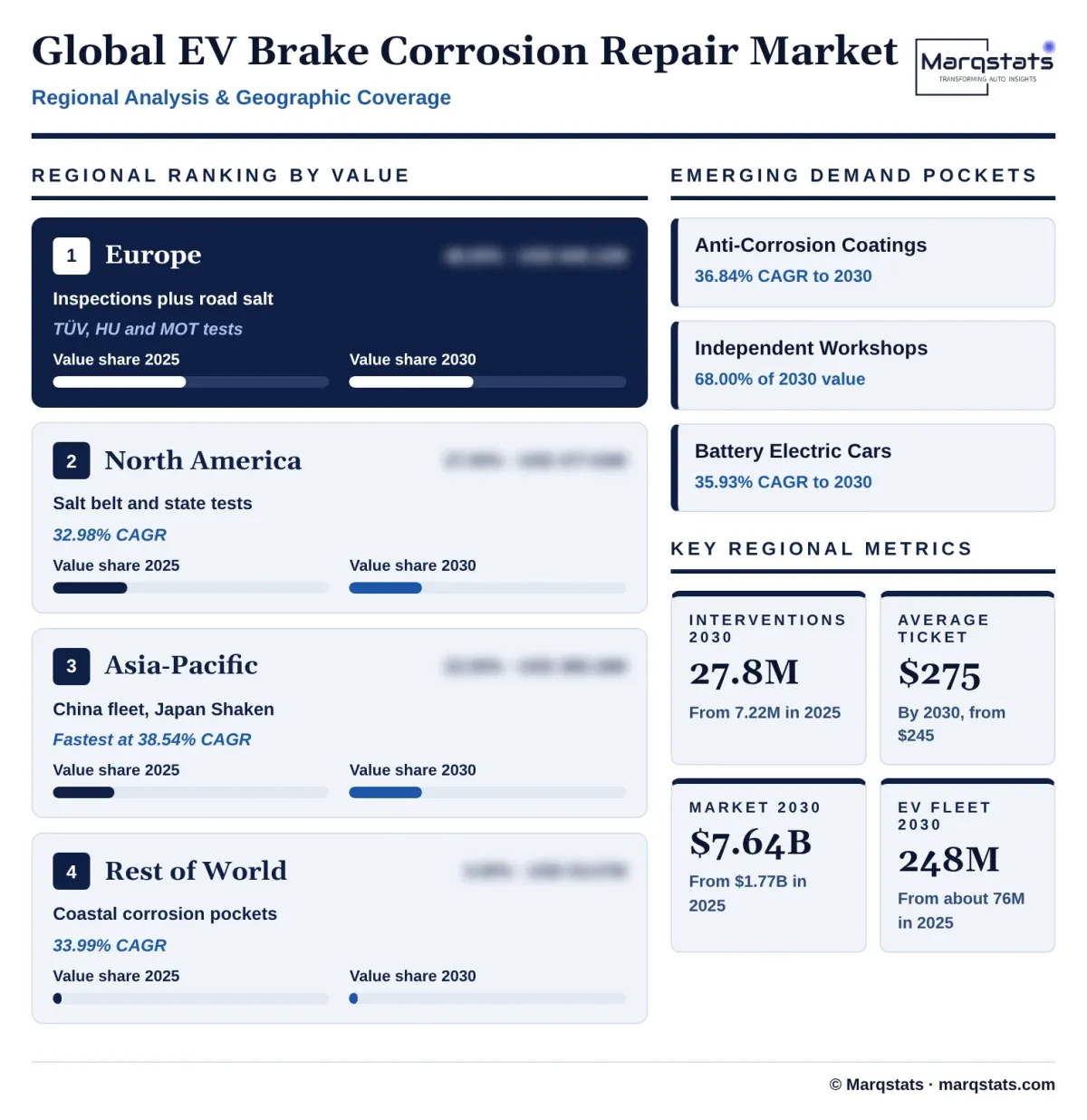
Europe
Europe is the largest market, with 48.00% of 2025 value, USD 849.12 million, rising to an estimated USD 3,437.78 million by 2030, a 32.27% CAGR, while its share eases to 45.00%. High electric vehicle adoption in Norway, Germany, the UK, Sweden and the Netherlands, mandatory periodic testing under EU Directive 2014/45/EU, the German HU and the UK MOT, and heavy use of road salt from November to March create a spring peak in repairs ahead of inspections. The TÜV Report 2026 put the Tesla Model Y and Model 3 at the bottom of the two-to-three-year rankings.
North America
North America accounts for 27.00% of 2025 value, USD 477.63 million, and grows at an estimated 32.98% a year to USD 1,986.27 million and 26.00% of the market by 2030. Demand is concentrated in the salt belt of New England, the Great Lakes and Canada, and in jurisdictions with regular safety inspections such as Pennsylvania, New York, Ontario and Quebec, while dry states such as California, Arizona and Nevada generate little corrosion work despite their large electric fleets.
Asia-Pacific
Asia-Pacific accounts for 22.00% of 2025 value, USD 389.18 million, and grows fastest, at an estimated 38.54% a year, to USD 1,986.27 million and 26.00% of the market by 2030. China has the largest electric car fleet in the world and periodic safety testing under GB 38900-2020, with the coldest corrosion conditions in its northern provinces, and Japan applies the Shaken inspection system, with salt exposure along its Sea of Japan coast.
Rest of World
The rest of the world accounts for 3.00% of 2025 value, USD 53.07 million, and grows at an estimated 33.99% a year to USD 229.18 million by 2030, keeping a 3.00% share. Electric fleets are still small, inspection rules vary and corrosion is concentrated in coastal cities in South America, the Middle East and Africa.
How Competition Is Evolving
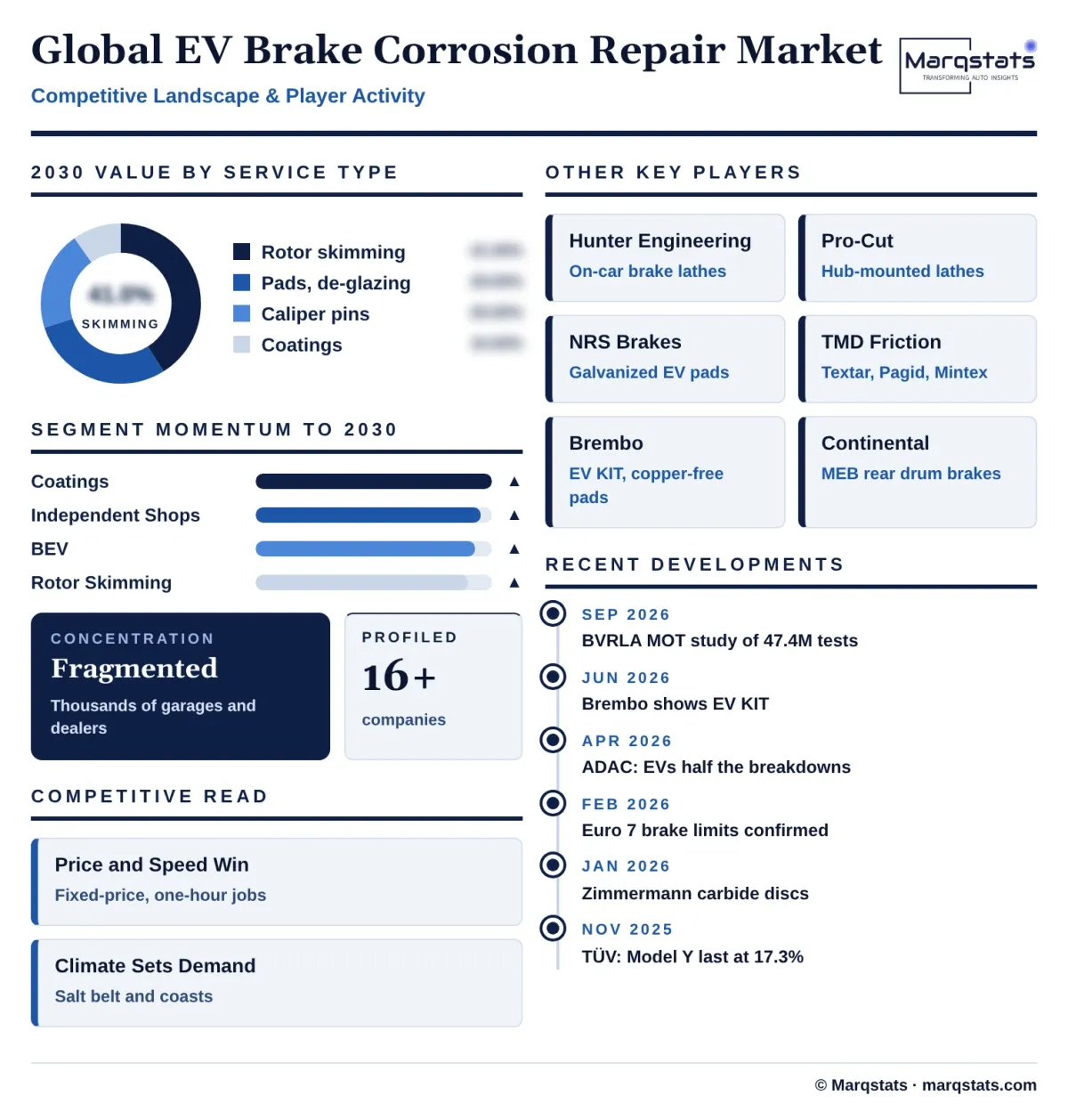
The EV brake corrosion repair market is fragmented. Service revenue is earned by tens of thousands of independent garages, fast-fit chains such as Kwik Fit and Halfords in the UK, and franchised dealers, none of which holds a large share of global revenue.
Suppliers shape how the work is done. Hunter Engineering and Pro-Cut International supply most on-car lathes, NRS Brakes, TMD Friction with Textar, Pagid and Mintex, Brembo, Bosch, ZF and Akebono supply pads and discs, Tenneco supplies Wagner calipers and hardware, and Würth and Henkel supply lubricants, cleaners and protective coatings.
Carmakers influence the size of the market. Volkswagen uses enclosed rear drum brakes developed with Continental on its MEB models, Kia provides a disc cleaning function, and Tesla runs its own service centres, so each brand creates a different mix of repair needs.
Competition will be decided by price, speed and trust. Workshops that can skim a disc and rebuild slide pins in about an hour at a fixed price, and explain why replacement is not needed, will win repeat business from owners and fleets.
Companies Covered
Companies covered in the report include:
Recent Market Activity
Table of Contents
Coverage & Segmentation
The study covers the global EV brake corrosion repair market, with 2025 as the base year, 2021 – 2025 as the historical period and 2026 – 2030 as the forecast period. Values are in US dollars at workshop prices, including parts fitted during reconditioning jobs, and volumes are annual service interventions. The market is segmented by service type, powertrain, workshop channel and region.
New replacement rotors sold in scrap-and-replace jobs, routine pad replacement for wear, brake fluid service, brake work on combustion vehicles and brake parts sold to do-it-yourself buyers are excluded. Segment splits, 2030 regional values and the intervention and ticket forecasts are Marqstats estimates built on electric fleet data, inspection results, workshop price surveys and supplier disclosures.