Market Snapshot
Key Takeaways
Market Overview & Analysis
Report Summary
The electric vehicle battery repair and remanufacturing market comprises the organized service ecosystem that extends the first automotive life of high-voltage traction batteries through diagnosis, component repair, module replacement, refurbishment, and OEM-grade remanufacturing. The 2025 market of USD 3.10 billion is sized on the core service definition — diagnostics, labour, replacement modules and components, repair, refurbishment, remanufacturing service, and post-repair testing — distinct from the sale of new replacement packs, recycling, and second-life applications, whose inclusion would materially inflate the estimate and obscure repair economics. Passenger cars form the primary market, with light-commercial, truck, bus, and two- and three-wheeler batteries as adjacent segments with different economics.
The demand foundation is the electric vehicle parc rather than annual battery production. Global electric-car sales rose about 20% to more than 20 million units in 2025, with China selling more than 13 million, Europe about 4.2 million, and the United States around 1.5 million. Battery demand deployed in electric vehicles reached about 1.2 TWh in 2025, nearly 30% higher than 2024 and more than seven times the 2020 level, with light-duty vehicles representing more than 85% of deployment. Every year of sales adds a cumulative cohort that may later experience warranty defects, collision or underbody damage, water intrusion, cooling-system failure, battery-management or contactor failure, module imbalance, or economic total-loss decisions, so the addressable repair pool expands even when annual sales slow.
Battery durability reshapes how the market must be sized. Independent telematics analysis of more than 22,700 electric vehicles across 21 makes and models found average degradation of about 2.3% annually, concluding that modern batteries generally outlast typical vehicle ownership. The market should therefore not assume that every eight- or ten-year-old vehicle needs a complete remanufactured pack. In many cases the cells remain usable while another component fails — battery-management electronics, cooling pumps and valves, sensors, high-voltage contactors, pyrotechnic fuses, busbars, seals, or a small number of modules. The United States Department of Energy's circular-battery programme specifically identifies battery-management units and cooling pumps as components that fail earlier than cells, funding rapid diagnostics, reversible pack assembly, and robotic disassembly.
Repair economics favour intervention over replacement for many vehicles. For an older electric vehicle, a new original-equipment battery may represent a substantial proportion of resale value, so repairing a failed electronic or thermal component or replacing a limited number of modules can preserve the vehicle at a fraction of the cost and material requirement of a full pack. The opportunity is strongest where the vehicle remains mechanically sound, replacement packs are expensive or unavailable, the failure is isolated, the vehicle is used commercially, downtime is costly, or an insurer would otherwise declare a total loss. Repairing and refurbishing used electric vehicles currently offers better economic returns than immediate dismantling, retaining value through first-life extension. Average battery prices fell about 8% in 2025, with Chinese packs around 30% cheaper than in North America and 35% cheaper than in Europe, so remanufacturing economics vary sharply by region and repair costs must remain well below replacement to stay attractive.
Service demand divides into distinct repair events with different frequency and value. Diagnostic-only assessments are high-frequency and low-ticket; electronic, thermal, mechanical, and module-level repairs are medium-frequency and medium-ticket; and pack refurbishment and full remanufacturing are lower-frequency and high-ticket, with a complete remanufactured pack sale carrying the highest value. Across the forecast period, diagnostics, component repair, and module-level repair account for the majority of service events, while complete remanufacturing contributes disproportionate revenue per transaction. Under the EU Battery Regulation, remanufacturing requires restoration to at least 90% of original rated capacity with state-of-health variation among cells limited to three percentage points, and a remanufactured battery is treated as newly placed on the market with a renewed warranty.
Market Dynamics
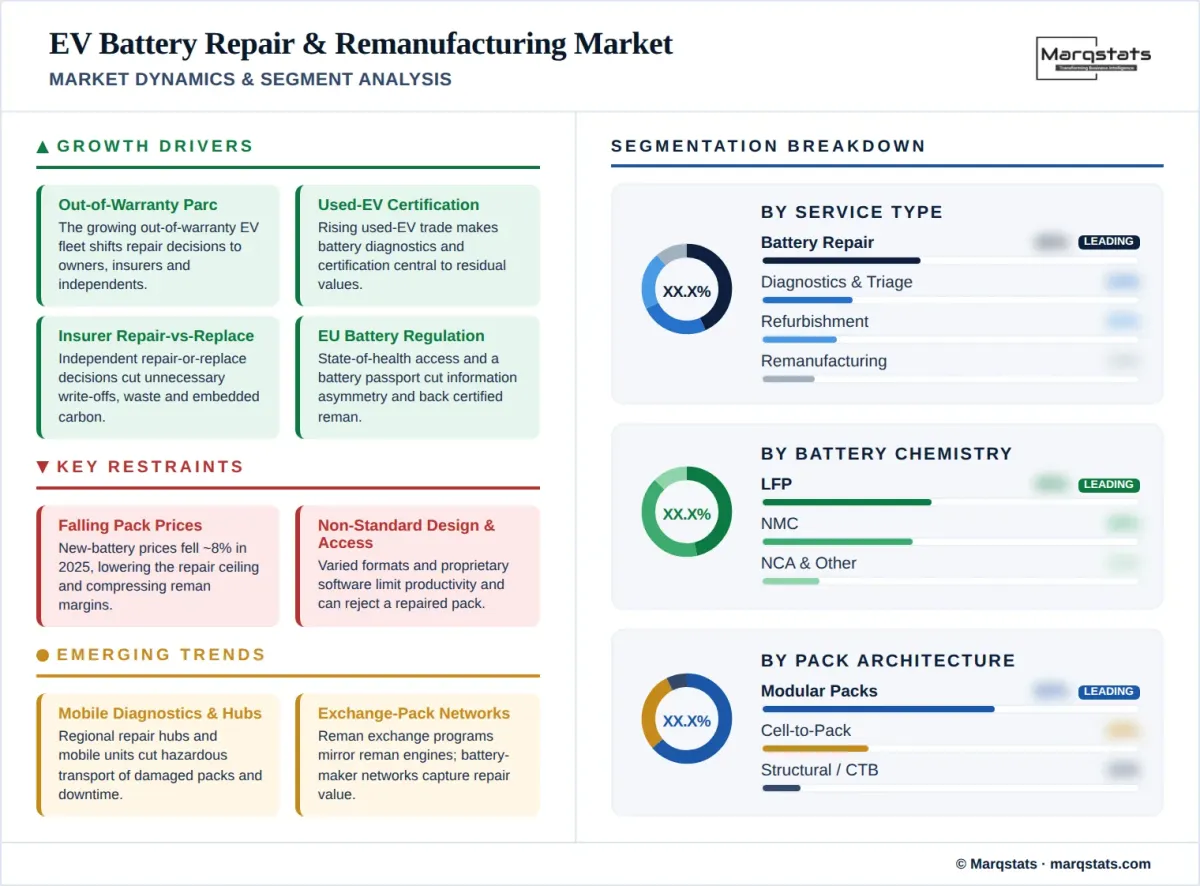
Key Drivers
- The growing out-of-warranty electric vehicle parc transfers repair decisions from warranty departments to owners, independent repairers, insurers, and used-car operators.
- Rising used-EV transactions make battery diagnostics and certification central to residual values, lease returns, auction conversion, and cross-border resale.
- Insurer demand for independent repair-versus-replace decisions reduces unnecessary write-offs, material waste, and embedded-carbon loss.
- OEM circular-economy strategies convert remanufacturing into a formal aftersales business rather than solely an environmental programme.
- European battery regulation provides state-of-health access and a battery passport, reducing information asymmetry and supporting certified remanufacturing.
- Fleet uptime requirements drive regional repair centres, exchange packs, and mobile diagnostics that reduce vehicle downtime.
Key Restraints
- Declining new-battery prices, down about 8% in 2025, lower the economic ceiling for repair and compress remanufacturing margins against replacement.
- Non-standardized battery design across cell formats, chemistries, cooling, adhesives, and software limits technician productivity and scale economies.
- Limited availability of matched replacement modules by chemistry, capacity, resistance, and state of health raises imbalance and safety risk.
- Proprietary software, component pairing, and cybersecurity can cause a vehicle to reject a physically repaired battery without authorized access.
Key Trends
- Mobile diagnostic units and regional repair hubs reduce hazardous-goods transport of damaged batteries and cut downtime and dealer dependence.
- Exchange remanufactured-pack programmes emerge, mirroring remanufactured engines by supplying a pack while retaining the customer core.
- Battery-manufacturer service networks expand, capturing value in integrated cell-to-pack designs through proprietary repair procedures.
- Recurring service models grow through periodic state-of-health testing, remote monitoring, predictive maintenance, and used-EV certification.
Market Segmentation
Battery diagnostics and triage is the highest-frequency and lowest-ticket service, spanning state-of-health and remaining-useful-life assessment, cell- and module-level voltage analysis, insulation-resistance testing, battery-management diagnostic-code analysis, thermal imaging, cooling-system leak testing, and repair-versus-replace decision support. As the entry point to every intervention and a standalone service for used-EV certification and insurer assessment, diagnostics generates the most service events and anchors recurring revenue through periodic testing and battery-health scoring.
Battery repair is the largest segment by service events and value in the near term, covering battery-management repair or replacement, contactor, fuse and relay replacement, connector, harness and busbar repair, cooling-pump, valve and thermal-system repair, seal and enclosure repair, corrosion and water-ingress remediation, replacement of damaged modules, cell or module balancing, software reprogramming, and end-of-line testing. Because cells frequently remain usable while a peripheral component fails, component and module repair preserves vehicles at a fraction of full-pack cost and dominates the market through the forecast period.
Refurbishment and reconditioning restores functional battery performance by replacing defective modules and components, rebalancing retained modules, resealing packs, and validating safety, returning a usable pack without necessarily meeting the full remanufacturing threshold. The segment carries higher tickets than component repair and serves out-of-warranty vehicles, fleets, and used-EV reconditioning, growing as organized capacity and module-matching capability expand.
Remanufacturing is the highest-value and fastest-growing service, involving complete disassembly, assessment of all cells and modules, replacement of degraded components, cell or module matching, restoration to a defined original-equipment or regulatory performance level, and reassembly with certification and renewed warranty. Under European rules, remanufacturing restores at least 90% of original capacity with cell state-of-health variation within three percentage points. Volumes are low initially, yet revenue per transaction is highest, and OEM circular factories are formalizing remanufacturing into a warranty-backed aftersales business.
Lithium iron phosphate represented more than 55% of global battery deployment in 2025 and averaged more than 40% lower cost per kWh than nickel-based packs. Long cycle life supports refurbishment and continued use, and China's vast parc creates high service volumes, yet low new-pack prices reduce the maximum economical repair cost and integrated cell-to-pack designs complicate module replacement. LFP anchors high-volume, lower-ticket service, especially across China and commercial fleets.
Nickel manganese cobalt chemistry is common in longer-range European and North American vehicles and supports higher repair tickets, as greater original battery value and nickel- and cobalt-bearing modules carry stronger residual worth. Greater thermal-management complexity creates repair opportunities, while cell matching and safety validation are more demanding and insurers and manufacturers may apply stricter protocols. NMC anchors the higher-value repair and remanufacturing segment.
Nickel cobalt aluminium chemistry supports premium and long-range vehicles with high pack value and repair tickets, and emerging chemistries including sodium-ion, lithium manganese iron phosphate, and silicon-enhanced and solid-state designs gradually add repair-network complexity. These emerging chemistries are unlikely to represent a meaningful share of remanufacturing revenue across most of the forecast period, though they shape long-term tooling and training investment.
Modular packs offer the strongest near-term repair opportunity, as technicians can isolate a defective module, replace a limited number of modules, retain most original components, match replacement-module state of health, and reassemble and validate the battery. Modular architecture underpins the majority of the addressable repair pool through the forecast period and supports independent and refurbishment-oriented service models.
Cell-to-pack designs remove conventional modules to raise volumetric efficiency, yet complicate cell-level access, lengthen disassembly, demand specialized tooling, and raise enclosure and cooling-system damage risk. Battery manufacturers gain advantage in this architecture, with CATL developing specific cell-to-pack repair services to avoid full replacement after underbody impacts, illustrating how pack integration shifts service control toward the battery maker.
Structural and cell-to-body packs create the largest repair challenge, as the battery is integrated into the vehicle body using extensive adhesives, foam, or potting. This can bifurcate the market, with minor electronic and peripheral repairs remaining feasible while severe internal damage forces complete pack or vehicle replacement. The United States Department of Energy identifies difficult disassembly as a major barrier and supports reversible assembly, debondable adhesives, and robotics to preserve repairability.
Original-equipment captive networks hold design and engineering information, proprietary software access, original modules, and the ability to provide factory-backed warranties, dominating in-warranty work. Their weaknesses include higher service pricing, limited interest in supporting very old vehicles, model-specific coverage, and a possible preference for complete replacement over component repair. OEM circular factories anchor formal, warranty-backed remanufacturing.
Battery-manufacturer networks hold cell- and pack-level knowledge, module-matching capability, replacement-part access, and the ability to close the loop with recycling, giving a strong position in integrated cell-to-pack batteries. CATL's service network of about 1,200 stations across 75 countries indicates that battery makers may capture a large share of value once expected to flow to independent repairers, subject to data-sharing and original-equipment relationships.
Independent specialists offer multi-brand coverage, willingness to repair older and out-of-warranty vehicles, competitive pricing, and the ability to serve insurers, used-car dealers, and fleets, progressively capturing out-of-warranty, fleet, and used-EV demand. Their constraints are limited software access, module-sourcing difficulty, and product-liability exposure. Platforms such as Cox Automotive scale this model across regions, and fleet battery-health contracts increasingly support mobility-as-a-service operators managing uptime across shared electric fleets.
By Geography
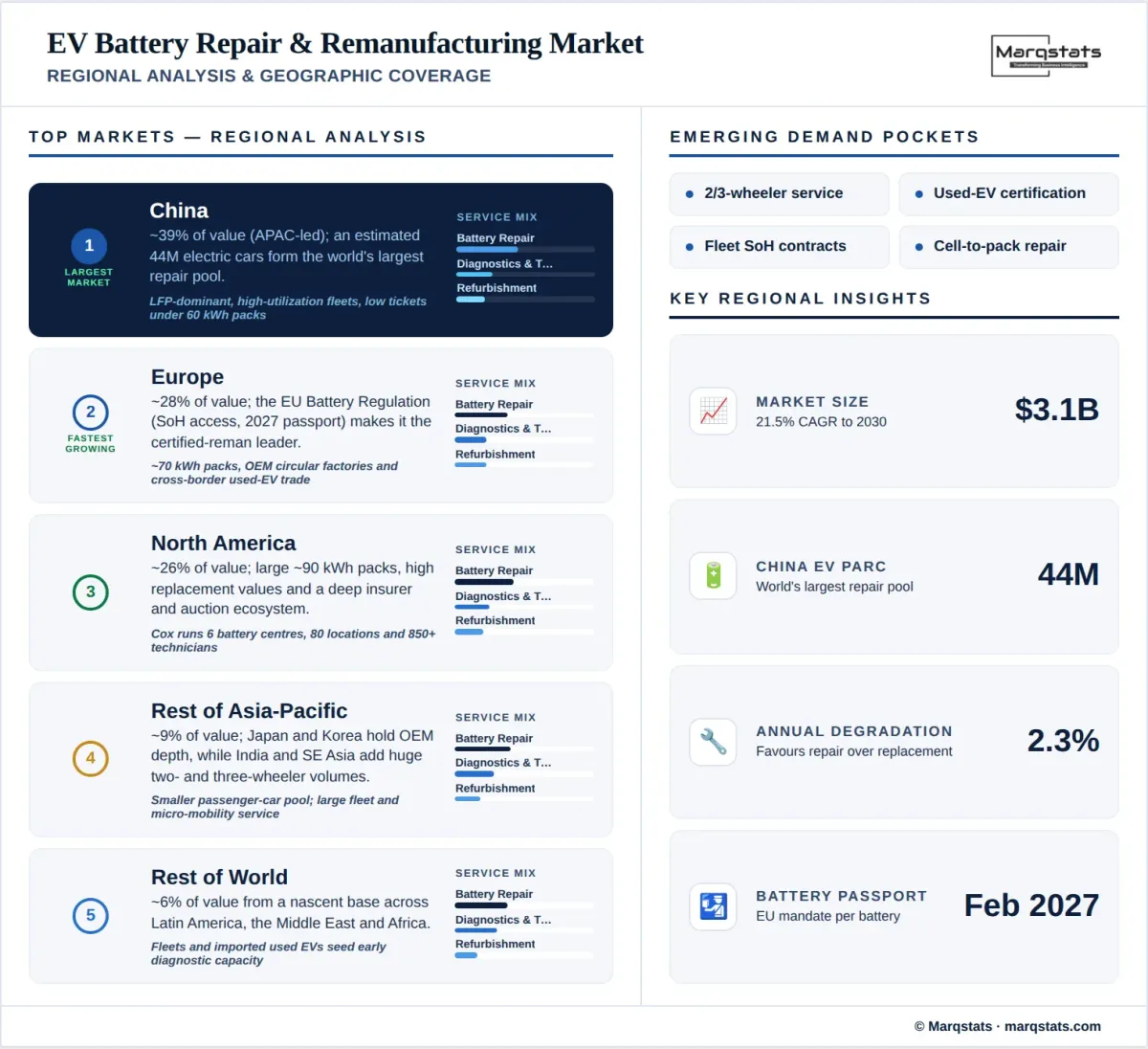
China
China is the world's largest market by service-event volume, the core of Asia-Pacific's roughly 39% share of 2025 global service value. An estimated 44 million electric cars were in operation at the end of 2025, lithium iron phosphate dominates new deployment, and large taxi, ride-hailing, and commercial fleets drive high vehicle utilization and service volumes. A strong domestic battery supply chain, battery-maker service networks, and rapidly developing cell-to-pack repair capability support the market, while low new-battery prices, intense manufacturer control, rapid pack-design evolution, and lower repair tickets than Europe or North America constrain average revenue per intervention. China is the largest market by volume yet not the highest by average ticket, and its smaller average pack size below 60 kWh and battery-swapping in some commercial segments further shape service economics distinct from Western markets.
Europe
Europe is the strongest region for formal remanufacturing and certified independent repair, and the fastest-growing on regulatory catalysts, contributing about 28% of 2025 global service value. The EU Battery Regulation requires battery-management systems to provide state-of-health access from August 2024 and mandates a digital battery passport for each battery from February 2027, reducing information asymmetry and supporting certified remanufacturing. Higher vehicle and battery values, an average battery-electric pack near 70 kWh, strong circularity policy, original-equipment circular factories, and large cross-border used-EV trade favour organized, higher-value service, while high labour costs, stringent liability, and diverse platforms restrain the market. Europe is the most attractive region for certified, higher-value repair and remanufacturing, and a remanufactured battery placed on the market as newly certified must meet the 90%-capacity restoration threshold with cell state-of-health variation within three percentage points.
North America
North America contributes about 26% of 2025 global service value, led by the United States and especially high-penetration states such as California. Large long-range packs averaging about 90 kWh, high replacement values, strong insurer involvement, a large collision-repair market, and an extensive auction and remarketing ecosystem support high average service revenue. Independent lifecycle platforms scale rapidly — one operator runs six battery centres, 80 repair locations, and more than 850 technicians covering roughly 85% of the United States automotive market — while long transport distances, fragmented state regulation, and product-liability exposure restrain the market. Insurers, fleets, and remarketing companies play a major role, and California's Advanced Clean Cars II programme phases battery-durability and warranty requirements toward a 75% retained-energy threshold over eight years or 100,000 miles from model year 2031, standardizing state-of-health disclosure that supports used-EV transactions and repair-versus-replace decisions.
Rest of Asia-Pacific
The rest of Asia-Pacific, including Japan, South Korea, India, and Southeast Asia, contributes about 9% of 2025 global service value. Japan and South Korea hold strong original-equipment and battery technical capability, yet slower domestic battery-electric adoption, while India and Southeast Asia have rapidly expanding electric two- and three-wheeler populations whose service economics differ substantially from passenger cars. The passenger-car opportunity is smaller across the forecast period, though two- and three-wheeler and commercial-fleet battery service carries high volumes and warrants separate analysis.
Rest of World
The rest of world, spanning Latin America, the Middle East, and Africa, contributes about 6% of 2025 global service value from a nascent base. Electric-vehicle adoption remains early, and battery service concentrates around fleets, imported used electric vehicles, and urban markets. The region advances gradually as parc scale builds, used-EV imports rise, and organized diagnostic and repair capacity develops from a low base.
How Competition Is Evolving
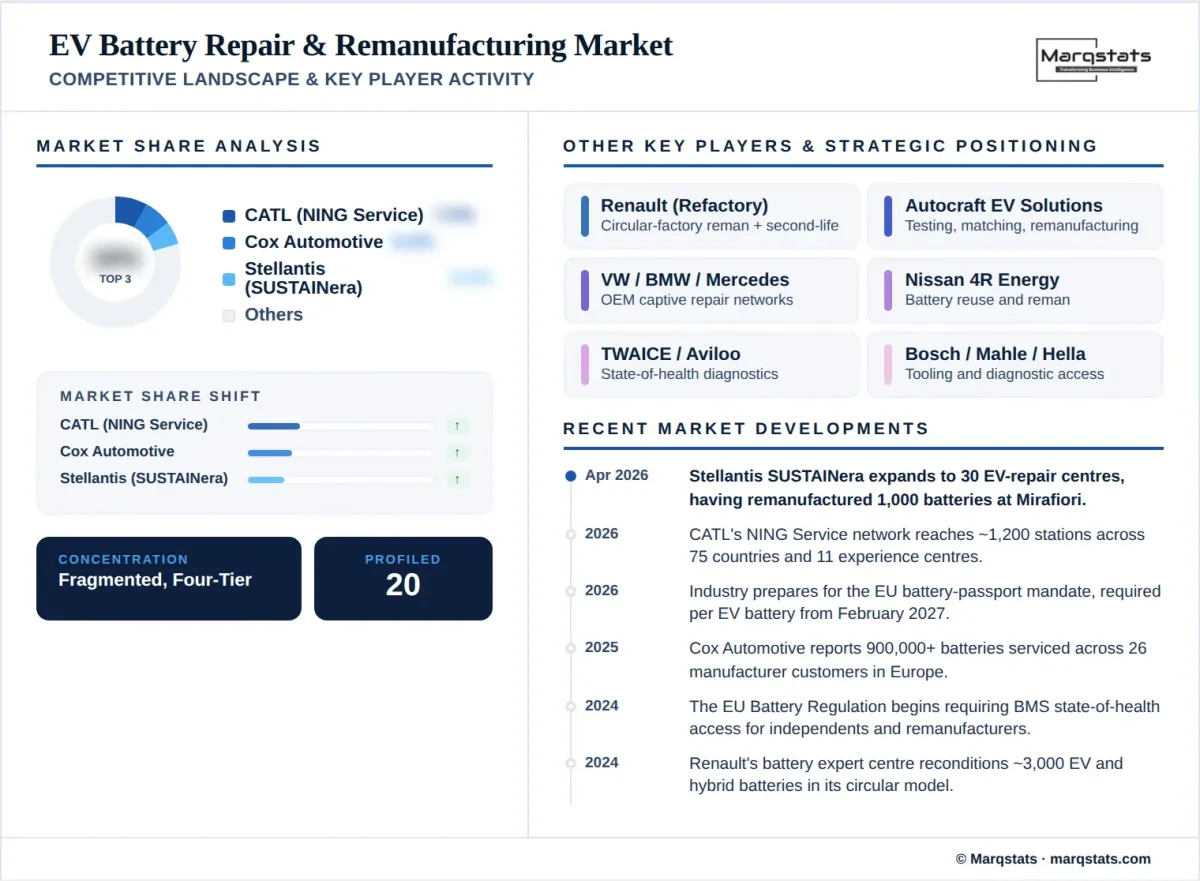
The electric vehicle battery repair and remanufacturing market is regionally concentrated yet globally fragmented, with four principal competitor groups: vehicle manufacturers, battery manufacturers, large automotive-service and lifecycle companies, and independent battery-remanufacturing specialists. No credible global market-share table is supportable from public data, as company figures are not directly comparable — batteries serviced may include testing or repeat interventions, while packs remanufactured represent a more intensive, higher-value activity. Original-equipment manufacturers and battery makers dominate in-warranty work, while specialists progressively capture out-of-warranty, fleet, insurer, and used-EV demand.
Battery manufacturers hold the strongest structural position in integrated designs. CATL's NING Service network reported about 1,200 service stations across 75 countries and 11 experience centres, combining battery-engineering data, proprietary pack knowledge, replacement components, and cell-to-pack expertise to capture value once expected to flow to independent repairers. Among vehicle manufacturers, Stellantis distinguishes repair from remanufacturing across a network that reached 30 electric-repair centres globally by April 2026, remanufacturing 1,000 batteries at its Mirafiori circular hub in its first year on a EUR 40 million investment, while Renault's circular-factory model reconditioned about 3,000 batteries in 2024 and integrates repair, remanufacturing, and second-life activity.
Independent and lifecycle platforms anchor the multi-brand and out-of-warranty market. Cox Automotive operates six battery centres, 80 repair locations, and more than 850 technicians in the United States, and reports more than 900,000 batteries serviced across 26 manufacturer customers in Europe, drawing on auction, fleet, remarketing, and insurer access. Specialist remanufacturers such as Autocraft EV Solutions provide testing, module matching, and remanufacturing at dedicated facilities, and diagnostic and analytics providers add state-of-health certification and battery data. Competition is measured through certified capacity, remanufactured-pack volume, technician coverage, software and parts access, and insurer, fleet, and original-equipment relationships rather than published share, and the European regulatory framework is accelerating certified, warranty-backed service through 2030.
Companies Covered
The report profiles 20++ companies with full strategy and financials analysis, including:
Recent Market Activity
Table of Contents
Coverage & Segmentation
This report provides a comprehensive analysis of the global electric vehicle battery repair and remanufacturing market covering the historical period 2021 to 2025 and the forecast period 2026 to 2030, with 2025 as the base year. The study defines the market as revenue from diagnosing, repairing, restoring, and remanufacturing high-voltage traction batteries used in electric vehicles, spanning diagnostics and triage, component and module repair, refurbishment or reconditioning, full remanufacturing, and post-repair testing and certification. Sale of new replacement batteries, recycling and material recovery, second-life repurposing, battery swapping, routine servicing unrelated to the high-voltage battery, and 12-volt and consumer batteries are excluded and treated as adjacent markets. Passenger cars form the primary market, with light-commercial, truck, bus, and two- and three-wheeler batteries covered as adjacent segments.
The study segments the market by service type, battery chemistry, pack architecture, and service provider, and examines regional demand across China, Europe, North America, the rest of Asia-Pacific, and the rest of world, alongside repair economics, pack architecture, regulation, and competition. Market sizing is built bottom-up from an electric-vehicle-parc cohort model, ageing each annual sales cohort and applying age-, chemistry-, and architecture-specific intervention rates, repairable-share assumptions, service-type allocation, and region- and service-specific pricing, with company-capacity cross-checks. Because no authoritative public revenue series exists for this narrowly defined market, figures are transparently estimate-based and triangulated. The competitive section profiles 20 manufacturers, battery makers, lifecycle platforms, and specialists.