Market Snapshot
Middle bar: base-year value × (1 + CAGR), rounded to two decimals. This is a calculated illustration, not a separately researched annual estimate.
The Africa electric keke market size is estimated at USD 27.39 million in 2025 and is projected to reach USD 109.41 million by 2030, growing at a CAGR of 31.91% over 2026 – 2030. Annual sales of battery electric passenger tricycles rise from about 7,250 units to 27,920, and the active fleet grows from about 17,900 vehicles to 98,600. Vehicle hardware accounts for 83.39% of 2025 value and paid charging and battery services for the rest.
Electric kekes are still a small part of Africa's tricycle fleet. Marqstats estimates that about 503,000 three-wheelers were sold across Africa in 2025, of which about 2.4%, or roughly 12,070 units, were electric. Passenger kekes, known as tuk-tuks in East Africa and Egypt and as kekes or Keke NAPEP in Nigeria, make up about 60% of those electric units, with cargo tricycles accounting for the rest. In Kenya, 517 electric tuk-tuks were registered in 2025, 7.6% of new tuk-tuk registrations.
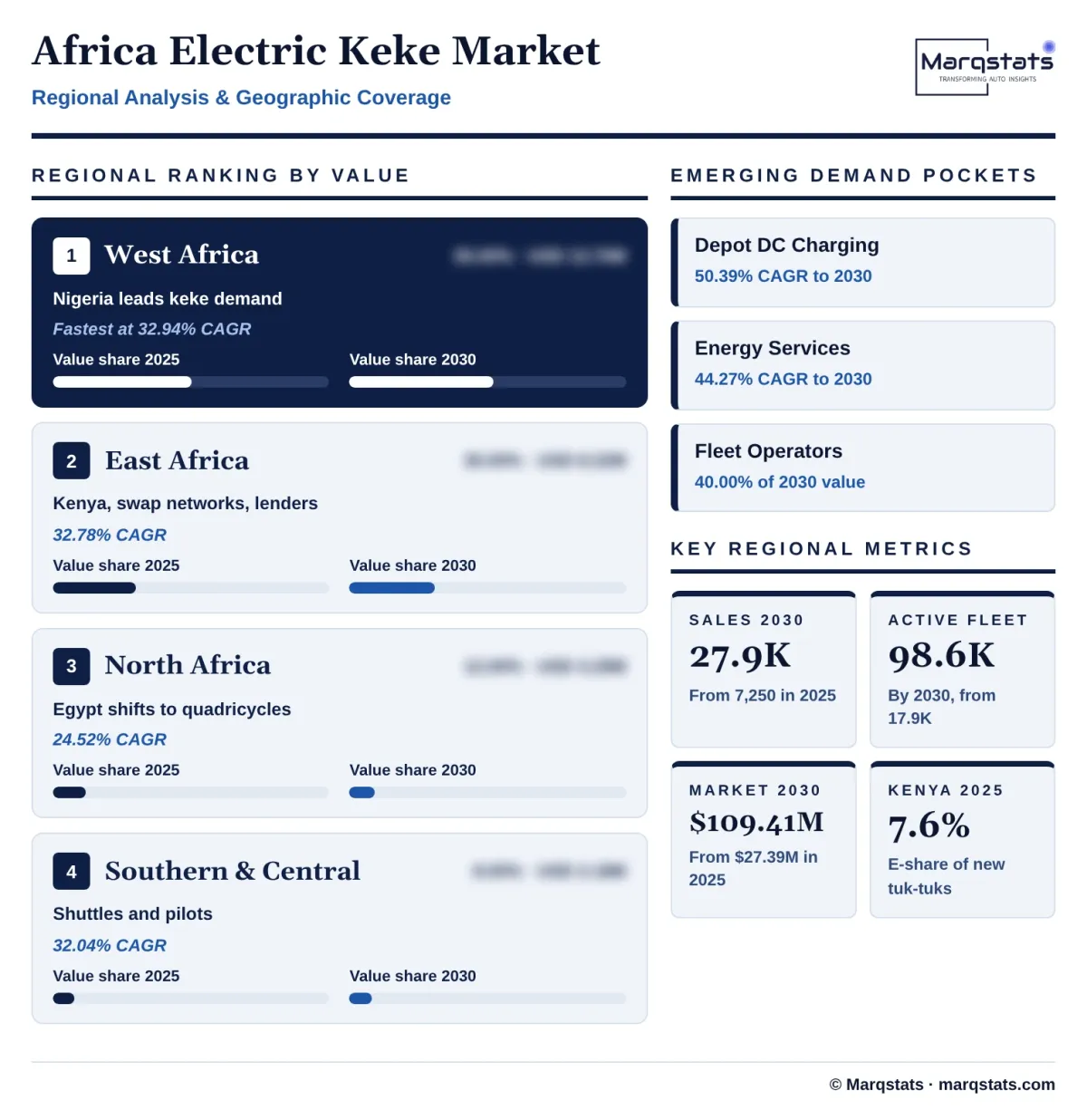
West Africa is the largest region, with an estimated 50.00% of 2025 value, followed by East Africa at 30.00%, North Africa at 12.00% and Southern and Central Africa at 8.00%. The study segments the market by value layer, charging architecture, battery chemistry, operating model and body type. Values are in US dollars at constant 2025 average exchange rates and cover new vehicle sales at landed dealer prices plus paid swap and charging revenue from commercial fleets.
Key Takeaways
Market Overview & Analysis
Report Summary
Marqstats sizes the Africa electric keke market as the value of new battery electric passenger tricycles sold across Africa, at landed dealer prices excluding VAT, plus the paid swap and charging revenue that commercial operators collect from active passenger tricycle fleets. Passenger tricycles here are three-wheeled vehicles of UNECE category L5e-A or equivalent national classes, used mainly for shared taxi and hire work. Cargo tricycles, electric motorcycles, four-wheel quadricycles such as the Bajaj Qute, petrol and gas tricycles, and conversion kits are excluded.
The market grew from an estimated USD 4.68 million in 2021 to USD 27.39 million in 2025, as unit sales rose from about 1,250 to 7,250. Growth came from three sources: imported Chinese electric tricycles in Nigeria, Ghana, Togo and Benin; Indian and Italian brands such as Piaggio, whose Apé E-City was launched in Kenya through Car & General; and fleet pilots by ride-hailing and swap operators. Marqstats estimates sales of about 9,900 units in 2026 as the Nigerian federal programme and East African fleet orders arrive.
Electric kekes compete with petrol tricycles on running cost rather than purchase price. An electric keke costs more to buy than a comparable petrol model, but energy costs per kilometre are much lower, and operators in Nigeria and Kenya face high and volatile pump prices. The live Marqstats Africa three-wheeler study cites per-kilometre energy costs as much as 80% lower than petrol. Lenders bridge the price gap by collecting small daily repayments from those savings.
The market sits inside a much larger three-wheeler industry. Marqstats estimates about 503,000 three-wheelers were sold in Africa in 2025, worth about USD 2.25 billion, and electric models were only about 2.4% of those units. Marqstats expects electric three-wheelers to reach about 42,950 units by 2030, and passenger kekes to account for about 65% of them, or 27,920 units, as fleet operators move first.
The forecast rests on three conditions. Petrol prices in Nigeria and East Africa stay high relative to electricity, lenders keep financing electric tricycles at terms close to petrol models, and governments keep tax relief such as Kenya's zero-rated VAT on electric two- and three-wheel vehicles and lithium batteries. Under these conditions, sales reach 27,920 units in 2030 and market value reaches USD 109.41 million.
Africa Electric Keke Market Size and Forecast
The Africa electric keke market grows from USD 27.39 million in 2025 to USD 109.41 million in 2030, a CAGR of 31.91%. Vehicle hardware rises from USD 22.84 million to USD 80.97 million, a 28.80% CAGR, and paid swap and charging services rise from USD 4.55 million to USD 28.44 million, a 44.27% CAGR. The market reaches an estimated USD 37.77 million in 2026 and passes USD 50 million in 2027.
Unit sales grow faster than hardware value because prices fall. Annual sales rise from about 7,250 units in 2025 to 27,920 in 2030, a 30.95% annual rate, while the average landed price falls from about USD 3,150 to USD 2,900. Open-body Chinese models land at about USD 1,800 to USD 2,800, and enclosed models from Indian and Italian brands cost more, so the mix matters as much as price cuts.
The active fleet grows about fivefold. Marqstats estimates the fleet of electric passenger tricycles in use rises from about 17,900 at the end of 2025 to 98,600 by 2030. The share of that fleet paying a commercial operator for swaps or depot charging rises from about 60% to 70%, which drives the faster growth of the energy layer even as revenue per paying vehicle falls from about USD 520 to USD 470 a year.
Growth was fastest in the early years. The market grew at about 55.52% a year from 2021 to 2025 from a very small base. Growth slows to about 38% in 2026 and to just under 30% by 2030 as volumes rise and the Nigerian programme and East African fleets move from pilots to repeat orders.
Market Dynamics
Key Drivers
Five forces are pulling Africa's passenger tricycle operators toward electric kekes.
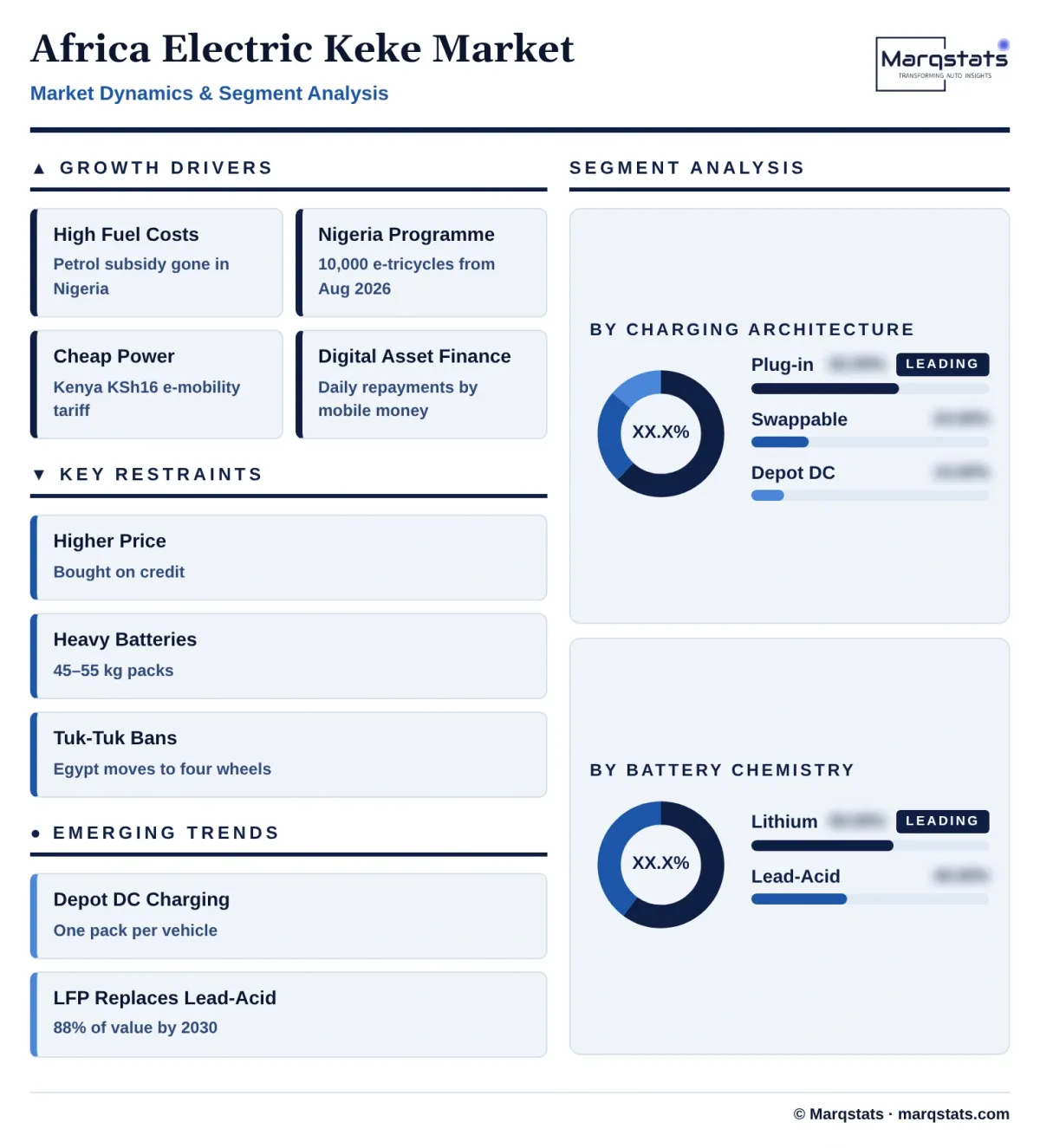
- High fuel costs. Nigeria removed its petrol subsidy in 2023, and pump prices in Nigeria, Kenya and Uganda have stayed high relative to electricity. Keke operators who drive 100 km or more a day spend a large share of their earnings on fuel, so lower per-kilometre energy costs make electric models attractive even at a higher purchase price.
- Government programmes. In June 2026 Nigerian Vice President Kashim Shettima said 10,000 electric tricycles would be distributed through the North East Development Commission from August 2026 and that the President had approved replicating the initiative through other regional development commissions. Kenya's National Electric Mobility Policy, launched on 3 February 2026, keeps zero-rated VAT on electric motorcycles, bicycles, buses and lithium-ion batteries and introduces green number plates.
- Cheaper electricity for charging operators. Kenya's Energy and Petroleum Regulatory Authority (EPRA) offers an e-mobility tariff of KSh16 per kWh, with KSh8 per kWh off-peak, and an amendment gazetted on 18 September 2026 replaced the 15,000 kWh monthly ceiling with a consumption threshold. Large depots and swap networks can now stay on the discounted tariff as they grow.
- Digital asset finance. Lenders such as Watu Credit and Mogo, licensed as digital credit providers by the Central Bank of Kenya, finance tuk-tuks on daily or weekly repayments collected by mobile money. Kenya's move to electronic logbooks from 10 June 2026 makes it easier for lenders to register and release vehicles, which lowers the cost of lending against electric kekes.
- Investment in e-mobility platforms. Spiro raised USD 215 million in June 2026, ARC Ride raised USD 33.3 million in September 2026 and Zeno raised USD 25 million in March 2026. Most of this money goes into electric motorcycles, but it builds the battery, charging and service networks that electric kekes can use, and ARC Ride says it is extending its battery system to three-wheelers.
Key Restraints
Four constraints keep electric kekes a small share of Africa's three-wheeler fleet.
- Higher purchase price. An electric keke costs more than a petrol model of similar size, and most operators buy on credit. Lenders charge high rates to informal operators, and the extra price must be repaid from fuel savings, so a gap between expected and actual savings can push drivers into arrears.
- Heavy batteries limit swapping. Keke battery packs of about 7.7 kWh weigh 45 to 55 kg, too heavy for one person to swap safely, and a swap network needs two to three packs per vehicle. These limits raise the cost of the swap model that has worked well for electric motorcycles and slow the build-out of three-wheeler energy networks.
- Weak data and mixed product quality. Few African registries separate electric from petrol tricycles, and many low-cost imports use lead-acid batteries with short lives. Poor battery life and patchy after-sales service damage operator confidence, especially in Nigeria, where most electric kekes are imported or converted.
- Policy moves away from tricycles in some cities. Egypt has banned imports of fully built three-wheelers since the end of 2021, Cairo and Giza are replacing tuk-tuks with four-wheel quadricycles and small taxis, and several Nigerian cities restrict keke routes. These rules shrink the addressable market even where electric models are cheaper to run.
Key Trends
Four shifts are changing how electric kekes are built, financed and charged.
- Depot DC charging is overtaking swapping for kekes. Studies and operator choices point to fixed batteries charged at depots or solar-backed hubs, which need one pack per vehicle. Depot DC charging grows from 14.00% of 2025 value to 27.00% by 2030, the fastest-growing charging architecture.
- Lithium iron phosphate is becoming standard. Operators are moving from lead-acid packs, which last a year or two in daily taxi work, to LFP packs with much longer cycle lives. LFP also tolerates high ambient temperatures and frequent fast charging better than other chemistries.
- Motorcycle platforms are moving into three-wheelers. ARC Ride says it is moving into three-wheel and small four-wheel vehicles using its existing battery system, and Spiro's partnership with Yadea, announced in September 2026, adds a large supplier to Africa's largest swap network. Shared batteries and modular packs could make swapping practical for lighter kekes.
- Fleet and platform models are spreading. Ride-hailing platforms such as Bolt and fleet operators run electric tricycle pilots in Lagos and Nairobi, and lenders bundle vehicle, finance and charging. Fleet and platform operators rise from 30.00% of 2025 value to 40.00% by 2030.
Strategic Implications
- For vehicle makers, price and durability decide sales. Manufacturers should offer LFP models near the price of petrol kekes, with chassis and suspension built for rough roads, and support them with parts and service through local assemblers and dealers. Locally assembled semi-knocked-down kits benefit from lower duties in Kenya, Nigeria and Rwanda than fully built imports.
- For energy operators, depots come before swap stations. Depot DC charging needs one battery per vehicle and fits keke duty cycles, which include long waits at ranks. Operators should build depots with time-of-use tariffs and solar support, and offer swapping only where packs are modular and light enough to handle safely.
- For lenders, battery health is the main credit risk. Telematics that track battery condition and vehicle use, immobilisers linked to repayments and electronic logbooks reduce losses. Lenders should set terms on realistic fuel savings rather than best-case figures and treat lead-acid models as higher risk.
- For governments, consistent rules matter most. Tax relief, route permits and charging tariffs have the largest effect on the price gap between electric and petrol kekes. Programmes such as Nigeria's 10,000-tricycle distribution work best when they come with service networks and financing, and city route bans should be weighed against the fuel and air-quality benefits of electric models.
- For investors, the energy layer offers recurring revenue. Paid charging and swap revenue grows at 44.27% a year to 2030. Platforms that combine vehicle sales, finance and charging capture more of each vehicle's lifetime value than vehicle importers alone.
Market Segmentation
New electric passenger tricycles account for USD 22.84 million in 2025, 83.39% of market value, from about 7,250 units at an average landed price of about USD 3,150. Hardware rises to USD 80.97 million by 2030, a 28.80% CAGR, as sales reach 27,920 units at about USD 2,900. Chinese open-body models dominate unit volume, while enclosed Indian and Italian models carry higher prices.
Paid swap subscriptions and depot charging revenue from commercial fleets account for USD 4.55 million in 2025, 16.61% of value. This layer grows fastest, at 44.27% a year, to USD 28.44 million by 2030, as the active fleet rises from about 17,900 to 98,600 vehicles and more of it runs through commercial depots and swap networks.
Kekes charged from home or rank sockets account for USD 16.98 million in 2025, 62.00% of value. This remains the largest architecture but its share falls to 48.00% by 2030, at a 25.34% CAGR to USD 52.52 million, as fleets move to managed depots. Most lead-acid and low-cost lithium kekes use slow AC chargers.
Kekes on battery swap networks account for USD 6.57 million in 2025, 24.00% of value, rising to USD 27.35 million by 2030, a 33.01% CAGR. The share stays near a quarter because keke packs are heavy and swap networks need more batteries per vehicle. Growth comes from modular packs that use motorcycle-sized batteries and from platform fleets.
Kekes charged at fleet depots and hubs with DC chargers account for USD 3.84 million in 2025, 14.00% of value. This is the fastest-growing architecture, rising to USD 29.54 million by 2030, a 50.39% CAGR and 27.00% of value. One pack per vehicle and charging during rank waits make depot charging cheaper than swapping for most keke fleets.
Lithium-ion kekes account for USD 16.43 million in 2025, 60.00% of value. Lithium rises to USD 96.28 million by 2030, a 42.42% CAGR and 88.00% of value, as LFP pack prices fall and fleets choose longer cycle life and faster charging.
Lead-acid kekes account for USD 10.96 million in 2025, 40.00% of value, mainly low-cost imports sold to individual operators. Lead-acid value grows only slowly, at 3.68% a year to USD 13.13 million by 2030, and its share falls to 12.00% as short battery life and replacement costs push buyers toward lithium.
Drivers who own or are buying their own keke account for USD 16.98 million in 2025, 62.00% of value. They remain the largest group, rising to USD 56.89 million by 2030, a 27.36% CAGR, but their share falls to 52.00%. Most buy on credit from digital lenders and repay from daily earnings.
Fleet owners, ride-hailing platforms and swap operators that place kekes with drivers account for USD 8.22 million in 2025, 30.00% of value. They grow fastest, at 39.71% a year, to USD 43.76 million by 2030 and 40.00% of value, because they can bundle vehicle, finance and charging.
Vehicles bought through public programmes, development agencies and institutions account for USD 2.19 million in 2025, 8.00% of value, rising to USD 8.76 million by 2030, a 31.95% CAGR. Nigeria's distribution of 10,000 electric tricycles through the North East Development Commission is the largest programme announced.
Open-body passenger tricycles with canvas or light roofs account for USD 18.08 million in 2025, 66.00% of value. They grow at 27.19% a year to USD 60.18 million by 2030, but their share falls to 55.00%. Low-cost Chinese models in Nigeria, Ghana, Togo and Benin dominate this group.
Enclosed passenger tricycles with doors and hard cabins account for USD 9.31 million in 2025, 34.00% of value. They grow faster, at 39.53% a year, to USD 49.23 million by 2030 and 45.00% of value, as fleets and ride-hailing platforms in East Africa choose safer, more comfortable models such as Piaggio's Apé E-City.
By Geography
West Africa
West Africa, led by Nigeria with Ghana, Togo, Benin and Côte d'Ivoire, is the largest region, with an estimated USD 13.70 million in 2025, 50.00% of value. It grows at 32.94% a year to USD 56.89 million by 2030 and 52.00% of value. Nigeria is Africa's largest keke market, with about a third of continental three-wheeler sales, and the 2023 removal of the petrol subsidy, the federal programme of 10,000 electric tricycles from August 2026 and pilots by Bolt and swap operators in Lagos drive demand. Most electric kekes in Nigeria are imported from China or converted locally, and a 2026 study found that swapping is not viable for the varied converted fleet.
East Africa
East Africa, covering Kenya, Uganda, Tanzania, Rwanda and Ethiopia, accounts for an estimated USD 8.22 million in 2025, 30.00% of value, rising to USD 33.92 million by 2030, a 32.78% CAGR. Kenya is the best-documented market: 517 electric tuk-tuks were registered in 2025, 7.6% of new tuk-tuk registrations, against about one in six new motorcycles. Zero-rated VAT, the EPRA e-mobility tariff and digital lenders support adoption, and the region's swap networks, built by Spiro, ARC Ride and Ampersand for motorcycles, give fleets an option that West Africa largely lacks.
North Africa
North Africa, led by Egypt with Morocco and Tunisia, accounts for an estimated USD 3.29 million in 2025, 12.00% of value. It grows slowest, at 24.52% a year to USD 9.85 million by 2030, and its share falls to 9.00%. Egypt has banned imports of fully built three-wheelers since the end of 2021, and Cairo and Giza are replacing tuk-tuks with licensed quadricycles and small taxis. In Giza the replacement vehicles cost about EGP 200,000 against about EGP 300,000 for a tuk-tuk, and drivers receive an EGP 10,000 subsidy, which moves urban demand toward four-wheel vehicles outside this market's scope.
Southern and Central Africa
Southern and Central Africa, including South Africa, Zambia, Malawi, Mozambique, Cameroon and the Democratic Republic of the Congo, accounts for an estimated USD 2.18 million in 2025, 8.00% of value, rising to USD 8.75 million by 2030, a 32.04% CAGR. Tricycle taxis are less common here than in West and East Africa, and demand comes from township and tourism shuttles, municipal pilots and imports from China. Country shares are Marqstats allocations based on three-wheeler sales, registration data and operator disclosures.
How Competition Is Evolving
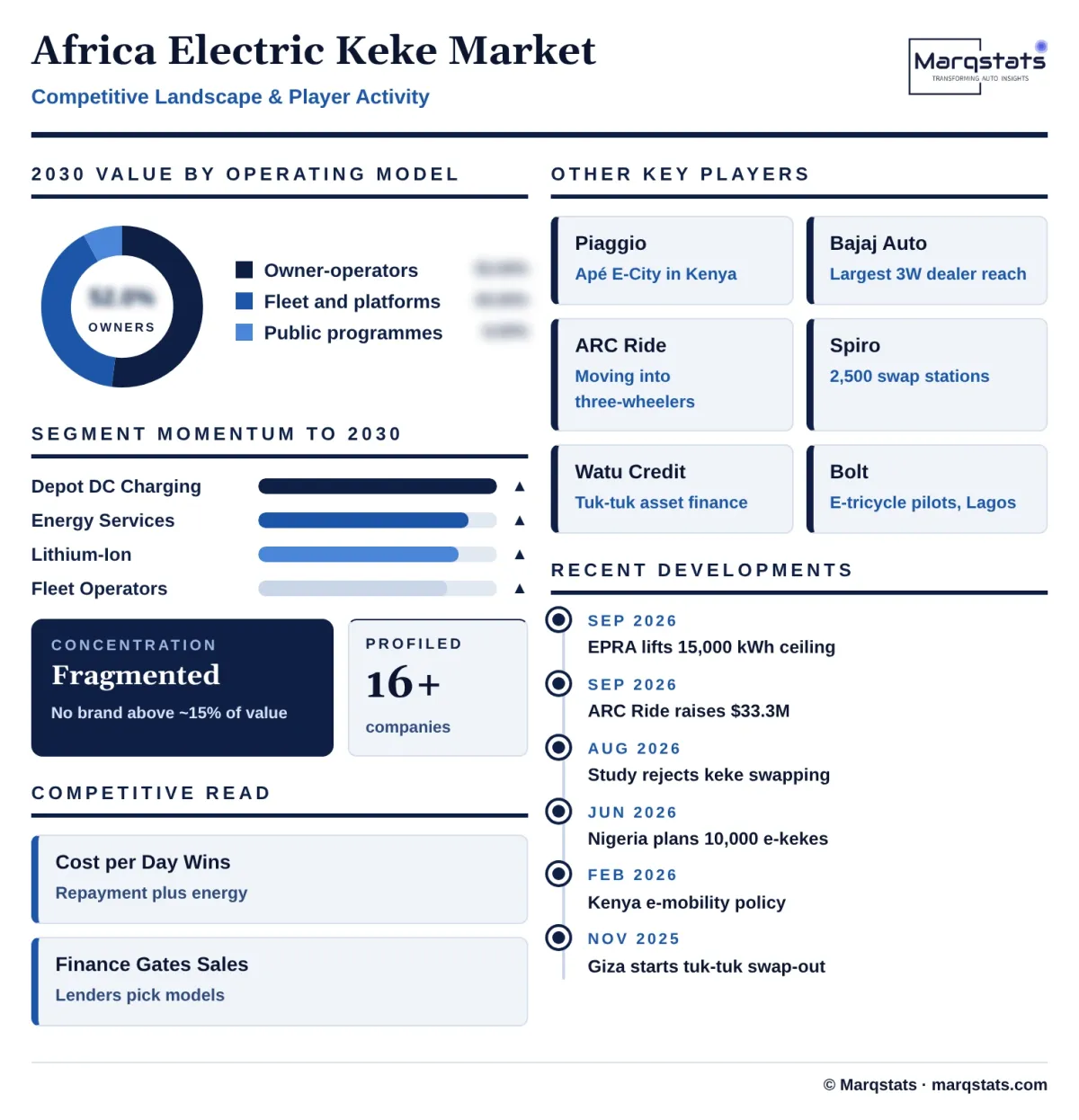
The Africa electric keke market is fragmented. Low-cost Chinese makers such as Jiangsu Jinpeng and Chongqing Zongshen supply most units through importers and local assemblers, while Piaggio, Bajaj Auto, TVS Motor and Mahindra Last Mile Mobility compete at higher price points through established three-wheeler dealer networks. Marqstats estimates that no single vehicle brand holds more than about 15% of 2025 value.
Indian and Italian brands bring dealer networks. Bajaj holds about a third of African three-wheeler volume across all fuel types, and its distributors, such as GB Auto in Egypt, give it reach that new entrants lack. Piaggio launched its Apé E-City passenger and Apé E-Xtra cargo models in Kenya through Car & General, with 8 kWh batteries and a claimed range of up to 145 km. These brands are best placed when fleets demand enclosed, durable models with parts and service.
Energy and platform operators are a second competitive layer. Spiro, ARC Ride, Ampersand and Zeno built battery swap and charging networks for electric motorcycles and are now the main source of energy infrastructure that kekes can use. ARC Ride says it is moving into three-wheel and small four-wheel vehicles using its existing battery system, and Bolt and swap operators have run electric tricycle pilots in Lagos.
Lenders shape demand as much as vehicle makers. Watu Credit and Mogo in Kenya, and lenders and fleet financiers such as MAX in Nigeria, decide which models operators can buy and on what terms. Their choice of brands, deposits and repayment schedules directly affects which electric kekes sell.
Competition is moving to total cost per day. Operators compare the daily repayment, energy cost and downtime of each option, not just the purchase price. Suppliers that combine affordable LFP vehicles, financing partners and reliable charging or swap access win fleet orders, while importers selling lead-acid models on price alone face rising warranty and reputation risks.
Capital is concentrating in a few platforms. Spiro's funding in 2025 and 2026, about USD 270 million in 2026 alone including its USD 215 million round, is far larger than any keke-focused company has raised. Keke suppliers that partner with these platforms gain access to charging, finance and customers, while standalone importers compete mainly on price.
Companies Covered
Companies covered in the report include:
Recent Market Activity
Table of Contents
Coverage & Segmentation
The study covers the Africa electric keke market across West Africa, East Africa, North Africa and Southern and Central Africa, with 2025 as the base year, 2021 – 2025 as the historical period and 2026 – 2030 as the forecast period. Values are in US dollars at constant 2025 average exchange rates. The market is defined as the value of new battery electric passenger tricycles (UNECE L5e-A or equivalent national classes) at landed dealer prices excluding VAT, plus paid battery swap and depot charging revenue from commercial passenger tricycle fleets. It is segmented by value layer, charging architecture, battery chemistry, operating model and body type.
Electric cargo tricycles, electric motorcycles and scooters, four-wheel quadricycles, petrol, diesel and gas tricycles, conversion kits, used vehicles and electricity bought directly by owners at home are excluded. The market is a subset of the electric three-wheeler segment in the Marqstats Africa three-wheeler study, whose figure of about 12,070 electric three-wheelers in 2025 includes cargo models, and it does not overlap with the Africa electric two-wheeler study, which excludes three-wheelers. Unit sales, prices, fleet size, energy revenue and segment and regional splits are Marqstats estimates built on registration data, operator disclosures and published studies.