Market Snapshot
The global electric truck chassis market was worth USD 10.59 billion in 2025 and is forecast to reach USD 23.50 billion by 2030, a CAGR of 17.28% that adds USD 12.91 billion of annual chassis value. Volume grows from 440,000 to 959,000 medium and heavy electric truck chassis, a 16.86% CAGR. China builds 90.00% of those chassis but captures 78.19% of the value, and that gap widens as Europe scales.
Marqstats sizes the market bottom-up as units multiplied by chassis value per unit. Units follow the International Energy Agency (IEA) Global EV Outlook 2026 count of electric medium freight trucks (210,000) and heavy freight trucks (230,000) sold in 2025, split by region with registration data from the European Automobile Manufacturers' Association (ACEA), the International Council on Clean Transportation (ICCT) and CV World. Chassis value per unit is a Marqstats estimate at ex-works level, excluding traction battery cells and modules, bodies, dealer margin and taxes. The panel is most sensitive to the Chinese heavy chassis value of USD 28,000, which sets 58.26% of the 2025 total.
Every regional chassis price falls through 2030, yet the global average rises. Marqstats expects Chinese heavy chassis to slip from USD 28,000 to USD 25,000 and European heavy chassis from USD 110,000 to USD 90,000. The global average still moves from USD 24,068 to USD 24,505 per unit because Europe's share of units more than doubles, from 3.86% to 8.34%, and a European chassis is worth roughly four times a Chinese one.
Heavy freight truck chassis hold 67.71% of 2025 value, rising to 71.49% by 2030. China drove this shift. New-energy heavy trucks reached 29% of Chinese heavy-truck sales in 2025 and 54% in December 2025, according to CV World data reported by electrive in January 2026, and the China Passenger Car Association (CPCA) put the share at 50% in September 2026.
The chassis is also changing shape. Contemporary Amperex Technology Co., Limited (CATL) launched its dual-electric range extension battery in Beijing on 20 October 2026, pairing a swappable 432 kWh or 513 kWh main pack under the frame with a fixed 77 kWh pack behind the cab. Battery mounting is now a chassis design decision, not a pack decision.
Key Takeaways
Market Overview & Analysis
Report Summary
An electric truck chassis is the rolling platform under a medium or heavy electric freight truck: the frame rails or structural tray, the cab where one is fitted, the electric drive axle or central motor, the inverter and high-voltage distribution, battery enclosures with their mounting, thermal and management hardware, and the suspension, steering and braking systems. It is sold either as a complete truck, as a cab-chassis for a body builder to finish, or as a stripped or skateboard platform. In the United States, incomplete vehicles move between manufacturers under 49 CFR Part 568. In the European Union, the equivalent route is multi-stage type-approval under Regulation (EU) 2018/858.
The central conclusion is that value and volume live in different places. China sells most of the world's electric trucks at a fraction of Western chassis prices, so its share of chassis value is well below its share of units. Europe sells few trucks, but its heavy chassis carry longer frames, higher-voltage e-axles and more complex braking and safety content, and its volume is about to rise sharply under the EU heavy-duty CO2 standards. The market's centre of value therefore moves west even as China keeps adding the most units.
The forecast rests on a published unit base and on chassis values that Marqstats estimates from public price points, battery cost structures and OEM disclosures. The IEA counted more than 400,000 electric medium and heavy freight trucks sold in 2025, about double 2024, with heavy freight trucks almost tripling to 230,000 and medium freight trucks up 65% to 210,000. Marqstats projects 959,000 units in 2030 and applies regional chassis values that decline by 2.2% to 3.9% a year.
Global Electric Truck Chassis Market Size and Forecast
The market grew from USD 1.55 billion in 2021 to USD 2.60 billion in 2022, USD 3.70 billion in 2023, USD 5.30 billion in 2024 and USD 10.59 billion in 2025, a historical CAGR of 61.67%. The 2025 jump came from China. Units roughly doubled from about 207,000 in 2024 to 440,000 in 2025, while the average chassis value fell from USD 25,604 to USD 24,068 as Chinese heavy trucks took a larger share of the mix.
Marqstats forecasts USD 13.56 billion in 2026, USD 15.94 billion in 2027, USD 18.27 billion in 2028, USD 20.69 billion in 2029 and USD 23.50 billion in 2030. Units reach 561,000 in 2026 and 959,000 in 2030. The 2026 step is the largest of the forecast, at 28.05%, because China closed 2025 with a 54% new-energy share of heavy-truck sales in December and was back at 50% in September 2026. Growth then settles between 13% and 18% a year.
The average chassis value is close to flat, at USD 24,171 in 2026 and USD 24,505 in 2030. That stability hides two opposing forces. Regional prices fall as e-axles, inverters and battery enclosures scale. Mix moves toward Europe and toward heavy chassis, which are worth more per unit. A reading that assumes falling battery costs push the whole market's average price down misses the mix effect, and it understates 2030 value.
Sizing is anchored on units, so the most important external input is the IEA unit count. Unit splits by region use ACEA registrations for Europe, ICCT and IEA data for the United States, CV World data for China and NITI Aayog statements for India. Chassis values are Marqstats estimates. A USD 1,000 change in the Chinese heavy chassis value moves the 2025 total by about USD 0.22 billion.
Chassis Value Moves West While Units Stay in China
The signature finding is a split between where electric truck chassis are built and where their value accrues. China built 396,000 of the 440,000 electric truck chassis sold worldwide in 2025, 90.00% of units, but its chassis carry an average value of about USD 20,909. Europe built 17,000, at about USD 77,647 each. So China holds 78.19% of value, not 90%.
By 2030 the gap matters more. Marqstats expects China to reach 800,000 units and Europe 80,000. Europe's unit share rises to 8.34%, and its value share to 23.74%. China's value share falls to 64.77% even though it adds more than 400,000 units. Suppliers that size their e-axle, frame and brake capacity on unit counts alone will overbuild for China and underbuild for Europe.
Three mechanisms drive the price gap. Chinese heavy trucks use simpler frames and standard e-axles bought from a deep domestic supply base. European tractors carry Regulation (EU) 2019/2144 General Safety Regulation content, longer-range battery packaging and more complex electronic braking. European volumes are also still small, so tooling is spread over fewer frames. The first two mechanisms persist through 2030. The third fades, which is why European chassis values fall fastest, at 3.93% a year in Marqstats estimates.
Battery Swapping Turns the Chassis into an Interface Standard
Battery swapping changes what a heavy chassis is sold as. In a swap truck, the fleet buys the frame, cab and e-drive, and leases the main battery through a battery-as-a-service contract. The chassis must accept a standard pack, a standard locking baseplate and a standard electrical connector, which turns the frame into an interface product.
CATL is now writing that interface. Its dual-electric range extension battery, launched in Beijing on 20 October 2026, mounts a swappable 432 kWh or 513 kWh main pack under the frame and a fixed 77 kWh 3C-charging pack behind the cab. CATL says the backup pack lets operators use more than 95% of the main battery, up from about 70%. It signed agreements covering 13,000 vehicles at the launch and targets 900 heavy-truck swap stations by the end of 2026 and 2,000 by 2027.
For chassis makers this is a mixed result. Standard mounting points cut engineering cost and reassure buyers about residual values. They also commoditise the part of the chassis that used to differentiate one brand from another. Marqstats expects Chinese heavy chassis value per unit to fall from USD 28,000 to USD 25,000 by 2030, partly because swap standardisation removes bespoke battery integration work from the OEM.
Market Dynamics
Key Drivers
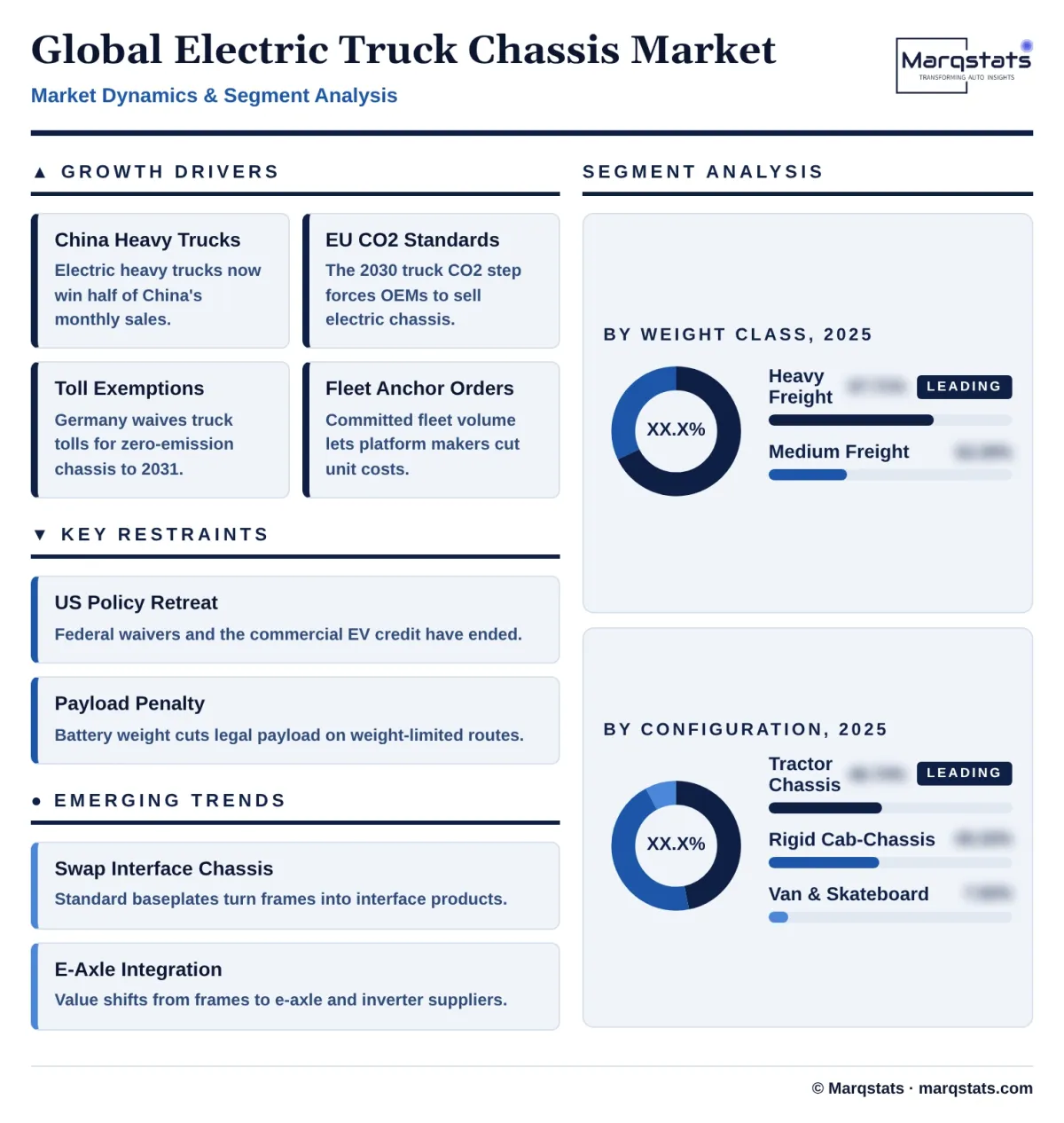
Four forces carry chassis demand through 2030, and each is backed by a named instrument or a measured sales shift.
- China heavy-truck electrification: new-energy heavy trucks reached 231,100 units in 2025, up 182%, and 29% of heavy-truck sales, per CV World. A joint plan from 11 ministries including the Ministry of Transport, reported in June 2026, targets 40% of new heavy-truck registrations by 2030 and a fleet above 1.6 million. The market is already above that target in many months, so the plan works as a floor.
- EU heavy-duty CO2 standards: Regulation (EU) 2019/1242, amended by Regulation (EU) 2024/1610, requires truck makers to cut fleet CO2 by 15% from 2025, 45% from 2030, 65% from 2035 and 90% from 2040. OEMs cannot meet the 2030 step without selling tens of thousands of electric chassis a year in Europe.
- Toll and operating cost advantages: Germany extended its truck toll exemption for zero-emission trucks of 4.25 tonnes and above to 30 June 2031. Toll savings on long-haul routes are large enough that fleets register electric chassis in Germany even when trucks run across borders.
- Fleet anchor orders: FedEx ordered 2,000 electric trucks from Harbinger Motors Inc. for more than USD 300 million in September 2026, for delivery by the end of 2027. Anchor orders give platform makers the volume needed to cut unit costs, which matters more for chassis than for complete trucks.
Key Restraints
Three constraints slow chassis demand, and each falls hardest on a different region.
- US policy retreat: Congressional Review Act resolutions signed in June 2025 revoked the federal waivers behind California's Advanced Clean Trucks rule, and the Section 45W commercial clean vehicle credit ended for vehicles acquired after 30 September 2025. US Class 7-8 zero-emission registrations fell to 875 in 2025 from 1,103 in 2024, per the ICCT.
- Payload penalty: a heavy battery-electric chassis carries several tonnes more than a diesel equivalent, which reduces legal payload on weight-limited routes. EU rules allow extra weight allowances for zero-emission trucks, but they do not fully offset the penalty for bulk haulers.
- Charging and grid lead times: medium-voltage depot connections can take years in Western Europe and the United States, while chassis can be delivered in months. Fleets that cannot charge delay chassis orders, which pushes European and North American demand later in the forecast window.
Key Trends
Three engineering trends change what a chassis contains and who earns its value.
- E-axles replace central motors: integrated e-axles combine motor, gearbox and inverter between the wheels, which removes the propeller shaft and frees the frame centre for battery packs. This moves value from the chassis builder to the e-axle supplier.
- Dual-pack layouts: CATL's 20 October 2026 launch pairs a swappable main pack with a fixed backup pack. Chassis must now carry two battery systems and two thermal circuits, which raises chassis value per unit for swap trucks even as cell costs fall.
- Platform makers integrate vertically: Workhorse Group Inc. completed its merger with Motiv Electric Trucks in December 2025 and targets production of a Class 5/6 cab chassis in early 2027. Harbinger Motors Inc. builds its own chassis, e-axles and battery packs. Small platform makers survive by controlling more of the chassis, not less.
Strategic Implications
- For entrants: a skateboard or stripped chassis needs a fleet anchor before it needs a factory. Harbinger secured FedEx volume and built its 1,000th vehicle by September 2026; REE Automotive Ltd. reached certification without volume and sought court protection in July 2026.
- For incumbent truck makers: European heavy chassis will carry 23.74% of global chassis value in 2030 on 8.34% of units. Capacity planning should follow value, and the 2030 EU CO2 step makes the European ramp a compliance cost, not an option.
- For suppliers and investors: e-axle, inverter and battery-enclosure suppliers capture the value that moves out of frames and drivelines. In China, swap-interface standards set by CATL will decide which chassis suppliers stay on approved lists, so supplier qualification with the battery maker matters as much as qualification with the truck maker.
Market Segmentation
Heavy freight truck chassis are the larger segment at USD 7.17 billion in 2025, 67.71% of value, rising to USD 16.80 billion in 2030, a 18.57% CAGR. Heavy chassis are 52.27% of 2025 units (230,000) and 56.73% of 2030 units (544,000).
The segment is dominated by Chinese tractors and dump trucks. Chinese heavy chassis carry a Marqstats-estimated value of USD 28,000 per unit in 2025, against USD 110,000 in Europe and USD 150,000 for US Class 7-8 trucks. The heavy segment's share of value grows because Europe's heavy volumes rise under the 2030 CO2 step and China keeps moving bulk haulage, port and mine traffic onto battery-swap tractors.
Medium freight truck chassis are worth USD 3.42 billion in 2025, 32.29% of value, rising to USD 6.70 billion in 2030 at a 14.40% CAGR. Units go from 210,000 to 415,000.
The segment covers trucks above 3.5 tonnes and below the heavy threshold, including US Class 2b-3 heavy vans, Class 4-6 cab-chassis, European N2 trucks and Chinese medium trucks. US heavy vans are the largest single block outside China, about 15,522 units in 2025 per the IEA and ICCT data, led by Rivian Automotive, Inc. delivery vans. Medium chassis grow more slowly than heavy chassis because Chinese medium-truck electrification started earlier and is closer to maturity.
Tractor chassis are worth USD 4.95 billion in 2025, 46.74% of value, and become the largest configuration by 2030 at USD 12.12 billion, 51.57% of value, a 19.61% CAGR.
Tractors gain because the most valuable new demand is regional and long-haul freight. In China, tractors are the main battery-swap application. In Europe, the 2030 CO2 step can only be met by electrifying tractors, since they emit most of the fleet's CO2. Tesla, Inc. said volume production of its Class 8 Semi tractor began in the third quarter of 2026, with installed capacity of 25,000 a year in Nevada.
Rigid cab-chassis are worth USD 4.80 billion in 2025, 45.33% of value, rising to USD 9.87 billion in 2030 at a 15.51% CAGR. Their share falls to 42.00%.
Rigid cab-chassis carry refuse, tipper, mixer, box and refrigerated bodies fitted by second-stage builders. They electrified first because urban routes are short and return to base each night. Their slower growth is a sign of earlier maturity, not weakness: in China, rigid electric dump trucks and mixers were among the first heavy segments to switch.
Integrated van and skateboard platforms are worth USD 0.84 billion in 2025, 7.93% of value, and USD 1.51 billion in 2030, a 12.44% CAGR.
This configuration covers walk-in vans and purpose-built skateboards above 3.5 tonnes where the battery tray forms part of the structure. It is the most volatile segment. Rivian Automotive, Inc. delivered about 10,000 heavy delivery vans in the United States in 2025, per the IEA. REE Automotive Ltd. sought a stay of proceedings at the Tel Aviv District Court in July 2026, with Nasdaq delisting on 7 July 2026, after its market value fell from USD 3.1 billion at listing to about USD 6.11 million. Platform success here depends on a committed fleet buyer.
By Geography
China
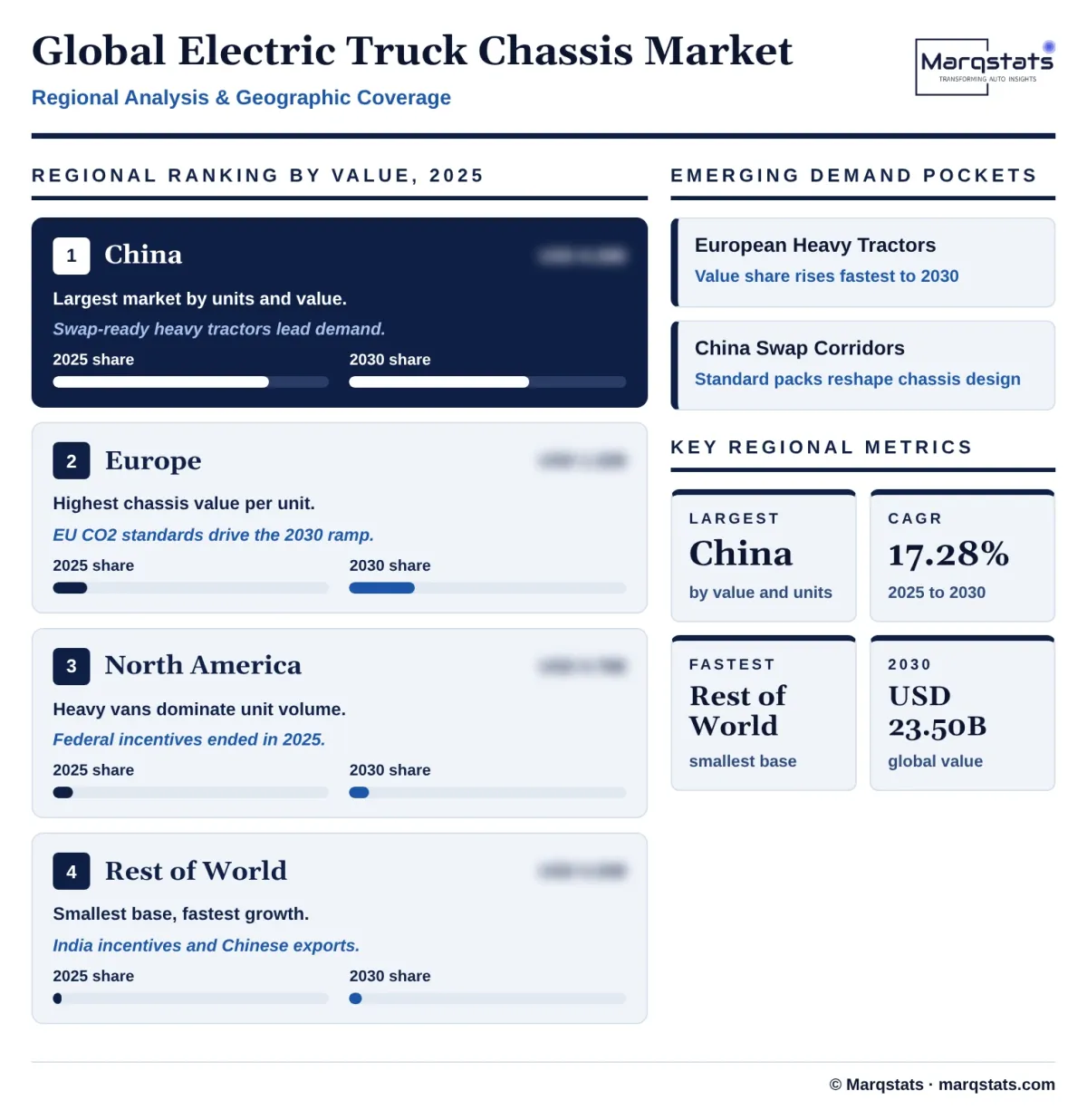
China is the largest market at USD 8.28 billion in 2025, 78.19% of value, on 396,000 units. It grows to USD 15.22 billion by 2030 at a 12.95% CAGR, with 800,000 units.
China's lead rests on price and policy. New-energy heavy trucks reached 29% of heavy-truck sales in 2025 and 54% in December 2025, per CV World. The CPCA reported a 50% share in September 2026. Chassis values are low because domestic e-axle, frame and battery-enclosure suppliers compete hard and battery-swap standardisation removes bespoke work. CATL, XCMG Construction Machinery Co., Ltd., Sany Heavy Industry Co., Ltd., China FAW Group Co., Ltd., Shaanxi Automobile Group Co., Ltd. and Zhengzhou Yutong Group Co., Ltd. are central to this ecosystem.
Europe
Europe (EU, EFTA and the United Kingdom) is worth USD 1.32 billion in 2025 on 17,000 units and grows to USD 5.58 billion on 80,000 units by 2030, a 33.42% CAGR. Its value share rises from 12.46% to 23.74%.
ACEA data for 2025 show electric trucks at 4.2% of EU truck registrations, with 7,867 medium and 4,991 heavy electric trucks. In the first half of 2026, EU electrically chargeable truck registrations rose 47.7% to 8,235. Germany, the Netherlands and France account for 74% of EU electric truck registrations. Europe is the main reason the global average chassis value rises, since a European chassis averages about USD 77,647 in 2025 against about USD 20,909 in China.
North America
North America (the United States and Canada) is worth USD 0.79 billion in 2025 on 19,700 units and grows to USD 1.65 billion by 2030, a 15.87% CAGR, the slowest of the four regions.
The United States sold about 17,000 electric trucks above 3.5 tonnes in 2025, per the IEA, and Canada about 2,700. Most US volume is heavy vans: ICCT registration data count only 603 Class 4-6 and 875 Class 7-8 zero-emission trucks in 2025. Marqstats expects US units to dip to about 15,220 in 2026 after federal incentives ended, then recover to about 33,600 by 2030 as Tesla, Inc., Harbinger Motors Inc. and the legacy truck makers ramp production.
Rest of World
The rest of the world is worth USD 0.20 billion in 2025 on 7,300 units and grows to USD 1.05 billion by 2030, a 39.33% CAGR, the fastest of any region from the smallest base.
India sold about 800 heavy-duty electric trucks in 2025, according to NITI Aayog. The PM E-DRIVE scheme, notified by the Ministry of Heavy Industries on 10 July 2025, offers incentives for up to 5,643 electric trucks. Mexico, Brazil, South Korea, Japan and Australia add smaller volumes. Chinese exporters supply a growing share of rest-of-world chassis, which keeps prices in the region close to Chinese levels.
How Competition Is Evolving
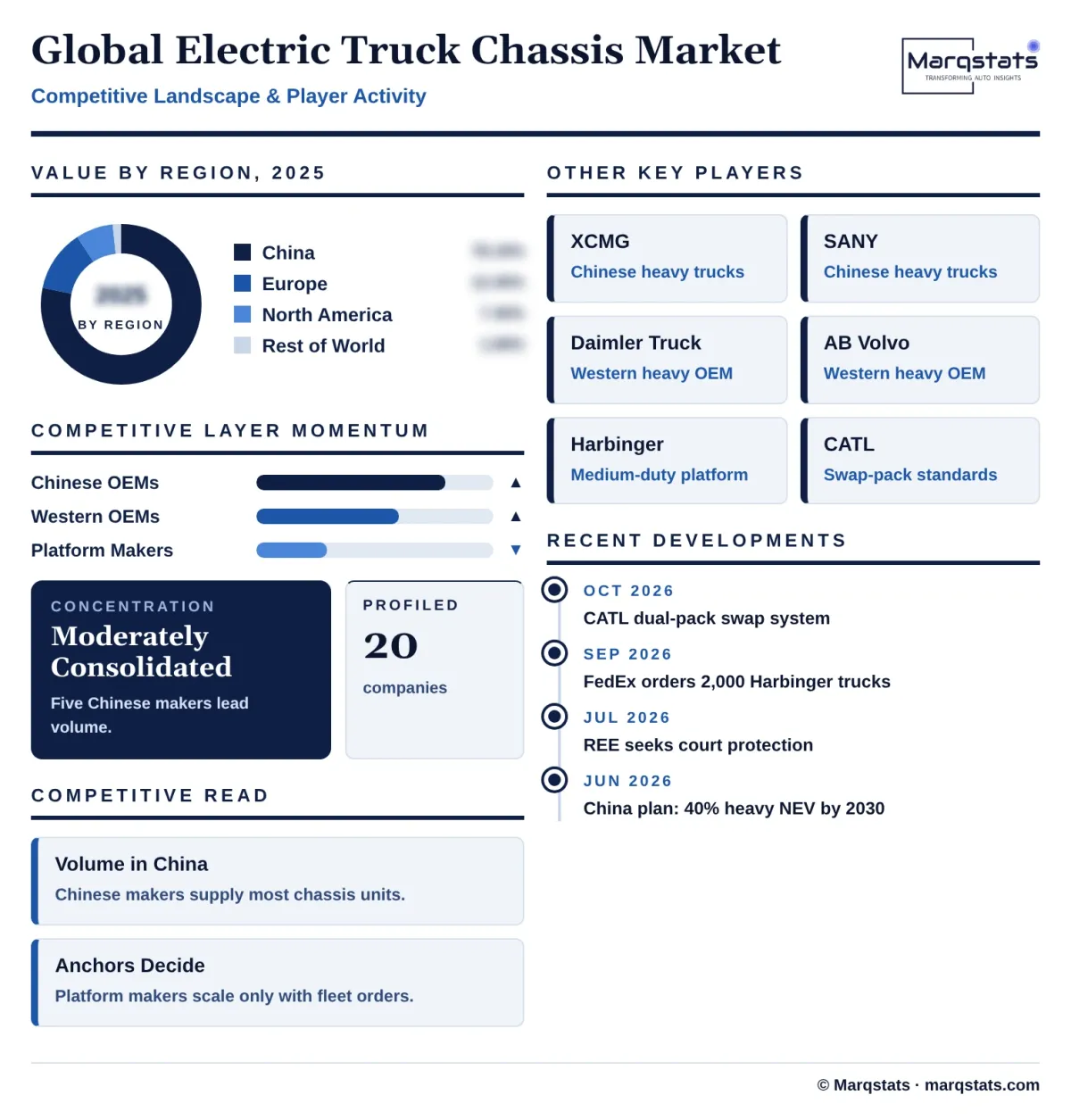
Competition splits into three layers. Chinese heavy-truck makers and construction-machinery groups supply most units. Western truck groups supply most value outside China. Platform makers build skateboards and stripped chassis for fleets and body builders. Marqstats rates the market as moderately consolidated. The ICCT, as reported by electrive in January 2026, put the top five Chinese zero-emission truck makers (XCMG, SANY, FAW, Shacman and Yutong) at 61% of Chinese zero-emission truck sales in 2025. China is 90% of global units, so those five lead the world by volume.
Western incumbents compete on engineering content and service networks. Daimler Truck Holding AG, AB Volvo and TRATON SE build electric chassis on adapted ladder frames that keep standard body-mounting interfaces, so body builders can fit refuse, tipper and box bodies without redesign. PACCAR Inc, Iveco Group N.V. and Isuzu Motors Limited compete in medium and heavy rigid chassis. Tesla, Inc. entered volume production of its Class 8 Semi in the third quarter of 2026.
Platform makers are the most fragile layer. Harbinger Motors Inc. builds its own chassis, e-axles and battery packs, built its 1,000th vehicle by September 2026 and holds a 2,000-truck FedEx order. Workhorse Group Inc. combined with Motiv Electric Trucks in December 2025 and reported 21 vehicle deliveries in the first quarter of 2026. REE Automotive Ltd. sought a court-supervised debt settlement in July 2026. The pattern is clear. A skateboard platform needs a committed fleet buyer before it scales.
CATL shapes competition without building chassis. Its swap-pack standards and its target of 900 heavy-truck swap stations by the end of 2026 decide which Chinese chassis are compatible with the largest swap network. That gives a battery maker leverage over chassis design normally held by truck makers.
Companies Covered
Companies covered in the report include:
Recent Market Activity
Table of Contents
Coverage & Segmentation
Marqstats defines the market as annual sales value of new electric medium and heavy freight truck chassis above 3.5 tonnes gross vehicle weight, following the IEA medium freight truck and heavy freight truck definitions. It covers battery-electric, fuel-cell and plug-in hybrid chassis, sold as complete trucks, cab-chassis, tractors, stripped chassis or skateboard platforms. Value is measured at ex-works level and includes the frame or structural tray, cab where fitted, e-drive, power electronics, high-voltage distribution, battery enclosures with mounting and thermal hardware, suspension, steering and brakes.
Traction battery cells and modules, bodies and upfits, trailers, buses, light commercial vehicles at or below 3.5 tonnes, dealer margin, taxes and purchase incentives are excluded. Regions are China, Europe (EU, EFTA and the United Kingdom), North America (United States and Canada) and Rest of World. The base year is 2025, history covers 2021 to 2025 and the forecast runs from 2026 to 2030.
Scope boundaries with related Marqstats pages: the chassis layer sits below complete-vehicle markets and must not be added to them. The global electric heavy duty truck market page values complete trucks above 15 tonnes; the China electric heavy duty truck market page counts 231,100 units in 2025 on a 12 to 14 tonne threshold, which sits inside the China total here; the Europe electric medium and heavy duty truck market page covers the EU27 only. The North America slice uses the same 17,000 US units as the Marqstats US electric truck sizing. Do not add chassis value to any of these complete-truck figures.