Market Snapshot
Key Takeaways
Market Overview & Analysis
Report Summary
The SDV middleware market is at the centre of the most consequential architectural transition in the automotive industry since the adoption of multiplexed CAN bus networking in the 1990s. The study period is 2021–2030 with 2025 as base year. The market's defining dynamic is the convergence of three structural forces: the regulatory imperative (UNECE R155/R156 requiring cybersecurity management systems and controlled software update processes), the architectural imperative (centralised and zonal E/E architectures requiring middleware to orchestrate services across heterogeneous compute domains), and the commercial imperative (OEMs recognising that the vehicle software stack — including middleware — is a long-duration differentiation and monetisation asset, not just an engineering cost). The European Commission's March 2025 Automotive Action Plan's explicit commitment to an 'EU-wide open platform on SDVs, including software building blocks, interfaces, standards, and tools' and a 'large-scale distributed pilot facility in 2026/2027 for SDV and AI engineering' confirms that middleware is now treated as strategic industrial infrastructure, not just a supplier niche.
The automotive middleware landscape in 2025 operates on two parallel tracks: the formal standards track (AUTOSAR Classic for embedded ECUs, AUTOSAR Adaptive for high-performance compute domains) and the open-source collaborative track (Eclipse S-CORE as a shared safety-aligned middleware foundation, SOAFEE as the cloud-native architectural layer, COVESA VSS as the vehicle data model). These tracks are not competing — they are increasingly complementary, with commercial vendors (Qorix, Elektrobit, Vector, ETAS, TTTech Auto/NXP) building production-qualified, safety-certified products on top of open-source foundations and AUTOSAR standards. The Eclipse/VDA pre-competitive collaboration's explicit goal — shared automotive-grade components reducing non-differentiating engineering effort — reflects the industry's recognition that middleware, like the CAN protocol before it, is most commercially valuable when standardised so that OEMs and Tier-1s can focus their differentiation on applications, user experience, and vehicle-specific intelligence.
The competitive intensity of the SDV middleware market is increasing rapidly, as evidenced by the pace of M&A (NXP/TTTech Auto), new platform launches (QNX/Vector Alloy Kore, Qorix Performance Stack, TTTech Auto MotionWise Communication), open-source contributions (ETAS v0.6.0, Qualcomm joining S-CORE), and services-side engagement wins (KPIT USD 232 million Q2 FY2026, middleware wins across European and American OEMs). The market is simultaneously expanding horizontally — middleware is needed for every new vehicle architecture — and deepening vertically — as safety certification, OTA orchestration, and AI integration add new requirements to the middleware stack. Both dimensions benefit incumbent middleware vendors with established certification credentials and growing entrants with open-source-native architecture.
Market Dynamics
Key Drivers
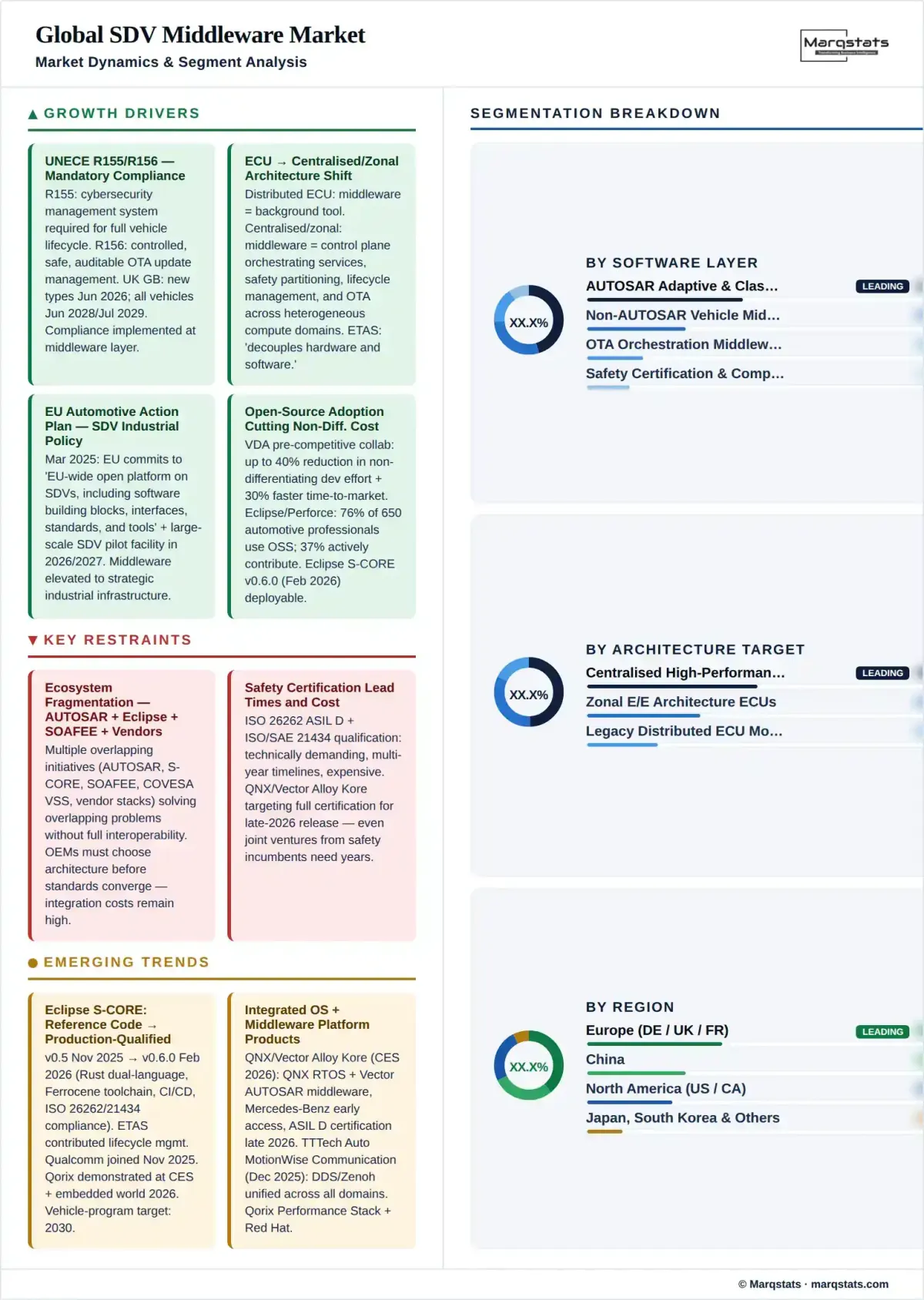
- UNECE R155/R156 creating mandatory cybersecurity management and software update management obligations that require middleware support: The most direct regulatory driver for the SDV middleware market is UNECE Regulation 155 (vehicle cybersecurity) and Regulation 156 (software update management). R155 requires manufacturers to have a cybersecurity management system covering the full vehicle lifecycle, including identifying threats, implementing mitigations, monitoring and responding to attacks, and providing evidence of compliance. R156 requires a software update management system ensuring that software updates are safe, controlled, and leave vehicles in a compliant state. The UK Vehicle Certification Agency's implementation timeline — R155 and R156 compliance required for new GB vehicle types by June 2026, complete and incomplete vehicles by June 2027, and all completed vehicles by June 2028 (R155) and July 2029 (R156) — establishes a clear compliance calendar that applies across all markets where UNECE regulations are adopted. For automotive middleware vendors, these regulations are market-expanding because software stacks must now actively support traceable, auditable cybersecurity processes and safe update orchestration — capabilities that are implemented at the middleware layer and require ongoing vendor support rather than one-time engineering effort.
- Architectural migration from distributed ECU to centralised/zonal compute elevating middleware from infrastructure to strategic control layer: The fundamental architectural transition shaping the SDV middleware market is the shift from distributed ECU architectures — where each function runs on a dedicated, proprietary ECU — toward centralised high-performance compute and zonal E/E architectures that consolidate vehicle intelligence on fewer, more powerful compute nodes. This architectural shift is precisely described by ETAS as the move to 'high-performance computing and centralized zonal E/E architectures that consolidate in-vehicle intelligence while decoupling hardware and software.' In distributed architectures, middleware is a background integration layer. In centralised and zonal architectures, middleware is the control plane that orchestrates services across compute domains, manages application lifecycle, handles inter-domain communication, enables hardware abstraction, and implements safety partitioning between mixed-criticality workloads. This architectural shift does not just increase the importance of automotive middleware — it makes it mission-critical in a way that directly expands market value.
- EU Automotive Action Plan 2025 committing to EU-wide open SDV software platform elevating middleware to industrial-policy priority: The European Commission's March 2025 Automotive Action Plan — committing to develop an 'EU-wide open platform on SDVs, including software building blocks, interfaces, standards, and tools' and to 'develop an in-vehicle computing architecture for SDVs' — is a major demand catalyst for the SDV middleware market. When middleware is designated as industrial infrastructure by the EU, the commercial and policy ecosystem that surrounds it expands: government grants, collaborative research programmes, OEM participation requirements, and procurement standards all begin to reflect the priority status. The Commission's commitment to a large-scale distributed SDV pilot facility in 2026/2027 for SDV and AI engineering directly supports the testing and validation infrastructure that middleware vendors and OEMs need to qualify production-grade automotive middleware at scale.
- OEM software-stack monetisation — Rivian/VW and platform licensing — confirming middleware as a strategic commercial asset: Rivian's disclosure that Volkswagen Group planned to use Rivian's zonal ECU architecture and software stack across multiple VW brands — with Rivian receiving approximately USD 1.3 billion for IP related to its existing vehicle electrical architecture and software technology — is one of the most commercially significant signals that SDV software stacks, including their middleware components, are becoming monetisable strategic assets. This licensing model — where an OEM with a mature software architecture licenses it to other OEMs rather than each building proprietary stacks — has direct implications for middleware vendors: it creates demand for middleware that is architecturally clean enough to be licensed, documented enough to be integrated across organisations, and certified to standards that multiple OEMs can adopt. The trend toward platform licensing also potentially concentrates middleware design wins in the winning OEM's preferred supplier stack.
- Open-source adoption reducing non-differentiating development cost and accelerating middleware deployment timelines: The VDA-backed pre-competitive open-source collaboration's claim that shared automotive-grade middleware components can reduce non-differentiating development effort by up to 40% and improve time-to-market by up to 30% captures the commercial logic driving open-source middleware adoption. An Eclipse/Perforce survey of approximately 650 automotive development professionals found approximately 76% use open-source tools and/or in-vehicle software, and approximately 37% actively contribute — confirming that open-source middleware foundations are mainstream automotive development practice. Eclipse S-CORE's progression from concept (2024) to v0.5 (November 2025) to v0.6.0 (February 2026) — with vehicle-program targeting by 2030 — demonstrates that the open-source middleware track is delivering usable code, not just standards documents. Commercial middleware vendors (Qorix, Elektrobit, ETAS) are actively building production-qualified, safety-certified products on S-CORE foundations — creating an open-source-to-production pipeline that benefits the entire ecosystem.
Key Restraints
- Ecosystem fragmentation across AUTOSAR, Eclipse SDV, SOAFEE, COVESA, and vendor-specific stacks creating integration complexity and adoption friction: The SDV middleware ecosystem is characterised by multiple overlapping initiatives — AUTOSAR Classic and Adaptive for standards, Eclipse S-CORE for shared safety-aligned middleware, SOAFEE for cloud-native architectural patterns, COVESA VSS for vehicle data models, and dozens of vendor-specific commercial stacks — that are solving overlapping parts of the middleware problem without full interoperability. This fragmentation creates genuine commercial friction: OEMs must make architectural decisions about which standards to implement, which open-source foundations to adopt, and which commercial middleware vendors to engage, with limited certainty that these choices will converge toward an industry standard. The existence of so many simultaneous alliances — each with legitimate technical contributions and industry backing — is evidence that the middleware standardisation problem is not yet solved and that integration costs remain high.
- Safety certification requirements creating long lead times and high qualification costs for automotive middleware: Automotive middleware operating in safety-critical domains (ADAS, autonomous driving, powertrain control) must be qualified to functional safety standards (ISO 26262 ASIL B/C/D) and cybersecurity standards (ISO/SAE 21434). These certification processes are technically demanding, time-consuming, and expensive — requiring documented evidence of development processes, tool qualification, systematic testing, and auditable safety cases. QNX/Vector's Alloy Kore platform is targeting full ISO 26262 ASIL D and ISO/SAE 21434 certification for its late-2026 release — implying that even well-resourced joint ventures from established safety software vendors require a multi-year certification timeline. For smaller middleware vendors, the cost and lead time of full safety qualification can limit addressable program opportunities and create barriers to entering safety-critical middleware segments.
- OEM build-versus-buy tension reducing addressable market for third-party middleware when OEMs develop proprietary stacks: Some OEMs — particularly those with large software engineering organisations — are investing in proprietary middleware stacks rather than purchasing from third-party vendors. Tesla's vertically integrated software model is the clearest example: it develops its own operating system, middleware, and application stacks, reducing reliance on external middleware suppliers. When OEMs choose to build rather than buy, the addressable market for commercial middleware vendors shrinks in that OEM's program pipeline. The Rivian/VW licensing model represents an intermediate scenario — where OEM-developed middleware becomes a licensable commercial asset — but it is not yet the industry norm. The commercial middleware market therefore depends on the majority of OEMs continuing to rely on Tier-1 or specialist middleware suppliers rather than internalising the capability.
- China's domestic middleware ecosystem reducing global vendor penetration in one of the most commercially important growth markets: China is the world's largest automotive market and the fastest-growing SDV deployment environment, but it has a well-established domestic software and middleware ecosystem — including Huawei HarmonyOS Automotive, Neusoft Reach, ECARX's Cloudpeak middleware, and other domestic suppliers — that competes directly with European and North American middleware vendors. International vendors entering China must navigate local preferences, partner requirements, export control considerations, and the commercial strength of domestic alternatives. Qorix's March 2026 partnership with Shanghai Tranzy Group as its first Chinese reseller represents the typical entry strategy — local distribution and technical integration partnerships — but it carries the inherent risk of the partner's limited reach versus established domestic competitors.
Key Trends
- Eclipse S-CORE progressing from reference code to production-qualified automotive middleware: Eclipse S-CORE is the most commercially significant open-source development in automotive middleware, and its progression from conceptual consortium (2024) to v0.5 first public release (November 2025) to v0.6.0 with full dual-language C++ and Rust support, ISO 26262 and ISO/SAE 21434 compliance enhancements, and CI/CD automation (February 2026) marks its transition from research project to deployable software. Key S-CORE developments: ETAS contributed lifecycle and health management capabilities in v0.6.0; Qualcomm joined the project in November 2025, bringing Snapdragon hardware alignment; Qorix demonstrated S-CORE-based middleware at CES 2026, embedded world 2026, and ELIV 2025. The v0.5 release in November 2025 and vehicle-program targeting by 2030 mean that programs that start architecture selection in 2025–2026 can consider S-CORE-based middleware as a viable foundation — a transition point with major commercial implications for both open-source-based vendors and proprietary stack providers.
- New vehicle software platform products combining OS, middleware, and toolchain into integrated SDV foundations: A new category of integrated vehicle software platform — combining a safety-certified operating system, middleware, and software development toolchain into a unified, pre-integrated foundation — is emerging as the most commercially attractive SDV infrastructure product. QNX and Vector's Alloy Kore (unveiled at CES 2026, early access to Mercedes-Benz, full certification release late 2026) combines QNX RTOS with Vector AUTOSAR middleware for centralized HPC and OTA update support. TTTech Auto's MotionWise Communication (launched December 2025) provides unified automotive communication middleware using DDS and Zenoh protocols across all vehicle domains. Qorix's Performance Stack (demonstrated with Red Hat In-Vehicle OS at embedded world 2026 and with ECARX hardware at CES 2026) similarly integrates middleware and OS layers with deterministic orchestration for safety-relevant architectures. These integrated platform products reduce the OEM/Tier-1 integration effort and create a higher average selling price per program than individual middleware components sold separately.
- Rust language adoption in safety-critical automotive middleware opening new development paradigms: Eclipse S-CORE v0.6.0's addition of full Rust language support — including 5 Rust API modules, Rust backends for persistence, communication, and logging, and integration of the Ferrocene safety-critical Rust toolchain — marks a significant shift in automotive middleware development practice. Rust's memory safety guarantees, which prevent the class of memory corruption bugs most responsible for cybersecurity vulnerabilities in C/C++ codebases, align well with the automotive industry's growing ISO/SAE 21434 cybersecurity obligations. The adoption of Rust in safety-critical middleware also aligns with trends in broader systems software (Linux kernel, Android system components) and reduces the gap between automotive and consumer/cloud software development practices, making automotive middleware more accessible to the larger pool of Rust-familiar software engineers outside the traditional automotive software supply chain.
- SOME/IP protocol openness and service-oriented architecture adoption accelerating middleware interoperability: Technica Engineering and KPIT's January 2026 decision to open the full SOME/IP specification for free marks a commercially important ecosystem development. SOME/IP (Scalable Service-Oriented Middleware over IP) — originally developed by BMW — is one of the most widely used protocols for in-vehicle Ethernet, supporting service-oriented communication for SDV, ADAS, and connected mobility applications. Making the full specification freely available to OEMs, suppliers, developers, and academic institutions reduces a licensing barrier that previously constrained adoption outside major automotive tier-1 ecosystems. This openness directly supports the service-oriented architecture model that Adaptive AUTOSAR and Eclipse S-CORE both depend on, accelerating the migration from signal-based to service-based in-vehicle communication that SDV middleware requires.
Market Segmentation
Automotive middleware — the software layer between operating system and application in vehicle compute systems — matters in software-defined vehicles for reasons that are architecturally fundamental rather than incidental. In a distributed ECU architecture, software can be tightly coupled to hardware without significant cost: each ECU runs one function, and the vendor who supplies the hardware typically also supplies the software. In a centralised or zonal SDV architecture, multiple functions from different vendors run on shared hardware nodes, multiple compute domains (safety-critical, non-safety, infotainment, connectivity) must coexist on the same physical hardware, and software must continue to be updated, reconfigured, and extended throughout the vehicle's service life. None of this is achievable without a stable middleware layer that provides hardware abstraction, service-oriented communication, lifecycle management, safety partitioning, and update orchestration.
ETAS describes this precisely: the shift toward high-performance computing and centralised zonal E/E architectures consolidates in-vehicle intelligence while decoupling hardware and software. That decoupling — enabling software to be developed, tested, and deployed independently of specific hardware revisions — is the middleware layer's core value proposition. Without it, every software update requires re-validation of the entire hardware/software stack, every new compute platform requires re-integration of all application software, and every OEM must maintain a proprietary integration capability that has no customer-facing value. With mature middleware, software updates can be deployed over the air, new hardware generations can be adopted without application rewrites, and development teams can work in parallel on different software domains without manual integration bottlenecks.
AUTOSAR Adaptive Platform is the primary formal standard for automotive middleware on high-performance compute domains in software-defined vehicles. Where AUTOSAR Classic serves deeply embedded, resource-constrained ECUs with static software configurations — providing deterministic real-time behaviour for body electronics, powertrain control, and other traditional automotive functions — AUTOSAR Adaptive is designed for high-performance computing platforms running dynamic applications: ADAS processing, connected services, central compute domains, and software applications that need to be loaded, updated, and reconfigured at runtime. AUTOSAR Adaptive implements a service-oriented architecture using SOME/IP for inter-process and inter-machine communication, provides dynamic service discovery and binding between clients and services, manages application lifecycle (loading, starting, stopping, updating) and supports software component isolation and containerisation.
The commercial significance of AUTOSAR Adaptive as a middleware standard is that it provides a portable, vendor-neutral interface that allows OEMs to deploy software from multiple suppliers on shared hardware without requiring each supplier to integrate with every other supplier's proprietary communication and runtime layer. Vector's MICROSAR Adaptive, Elektrobit's EB corbos, ETAS's AUTOSAR Adaptive implementation, and other commercial AUTOSAR Adaptive stacks all provide the same standardised interfaces — differentiated by performance, certification depth, toolchain integration, and support services — rather than by proprietary API. This standardisation makes AUTOSAR Adaptive a growth driver for the commercial middleware market rather than a commoditising force: the standard defines the interface, but the implementation quality, safety certification, and vendor support create real commercial differentiation.
Vector became an AUTOSAR core partner in January 2026 — alongside DENSO and Huawei — indicating that the AUTOSAR governance structure is expanding to include a broader range of strategically important contributors. Vector's MICROSAR Adaptive covers network management and delta update capabilities. Elektrobit's EB corbos product family — including its corbos Linux for Safety Applications — provides an AUTOSAR Adaptive-aligned runtime with Linux-based safety profile. ETAS's Vehicle Software Platform Suite covers both AUTOSAR Adaptive and Classic implementations alongside ADAS/AD deterministic middleware and edge middleware, positioning it as one of the broadest-scope middleware vendors in the market.
Centralised compute and zonal E/E architecture represent the two primary architectural destinations of the SDV transition. Centralised compute consolidates vehicle intelligence on a small number of high-performance compute units — vehicle computers running automotive-grade processors (Qualcomm Snapdragon Automotive, NXP S32, Renesas R-Car, NVIDIA DRIVE) — with zonal architectures distributing simpler zonal ECUs geographically around the vehicle to aggregate sensor inputs and control local actuators. Both architectures require middleware to manage the software layer, but they require it differently: centralised compute needs middleware that can orchestrate multiple concurrent applications from different suppliers with safety partitioning and deterministic timing; zonal ECUs need lightweight middleware that provides standardised interfaces, update capability, and communication bridging between zones and the central compute.
NXP's positioning is illustrative: its S32K5 family extends the CoreRide platform with pre-integrated zonal and electrification solutions for scalable SDV architectures — providing hardware and software-middleware integration in a single platform product that reduces OEM integration effort for zonal architectures. TTTech Auto's MotionWise Communication (December 2025) explicitly targets the full range from high-performance compute units to resource-constrained microcontrollers — addressing both centralised and zonal compute requirements with a unified communication middleware product. Qorix's Performance Stack demonstrations at CES 2026 and embedded world 2026 showed different vehicle domains operating on shared hardware under controlled, deterministic conditions — precisely the centralised compute scenario that requires middleware for safety partitioning and domain isolation.
The vehicle operating system and hypervisor layer sits immediately below the middleware in the SDV software stack, and the boundary between OS, hypervisor, and middleware is increasingly blurred as integrated platform products bundle all three layers. QNX — developed by BlackBerry's QNX division — is the leading safety-certified real-time operating system for automotive applications, widely used in instrument clusters, ADAS, and infotainment. QNX's virtualisation capabilities allow multiple operating environments to run on shared hardware under a QNX hypervisor, with safety-certified isolation between critical and non-critical domains. The QNX/Vector Alloy Kore platform unifies QNX OS with Vector AUTOSAR middleware specifically to provide an integrated foundation for centralised HPC and OTA update deployment — targeting ISO 26262 ASIL D and ISO/SAE 21434 in its late-2026 full release.
Linux-based automotive operating systems are increasingly important as high-performance compute platforms require the broader software ecosystem that Linux provides. Red Hat's In-Vehicle Operating System — a production-grade Linux foundation tailored to automotive environments — was demonstrated with Qorix Performance Stack at embedded world 2026, showing how automotive Linux can be integrated into a centralised vehicle architecture with controlled system boundaries and deterministic middleware orchestration. Elektrobit's corbos Linux for Safety Applications provides a safety-profiled Linux in the AUTOSAR Adaptive ecosystem. Eclipse S-CORE v0.6.0's integration updates for QNX, Red Hat AutoSD, and Elektrobit corbos Linux demonstrate that the open-source middleware layer is being actively tested with all three major automotive OS options simultaneously.
Over-the-air software update management is one of the most commercially important functions that automotive middleware must support in software-defined vehicles. UNECE R156 makes software update management systems a regulatory obligation — updates must be safe, controlled, and leave vehicles in a compliant state. At the middleware layer, OTA support requires: secure download and verification of software packages, staged deployment with rollback capability, version management across multiple ECUs and compute domains, compliance verification before and after update, and audit trail generation for regulatory evidence. These requirements go significantly beyond what simple embedded software update utilities provide — they require the middleware to orchestrate a vehicle-level update process across a heterogeneous multi-ECU architecture. Bosch and ETAS explicitly frame SDVs as vehicles designed to improve over time through OTA updates — describing this as a fundamental characteristic that middleware must support as a first-class capability, not an afterthought.
Domain integration — middleware enabling communication and service interaction across the safety-critical, ADAS, connectivity, and infotainment domains that previously operated in isolation — is the other structurally important middleware growth driver. TTTech Auto's MotionWise Communication uses DDS (Data Distribution Service) and Zenoh protocols to provide unified communication across vehicle domains, explicitly addressing both safety-critical and real-time domains, central compute ECUs, ADAS/AD systems, and zonal architectures from a single product. SOME/IP — the service-oriented middleware protocol for in-vehicle Ethernet, now with its full specification open-sourced by Technica Engineering and KPIT — is the most widely adopted inter-domain communication standard, present in AUTOSAR Adaptive, Eclipse S-CORE, and most commercial SDV middleware products.
By Geography
Europe — Regulatory Lead, AUTOSAR Hub, Most Advanced Open-Source Ecosystem
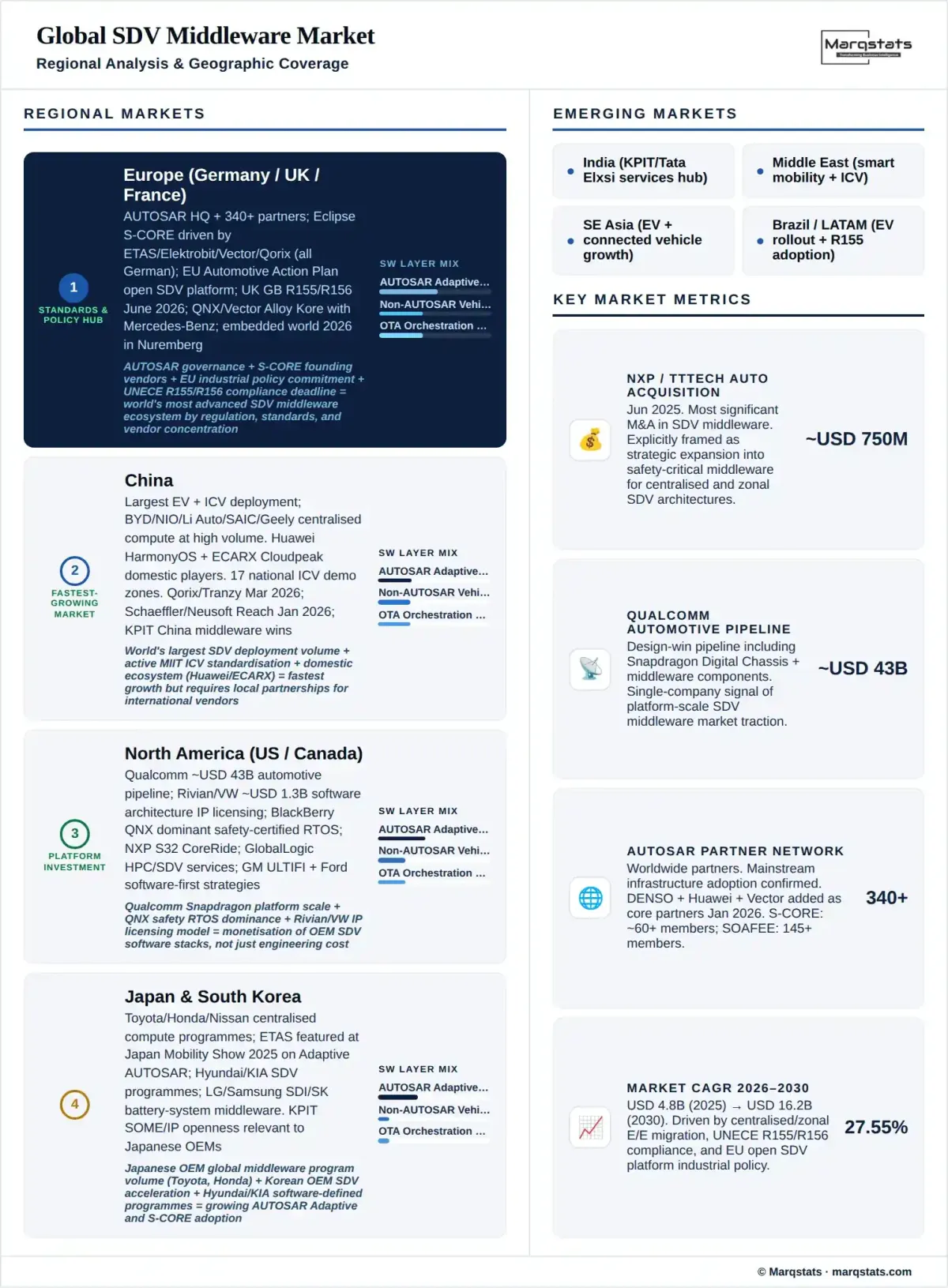
Europe is the world's most advanced SDV middleware market from a regulatory, standards, and open-source-ecosystem standpoint. UNECE R155/R156 implementation is most advanced in Europe — with UK GB type approval timelines (June 2026 for new vehicle types) and EU adoption both creating near-term compliance demand. The EU Commission's March 2025 Automotive Action Plan commits to an EU-wide open SDV platform and SDV pilot facility — making Europe the region where middleware is most explicitly an industrial policy priority. AUTOSAR is headquartered and governed in Europe, with its 340+ partners predominantly European automotive OEMs and Tier-1 suppliers. Eclipse S-CORE is driven primarily by European companies: ETAS (Bosch), Elektrobit, Vector, and Qorix are all European and are the most active S-CORE contributors. QNX/Vector's Alloy Kore was launched with Mercedes-Benz as the reference OEM exploring integration. Qorix and ETAS demonstrated S-CORE-based middleware at embedded world 2026 in Germany — Europe's most important automotive embedded software event. Europe is also home to the dominant commercial middleware vendors: Elektrobit (Germany), Vector (Germany), ETAS/Bosch (Germany), TTTech Auto/NXP (Austria/Netherlands), and Qorix (Germany).
North America — Platform Investment, Tier-1 Services, High Compute Architectures
North America is the second-largest SDV middleware market, characterised by high-compute platform investment from semiconductor companies (Qualcomm Snapdragon Digital Chassis, NXP S32), strong Tier-1 engineering services activity (KPIT, GlobalLogic/Hitachi), and OEM software-first strategies (GM ULTIFI, Ford, Rivian). Qualcomm's approximately USD 43 billion automotive design-win pipeline is the clearest North American signal of platform-scale SDV middleware traction. Redwood's Rivian/VW platform licensing — approximately USD 1.3 billion for software architecture IP — is the most commercially significant proof point that North American OEM-developed SDV stacks including middleware are monetisable assets. GlobalLogic and Elektrobit expanded their 15-year partnership in January 2026 — GlobalLogic providing safety-critical software, HPC, and SDV tooling alongside Elektrobit's Adaptive and Classic AUTOSAR middleware for OEM programs globally. BlackBerry QNX (Canada) is the dominant safety-certified RTOS in North American automotive programs, and QNX/Vector Alloy Kore is positioned for North American OEM deployments in addition to Mercedes-Benz.
China — Fastest-Growing Market, Domestic Ecosystem Building, International Vendors Entering
China is the fastest-growing national SDV middleware market, reflecting China's dominant position in global EV and intelligent-connected-vehicle deployment, active state-backed standardisation for ICV architectures, and rapidly scaling OEM demand for production-grade middleware. The Chinese government had established 17 national demonstration zones for ICV testing by 2025, and MIIT has been running standardisation programmes for new energy vehicles and intelligent connected vehicles. Chinese OEMs — BYD, NIO, Li Auto, SAIC, Geely, and others — are deploying centralised compute architectures at high volume, creating substantial demand for middleware that can orchestrate these architectures. Domestic middleware players include Huawei HarmonyOS Automotive, ECARX's Cloudpeak (an open middleware architecture demonstrated on the Zenith platform with Qualcomm SA8797P compute), and Neusoft Reach (with its Schaeffler SDV co-development). International vendors are entering: Qorix signed its first Chinese reseller agreement with Shanghai Tranzy Group in March 2026; KPIT secured middleware engagements with Chinese OEMs in its Q3 FY2026 update; Autolink and Tata Elxsi signed an MoU at CES 2026 for SDV middleware and E/E architecture collaboration. The China middleware market is large enough to attract significant international investment but competitive enough that local partnerships are essential for market penetration.
Japan and South Korea — OEM-Led Adoption, Standards Engagement
Japan and South Korea are significant SDV middleware markets through their OEM and Tier-1 global programs. Toyota, Honda, and Nissan are all developing SDV architectures with centralised compute, and Japan's engagement with AUTOSAR and SOAFEE is substantial. Bosch/ETAS gave a featured interview at the Japan Mobility Show 2025, specifically discussing SDV middleware, Adaptive AUTOSAR, and AUTOSAR open-source standardisation as priorities. South Korea's three battery manufacturers (LG, Samsung SDI, SK) and Hyundai/KIA's software-defined vehicle programmes create demand for middleware in both electrified and intelligent vehicle contexts. KPIT — through its Technica Engineering subsidiary (part of the KPIT Group) — opened the SOME/IP specification in January 2026, a move that has direct relevance to Japanese and Korean OEM programs that use in-vehicle Ethernet.
How Competition Is Evolving
The SDV middleware competitive landscape is best understood in three tiers: infrastructure and standards organisations (AUTOSAR, Eclipse SDV/S-CORE, SOAFEE, COVESA), commercial middleware vendors (Elektrobit, Vector, ETAS, TTTech Auto/NXP, Qorix, BlackBerry QNX), and engineering services and integration specialists (KPIT, GlobalLogic, Tata Elxsi). These tiers are not fully distinct — commercial vendors are active contributors to open-source foundations, and engineering services companies both integrate commercial middleware and build proprietary solutions — but the tiering is commercially useful because it reflects different revenue models and competitive dynamics.
Among commercial middleware vendors, Elektrobit is one of the most visible by installed-base scale — its software powering approximately 5 billion devices in approximately 620 million vehicles worldwide. The January 2026 expanded partnership with GlobalLogic combines Elektrobit's middleware product depth (EB corbos, EB tresos, EB robinos, EB zoneo, EB zentur) with GlobalLogic's safety-critical software and HPC engineering services for OEM program delivery globally. TTTech Auto — now part of NXP following the June 2025 approximately USD 750 million acquisition — brings MotionWise safety middleware and MotionWise Communication into NXP's automotive portfolio, creating an integrated compute platform (S32 silicon) plus middleware offering. Vector's MICROSAR Adaptive and AUTOSAR tooling position, reinforced by its January 2026 AUTOSAR core partner status and the Alloy Kore launch with QNX, makes it a central middleware and toolchain player. ETAS's Vehicle Software Platform Suite — spanning AUTOSAR Adaptive and Classic, ADAS/AD deterministic middleware, and edge middleware, plus its S-CORE contribution — positions it as one of the broadest-scope middleware vendors. Qorix, a focused SDV middleware specialist, has built a differentiated position through early S-CORE production qualification activity, the AI-powered Qorix Developer tool, and the Performance Stack demonstrated on production hardware with partners including ECARX, Red Hat, and ZF.
In engineering services, KPIT is the most commercially visible SDV middleware services specialist — securing USD 232 million in new engagements in Q2 FY2026 including strategic middleware wins with European and American car manufacturers, and opening the SOME/IP specification through its Technica Engineering subsidiary. GlobalLogic (Hitachi Group) supports Elektrobit and OEMs in safety-critical software, HPC, and SDV tooling. Tata Elxsi provides the AVENIR SDV framework spanning middleware, ADAS, cockpit, and compliance, demonstrated in its CES 2026 MoU with Autolink.
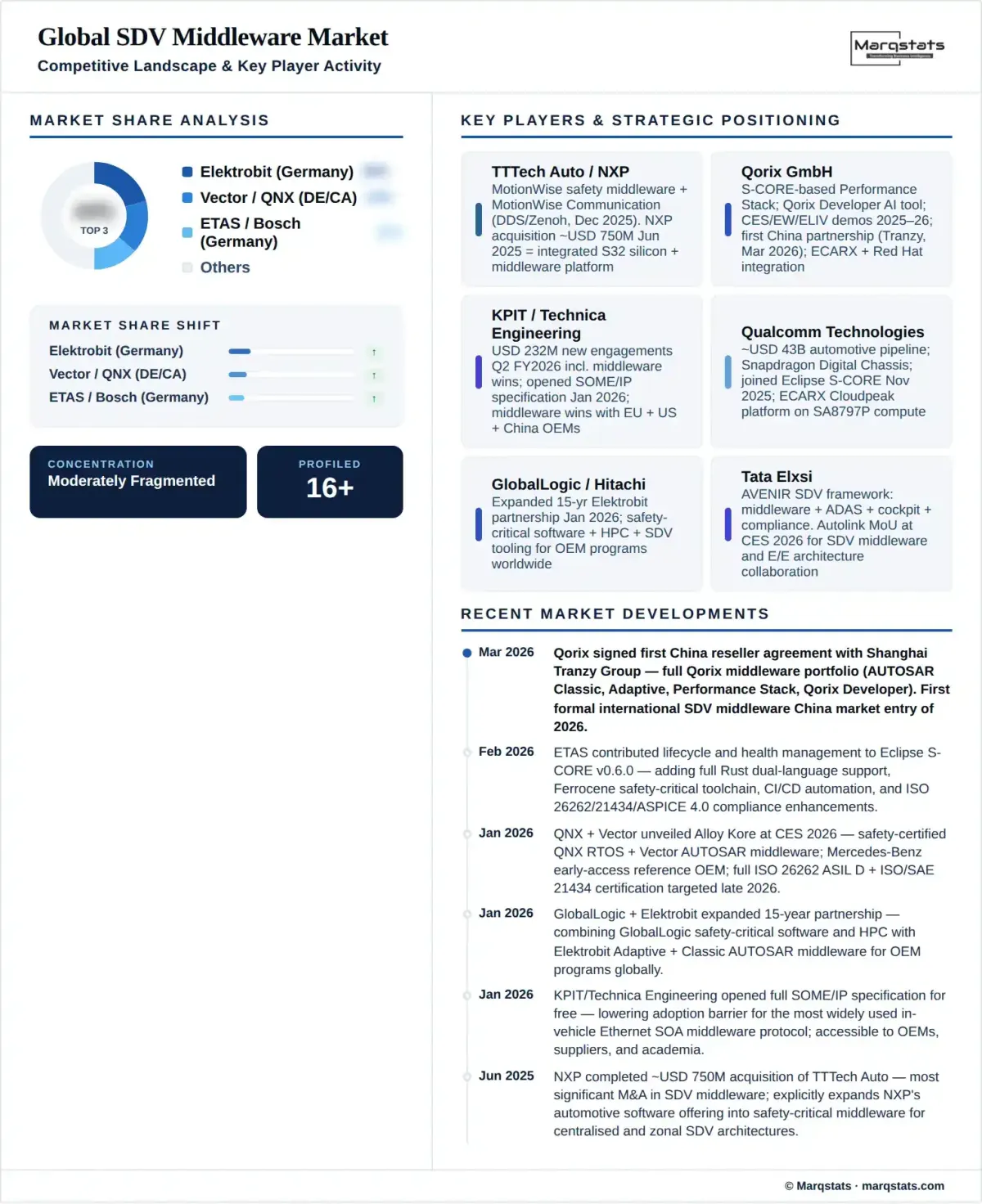
Companies Covered
The report profiles 16++ companies with full strategy and financials analysis, including:
Recent Market Activity
Table of Contents
Coverage & Segmentation
This report provides a comprehensive analysis of the global SDV middleware market covering AUTOSAR Classic and Adaptive platform software, non-AUTOSAR vehicle middleware stacks (TTTech Auto MotionWise, Elektrobit corbos, Qorix Performance Stack, BlackBerry QNX middleware), safety certification and compliance services for middleware, OTA orchestration middleware, communication middleware (SOME/IP, DDS, Zenoh), and integration services for automotive middleware programs — spanning the 2021–2030 study period with 2025 as base year. Standards and open-source ecosystem coverage includes AUTOSAR (Classic and Adaptive), Eclipse SDV/S-CORE, SOAFEE, COVESA VSS, and the VDA-backed pre-competitive open-source collaboration. Regulatory coverage includes UNECE R155 (vehicle cybersecurity), UNECE R156 (software update management), EU Automotive Action Plan 2025 (SDV open platform commitment), ISO 26262 (functional safety), and ISO/SAE 21434 (cybersecurity engineering). Geographic coverage spans Europe (Germany, UK, France, other EU), North America (US, Canada), China, Japan, and South Korea. Company coverage spans Elektrobit, Vector, ETAS, TTTech Auto/NXP, Qorix, BlackBerry QNX, KPIT, GlobalLogic, Qualcomm, Tata Elxsi, Eclipse S-CORE project, AUTOSAR organisation, and Schaeffler/Neusoft Reach. Primary research includes 40+ interviews with OEM software architecture leads, Tier-1 middleware product managers, open-source project maintainers, semiconductor platform managers, and automotive software services executives.