Market Snapshot
Middle bar: base-year value × (1 + CAGR), rounded to two decimals. This is a calculated illustration, not a separately researched annual estimate.
The global EV insulated tools and high-voltage service kits market size is estimated at USD 814.65 million in 2025 and is projected to reach USD 1,732.40 million by 2030, growing at a CAGR of 16.29% over 2026 – 2030. Annual shipments of complete kits, modular trays and high-voltage workshop carts rise from about 324,500 to 628,400 units, a 14.13% annual rate, while the average value per shipment rises from about USD 2,510 to USD 2,757.
Marqstats defines the market as aftermarket and dealer spending on equipment that lets technicians work safely on the traction systems of battery electric cars, plug-in hybrids and electric commercial vehicles. It covers 1,000 V insulated hand tools and sets certified to IEC 60900 or ASTM F1505, insulated torque wrenches, insulation multimeters, absence-of-voltage testers and high-voltage vehicle testers, and dedicated workshop trolleys with Class 0 insulating gloves, arc-flash face shields, rescue hooks and lockout hardware. Battery lift tables, which Marqstats sizes in a separate study, battery quarantine containers, ADAS calibration frames, diagnostic software subscriptions and general industrial insulated tools sold to electricians are excluded.
Insulated hand tools and basic sets account for 41.50% of 2025 value, franchised dealerships for 57.00% and vehicles with 400 V systems for 82.50%. Asia-Pacific accounts for 44.00% of 2025 value and Europe for 31.00%. The study segments the market by product type, workshop type, vehicle voltage class and region.
Key Takeaways
Market Overview & Analysis
Report Summary
Marqstats sizes the EV insulated tools and high-voltage service kits market as the spending workshops make to equip technicians and bays for work on electric traction systems. In 2025 this came to an estimated USD 814.65 million, covering about 324,500 complete kits, modular trays and workshop carts together with the meters, testers, torque tools and protective equipment that go with them.
Electric vehicles carry traction batteries that typically run at 400 V, and a growing share of models now use 800 V systems. Ordinary chrome-vanadium hand tools conduct electricity, so a socket or spanner dropped across battery terminals or exposed busbars can create a short circuit, an arc flash and molten metal spatter. Insulated tools prevent this. Under IEC 60900, the international standard for hand tools used on live parts up to 1,000 V AC and 1,500 V DC, every tool is tested at 10,000 V AC, the insulation must stay intact after impact tests at minus 25 degrees Celsius, and tools carry a double-triangle mark with the 1,000 V rating, the manufacturer and the year of manufacture. Many tools use two layers of insulation in contrasting colours, so worn insulation shows at a glance.
Workplace rules turn these technical standards into purchases. In Germany, DGUV Information 209-093, updated in July 2021, sets out the qualification steps for work on high-voltage vehicles, from staff who only work near high-voltage systems to technicians qualified to de-energise a vehicle and specialists qualified to work on live battery systems, and each step requires matching tools and protective equipment. In the United States, OSHA rules and NFPA 70E require employers to provide insulated tools and personal protective equipment when staff work near exposed energised parts, and ASE offers an xEV Electrical Safety Awareness certification and an xEV Technician Electrical Safety certification. In China, transport industry standard JT/T 1344-2020, in force since 1 February 2021, sets the inspection and maintenance requirements for battery electric vehicles.
Access to vehicle data is now linked to qualification too. Under Regulation (EU) 2018/858, carmakers must give independent operators access to repair and maintenance information, and the Security-related Repair and Maintenance Information scheme, known as SERMI, decides which independents may use security-related functions. SERMI went live in the UK on 1 April 2026 with the backing of 22 carmakers. A garage that wants to de-energise and repair high-voltage systems therefore needs vetted staff, qualified technicians and certified tools together.
The market grew from an estimated USD 422.10 million in 2021, when about 185,000 kits and carts were shipped, to USD 588.45 million in 2023 and USD 692.15 million in 2024, a 17.87% CAGR over 2021 – 2025, as franchised dealer networks equipped for the first wave of electric models. Marqstats expects about 371,000 shipments worth USD 948.25 million in 2026.
Global EV Insulated Tools and High-Voltage Service Kits Market Size and Forecast
The global EV insulated tools and high-voltage service kits market grows from USD 814.65 million in 2025 to USD 1,732.40 million in 2030, a CAGR of 16.29%. Marqstats expects the market to reach USD 948.25 million in 2026, USD 1,105.70 million in 2027, USD 1,288.10 million in 2028 and USD 1,497.80 million in 2029, with shipments of about 424,500 units in 2027, 485,000 in 2028 and 553,000 in 2029.
The 2025 value is built from three demand streams. First, outfitting new high-voltage-capable bays: Marqstats estimates about 95,000 bays were equipped worldwide in 2025 at an average of about USD 4,200 each for a full kit, meter, torque tools, protective equipment and trolley, worth USD 399.00 million. Second, keeping the installed base compliant: an average of about 430,000 certified bays in service during 2025, each spending about USD 650 a year on replacing damaged insulated tools, recalibrating meters and torque wrenches and re-testing gloves, worth USD 279.50 million. Third, personal insulated sets bought by or for newly qualified technicians: about 272,300 sets at about USD 500, worth USD 136.15 million.
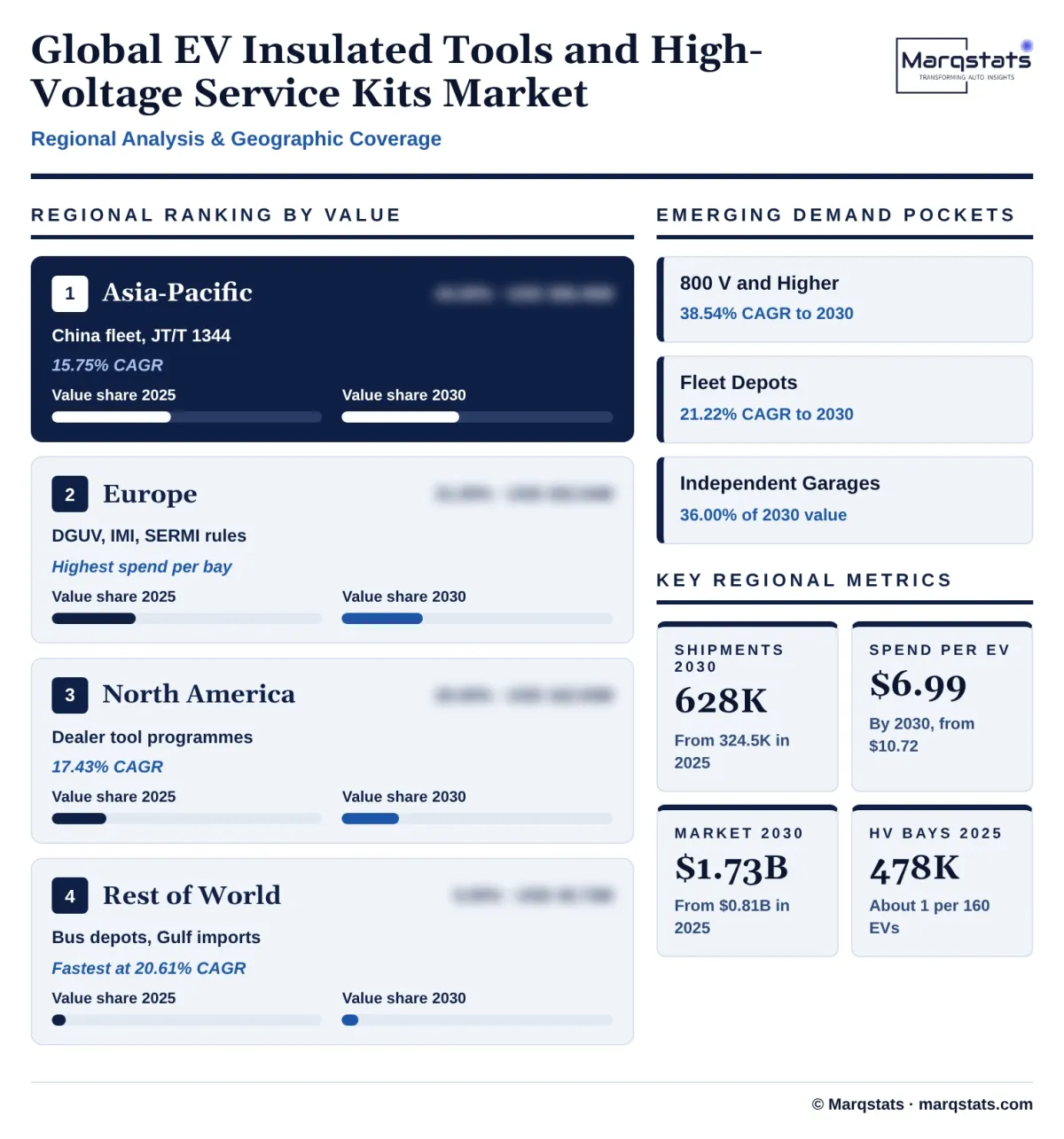
Marqstats estimates about 477,500 high-voltage-capable workshop bays were in service worldwide at the end of 2025, roughly one for every 160 electric vehicles on the road, including franchised dealer bays, independent garages, fast-fit chains, fleet depots and the large network of brand service outlets in China. The installed base grows more slowly than the fleet, because each certified bay can serve more vehicles as electric models become more reliable and service intervals lengthen.
Upfront costs per bay vary widely. Marqstats estimates a basic bay set-up for de-energised work, with a 1,000 V insulated tool set, a two-pole voltage tester, Class 0 gloves and barrier equipment, costs about USD 1,800 to 3,500, and a full set-up with an insulated torque set, insulation multimeter, arc-flash protection, rescue hook and a dedicated trolley costs about USD 3,100 to 8,400. Recurring costs of about USD 450 to 850 a bay each year cover tool attrition, annual meter and torque calibration, and laboratory re-testing of insulating gloves every six months.
Value grows faster than shipments because the product mix is moving up. Insulated torque wrenches, insulation meters and full workshop carts, which cost more than loose hand tools, take a larger share of spending, and 800 V vehicles push workshops toward instruments with higher voltage ratings. Marqstats tracks four indicators to monitor the forecast: qualified technician numbers by country, certified bay counts in dealer networks, SERMI and similar registrations by independent garages, and the share of new electric models built on 800 V platforms.
Market Dynamics
Key Drivers
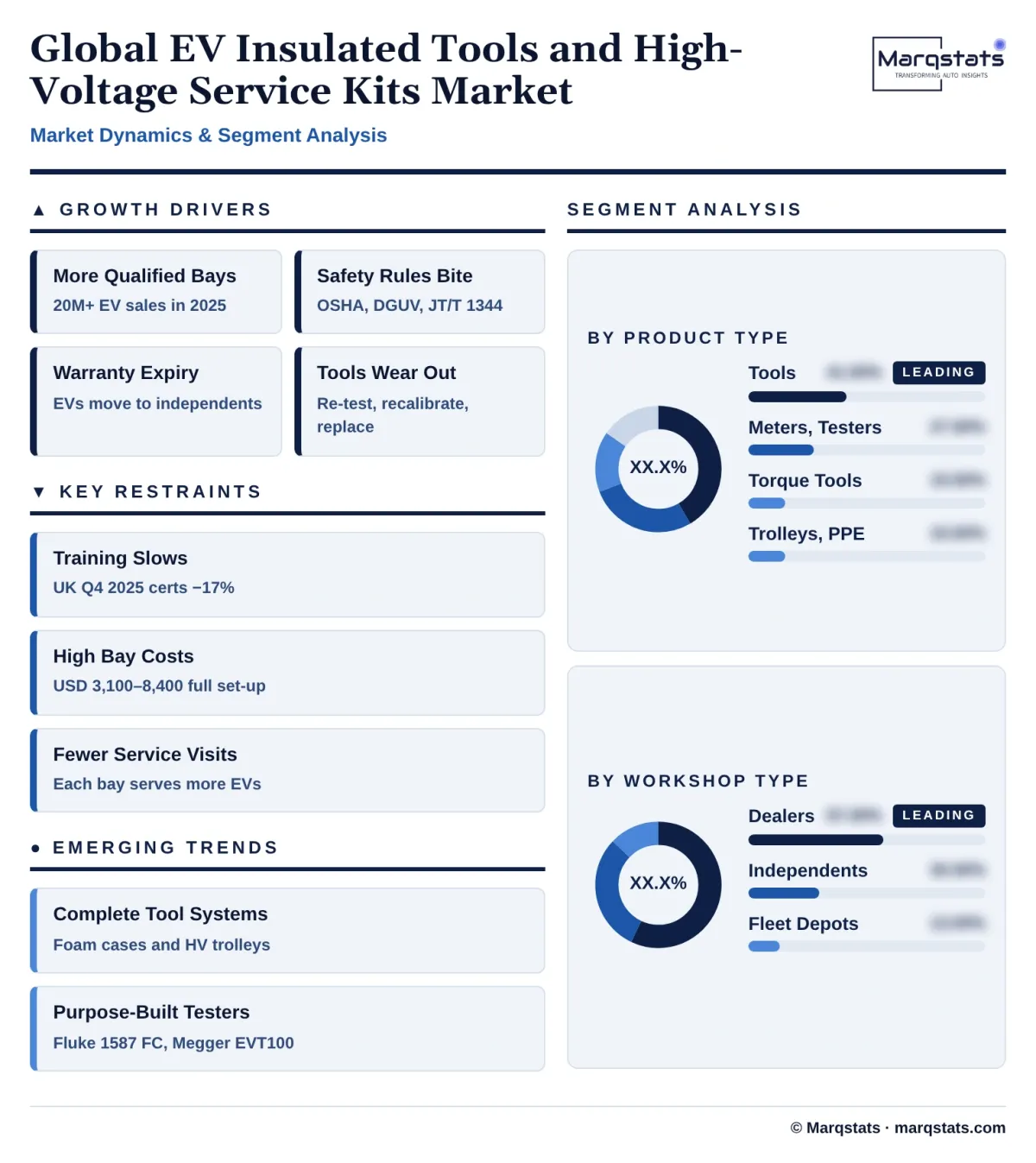
Five forces are lifting spending on insulated tools and high-voltage kits for electric vehicle service.
- A larger electric fleet needs more qualified bays. Electric car sales passed 20 million in 2025, and every dealer and independent garage that services these vehicles needs at least one bay with certified insulated tools, meters and protective equipment.
- Workplace safety rules require certified tools. OSHA rules and NFPA 70E in the United States, DGUV Information 209-093 in Germany and JT/T 1344-2020 in China set out tool, protective equipment and qualification requirements for high-voltage work, and insurers and auditors check compliance.
- Electric vehicles leave warranty and move to independents. First-generation electric cars sold from 2017 to 2021 are now outside their factory warranties, and independent garages must invest in high-voltage tooling to keep these customers.
- Insulated tools wear out by design. Any tool with nicked or worn insulation must be withdrawn, gloves must be re-tested every six months and meters and torque wrenches calibrated every year, so spending recurs throughout the life of a bay.
- Carmaker tool programmes. Franchised dealers must buy the high-voltage tools and testers each brand specifies, such as the VAS 6558A high-voltage test module used across Volkswagen Group dealers, as a condition of selling and servicing electric models.
Key Restraints
Four constraints limit how fast workshops buy high-voltage tooling.
- Technician training is slowing. In the UK, 2,792 technicians gained an EV qualification in Q4 2025, 17% fewer than a year earlier, and workshops do not equip bays until they have qualified staff to use them.
- High upfront costs for small garages. A full high-voltage bay can cost several thousand dollars before diagnostic subscriptions and training, a hurdle for small independents with few electric customers.
- Fewer service visits per electric vehicle. Electric drivetrains need less routine maintenance than combustion engines, so each certified bay can serve more vehicles, which slows growth in the number of bays.
- Carmaker control of repair data. Where independents cannot access high-voltage isolation and battery management functions, they have less reason to buy the hardware, and the work stays with dealers.
Key Trends
Four shifts are changing what high-voltage workshop tooling looks like and how it is sold.
- Complete systems instead of loose tools. Suppliers such as Wiha, Knipex and Snap-on sell foam-organised cases and five-drawer carts that keep 1,000 V tools apart from standard tools, including the 34-piece Knipex Basic E-Mobility case and a 113-piece Wiha eMobility workshop trolley.
- Purpose-built high-voltage testers. Instruments such as the Fluke 1587 FC insulation multimeter and the Megger EVT100, which tests insulation resistance up to 1 kV and is designed for UNECE R100 vehicles, combine several workshop checks in one device.
- Battery pack tools. Suppliers now offer insulated tools for opening packs, such as Cementex's insulated battery openers and seal breaker rated for live work up to 1,000 V AC or 1,500 V DC, launched in April 2025.
- Tools sold with training. Toolmakers increasingly reach technicians through training providers and certification bodies, so a technician leaves an EV course with a personal insulated set.
Strategic Implications
- For toolmakers, the sale is a certified system, not a single tool. Kits that keep insulated tools in shadow-foam trays, include a voltage tester and protective equipment, and come with inspection and replacement records are easier for workshops to defend in a safety audit.
- For independent garages, a phased investment works best. Marqstats suggests qualifying at least one technician, equipping one certified bay with a 1,000 V tool trolley and an insulation multimeter, and registering for secure data access before adding more bays as electric work grows.
- For dealers, carmaker tool lists set the floor. Dealers that track tool calibration, glove re-test dates and replacement of damaged tools avoid failing brand audits and losing the right to service electric models.
- For fleets and bus depots, standard kits cut risk. Depots that use the same colour-coded tool sets, voltage testers and lockout stations in every bay, and record calibration dates in their maintenance software, reduce injury and liability risk.
- For training providers, partnerships with toolmakers add value. Bundling a personal insulated set with an EV qualification helps technicians start work on high-voltage systems immediately.
Market Segmentation
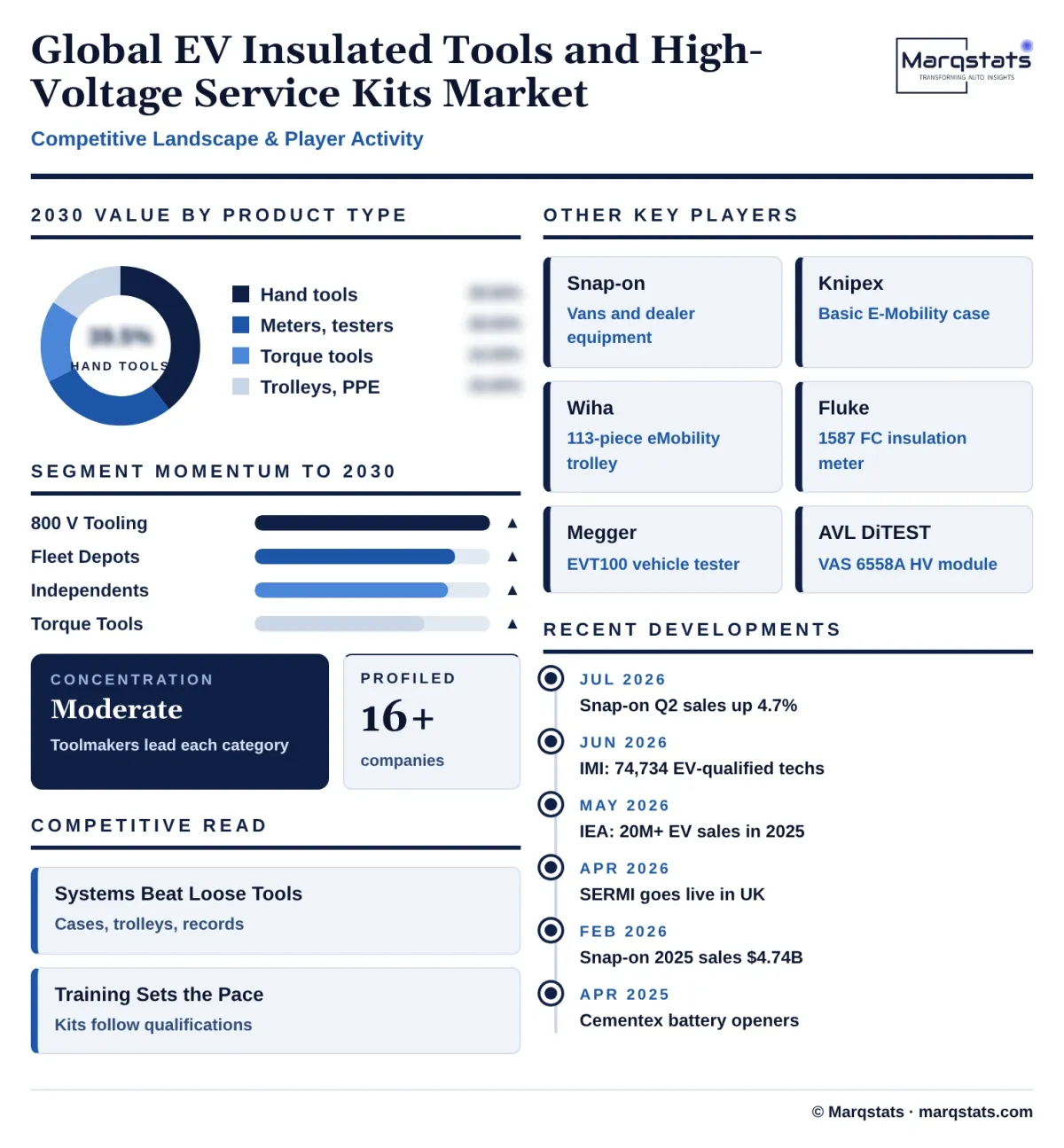
Insulated hand tools and basic sets account for 41.50% of 2025 value, USD 338.10 million, and grow at 15.14% a year to USD 684.30 million and 39.50% of the market by 2030. Sockets, ratchets, spanners, pliers, cable cutters and screwdrivers certified to IEC 60900 or ASTM F1505 are bought for every certified bay and every newly qualified technician, and are replaced whenever the insulation is damaged.
Insulation multimeters, absence-of-voltage testers and dedicated high-voltage vehicle testers account for 27.50% of 2025 value, USD 224.00 million, and grow at 16.71% a year to USD 485.07 million and 28.00% by 2030. Products such as the Fluke 1587 FC and the Megger EVT100 measure insulation resistance and confirm that a vehicle is safe to work on, and 800 V platforms push workshops toward instruments with higher voltage ratings.
Insulated torque wrenches account for 15.50% of 2025 value, USD 126.25 million, and grow fastest among product groups, at 17.76% a year, to USD 285.85 million and 16.50% by 2030. Battery busbars, contactor terminals and high-voltage connectors must be tightened to exact values, because a loose joint raises resistance and heat, and the tools must be recalibrated regularly.
Dedicated high-voltage workshop trolleys, Class 0 insulating gloves, arc-flash face shields, rescue hooks, barriers and lockout stations account for 15.50% of 2025 value, USD 126.30 million, and grow at 17.02% a year to USD 277.18 million and 16.00% by 2030. Gloves must be laboratory re-tested every six months, adding recurring spending.
Franchised dealerships account for 57.00% of 2025 value, USD 464.35 million, and grow at 12.36% a year to USD 831.55 million, while their share falls to 48.00% by 2030. Carmakers require dealers to buy specified high-voltage tools and testers before they can sell and service electric models, so most of the first wave of spending came from dealer networks.
Independent garages and fast-fit chains account for 30.00% of 2025 value, USD 244.40 million, and grow at 20.61% a year to USD 623.66 million and 36.00% by 2030. As electric cars leave warranty, independents invest in certified tooling to keep their customers, helped by secure access schemes such as SERMI.
Fleet maintenance depots and bus and transit operators account for 13.00% of 2025 value, USD 105.90 million, and grow fastest, at 21.22% a year, to USD 277.19 million and 16.00% by 2030, as delivery vans, buses and trucks are electrified and serviced in-house.
Tooling bought for vehicles with 400 V systems accounts for 82.50% of 2025 value, about USD 672.09 million, and grows at 8.38% a year to about USD 1,004.79 million, while its share falls to 58.00% by 2030. Standard 1,000 V insulated tools and CAT III 1,000 V meters give a wide safety margin on these vehicles.
Tooling bought for vehicles with 800 V and higher systems accounts for 17.50% of 2025 value, about USD 142.56 million, and grows at 38.54% a year to about USD 727.61 million and 42.00% by 2030. Higher system voltages and fast-switching silicon carbide inverters push workshops toward meters and test leads with higher ratings and stricter inspection of insulation and clearances.
By Geography
Asia-Pacific
Asia-Pacific is the largest market, with 44.00% of 2025 value, USD 358.45 million, rising to an estimated USD 744.93 million by 2030, a 15.75% CAGR, while its share eases to 43.00%. China has the largest electric fleet and the widest network of brand service outlets, and JT/T 1344-2020 sets maintenance requirements for battery electric vehicles. Domestic suppliers such as SATA, part of Apex Tool Group, sell lower-cost certified insulated sets in high volumes.
Europe
Europe accounts for 31.00% of 2025 value, USD 252.54 million, and grows at an estimated 15.53% a year to USD 519.72 million and 30.00% of the market by 2030. Europe spends the most per bay because of strict qualification rules, including DGUV Information 209-093 in Germany and IMI TechSafe in the UK, where 74,734 technicians, about 35% of the workforce, held an EV qualification at the end of 2025. SERMI controls independent access to security-related repair functions across the EU and, since 1 April 2026, the UK.
North America
North America accounts for 20.00% of 2025 value, USD 162.93 million, and grows at an estimated 17.43% a year to USD 363.80 million and 21.00% by 2030. Dealer tool programmes drive most spending, while independents invest mainly to meet OSHA and NFPA 70E duties and limit liability. ASE xEV certifications give shops a recognised way to show technician competence.
Rest of World
The rest of the world accounts for 5.00% of 2025 value, USD 40.73 million, and grows fastest, at an estimated 20.61% a year, to USD 103.95 million and 6.00% by 2030, led by electric bus depots in Latin America, luxury electric imports in the Gulf states and growing assembly in Southeast Asia.
How Competition Is Evolving
The market is moderately concentrated. Snap-on, Knipex, Wiha, Fluke, Megger and Apex Tool Group lead their product categories, alongside many regional suppliers of certified insulated tools and protective equipment.
Snap-on is the largest supplier to automotive technicians. In 2025 its Snap-on Tools Group, which sells through mobile vans, had sales of USD 1,964.9 million, and its Repair Systems and Information Group, which equips dealer networks and repair shops, had sales of USD 1,877.1 million, out of group net sales of USD 4,743.2 million. These figures cover all tools and equipment, not only high-voltage products.
German toolmakers lead in certified insulated tools. Knipex, Wiha, Stahlwille and Hazet sell VDE-certified cases and trolleys designed for electric vehicle workshops, and Bahco, Facom, Klein Tools, Cementex and Dynamic, part of Gray Tools, compete in other regions.
Instrument makers and carmaker tool partners hold the testing segment. Fluke, Megger and Hioki supply insulation testers and multimeters, and AVL DiTEST supplies high-voltage test modules used in Volkswagen Group dealer networks.
Companies Covered
Companies covered in the report include:
Recent Market Activity
Table of Contents
Coverage & Segmentation
The study covers the global EV insulated tools and high-voltage service kits market, with 2025 as the base year, 2021 – 2025 as the historical period and 2026 – 2030 as the forecast period. Values are in US dollars at end-user prices, and volumes are shipments of complete kits, modular trays and high-voltage workshop carts. The market is segmented by product type, workshop type, vehicle voltage class and region.
Battery lift tables, sized separately by Marqstats in its EV battery lift table study and not to be added to this market, battery quarantine containers, ADAS calibration frames, diagnostic software subscriptions and insulated tools sold to electricians and utilities are excluded. Segment splits, 2030 regional values, bay counts and the shipment forecast are Marqstats estimates built on electric fleet data, workshop qualification data, supplier disclosures and price benchmarks.