Market Snapshot
Middle bar: base-year value × (1 + CAGR), rounded to two decimals. This is a calculated illustration, not a separately researched annual estimate.
The global 800V+ vehicle architecture market size is estimated at USD 101.28 billion in 2025 and is projected to reach USD 396.00 billion by 2030, growing at a CAGR of 31.35% over 2026 – 2030. Annual deliveries of vehicles with 800V or higher electrical systems rise from about 2.42 million to 11.25 million, a 35.98% annual rate, lifting their share of global battery electric vehicle sales from 17.54% to 45.00%.
Marqstats defines the market as the transaction value of complete passenger cars, light commercial vehicles, trucks and buses whose main traction battery operates at a nominal 550V DC or higher, covering native 800V platforms and dual-voltage systems that switch between 400V and 800V. Vehicles on 400V platforms, plug-in hybrids on low-voltage systems, two- and three-wheelers and charging equipment are excluded. The component layer, including silicon carbide traction inverters, is covered separately in the Marqstats Global Silicon Carbide Traction Inverter Market report and should not be added to this market.
Passenger vehicles account for an estimated 96.21% of 2025 value and native 800V platforms for 77.00%. China accounts for 55.98% of 2025 value and Europe for 24.53%. The study segments the market by vehicle type, electrical architecture and region.
Key Takeaways
Market Overview & Analysis
Report Summary
Marqstats sizes the 800V+ vehicle architecture market as the transaction value of complete vehicles whose main traction battery operates at a nominal 550V DC or higher. The definition includes native 800V platforms, where the battery, inverter and motor all run at high voltage, and dual-voltage vehicles that split the battery into two 400V halves or use the motor to boost voltage when connected to older chargers. In 2025 about 2.42 million such vehicles were sold worldwide, worth an estimated USD 101.28 billion at an average price of about USD 41,850.
Higher voltage reduces current. For the same charging power, doubling the voltage halves the current, and resistive heat losses fall by three quarters. This lets carmakers use thinner, lighter cables, smaller cooling systems and higher charging power without overheating, so cars can charge from 10% to 80% in 10 to 20 minutes on suitable chargers. Silicon carbide power electronics, which handle high voltages with lower switching losses than silicon, make the architecture practical and add 5% to 10% to drive-cycle efficiency.
The technology began with the Porsche Taycan in 2019 and reached the volume market with Hyundai Motor Group's E-GMP platform in 2021. Between 2023 and 2025 Chinese carmakers including Geely's Zeekr brand, XPeng, BYD, Li Auto and Huawei-partnered brands moved 800V from premium models into mid-priced cars, and Europe followed with the Volkswagen Group Premium Platform Electric, the Mercedes-Benz MMA and VAN.EA platforms, Volvo's SPA2 platform and the BMW Neue Klasse.
The market grew from about 70,000 vehicles worth USD 5.04 billion in 2021 to 220,000 worth USD 12.87 billion in 2022, 580,000 worth USD 28.54 billion in 2023 and 1.34 million worth USD 59.09 billion in 2024. Marqstats expects about 3.65 million deliveries worth USD 146.73 billion in 2026.
Marqstats sizes the vehicle layer. The high-voltage component layer, including traction inverters, on-board chargers, DC-DC converters, electric compressors and contactors, is worth an estimated USD 4.90 billion in 2025. Silicon carbide traction inverters are covered in detail in the Marqstats Global Silicon Carbide Traction Inverter Market report, which estimates 800V and higher systems at 41.92% of 2025 inverter value. Component values are part of vehicle value and must not be added to the market sized here.
Three groups shape the market. Carmakers decide platform voltage years before launch and carry the cost of new power electronics, wiring and battery management. Semiconductor and power electronics suppliers such as Infineon, STMicroelectronics, onsemi, BorgWarner and Bosch provide the silicon carbide devices and modules that make 800V affordable. Charging network operators decide whether public chargers can deliver the higher voltage, which determines whether drivers see the benefit of faster charging.
Global 800V+ Vehicle Architecture Market Size and Forecast
The global 800V+ vehicle architecture market grows from USD 101.28 billion in 2025 to USD 396.00 billion in 2030, a CAGR of 31.35%. Marqstats expects about 5.15 million deliveries worth USD 198.79 billion in 2027, 6.85 million worth USD 254.82 billion in 2028 and 8.85 million worth USD 319.49 billion in 2029, before reaching 11.25 million vehicles in 2030.
Penetration drives growth. Marqstats estimates global battery electric vehicle sales rise from about 13.80 million in 2025 to 25.00 million in 2030, while the 800V share rises from 17.54% to 45.00%. Each 5 percentage points of 2030 penetration changes deliveries by about 1.25 million vehicles and market value by about USD 44 billion.
Average prices fall as 800V moves into cheaper cars. Marqstats estimates the average price of an 800V vehicle falls from about USD 72,000 in 2021, when the technology was concentrated in premium models, to USD 41,850 in 2025 and USD 35,200 in 2030, a decline of 3.40% a year over the forecast period. Volume therefore grows at 35.98% a year while value grows at 31.35%.
Component costs fall faster than vehicle prices. Marqstats estimates the extra cost of a silicon carbide inverter over a silicon inverter falls from about USD 310 per vehicle in 2025 to about USD 85 in 2030 as 200mm wafers replace 150mm wafers. A delay of USD 50 in this cost decline would reduce mass-market adoption by about 420,000 vehicles over 2027 and 2028.
The component layer grows from an estimated USD 4.90 billion in 2025 to USD 18.45 billion in 2030. Silicon carbide traction inverters account for about 53% of that value, on-board chargers about 20%, DC-DC converters about 12%, high-voltage thermal management about 9% to 10% and relays, contactors and busbars about 5%. These values are included in vehicle prices and are shown for context only.
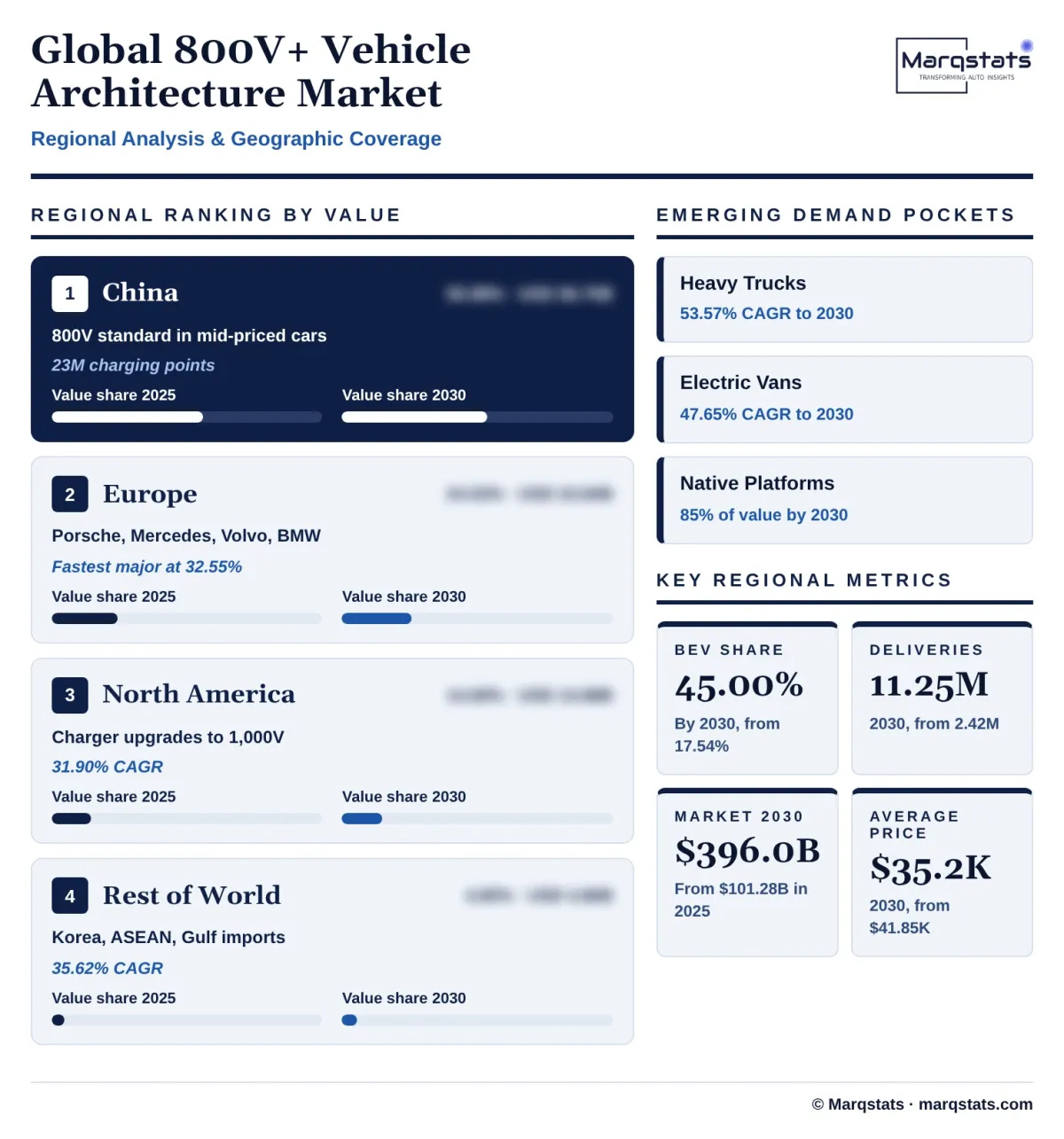
The mix shifts over the forecast. Passenger vehicles fall from 96.21% to 92.56% of value as vans and trucks adopt 800V, native platforms rise from 77.00% to 85.00%, and China's share falls from 55.98% to 53.70% as Europe, North America and other regions grow faster from smaller bases.
Marqstats tracks four indicators to monitor the forecast: the 800V share of new battery electric models launched in China and Europe, the entry price of 800V cars, the cost premium of silicon carbide inverters over silicon inverters, and the share of public fast chargers able to deliver 800V or more. Faster price cuts in China or a faster rollout of high-power chargers in North America would push deliveries above the base path, while a slowdown in battery electric sales or delays in 200mm silicon carbide production would slow growth.
Market Dynamics
Key Drivers
Five forces are moving electric vehicles from 400V to 800V and higher electrical systems.
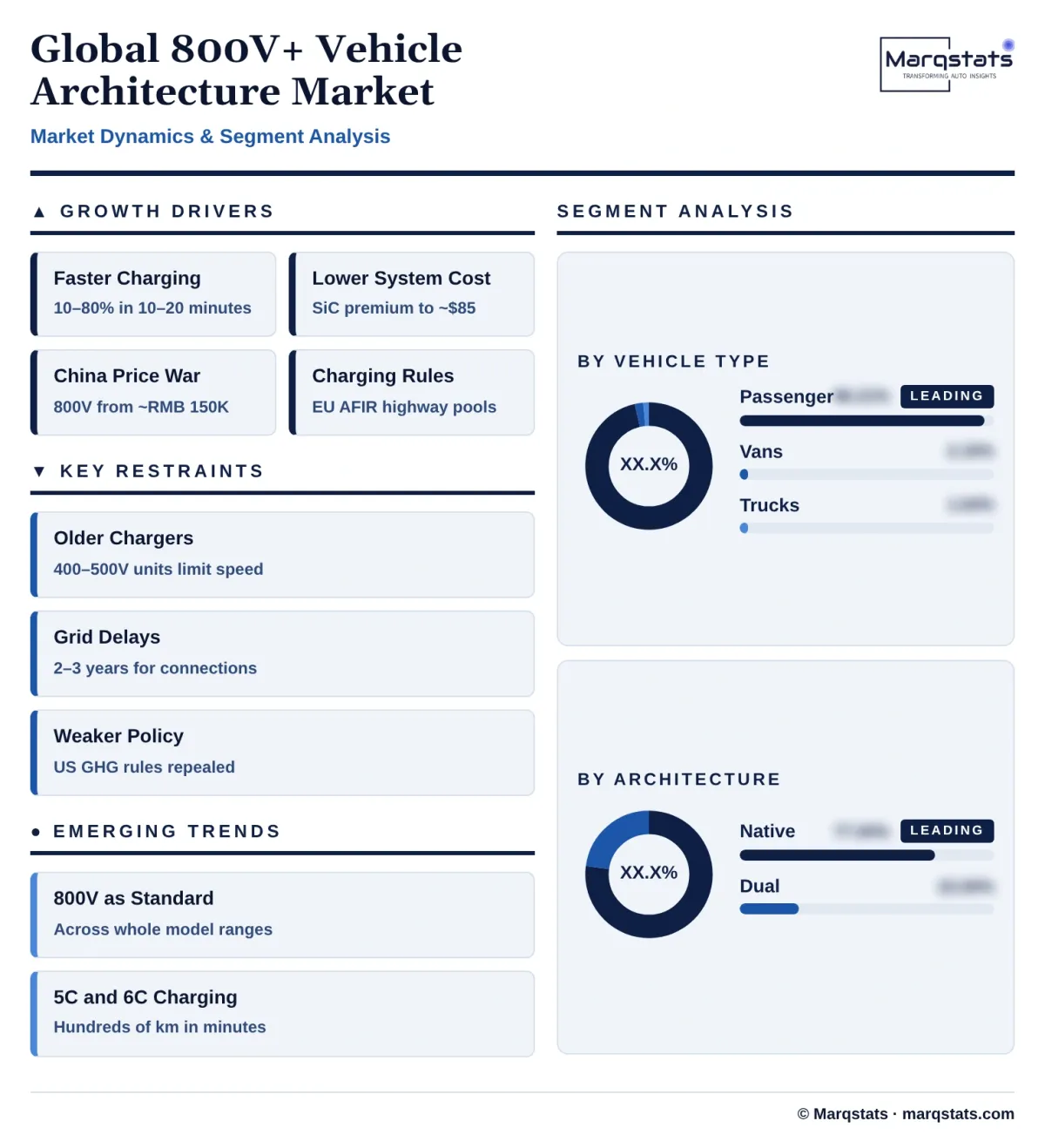
- Faster charging. 800V systems let cars charge from 10% to 80% in 10 to 20 minutes on suitable chargers, closing the gap with refuelling. Porsche says the Cayenne Electric charges from 10% to 80% in under 16 minutes at up to 400 kW, and Smart says its new #1 needs about 12 minutes.
- Lower system cost. Silicon carbide devices, larger wafers and integrated electric drive units are reducing the cost of 800V power electronics, while thinner cables and smaller cooling systems save weight and cost elsewhere in the vehicle.
- Chinese price competition. Chinese carmakers use 800V as a selling point in mid-priced cars, forcing competitors to match it. The new Smart #1 and Changan Qiyuan Q06 offer 800V from about RMB 150,000, and XPeng fits 800V as standard across the G9L range.
- High-power charging rules. The EU Alternative Fuels Infrastructure Regulation requires fast-charging pools on core highways, and China's charging network grew 43.2% in the year to June 2026, giving 800V vehicles the chargers they need.
- Truck and van electrification. Heavy electric trucks need 800V to 1,250V systems to use megawatt charging during driver rest breaks, and new van platforms such as the Mercedes-Benz VAN.EA use 800V for long-distance use.
Key Restraints
Four constraints slow the move to 800V outside China and the premium segment.
- Older chargers. Many public chargers, including older Tesla Superchargers in North America, operate at 400V to 500V, limiting the charging speed of 800V vehicles unless the vehicle has boost hardware.
- Grid connection limits. High-power charging plazas need large grid connections that can take two to three years to approve and build in North America and Europe, slowing the rollout of chargers that 800V vehicles need.
- Weaker policy support. The US Environmental Protection Agency repealed federal vehicle greenhouse gas standards in February 2026, and the European Commission proposed in December 2025 to ease the 2035 car target from a 100% to a 90% CO2 reduction, reducing regulatory pressure to electrify in some markets.
- Supply chain risk. 800V vehicles depend on silicon carbide wafers, high-voltage contactors and specialised cables from a limited number of suppliers, and any shortage or yield problem raises costs.
Key Trends
Four shifts are changing how 800V vehicles are designed, charged and priced.
- 800V as standard. Carmakers are making 800V standard across model ranges rather than an option, as Smart did on the new #1 and XPeng on the G9L.
- Ultra-fast charging rates. Chinese carmakers promote 5C and 6C charging, adding several hundred kilometres of range in under 10 minutes on 480 kW to 600 kW chargers.
- Legacy platforms moving to 800V. Volvo moved the EX90 from 400V to 800V for model year 2026, and Renault plans an 800V RGEV Medium 2.0 platform under its futuREady plan.
- Battery storage at charging sites. Charging operators add stationary batteries at high-power sites to avoid grid delays and demand charges, enabling 800V charging where grid capacity is limited.
Strategic Implications
- For carmakers, a new platform launched on 400V after 2026 risks looking outdated in China and Europe. Native 800V platforms with silicon carbide inverters are becoming the default, with dual-voltage designs mainly useful where older chargers remain common.
- For component suppliers, demand is moving from silicon IGBT modules to silicon carbide MOSFET modules, 800V on-board chargers, high-voltage contactors and 800V electric compressors. Suppliers with long-term wafer supply and automotive-grade packaging will gain share.
- For charging operators, new chargers should support 1,000V operation. Installing chargers limited to 500V risks stranded assets as 800V vehicles become the majority of new electric cars.
- For fleet operators, 800V vans and trucks reduce charging time during shifts and rest breaks, improving vehicle use, but depend on access to high-power and megawatt charging.
- For investors, value is shifting toward carmakers and suppliers that combine low-cost 800V platforms with fast-charging ecosystems, particularly Chinese groups expanding exports.
- For policymakers, high-power charging rules matter as much as purchase incentives. Requirements for charger power along highways, faster grid connections for charging sites and common charging standards determine whether drivers can use the fast-charging capability that 800V vehicles offer.
Market Segmentation
Passenger cars account for 96.21% of 2025 value, USD 97.44 billion and about 2.37 million vehicles, rising to USD 366.52 billion and 10.78 million vehicles by 2030, a 30.34% CAGR, while their share falls to 92.56%. Hyundai Motor Group's E-GMP models, Porsche and Audi on the Premium Platform Electric, Geely's SEA brands, BYD, XPeng and Li Auto lead the segment.
Vans and light trucks account for 2.15% of 2025 value, USD 2.18 billion and about 42,000 vehicles, and grow at 47.65% a year to USD 15.30 billion and 3.86% of value by 2030. Mercedes-Benz unveiled the VLE on its 800V VAN.EA platform in March 2026 with a 115 kWh battery and up to 700 km of range.
Medium and heavy trucks and buses account for 1.64% of 2025 value, USD 1.66 billion and about 13,000 vehicles, and grow fastest, at 53.57% a year, to USD 14.18 billion and 3.58% of value by 2030 as long-haul trucks adopt megawatt charging at up to 1,250V.
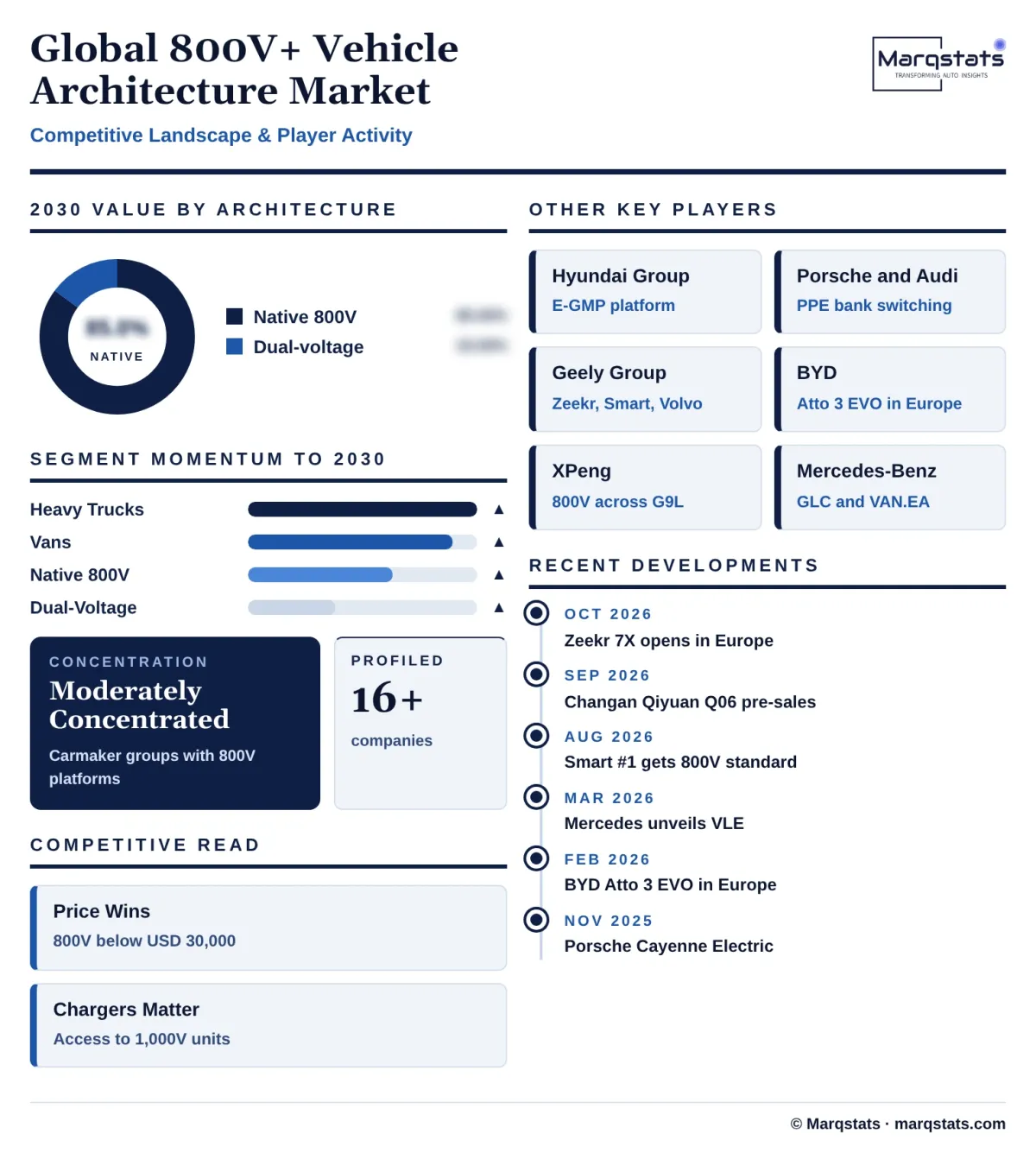
Native 800V platforms, where the battery, inverter and motor operate only at high voltage, account for an estimated 77.00% of 2025 value, USD 77.99 billion and about 1.89 million vehicles, and grow at 33.97% a year to USD 336.60 billion and 85.00% of value by 2030. They offer the best efficiency and lightest wiring but need boost hardware or bank switching to charge at full speed on older 400V chargers.
Vehicles that switch between 400V and 800V by splitting the battery or boosting voltage through the motor account for an estimated 23.00% of 2025 value, USD 23.29 billion and about 530,000 vehicles, and grow at 20.59% a year to USD 59.40 billion and 15.00% of value by 2030, as high-power chargers reduce the need for backward compatibility.
By Geography
China
China is the largest market, with 55.98% of 2025 value, USD 56.70 billion and about 1.62 million vehicles, rising to USD 212.66 billion and 6.86 million vehicles by 2030, a 30.26% CAGR. Domestic silicon carbide production, a charging network of about 23.06 million points at the end of June 2026 with 480 kW to 600 kW chargers on major highways, and intense price competition have made 800V a standard feature in mid-priced cars from Geely, XPeng, BYD, Li Auto, Smart and Changan.
Europe
Europe accounts for 24.53% of 2025 value, USD 24.84 billion and about 460,000 vehicles, and grows at 32.55% a year to USD 101.64 billion by 2030. Porsche's Taycan, Macan Electric and Cayenne Electric, Audi models on the Premium Platform Electric, the Mercedes-Benz GLC with EQ Technology, Volvo's EX90 and ES90, the BMW Neue Klasse and Chinese imports such as the Zeekr 7X and BYD Atto 3 EVO drive adoption, supported by EU high-power charging rules.
North America
North America accounts for 14.69% of 2025 value, USD 14.88 billion and about 240,000 vehicles, and grows at 31.90% a year to USD 59.40 billion by 2030. Older 400V to 500V Supercharger hardware limits charging speeds for some 800V vehicles, but newer 1,000V-capable Supercharger cabinets and the SAE J3400 connector standard support higher voltages. The end of the federal EV purchase credit in September 2025 and the repeal of federal vehicle greenhouse gas standards in February 2026 slow near-term growth.
Asia-Pacific excluding China
South Korea, Japan, Australia and Southeast Asia account for 4.07% of 2025 value, USD 4.12 billion, and grow at 33.94% a year to USD 17.76 billion by 2030, led by Hyundai and Kia in South Korea and Chinese exports across Southeast Asia and Australia.
Rest of World
The Middle East, Latin America, India and Africa account for 0.73% of 2025 value, USD 0.74 billion, and grow fastest, at 43.74% a year, to USD 4.54 billion by 2030 from premium imports in the Gulf and local assembly in India and Latin America.
How Competition Is Evolving
The market is moderately concentrated among carmaker groups with dedicated 800V platforms. Hyundai Motor Group, Volkswagen Group through Porsche and Audi, Geely Holding through Zeekr, Lotus, Smart and Volvo, BYD, XPeng, Li Auto and Huawei-partnered brands account for most 2025 deliveries. Marqstats estimates Chinese groups account for about two thirds of global 800V volume.
Strategies differ. Hyundai Motor Group uses its rear motor and inverter to boost 400V charger output to 800V. Porsche and Audi use bank switching that splits the battery into two 400V halves on older chargers. Chinese carmakers pair native 800V systems with 5C and 6C batteries and their own high-power charging networks, and Tesla uses a split-pack design on the Cybertruck.
Suppliers are critical. Infineon, STMicroelectronics, onsemi, Wolfspeed, BorgWarner and Bosch supply silicon carbide devices, modules and inverters, while Chinese carmakers such as BYD make much of their own power electronics. The move from 150mm to 200mm silicon carbide wafers is the main source of cost reduction.
Competition will be decided by platform cost, charging speed and charger access. Carmakers that offer 800V in cars below USD 30,000 and secure access to high-power charging will gain share as the technology moves into the mass market.
Chinese exports are widening competition. Zeekr opened European orders for the updated 7X on an 800V platform from EUR 52,990 in October 2026, and BYD brought 800V to the Atto 3 EVO in Europe in February 2026. European carmakers are responding with new 800V platforms and lower-priced models, while Hyundai Motor Group continues to expand its E-GMP range.
Companies Covered
Companies covered in the report include:
Recent Market Activity
Table of Contents
Coverage & Segmentation
The study covers the global 800V+ vehicle architecture market, with 2025 as the base year, 2021 – 2025 as the historical period and 2026 – 2030 as the forecast period. Values are in US dollars at transaction value and constant 2025 exchange rates. The market covers passenger cars, light commercial vehicles, trucks and buses whose main traction battery operates at a nominal 550V DC or higher, and is segmented by vehicle type, electrical architecture and region.
Vehicles on 400V platforms, plug-in hybrids and range-extended vehicles on lower-voltage systems, two- and three-wheelers, off-highway vehicles and charging equipment are excluded. High-voltage components, including silicon carbide traction inverters covered in the Marqstats Global Silicon Carbide Traction Inverter Market report, are part of vehicle value and must not be added to this market. Architecture splits and 2026 – 2030 values are Marqstats estimates built on platform production tracking, carmaker disclosures and price benchmarks.