Market Snapshot
Middle bar: base-year value × (1 + CAGR), rounded to two decimals. This is a calculated illustration, not a separately researched annual estimate.
The Brazil hybrid flex vehicle market size is estimated at USD 775.21 million in 2025 and is projected to reach USD 4,995.51 million by 2030, growing at a CAGR of 45.16% over 2026 – 2030. Registrations rise from 21,323 vehicles in 2025 to about 150,000 in 2030, a 47.72% annual rate, while the average transaction price eases from about BRL 202,500 to BRL 185,500 as compact SUVs take a larger share of sales.
Marqstats defines the market as the retail transaction value of new full hybrid flex (HEV Flex) light vehicles registered in Brazil. These vehicles pair a high-voltage battery and electric motors that can move the car on electric power alone with a flex-fuel combustion engine that runs on hydrous ethanol, gasoline or any mix of the two, and they cannot be charged from the grid. Mild hybrid flex vehicles with 12V or 48V belt starter generators (MHEV Flex), plug-in hybrid flex vehicles (PHEV Flex), gasoline-only full hybrids, battery electric vehicles, used vehicles, parts and services are excluded. PHEV Flex is sized separately because it carries a different price structure and supplier base.
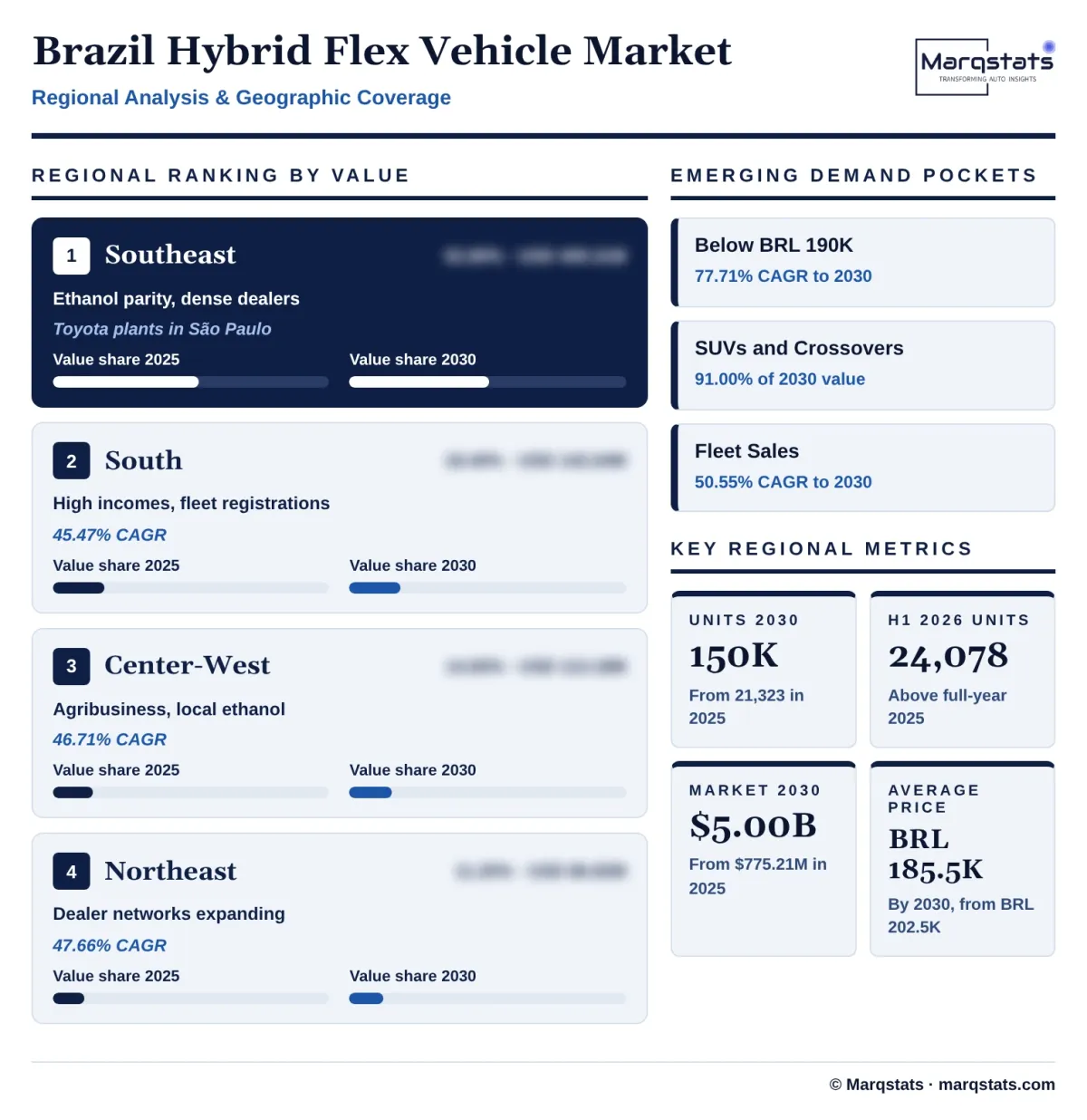
SUVs and crossovers account for an estimated 70.00% of 2025 value and vehicles priced between BRL 190,000 and BRL 230,000 for 78.00%. The Southeast accounts for 52.80% of 2025 value and the South for 18.40%. The study segments the market by body type, retail price band, sales channel and region.
Key Takeaways
Market Overview & Analysis
Report Summary
Marqstats sizes the Brazil hybrid flex vehicle market as the retail transaction value of new full hybrid flex light vehicles registered in the country. In 2025, 21,323 HEV Flex vehicles were registered, according to the Brazilian Electric Vehicle Association (ABVE), worth an estimated BRL 4,317.91 million, or USD 775.21 million at the 2025 average exchange rate of BRL 5.57 per US dollar, at an average transaction price of about BRL 202,500 (USD 36,355).
Brazil counts electrified vehicles in two different ways. ABVE counts battery electric vehicles, plug-in hybrids and full hybrids, split into gasoline full hybrids (HEV) and flex full hybrids (HEV Flex), and has excluded 12V and 48V mild hybrids from its headline total since January 2025 because they cannot drive on electric power alone. On this basis Brazil registered 223,912 electrified light vehicles in 2025, 26% more than in 2024. HEV Flex accounted for 9.52% of this total and 50.33% of the 42,370 full hybrids, while gasoline full hybrids reached 21,047 units. Mild hybrids, counted separately, reached 61,340 units. Wider counts that include mild hybrids are therefore much larger than the core electrified series.
A full hybrid flex vehicle combines two technologies Brazil already knows well. Flex-fuel engines, which run on any blend of hydrous ethanol and gasoline, have dominated new car sales since the mid-2000s. Full hybrid systems add a high-voltage battery and two electric motor-generators that recover braking energy and can move the car at low speed with the engine off. The combination cuts fuel use in city driving and lets the owner choose the cheaper fuel at each fill-up.
Toyota created the category. It launched the Corolla sedan with a hybrid flex powertrain in 2019 and the Corolla Cross in 2021, both using a 1.8-litre Atkinson-cycle flex engine, two motor-generators and a planetary-gear electronic continuously variable transmission. For five years these two models made up almost all HEV Flex sales, and registrations moved between 15,838 in 2021, 23,638 in 2022, 19,980 in 2023, 20,278 in 2024 and 21,323 in 2025. Market value grew from USD 469.17 million in 2021 to USD 775.21 million in 2025, a 13.38% annual rate, mostly through higher prices rather than more vehicles.
The market changed in 2026. Toyota opened pre-sales of the Yaris Cross hybrid flex in November 2025 and started production at Sorocaba in January 2026, with deliveries from late February. The compact SUV uses a 1.5-litre flex engine and an electric motor with a combined 111 hp, is rated at 17.9 km per litre in urban driving, and was priced at BRL 172,390 for the XRE Hybrid and BRL 189,990 for the XRX Hybrid. GWM made every version of the Haval H6 built at Iracemápolis flex-fuel in June 2026, adding a second locally built HEV Flex model. HEV Flex registrations reached 24,078 in the first half of 2026, 5,240 in August and 5,786 in September.
The wider electrified market is growing even faster. Brazil passed 1,000,000 cumulative electrified light vehicle registrations in September 2026, only 14 months after reaching 500,000, which had taken more than 13 years. Electrified registrations reached 381,609 in the first nine months of 2026, and in September they took 19.8% of a 268,721-unit light vehicle market. HEV Flex accounted for 10.89% of electrified registrations that month, behind battery electric vehicles and plug-in hybrids but ahead of gasoline full hybrids.
Brazil Hybrid Flex Vehicle Market Size and Forecast
The Brazil hybrid flex vehicle market grows from USD 775.21 million in 2025 to USD 4,995.51 million in 2030, a CAGR of 45.16%. Marqstats estimates about 57,000 registrations worth USD 1,964.81 million in 2026, 80,000 worth USD 2,714.54 million in 2027, 104,000 worth USD 3,491.56 million in 2028 and 128,000 worth USD 4,274.33 million in 2029, before reaching 150,000 vehicles in 2030.
In Brazilian reais, market value rises from BRL 4,317.91 million in 2025 to about BRL 10,944.00 million in 2026, BRL 15,120.00 million in 2027, BRL 19,448.00 million in 2028, BRL 23,808.00 million in 2029 and BRL 27,825.00 million in 2030. All US dollar values in the analysis use a constant rate of BRL 5.57 per US dollar, the 2025 average of the Central Bank of Brazil PTAX rate, so growth rates are the same in both currencies.
Volume grows faster than value because the mix moves down market. The average transaction price rises from BRL 165,000 in 2021 to a peak of BRL 202,500 in 2025, then eases to about BRL 192,000 in 2026 as the Yaris Cross adds a lower-priced model, and to about BRL 185,500 by 2030 as Volkswagen, Honda and Stellantis add compact and mid-size models. In US dollars the average price moves from about USD 36,355 in 2025 to USD 33,303 in 2030. Registrations therefore grow at 47.72% a year while value grows at 45.16%.
Growth slows after the 2026 step change. The first year of Yaris Cross production lifts registrations by about 167%, after which annual growth moderates to about 40% in 2027, 30% in 2028, 23% in 2029 and 17% in 2030 as the market moves from one manufacturer to five. By 2030, Marqstats estimates HEV Flex will account for around 5% of Brazilian light vehicle sales.
Four indicators drive the forecast: monthly HEV Flex registrations published by ABVE, the start of production for each announced local hybrid flex programme, the ethanol-to-gasoline pump price ratio in the main consuming states, and the gap between local hybrid prices and those of imported plug-in and battery electric vehicles after the 35% tariff.
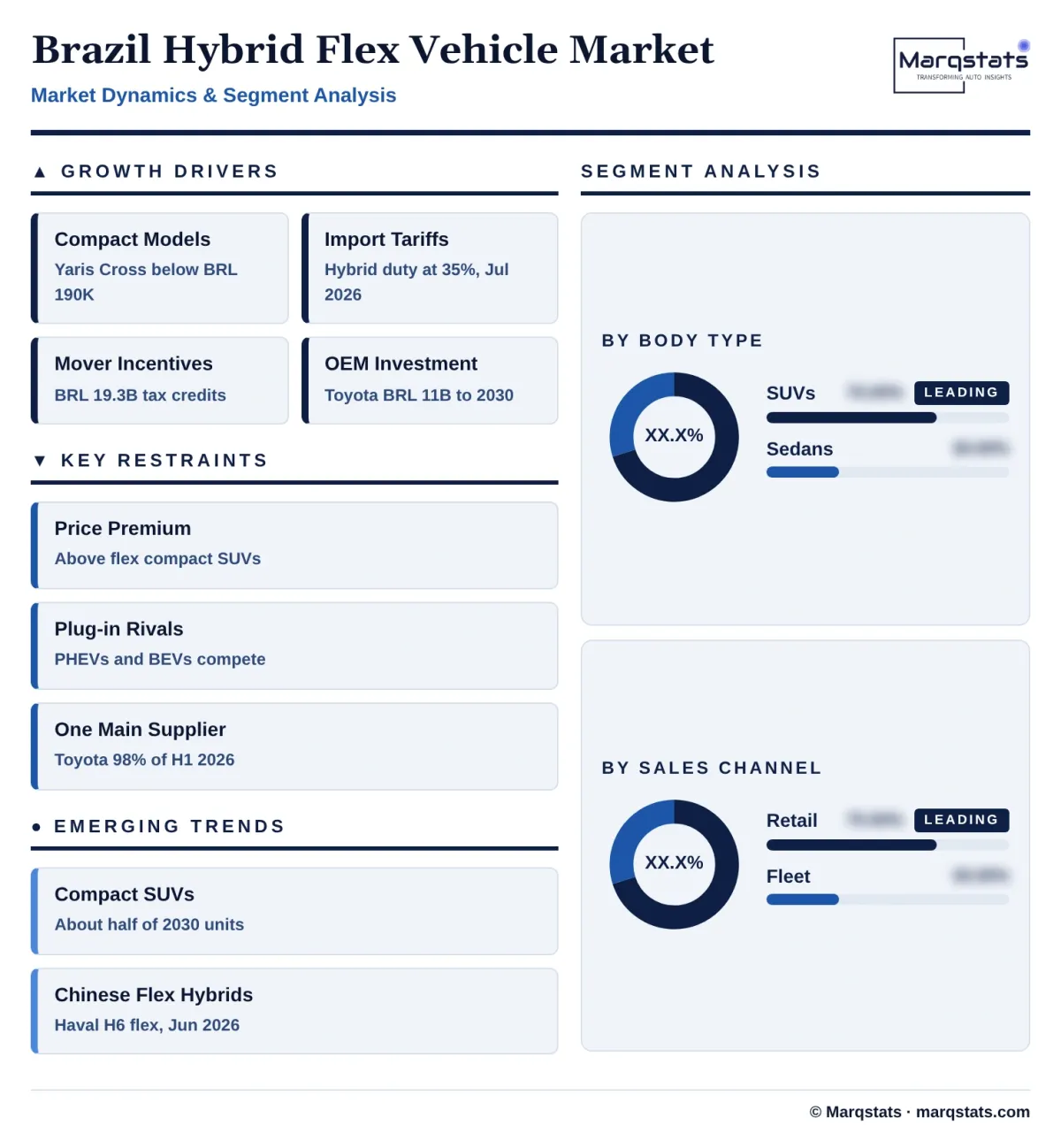
The mix of vehicles changes over the forecast. SUVs and crossovers rise from 70.00% to 91.00% of value, vehicles priced below BRL 190,000 from 16.00% to 44.00%, and fleet and direct sales from 30.00% to 36.00%. The Southeast remains the largest region, but its share eases from 52.80% to 50.50% as the South, Center-West, Northeast and North grow slightly faster from smaller bases.
Market Dynamics
Key Drivers
Five forces are pushing full hybrids with ethanol-capable engines into the Brazilian mainstream.
- Lower-priced models widen the market. The Yaris Cross brought full hybrid flex technology below BRL 190,000 for the first time, into the compact SUV segment where most Brazilian buyers in this price range shop. It accounted for 29.36% of HEV Flex registrations in the first half of 2026, only four months after deliveries started.
- Import tariffs reward local production. The import tariff on full hybrids rose from 15% in January 2024 to 25% in July 2024, 30% in July 2025 and 35% in July 2026, and duty-free quotas ended on 30 June 2026. Manufacturers that want to sell hybrids in volume now have a strong incentive to build them in Brazil, and building them in Brazil means making them flex-fuel.
- The Mover programme rewards efficient, low-carbon vehicles. Brazil regulated the Green Mobility and Innovation programme (Mover) in March 2024, offering BRL 19.3 billion in tax credits for research and production investment from 2024 to 2028, an IPI tax on new vehicles that falls for more efficient and lower-carbon models, and a goal of cutting vehicle carbon emissions by 50% by 2030. Its well-to-wheel accounting credits the carbon absorbed by sugarcane, which favours ethanol-capable hybrids.
- Manufacturers are committing capital. Toyota confirmed in March 2024 an investment of BRL 11 billion in Brazil through 2030 focused on hybrid flex production, Honda plans a hybrid flex model as part of a BRL 4.2 billion programme, and Volkswagen plans to build full hybrid flex SUVs at its Anchieta plant in São Bernardo do Campo.
- Owners save on fuel and keep fuel choice. A full hybrid uses much less fuel in city traffic than a conventional flex car, and the flex engine lets owners switch to ethanol whenever it costs less than about 70% of the gasoline price per litre. Owners do not need a home charger or access to public charging, which remains thin outside the main cities.
Key Restraints
Four constraints limit how fast hybrid flex vehicles can scale in Brazil.
- Higher purchase prices. Even the cheapest HEV Flex model costs well above the conventional flex compact SUVs that dominate Brazilian sales, and high interest rates make that premium harder to finance for retail buyers.
- Strong competition from plug-in and battery electric vehicles. Plug-in hybrids and battery electric cars made up 101,364 and 80,178 registrations in 2025 respectively, and Chinese manufacturers now build plug-in hybrid flex models in Brazil, such as the BYD Song Pro flex built at Camaçari from August 2026. These compete for the same buyers at similar prices.
- Supply concentration creates risk. With one manufacturer supplying almost all HEV Flex vehicles, plant disruptions affect the whole market. A storm damaged the roof of Toyota's Porto Feliz engine plant in September 2025, forcing the company to import engines from Japan while the plant was repaired.
- Ethanol economics vary by region. In the North and Northeast, transport costs and state fuel taxes often push the ethanol price above 70% of the gasoline price, so owners mostly use gasoline and lose part of the cost and carbon advantage.
Key Trends
Four shifts are changing who builds hybrid flex vehicles and where they sell.
- Hybrid flex moves into compact SUVs. Until 2025 the category was limited to the C-segment Corolla and Corolla Cross. Marqstats estimates compact B-segment SUVs will account for about half of HEV Flex registrations by 2030, led by the Yaris Cross and followed by local models from Volkswagen and Honda.
- Chinese manufacturers adopt flex engines. GWM made the whole Haval H6 range flex-fuel in June 2026, with the HEV One version starting at BRL 199,900, and BYD began selling a flex-fuel plug-in hybrid in August 2026. Flex capability is becoming a requirement for any manufacturer building electrified vehicles in Brazil.
- More hybrid architectures. Toyota uses a power-split system, GWM a dedicated hybrid transmission, Honda a two-motor system that switches between series and direct engine drive, Stellantis a 48V electrified dual-clutch transmission, and Volkswagen a 1.5 TSI Evo2 flex engine with two electric motors and a 1.6 kWh battery. Buyers will be able to choose between several approaches by the end of the decade.
- Engine engineering adapted to ethanol. Ethanol vaporises poorly when cold and contains water, so hybrid flex engines use heated injectors or direct injection for cold starts, fast catalyst warm-up for frequent engine restarts, and corrosion-resistant fuel system parts. These parts create new demand for local suppliers.
Strategic Implications
- For carmakers already producing in Brazil, full hybrid flex is now a mainstream product, not a niche. Manufacturers that rely only on 12V mild hybrids to meet efficiency and tax targets risk losing buyers who want electric driving in town without charging.
- For new entrants, local flex production is the price of access. The 35% hybrid import tariff, the end of duty-free quotas and Mover tax credits all favour vehicles built and calibrated in Brazil, and flex capability is expected by buyers who use ethanol as a hedge against gasoline prices.
- For suppliers, localisation creates demand for ethanol-tolerant fuel pumps and injectors, engine control units with flex software, inverters, battery packs and electric motors. Suppliers that can meet local content rules and Toyota-level quality standards are best placed to serve the second wave of programmes.
- For fleet and rental companies, HEV Flex lowers fuel costs per kilometre in urban use without charging infrastructure, making it a practical first step into electrification for executive and app-based ride fleets.
- For ethanol producers, every hybrid flex vehicle is a long-term ethanol customer. Keeping pump prices below 70% of gasoline in more states would increase ethanol use by the growing hybrid fleet and strengthen the well-to-wheel carbon case for the technology.
- For policymakers, the HEV Flex market shows that tariff and tax signals change product plans quickly. Stable rules on well-to-wheel carbon accounting and import tariffs will decide whether hybrid flex becomes a long-term mainstream powertrain or a bridge to plug-in and battery electric vehicles.
Market Segmentation
SUVs and crossovers account for 70.00% of 2025 value, USD 542.65 million and about 14,900 vehicles, almost all Corolla Cross. They grow at 52.97% a year to USD 4,545.91 million and 91.00% of 2030 value as the Yaris Cross, the Haval H6 and new SUVs from Volkswagen and Honda join the category. Marqstats estimates compact B-segment SUVs alone will account for about half of HEV Flex registrations by 2030.
Sedans account for 30.00% of 2025 value, USD 232.56 million and about 6,400 vehicles, through the Corolla. Sedan value grows at 14.09% a year to USD 449.60 million, but its share falls to 9.00% of 2030 value as Brazilian buyers continue to move from sedans to SUVs.
Vehicles priced below BRL 190,000 account for 16.00% of 2025 value, USD 124.03 million, and grow fastest, at 77.71% a year, to USD 2,198.02 million and 44.00% of 2030 value. The Yaris Cross, priced from BRL 172,390 at launch, and future compact SUVs from Volkswagen and Honda sit in this band.
Vehicles priced between BRL 190,000 and BRL 230,000 account for 78.00% of 2025 value, USD 604.67 million, through most Corolla and Corolla Cross versions. This band grows at 30.61% a year to USD 2,297.94 million, but its share falls to 46.00% of 2030 value as lower-priced models expand. The Haval H6 HEV versions, priced from BRL 199,900 to BRL 225,000, also compete here.
Vehicles priced above BRL 230,000 account for 6.00% of 2025 value, USD 46.51 million, through top-trim versions, and grow at 60.77% a year to USD 499.55 million and 10.00% of 2030 value as larger SUVs adopt full hybrid flex systems.
Private buyers purchasing through dealers account for 70.00% of 2025 value, USD 542.65 million, and grow at 42.58% a year to USD 3,197.13 million, 64.00% of 2030 value. Fuel savings in city driving and the ability to choose ethanol are the main purchase reasons.
Direct sales to rental companies, leasing firms, businesses and professionals account for 30.00% of 2025 value, USD 232.56 million, and grow faster, at 50.55% a year, to USD 1,798.38 million and 36.00% of 2030 value as rental and subscription fleets add hybrids to lower fuel costs per kilometre.
By Geography
Southeast
The Southeast accounts for 52.80% of 2025 value, USD 409.31 million and about 11,260 vehicles, and grows at 43.87% a year to USD 2,522.74 million by 2030, when its share eases to 50.50%. São Paulo, Minas Gerais and Rio de Janeiro combine the highest incomes, the densest dealer networks and ethanol prices that often sit below 70% of gasoline prices. Toyota builds its hybrid flex vehicles and engines in São Paulo state, and Volkswagen plans hybrid flex production at São Bernardo do Campo. Rental fleets registered in Minas Gerais because of its lower vehicle tax rate add to the regional total.
South
The South accounts for 18.40% of 2025 value, USD 142.64 million and about 3,920 vehicles, and grows at 45.47% a year to USD 929.16 million and 18.60% of the market by 2030. High household incomes in Paraná, Santa Catarina and Rio Grande do Sul support demand for SUVs, and Paraná is a registration base for rental and leasing fleets.
Center-West
The Center-West accounts for 14.60% of 2025 value, USD 113.18 million and about 3,110 vehicles, and grows at 46.71% a year to USD 769.31 million and 15.40% of the market by 2030. Agribusiness incomes in Mato Grosso and Goiás, local sugarcane and corn ethanol production that keeps ethanol prices low, and government and corporate fleets in Brasília support demand.
Northeast
The Northeast accounts for 11.20% of 2025 value, USD 86.82 million and about 2,390 vehicles, and grows at 47.66% a year to USD 609.45 million and 12.20% of the market by 2030. Ethanol is often less competitive with gasoline at the pump than in the Southeast, but dealer networks are expanding in Salvador, Recife and Fortaleza.
North
The North accounts for 3.00% of 2025 value, USD 23.26 million and about 640 vehicles, and grows fastest, at 47.94% a year, to USD 164.85 million and 3.30% of the market by 2030 from a small base. Long distances and higher ethanol prices limit the advantage of flex fuel, but full hybrids appeal where charging stations are scarce.
How Competition Is Evolving
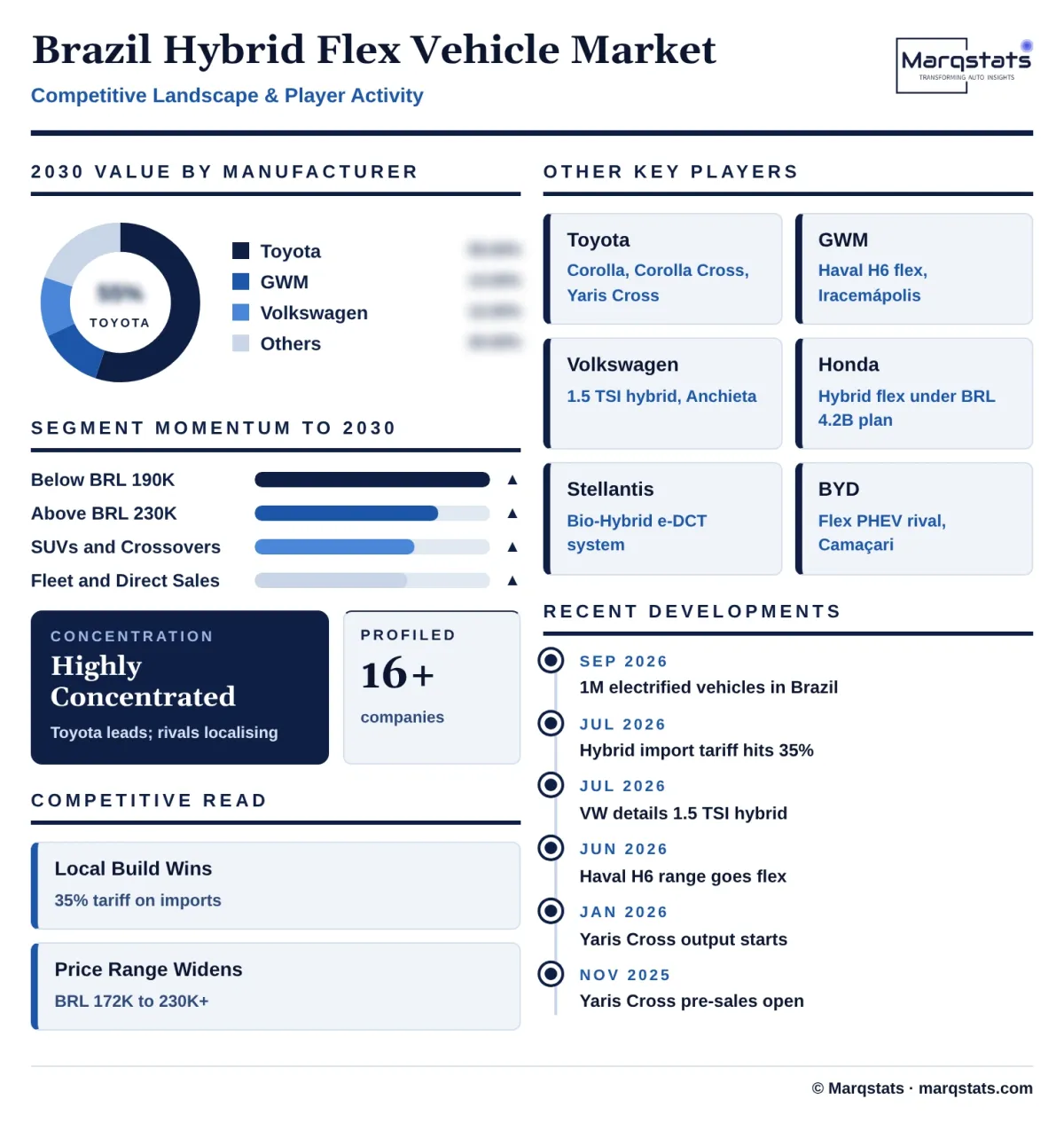
The Brazil hybrid flex vehicle market is highly concentrated. Toyota supplied almost all HEV Flex vehicles from 2019 to 2025 with the Corolla and Corolla Cross, and its models still accounted for 98.33% of registrations in the first half of 2026: the Corolla Cross 36.22%, the Corolla 32.75% and the Yaris Cross 29.36%. The GWM Haval H6 HEV Flex took the remaining 1.67%.
The market is moving from one supplier to several. GWM made all versions of the Haval H6 built at Iracemápolis flex-fuel in June 2026. Volkswagen plans a full hybrid flex system built around its 1.5 TSI Evo2 engine for SUVs produced at Anchieta, Honda plans a hybrid flex model under a BRL 4.2 billion investment programme, and Stellantis has developed a 48V Bio-Hybrid e-DCT system that allows low-speed electric driving. Marqstats expects Toyota to hold about 55% of market value by 2030, GWM about 13%, Volkswagen about 12% and other manufacturers about 20%.
Toyota defends its lead through capacity and price range. Its BRL 11 billion investment programme to 2030 supports more local hybrid flex models and engine production at Porto Feliz, and the Yaris Cross gives it a lower-priced entry point before rivals launch competing compact SUVs.
Adjacent technologies shape competition. Stellantis sells large volumes of 12V mild hybrid flex vehicles, and BYD and GWM build plug-in hybrid flex vehicles in Brazil. These products are outside this market but compete with HEV Flex for the same buyers, and manufacturers can move between architectures as tax incentives and prices change.
Pricing is becoming a competitive weapon. When GWM made the Haval H6 flex-fuel in June 2026, it also lowered the entry price of the range, with the HEV One at BRL 199,900 and the HEV2 at BRL 225,000. As more manufacturers launch locally built full hybrid flex vehicles, Marqstats expects price competition to intensify in the BRL 170,000 to BRL 230,000 range, where most HEV Flex value sits.
Companies Covered
Companies covered in the report include:
Recent Market Activity
Table of Contents
Coverage & Segmentation
The study covers the Brazil hybrid flex vehicle market, with 2025 as the base year, 2021 – 2025 as the historical period and 2026 – 2030 as the forecast period. Values are retail transaction values of new full hybrid flex (HEV Flex) light vehicles registered in Brazil, converted to US dollars at a constant BRL 5.57 per US dollar, the 2025 average of the Central Bank of Brazil PTAX rate. Volumes are annual registrations. The market is segmented by body type, retail price band, sales channel and region.
Mild hybrid flex vehicles (MHEV Flex) with 12V or 48V belt starter generators, which ABVE excludes from its electrified total, and plug-in hybrid flex vehicles (PHEV Flex), which Marqstats sizes in a separate study, are excluded and are discussed only as competing technologies. Gasoline-only full hybrids, battery electric vehicles, used vehicles, parts and aftermarket services are also excluded. Segment, regional and company splits are Marqstats estimates built on ABVE registration data, model prices and manufacturer announcements.