Market Snapshot
Middle bar: base-year value × (1 + CAGR), rounded to two decimals. This is a calculated illustration, not a separately researched annual estimate.
The Brazil plug-in hybrid flex vehicle market size is estimated at USD 1.08 million in 2025 and is projected to reach USD 6,576.30 million by 2030. The 2025 base consists of about 30 pre-launch vehicles, so the five-year CAGR of 471.36% describes a market that started retail sales in June 2026. From 2026, the first year of commercial sales, value grows at 43.20% a year, from USD 1,564.09 million to USD 6,576.30 million, and registrations rise from about 36,000 to 185,000 vehicles.
Marqstats defines the market as the retail transaction value of new plug-in hybrid flex (PHEV Flex) light vehicles registered in Brazil. These vehicles combine a high-voltage battery that is charged from the grid, one or more electric motors, and a flex-fuel combustion engine that runs on hydrous ethanol, gasoline or any blend of the two. Gasoline-only plug-in hybrids, full hybrid flex vehicles that cannot be plugged in (HEV Flex), mild hybrids, battery electric vehicles, used vehicles, parts and services are excluded. This study is a dedicated deep-dive on the flex-fuel layer of the wider Brazilian plug-in hybrid market.
Mid-size SUVs account for all 2026 value, through the GWM Haval H6 and the BYD Song Pro, and vehicles priced between BRL 230,000 and BRL 300,000 for 54.00%. The Southeast accounts for 51.00% of 2026 value and the South for 17.00%. The study segments the market by body type, retail price band, sales channel and region.
Key Takeaways
Market Overview & Analysis
Report Summary
Marqstats sizes the Brazil plug-in hybrid flex vehicle market as the retail transaction value of new PHEV Flex light vehicles registered in the country. In 2025 the category consisted of about 30 pre-launch vehicles, mainly the special-edition BYD Song Pro fleet supplied for the COP30 climate conference in Belém, worth an estimated BRL 6.00 million, or USD 1.08 million at the 2025 average exchange rate of BRL 5.57 per US dollar. Retail sales started in June 2026, and Marqstats estimates about 36,000 registrations worth BRL 8,712.00 million, or USD 1,564.09 million, for the full year 2026.
Plug-in hybrids are the largest electrified technology in Brazil. The Brazilian Electric Vehicle Association (ABVE) counted 223,912 electrified light vehicles in 2025, of which 101,364 were plug-in hybrids, 80,178 battery electric vehicles and 42,370 full hybrids. Almost all 2025 plug-in hybrids were imported from China and ran on gasoline only. ABVE publishes plug-in hybrids as one category, so Marqstats builds the PHEV Flex series from model and version registrations, manufacturer launch dates and production records.
The plug-in hybrid segment kept growing in 2026. Plug-in hybrid registrations reached 117,435 in the first eight months of the year, 98.8% more than in the same period of 2025, and 20,535 in August alone. Marqstats estimates that PHEV Flex vehicles accounted for more than one in five plug-in hybrids registered in Brazil in August 2026, their first month with two locally built models on sale.
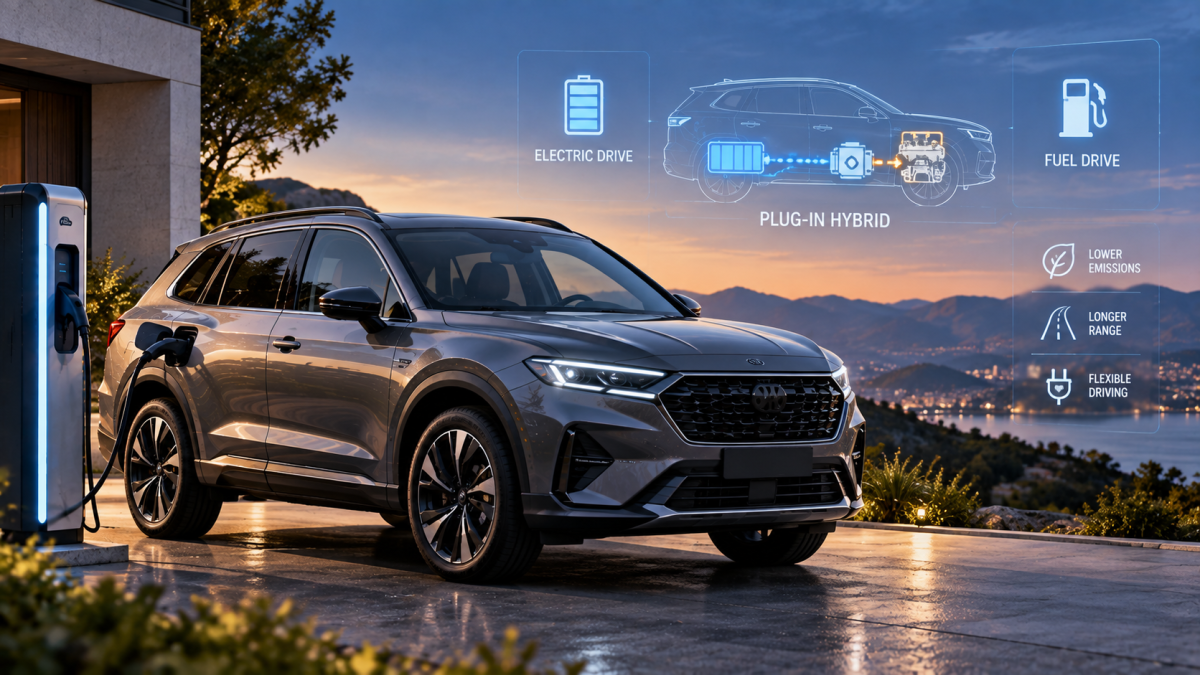
A plug-in hybrid flex vehicle combines Brazil's two strongest automotive technologies. Flex-fuel engines, which run on any blend of hydrous ethanol and gasoline, have dominated new car sales since the mid-2000s. Plug-in hybrid systems add a battery large enough for daily electric driving, typically 13 kWh to 35 kWh, and an on-board charger. The owner can charge at home, drive on electricity in town, and choose the cheaper liquid fuel at each fill-up for longer trips.
The engineering is harder than it looks. Ethanol vaporises poorly in cold conditions, absorbs water and attacks some materials. A plug-in hybrid may run on electricity for days and then start its engine cold under high load, so manufacturers need ethanol-compatible fuel pumps and injectors, sensors that read the fuel blend in real time, revised valve seats and seals, and engine software that adapts within seconds. GWM tested its flex plug-in hybrids over more than 400,000 km in Brazil, and BYD spent two years and about BRL 100 million on the Song Pro flex project.
The wider electrified market is growing fast. Brazil passed 1,000,000 cumulative electrified light vehicle registrations in September 2026, and electrified vehicles took 19.8% of light vehicle sales that month. ABVE projects that electrified vehicles will reach about 30% of light vehicle sales in 2027. Plug-in hybrids are the largest part of this market, and flex versions are the part that local plants are now building.
Brazil Plug-in Hybrid Flex Vehicle Market Size and Forecast
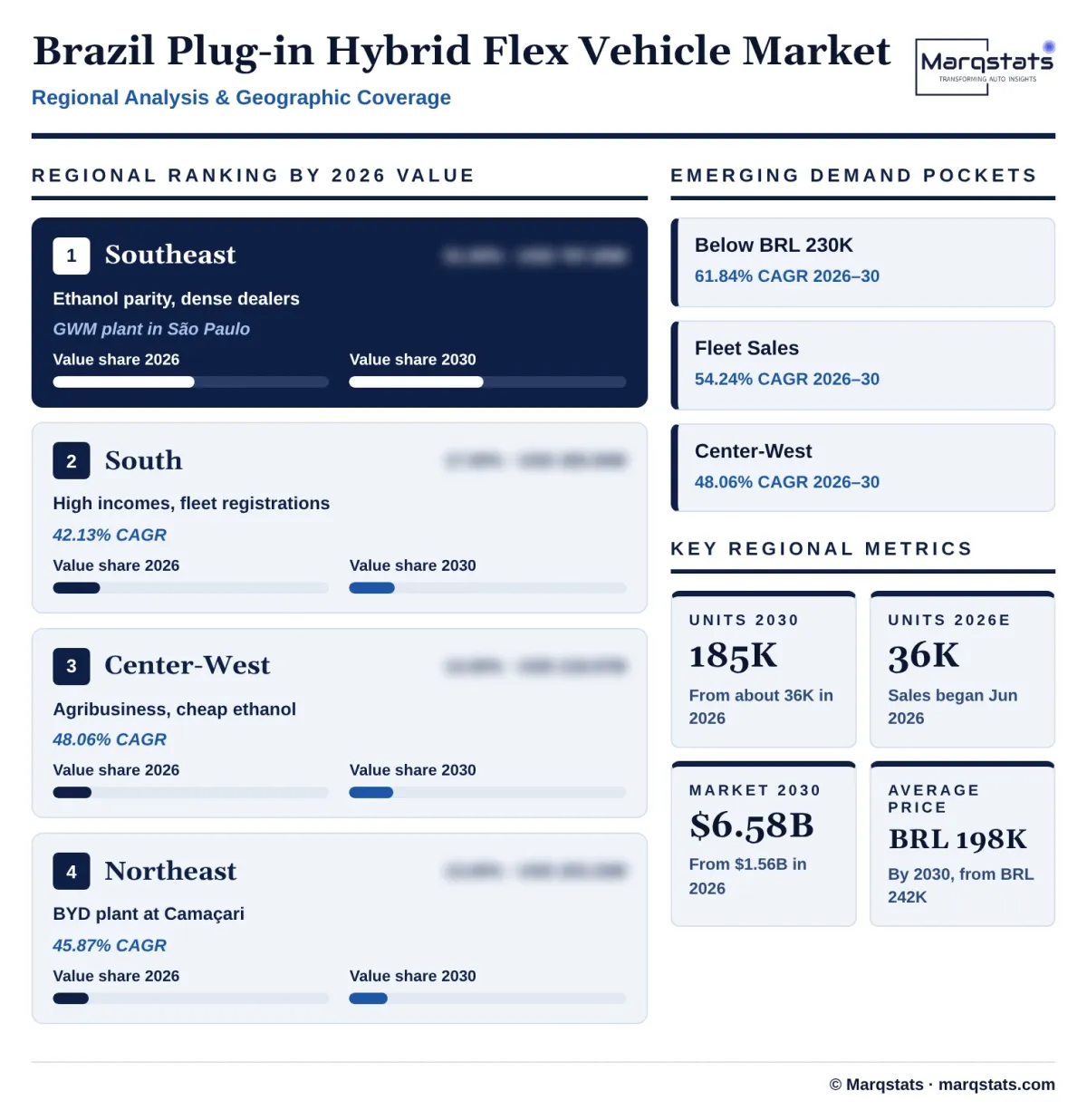
The Brazil plug-in hybrid flex vehicle market grows from USD 1.08 million in 2025 to USD 6,576.30 million in 2030. Marqstats estimates about 36,000 registrations worth USD 1,564.09 million in 2026, 70,000 worth USD 2,815.08 million in 2027, 108,000 worth USD 4,110.59 million in 2028 and 148,000 worth USD 5,420.47 million in 2029, before the market reaches 185,000 vehicles in 2030.
In Brazilian reais, market value rises from BRL 6.00 million in 2025 to about BRL 8,712.00 million in 2026, BRL 15,680.00 million in 2027, BRL 22,896.00 million in 2028, BRL 30,192.00 million in 2029 and BRL 36,630.00 million in 2030. All US dollar values use a constant rate of BRL 5.57 per US dollar, the 2025 average of the Central Bank of Brazil PTAX rate, so growth rates are the same in both currencies.
The 2021 to 2024 historical period carries no registrations. Plug-in hybrid flex powertrains were in development and testing in those years, and every plug-in hybrid sold in Brazil ran on gasoline. The 2025 base of about 30 vehicles is the first year with PHEV Flex vehicles on Brazilian roads, which is why the five-year CAGR of 471.36% is very high. The 2026 to 2030 rate of 43.20% in value and 50.56% in units is the better guide to the pace of the market once sales are under way.
The average transaction price falls as the range widens. It peaks at about BRL 242,000 in 2026, when the Haval H6 plug-in versions priced between BRL 250,000 and BRL 326,000 dominate sales, and eases to about BRL 224,000 in 2027, BRL 212,000 in 2028, BRL 204,000 in 2029 and BRL 198,000 in 2030 as the Song Pro, compact SUVs and pickups gain share. In US dollars the average price moves from about USD 43,447 in 2026 to USD 35,548 in 2030. Registrations therefore grow faster than value.
Growth slows as the base gets bigger. Registrations rise by about 94% in 2027, the first full year with both GWM and BYD in production, then by about 54% in 2028, 37% in 2029 and 25% in 2030. By 2030, Marqstats estimates PHEV Flex vehicles will account for about 6% of Brazilian light vehicle sales and for most plug-in hybrids built in the country.
Four indicators drive the forecast: monthly registrations of each PHEV Flex model and version, the start of production for each announced local plug-in hybrid programme, the ethanol-to-gasoline pump price ratio in the main consuming states, and the price gap between locally built PHEV Flex models and imported gasoline plug-in hybrids after the 35% tariff.
The mix of vehicles changes over the forecast. Mid-size SUVs fall from all 2026 value to 50.00% in 2030 as compact SUVs reach 30.00% and pickups 20.00%. Vehicles priced below BRL 230,000 rise from 38.00% to 62.00% of value, and fleet and direct sales from 26.00% to 35.00%. The Southeast remains the largest region, but its share eases from 51.00% to 48.50% as the Center-West and Northeast grow faster.
Market Dynamics
Key Drivers
Five forces are moving plug-in hybrids with ethanol-capable engines from pilot fleets into Brazilian showrooms.
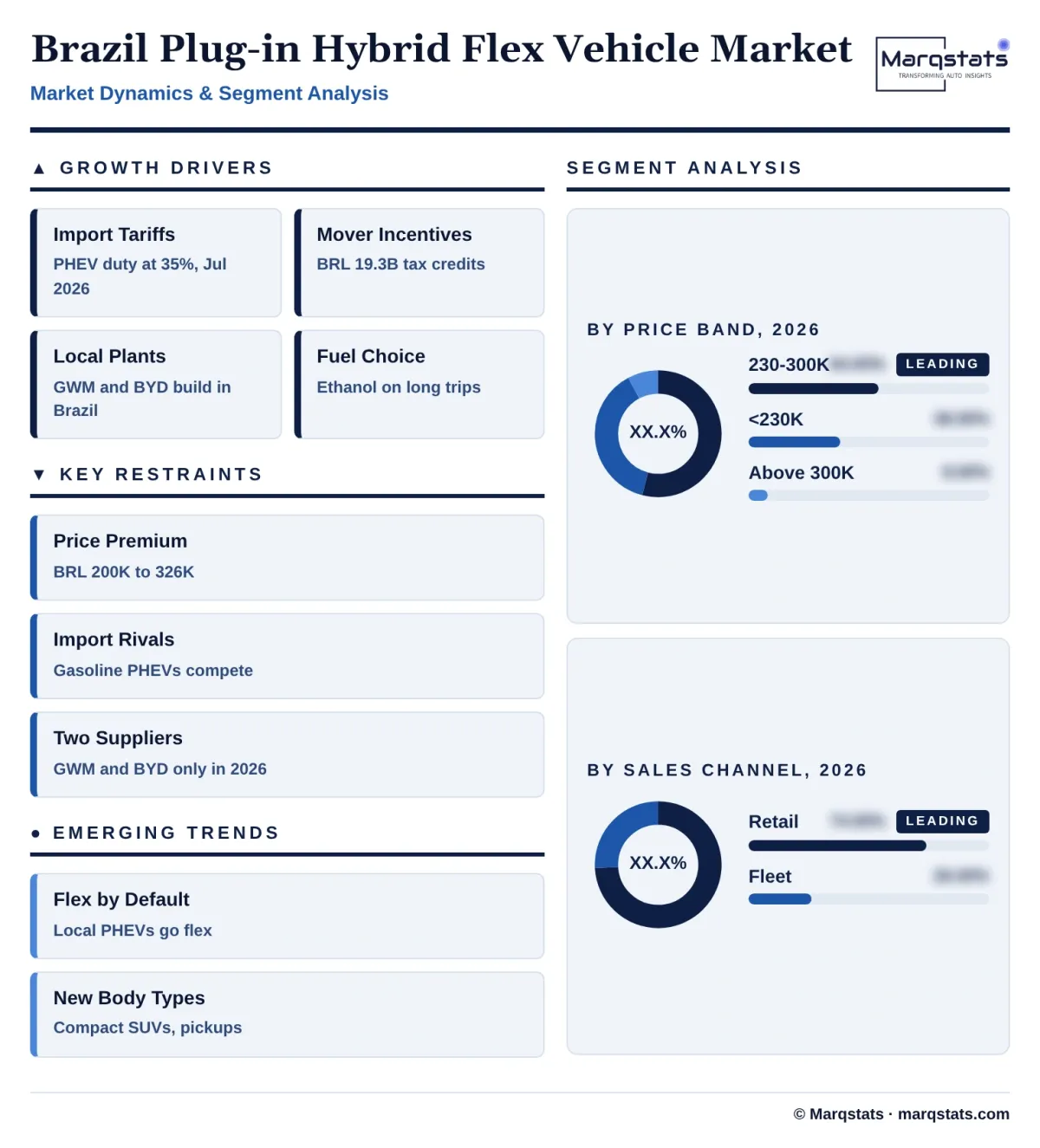
- Import tariffs favour local production. The import tariff on plug-in hybrids rose from 12% in January 2024 to 20% in July 2024, 28% in July 2025 and 35% in July 2026, and the duty-free import quota for plug-in hybrids, USD 75 million in its last period, ended on 30 June 2026. Manufacturers that want to sell plug-in hybrids in volume now build them in Brazil, and locally built models are being calibrated for ethanol.
- The Mover programme rewards efficient, low-carbon vehicles built in Brazil. Law 14.902 of 2024 created the Green Mobility and Innovation programme (Mover), with BRL 19.3 billion in tax credits for research and production investment from 2024 to 2028. The IPI tax on new vehicles falls for more efficient and lower-carbon models, and the programme measures emissions from well to wheel, which credits the carbon absorbed by sugarcane and favours ethanol-capable powertrains.
- Chinese manufacturers have built local plants. GWM produces the Haval H6 at Iracemápolis in São Paulo state, and BYD opened its Camaçari complex in Bahia in October 2025 as part of a BRL 5.5 billion investment. BYD plans to produce about 180,000 vehicles at Camaçari in 2026, about 150,000 of them for Brazil, and aims for more than 50% local content by January 2027.
- Flex capability widens the buyer base. Many Brazilian drivers see ethanol as a hedge against gasoline prices and expect it in a new car. A plug-in hybrid flex vehicle gives them electric driving at home and ethanol on the road, and it removes the main objection of buyers who drive long distances where public charging is thin.
- Fleet emission rules reward plug-in hybrids. The PROCONVE L8 light vehicle standard, in force since January 2025, sets a sales-weighted fleet average limit for each manufacturer that tightens in 2027 and again in 2029. Plug-in hybrids record very low tailpipe emissions on the test cycle, which helps manufacturers balance their sales of combustion pickups and SUVs.
Key Restraints
Four constraints limit how fast plug-in hybrid flex vehicles can scale in Brazil.
- High purchase prices. The Song Pro flex starts below BRL 200,000 and the Haval H6 plug-in versions cost BRL 250,000 to BRL 326,000, well above the conventional flex cars that dominate Brazilian sales. High interest rates make that premium harder to finance for retail buyers.
- Competition from imported and local alternatives. Gasoline plug-in hybrids such as the Jaecoo 7, BYD Song Plus and Geely EX5 EM-i, full hybrid flex vehicles such as the Toyota Yaris Cross, and battery electric cars compete for the same buyers. The 35% tariff narrows but does not remove the price advantage of some imported models.
- Few suppliers and few models. Only two manufacturers built PHEV Flex vehicles in Brazil in 2026, so a supply problem at Iracemápolis or Camaçari would affect most of the market. Local production of batteries and electric motors is still being set up, which leaves the market exposed to imported components and exchange rates.
- Regional ethanol economics vary. In much of the North and Northeast, transport costs and state taxes often push the ethanol price above 70% of the gasoline price, so owners mostly use gasoline when the engine runs and lose part of the cost and carbon advantage of the flex engine.
Key Trends
Four shifts are changing who builds plug-in hybrid flex vehicles and which buyers they reach.
- Flex becomes the default for locally built plug-in hybrids. GWM made the whole Haval H6 range flex-fuel in June 2026 and BYD launched the Song Pro flex in August 2026. Marqstats expects most plug-in hybrids built in Brazil to be flex-fuel by 2030, while gasoline-only plug-in hybrids remain mainly imported premium models.
- Plug-in hybrid flex moves into compact SUVs and pickups. The first two models are mid-size SUVs. Marqstats estimates compact SUVs will account for 30.00% and pickups for 20.00% of 2030 value as manufacturers bring the technology to higher-volume body types, including pickups aimed at agribusiness users.
- Longer electric ranges. The Haval H6 PHEV35 has an electric range of 126 km on the Brazilian PBEV cycle and the Song Pro GS about 120 km, enough for most daily commutes. Longer ranges increase the share of driving on electricity and reduce the role of the engine to long trips.
- Local engineering and content rise. The Song Pro flex was the first project developed jointly by BYD engineering teams in Brazil and China, and GWM developed its flex calibration in Brazil. Both companies are adding local suppliers to meet Mover requirements, which creates demand for ethanol-compatible fuel system parts, electric motors and battery packs made in Brazil.
Strategic Implications
- For carmakers already producing in Brazil, plug-in hybrid flex is now a real product category. Manufacturers without a plug-in flex model risk losing mid-size SUV buyers to GWM and BYD, whose models combine long electric ranges with ethanol capability.
- For new entrants, local flex production is the price of access to volume. The 35% plug-in hybrid import tariff, the end of duty-free quotas and Mover tax credits all favour vehicles built and calibrated in Brazil.
- For suppliers, localisation creates demand for ethanol-tolerant fuel pumps and injectors, flex fuel sensors, engine control software, inverters, battery packs and electric motors. Suppliers that can meet local content rules and support Chinese manufacturers' development schedules are best placed to win the next programmes.
- For fleet and rental companies, PHEV Flex vehicles cut fuel costs in urban use and remove range concerns on long trips, which makes them a practical option for executive fleets and long-term rental contracts.
- For ethanol producers, each plug-in hybrid flex vehicle adds a long-term ethanol customer. Keeping pump prices below 70% of gasoline in more states would increase ethanol use by the growing fleet and strengthen the well-to-wheel carbon case for the technology.
- For policymakers, the PHEV Flex market shows how quickly tariff and tax signals change product plans. Within one year of the final tariff step, the two largest Chinese plug-in hybrid sellers in Brazil were building flex versions locally. Stable rules on well-to-wheel carbon accounting will decide how far the technology spreads.
Market Segmentation
Mid-size SUVs account for all value in 2025 and 2026, through the BYD Song Pro and the GWM Haval H6, with USD 1,564.09 million in 2026. Their value grows at 20.41% a year from 2026 to USD 3,288.15 million in 2030, but their share falls to 50.00% as the technology reaches other body types. Mid-size SUVs have the space and price level to carry a large battery and a turbocharged flex engine.
Compact SUVs have no PHEV Flex model in 2025 or 2026. Marqstats estimates they reach USD 1,972.89 million and 30.00% of value by 2030 as manufacturers adapt smaller plug-in hybrid systems with batteries of about 13 kWh to 18 kWh to flex engines. Compact SUVs are the largest body type in the Brazilian car market, so this segment carries the most volume potential.
Pickups also have no PHEV Flex model in 2025 or 2026. Marqstats estimates they reach USD 1,315.26 million and 20.00% of value by 2030. Plug-in hybrid pickups suit agribusiness owners in the Center-West, who drive long distances on roads with few charging points and have access to some of the cheapest ethanol in the country.
Vehicles priced below BRL 230,000 account for 38.00% of 2026 value, USD 594.35 million, mainly through the Song Pro flex, and grow fastest, at 61.84% a year, to USD 4,077.31 million and 62.00% of 2030 value. Compact SUVs and lower-priced pickups enter this band as local content rises and battery costs fall.
Vehicles priced between BRL 230,000 and BRL 300,000 account for 54.00% of 2026 value, USD 844.61 million, through the Haval H6 PHEV19 at BRL 250,000 and PHEV35 at BRL 290,000. This band grows at 23.63% a year to USD 1,972.89 million, but its share falls to 30.00% of 2030 value as lower-priced models expand.
Vehicles priced above BRL 300,000 account for 8.00% of 2026 value, USD 125.13 million, through the Haval H6 GT at BRL 326,000. The band grows at 43.19% a year to USD 526.10 million and keeps an 8.00% share of 2030 value as larger SUVs and premium pickups adopt plug-in hybrid flex systems.
Private buyers purchasing through dealers had no PHEV Flex registrations in 2025 and account for 74.00% of 2026 value, USD 1,157.43 million. Retail value grows at 38.63% a year to USD 4,274.60 million, 65.00% of 2030 value. Buyers choose these vehicles for low running costs in town, long electric range and the option of ethanol on the road.
Direct sales to government bodies, rental companies, leasing firms and businesses account for all 2025 value, USD 1.08 million, through the COP30 fleet, and 26.00% of 2026 value, USD 406.66 million. This channel grows faster than retail, at 54.24% a year from 2026, to USD 2,301.70 million and 35.00% of 2030 value as rental and corporate fleets add plug-in hybrids to cut fuel costs and emissions.
By Geography
Southeast
The Southeast accounts for 51.00% of 2026 value, USD 797.69 million, and grows at 41.41% a year to USD 3,189.51 million by 2030, when its share eases to 48.50%. São Paulo, Minas Gerais and Rio de Janeiro combine the highest incomes, the densest dealer and charging networks and ethanol prices that often sit below 70% of gasoline prices. GWM builds the Haval H6 at Iracemápolis in São Paulo state.
South
The South accounts for 17.00% of 2026 value, USD 265.90 million, and grows at 42.13% a year to USD 1,085.09 million and 16.50% of the market by 2030. High household incomes in Paraná, Santa Catarina and Rio Grande do Sul support demand for mid-size SUVs, and Paraná is a registration base for rental and leasing fleets. Ethanol is less competitive with gasoline here than in the Southeast.
Center-West
The Center-West accounts for 14.00% of 2026 value, USD 218.97 million, and grows fastest, at 48.06% a year, to USD 1,052.21 million and 16.00% of the market by 2030. Agribusiness incomes in Mato Grosso and Goiás, local sugarcane and corn ethanol production that keeps ethanol prices low, and government fleets in Brasília support demand, and plug-in hybrid pickups suit the long distances in the region.
Northeast
The Northeast accounts for 13.00% of 2026 value, USD 203.33 million, and grows at 45.87% a year to USD 920.68 million and 14.00% of the market by 2030. BYD builds the Song Pro flex at Camaçari in Bahia, and dealer networks are expanding in Salvador, Recife and Fortaleza, although ethanol is often less competitive with gasoline than in the Southeast.
North
The North accounts for all 2025 value, USD 1.08 million, because the COP30 fleet operated in Belém, and for 5.00% of 2026 value, USD 78.20 million. Value grows at 43.20% a year to USD 328.81 million by 2030 while the share holds at 5.00%. Long distances and higher ethanol prices limit the flex advantage, but plug-in hybrids appeal where charging stations are scarce.
How Competition Is Evolving
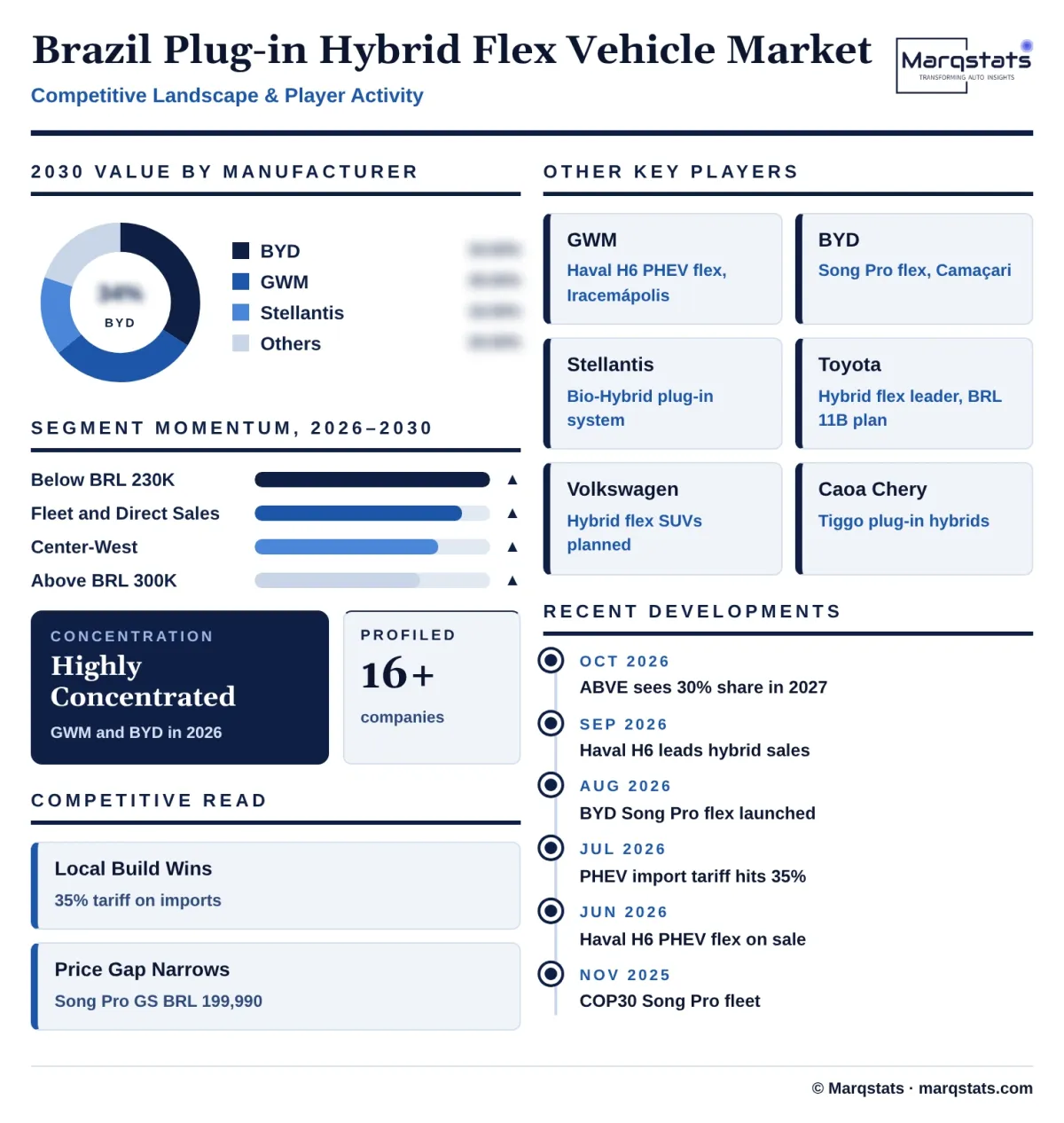
The Brazil plug-in hybrid flex vehicle market is highly concentrated. In 2026 only two manufacturers build PHEV Flex vehicles in Brazil. Marqstats estimates GWM holds about 60% of 2026 value through the Haval H6 PHEV19, PHEV35 and GT, and BYD about 40% through the Song Pro flex in GL and GS versions.
GWM moved first. It put the flex-fuel Haval H6 range on sale on 9 June 2026 and described its plug-in versions as the first plug-in hybrid flex vehicles built in Brazil. The Haval H6 plug-in hybrid registered 2,660 units in July 2026, and the full H6 range led Brazilian hybrid sales in September 2026 with 6,234 registrations, ahead of the Song Pro at 3,533.
BYD competes on price and scale. The Song Pro flex launched on 4 August 2026 with the GS version at BRL 199,990, about BRL 50,000 below the cheapest Haval H6 plug-in hybrid. BYD's Camaçari plant targets about 180,000 vehicles in 2026, so the company can expand flex versions quickly once demand is proven.
The market will broaden after 2027. Marqstats expects Stellantis, which has announced a Bio-Hybrid plug-in system for its Brazilian range, to reach about 16% of 2030 value, and other manufacturers, including Toyota, Volkswagen and Chinese entrants such as Caoa Chery, about 20%. By 2030 Marqstats estimates BYD at about 34% and GWM at about 30%.
Adjacent technologies shape competition. Imported gasoline plug-in hybrids such as the Jaecoo 7 and the Chery Tiggo 7 and Tiggo 8 plug-in hybrids, full hybrid flex vehicles led by Toyota, and battery electric cars compete for the same buyers. Manufacturers can move between these architectures as tariffs, tax incentives and fuel prices change.
Pricing is becoming a competitive weapon. The Song Pro flex placed a plug-in hybrid flex SUV below BRL 200,000 within two months of the first launch. As more manufacturers launch locally built plug-in hybrid flex vehicles, Marqstats expects price competition to intensify in the BRL 180,000 to BRL 250,000 range, where most volume will sit by 2030.
Companies Covered
Companies covered in the report include:
Recent Market Activity
Table of Contents
Coverage & Segmentation
The study covers the Brazil plug-in hybrid flex vehicle market, with 2025 as the base year, 2021 – 2025 as the historical period and 2026 – 2030 as the forecast period. Values are retail transaction values of new plug-in hybrid flex (PHEV Flex) light vehicles registered in Brazil, converted to US dollars at a constant BRL 5.57 per US dollar, the 2025 average of the Central Bank of Brazil PTAX rate. Volumes are annual registrations. The market is segmented by body type, retail price band, sales channel and region.
Gasoline-only plug-in hybrids, which are sized in the wider Brazil plug-in hybrid electric vehicle market, full hybrid flex vehicles without a charging port (HEV Flex), mild hybrids, battery electric vehicles, used vehicles, parts and aftermarket services are excluded and are discussed only as competing technologies. Segment, regional and company splits are Marqstats estimates built on model registration data, list prices and manufacturer announcements.