Market Snapshot
The GCC used car market size is estimated at USD 35,540.00 million in 2025 and is projected to reach USD 53,584.19 million by 2030, growing at a CAGR of 8.56% over 2026 – 2030. Transactions rise from about 2,925,000 to 3,669,000 vehicles as dealers, platforms and fleet sellers formalise trade.
Marqstats defines the market as the transaction value of used passenger vehicles, meaning sedans, hatchbacks, SUVs, crossovers, MPVs and pickups, that change hands between a seller and a buyer resident in Saudi Arabia, the United Arab Emirates (UAE), Kuwait, Qatar, Oman or Bahrain in a calendar year. Dealer retail, certified pre-owned, online and private-party sales are all counted. Vehicles re-exported through UAE free zones, trade between dealers, trucks, buses and new vehicles are excluded.
The UAE is the largest market at 45.53% of 2025 value and also grows fastest, at 9.42% a year, followed by Saudi Arabia at 35.82%. SUVs and crossovers hold 47.00% of value, independent dealers 48.00% and petrol cars 83.00%, while battery-electric and plug-in hybrid vehicles grow fastest at 45.56% a year.
Key Takeaways
Market Overview & Analysis
Report Summary
Marqstats sizes the GCC used car market as the value of used passenger vehicles bought by residents of the six Gulf Cooperation Council states each year. Every retail transaction is counted once, whether the seller is a franchised dealer, an independent dealer on a used car lot, an online retailer, a rental or leasing company selling its old fleet, or a private owner. Trade between dealers is not counted, because the same car would otherwise enter the market twice.
Saudi Arabia and the UAE carry the figures of the live Marqstats country studies without change: 1,550,000 transactions and USD 12,730.00 million for Saudi Arabia, and 880,000 transactions and USD 16,180.00 million for the UAE in 2025, rising to USD 18,920.00 million and USD 25,380.00 million by 2030. Both studies count pickups as a body type and both exclude re-exports, so the six-country total is built on one definition.
The UAE is also the Gulf re-export hub. The live Marqstats UAE used car import and re-export study counts 591,161 used passenger vehicles imported in 2025, of which 266,980 were right-hand-drive vehicles that cannot be registered for UAE roads, and Japan alone shipped about 253,000 used vehicles to the UAE in 2025 out of about 1.71 million used vehicle exports. That flow is a separate market sized at inbound trade value and is not added here.
The four smaller markets are Marqstats constructions. The National Centre for Statistics and Information (NCSI) of Oman counted 1,851,469 registered vehicles at the end of 2025, of which 1,465,455 were private vehicles. Kuwait had 2,028,665 private cars at the end of 2023 on the Central Administration of Statistics bulletin. Bahrain had 749,376 registered vehicles in 2023, growing by about 20,000 a year. Qatar recorded 32,108 vehicle ownership transfers in November 2023 on Planning and Statistics Authority data, a run rate of close to 385,000 transfers a year across all vehicle types, which overstates retail sales because a trade-in that is resold creates two transfers.
The research behind this market corrected a set of inconsistent starting figures. The pack used to commission the study stated a headline of 2.35 million transactions while its own country table summed to 2,812,000, and both are below the 2,430,000 transactions that Saudi Arabia and the UAE alone record on the live Marqstats studies. Marqstats therefore rebuilt the total from the two country studies plus the four constructions, giving 2,925,000 transactions in 2025.
GCC Used Car Market Size and Forecast
The GCC used car market grows from USD 35,540.00 million in 2025 to USD 53,584.19 million in 2030, a CAGR of 8.56%. Transactions grow at 4.64% a year, from about 2,925,000 to 3,669,000, and the average transaction value grows at 3.75% a year, from about USD 12,150 to USD 14,605. Volume therefore supplies a little more than half of the growth and a richer mix of SUVs, certified cars and electrified vehicles supplies the rest.
The market rises to USD 38,577.86 million in 2026, up 8.55%, on about 3,060,500 transactions. New passenger car sales in the six states fall from about 1,321,315 in 2025 to about 1,011,000 in 2026 on the sibling Marqstats Saudi, UAE and Middle East and Africa passenger car builds, after the Strait of Hormuz disruption cut shipments from March 2026 and the Saudi Ministry of Commerce and the Saudi Standards, Metrology and Quality Organization (SASO) suspended light-vehicle imports from 29 manufacturers in June 2026. Buyers unable to get a new car bought a used one instead.
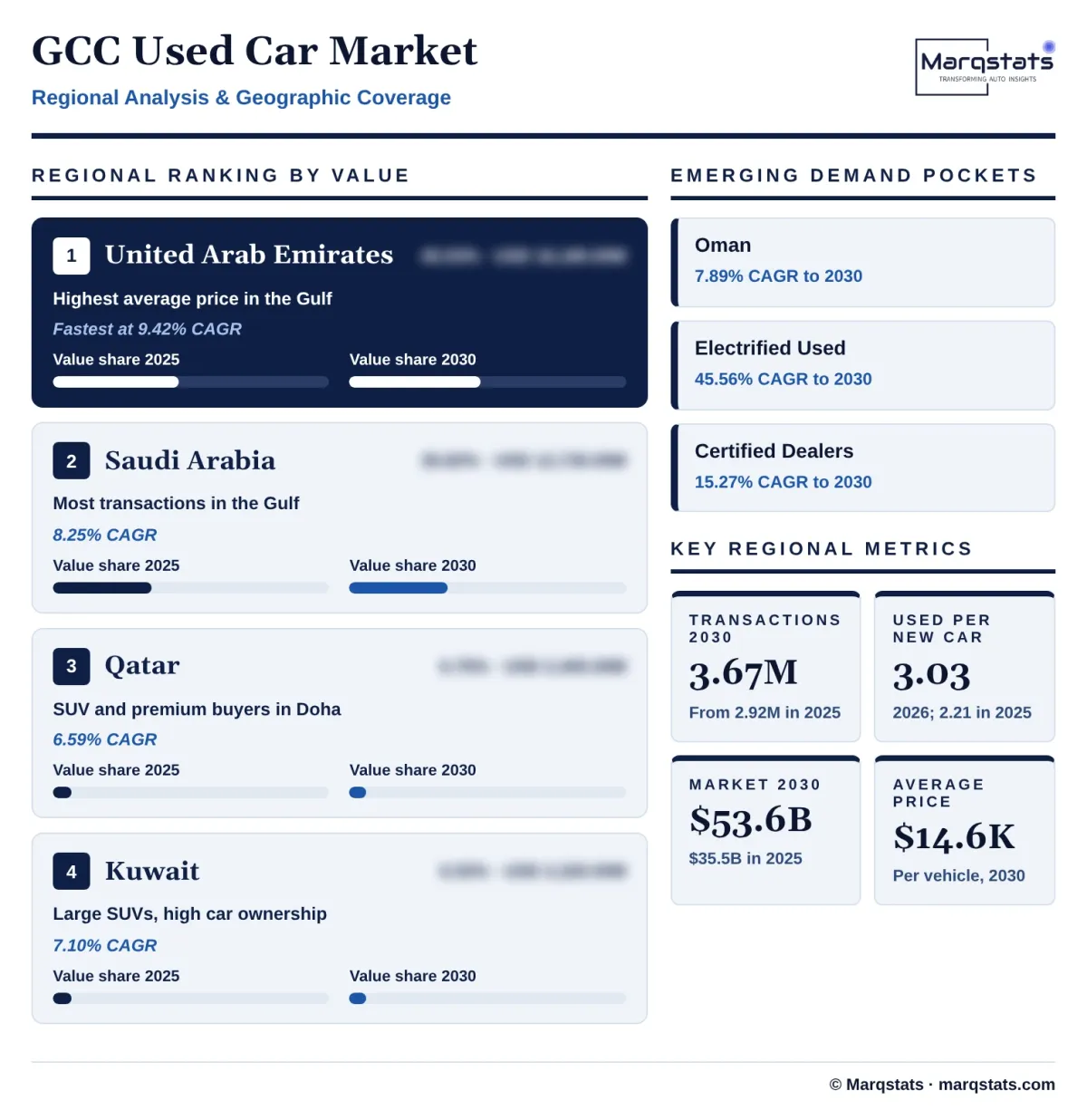
The forecast follows the country studies to 2030. Saudi Arabia grows at 8.25% a year and the UAE at 9.42% a year when recomputed from the 2025 and 2030 anchors on their live pages. Kuwait grows at 7.10%, Qatar at 6.59%, Oman at 7.89% and Bahrain at 6.03% a year on Marqstats estimates of transaction and price growth.
The value basis is the price the buyer pays. Saudi Arabia charges 15% value added tax (VAT), Bahrain 10%, and the UAE and Oman 5%, while Kuwait and Qatar have not introduced VAT. Dealer sales in the UAE can be taxed on the margin only under the Profit Margin Scheme, and private sales carry no VAT in any state, so transaction values sit close to the cash price agreed between buyer and seller. Local currencies are converted at single 2025 average rates: SAR 3.75, AED 3.6725, QAR 3.64, OMR 0.3845 and BHD 0.376 per US dollar, and USD 3.2592 per Kuwaiti dinar.
Marqstats tracks four indicators to monitor the forecast: monthly new-car sales in Saudi Arabia and the UAE as Gulf shipping recovers, Qatar ownership transfer counts, the used-vehicle sales lines in the quarterly results of Lumi Rental Company and United International Transportation Company (Budget Saudi), and Japanese used-vehicle exports to the UAE, which fell to 38,624 units over January to May 2026 on the live Marqstats UAE import study.
Market Dynamics
Key Drivers
Five forces push used-car demand in the Gulf ahead of new-car sales, and two of them strengthened in 2026.
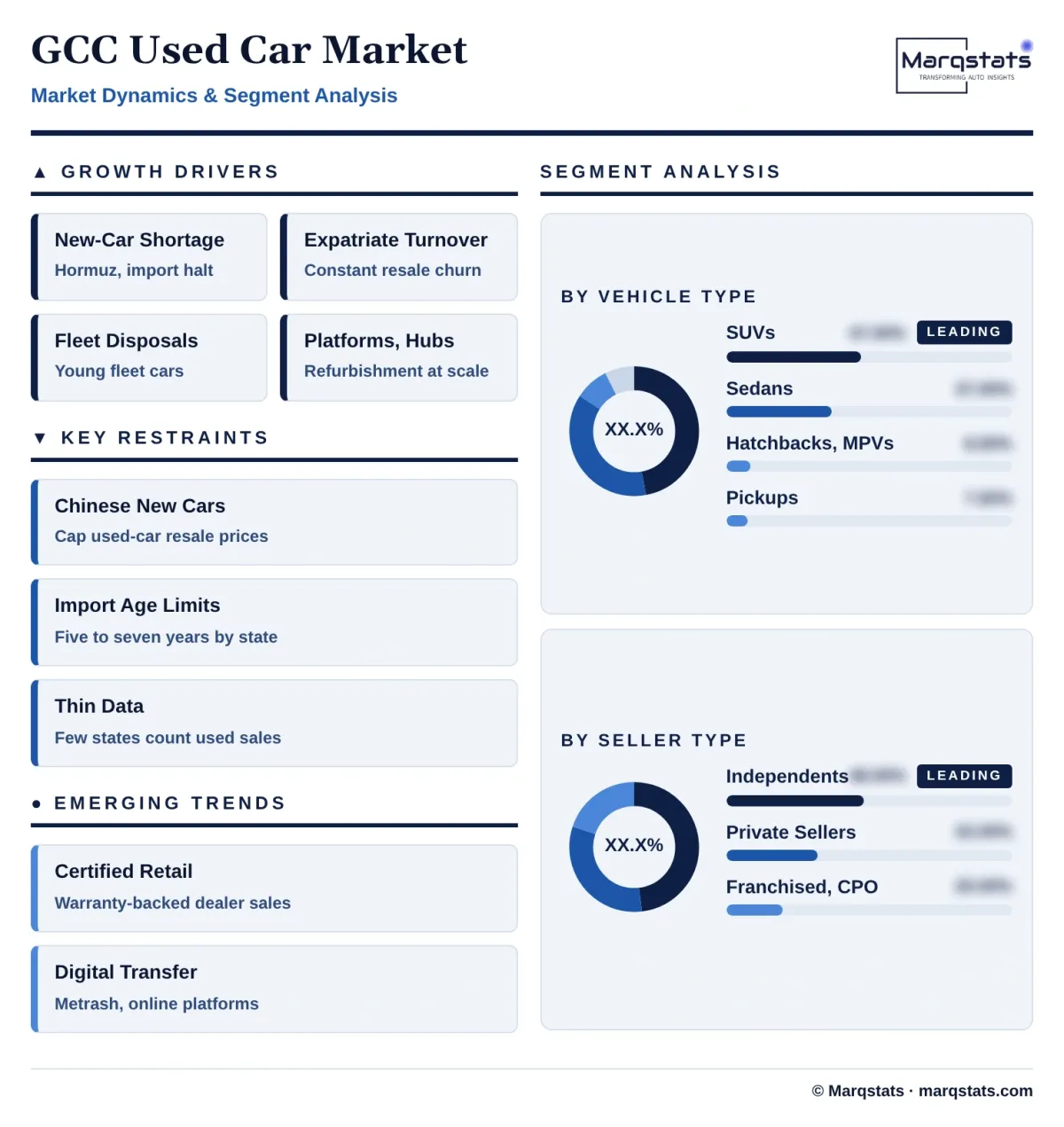
- A shortage of new cars sends buyers to the used market. UAE new vehicle sales fell 47.2% in March 2026, and Marqstats estimates that Gulf new passenger car sales fall by about 310,315 in 2026, after Maersk and Hapag-Lloyd suspended transits through the Strait of Hormuz and CMA CGM imposed an emergency surcharge of up to USD 4,000 per container bound for the UAE.
- Expatriate turnover keeps cars changing hands. Residents of the UAE, Qatar, Kuwait and Bahrain who arrive buy a used car and those who leave sell one, so the used market turns over on employment cycles rather than on household replacement, and the UAE alone records about 880,000 used transactions a year against a new-car market of 288,800 cars.
- Rental and leasing fleets supply young used cars. Lumi Rental Company sold about 7,879 used vehicles in 2025 for about SAR 482.4 million, and its fleet stood at 34,389 vehicles at the end of 2025, so fleet sellers bring three-year-old, serviced stock into a market where the average Saudi transaction is far older and cheaper.
- Platforms and refurbishment hubs lower the cost of buying used. DP World and CARS24 began building an AED 55 million, 220,000 square foot refurbishment hub for more than 100,000 vehicles a year at National Industries Park in Dubai in November 2025, and Syarah raised USD 12 million from Impact46 in September 2026 to take its online car marketplace across Saudi Arabia.
- Tax rules favour registered dealers. The UAE Federal Tax Authority published its first VAT Guide on the Profit Margin Scheme (VATGPM1) on 2 January 2026, confirming that a dealer reselling a used car on which VAT was charged earlier pays VAT on the margin only, which gives registered dealers a price advantage over cash traders who cannot document the earlier charge.
Key Restraints
Four constraints hold transaction values and dealer margins below what volume growth alone would deliver.
- Cheap new Chinese cars compress used prices. United International Transportation Company (Budget Saudi) said in May 2024 that Chinese cars had the lowest resale value after two years among the brands it sells, and the growth of Chinese brands in Saudi Arabia and the UAE in 2025 and 2026 puts a ceiling on what buyers will pay for a three-year-old Japanese or Korean sedan.
- Import rules divide the Gulf into separate markets. Oman allows private used vehicles under seven years old, imported used private cars over five years old cannot be registered in Bahrain without a BHD 1,000 file-opening fee that the government kept in January 2026, and Saudi Arabia applies a five-year limit under its conformity rules, so stock cannot flow freely from the UAE to its neighbours.
- The Gulf supply chain is exposed to shipping shocks. The Strait of Hormuz disruption that pushed demand toward used cars also stopped Japanese used-car shipments through the Dubai Auto Zone, which handles about 15% of Japanese used-vehicle exports, and Japanese shipments to the UAE fell to 38,624 units over January to May 2026, tightening the supply of the cheapest stock.
- Data is thin outside Saudi Arabia and the UAE. Kuwait, Qatar, Oman and Bahrain publish registered vehicle totals and ownership transfer counts but no retail transaction series, and private sales between individuals are recorded only as transfers, so a large part of the market is estimated rather than counted.
Key Trends
Four shifts are changing who sells used cars in the Gulf, what they sell and how buyers pay.
- Certified pre-owned retail grows fastest. Franchised and OEM-certified dealers rise from 20.00% to 27.00% of value by 2030, as Al-Futtaim Automall, which offers warranties of 12 months to three years on certified cars at its new showroom near Dalma Mall in Abu Dhabi, and other distributor groups take trade-ins and sell them with finance and service contracts.
- Buying moves online. Online and omnichannel sales rise from 37.00% to 56.00% of value between 2025 and 2030, as Syarah, CARS24, dubizzle, CarSwitch and YallaMotor add inspection reports, home delivery and finance approval to listings that were once simple classified advertisements.
- Ownership transfer goes digital. The General Directorate of Traffic of the Qatar Ministry of Interior moved vehicle ownership transfer onto the Metrash app in July 2025, with the buyer confirming the sale in their own app before it is completed, cutting the paperwork that kept many private sales informal.
- Electrified used vehicles enter the market in volume. Hybrid, battery-electric and plug-in hybrid vehicles rise from 12.00% to 31.00% of used value by 2030, led by the UAE, where Dubai had 47,944 registered electric vehicles at the end of 2025, up 27.9%, and where used hybrids are in shorter supply than buyers want.
Strategic Implications
- For dealer groups and platforms, 2026 is the year to buy stock, not to wait. With used value at 106.12% of new-car value in 2026, trade-in and fleet-disposal pipelines are worth more than new-car allocation, and groups that can refurbish and certify cars quickly capture the buyers whom new-car shortages turned away.
- For rental and leasing companies such as Lumi Rental Company and Budget Saudi, disposal is now a profit line to manage, not a residual. Selling direct to consumers through certified retail earns more per car than wholesale auctions, but rising Chinese new-car volumes mean residual-value assumptions for Japanese and Korean models need to be cut, not held.
- For lenders and insurers, the shift from private sales to dealers, from 32.00% private in 2025 to 21.00% in 2030, opens room for point-of-sale finance on used cars, which was hard to offer when most cars changed hands for cash between individuals.
- For new entrants, the smaller Gulf markets are a test, not a prize. Kuwait, Qatar, Oman and Bahrain together hold less value than the UAE and grow more slowly, so entrants should build scale in the UAE or Saudi Arabia and serve the others through cross-border sourcing within the age limits each state applies.
- For regulators, digital transfer and margin taxation are the strongest levers. Qatar's Metrash transfer and the UAE Profit Margin Scheme guide each move transactions from cash and informal trade into documented sales, which improves consumer protection and the data on which this market is measured.
Market Segmentation
SUVs and crossovers account for 47.00% of 2025 value, USD 16,703.80 million, and grow at 11.62% a year to USD 28,935.46 million and 54.00% of the market by 2030. The Toyota Land Cruiser, Nissan Patrol and GMC Yukon hold their value best, and the live Marqstats studies put SUVs at about 46% of UAE and about 38% of Saudi used transactions in 2025, rising to about 56% and 47% by 2030.
Sedans account for 37.00% of 2025 value, USD 13,149.80 million, and grow at 4.10% a year to USD 16,075.26 million. The Toyota Camry, Hyundai Elantra and Nissan Sunny are the volume models, especially in Saudi Arabia, where sedans are about 45% of transactions, but cheap new Chinese sedans and crossovers cut into their resale prices.
Pickups account for 7.50% of 2025 value, USD 2,665.50 million, and grow at 7.07% a year to USD 3,750.89 million. The Toyota Hilux, Nissan Navara and Isuzu D-Max serve small businesses and rural buyers, and the Eastern Province of Saudi Arabia shows above-average pickup demand.
Hatchbacks and MPVs account for 8.50% of 2025 value, USD 3,020.90 million, and grow at 9.81% a year to USD 4,822.58 million. Small hatchbacks such as the Suzuki Swift and seven-seat MPVs such as the Toyota Innova serve entry-level expatriate buyers and ride-hailing drivers in the lowest price bands.
Independent dealers, used car lots and professional retailers account for 48.00% of 2025 value, USD 17,059.20 million, and grow at 10.31% a year to USD 27,863.78 million and 52.00% of the market. They include the lots of Ras Al Khor and Sharjah, the Haraj market in Riyadh and the online retailers that buy, recondition and resell stock.
Private sales between individuals account for 32.00% of 2025 value, USD 11,372.80 million, and are broadly flat to 2030, at -0.21% a year, to USD 11,252.68 million and 21.00% of the market. Departing expatriates and Saudi households still sell directly, but instant-offer services from platforms take a growing share of cars that used to be sold privately.
Franchised dealers and OEM-certified programmes account for 20.00% of 2025 value, USD 7,108.00 million, and grow fastest among sellers, at 15.27% a year, to USD 14,467.73 million and 27.00% of the market. Al-Futtaim Automall, Abdul Latif Jameel Motors and other distributor groups sell inspected cars with warranties, finance and service contracts.
Petrol vehicles account for 83.00% of 2025 value, USD 29,498.20 million, and grow at 3.38% a year to USD 34,829.73 million while their share falls to 65.00%. Cheap fuel keeps petrol dominant, at about 88% of Saudi and about 80% of UAE used transactions in 2025.
Diesel vehicles account for 5.00% of 2025 value, USD 1,777.00 million, and grow at 3.82% a year to USD 2,143.37 million. Diesel is concentrated in pickups and large SUVs used for work and desert travel.
Hybrids account for 9.00% of 2025 value, USD 3,198.60 million, and grow at 24.70% a year to USD 9,645.15 million and 18.00% of the market. Toyota and Lexus hybrids hold their value well because they need no charging, and taxi and ride-hailing fleets that retire them supply much of the used stock.
Battery-electric and plug-in hybrid vehicles account for 3.00% of 2025 value, USD 1,066.20 million, and grow fastest among fuel types, at 45.56% a year, to USD 6,965.94 million and 13.00% of the market by 2030, as the first large waves of Tesla, BYD and Geely-group cars sold new in the UAE and Saudi Arabia reach resale age.
Offline sales through lots, showrooms and auctions account for 63.00% of 2025 value, USD 22,390.20 million, and grow at 1.04% a year to USD 23,577.04 million and 44.00% of the market. Buyers still want to see and drive the car, especially in Saudi Arabia, where about 70% of sales are offline.
Online and omnichannel sales account for 37.00% of 2025 value, USD 13,149.80 million, and grow at 17.94% a year to USD 30,007.15 million and 56.00% of the market by 2030. Platforms that combine listings with inspection, finance and delivery, such as CARS24, Syarah and dubizzle, lead the channel.
By Geography
United Arab Emirates
The UAE is the largest and fastest-growing market, with USD 16,180.00 million, or 45.53% of 2025 value, on about 880,000 transactions, and grows at 9.42% a year to USD 25,380.00 million by 2030. The average transaction of about USD 18,386 is the highest in the Gulf because premium and luxury vehicles make up about 32% of transactions. Dubai leads, followed by Abu Dhabi and Sharjah. The re-export trade through the Dubai Auto Zone is a separate market and is not counted.
Saudi Arabia
Saudi Arabia is the largest market by volume, with about 1,550,000 transactions and USD 12,730.00 million, or 35.82% of 2025 value, and grows at 8.25% a year to USD 18,920.00 million by 2030. The average transaction is only about USD 8,213 because older sedans and private sales dominate, but certified and fleet-disposal sales lift it. Riyadh and the Central Region lead, followed by the Western Region around Jeddah, Makkah and Madinah.
Qatar
Qatar accounts for USD 2,400.00 million, or 6.75% of 2025 value, on about 150,000 transactions, and grows at 6.59% a year to USD 3,301.61 million. Marqstats derives retail transactions from Planning and Statistics Authority ownership transfer counts after removing commercial vehicles and dealer resale transfers, and values them at about USD 16,000, or QAR 58,240, because Doha buyers favour large SUVs and premium brands.
Kuwait
Kuwait accounts for USD 2,320.00 million, or 6.53% of 2025 value, on about 160,000 transactions, and grows at 7.10% a year to USD 3,269.44 million. Marqstats applies a turnover rate of about 7.5% to a private car parc estimated at about 2.13 million in 2025, rolled forward from the 2,028,665 private cars of 2023, and an average of about USD 14,500, or KWD 4,449, reflecting a preference for large SUVs.
Oman
Oman accounts for USD 1,260.00 million, or 3.55% of 2025 value, on about 120,000 transactions, and grows at 7.89% a year, the fastest of the four smaller markets, to USD 1,841.96 million. NCSI counted 1,465,455 private vehicles at the end of 2025, and the seven-year import limit lets Omani dealers buy older stock from the UAE than their neighbours can, so the average transaction is lower, at about USD 10,500, or OMR 4,037.
Bahrain
Bahrain is the smallest market, with USD 650.00 million, or 1.83% of 2025 value, on about 65,000 transactions, and grows at 6.03% a year to USD 871.18 million. The registered fleet grows by about 20,000 vehicles a year, and the BHD 1,000 fee on registering imported used cars over five years old keeps the market supplied mostly from the domestic fleet, at an average of about USD 10,000, or BHD 3,760.
How Competition Is Evolving
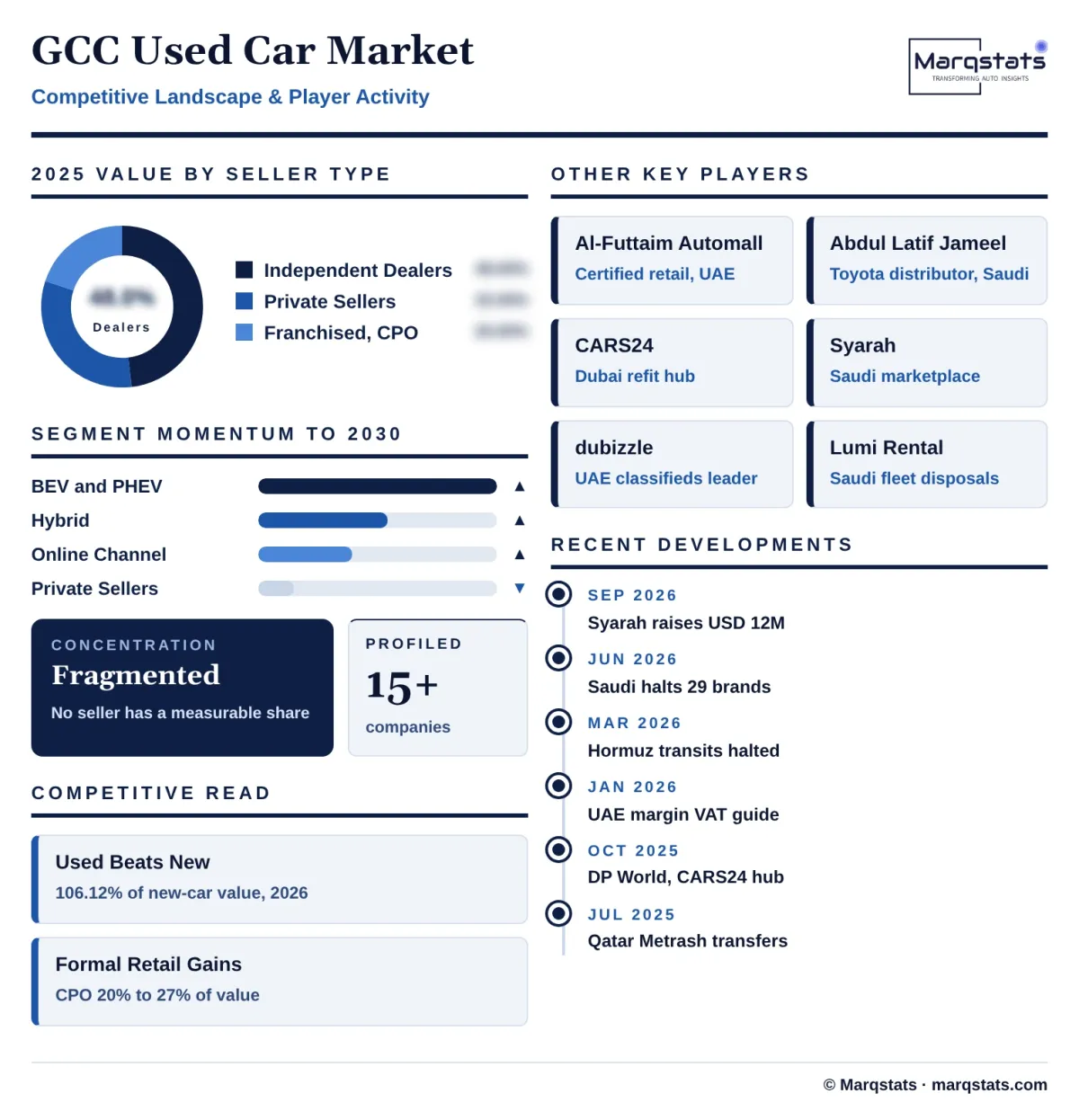
The market is fragmented. Independent dealers and private sellers together account for 80.00% of 2025 value, and no dealer group, platform or fleet seller publishes a transaction count large enough to hold a measurable regional share, so Marqstats describes competition by seller layer and by named, dated actions rather than with a company share table.
Distributor groups lead certified retail. Al-Futtaim Automall in the UAE and Abdul Latif Jameel Motors in Saudi Arabia, the Toyota and Lexus distributors in their markets, sell inspected used cars with warranties and finance, and they control the largest flow of trade-ins because they sell the most new cars. Their advantage is supply, not price.
Platforms compete to own the buyer. CARS24 builds a refurbishment hub for more than 100,000 vehicles a year in Dubai, Syarah raised USD 12 million in September 2026 after a USD 60 million Series C led by Artal Capital in 2024, and dubizzle, CarSwitch, YallaMotor, DubiCars, Haraj and 4Sale run the classifieds where most private sellers start. The platforms that also buy, recondition and finance cars take margin that classified sites cannot.
Fleet sellers set the price of young used cars. Lumi Rental Company sold about 7,879 used vehicles in 2025 for about SAR 482.4 million, an average of about USD 16,327 per vehicle, roughly twice the average Saudi transaction, and Budget Saudi, Al-Futtaim and the UAE leasing companies sell similar volumes. When these sellers cut prices to clear fleet stock, they reset prices for the whole three-year-old segment.
Companies Covered
Companies covered in the report include:
Recent Market Activity
Table of Contents
Coverage & Segmentation
The study covers the GCC used car market, with 2025 as the base year, 2021 – 2025 as the historical period and 2026 – 2030 as the forecast period. It covers used passenger vehicles, including sedans, hatchbacks, SUVs, crossovers, MPVs and pickups, sold to buyers resident in Saudi Arabia, the UAE, Kuwait, Qatar, Oman and Bahrain, segmented by vehicle type, seller type, fuel type, sales channel and six countries. Values are transaction prices paid by the buyer in US dollars, converted at single 2025 average rates: SAR 3.75, AED 3.6725, QAR 3.64, OMR 0.3845, BHD 0.376 per US dollar and USD 3.2592 per Kuwaiti dinar.
New vehicles, trucks, buses, motorcycles, trade between dealers, auction sales to other traders and vehicles re-exported through UAE free zones are excluded. Saudi Arabia and the UAE carry the live Marqstats Saudi Arabia and UAE used car studies exactly; the Middle East and Africa used car study contains all six states, and the UAE used car import and re-export study measures the inbound trade flow at customs value, so neither should be added to this market. The new-car comparison uses the Marqstats Saudi, UAE and Middle East and Africa passenger car builds and is not additive.