Market Snapshot
Middle bar: base-year value × (1 + CAGR), rounded to two decimals. This is a calculated illustration, not a separately researched annual estimate.
The Slovenia used car market size is estimated at USD 1,957.69 million in 2025 and is projected to reach USD 2,419.78 million by 2030, growing at a CAGR of 4.33% over 2026 – 2030. Used passenger car transactions rise from 146,200 to 166,000, with diesel cars leading at 54.38% of 2025 value.
Slovenia sells about two and a half used passenger cars for every new one. In 2025 the market recorded 146,200 used passenger car (M1) transactions: 107,450 domestic changes of ownership and 38,750 first registrations of imported used cars, against 57,557 new-car registrations. Marqstats values these transactions at an average of EUR 11,850, or EUR 1,732.47 million, converted at the 2025 European Central Bank average of USD 1.13 per euro.
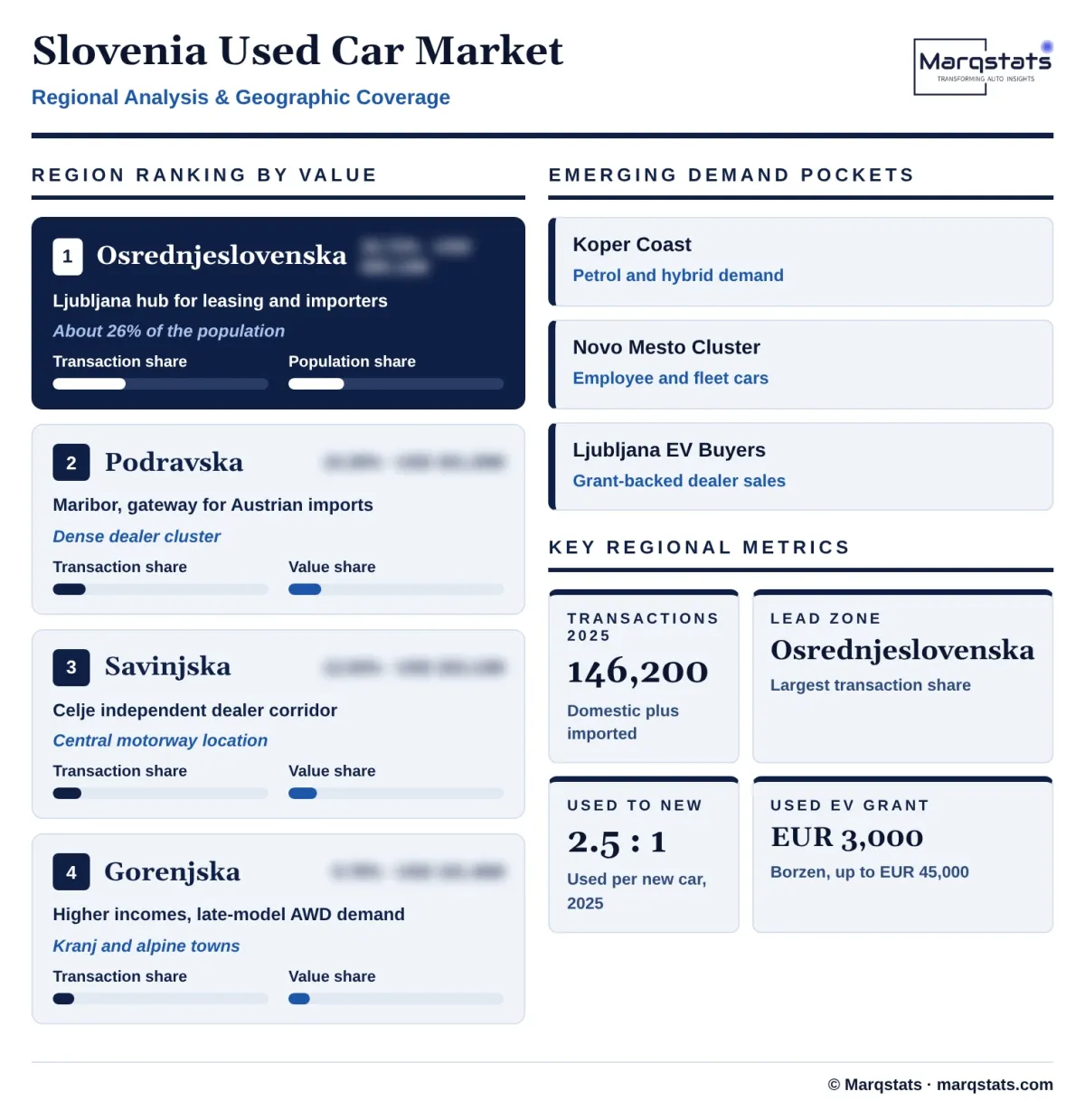
Demand is concentrated in Central Slovenia. Osrednjeslovenska, the region around Ljubljana, accounts for 33.72% of transactions, followed by Podravska around Maribor at 15.39% and Savinjska around Celje at 12.93%. The study segments the market by fuel type (diesel, petrol, hybrid and battery electric), sales channel (private sellers, independent dealers and franchise dealers) and vehicle age, and covers M1 passenger cars only.
Key Takeaways
Market Overview & Analysis
Report Summary
Marqstats sizes the Slovenia used car market as the value of all used passenger car (M1) transactions in a year: domestic changes of ownership between Slovenian owners and first registrations of imported used cars. In 2025 these totalled 146,200 transactions, 107,450 domestic and 38,750 imported. Transactions are valued at an average of EUR 11,850 across franchise dealers, independent dealers and private sales, and converted to US dollars at the 2025 European Central Bank average of USD 1.13 per euro.
The market sits between Western European supply and a domestic fleet that is renewing gradually. Imported used cars come mainly from Germany, Austria, Italy and France and must pass single-vehicle conformity checks and ZDMV-1 tax assessment before registration. Domestic transfers carry an older tail, with many cars more than eight years old. A central vehicle registry logs mileage at every technical inspection and change of owner, and buyers can check it through the eUprava portal using the VIN, which keeps odometer fraud lower than in many neighbouring markets.
Prices span a wide range. Compact cars such as the Volkswagen Golf and Škoda Octavia, the core of the market, trade at roughly EUR 8,000 to EUR 15,000, while late-model executive imports and certified premium SUVs sell for EUR 22,000 to more than EUR 65,000. Mileage is high across much of the market: 18% of transacted cars show less than 60,000 kilometres, 41% between 60,000 and 150,000 kilometres and 41% more than 150,000 kilometres.
The forecast rests on three conditions. Household incomes keep rising, supporting demand for younger cars. Leasing and certified dealer programmes continue to expand, pulling transactions from private sales into dealer channels. And the ZDMV-1 tax structure and Borzen grants remain broadly in place. Under these conditions transactions reach 166,000 in 2030 and market value USD 2,419.78 million.
Slovenia Used Car Market Size and Forecast
The Slovenia used car market grows from USD 1,957.69 million in 2025 to USD 2,419.78 million in 2030, a CAGR of 4.33%. In euro terms the market grows from EUR 1,732.47 million to EUR 2,141.40 million. Transactions grow from 146,200 to 166,000, a 2.57% annual rate, with domestic transfers rising to about 119,700 and imports to about 46,300. The average transaction rises from EUR 11,850 to EUR 12,900 as hybrids, electric cars and younger stock take a larger share.
Value grows faster than volume throughout the period, by about 1.76 percentage points a year. SUVs and crossovers continue to replace hatchbacks, electrified cars carry higher prices than the diesels they replace, and certified dealer programmes keep three- to six-year-old cars in better condition, which slows their depreciation.
Market Dynamics
Key Drivers
Five conditions push both volume and value higher over the forecast.
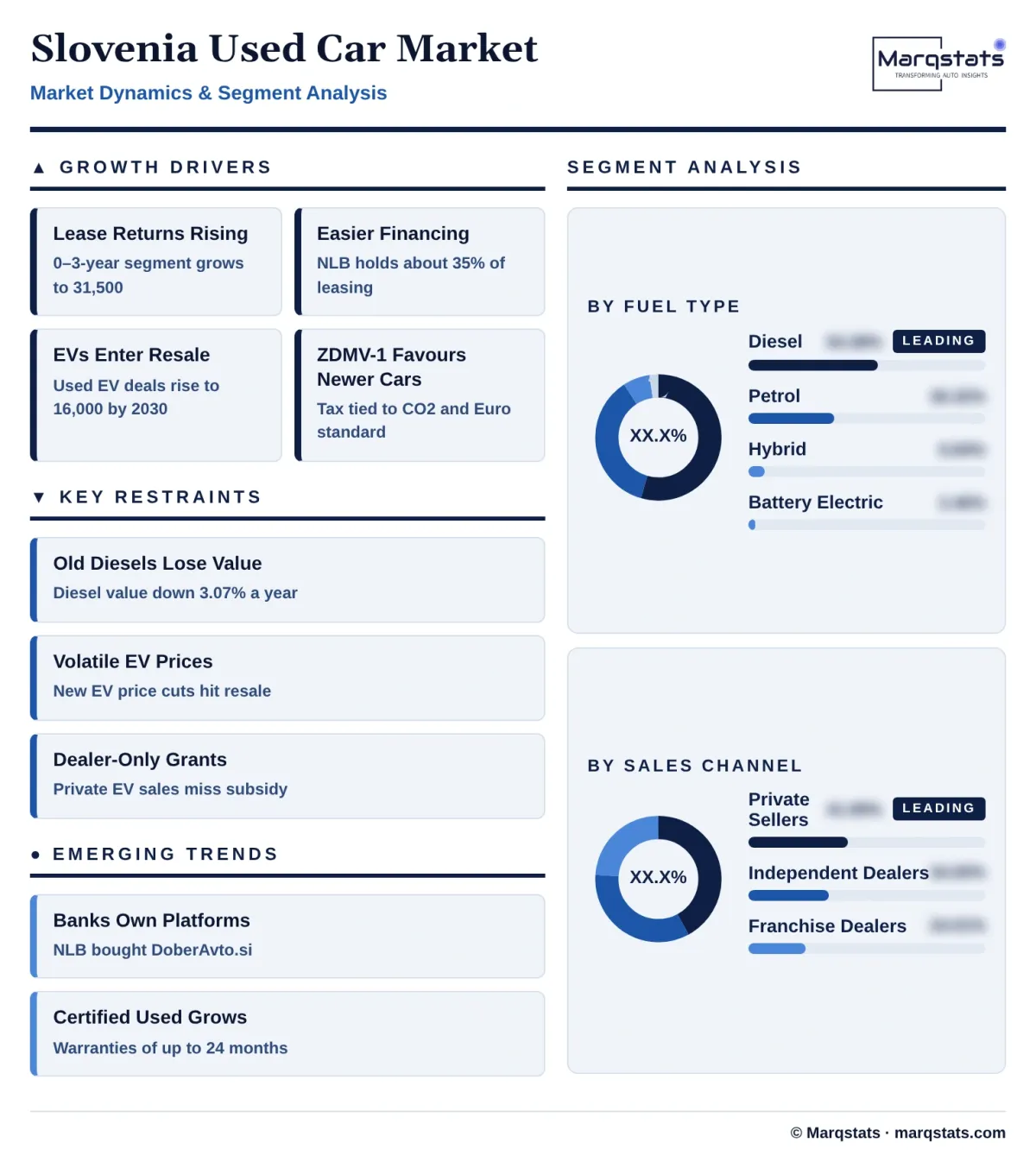
- Lease returns are increasing used supply. NLB Lease&Go, Porsche Finance Group Slovenia and SKB Leasing finance a large share of new cars, and those cars return to the market after three to five years. Lease returns supply most of the 0- to 3-year-old segment, which grows from 23,400 transactions in 2025 to 31,500 by 2030.
- Financing is easier to get at the point of sale. The merger of NLB Lease&Go and Summit Leasing in July 2025 created a lender with about 35% of the leasing market, and NLB has embedded instant credit decisions into DoberAvto.si listings. Porsche Finance Group Slovenia offers discounts of up to EUR 1,500 to buyers who bundle financing, insurance and warranty.
- Electrified cars are entering the used market. Battery electric cars made up about 11% of 2025 new-car registrations, and those cars will reach the used market from 2027 onward. Combined with Borzen grants of up to EUR 3,000 for used electric cars, Marqstats expects used electric transactions to grow from 3,600 in 2025 to 16,000 by 2030.
- The ZDMV-1 tax favours younger imports. By taxing emissions instead of engine size, ZDMV-1 lowered registration tax on late-model Euro 6d cars, including larger diesel estates and premium SUVs. Importers have shifted toward newer, higher-value cars from Germany and Austria, lifting the average transaction value.
- Commuting and cross-border travel sustain car ownership. Many Slovenians commute long distances to Ljubljana and other employment centres and travel regularly to Austria, Italy and Croatia. High car dependency keeps used car demand steady across economic cycles. Public transport outside Ljubljana is limited, so most households own at least one car, and many keep a second, older car for local trips.
Key Restraints
Four constraints slow the shift away from older diesel stock.
- Older diesels are losing value. ZDMV-1 surcharges on Euro 4 and Euro 5 diesels and low-emission zones in neighbouring countries reduce the appeal of older diesel cars. The 12-years-and-older segment shrinks from 27,100 transactions in 2025 to 23,000 by 2030, and diesel value declines by 3.07% a year.
- Used electric car prices are volatile. Price cuts on new electric cars push down resale values of three- to five-year-old models such as the Tesla Model 3 and Volkswagen ID.3. Buyers who fear further price drops or battery wear delay purchases, and dealers carry more risk on electric stock.
- Grants favour dealers over private sellers. Borzen grants apply only to used electric cars bought from registered dealers and no more than 36 months old. Private sellers of older electric cars cannot offer buyers the same subsidy, which slows private electric resale.
- The market is small and import-dependent. With about 146,200 transactions a year, Slovenia offers limited scale for large used car retailers, and imported supply depends on prices and availability in Germany, Austria and Italy. Shifts in those markets pass quickly into Slovenian prices.
Key Trends
Four shifts are reshaping how used cars are sourced, financed and sold.
- Banks are moving into used car platforms. NLB acquired DoberAvto.si in February 2025 and links listings to its NLB Hitri lizing instant credit service. Listing, financing and insurance are converging into a single online journey, which favours platforms backed by lenders.
- Certified programmes are becoming the norm for younger cars. Porsche Inter Auto sells Volkswagen Group used cars under Das WeltAuto and Porsche Approved, with 250-point inspections and warranties of up to 24 months. Emil Frey, Avto Aktiv Intercar and AC Kondor run similar programmes for their brands.
- Avto.net remains the main price reference. Avto.net is the primary used car classifieds portal for dealers and private sellers, while Bolha.com serves cheaper cars and private sales. Mileage records available through eUprava make online prices easier to compare.
- Corporate fleets are buying used electric cars. Borzen opened a EUR 5.0 million call in March 2026 offering companies EUR 3,000 for used electric passenger and light commercial vehicles under 36 months old, creating a new buyer group for ex-lease electric stock.
Strategic Implications
- For dealers, younger and electrified stock is where value grows. The 0- to 3-year-old segment grows at 7.94% a year in value and battery electric cars at 37.10%. Dealers that secure lease-return supply and qualify for Borzen grant sales will outgrow the market.
- For importers, ZDMV-1 rewards newer cars. Four- to seven-year-old Euro 6d cars from Germany and Austria carry lower registration tax and stronger resale values than older diesels. Importers should shift sourcing toward petrol, hybrid and late-model diesel stock.
- For lenders, the used market offers growth beyond new-car leasing. With franchise and independent dealers taking share from private sales, point-of-sale financing will reach more used transactions. Lenders linked to listing platforms, as NLB now is through DoberAvto.si, can capture buyers earlier in the search.
- The most likely path is steady volume growth with rising value. The research identifies no pending, dated decision that would move the 2030 value materially from the base case. Marqstats therefore states a single base case rather than alternative scenarios.
Market Segmentation
Diesel cars account for 79,500 transactions in 2025, 54.38% of the market and USD 1,064.59 million. They remain the largest segment but decline to 62,500 transactions and 37.65% of volume by 2030, with value falling 3.07% a year to USD 911.05 million. Long commutes and cross-border travel sustain demand for Volkswagen, Škoda and BMW diesel estates, but ZDMV-1 surcharges weigh on older models.
Petrol cars account for 53,100 transactions in 2025, 36.32% of the market and USD 711.03 million, rising to 60,000 transactions and USD 874.51 million by 2030, a 4.23% value CAGR. Petrol holds its share in small urban cars and second household cars.
Hybrids, including mild, full and plug-in hybrids, account for 10,000 transactions in 2025, 6.84% of the market and USD 133.91 million. They rise to 27,500 transactions and 16.57% of volume by 2030, with value growing at 24.53% a year to USD 400.96 million. Toyota full hybrids and Volkswagen Group plug-in hybrids lead the segment.
Battery electric cars account for 3,600 transactions in 2025, 2.46% of the market and USD 48.16 million, and are the fastest-growing segment. They rise to 16,000 transactions and 9.64% of volume by 2030, with value growing at 37.10% a year to USD 233.27 million, supported by Borzen grants and the arrival of ex-lease Tesla, Volkswagen ID and Škoda Enyaq models.
Private sales account for 61,400 transactions in 2025, 41.99% of the market and USD 822.03 million. They remain the largest channel but fall to 58,500 transactions and 35.24% by 2030, with value growing only 0.74% a year to USD 852.73 million. Private sales carry no commercial warranty and cannot access Borzen grants.
More than 600 licensed independent dealers account for 49,700 transactions in 2025, 34.00% of the market and USD 665.61 million. They rise to 61,000 transactions and 36.75% by 2030, with value growing at 5.97% a year to USD 889.27 million. Many also act as import brokers for cars from Germany and Austria.
Franchise dealers account for 35,100 transactions in 2025, 24.01% of the market and USD 470.04 million, and are the fastest-growing channel. They rise to 46,500 transactions and 28.01% by 2030, with value growing at 7.59% a year to USD 677.78 million, led by Porsche Inter Auto, Emil Frey and Avto Aktiv Intercar certified programmes.
Cars up to three years old account for 23,400 transactions in 2025, 16.01% of the market and USD 313.43 million. Lease returns, fleet disposals and demonstrators make up most of this segment, which grows to 31,500 transactions and USD 459.27 million by 2030, a 7.94% value CAGR, the fastest of any age band.
Cars aged four to seven years are the core of the market, with 55,500 transactions in 2025, 37.96% of the market and USD 743.14 million. The segment grows to 68,000 transactions and 40.96% by 2030, with value at USD 991.14 million, a 5.93% CAGR. Imports concentrate here because ZDMV-1 rates are favourable for Euro 6 cars.
Cars aged eight to eleven years account for 40,200 transactions in 2025, 27.50% of the market and USD 538.36 million, rising to 43,500 transactions and USD 633.98 million by 2030, a 3.32% value CAGR. Budget buyers and second-car households drive demand.
Cars twelve years and older account for 27,100 transactions in 2025, 18.53% of the market and USD 362.76 million. The segment shrinks to 23,000 transactions and USD 335.38 million by 2030, a 1.56% annual decline in value, as older cars fail annual technical inspections and leave the fleet.
By Geography
Osrednjeslovenska
Osrednjeslovenska, around Ljubljana, is the largest regional market, with 49,300 transactions in 2025, 33.72% of the national total and about USD 660.13 million. Leasing companies such as NLB Lease&Go and Porsche Finance Group Slovenia, importers such as Porsche Inter Auto and many corporate fleets are domiciled here and register stock in the capital before selling it nationwide.
Podravska
Podravska, centred on Maribor, accounts for 22,500 transactions, 15.39% of the market and about USD 301.29 million. Its large population and road links to Austria make it a natural entry point for imported used cars, and franchise and independent dealers cluster around the city.
Savinjska
Savinjska, centred on Celje, accounts for 18,900 transactions, 12.93% of the market and about USD 253.13 million. A dense network of independent dealers and service businesses along the central motorway corridor serves buyers from across eastern Slovenia.
Gorenjska
Gorenjska, centred on Kranj, accounts for 14,300 transactions, 9.78% of the market and about USD 191.46 million. Higher incomes and alpine terrain support demand for late-model, all-wheel-drive cars.
Obalno-kraška
Obalno-kraška, on the coast around Koper, accounts for 10,200 transactions, 6.98% of the market and about USD 136.65 million. The port and coastal economy support franchise operations and demand for petrol and hybrid cars.
Jugovzhodna Slovenija
Jugovzhodna Slovenija, centred on Novo Mesto, accounts for 9,800 transactions, 6.70% of the market and about USD 131.17 million. The Novo Mesto car manufacturing cluster supports incomes and a steady supply of employee and fleet cars.
Other Regions
The remaining six regions, Goriška, Pomurska, Koroška, Posavska, Primorsko-notranjska and Zasavska, account for 21,200 transactions, 14.50% of the market and about USD 283.87 million. Lower incomes keep cars in service longer, so older domestic transfers and private sales make up a larger share of trade.
How Competition Is Evolving
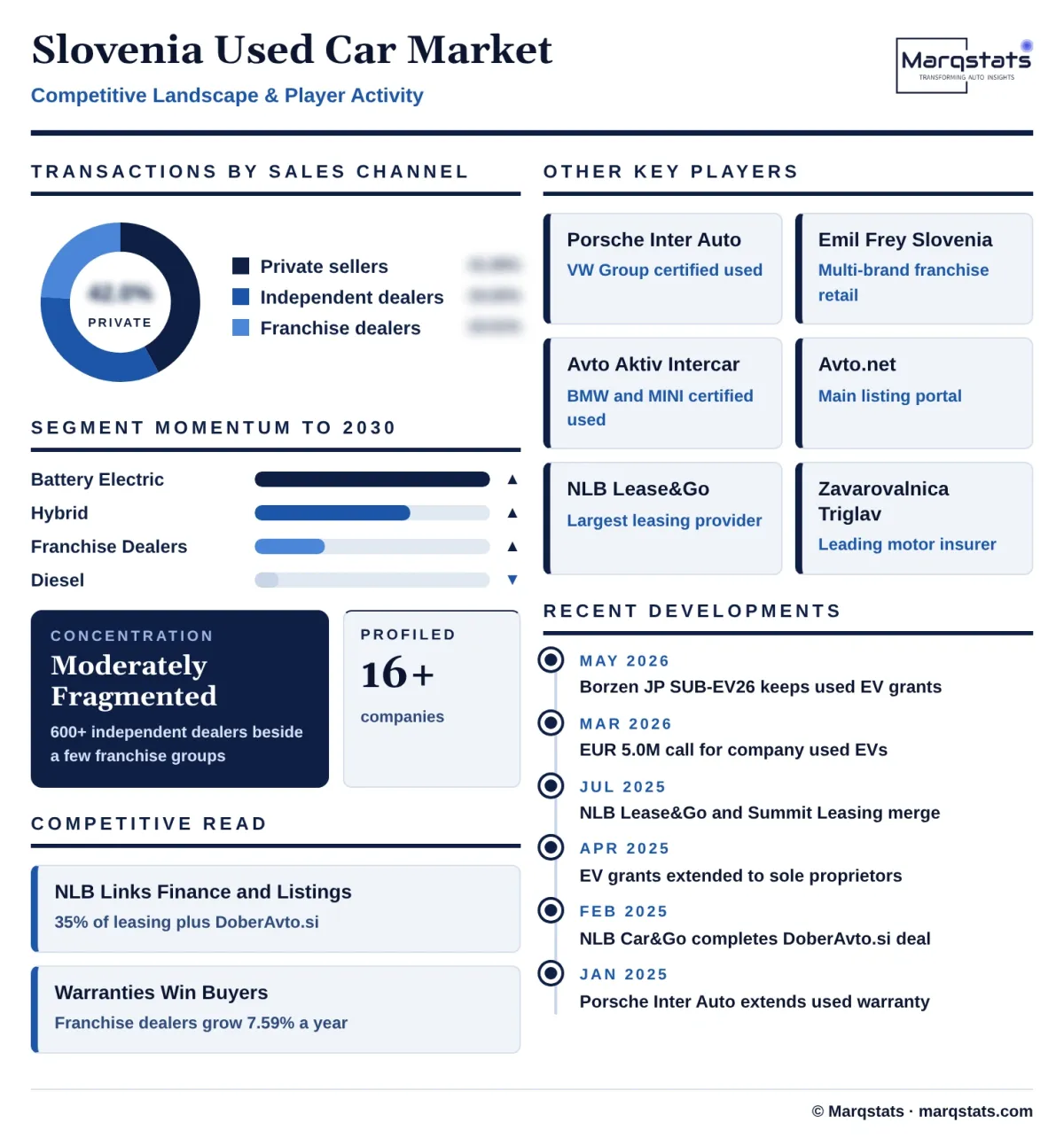
The Slovenia used car market is moderately fragmented. Marqstats estimates private sellers account for 41.99% of 2025 transactions, independent dealers for 34.00% and franchise dealers for 24.01%. A handful of franchise groups lead organised retail, while more than 600 licensed independent dealers compete for the rest, from mid-sized lots with 100 to 250 cars to small import brokers.
Franchise groups dominate certified used sales. Porsche Inter Auto runs five retail hubs in Ljubljana, Maribor and Koper and sells Volkswagen, Audi, Škoda, SEAT, CUPRA and Porsche used cars under Das WeltAuto and Porsche Approved. Emil Frey Group Slovenia covers Mercedes-Benz, Peugeot, Citroën and Opel through Autocommerce and Avtotehna Vis, and Avto Aktiv Intercar leads in BMW, MINI, Jaguar and Land Rover. AC Kondor in Ljubljana and Avtotehnika Celje are large multi-brand retailers.
Competition is shifting toward warranties and verified condition. The Consumer Protection Act requires dealers to give at least a one-month warranty, and franchise groups extend this to 12 or 24 months with multi-point inspections. Mileage records in the national registry, visible through eUprava, make it harder for sellers to hide high-mileage cars. Independent dealers respond with extended warranties from third-party providers and by partnering with leasing companies, while the strongest independents are building larger lots near motorway junctions in Ljubljana, Maribor and Celje.
Finance and listings are consolidating around NLB. NLB Lease&Go holds about 35% of the leasing market after merging with Summit Leasing, and owns DoberAvto.si through NLB Car&Go. Avto.net remains the main listing portal, Bolha.com serves budget and private sales, and Porsche Finance Group Slovenia and SKB Leasing compete in dealer financing. Zavarovalnica Triglav, Zavarovalnica Sava and Generali lead motor insurance.
Companies Covered
Companies covered in the report include:
Recent Market Activity
Table of Contents
Coverage & Segmentation
The study covers the Slovenia used car market nationally, with 2025 as the base year, 2021 – 2025 as the historical period and 2026 – 2030 as the forecast period. Values are in US dollars, converted from euros at the 2025 European Central Bank average of USD 1.13 per euro. The market is defined as the value of used passenger car (M1) transactions: domestic changes of ownership and first registrations of imported used cars. It is segmented by fuel type, sales channel and vehicle age.
Light commercial vehicles, motorcycles, buses and trucks are excluded, as are new-car sales and finance, insurance and aftersales revenue. The import and domestic transaction split, the average transaction value and the fuel, channel and age splits are Marqstats estimates built on national registry data and dealer and platform pricing.