Market Snapshot
Middle bar: base-year value × (1 + CAGR), rounded to two decimals. This is a calculated illustration, not a separately researched annual estimate.
The Dominican Republic used car market size is estimated at USD 1,880.39 million in 2025 and is projected to reach USD 2,413.27 million by 2030, growing at a CAGR of 5.12% over 2026 – 2030. Four-wheel used vehicle transfers rise from 192,269 to 241,327, with SUVs (jeepetas) leading at 45.80% of 2025 volume.
The Dominican used car market runs on two flows. Imports bring in late-model used vehicles, because Law No. 04-07 bars vehicles more than five years old. Domestic resale then trades those vehicles for years. The Dirección General de Impuestos Internos (DGII) recorded 228,075 vehicle ownership transfers (traspasos) in 2025, up 4.8% from 217,607 in 2024, across a registered fleet of 6,640,871 vehicles. Marqstats sizes the four-wheel used car market at 192,269 of those transfers, at an average transacted value of USD 9,780.
Demand concentrates in the capital. The Distrito Nacional accounts for an estimated 34.00% of four-wheel transfers and Santo Domingo Province for 21.00%, followed by Santiago at 11.00%. The study segments the market by vehicle type (SUVs and crossovers, passenger cars, pickups and light commercial vehicles, vans and minivans), by fuel type (gasoline, diesel, LPG, hybrid and electric) and by sales channel, and excludes motorcycles, buses and heavy trucks.
Key Takeaways
Market Overview & Analysis
Report Summary
Marqstats sizes the Dominican Republic used car market as the value of ownership transfers of used four-wheel vehicles: passenger cars, SUVs and crossovers, pickups and light commercial vehicles, and vans. The base is the DGII's 228,075 vehicle transfers recorded in 2025, of which Marqstats attributes 192,269 to four-wheel vehicles. The rest are motorcycles, buses, heavy trucks and machinery. Transfers are valued at an average transacted price of USD 9,780, derived from DGII value tables and retail listing prices converted at the Banco Central de la República Dominicana average rate.
Structurally, the market combines strict import rules with a large, ageing domestic fleet. Law No. 04-07 limits imports to vehicles up to five years old and excludes salvage and rebuilt titles, so every imported car arrives relatively young and relatively expensive. The registered fleet of 6,640,871 vehicles includes 1,188,583 automobiles, 797,851 jeeps and 575,928 cargo vehicles, and 83.7% of the fleet is more than five years old. Each imported vehicle therefore changes hands several times domestically over its life, which is why transfers far exceed imports.
The forecast rests on three conditions. Real GDP keeps growing near the Banco Central's 4.8% to 5.1% range, sustaining household purchasing power and remittance flows. Consumer credit eases from 2025's 19.4% rates, widening access to dealer financing. And the five-year import limit stays in place, keeping imported supply young. Under these conditions four-wheel transfers reach 241,327 in 2030 and market value USD 2,413.27 million.
Dominican Republic Used Car Market Size and Forecast
The Dominican Republic used car market grows from USD 1,880.39 million in 2025 to USD 2,413.27 million in 2030, a CAGR of 5.12%. Four-wheel transfers grow from 192,269 to 241,327, a 4.65% annual rate, in line with the 4.8% growth in total DGII transfers between 2024 and 2025. The average transacted value moves from USD 9,780 to USD 10,000 as SUVs take a larger share of the mix. In local currency the market grows faster, because the peso has depreciated steadily against the dollar.
Market Dynamics
Key Drivers
Five conditions move this market, and import rules and credit matter more than any single brand.
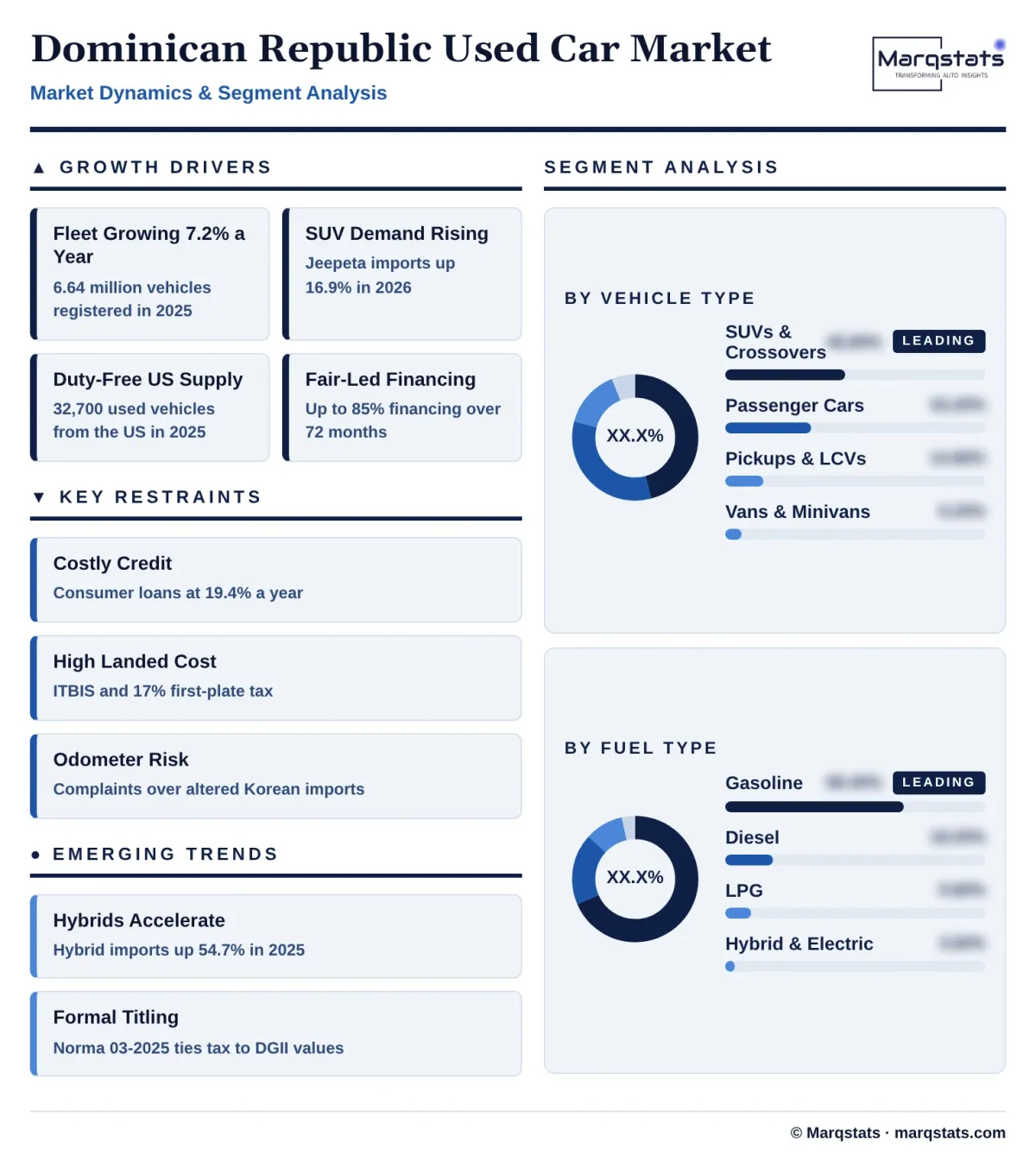
- The fleet is growing faster than the economy. The DGII registered fleet rose 7.2% in 2025, by 446,819 vehicles, to 6,640,871. Jeeps grew 8.4% to 797,851 and cargo vehicles 5.0% to 575,928. Every vehicle added to the fleet becomes future used supply, and the transfer count rose 4.8% to 228,075 in the same year.
- SUV demand is reshaping both imports and resale. Jeepetas made up 45.18% of vehicle imports in the first half of 2025 and 55.64% of import value, and jeepeta imports rose another 16.9% in January to July 2026. Dominican buyers favour higher ground clearance for poor roads and flooding, so SUVs command the strongest resale demand and the fastest value growth in the used market.
- Duty-free US supply keeps the import pipeline full. The DR-CAFTA agreement exempts US-origin vehicles from tariffs, and the United States supplied 32,700 used vehicles in 2025, ahead of Japan and South Korea. US auction stock of clean-title, sub-five-year vehicles is the main source for the import dealers that belong to the Asociación de Importadores de Vehículos Usados (ASOCIVU).
- Dealer fairs concentrate demand and credit. ASOCIVU held its 47th Autoferia at Ciudad Ganadera in July 2026 with more than 80 dealers and over 3,000 used vehicles, and the Asociación Nacional de Agencias Distribuidoras de Vehículos (ANADIVE) ran its 2026 Autoferia at the Feria Ganadera from 28 May to 1 June. Banks offer preferential rates, 15% deposits and terms of up to 72 months at these events, which pull forward purchases.
- Tax incentives favour hybrids. Law No. 103-13 cuts import duty, the 18% ITBIS and the first-plate tax by half for eligible electric and hybrid vehicles, including used vehicles within the five-year limit. Hybrid imports rose 54.7% in 2025, and Japanese hybrids such as the Toyota Aqua and Prius are entering the used pool in growing numbers.
Key Restraints
Four constraints limit how fast transfer volume turns into value.
- Credit is expensive. Personal and consumer loan rates reached 19.4% a year in 2025, which reduced buyers' purchasing power and kept many transactions in cash between private parties. Until rates fall, financing will remain concentrated in dealer fairs and in buyers with formal incomes.
- Import costs are high. Beyond the purchase price and freight, imported used vehicles pay ITBIS of 18%, a 17% first-plate tax under Law No. 173-07 and an emissions charge under Law No. 253-12, plus a 10% duty on non-US vehicles. The five-year age limit adds to this by excluding the cheapest stock, so the landed cost of a young used import is high relative to local incomes.
- Odometer fraud and condition risk damage trust. The Instituto Nacional de Protección de los Derechos del Consumidor (Pro Consumidor) has received complaints about imported South Korean sedans, including former taxis with altered odometers. Buyers discount vehicles without inspection records, which slows private sales and favours dealers that offer inspections and warranties.
- Formalisation raises costs for small lots. Norma General 03-2025 bases the 2% transfer tax on the higher of sale price and the DGII value table, and requires formal registration of vehicles held by dealers. Small independent lots that relied on open, endorsed titles face higher tax and administrative costs, and some will consolidate or exit.
Key Trends
Four shifts show where the market is heading and who benefits.
- Car imports are falling while SUV and cargo imports rise. In January to July 2026, car imports fell 14.5% to 16,013 while jeepeta imports rose 16.9% to 41,910 and cargo vehicles 9.5% to 15,823, according to DGA data. The used market will follow the same shift over the next three to five years as these vehicles reach their second owners.
- Chinese brands are entering through new sales, not used imports. China supplied 14,556 new vehicles in 2025 against only 505 used ones. As those new Chinese cars age, they will enter the domestic transfer market without a used-import history, so dealers will need to price them without the auction benchmarks they use for US and Japanese stock.
- Dealer associations are moving to certified inspection and warranties. In response to Pro Consumidor complaints, dealers and inspection providers such as SAM Latinoamérica offer multi-point inspections and written mechanical warranties. Certified stock sells at a premium and qualifies more easily for bank financing.
- Online classifieds are the main price reference. SuperCarros.com and Corotos.com.do host the largest pools of used vehicle listings, used by dealers and private sellers alike. As DGII value tables now set the floor for transfer tax, listing prices and official values are converging.
Strategic Implications
- For importers, SUVs and hybrids are the safest stock. Jeepeta imports grew 16.9% in early 2026 and hybrid imports 54.7% in 2025, while car imports fell. Importers should weight purchasing toward sub-five-year US and Japanese SUVs and hybrids, and use Law No. 103-13 incentives to price hybrids competitively.
- For dealers, formal titling is now a selling point. Norma General 03-2025 makes informal holding costlier, but it also lets formal dealers offer clean titles, inspections and bank financing that private sellers cannot. Dealers that title stock promptly and partner with lenders such as Banco BACC, Banco Caribe and Motor Crédito will take share from private sales.
- For lenders, the used market is larger than the new one. With 228,075 transfers a year and consumer rates near 19.4%, banks that bring rates down for inspected, formally titled used vehicles can grow loan books with collateral they can value through DGII tables.
- The most likely path is steady volume growth with a rising SUV share. The research identifies no pending, dated decision that would move the 2030 value materially from the base case; changes to the five-year import limit or transfer tax have been discussed but not scheduled. Marqstats therefore states a single base case rather than alternative scenarios.
Market Segmentation
SUVs and crossovers (jeepetas) account for an estimated 88,059 transfers, or 45.80% of the 2025 market, worth USD 861.22 million. They are the leading and fastest-growing large segment, rising to 117,285 transfers and 48.60% of volume by 2030, with value growing at 6.37% a year to USD 1,172.85 million. The Honda CR-V, Toyota RAV4 and Hyundai Tucson anchor the segment, and jeepetas made up 49.6% of vehicle imports in January to July 2026.
Passenger cars account for an estimated 63,833 transfers, 33.20% of the 2025 market and USD 624.29 million. Share falls to 29.80% by 2030 as buyers shift to SUVs, and value grows at 2.87% a year to USD 719.15 million. Car imports fell 14.5% in January to July 2026, and the Toyota Corolla, Honda Civic and Hyundai Sonata remain the most traded models.
Pickups and light commercial vehicles account for an estimated 28,456 transfers, 14.80% of the 2025 market and USD 278.30 million, rising to 15.00% of volume and USD 361.99 million by 2030, a 5.40% CAGR. Demand comes from agriculture in the Cibao region, construction and small businesses, with the Toyota Hilux and Isuzu D-Max as core models.
Vans and minivans account for an estimated 11,921 transfers, 6.20% of the 2025 market and USD 116.58 million, growing to 6.60% of volume and USD 159.28 million by 2030, a 6.44% CAGR. Tourism shuttles, airport transfers and delivery services in the eastern region drive turnover, with the Toyota Sienna and Hyundai H-1 as common models.
Gasoline vehicles account for an estimated 68.40% of 2025 transfers, 131,512 vehicles worth USD 1,286.19 million. Share falls to 63.00% by 2030 as hybrids grow, with value rising at 3.40% a year to USD 1,520.36 million. Gasoline remains the default for imported US-market vehicles.
Diesel vehicles account for an estimated 18.20% of 2025 transfers, 34,993 vehicles worth USD 342.23 million, concentrated in pickups, vans and commercial vehicles. Value grows at 3.69% a year to USD 410.26 million by 2030.
LPG vehicles account for an estimated 9.80% of 2025 transfers, 18,842 vehicles worth USD 184.28 million. The segment is built on South Korean LPI sedans such as the Hyundai Sonata and Kia K5, often former taxis; complaints over altered odometers and cheaper alternatives are holding growth to 3.34% a year.
Hybrid and electric vehicles account for an estimated 3.60% of 2025 transfers, 6,922 vehicles worth USD 67.69 million, and are the fastest-growing fuel type. Supported by Law No. 103-13 incentives and a 54.7% rise in hybrid imports in 2025, the segment reaches 11.00% of transfers and USD 265.46 million by 2030, a 31.43% CAGR.
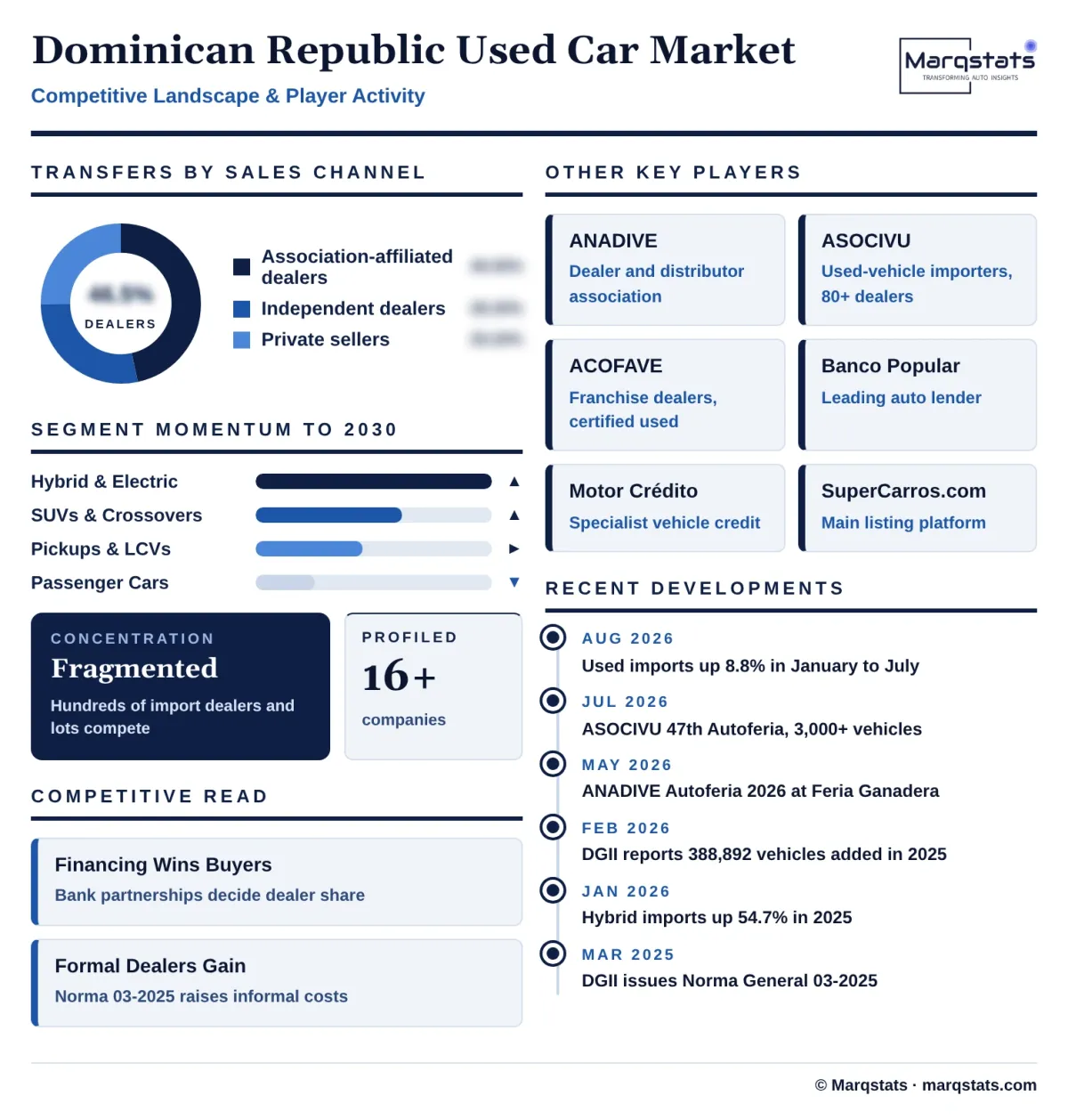
Dealers affiliated with ANADIVE and ASOCIVU account for an estimated 46.50% of 2025 transfers, 89,405 vehicles worth USD 874.38 million, rising to 49.00% by 2030. Their fairs, bank partnerships and inspected stock give them the strongest access to financed buyers.
Independent dealers outside the associations account for an estimated 28.30% of 2025 transfers, 54,412 vehicles worth USD 532.15 million. Norma General 03-2025 raises their titling and tax costs, and their share eases to 27.00% by 2030.
Private sales account for an estimated 25.20% of 2025 transfers, 48,452 vehicles worth USD 473.86 million, falling to 24.00% by 2030. They rely on SuperCarros.com and Corotos.com.do listings and are mostly cash transactions.
By Geography
Distrito Nacional
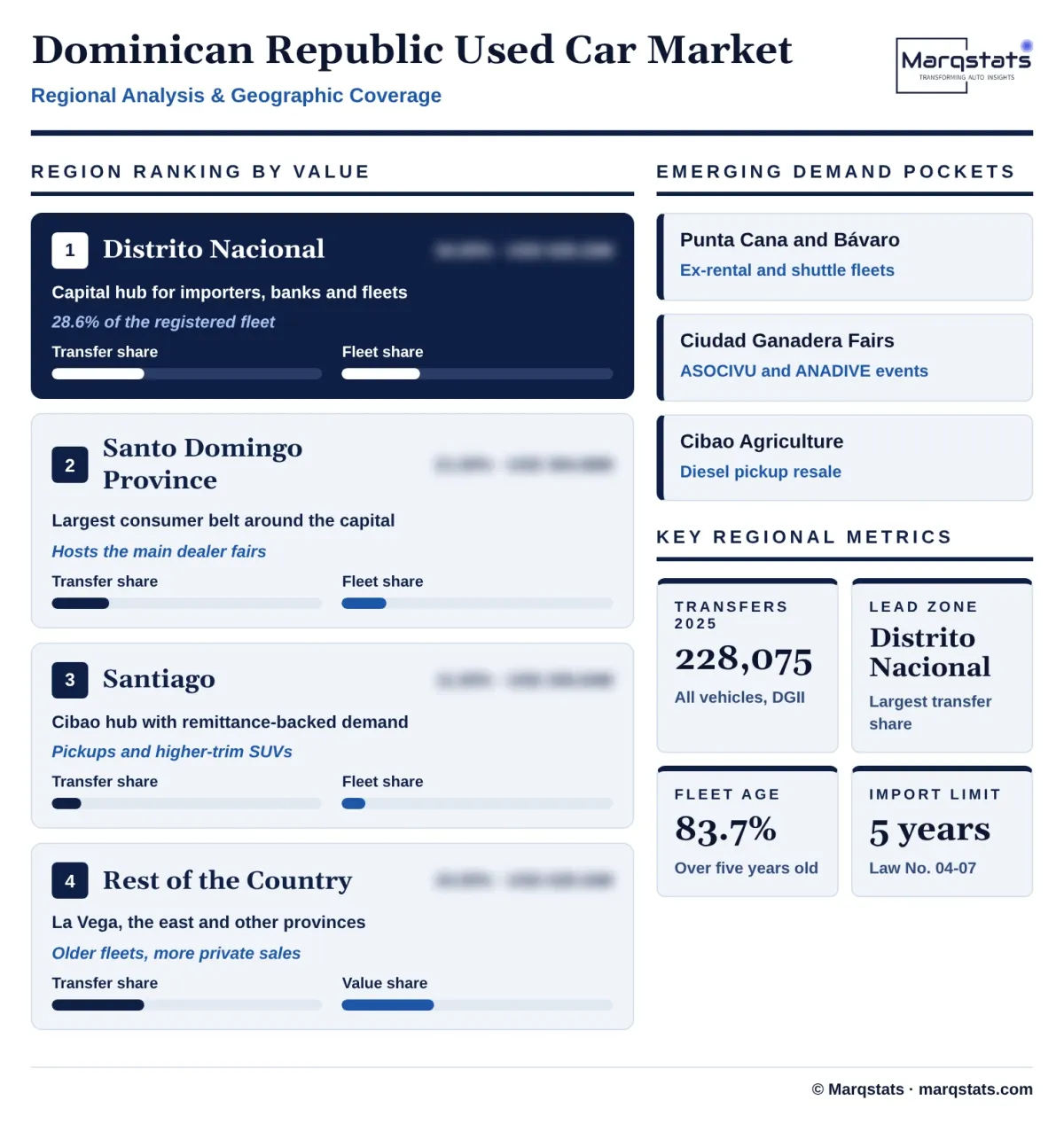
The Distrito Nacional is the market's financial and administrative centre. It holds 28.6% of the registered fleet, according to the DGII, and Marqstats estimates it accounts for 34.00% of four-wheel transfers, about 65,371 vehicles worth USD 639.33 million. Leasing companies, corporate fleets, importers and bank headquarters register vehicles here, so many cars titled in the capital are used across the metropolitan area.
Santo Domingo Province
Santo Domingo Province is the largest consumer market around the capital, with 16.5% of the registered fleet. Marqstats estimates 21.00% of transfers, about 40,376 vehicles worth USD 394.88 million. Dealer clusters in Santo Domingo Este, Norte and Oeste serve commuters with compact sedans, ride-hailing cars and family SUVs, and Ciudad Ganadera hosts the main ANADIVE and ASOCIVU fairs.
Santiago
Santiago de los Caballeros anchors the Cibao valley, with 8.4% of the registered fleet. Marqstats estimates 11.00% of transfers, about 21,150 vehicles worth USD 206.84 million. Remittances from the United States and agricultural trade support demand for pickups, light trucks and higher-trim SUVs.
La Vega and Northern Cibao
La Vega and the northern Cibao provinces account for an estimated 6.50% of transfers, about 12,497 vehicles worth USD 122.23 million. Agriculture and regional transport drive demand for diesel pickups, light trucks and family SUVs.
Eastern Region
The eastern region, led by La Altagracia (Punta Cana and Bávaro) and La Romana, accounts for an estimated 6.00% of transfers, about 11,536 vehicles worth USD 112.82 million. Hotel shuttles, airport vans and rental fleets retired after two to three years make the region a steady source of late-model used stock.
Rest of the Country
The remaining provinces account for an estimated 21.50% of transfers, about 41,339 vehicles worth USD 404.29 million. Fleets here are older, pickups and small diesel trucks are more common, and private sales dominate. Departmental shares are a Marqstats allocation based on DGII fleet distribution.
How Competition Is Evolving
The Dominican Republic used car market is fragmented. Hundreds of import dealers and lots compete, and Marqstats estimates association-affiliated dealers handle 46.50% of four-wheel transfers, independent dealers 28.30% and private sellers 25.20%. ANADIVE represents dealers and distributors, ASOCIVU represents more than 80 used-vehicle import dealers at its fairs, and the Asociación de Concesionarios de Fabricantes de Vehículos (ACOFAVE) represents franchised new-car dealers with growing certified pre-owned programmes. No single dealer group handles a large share of transfers.
Dealers compete on financing and fairs. The big events, ANADIVE's Autoferia at the Feria Ganadera and ASOCIVU's Autoferia at Ciudad Ganadera, bring together dozens of dealers and thousands of vehicles with bank financing of up to 85% of value. Banco Popular Dominicano, Banco de Reservas and Banco BHD lead auto lending, while specialist lenders such as Motor Crédito, Banco BACC, Banco Caribe and Banco Confisa finance independent lots and their buyers.
Regulation is pushing the market toward formal operators. Norma General 03-2025 and anti-money-laundering rules under Law No. 155-17 favour dealers that title stock promptly and document payments. Import dealers that combine sub-five-year US and Japanese stock, inspection and bank financing are best placed to take share from informal lots and private sales.
Companies Covered
Companies covered in the report include:
Recent Market Activity
Table of Contents
Coverage & Segmentation
The study covers the Dominican Republic used car market nationally, with 2025 as the base year, 2021 – 2025 as the historical period and 2026 – 2030 as the forecast period. Values are in US dollars, converted from Dominican pesos at Banco Central de la República Dominicana average rates. The market is defined as the value of ownership transfers of used four-wheel vehicles: SUVs and crossovers, passenger cars, pickups and light commercial vehicles, and vans and minivans, through dealers and between private parties. It is segmented by vehicle type, fuel type and sales channel.
Motorcycles, buses, heavy trucks and machinery are excluded, as are new-vehicle sales and finance, insurance and aftersales revenue. Used imports are covered when they are first registered and when they change hands. The four-wheel transfer count, the segment and regional splits and the average transacted value are Marqstats estimates built on DGII registry data and customs statistics.