Market Snapshot
The Germany light commercial vehicle market size is estimated at USD 12,343.61 million in 2025 and is projected to reach USD 15,282.07 million by 2030, growing at a CAGR of 4.36% over 2026 – 2030. New registrations rise from 265,801 to 296,500 vans, a 2.21% annual rate, while the average transaction value per van climbs from about USD 46,439 to USD 51,542 as electric vans and driver-assistance equipment lift the mix.
Marqstats defines the market as the net transaction value of new goods vehicles, pickups and chassis cabs up to 3.5 tonnes gross vehicle weight (European category N1) registered in Germany, including factory-fitted equipment and excluding value-added tax, registration fees and later body conversions. The vehicles covered include the Volkswagen Transporter and Crafter, Mercedes-Benz Sprinter and Vito, Ford Transit Custom, Fiat Ducato, Renault Master and Iveco Daily. Trucks above 3.5 tonnes, buses and used vans are excluded.
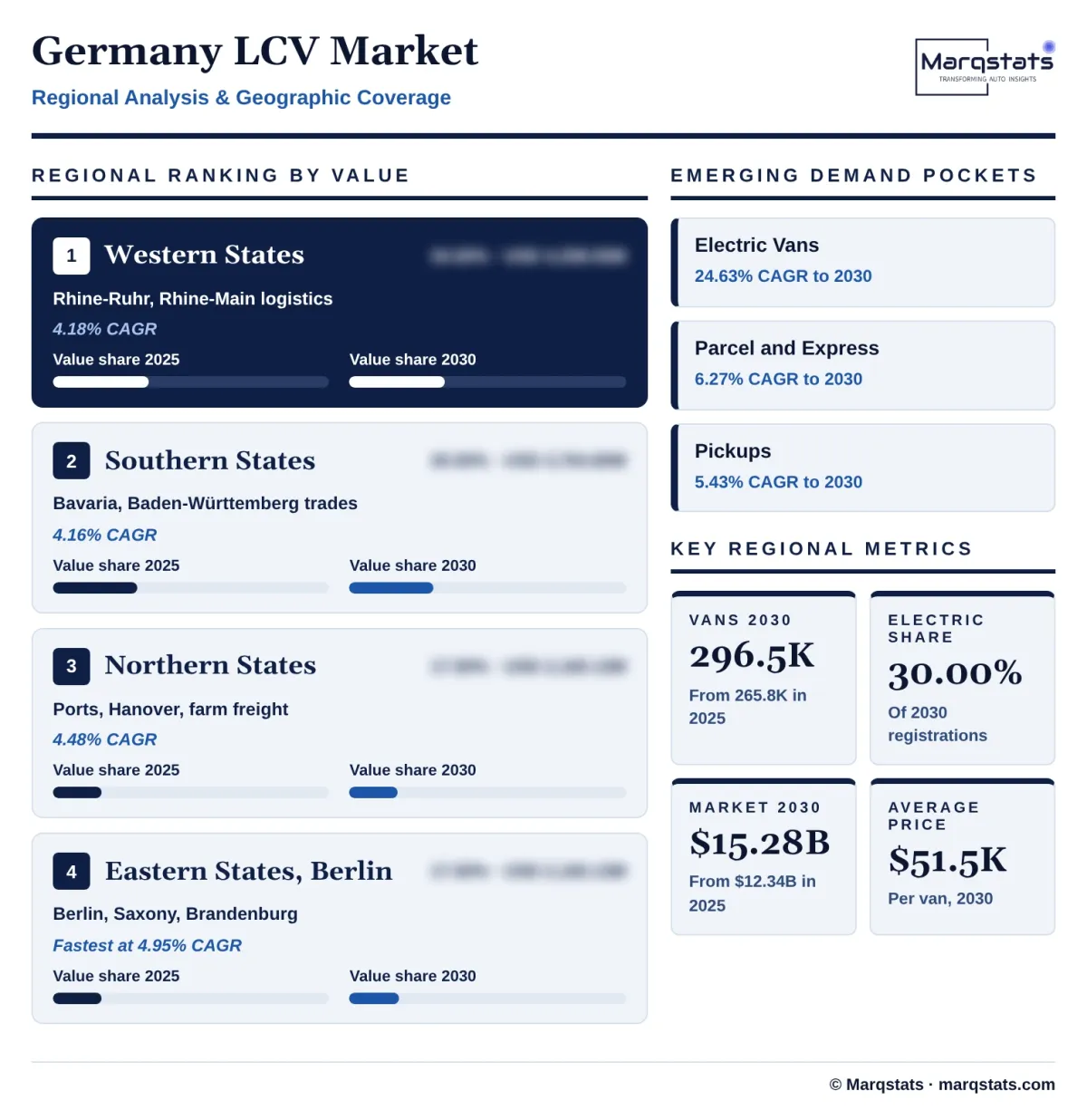
Large vans and chassis cabs account for 46.00% of 2025 value, diesel vans for 80.02% and craft trades and construction for 33.19% of value. The Western States lead with 34.50% of value, while electrically chargeable vans grow fastest at 24.63% a year, from 11.38% to 30.00% of registrations.
Key Takeaways
Market Overview & Analysis
Report Summary
Marqstats sizes the Germany light commercial vehicle market as the net transaction value of new vans, pickups and chassis cabs with a technically permissible gross vehicle weight of up to 3.5 tonnes that are first registered in Germany each year. These vehicles belong to category N1 under Regulation (EU) 2018/858, and the volume base is the van series of the European Automobile Manufacturers' Association (ACEA), which counted 265,801 new van registrations in Germany in 2025 against 281,078 in 2024. Germany is the second-largest national van market in the European Union, with 18.37% of the 1,447,273 vans registered in the bloc in 2025, behind France at 358,299 vans and ahead of Italy at 188,373 and Spain at 185,559.
Vans are the working tools of the German economy. Courier, express and parcel operators, craft businesses known as Handwerk, building contractors, food and retail distributors, utilities and municipal services all buy vehicles in this class because it carries up to 3.5 tonnes without the distance-based Lkw-Maut that has applied to trucks above that weight since 1 July 2024. The boundary matters for the market definition: ACEA counted 77,431 medium and heavy trucks above 3.5 tonnes in Germany in 2025, about one truck for every 3.4 vans, and none of them are in the market sized here.
The market shrank in 2025 and the first half of 2026. German van registrations fell 5.40% in 2025, and the Kraftfahrt-Bundesamt (KBA) and ACEA registration series both show the decline, which Marqstats attributes to weaker construction, industry and small-business investment. In the first half of 2026 registrations fell a further 4.60% to 122,842 vans from 128,813 a year earlier. Even so, 2025 volume was 2.50% above the 259,315 vans registered in 2023, so the market has not collapsed; it has returned from a pull-forward peak in 2024.
The powertrain mix is changing faster than the market. Electrically chargeable vans, which are mainly battery-electric vans with a small number of plug-in hybrids, rose from 14,999 registrations in 2024 to 30,252 in 2025, and from 10,109 in the first half of 2025 to 18,021 in the first half of 2026, a share of 14.67% of all vans. Diesel fell to 83.47% of 2025 registrations from 87.74% in 2024, and still carries 80.02% of market value.
Marqstats values the market at USD 11,515.92 million in 2023 and USD 12,768.25 million in 2024 at constant 2025 exchange rates, then USD 12,343.61 million in 2025, a fall of 3.33% from 2024 as volume fell 5.40% and average value per van rose about 2.23%. The forecast has registrations recovering to 254,000 vans in 2026, USD 12,044.35 million, and then growing every year to 296,500 vans in 2030, above the 2024 peak of 281,078.
Germany Light Commercial Vehicle Market Size and Forecast
The Germany light commercial vehicle market grows from USD 12,343.61 million in 2025 to USD 15,282.07 million in 2030, a CAGR of 4.36%. Volume contributes about half of the growth: registrations rise at 2.21% a year, from 265,801 to 296,500 vans, and the average value per van rises at 2.11% a year, from about USD 46,439 to USD 51,542, as the share of higher-priced electric vans and the cost of mandatory safety systems build into prices. The path is uneven: 2026 is estimated at 254,000 vans and USD 12,044.35 million, a fall of 2.42% in value, because first-half registrations were 4.60% lower and fleet buyers are still holding back orders.
The 2025 value is built bottom-up from classes and prices. Marqstats estimates 44,000 compact vans at about EUR 27,500 each, 100,000 mid-size vans at EUR 40,000, 105,801 large vans and chassis cabs at EUR 47,500 and 16,000 pickups at EUR 43,000. Prices are net transaction values including factory equipment and excluding value-added tax, and they sit above entry list prices such as the EUR 36,780 for a German-specification Volkswagen Transporter because typical fleet orders add load-area, safety and connectivity packages. The weighted average is about EUR 41,097, converted at EUR 1 = USD 1.13, the 2025 annual average.
The volume base is official. The ACEA series counts 265,801 vans for 2025 and 281,078 for 2024, and the 2023 figure of 259,315 is consistent with ACEA growth of 8.4% in 2024. Marqstats cross-checked the volume against the SP-X count of about 341,000 vehicles up to 7 tonnes, including passenger-car-derived vans, registered in Germany in January to August 2025, which is wider in scope because it includes vehicles above 3.5 tonnes and car-based variants. Value is Marqstats arithmetic on that volume, so it should be read as a Marqstats estimate.
Electric vans add value faster than volume. Marqstats expects electrically chargeable registrations to rise from 30,252 in 2025 to 88,950 in 2030, which lifts their share of units from 11.38% to 30.00% and their share of value from 15.82% to 38.43%, because an electric van is priced at about 1.45 times a diesel van of the same size class. Diesel registrations fall from 221,840 to 185,313, a drop of 3.53% a year, and diesel value falls at 3.10% a year.
Marqstats tracks four indicators to monitor the forecast: monthly KBA and ACEA registrations by fuel type, the legislative outcome of the December 2025 Commission proposal that would cut the 2030 van CO2 reduction target from 50% to 40%, the pace of depot charging connections at parcel and trade fleets, and order intake at Volkswagen Commercial Vehicles, Mercedes-Benz Vans and Ford Pro. A weaker target would slow the electric share first, so the forecast keeps the electric share at 30.00% in 2030 rather than the higher levels the earlier target would imply.
Market Dynamics
Key Drivers
Five forces keep demand for new vans in Germany resilient even though registrations fell in 2025 and the first half of 2026.
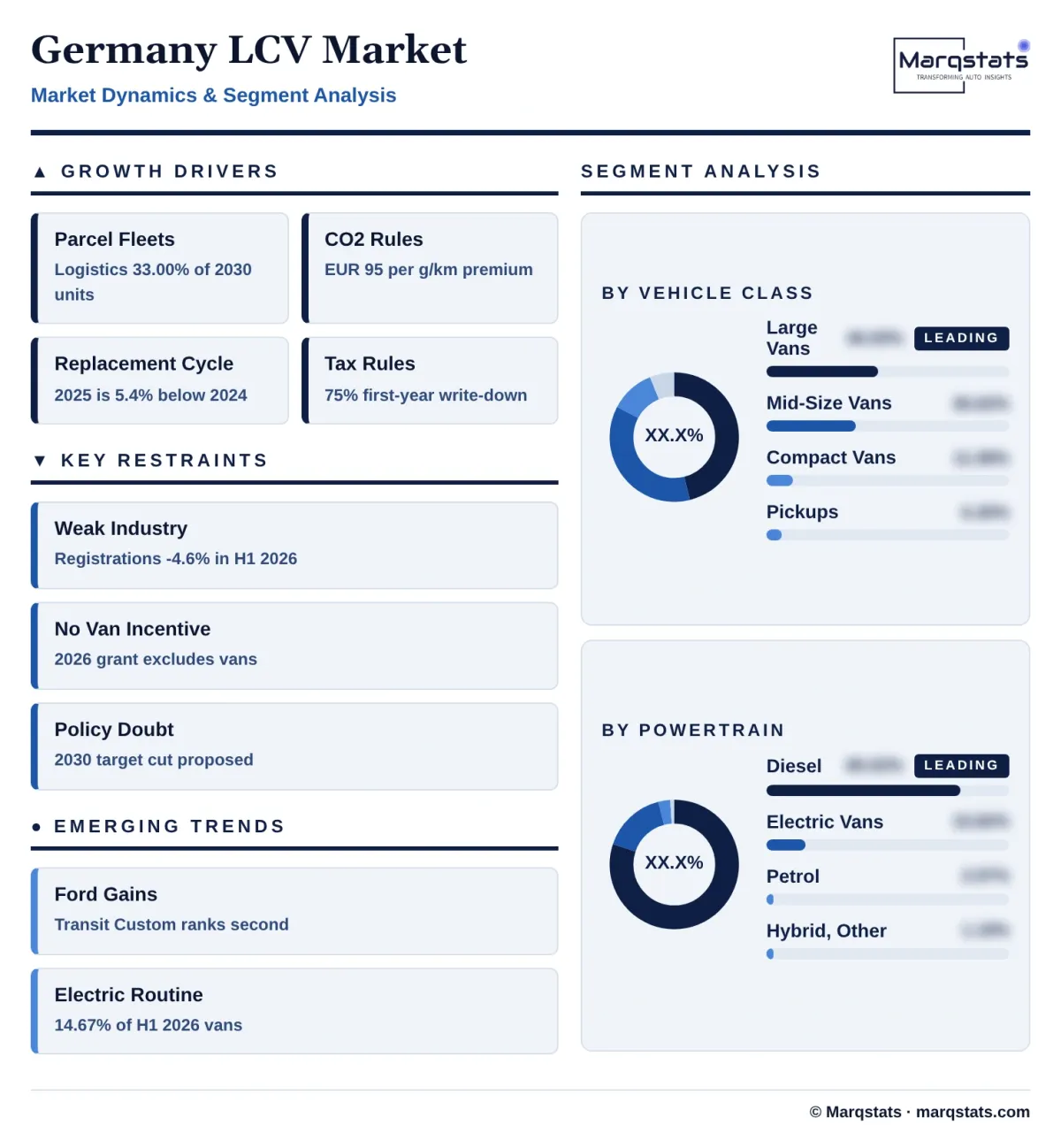
- Parcel and express fleets keep buying large vans. Marqstats estimates that parcel, express and logistics operators bought about 30.00% of 2025 registrations and that the share rises to 33.00% by 2030, because home delivery and business-to-business replenishment run on vehicles of 3.0 to 3.5 tonnes with high load volume. This end use grows faster than any other, at 6.27% a year in value.
- Fleet CO2 rules pull electric vans into the mix. Regulation (EU) 2019/631 sets a 15% reduction for new vans from 2025 against the 2021 baseline and an excess emissions premium of EUR 95 for each gram of CO2 per kilometre above a maker target, multiplied by the vehicles registered. Electrically chargeable registrations rose 101.7% in 2025 to 30,252 vans while the whole market fell 5.4%.
- Replacement demand is building. The 265,801 vans registered in 2025 were 2.50% above the 2023 total of 259,315 and 5.43% below the 2024 peak, so buyers who postponed purchases in 2025 still need vehicles. Marqstats expects registrations to pass the 2024 level in 2029 and reach 296,500 by 2030.
- Tax rules favour electric purchases. The Bundesrat approved on 19 December 2025 an extension of the motor vehicle tax exemption to pure electric vehicles first registered by 31 December 2030, with each vehicle exempt for up to ten years and no later than the end of 2035, and a 75% first-year write-down applies to electric vehicles acquired between 1 July 2025 and 31 December 2027.
- Product renewal sharpens choice. The Volkswagen Transporter, built on the Ford Transit Custom, went on sale in Germany from EUR 36,780, Volkswagen Commercial Vehicles added a long ID. Buzz Cargo and new Crafter body variants for 2026, and Mercedes-Benz Vans has announced its modular VAN.EA electric architecture from 2026, so fleets see new vehicles in every size class.
Key Restraints
Four constraints hold registrations below the 2024 peak and slow the shift away from diesel.
- Industrial and construction demand is weak. German van registrations fell 5.4% in 2025 and 4.6% in the first half of 2026, and craft trades and construction, which Marqstats estimates at 35.00% of 2025 registrations, grow at only 2.41% a year in value to 2030. Small businesses delay renewals when order books are thin.
- Electric vans cost more to buy and have no federal incentive. Germany ended the Umweltbonus in December 2023, and the national purchase incentive that opened in 2026 does not cover vans, so buyers rely on tax rules and fleet CO2 pricing. An electric van costs about 1.45 times a diesel van in the Marqstats model, which is a hurdle for small trades without depot charging.
- Policy direction is less certain. In December 2025 the European Commission proposed a 40% cut in van CO2 emissions by 2030 instead of 50%, a 90% cut by 2035 instead of 100%, and banking and borrowing of credits for 2030 to 2032. Fleets that planned around the earlier target may slow electric orders until Parliament and Council decide.
- Compliance costs lift prices and squeeze margins. Since 7 July 2024 every new van must meet the second phase of General Safety Regulation (EU) 2019/2144, and Volkswagen Commercial Vehicles reported an operating profit of EUR 245 million on revenue of EUR 16.9 billion in 2025, a 1.5% return against 4.9% a year earlier, so makers have little room to absorb extra cost.
Key Trends
Four shifts are changing which vans German fleets buy, who builds them and how they are powered.
- Ford Pro closes on the leaders. SP-X registration data published by AUTOHAUS in October 2025 showed that Ford registrations rose 24.9% in January to August 2025 and that the Transit Custom reached second place among models, less than 50 units behind the Mercedes-Benz Sprinter, with an electric share of 12.4% for the model.
- Platform sharing spreads. Volkswagen Commercial Vehicles sells the Transporter on the Ford Transit Custom architecture and Stellantis sells one large-van platform under four brands, so makers share development cost while competing on dealer reach, finance and electric range.
- Electric vans move from pilot to routine fleet purchase. The electrically chargeable share of German van registrations rose from 5.34% in 2024 to 11.38% in 2025 and 14.67% in the first half of 2026, ahead of the 11.2% EU average for 2025, led by parcel and municipal fleets with depot charging.
- The 3.5 tonne line shapes specification. The Lkw-Maut has applied to vehicles above 3.5 tonnes since 1 July 2024, and smart tachograph version 2 is required in vans above 2.5 tonnes in international transport from 1 July 2026, so operators keep domestic fleets at or under 3,500 kilograms and specify load capacity carefully.
Strategic Implications
- For van makers, the winning position in Germany is a full electric range across all three size classes before 2028. Electrically chargeable vans reach about 30.00% of registrations in 2030 in the Marqstats forecast, and makers that fix price, payload and depot-charging support early win the parcel and municipal fleets that decide share.
- For fleet operators, the choice is between buying electric now under the 75% first-year write-down, which applies to vehicles acquired by the end of 2027, and waiting for the 2030 rules to settle. Operators with predictable depot routes gain most from buying now, while operators with long-haul or irregular routes keep diesel a little longer.
- For leasing and finance companies, the electric share will lift residual-value risk in a market where an electric van costs about 1.45 times a diesel van. Lenders that price residuals on battery health, not only on age and mileage, can win business that banks pass over.
- For upfitters and body builders, the growth sits in large vans and chassis cabs, which hold 46.01% of 2025 value, and in electric chassis that need new mounting, power take-off and weight designs. The Europe LCV Body Conversion Market report covers those conversion revenues, which are excluded from this market.
- For charging and energy suppliers, depot connections at parcel and trade fleets decide how fast electric vans can grow. Each additional 10,000 electric registrations a year needs depot capacity at fleet sites, so grid access is a bottleneck that suppliers can price into service contracts.
Market Segmentation
Compact vans, mainly car-derived models such as the Volkswagen Caddy, Renault Kangoo, Ford Transit Courier and Mercedes-Benz Citan, account for 11.08% of 2025 value, USD 1,367.30 million, and grow at 2.78% a year to USD 1,568.36 million. Marqstats estimates about 44,000 units in 2025, sold to urban delivery, service engineers and small retailers.
Mid-size vans of the one-tonne class, led by the Volkswagen Transporter, Ford Transit Custom and Mercedes-Benz Vito, account for 36.62% of 2025 value, USD 4,520.00 million, and grow at 4.94% a year to USD 5,753.03 million. About 100,000 units were registered in 2025, mainly for craft trades, installers and mixed fleets.
Large vans and chassis cabs of 3.0 to 3.5 tonnes, including the Mercedes-Benz Sprinter, Volkswagen Crafter, Ford Transit, Fiat Ducato and Iveco Daily, account for 46.00% of 2025 value, USD 5,678.87 million, and grow at 4.12% a year to USD 6,948.03 million. About 105,801 units were registered in 2025, the largest volume layer, serving parcel networks, refrigerated and box-body operators.
Pickups such as the Ford Ranger, Toyota Hilux and Volkswagen Amarok account for 6.30% of 2025 value, USD 777.44 million, and grow fastest among classes, at 5.43% a year, to USD 1,012.65 million. About 16,000 units were registered in 2025, bought by utilities, forestry, municipal and construction fleets that need off-road ability.
Diesel vans account for 80.02% of 2025 value, USD 9,876.76 million, and 83.47% of 2025 units, with 221,840 registrations. Value falls at 3.10% a year to USD 8,437.57 million and 55.21% of the market by 2030, but diesel remains the default for long routes and heavy payloads.
Electrically chargeable vans, mainly battery-electric with a small number of plug-in hybrids, account for 15.82% of 2025 value, USD 1,952.98 million, and grow fastest, at 24.63% a year, to USD 5,872.52 million and 38.43% of the market. Registrations doubled to 30,252 in 2025 and reach about 88,950 in 2030.
Petrol vans account for 2.97% of 2025 value, USD 366.89 million, with 10,565 registrations, down 29.1% from 2024. Value falls at 6.42% a year to USD 263.23 million as small car-derived models switch to hybrid and electric drive.
Hybrid-electric and other fuels, including gas, account for 1.19% of 2025 value, USD 146.98 million, with 3,144 registrations. Mild-hybrid diesel versions of large vans lift the segment at 36.98% a year to USD 708.75 million, though from a very small base.
Parcel, express and contract logistics operators account for 32.93% of 2025 value, USD 4,065.25 million, and grow fastest among end uses, at 6.27% a year, to USD 5,510.20 million and 36.06% of the market. They buy large vans and chassis cabs in volume and lead electric adoption through depot charging.
Craft trades, installers and construction firms account for 33.19% of 2025 value, USD 4,096.08 million, and grow at 2.41% a year to USD 4,614.65 million. This is the largest end use by units, but the slowest growing, because building output and small-business investment recover slowly.
Retail, food distribution, rental and commercial services account for 19.91% of 2025 value, USD 2,457.63 million, and grow at 3.76% a year to USD 2,956.20 million. Refrigerated and box-body conversions of large vans and chassis cabs dominate purchases.
Utilities, municipal services and public authorities account for 13.97% of 2025 value, USD 1,724.65 million, and grow at 5.00% a year to USD 2,201.02 million. They buy pickups, mid-size vans and electric models early because tender rules reward low emissions.
By Geography
Western States
The Western States, which Marqstats groups as North Rhine-Westphalia, Hesse, Rhineland-Palatinate and the Saarland, account for 34.50% of 2025 value, USD 4,258.55 million, and grow at 4.18% a year to USD 5,226.47 million. The Rhine-Ruhr and Rhine-Main logistics corridors hold the dense parcel networks, Mercedes-Benz Vans builds the Sprinter in Düsseldorf, and leasing companies such as Deutsche Leasing in Bad Homburg register vehicles that work in other states.
Southern States
The Southern States, Bavaria and Baden-Württemberg, account for 30.50% of 2025 value, USD 3,764.80 million, and grow at 4.16% a year to USD 4,615.19 million. The region has the densest craft and supplier base, and Munich hosts the head offices of leasing and fleet management companies such as Alphabet.
Northern States
The Northern States, Lower Saxony, Hamburg, Bremen and Schleswig-Holstein, account for 17.50% of 2025 value, USD 2,160.13 million, and grow at 4.48% a year to USD 2,689.64 million. Port feeder traffic, agricultural freight and the Hanover plant of Volkswagen Commercial Vehicles support steady demand.
Eastern States and Berlin
The Eastern States and Berlin, which combine Berlin, Brandenburg, Saxony, Saxony-Anhalt, Thuringia and Mecklenburg-Western Pomerania, account for 17.50% of 2025 value, USD 2,160.13 million, and grow fastest, at 4.95% a year, to USD 2,750.77 million. Berlin urban delivery, municipal fleet renewal and new industrial sites in Saxony and Brandenburg raise demand from a smaller base.
How Competition Is Evolving
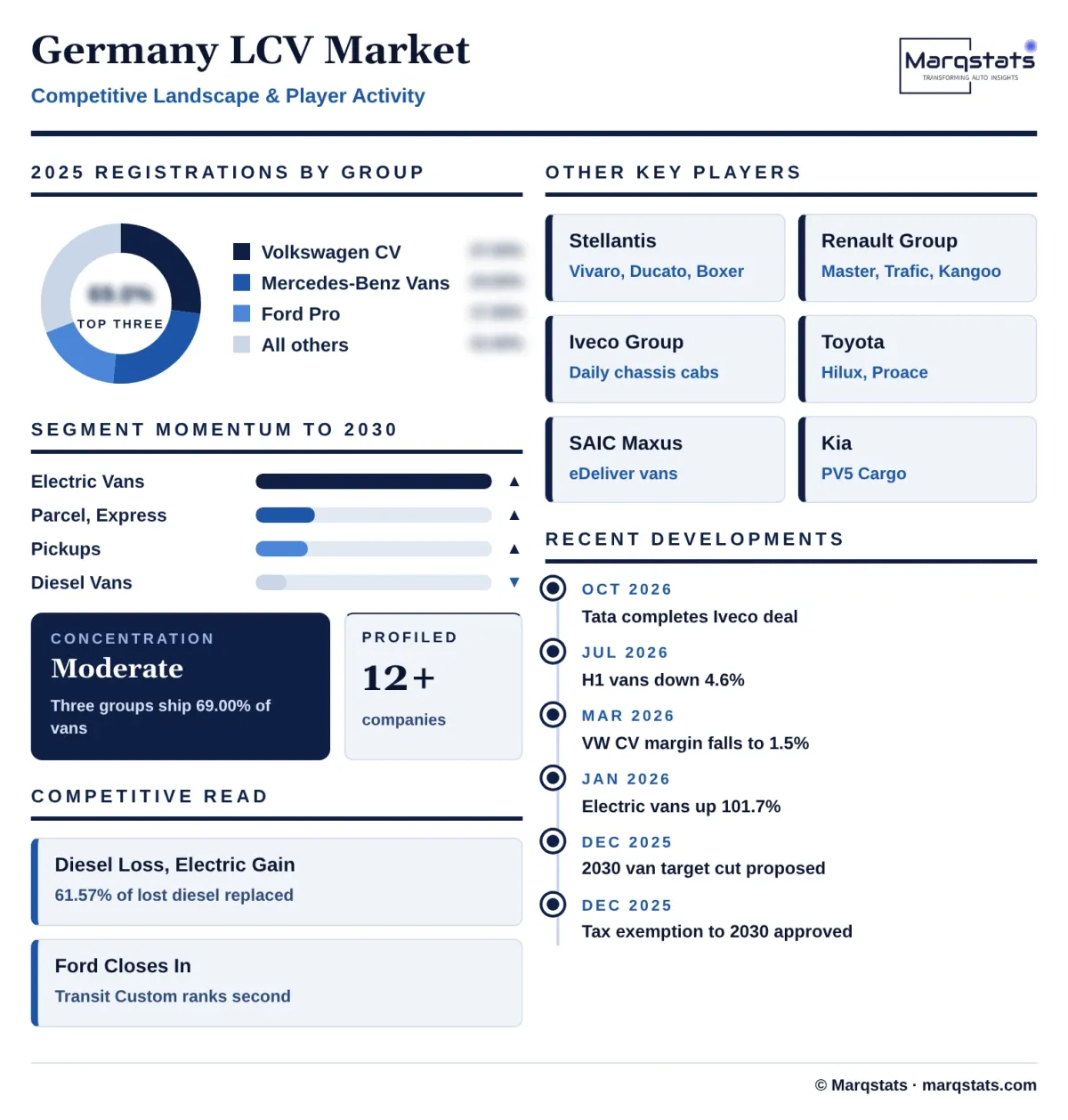
The market is moderately concentrated and led by three groups. Marqstats estimates that Volkswagen Commercial Vehicles held about 27.00% of 2025 registrations, Mercedes-Benz Vans about 24.50% and Ford Pro about 17.50%, a combined 69.00%, followed by Stellantis at about 14.50%, Renault Group at 6.00% and Iveco Group at 2.50%. The three-brand total is consistent with the 71% that SP-X registration data showed for Mercedes-Benz, Volkswagen Nutzfahrzeuge and Ford in January to August 2025 on a basis that includes vehicles up to 7 tonnes.
Volkswagen Commercial Vehicles describes itself as the clear number one in Germany. It reported 428,000 deliveries worldwide in 2025, up 6%, revenue of EUR 16.9 billion and an operating profit of EUR 245 million, and its Caddy, Transporter, Crafter and ID. Buzz Cargo cover compact, mid-size and large classes. Its margin fell to 1.5% from 4.9%, which limits its room to discount against Ford Pro.
Mercedes-Benz Vans sold 359,100 vans worldwide in 2025 and reported that German sales stayed at the level of the previous year, with electric vans at 11% of European sales. The Sprinter leads large vans and the Vito and Citan cover the mid-size and compact classes. Ford Pro gained most in 2025, and its Transit Custom is also the base of the Volkswagen Transporter.
Competition is shifting from price to total cost. Stellantis, Renault Group and Iveco Group compete with large-van platforms and chassis cabs, while Toyota, Maxus, Hyundai, Nissan, Kia and other brands hold about 8.00% between them. Tata Motors completed its cash acquisition of 89.42% of Iveco Group on 30 October 2026, which changes the ownership of the Daily range sold in Germany.
Companies Covered
Companies covered in the report include:
Recent Market Activity
Table of Contents
Coverage & Segmentation
The study covers the Germany light commercial vehicle market, with 2025 as the base year, 2023 – 2025 as the historical period and 2026 – 2030 as the forecast period. It covers new vans, pickups and chassis cabs of category N1 with a gross vehicle weight up to 3.5 tonnes, first registered in Germany, segmented by vehicle class, powertrain, end use and region. Values are net transaction values in US dollars, including factory equipment and excluding value-added tax, registration fees and later body conversions, and euro figures use the 2025 average of EUR 1 = USD 1.13.
Trucks above 3.5 tonnes, buses, used vans, vehicles in transit or re-exported, trailers and aftermarket body conversions are excluded. Segment and regional splits are Marqstats estimates built on ACEA and KBA registrations, company disclosures and price benchmarks. The live Marqstats reports on the Europe Electric Light Commercial Vehicle Market, the Global Electric LCV Market and the Europe LCV Body Conversion Market overlap in part with this market, and their figures should not be added to it.