Market Snapshot
The France light commercial vehicle (LCV) market size is estimated at USD 12,145.41 million in 2025 and is projected to reach USD 14,437.89 million by 2030, growing at a CAGR of 3.52% over 2026 – 2030. Registrations of new vans up to 3.5 tonnes rise from 358,225 to 380,000 vehicles, a 1.19% annual rate, while the average transaction value per van climbs from about USD 33,904 to USD 37,994 as battery-electric vans enter the mix.
Marqstats defines the market as the value of new light commercial vehicles of up to 3.5 tonnes gross vehicle weight registered in France, the N1 class that the Comité des Constructeurs Français d'Automobiles (CCFA) reports from AAA Data registrations as véhicules utilitaires légers. Value is registered volume multiplied by a Marqstats estimate of the average transaction price, excluding value added tax, converted at USD 1.13 per euro. Vans of 3.5 to 5.1 tonnes, trucks, buses, passenger cars, used vehicles and body conversions are excluded.
Large vans account for 39.82% of 2025 value, diesel vans for 75.63% and the Île-de-France for 26.00%. Battery-electric vans grow fastest among powertrains, at 28.05% a year, and Auvergne-Rhône-Alpes grows fastest among regions, at 4.18% a year, as Renault Group, Stellantis and Ford fill the electric price bands.
Key Takeaways
Market Overview & Analysis
Report Summary
Marqstats sizes the France light commercial vehicle market as the value of new vans, car-derived vans and light pickups of up to 3.5 tonnes gross vehicle weight registered each year. It counts city and car-derived vans such as the Renault Clio Société and Peugeot 208 van versions, compact vans such as the Renault Kangoo and Peugeot Partner, medium vans such as the Renault Trafic and Ford Transit Custom, large vans such as the Renault Master and Mercedes-Benz Sprinter, and pickups and light chassis-cabs. Vans of 3.5 to 5.1 tonnes, trucks, buses, passenger cars and used vehicles are excluded.
Registrations fell in 2025 and are falling again in 2026. The CCFA counted 358,225 vans up to 3.5 tonnes in 2025, down 5.7%, and 360,429 below 5.1 tonnes, down 5.6% from 381,855 in 2024; the Plateforme Automobile (PFA) published 360,504 for the same class. Vans of 3.5 to 5.1 tonnes were only 2,204 units, so the 3.5 tonne class is 99.39% of the French light commercial total. From January to September 2026, PFA and AAA Data recorded 251,684 vans below 5.1 tonnes, down 5.37%, and September alone fell 9.96% to 27,113.
The buyer base is professional. The Journal de l'Automobile counted 273,403 vans registered in the business-to-business channel in 2025 (long-term lessors, administrations and companies), down 5.8% and equal to 75.85% of the 360,429 vans below 5.1 tonnes. The Renault brand led that channel with 75,899 vans, down 13.4%, ahead of Peugeot at 54,916, Citroën at 35,072, Ford at 20,567, Mercedes-Benz at 14,591, Volkswagen at 14,147, Toyota at 12,891 and Iveco at 9,763. The Service des données et études statistiques (SDES) counted 6.5 million light commercial vehicles in the French fleet on 1 January 2025, against 39.7 million cars.
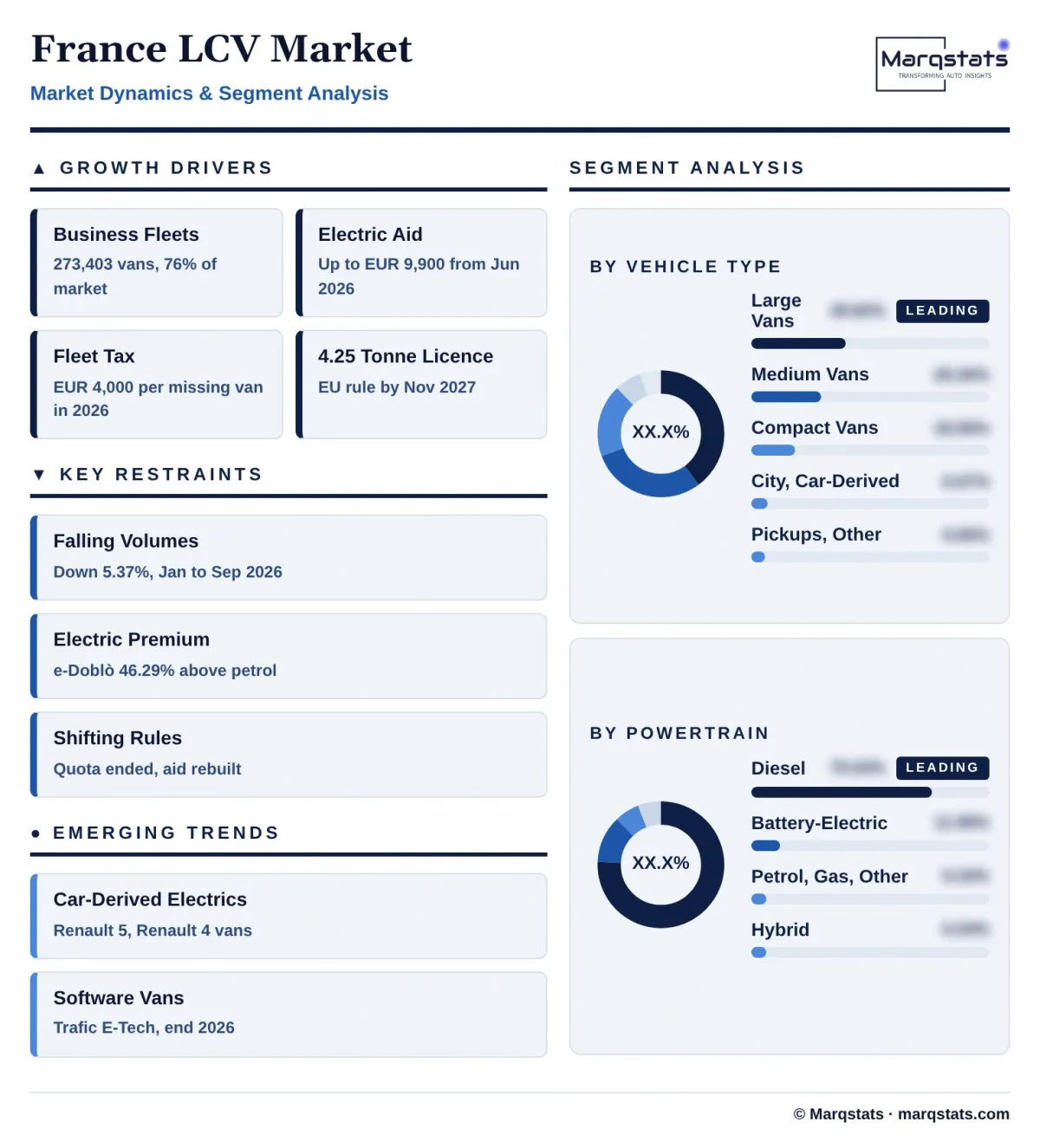
Policy changed the incentive more than the volume. The Finance Act for 2025 removed the obligation for private companies with more than 100 vehicles to include a share of low-emission vehicles in renewals, and replaced it with an incentive tax from 1 March 2025, with targets of 15% in 2025, 18% in 2026, 25% in 2027, 30% in 2028, 35% in 2029 and 48% in 2030 and a unit tariff of EUR 2,000 in 2025, EUR 4,000 in 2026 and EUR 5,000 from 2027. On 1 June 2026 a reformed Certificats d'économies d'énergie (CEE) aid for electric vans took effect, worth EUR 2,850 below 1.55 tonnes of kerb weight, EUR 6,160 between 1.55 and 2 tonnes and up to EUR 9,900 above 2 tonnes.
Marqstats estimates the market at about EUR 10.75 billion in 2025, equal to USD 12,145.41 million at the 2025 average of USD 1.13 per euro, built from 358,225 registrations at an average transaction price of about EUR 30,004 excluding value added tax. The 2026 estimate is 339,000 vans, 5.37% below 2025, before recovery from 2027.
France Light Commercial Vehicle (LCV) Market Size and Forecast
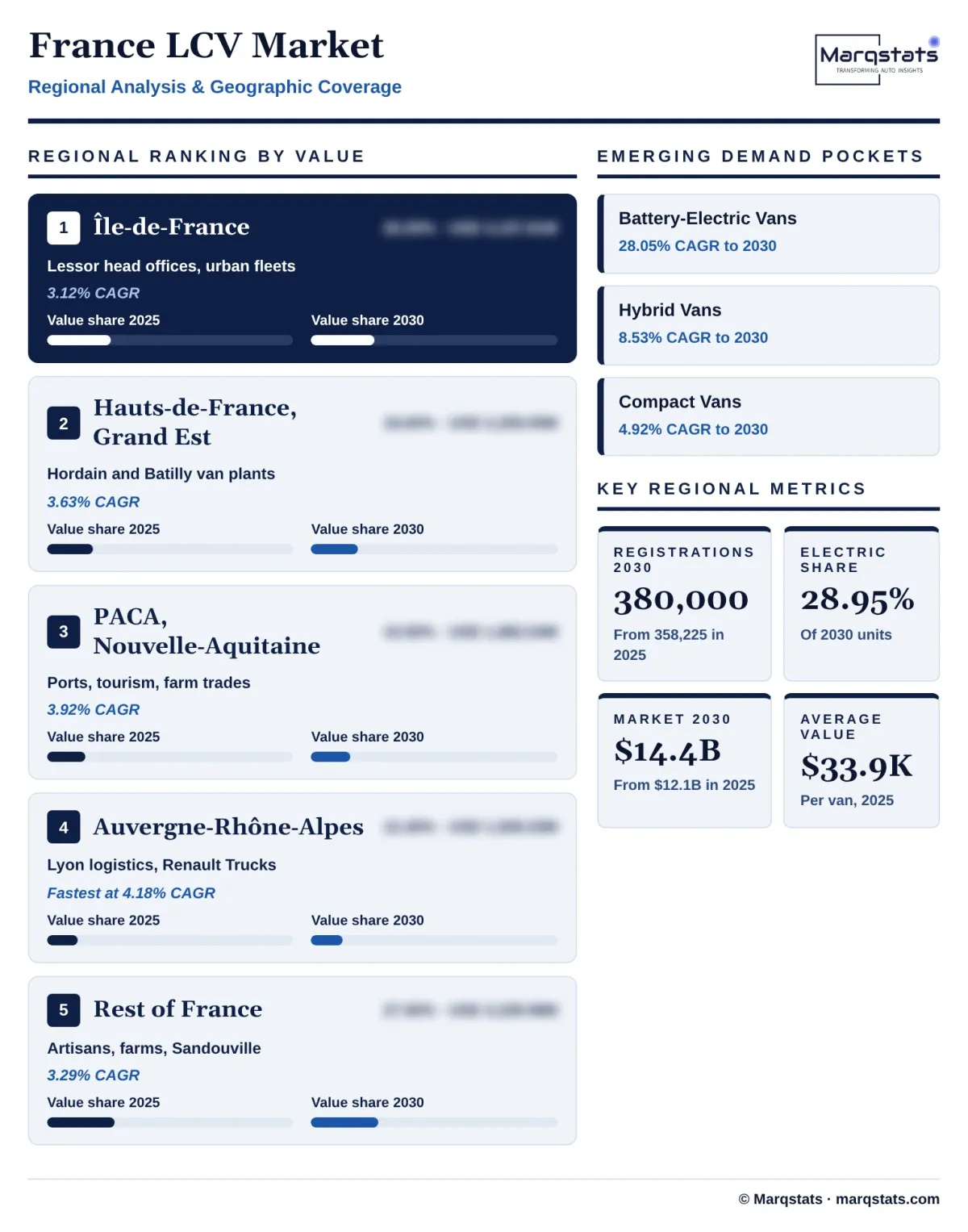
The France light commercial vehicle market grows from USD 12,145.41 million in 2025 to USD 14,437.89 million in 2030, a CAGR of 3.52%. Price and mix contribute about two thirds of the growth: registrations rise at 1.19% a year, from 358,225 to 380,000 vans, and the average transaction value rises at 2.30% a year, from about USD 33,904 to USD 37,994, because Marqstats assumes prices rise 2.50% a year in euros and battery-electric vans, priced about 30% above diesel equivalents, grow from 9.41% to 28.95% of units.
The 2025 value is built bottom-up from CCFA registrations and class prices. Marqstats splits the 358,225 registrations into 39,400 city and car-derived vans at about EUR 18,200, 84,540 compact vans at EUR 23,600, 100,300 medium vans at EUR 31,400, 118,225 large vans at EUR 36,200 and 15,760 pickups and other vans at EUR 38,500, all excluding value added tax and after fleet discounts. The class shares are Marqstats estimates anchored on the CCFA model shares for 2024, in which the Renault Master took 8.3%, the Trafic 7.4% and the Kangoo 6.0%, and on the 2025 business-channel ranking.
The price anchors come from published lists. In February 2026 Fiat Professional listed the Doblò Cargo from EUR 22,900 excluding value added tax and the electric e-Doblò Cargo from EUR 33,500, a premium of EUR 10,600 or 46.29%, and the 50 kWh Peugeot e-Partner van is quoted at EUR 34,500 excluding value added tax. In June 2026 Renault quoted business buyers EUR 27,340 for the Kangoo Van E-Tech electric and EUR 40,100 for the Master L2H2 E-Tech electric. Marqstats applies these as list anchors and converts them into transaction prices by class.
The 2026 estimate is 339,000 vans because registrations ran 3.8% below 2025 from January to July and 5.37% below from January to September, and the autumn months are weaker. Marqstats then expects growth of 3.54% in 2027, 2.99% in 2028, 2.63% in 2029 and 2.43% in 2030, as the Trafic E-Tech and other new electric vans reach fleets, the CEE aid reform lowers the cost of medium and large electric vans, and the 4.25 tonne B-licence rule comes into force in France. The recovery returns volume to 380,000 vans in 2030, still below the 381,855 of 2024.
Marqstats tracks four indicators to monitor the forecast: monthly CCFA registrations of vans by energy, the monthly share of battery-electric vans against 12.2% in the first half of 2026, the pace of Flexis-based Trafic E-Tech deliveries from Sandouville after the end of 2026, and the French transposition of the driving licence directive that allows 4.25 tonne vehicles on a category B licence.
Market Dynamics
Key Drivers
Six forces keep demand for new vans in France above 330,000 units a year even as total registrations fall.
- Business fleets renew on fixed cycles. The Journal de l'Automobile counted 273,403 vans in the business channel in 2025, three quarters of the market, and long-term lessors, administrations and companies replace vans on three to five year cycles, so even a year with 5.8% fewer registrations leaves a base of more than 270,000 orders.
- Electric vans now carry an incentive and a product line. The reformed CEE aid of 1 June 2026 pays up to EUR 9,900 for electric vans above 2 tonnes of kerb weight built in the European Union, and the Renault Kangoo registered 4,060 electric units in the first half of 2026, up 142%, with the Ford Transit Custom at 1,519 and the Peugeot Partner at 1,464.
- The fleet tax puts a price on diesel renewals. Companies with more than 100 vehicles pay EUR 2,000 in 2025, EUR 4,000 in 2026 and EUR 5,000 from 2027 for each vehicle missing against targets of 15%, 18% and 25%, scaled by the company renewal rate of high-emitting vehicles, which turns the electric share of a renewal into a cost line that fleet managers can budget.
- European carbon rules reward electric vans. The European Automobile Manufacturers' Association (ACEA) estimated in late 2025 that a 15% to 20% electric share was needed to meet the 2025 carbon target and that 50% is needed by 2030, and Renault cut volumes on some models in 2025 to manage its mix, so makers price electric vans aggressively, although the European Commission proposed in December 2025 to ease the 2030 van target from 50% to 40%.
- The B licence rule will lift payload. Directive (EU) 2025/2205, published in November 2025, lets drivers with two years of category B experience drive alternative-fuel vehicles up to 4,250 kg, member states must apply it by 26 November 2027, and the French government plans a text by 1 January 2027, which removes the payload penalty of 300 to 500 kg of battery on 3.5 tonne vans.
- Low-emission zones remain law. The Conseil constitutionnel annulled the repeal of the zones à faibles émissions on 21 May 2026 because it was a legislative rider, so urban delivery and trades fleets in the agglomerations that enforce the zones still face restrictions on older diesel vans.
Key Restraints
Four constraints hold back volume and the shift to electric vans.
- Volumes are falling. The CCFA recorded 358,225 vans up to 3.5 tonnes in 2025, down 5.7%, and PFA and AAA Data recorded 251,684 vans below 5.1 tonnes from January to September 2026, down 5.37%, with September down 9.96%. The ACEA put the nine-month fall in French van registrations at 5.6%, while the European Union total was roughly stable, so France is weaker than the European total.
- Electric vans cost far more to buy. Fiat Professional lists the e-Doblò Cargo at EUR 33,500 against EUR 22,900 for the petrol Doblò, a premium of 46.29%, and the aid for electric vans below 1.55 tonnes of kerb weight stays at EUR 2,850, so the smallest electric vans receive the least support relative to their price.
- The rules keep changing. Fleet quotas ended in 2025, the fleet tax tariff doubles from EUR 2,000 to EUR 4,000 in 2026, the CEE aid was rebuilt on 1 June 2026, and the future of the low-emission zones was decided by a court on 21 May 2026 rather than by a stable statute, so buyers delay orders until the price of an electric van after aid is known.
- The licence limit still binds. A category B licence in France allows 3,500 kg until a French text transposes Directive (EU) 2025/2205, and no French text had been published at the time of writing, so electric vans that exceed 3,500 kg with batteries carry less cargo than diesel vans of the same class and some trades choose diesel.
Key Trends
Five shifts are changing which vans French fleets and tradespeople buy.
- Car-derived electric vans scale up. Renault registered 2,132 Renault 5 vans and 790 Renault 4 vans in the first half of 2026, up 120% and new, and the Peugeot 208 van reached 1,072, down 50%, so small electric commercial versions of passenger cars are now among the ten best-selling electric vans.
- The software-defined medium van arrives. Renault signed on 20 February 2026 to buy the 45% of Flexis held by Volvo Group and the 10% held by CMA CGM, production of the Trafic Van E-Tech with a skateboard platform, an 800 volt motor and a software-defined architecture starts at Sandouville by the end of 2026, and Renault Trucks will sell it from 2027.
- Hybrids outnumber plug-in hybrids by four to one. The CCFA counted 16,954 non-rechargeable hybrid vans against 4,057 plug-in hybrids in 2025, so mild hybrids, not plug-ins, are how makers lower fleet emissions without changing refuelling.
- Petrol and gas vans shrink. Petrol registrations fell 38.6% in 2025 to 25,522 and a further 28.8% from January to July 2026 to 11,306, while liquefied petroleum gas and natural gas vans together were 1,405 in 2025, so alternative fuels other than electricity are not filling the gap left by diesel.
- Foreign brands gain in business fleets. Toyota rose 34% to 12,891 and Volkswagen 11.7% to 14,147 in the business channel in 2025 while Renault fell 13.4%, and Ford grew E-Transit Custom sales from 134 to 1,519 between the first halves of 2025 and 2026.
Strategic Implications
- For van makers, the competitive question has shifted from mandate compliance to price after aid. Renault Group and Stellantis hold 67.2% of the market and can price electric vans against their own diesel lines, while Ford, Toyota and Volkswagen win share by targeting the business channel with electric offers, so every maker needs an electric van whose price after the CEE aid sits within about EUR 10,000 of its diesel equivalent.
- For fleet managers and lessors, the tax tariff of EUR 4,000 per missing vehicle in 2026 and EUR 5,000 from 2027 is cheaper than most electric premiums, so the economic case rests on running cost and aid, not on avoiding the tax. Medium and large electric vans above 2 tonnes of kerb weight qualify for up to EUR 9,900 and deserve the first electric orders.
- For charging and energy suppliers, depot charging at lessor and fleet sites is the entry point, because the business channel buys three quarters of vans. The Île-de-France, Auvergne-Rhône-Alpes and the northern and eastern regions account for 57.00% of registrations.
- For bodybuilders and converters, a recovering 380,000-van market in 2030 with more weight on compact and medium vans and on 4.25 tonne electric chassis from 2027 means lighter bodies and refrigerated and tipper conversions designed for battery vans, and demand for conversions follows the large-van chassis that make up 39.82% of value.
- For investors and new entrants from Asia, the volume is large but the incumbents are dominant, so entry through the business channel with a lessor agreement, a clear aid-eligible product above 2 tonnes and local service coverage is more realistic than building a retail network.
Market Segmentation
City and car-derived vans account for 6.67% of 2025 value, USD 810.30 million, and 11.00% of units, or 39,400 registrations. They are commercial versions of passenger cars such as the Renault Clio, Peugeot 208 and Citroën C3, which registered 11,633, 10,469 and 3,905 units in the business channel in 2025, and the new Renault 5 and Renault 4 electric vans. The segment grows at 4.65% a year to USD 1,016.84 million as electric versions replace petrol and diesel ones.
Compact vans account for 18.56% of 2025 value, USD 2,254.51 million, and 23.60% of units, or 84,540 registrations. The Renault Kangoo led the business channel at 21,115, followed by the Peugeot Partner at 19,339, the Citroën Berlingo at 13,990 and the Toyota Proace City at 4,374. The segment grows at 4.92% a year to USD 2,866.38 million and is the main entry point for electric vans, since the Kangoo alone registered 4,060 electric units in the first half of 2026.
Medium vans account for 29.30% of 2025 value, USD 3,558.84 million, and 28.00% of units, or 100,300 registrations. The Renault Trafic registered 20,860 in the business channel, the Peugeot Expert 14,830, the Ford Transit Custom 11,764, the Citroën Jumpy 9,213, the Mercedes-Benz Vito 6,608 and the Volkswagen Transporter 4,088. The segment grows at 3.94% a year to USD 4,317.15 million and gains from the Trafic E-Tech that Renault starts building at Sandouville by the end of 2026.
Large vans account for 39.82% of 2025 value, USD 4,836.12 million, and 33.00% of units, or 118,225 registrations, which makes them the largest segment by value. The Renault Master registered 14,593 in the business channel and the Renault Trucks Master 4,292, with the Iveco Daily at 9,763, Peugeot Boxer at 7,762, Mercedes-Benz Sprinter at 6,570, Citroën Jumper at 6,055 and Volkswagen Crafter at 4,461. The segment grows at 2.43% a year to USD 5,451.94 million, slower than other vans because the 3.5 tonne limit holds back electric versions.
Pickups, light chassis-cabs and other light commercials account for 5.65% of 2025 value, USD 685.64 million, and 15,760 registrations. The segment includes pickups such as the Toyota Hilux and Ford Ranger sold as light commercials and chassis-cabs used by bodybuilders, and grows at 2.76% a year to USD 785.58 million.
Diesel vans account for 75.63% of 2025 value, USD 9,185.66 million, and 77.11% of units, or 276,276 registrations, down 6.2% on 2024. Diesel falls at -3.26% a year in value to USD 7,783.43 million and to 58.42% of units by 2030, but stays the choice for long-distance and heavy-payload work where charging at depots does not cover the route.
Battery-electric vans account for 11.99% of 2025 value, USD 1,456.25 million, and 9.41% of units, or 33,692 registrations, up 28.4%. They grow fastest, at 28.05% a year, to USD 5,013.64 million and 34.73% of value as units rise to 110,000. In the first half of 2026 electric vans reached 22,143 registrations, up 40.9%, a 12.2% share.
Hybrid vans account for 6.04% of 2025 value, USD 733.50 million, and 5.87% of units, or 21,011 registrations, of which 16,954 are non-rechargeable hybrids and 4,057 plug-in hybrids. The segment grows at 8.53% a year to USD 1,104.40 million as makers use mild hybrids to lower fleet emissions.
Petrol, gas and other vans account for 6.34% of 2025 value, USD 770.00 million, and 7.61% of units, or 27,246 registrations, made up of 25,522 petrol, 1,265 liquefied petroleum gas, 299 superethanol, 140 natural gas, 4 hydrogen and 16 other vans. The segment shrinks at 6.97% a year in value to USD 536.42 million.
By Geography
Île-de-France
The Île-de-France accounts for 26.00% of 2025 value, USD 3,157.81 million, and about 93,138 registrations, and grows at 3.12% a year to USD 3,681.66 million and 25.50% by 2030. Registration statistics overstate the region because lessors and corporate buyers register fleets at head-office addresses around Paris, while the vans work across France, and Marqstats allocates value by registration, as lessors and manufacturers report it. Urban delivery, trades and municipal fleets in the zones à faibles émissions make it the first market for electric vans.
Auvergne-Rhône-Alpes
Auvergne-Rhône-Alpes accounts for 12.40% of 2025 value, USD 1,506.03 million, and grows fastest among regions, at 4.18% a year, to USD 1,848.05 million and 12.80% by 2030. Lyon is a logistics and construction centre, the headquarters of Renault Trucks is in the Lyon area, and the Flexis team that develops the Trafic E-Tech works in Lyon and Paris, which keeps product development and fleet buyers close together.
Hauts-de-France and Grand Est
Hauts-de-France and Grand Est account for 18.60% of 2025 value, USD 2,259.05 million, and grow at 3.63% a year to USD 2,699.89 million. Stellantis builds the Peugeot Expert, Citroën Jumpy and Toyota Proace at Hordain in the Nord, and Renault builds the Master at Batilly in Meurthe-et-Moselle, so the two regions combine van factories with cross-border freight to Germany and Benelux.
Provence-Alpes-Côte d'Azur and Nouvelle-Aquitaine
Provence-Alpes-Côte d'Azur and Nouvelle-Aquitaine account for 15.50% of 2025 value, USD 1,882.54 million, and grow at 3.92% a year to USD 2,281.19 million. Tourism, port logistics, agriculture, forestry and construction buy compact and medium vans, and short urban and coastal delivery rounds suit electric vans.
Rest of France
The rest of France accounts for 27.50% of 2025 value, USD 3,339.98 million, and grows at 3.29% a year to USD 3,927.10 million. It covers Brittany, Normandy, Occitanie, Burgundy-Franche-Comté, Pays de la Loire, Centre-Val de Loire, Corsica and the overseas territories, where artisans, farms and municipal services buy compact and medium vans, and where Renault assembles the Trafic at Sandouville in Normandy.
How Competition Is Evolving
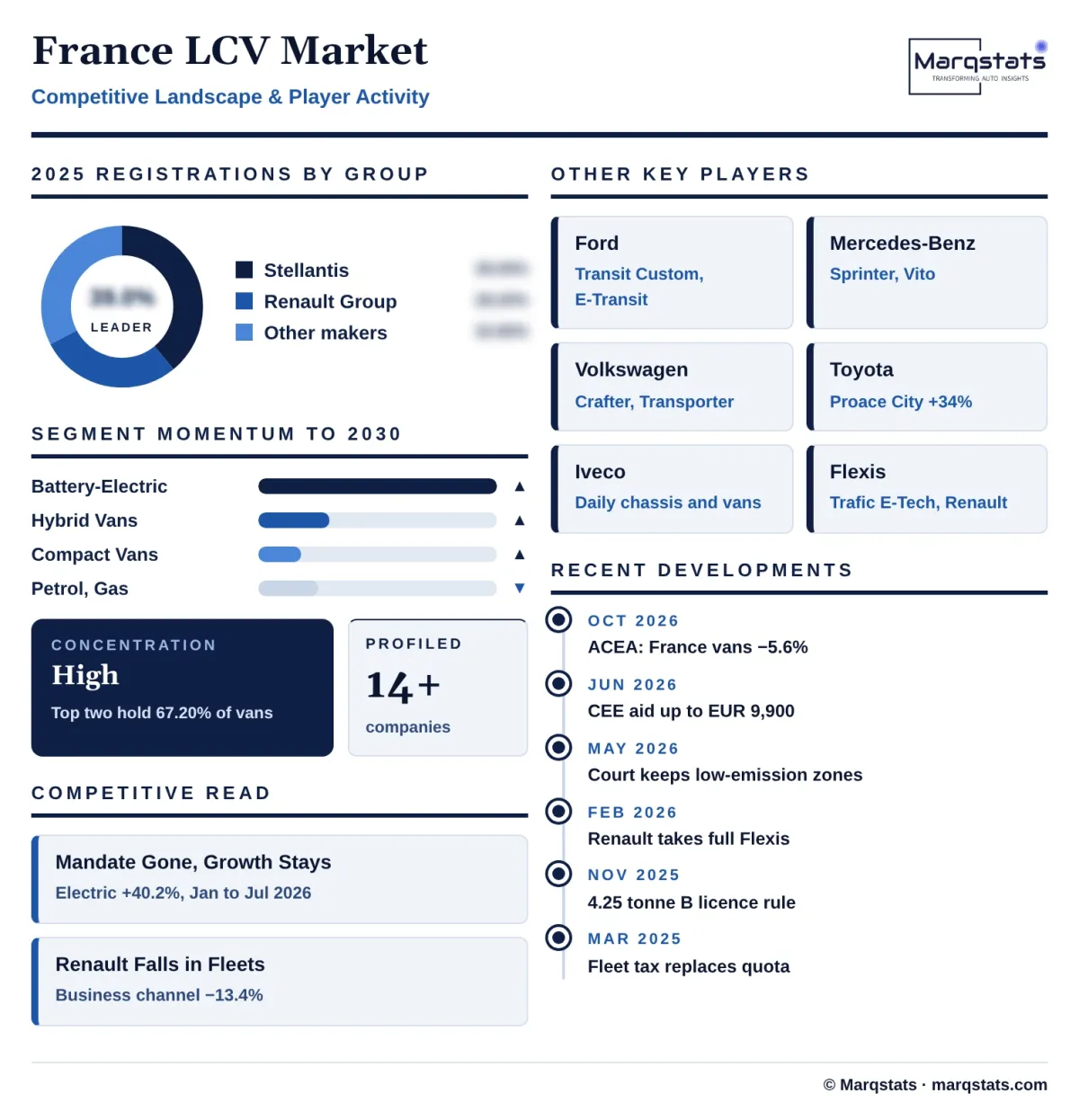
The market is highly concentrated in two French groups. Renault Group registered 101,517 vans in 2025, 28.2% of the market, according to the figures published for the group on 2 January 2026, and Stellantis held about 39% of light commercial registrations through November 2025, with its Pro One division leading electric vans at 42.4%. Together the two groups hold 67.2%, and Marqstats estimates the remaining 32.80% across Ford, Mercedes-Benz, Volkswagen, Toyota, Iveco and importers.
Stellantis leads on volume and Renault is losing ground in the business channel. Peugeot registered 54,916 vans and Citroën 35,072 in the business channel in 2025, down 2.3% and 13.2%, against 75,899 for Renault, down 13.4%, and Stellantis builds the Expert, Jumpy and Proace at Hordain in the Nord and the Boxer, Jumper and Ducato at its Atessa plant in Italy. In 2024 the CCFA put Renault, Stellantis and other French brands together at 69.2% of French light commercial sales.
Foreign brands grow where fleets look for electric vans. Ford registered 20,567 vans in the business channel and sold 1,519 E-Transit Custom vans in the first half of 2026, Toyota rose 34% to 12,891 and Volkswagen 11.7% to 14,147, and Mercedes-Benz Vans registered 14,591 and Iveco 9,763. Marqstats treats these makers, with importers, as the challenger layer that takes share when buyers compare the price of an electric van after aid.
Renault is rebuilding its position on electric vans through Flexis. The company signed on 20 February 2026 to acquire the 45% of Flexis held by Volvo Group and the 10% held by CMA CGM, with production of the Trafic Van E-Tech at Sandouville by the end of 2026, around 1,300 people working on development across Renault sites, and sales through Renault and Renault Trucks from 2027. The earlier plan of May 2025 had named Colis Privé, DB Schenker and Hyve as letter-of-intent customers.
Companies Covered
Companies covered in the report include:
Recent Market Activity
Table of Contents
Coverage & Segmentation
The study covers the France light commercial vehicle market, with 2025 as the base year, 2021 – 2025 as the historical period and 2026 – 2030 as the forecast period. It covers new light commercial vehicles of up to 3.5 tonnes gross vehicle weight registered in France, as classified by the CCFA and AAA Data, segmented by vehicle type, powertrain and region. Values are Marqstats estimates of the transaction value in US dollars, excluding value added tax, at the 2025 average of USD 1.13 per euro.
Vans of 3.5 to 5.1 tonnes (2,204 units in 2025), trucks, buses, passenger cars, used vehicles, imports for re-export and body conversions are excluded. Segment and regional splits, class prices and the forecast are Marqstats estimates built on CCFA and PFA registrations, business-channel model rankings and published price lists. The live Marqstats Europe Electric Light Commercial Vehicle report counts 358,299 French vans (a 74-unit difference from the CCFA figure) and 37,758 electrically chargeable vans, equal to the 33,692 battery-electric and 4,057 plug-in hybrid vans here within 9 units; it is a broader European report and its figures should not be added to this market. Europe LCV Body Conversion and Europe Refrigerated Van Conversion count body value on top of the chassis.
