Market Snapshot
The Australia heavy truck market size is estimated at USD 3,310.29 million in 2025 and is projected to reach USD 4,193.63 million by 2030, growing at a CAGR of 4.84% over 2026 – 2030. Deliveries rise from 14,297 to 15,750 trucks, a 1.95% annual rate, while the average truck gains value as prime movers and battery-electric models take share.
Marqstats defines the market as new heavy-duty trucks delivered to customers in Australia, following the heavy-duty class used in the Truck Industry Council T-Mark deliveries data: articulated prime movers and the heaviest rigid trucks, whether assembled locally at Bayswater in Victoria and Wacol in Queensland or imported. Value is counted at the dealer or importer for the cab-chassis or prime mover, before trailers, bodies, goods and services tax, finance and registration, and is converted at AUD 1 = USD 0.6451 (2025 average). Buses, coaches, vans, light-duty and medium-duty trucks, used trucks and off-road mining haul trucks are excluded.
Prime movers account for 67.35% of 2025 value, diesel and other combustion trucks for 99.63% and brands assembled in Australia for 47.56%. Victoria and Tasmania lead regional value with 28.71%, while Western Australia grows fastest at 5.61% a year and battery-electric trucks grow fastest by powertrain, from a base of 24 trucks in 2025.
Key Takeaways
Market Overview & Analysis
Report Summary
Marqstats sizes the Australia heavy truck market as the value of new heavy-duty trucks delivered to Australian customers each year. The unit count follows the Truck Industry Council T-Mark heavy-duty class, which separates heavy-duty trucks from light-duty trucks of 3.5 to 8 tonnes, medium-duty trucks and vans. It covers articulated prime movers that haul semi-trailers, B-doubles and road trains, and the heaviest rigid chassis used for tipping, concrete, waste and container work. Buses are covered in a separate Australia bus study, and no bus or coach is counted here.
Heavy trucks are the backbone of Australian freight. The Bureau of Infrastructure and Transport Research Economics (BITRE) counted 128,383 articulated trucks and 403,946 heavy rigid trucks registered at 31 January 2025, out of 22,305,347 registered motor vehicles. New deliveries are a small flow on a large stock: Marqstats estimates 8,750 prime movers were delivered in 2025, equal to 6.82% of the articulated fleet, an implied replacement cycle of about 14.7 years.
The market has just been through a record and a correction. The Truck Industry Council counted 14,966 heavy-duty deliveries in 2022, a record 17,569 in 2023, 17,152 in 2024 and 14,297 in 2025, down 16.7%. Heavy-duty deliveries have held up better than other classes in 2026: the first nine months show 9,733 heavy-duty trucks, down 7.9%, against medium-duty down 31.7% and light-duty down 13.9%.
The rulebook changed at the same time. Australian Design Rule 80/04, which adopts Euro VI emissions standards for heavy vehicles, applied to new vehicle models from 1 November 2024 and to every new vehicle supplied from 1 November 2025. The amended Heavy Vehicle National Law began on 1 August 2026, lifting general mass limits by 1 tonne for vehicles under 55 tonnes and by 2 tonnes above 55 tonnes, raising general access length from 19 metres to 20 metres and allowing Euro 6 vehicles up to 500 kilograms of extra mass across the steer and drive axles.
Marqstats estimates the market was worth USD 3,195.66 million in 2022, USD 3,853.48 million in 2023 and USD 3,861.60 million in 2024 before falling 14.28% to USD 3,310.29 million in 2025, equal to AUD 5,131.44 million at AUD 1 = USD 0.6451. The 2022 to 2024 values apply Marqstats price estimates to the official unit counts, so they show the shape of the cycle rather than audited sales.
Australia Heavy Truck Market Size and Forecast
The Australia heavy truck market grows from USD 3,310.29 million in 2025 to USD 4,193.63 million in 2030, a CAGR of 4.84%. Value grows faster than volume: deliveries rise at 1.95% a year, from 14,297 to 15,750 trucks, and the average value per truck rises at 2.83% a year, from about AUD 358,917 to AUD 412,746, because prime movers take a larger share of the mix, Euro VI and safety content raise specifications and battery-electric trucks cost about 2.2 times a diesel truck.
The 2025 value is built bottom-up from applications and prices. Marqstats estimates 8,750 prime movers at about AUD 395,000 each and 5,547 heavy rigid trucks at about AUD 302,000 each, both for the cab-chassis or prime mover before trailers, bodies and goods and services tax. The prime mover count is the sum of brand-level estimates: Marqstats assumes that about 80% of Kenworth, 75% of Volvo, 85% of Scania and 90% of DAF deliveries and nearly all Freightliner and Western Star deliveries are tractors, while only 20% to 25% of Isuzu, Fuso, Hino and UD Trucks deliveries are, and rounds the result to 8,750.
The unit base is official. The Truck Industry Council reported 14,297 heavy-duty deliveries in 2025 and brand totals that sum to the same figure, led by Kenworth with 3,347 and Volvo with 2,326. For 2026 Marqstats expects 13,250 deliveries, down 7.32%: the first nine months total 9,733, the third quarter 3,283 was 4.2% lower than a year earlier, and the fourth quarter of 2025 stood at 3,734 trucks, so a fourth quarter near 3,517 gives the full-year figure.
Growth returns from 2027 at 5.28%, 5.02%, 3.75% and 3.62%. The Truck Industry Council chief executive said in the third-quarter 2026 release that the council is optimistic for a return to stronger new truck sales in 2027, but 2030 deliveries of 15,750 remain below the 2023 peak of 17,569, because Marqstats expects fleets to stretch replacement cycles while diesel prices and interest rates stay high.
Marqstats tracks four indicators to monitor the forecast: monthly heavy-duty deliveries and brand rankings in the Truck Industry Council T-Mark release, the diesel price and fuel supply position after the 2026 Strait of Hormuz disruption, take-up of the amended Heavy Vehicle National Law mass and length allowances, and battery-electric deliveries from the Wacol line of Volvo Group Australia.
Market Dynamics
Key Drivers
Five forces are lifting demand for new heavy trucks in Australia even after a sharp correction in 2025 and 2026.
- A large fleet needs steady renewal. BITRE counted 128,383 articulated trucks on the register at 31 January 2025, and Marqstats estimates 8,750 prime movers were delivered in 2025, a 6.82% renewal rate. Even a modest shortening of the 14.7-year implied cycle adds hundreds of deliveries a year, and the 2023 and 2024 buying peaks put 34,721 heavy trucks on the road that will need replacing in the next decade.
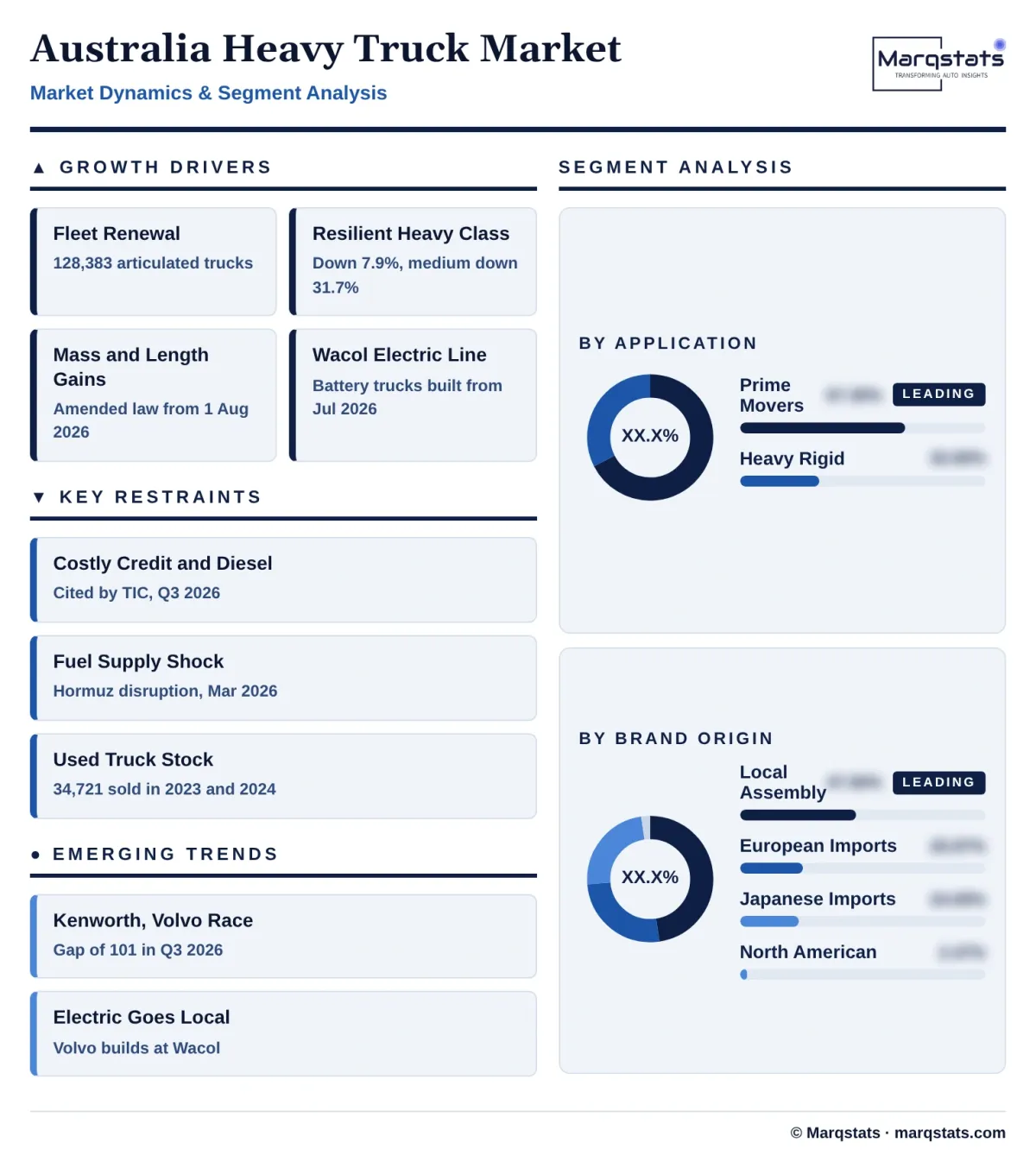
- Heavy-duty demand is the most resilient part of the truck market. The Truck Industry Council reported heavy-duty deliveries of 9,733 for the first nine months of 2026, down 7.9%, against medium-duty down 31.7% and light-duty down 13.9%. Linehaul, resource and primary freight fleets keep buying because their trucks earn more per day than a distribution truck.
- The amended Heavy Vehicle National Law pays for newer trucks. From 1 August 2026 general mass limits rise by 1 tonne for vehicles under 55 tonnes and 2 tonnes above that, general access length rises from 19 metres to 20 metres, and Euro 6 vehicles may carry up to 500 kilograms more across the steer and drive axles. A Euro VI truck therefore earns more payload than the Euro V truck it replaces.
- Regulators keep widening access for high-productivity combinations. On 7 April 2026 the National Heavy Vehicle Regulator and the South Australian Department for Infrastructure and Transport released five updated notices that extend access to prime movers with tri-axle groups and add Euro VI mass provisions to the National Class 2 Performance Based Standards notice. Each new access right favours newer, higher-specification prime movers.
- Local assembly and a new electric line support supply. Kenworth is assembled by PACCAR Australia at Bayswater, and Volvo and Mack trucks by Volvo Group Australia at Wacol, which Volvo has used to build trucks for more than 50 years. From July 2026 Wacol also builds battery-electric trucks, which gives buyers a locally supported route to zero-emission haulage.
Key Restraints
Four constraints hold deliveries below the 2023 record and slow the shift to cleaner trucks.
- Operating costs and borrowing costs weigh on buyers. The Truck Industry Council chief executive, Tony McMullan, cited cost-of-living pressure, elevated diesel prices and interest rates as brakes on operator investment in the third-quarter 2026 release and expected little relief before year-end. Heavy-duty deliveries are still falling, by 7.9% in the first nine months, because small and mid-sized carriers delay purchases first.
- The 2026 fuel shock raised risk for every diesel fleet. A 4 March 2026 report described the freight sector as highly exposed to the oil shock that followed disruption at the Strait of Hormuz, and on 16 April 2026 a fuel importer agreed with the Federal Government and Export Finance Australia to fast-track extra fuel imports for regional freight supply. Operators facing fuel supply risk and higher diesel prices postpone fleet growth even when their trucks are old.
- Record deliveries have left a large used stock. The Truck Industry Council counted 17,569 heavy-duty deliveries in 2023 and 17,152 in 2024, and Marqstats expects many of these trucks to reach the used market as first owners trade up. Late-model used prime movers compete with new trucks on price, which is one reason Marqstats projects 2030 deliveries of 15,750 and not a return to the 2023 level.
- Battery-electric trucks remain small and costly. Only about 24 heavy-duty battery-electric trucks were delivered in 2025, and Marqstats prices them at about 2.2 times a diesel truck of the same type. Megawatt charging is not in place on the main freight corridors, a battery adds weight that reduces payload under mass limits, and the first Volvo FH Electric delivered to New Energy Transport offers up to 400 kilometres of loaded range, short of interstate linehaul distances.
Key Trends
Four shifts are changing who builds, buys and runs heavy trucks in Australia.
- Kenworth and Volvo are in a closer fight for first place. Kenworth delivered 3,347 trucks in 2025 and Volvo 2,326, a gap of 1,021, wider than the gap of 659 in 2024 when Kenworth sold 3,774 and Volvo 3,115. In the third quarter of 2026 Kenworth delivered 674 and Volvo 573, a gap of 101.
- Electric heavy trucks move from imports to local assembly. Volvo Group Australia began building battery-electric trucks at Wacol in July 2026, with Linfox among the first customers, and New Energy Transport took delivery of its first Volvo FH Electric in July 2026 with a plan for 20 electric trucks by the end of 2026.
- Dual-brand groups gain ground. PACCAR Australia holds 27.68% of units across Kenworth and DAF, and DAF rose from 595 trucks in 2024 to 611 in 2025 while the market fell 16.7%. Groups with a premium conventional brand and a European cab-over brand can cover both linehaul and regional work.
- High-productivity combinations spread through regulation. The National Class 2 Performance Based Standards notices for 2026 add schedules and Euro VI mass provisions state by state, and the amended Heavy Vehicle National Law makes the 1 August 2026 mass and length allowances general, so prime movers specified for 30 metre combinations become the standard purchase.
Strategic Implications
- For truck makers, the winning position is local engineering. Kenworth, Volvo and Mack took 44.76% of 2025 deliveries from Bayswater and Wacol, and importers of Japanese and European trucks compete best when they specify axle loads, cooling, fuel capacity and animal protection for Australian conditions and keep parts close to the Hume, Bruce and Great Northern highways.
- For fleet operators, 2026 is a buyer market for prime movers. Lower deliveries, large used stock and the 1 August 2026 mass and length allowances favour carriers that renew early with Euro VI trucks specified for the new limits, and a buy-back or guaranteed residual agreement protects balance sheets against used-truck price risk.
- For electric truck suppliers, depots matter more than range. With about 24 heavy-duty battery-electric deliveries in 2025 and a 400 kilometre loaded range on the first Volvo FH Electric delivered to New Energy Transport, the buyers are return-to-base fleets such as Linfox and metropolitan distribution operators, and suppliers that bundle charging, grid connection and battery guarantees win them.
- For financiers and lessors, the correction is an entry point. The 45,191 trucks and vans delivered in 2025 were the third best year on record, so the stock of Euro VI trucks will build quickly, and structured finance with residual value support for prime movers and PBS-ready trailers lowers the barrier for mid-sized carriers.
- For parts, tyre and service providers, a fleet of 128,383 articulated trucks and a 14.7-year implied replacement cycle mean that aftermarket demand is larger and steadier than new truck demand, and Euro VI aftertreatment systems add a recurring need for diesel exhaust fluid, filters and diagnostics.
Market Segmentation
Prime movers account for 67.35% of 2025 value, USD 2,229.62 million, and grow at 5.01% a year to USD 2,847.15 million and 67.89% of the market. Marqstats estimates 8,750 prime movers were delivered in 2025, led by Kenworth T610, T909 and K220 models, Volvo FH and FH16, Scania R and S series, DAF XF and Mercedes-Benz Actros, and expects 9,700 by 2030 as B-double, road train and PBS operators renew fleets.
Heavy rigid trucks account for 32.65% of 2025 value, USD 1,080.67 million, and grow more slowly, at 4.50% a year, to USD 1,346.48 million. Marqstats estimates 5,547 deliveries in 2025, mostly Isuzu Giga and FY series, Fuso Shogun, Hino 700, UD Quon and Mercedes-Benz Arocs chassis used for tipping, concrete, refuse and container work, a segment tied to civil construction budgets rather than to interstate freight.
Diesel and other combustion trucks account for 99.63% of 2025 value, USD 3,298.09 million, and grow at 3.30% a year to USD 3,879.02 million, while their share falls to 92.50%. Every Euro VI truck relies on selective catalytic reduction and a diesel particulate filter, and the national diesel network keeps this segment the default for linehaul and road train work through 2030.
Battery-electric trucks account for 0.37% of 2025 value, USD 12.20 million, and grow fastest, at 91.55% a year, to USD 314.61 million and 7.50% of the market. Marqstats counts 24 heavy-duty deliveries in 2025 from Truck Industry Council class listings: 17 from Volvo, 4 from Scania and 3 from Sea Electric. Volvo Group Australia has built electric trucks at Wacol since July 2026, and Marqstats expects 560 battery-electric deliveries in 2030.
Brands assembled in Australia account for 47.56% of 2025 value, USD 1,574.27 million, and grow at 5.32% a year to USD 2,040.11 million and 48.64% of the market. Kenworth (3,347 trucks) is assembled by PACCAR Australia at Bayswater, and Volvo (2,326) and Mack (726) by Volvo Group Australia at Wacol, together 6,399 trucks and 44.76% of units.
Japanese imports account for 24.00% of 2025 value, USD 794.38 million, and grow at 3.50% a year to USD 943.43 million. Isuzu (2,212), Fuso (793), Hino (712) and UD Trucks (457) delivered 4,174 trucks, 29.19% of units, mostly rigid chassis priced below the prime movers that dominate value.
European imports account for 25.97% of 2025 value, USD 859.76 million, and grow at 4.75% a year to USD 1,084.49 million. Scania (1,207), Mercedes-Benz (793), DAF (611), Iveco (421), MAN (293) and Dennis Eagle (105) delivered 3,430 trucks, 23.99% of units, concentrated in premium linehaul and refuse work.
North American and other imports account for 2.47% of 2025 value, USD 81.88 million, and grow fastest among origins, at 8.93% a year, to USD 125.60 million. Western Star (168), Freightliner (125) and Foton Mobility (1) delivered 294 trucks, 2.06% of units, and Marqstats prices them at the top of the range because they are specified for heavy haulage.
By Geography
Victoria and Tasmania
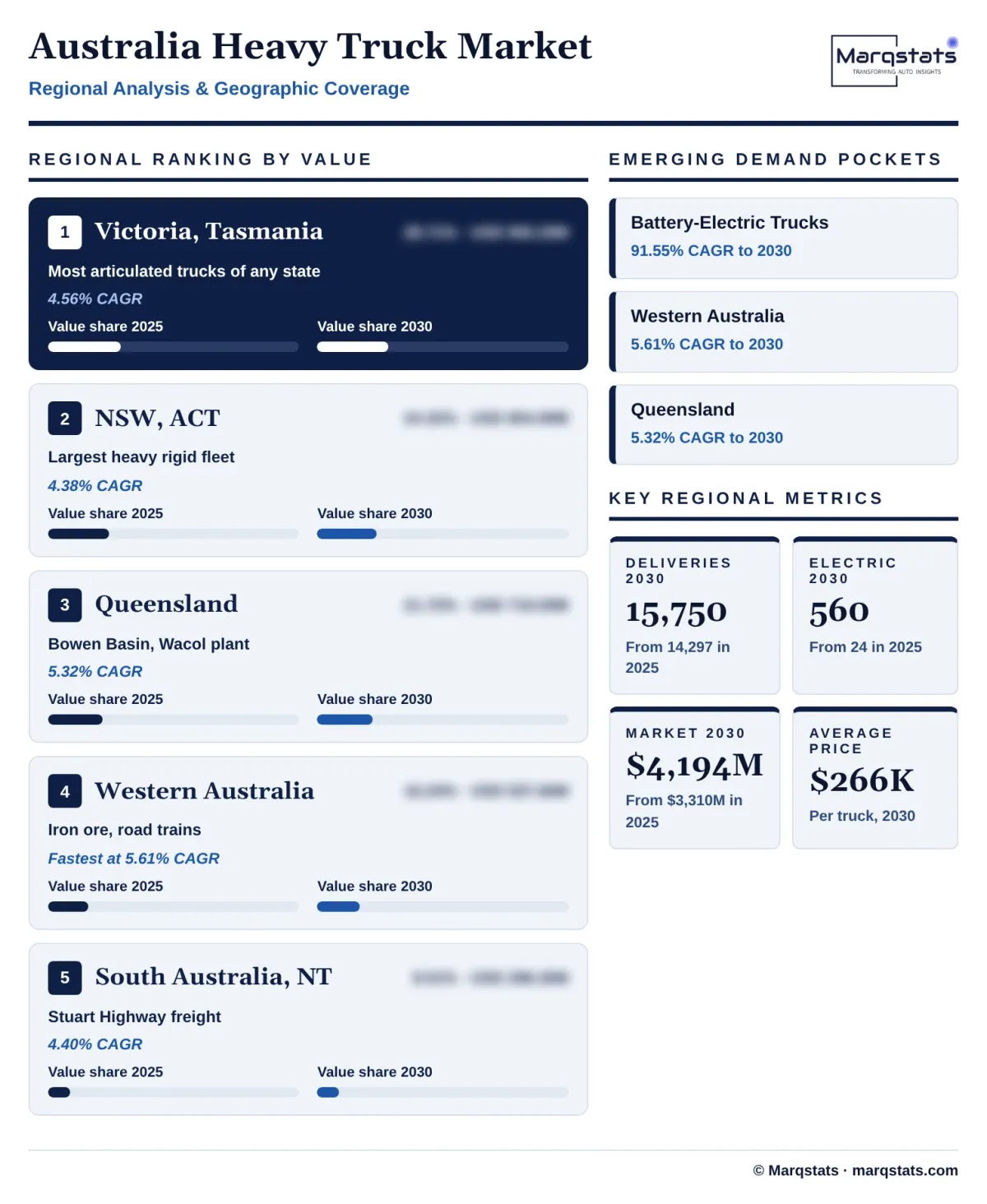
Victoria and Tasmania account for 28.71% of 2025 value, USD 950.29 million, and grow at 4.56% a year to USD 1,187.89 million. Victoria registers more articulated trucks than any other state, 35,897 against 28,672 in New South Wales, with Tasmania adding 2,424, together 29.85% of the national articulated fleet, because Melbourne is the base of Linfox and Toll Group and of the Hume corridor and the Port of Melbourne.
New South Wales and ACT
New South Wales and the Australian Capital Territory account for 24.32% of 2025 value, USD 804.99 million, and grow at 4.38% a year to USD 997.57 million. New South Wales holds the largest heavy rigid fleet at 111,675 registrations and 22.49% of articulated trucks with the Australian Capital Territory, so Sydney construction, waste and distribution work gives it more rigid demand than any other state.
Queensland
Queensland accounts for 21.72% of 2025 value, USD 719.00 million, and grows at 5.32% a year to USD 931.83 million. It holds 27,880 articulated and 87,770 heavy rigid trucks, mining logistics in the Bowen Basin and freight on the Bruce Highway, and it is the home of the Wacol plant where Volvo and Mack trucks and the first Australian-built electric trucks are made.
Western Australia
Western Australia accounts for 16.24% of 2025 value, USD 537.66 million, and grows fastest among regions, at 5.61% a year, to USD 706.40 million and 16.84% by 2030. The state holds 21,062 articulated trucks, runs its heavy vehicle rules through Main Roads Western Australia and is outside the national heavy vehicle regulator scheme, so its iron ore and road train fleets buy high-specification prime movers on their own rules.
South Australia and Northern Territory
South Australia and the Northern Territory account for 9.01% of 2025 value, USD 298.35 million, and grow at 4.40% a year to USD 369.94 million. South Australia holds 10,842 articulated trucks and the Northern Territory 1,402, and the Stuart Highway and the east-west link carry the road train and livestock freight that the April 2026 South Australian notices were written to ease.
How Competition Is Evolving
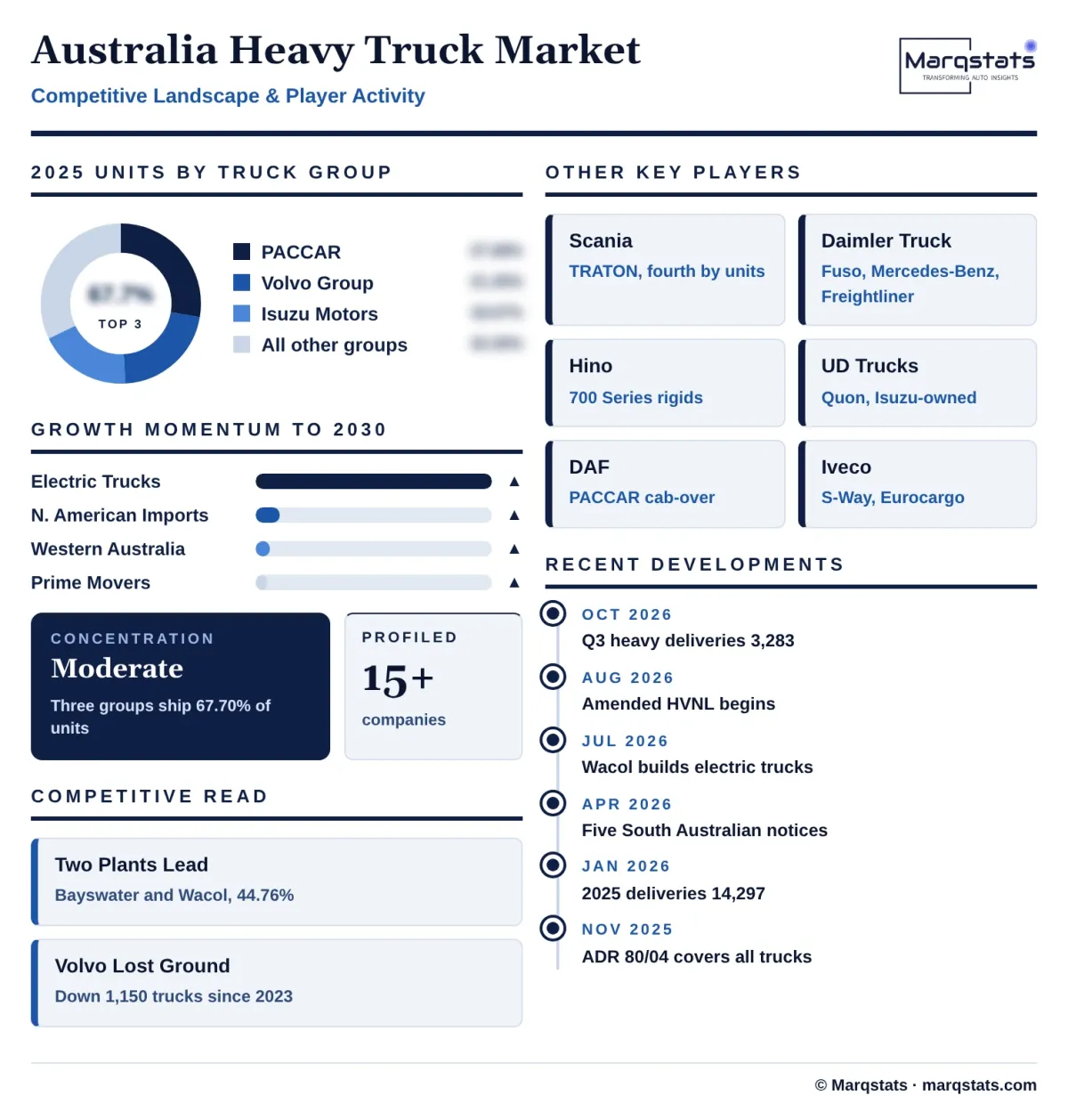
The market is concentrated at group level and contested at brand level. PACCAR, which owns Kenworth and DAF, delivered 3,958 trucks and 27.68% of 2025 units; Volvo Group, with Volvo and Mack, delivered 3,052 and 21.35%; and Isuzu Motors, with Isuzu and UD Trucks, delivered 2,669 and 18.67%. The three groups together hold 67.70%, while Daimler Truck, with Fuso, Mercedes-Benz, Western Star and Freightliner, holds 13.14% and TRATON, with Scania and MAN, 10.49%.
Kenworth leads the brand table with 3,347 trucks and 23.41% of units, up from 22.0% in 2024. Volvo is second with 2,326 and 16.27%, down from 3,476 in 2023, a fall of 1,150 trucks against a fall of 306 for Kenworth over the same two years. Isuzu is third with 2,212 and 15.47%, followed by Scania with 1,207 and 8.44%.
Rigid chassis and premium cab-over trucks sit lower in the table. Fuso and Mercedes-Benz each delivered 793, Mack 726, Hino 712, DAF 611, UD Trucks 457, Iveco 421, MAN 293, Western Star 168, Freightliner 125, Dennis Eagle 105 and Foton Mobility 1. September 2026 deliveries show Kenworth 247, Volvo 208, Isuzu 136 and Scania 119 of 1,124 heavy-duty trucks, so the order of the top four held in 2026.
Competition now turns on electrification, financing and service rather than list price. Volvo Group Australia is the first truck maker to build battery-electric trucks in the country, while Scania recorded four heavy-duty zero-emission deliveries in 2025 and Mercedes-Benz lists the eActros 600 in Australia. Local assembly, parts depth and residual values decide fleet orders, and a buyer who expects to trade a truck after five years cares more about the used-market value than about the first price.
Companies Covered
Companies covered in the report include:
Recent Market Activity
Table of Contents
Coverage & Segmentation
The study covers the Australia heavy truck market, with 2025 as the base year, 2021 – 2025 as the historical period and 2026 – 2030 as the forecast period. It covers new heavy-duty trucks delivered to Australian customers, in the heavy-duty class of the Truck Industry Council T-Mark data, segmented by application, powertrain, brand origin and region. Values are in US dollars at AUD 1 = USD 0.6451, the 2025 average, for the cab-chassis or prime mover before trailers, bodies, goods and services tax, finance and registration.
Buses and coaches, which Marqstats covers in a separate Australia bus market, are excluded, as are vans, light-duty trucks of 3.5 to 8 tonnes, medium-duty trucks, used trucks, trailers and bodies sold separately, and off-road mining haul trucks. Segment and regional splits are Marqstats estimates built on official delivery counts, BITRE registration data and price benchmarks. The live Electric Heavy-Duty Truck report and the Australia Electric Mining Equipment report are adjacent, and their figures should not be added to this market.