Market Snapshot
Key Takeaways
Market Overview & Analysis
Report Summary
This analysis sizes the Asia-Pacific automotive data management market as software platforms, cloud infrastructure, supercomputing data factory hosting, and analytical applications spanning consumer and commercial vehicles across China, Japan, South Korea, India, Australia and the rest of the region. The market is built from official national vehicle sales disclosures from CAAM, SIAM, JAMA and KAMA, calibrated against connected-vehicle penetration and statutory regulatory frameworks in each jurisdiction. The market is sized in USD across a 2024 base year and a 2025-2029 forecast period.
The Asia-Pacific automotive data management market is projected to grow from USD 3,820.00 million in 2024 to USD 9,883.00 million by 2029, a 20.93% compound annual growth rate, as the connected vehicle parc expands from 98.40 million to 301.20 million units. This growth reflects a region defined less by a single unified technology trajectory than by sovereign regulatory divergence: China's statutory in-vehicle processing and cross-border transfer restrictions force fundamentally different technical architecture than Japan's internationally-aligned Mobility DX Strategy, India's commercial-telematics-first AIS-140 mandate, or Australia's productivity-incentivized Smart OBM framework, meaning no single regional software platform can serve every jurisdiction without substantial localization investment.
The base-case 2029 forecast of USD 9,883.00 million assumes China's Vehicle-Road-Cloud Integration program expands from its initial 20 pilot cities to 100 prefecture-level cities by late 2026, Japan's Mobility DX Strategy achieves cross-OEM software API harmonization among Toyota, Honda and Nissan, and India extends AIS-140 compliance to light commercial fleets and electric three-wheelers. The binding upside condition is whether this infrastructure convergence accelerates faster than modeled; the binding downside condition, reflected in the market's own Sovereign-Bifurcation scenario reaching only USD 6,702.00 million, is whether the Cyberspace Administration of China enforces a total ban on cross-border transmission of vehicle telemetry and driving simulation data, triggering reciprocal hardware restrictions from Western and regional markets and halting municipal C-V2X funding beyond the initial 20-city pilot.
Market Dynamics
Key Drivers
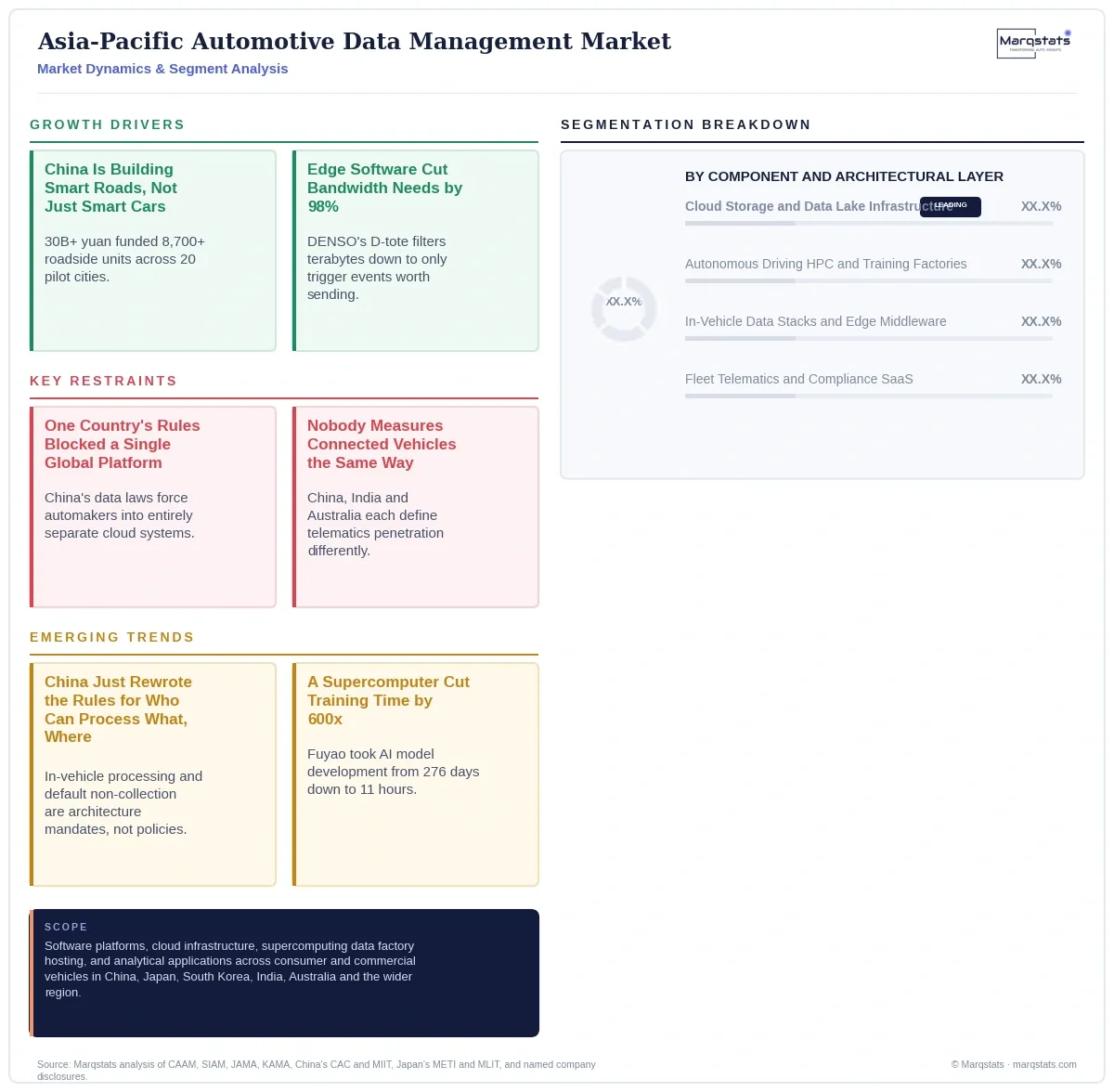
- China's Vehicle-Road-Cloud Integration model has mobilized more than 30 billion yuan in municipal investment across 20 pilot cities including Beijing, Shanghai, Chongqing, Wuhan, Shenzhen, Guangzhou and Chengdu, financing over 8,700 sets of 5G C-V2X roadside units and opening more than 35,000 kilometers of public roadways for integrated autonomous vehicle operations.
- Edge computing architectures including DENSO Corporation's D-tote data acquisition system reduce required wireless transmission bandwidth by over 98% by processing sensor data locally and transmitting only prioritized operational trigger events, resolving the bandwidth and cost constraints that would otherwise make mass-market connected vehicle data pipelines commercially unviable across the region.
- India's AIS-140 standardization mandates type-approved Telematics Control Units across all commercial transport vehicles, public passenger conveyance units, and hazardous materials transports, establishing a standardized baseline for continuous vehicle data ingestion that has made commercial fleet telematics an early and durable driver of automotive data scaling in South Asia.
- Japan's Mobility DX Strategy, jointly formulated by METI and MLIT, targets securing a 30% global market share for Japanese automakers in Software-Defined Vehicles by 2030 and 2035 through common application programming interfaces, virtual simulation environments, and harmonized edge-computing protocols intended to accelerate software release cadences while controlling development costs.
- Australia's National Heavy Vehicle Regulator rewards telematics compliance with direct commercial incentives: operators equipping multi-combination freight vehicles with type-approved Smart On-Board Mass systems and streaming certified mass records receive access to higher-productivity road networks, allowing up to 15% to 20% more payload per trip and offsetting the hardware and subscription costs of certified telematics units.
Key Restraints
- China's statutory in-vehicle processing principle and default non-collection doctrine, combined with mandatory government cybersecurity assessments for any cross-border transfer of important data, prevent automotive OEMs from implementing unified global data architectures, forcing the construction of entirely separate sovereign cloud data centers on domestic infrastructure for any company operating in the Chinese market.
- Regional statistical reporting lacks cross-border definitional consistency: Australia's NHVR tracks certified heavy vehicle telematics under Smart OBM and TMA protocols, India's MoRTH and SIAM monitor commercial fleets based on AIS-140 device installation, and China's MIIT and CAAM classify connected vehicles based on Level-2 or Level-3 driver-assist suite deployment, meaning cross-jurisdiction market comparisons require normalizing fleets by hardware capability rather than relying on headline registry figures.
- A modern connected vehicle equipped with Level-2+ and Level-3 autonomous driving suites produces between 1 and 4 terabytes of raw telemetry data per operating hour, and transmitting these volumes over public cellular infrastructure remains cost-prohibitive and constrained by mobile uplink capacity, requiring continued heavy investment in edge computing middleware rather than simpler centralized cloud ingestion.
- Automakers rarely disclose standalone connected-service revenue in audited financial statements across Hong Kong, Bombay and Tokyo Stock Exchange filings, instead aggregating recurring software revenue into overall vehicle sales or generalized aftermarket categories, preventing direct empirical observation of consumer subscription margins across the region's largest manufacturers.
Key Trends
- China's regulatory approach to automotive data represents a genuinely distinctive governance model rather than an incremental variation on Western privacy frameworks: the in-vehicle processing principle and default non-collection doctrine are architectural mandates that dictate where computation must physically occur, not merely consent requirements governing how data already collected may be used, a distinction with direct and unavoidable consequences for system design.
- The Fuyao supercomputing facility's compression of foundation model training cycles from 276 days to 11 hours demonstrates that Chinese automakers are not simply scaling existing AI development approaches but achieving a qualitatively different order of computational throughput, a capability gap that compounds over successive model generations rather than remaining static.
- China's Vehicle-Road-Cloud Integration model, distributing compute across municipal roadside infrastructure rather than concentrating it entirely within vehicles, represents a genuinely different architectural philosophy than the vehicle-centric edge computing approach dominant in Japan and other markets, one that depends on sustained public infrastructure investment rather than private vehicle-side capital alone.
- Commercial fleet telematics has proven a more durable and higher-margin revenue model than consumer connected-vehicle services across the region, evidenced by Tata Motors' Fleet Edge platform driving measurable fuel-efficiency gains and aftermarket parts revenue growth, while consumer subscription economics remain constrained by bundled connectivity pricing and low willingness to pay recurring fees.
- The market's own two-scenario framework discloses that regional growth trajectory depends more heavily on sovereign data-policy outcomes, specifically whether China maintains or restricts cross-border telemetry flows, than on underlying vehicle sales volume or technology adoption curves, making regulatory monitoring a more consequential forecasting input than typical automotive demand indicators.
Strategic Implications
For a technology startup or cloud software vendor entering the Asia-Pacific market, business models reliant on streaming high-volume, uncompressed telemetry directly to centralized cloud lakes are commercially and legally unviable in China specifically; entrants should invest in containerized edge-computing middleware that executes real-time feature extraction on vehicle hardware, and any provider targeting the Chinese automotive supply chain must build software architectures that run natively on domestic sovereign cloud platforms including Alibaba Cloud, Baidu AI Cloud or Tencent Cloud.
For a global automotive manufacturer, attempting to deploy a unified, monolithic software platform across all Asia-Pacific markets is not commercially viable given China's sovereign data requirements; manufacturers should transition to modular, decoupled software architectures separating vehicle actuation systems from localized cloud communications interfaces, allowing integration with Western hyperscalers including AWS or Microsoft Azure across Japan, South Korea, Australia and India while maintaining separate Alibaba Cloud or Baidu AI Cloud infrastructure specifically for mainland China.
For a Tier-1 automotive supplier or technology investor, capital should prioritize hardware-agnostic middleware platforms that decouple vehicle electronic control units from underlying system-on-chip hardware, following the KPIT-ZF-Qualcomm Qorix joint venture and DENSO's Mobility IoT Core model, while directing investment toward regulatory-mandated telematics ecosystems including Australia's Smart OBM and India's AIS-140, which generate reliable subscription revenue insulated from cyclical automotive sales fluctuations.
Outlook
Base case (Infrastructure-Convergence): USD 9,883.00 million by 2029 (20.93% five-year value CAGR), serving 301.20 million active connected vehicles. This trajectory assumes China's Vehicle-Road-Cloud Integration expands from 20 pilot cities to 100 prefecture-level cities by late 2026, Japan's Mobility DX Strategy achieves cross-OEM software API harmonization among Toyota, Honda and Nissan, and India extends AIS-140 compliance to light commercial fleets and electric three-wheelers.
Downside case (Sovereign-Bifurcation and Hardware Retraction): USD 6,702.00 million by 2029 (11.90% five-year value CAGR), constrained to 218.40 million active connected vehicles. The specific trigger is the Cyberspace Administration of China enforcing a total ban on cross-border transmission of vehicle telemetry, driving simulations and synthetic corner cases, combined with Western and regional markets implementing reciprocal hardware restrictions on Chinese-manufactured telematics control units, while municipal governments halt C-V2X funding beyond the initial 20-city pilot due to fiscal constraints.
An alternative rapid-growth scenario predicting full-scale commercial Level-4 robotaxi proliferation across the entire Asia-Pacific by 2029 was evaluated and explicitly rejected by the underlying source material: disclosed trial data indicates ongoing regulatory hurdles, weather-related sensor disengagements, and substantial infrastructure capital costs that make full region-wide robotaxi deployment unlikely within the five-year forecast window, regardless of which of the two evidenced scenarios materializes.
Market Segmentation
Cloud storage and data lake infrastructure held 38.00% of 2024 market value (USD 1,451.60 million), spanning object storage, multi-cloud ingestion pipelines, and localized cleanrooms required for sovereign data residency compliance, and is projected to reach 39.00% of value (USD 3,854.37 million) by 2029 as data volumes continue expanding across the connected vehicle parc.
Autonomous driving high-performance computing and training factories held 26.00% of 2024 market value (USD 993.20 million), anchored by GPU cluster leasing, automated data labeling, and physical and synthetic driving simulation exemplified by XPeng and Alibaba Cloud's Fuyao facility, and is projected to expand to 29.00% of value (USD 2,866.07 million) by 2029, the fastest-growing architectural layer.
In-vehicle data stacks and edge middleware held 21.00% of 2024 market value (USD 802.20 million), spanning edge runtimes, containerized execution environments, and AUTOSAR Classic and Adaptive standards for CAN and Ethernet ingestion, projected to reach USD 1,877.77 million by 2029 though contracting slightly to 19.00% share as HPC investment scales faster.
Fleet telematics and compliance SaaS held 15.00% of 2024 market value (USD 573.00 million), anchored by AIS-140 tracking, Smart OBM reporting, and predictive maintenance engines including Tata Motors' Fleet Edge, projected to reach USD 1,284.79 million by 2029 while contracting to 13.00% share as the higher-growth infrastructure and HPC layers expand faster.
By Geography
China
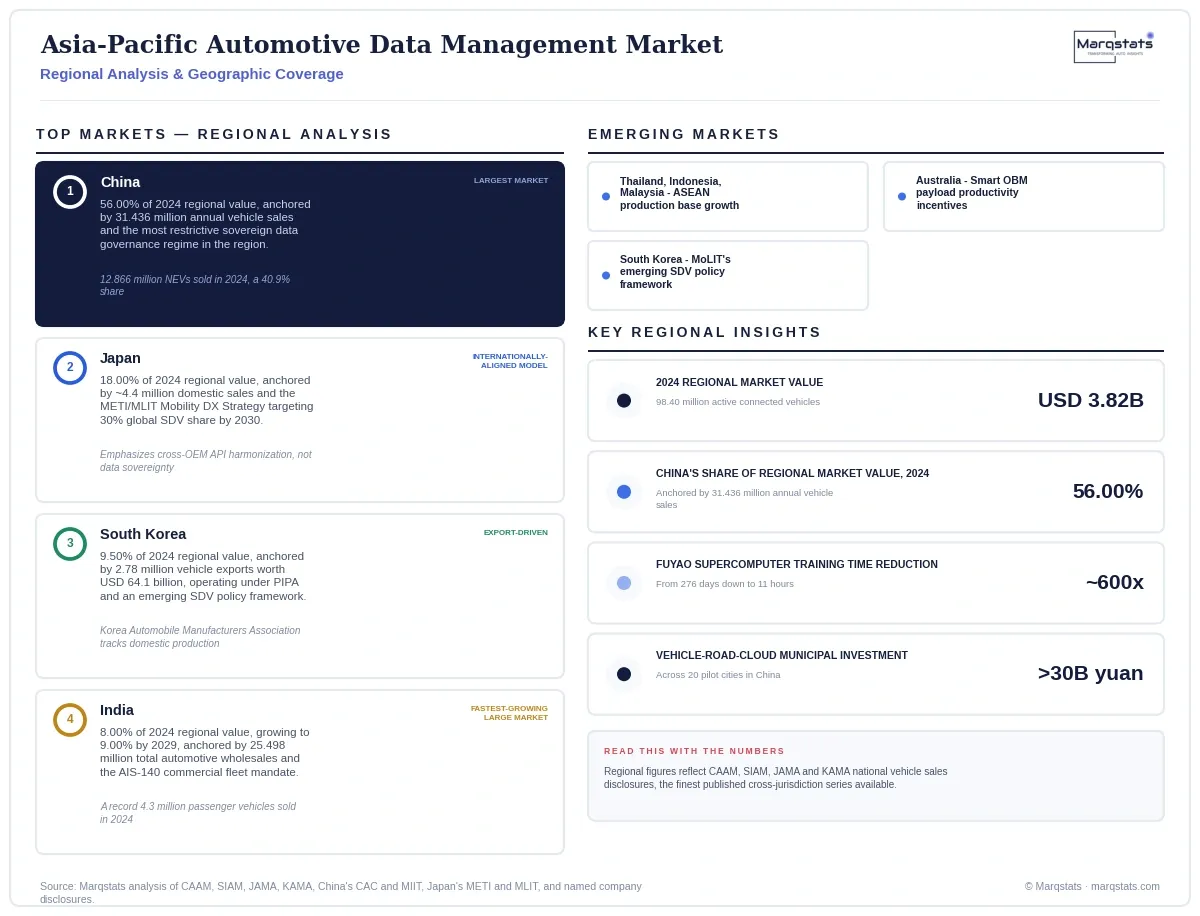
China dominates the regional market with 56.00% of 2024 value (USD 2,139.20 million), anchored by 31.436 million annual vehicle sales including 12.866 million new energy vehicles, a 40.9% NEV share, according to the China Association of Automobile Manufacturers; the Cyberspace Administration of China's Several Provisions on the Management of Automobile Data Security establishes the region's most restrictive sovereign data governance regime.
Japan
Japan holds 18.00% of 2024 regional value (USD 687.60 million), anchored by approximately 4.4 million domestic sales and 4.42 million vehicle exports according to the Japan Automobile Manufacturers Association; the jointly formulated METI and MLIT Mobility DX Strategy emphasizes international regulatory alignment and cross-OEM software standardization rather than the data-sovereignty model China has adopted.
South Korea
South Korea accounts for 9.50% of 2024 regional value (USD 362.90 million), anchored by 2.78 million vehicle exports valued at USD 64.1 billion according to the Korea Automobile Manufacturers Association, operating under the Personal Information Protection Act and an emerging Ministry of Land, Infrastructure and Transport Software-Defined Vehicle policy framework.
India
India represents 8.00% of 2024 regional value (USD 305.60 million) but is projected to reach 9.00% share by 2029, anchored by 25.498 million total automotive wholesales including a record 4.3 million passenger vehicles according to the Society of Indian Automobile Manufacturers; the Ministry of Road Transport and Highways' AIS-140 standard has made commercial fleet telematics an early and durable driver of regional data scaling.
Australia and Rest of Asia-Pacific
Australia accounts for 4.50% of 2024 regional value (USD 171.90 million), anchored by 1.216 million total vehicle registrations and the National Heavy Vehicle Regulator's productivity-incentivized Smart On-Board Mass framework, while the remaining Rest of Asia-Pacific region, spanning ASEAN production bases including Thailand, Indonesia and Malaysia, contributes a further 4.00% (USD 152.80 million) under the ASEAN Mutual Recognition Arrangement on Type Approval.
How Competition Is Evolving
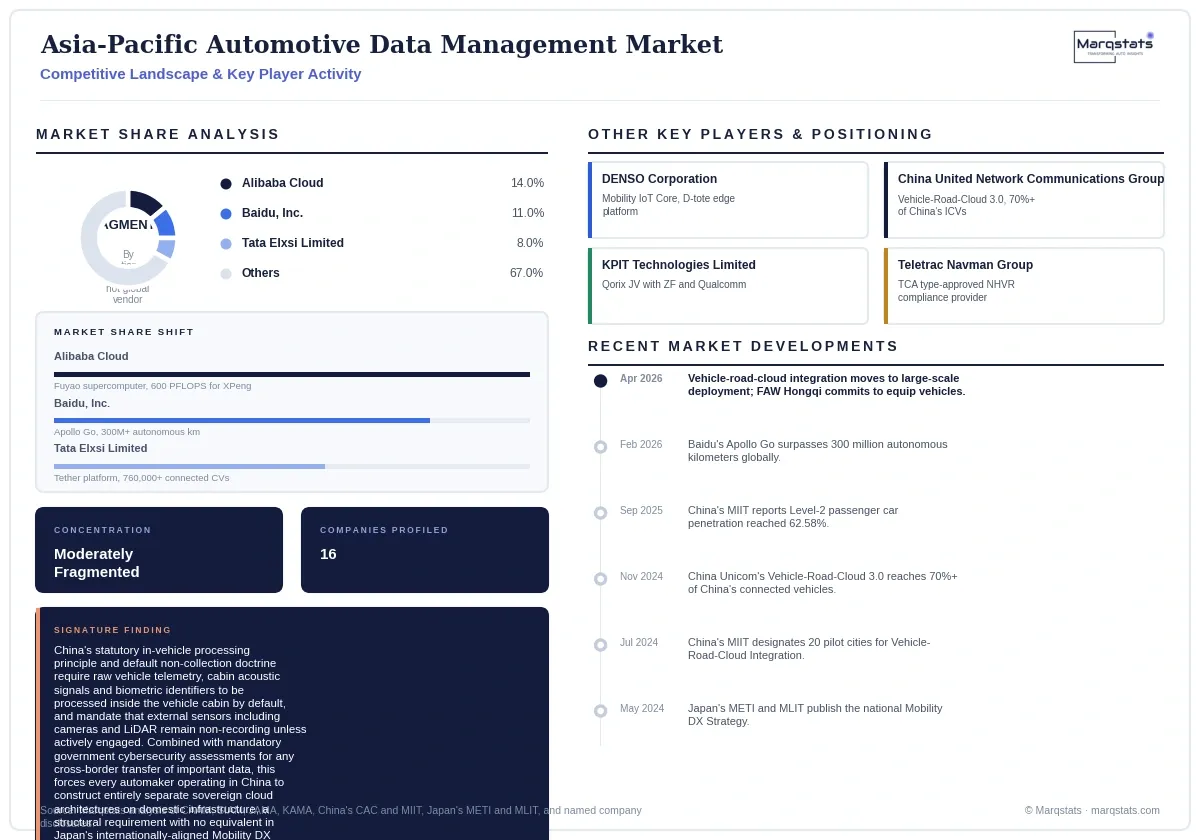
The Asia-Pacific automotive data management market is moderately fragmented across distinct national ecosystems rather than concentrated around a small number of pan-regional vendors: Chinese sovereign cloud hyperscalers including Alibaba Cloud and Baidu AI Cloud dominate mainland China's mandatory domestic infrastructure layer, Japanese and Indian Tier-1 suppliers including DENSO Corporation and Tata Elxsi anchor commercial and engineering integration, and Western hyperscalers including Amazon Web Services and Microsoft Azure serve automakers across Japan, South Korea, Australia and India specifically.
Firms compete differently by jurisdiction: Chinese hyperscalers compete on sovereign compliance and supercomputing scale, exemplified by Alibaba Cloud's Fuyao facility delivering 600 PFLOPS for XPeng Motors, Indian software integrators compete on commercial fleet monetization depth, exemplified by Tata Elxsi's Tether platform powering Tata Motors' Fleet Edge across more than 760,000 vehicles, and Australian certified telematics providers including Teletrac Navman compete on regulatory type-approval status required for NHVR compliance.
The most significant recent competitive-landscape development is the accelerating scale of Chinese autonomous driving compute infrastructure: Baidu AI Cloud's GPU Cloud revenue grew 283% year-over-year in the second quarter of 2026, driven by automotive OEMs utilizing its high-throughput compute infrastructure for driving simulation and digital twin rendering, while China Unicom's Vehicle-Road-Cloud Solution 3.0, unveiled in November 2024, now provides cloud network services to over 70% of China's connected vehicles across 92 automotive OEMs.
Companies Covered
The report profiles 16+ companies with full strategy and financials analysis, including:
Recent Market Activity
Table of Contents
Coverage & Segmentation
Coverage spans the Asia-Pacific automotive data management market, encompassing software platforms, cloud infrastructure, supercomputing data factory hosting, and analytical applications across consumer and commercial vehicles in China, Japan, South Korea, India, Australia and the wider region. The market is sized in USD across a 2024 base year and a 2025-2029 forecast period. One primary segmentation dimension is quantified in depth: component and architectural layer, spanning cloud storage, autonomous driving HPC, edge middleware and fleet telematics SaaS.
Excluded from scope: raw vehicle hardware and sensor manufacturing costs, cellular carrier connectivity transport fees billed directly by mobile network operators, and consumer usage-based insurance premiums. Standalone telematics subscription revenue is frequently aggregated into overall vehicle sales in regional corporate filings, a disclosed data limitation this analysis addresses through calibrated modeling rather than direct reported figures. A separate Marqstats study addresses the United States automotive data management market on a comparable basis.