Market Snapshot
The Africa two-wheeler tire market is valued at USD 596.66 million in 2025 and is forecast to reach USD 774.89 million by 2030, a CAGR of 5.37%. Volume rises from 37.04 million to 45.58 million tires (4.24% a year), and replacement demand from commercial motorcycle taxis, not new-bike fitment, sets the pace.
Marqstats sizes the market bottom-up, because no African customs authority or trade body publishes a continental two-wheeler tire total. The build multiplies an active, tire-consuming parc of 28.50 million motorcycles, scooters and mopeds by use-specific replacement rates, adds two tires for each of the 2.90 million new two-wheelers that entered use in 2025, and values each tire at landed import or ex-factory price before distributor margin and local taxes. The replacement rate for commercial taxis is the input the total is most sensitive to: every 0.10 change in tires per taxi per year moves 2025 volume by 1.94 million tires and value by USD 31.98 million.
The commercial fleet is the market. Boda-bodas in East Africa, okadas in Nigeria and zemidjans in Benin and Togo make up an estimated 68% of the active parc, run daily distances that private riders rarely match, and wear through 1.40 tires per vehicle per year against 0.45 for a private commuter. That fleet bought 27.13 million replacement tires in 2025, 4.68 times the 5.80 million tires fitted to new two-wheelers.
Electric two-wheelers are still a rounding error in tire demand, and they will not be by 2030. The International Energy Agency counted about 70,000 electric two-wheeler sales in Africa in 2025; Marqstats estimates they generated USD 5.14 million of tire demand (0.86%), rising to USD 53.66 million (6.92%) by 2030 as fleets such as those of Spiro scale past the 100,000 vehicles that operator reported in June 2026.
Key Takeaways
Market Overview & Analysis
Report Summary
Africa runs on motorcycle taxis, and a motorcycle taxi is a tire-consuming machine. Two shifts make the market interesting now. Indian exporters posted record volumes in FY2026 and told investors in August 2026 that African demand was growing by almost half, which enlarges the parc that will need replacement tires through 2030. At the same time, electric motorcycles moved from pilots to fleets: about 70,000 were sold across Africa in 2025, and Spiro alone reported more than 100,000 on the road in June 2026. Both shifts feed the replacement channel, which already holds most of the value.
The measure is new pneumatic rubber tires for motorcycles, scooters and mopeds, classified under HS 4011.40, sold into replacement channels or fitted to new two-wheelers entering use in Africa, valued at landed import (CIF) or ex-factory price in constant 2025 US dollars. Inner tubes (HS 4013), bicycle tires (HS 4011.50), three-wheeler and tuk-tuk tires, retreads and used tires are excluded, as are distributor and retail margins, fitting labour and local VAT. Adding those layers would roughly double the figure at the pump-side price a rider pays, so the boundary is the main reason published estimates differ.
The analysis is written for four readers. A tire maker deciding whether to put a distributor in Lagos or Nairobi first needs the regional split and the replacement rates. A motorcycle exporter negotiating fitment specifications needs to know how small the OEM pool is. A fleet operator or asset financier pricing a 24-month lease needs the tire cost per vehicle per year. An investor weighing a tire finishing or distribution venture in an East African corridor needs the electric fleet trajectory and its effect on tire specification.
Africa Two-Wheeler Tire Market Size and Forecast
The series rises from USD 487.30 million in 2021 to USD 512.90 million in 2022, USD 536.40 million in 2023, USD 561.80 million in 2024 and USD 596.66 million in 2025. Marqstats projects USD 628.70 million in 2026, USD 662.46 million in 2027, USD 698.04 million in 2028, USD 735.52 million in 2029 and USD 774.89 million in 2030. Units move from 31.20 million in 2021 to 37.04 million in 2025 and 45.58 million in 2030. All values are Marqstats estimates at constant 2025 exchange rates.
Volume is the primary series and value is derived from it. The 2025 replacement count is 31.24 million tires: 19.38 million commercial vehicles at 1.40 tires a year (27.13 million) plus 9.12 million private vehicles at 0.45 (about 4.11 million). Fitment adds 5.80 million tires on 2.90 million new two-wheelers. Replacement tires are valued at USD 16.50 each and fitment tires at USD 14.00, which gives USD 515.46 million and USD 81.20 million.
Value grows faster than volume, 5.37% against 4.24%, and the gap is mix rather than price inflation. The average tire rises from USD 16.11 to USD 17.00 because tubeless 17-inch and electric-rated sizes take a larger share of replacement demand while the price of a standard bias-ply 2.75-18 or 3.00-17 tube-type tire is held flat at constant exchange rates. A rider in Kano or Kisumu pays more in local currency every year; that is currency movement, and it does not enter a constant-dollar series.
The 2.90 million new two-wheelers that Marqstats counts for 2025 sit above the roughly 1.99 million unit sales for 2024 on the Marqstats Africa two-wheeler vehicle page. The difference is definitional. A tire count has to include every bike that enters use, which takes in informal cross-border imports, put at about 200,000 a year into Nigeria alone on the Marqstats vehicle page, and CKD kits assembled outside tracked retail channels. The vehicle page measures tracked sales. The 2.90 million fitment base is a Marqstats construction. Both figures stand, on their own bases.
The commercial taxi fleet buys almost three-quarters of all tires
Kilometres, not vehicle sales, drive this market. A Nairobi boda-boda or a Lagos okada works a full shift six or seven days a week, and Marqstats estimates its rear tire lasts between eight and twelve months on mixed tarmac and murram. A private commuter in Cairo or Abidjan replaces a tire roughly every two years. Applied to an active parc of 28.50 million, those rates put 27.13 million tires into commercial replacement in 2025 against about 4.11 million into private replacement.
The arithmetic changes who holds power. Commercial replacement alone is worth USD 447.65 million, 75.03% of the market, while new-vehicle fitment is USD 81.20 million (13.61%) and private replacement USD 67.81 million (11.36%). A tire maker that is specified on every Bajaj Boxer leaving Pune still sells fewer tires in Africa than a competitor with a strong roadside dealer network in Kano, Kampala and Kumasi. Fitment builds the brand; replacement pays for it.
The commercial rate is the most sensitive input in the model. Every 0.10 change in tires per taxi per year moves 2025 volume by 1.94 million tires and value by USD 31.98 million. Marqstats holds the rate at 1.40 through 2030 rather than raising it for electric fleets across the whole parc, because the electric share of the commercial fleet stays small until late in the forecast. Electric bikes are given their own higher rate inside their slice.
Africa imports its motorcycle tires, and the trade remedy that made news did not touch them
African two-wheeler tire supply is an import business. Indian bias-ply makers, Chinese volume producers and Thai and Indonesian exporters ship finished tires; the continent's tire plants in South Africa, Egypt and Morocco are geared to passenger-car and truck sizes, and Marqstats treats domestic two-wheeler tire output as immaterial to the total. The Linglong Group memorandum with Kenya's Ministry of Investments, Trade and Industry for a USD 800 million plant in the Mombasa Special Economic Zone, reported in September 2025, did not specify motorcycle sizes.
South Africa's trade remedy headlines in 2026 are often misread as a motorcycle-tire event. The International Trade Administration Commission of South Africa (ITAC) terminated its anti-circumvention investigation into tires routed from China through Cambodia, Thailand and Vietnam in Notice 3863 of 2026, published in Government Gazette No. 54419 on 27 March 2026; Vietnamese authorities publicised the outcome on 2 April 2026. The product scope was motor-car tires under tariff subheadings 4011.10 and bus or lorry tires under 4011.20. Motorcycle tires under 4011.40 were never in it, so the termination changed nothing in the landed cost of a two-wheeler tire in Johannesburg.
Standards are the sharper instrument. The Tanzania Bureau of Standards specification TZS 1591:2013 sets requirements and test methods for motorcycle and scooter tires, and national standards bureaus in the region use conformity checks at the border to screen imports. For a low-cost exporter, a failed inspection is more expensive than any tariff line, which is why established Indian brands keep share against unbranded imports in East Africa.
Electric fleets will reshape the tire specification before they reshape the total
Electric two-wheelers are 0.86% of 2025 value and 6.92% of 2030 value. The International Energy Agency put African electric two-wheeler sales at about 70,000 in 2025, more than 80 times the level at the start of the decade, and the live Marqstats Africa electric two-wheeler page forecasts 500,000 units a year by 2030. Marqstats adds two fitment tires per new bike and a replacement rate of 1.60 tires a year on an estimated 73,000 average active electric bikes in 2025 (the midpoint of a parc that grew from about 40,000 to about 106,000 during the year), rising to 0.99 million by 2030. That gives 0.26 million tires and USD 5.14 million in 2025, and 2.58 million tires and USD 53.66 million in 2030.
The higher replacement rate is a Marqstats estimate, set because swap-network motorcycles are commercial machines that run long daily distances with a battery pack adding weight over the rear wheel. Operators do not publish tire-life data, so the uplift remains a construction built on duty cycle and vehicle mass. What they do publish is scale: Spiro reported more than 100,000 electric motorcycles, over 2,500 swap stations and more than 30 million swaps across seven markets when it announced a USD 215 million equity round with Impact Fund Denmark and Equitane on 1 June 2026.
The consequence for suppliers is specification, not volume. Electric fleets run tubeless tires on cast wheels in a narrow set of 17-inch sizes, bought centrally by the operator or its financier rather than by the rider at a roadside stall. A tire maker that wins one fleet framework contract wins a predictable annual volume. By 2030 that buying model is worth USD 53.66 million and is concentrated in Kenya, Uganda, Rwanda, Togo, Benin and Nigeria.
Market Dynamics
Key Drivers
Four forces lift demand, and the first two account for most of the growth.
- Commercial parc expansion: Marqstats projects the active parc to grow from 28.50 million in 2025 to 34.60 million in 2030 (3.96% a year), with the commercial share rising from 68% to 70% as motorcycle taxis and delivery riders absorb urban job growth. Every additional taxi adds 1.40 tires a year.
- Record Indian exports: India shipped 5,180,395 two-wheelers in FY2026, up 23.44%, according to the Society of Indian Automobile Manufacturers figures reported in April 2026, and motorcycle exports rose a further 33% to 1,813,174 units in April to July 2026. Bajaj Auto Limited said in August 2026 that its retail sales in Africa had doubled, led by Nigeria.
- Distribution expansion by exporters: TVS Motor Company Limited added Enviable Tricycle Auto Parts Ltd as a Nigerian distributor in June 2026 and lifted its outlet count there from 17 to 47, including sales, service and spares points. Every new spares counter is a replacement tire point of sale.
- Electric fleet scale-up: Spiro raised USD 215 million of equity on 1 June 2026 and reported more than 100,000 electric motorcycles in seven markets. Fleet-bought tires are the fastest-growing slice, rising from USD 5.14 million in 2025 to USD 53.66 million in 2030.
Key Restraints
Three restraints cap the value growth rate below the parc growth rate.
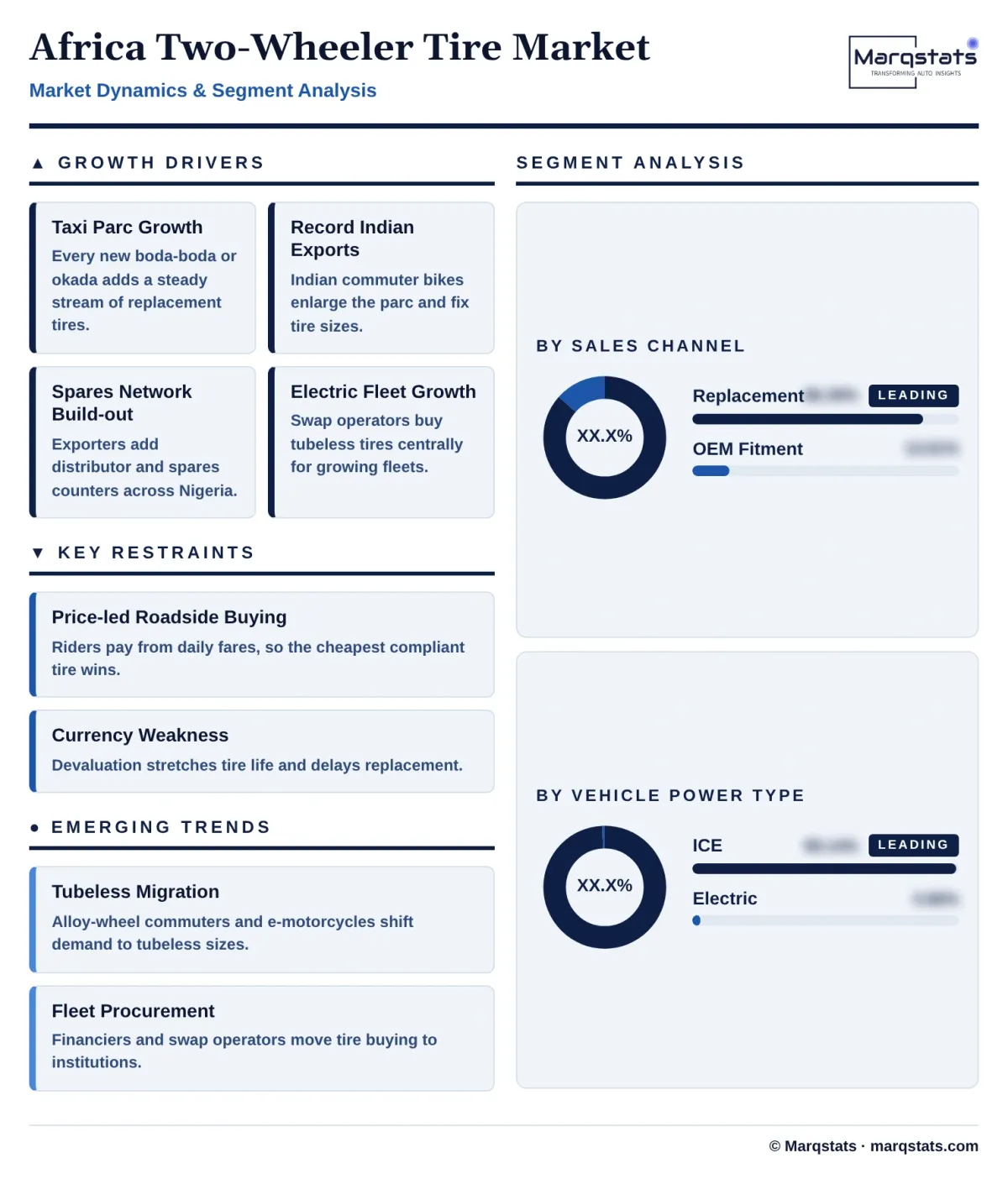
- Price-led buying in the roadside channel: most commercial riders pay for tires out of daily earnings, so the cheapest compliant tire wins. Marqstats holds the average replacement tire at USD 16.50 in 2025 and only USD 17.40 in 2030 at constant exchange rates; premium brands gain share only where a fleet or financier pays.
- Currency weakness: tires are priced in US dollars at the port and sold in naira, shillings, cedis and CFA francs. Each devaluation pushes riders to extend tire life past safe tread depth, which delays replacement and suppresses volume in the year it happens.
- Conformity and counterfeit risk: the Standards Organisation of Nigeria has repeatedly warned importers against substandard tires, and border testing under standards such as TZS 1591:2013 in Tanzania adds cost and delay for new entrants without a test history.
Key Trends
Three trends change what a winning tire portfolio looks like by 2030.
- Tubeless migration: new commuter models from Indian exporters increasingly ship on alloy wheels with tubeless tires, and electric fleets use them almost exclusively. Marqstats attributes most of the rise in average tire value from USD 16.11 to USD 17.00 between 2025 and 2030 to this shift.
- Fleet and financier procurement: asset financiers such as Watu, which financed about 8,000 mobility assets in Kenya in 2025, and swap operators buy or specify tires centrally. The buyer moves from the rider to an institution that cares about cost per kilometre.
- Local assembly ahead of local tire output: Egypt's Ministry of Investment said in January 2026 that TVS Motor Company Limited was studying a motorcycle and tricycle plant there, and Spiro runs assembly in Kenya, Rwanda and Uganda. Assembly localises fitment demand years before any tire line follows.
Strategic Implications
- For entrants: build the distributor network before chasing fitment. Commercial replacement is USD 447.65 million against USD 81.20 million of fitment, so the first investment is a stocking distributor in Lagos, Kano, Nairobi or Kampala with the five or six commuter sizes that cover most of the parc.
- For incumbents: protect the specification on Indian export models, because every fitment size becomes a replacement size for the next five to ten years, and add a tubeless 17-inch range rated for the weight of electric fleets before swap operators sign multi-year supply frameworks.
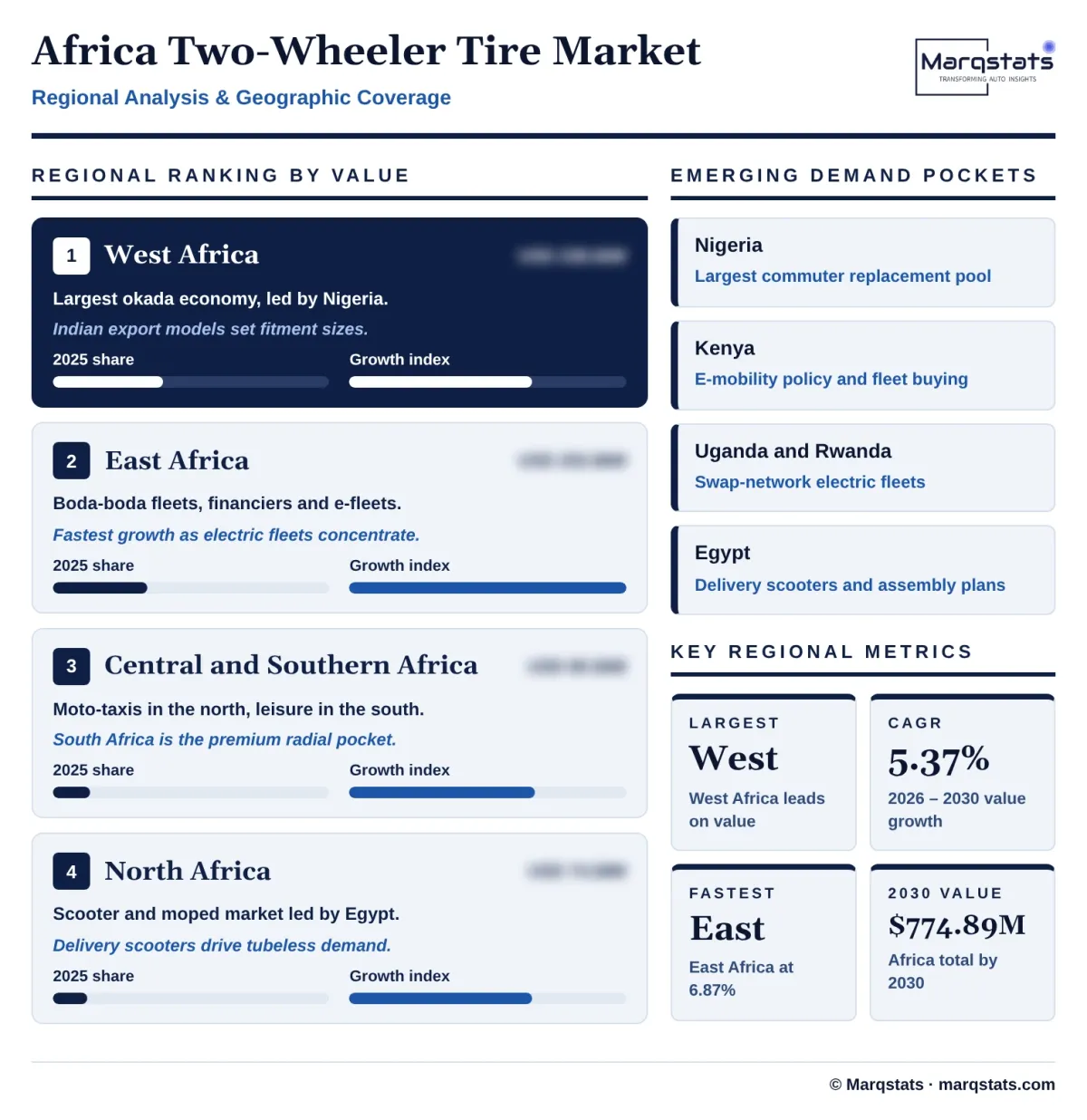
- For suppliers and investors: East Africa is the region where fleet buying, electric adoption and assembly converge, and it grows at 6.87% a year against 5.37% for the continent. A finishing or warehousing operation in the Mombasa or Dar es Salaam corridor serves the fastest-growing pool without depending on a continental tire plant that does not yet exist.
Market Segmentation
Replacement is the market. It is worth USD 515.46 million in 2025 (86.39%) and USD 671.29 million in 2030 (86.63%), a 5.42% CAGR, on volume of 31.24 million tires rising to 38.58 million. Commercial riders account for 27.13 million of the 2025 units.
The channel is a chain of importers, regional wholesalers and roadside fitters, and the rider usually pays cash. Brand loyalty exists, but it is loyalty to a tread pattern that survives potholes at a price that fits a day of fares. That is why replacement share edges up even as fitment volume grows.
Fitment is worth USD 81.20 million in 2025 (13.61%) and USD 103.60 million in 2030 (13.37%), a 4.99% CAGR, on 5.80 million tires rising to 7.00 million as new two-wheelers entering use grow from 2.90 million to 3.50 million.
Most fitment tires arrive already mounted on fully built or CKD motorcycles from India and China, so the contract is won in Pune, Hosur or Chongqing, not in Africa. The segment matters less for its revenue than for the sizes it locks into the parc.
Petrol motorcycles, scooters and mopeds take USD 591.52 million in 2025 (99.14%) and USD 721.23 million in 2030 (93.08%), a 4.04% CAGR. The 100cc to 150cc commuter motorcycle on 17-inch and 18-inch bias-ply tires remains the core of the parc through the forecast.
Share falls because the electric slice grows from a very low base, not because petrol demand contracts. The petrol parc still adds tires every year to 2030.
Electric two-wheelers take USD 5.14 million in 2025 (0.86%) and USD 53.66 million in 2030 (6.92%), a 59.86% CAGR, on 0.26 million tires rising to 2.58 million. The base is the International Energy Agency count of about 70,000 sales in 2025 and 500,000 a year by 2030 on the live Marqstats Africa electric two-wheeler page.
Electric tires are valued at USD 20.00 in 2025 and USD 20.80 in 2030, above the petrol average, because fleets specify tubeless, higher-load sizes. The slice is small in money and large in influence: it is where tire makers first meet an institutional buyer.
By Geography
West Africa
West Africa is the largest market because Nigeria has the largest motorcycle-taxi economy on the continent, with more than 8 million okadas cited on the Marqstats Africa two-wheeler page. The region is worth USD 238.66 million in 2025 (40.00%) and USD 298.33 million in 2030 (38.50%), a 4.56% CAGR.
Share slips slightly because naira volatility and city-level okada restrictions in Lagos slow parc growth, while Ghana, Côte d'Ivoire, Togo and Benin add commercial bikes steadily. Bajaj Auto Limited and TVS Motor Company Limited both named Nigeria as their lead African market in 2026, so fitment sizes here follow Indian specifications.
East Africa
East Africa grows fastest because electric fleets, asset financiers and local assembly all concentrate there. The region is worth USD 202.86 million in 2025 (34.00%) and USD 282.83 million in 2030 (36.50%), a 6.87% CAGR.
Kenya recorded 168,286 new motorcycle registrations in 2025, of which 25,277 (15.02%) were electric, and launched its National Electric Mobility Policy on 3 February 2026 with zero VAT on electric motorcycles and further VAT and excise exemptions announced by Transport Cabinet Secretary Davis Chirchir. Uganda, Rwanda, Tanzania and Ethiopia add large boda-boda fleets, and the region holds most of the continent's electric two-wheeler tire demand.
Central and Southern Africa
Central and Southern Africa is a moto-taxi market in the north and a leisure and delivery market in the south. The region is worth USD 80.56 million in 2025 (13.50%) and USD 100.74 million in 2030 (13.00%), a 4.57% CAGR.
Demand is driven by commercial fleets in the Democratic Republic of the Congo and in Cameroon, where Spiro is now active. South Africa is the region's premium pocket: higher-displacement leisure motorcycles on radial tires and a growing delivery fleet, served by importers rather than local tire plants.
North Africa
North Africa is a scooter and moped market with a lower share of commercial taxis, so each vehicle consumes fewer tires. The region is worth USD 74.58 million in 2025 (12.50%) and USD 92.99 million in 2030 (12.00%), a 4.51% CAGR.
Egypt carries most of the volume, with Morocco and Algeria next. Delivery scooters on 10-inch to 13-inch tubeless tires are the fastest-moving use case, and a TVS Motor Company Limited plant in Egypt, still at the study stage in January 2026, would localise fitment demand if it proceeds.
How Competition Is Evolving
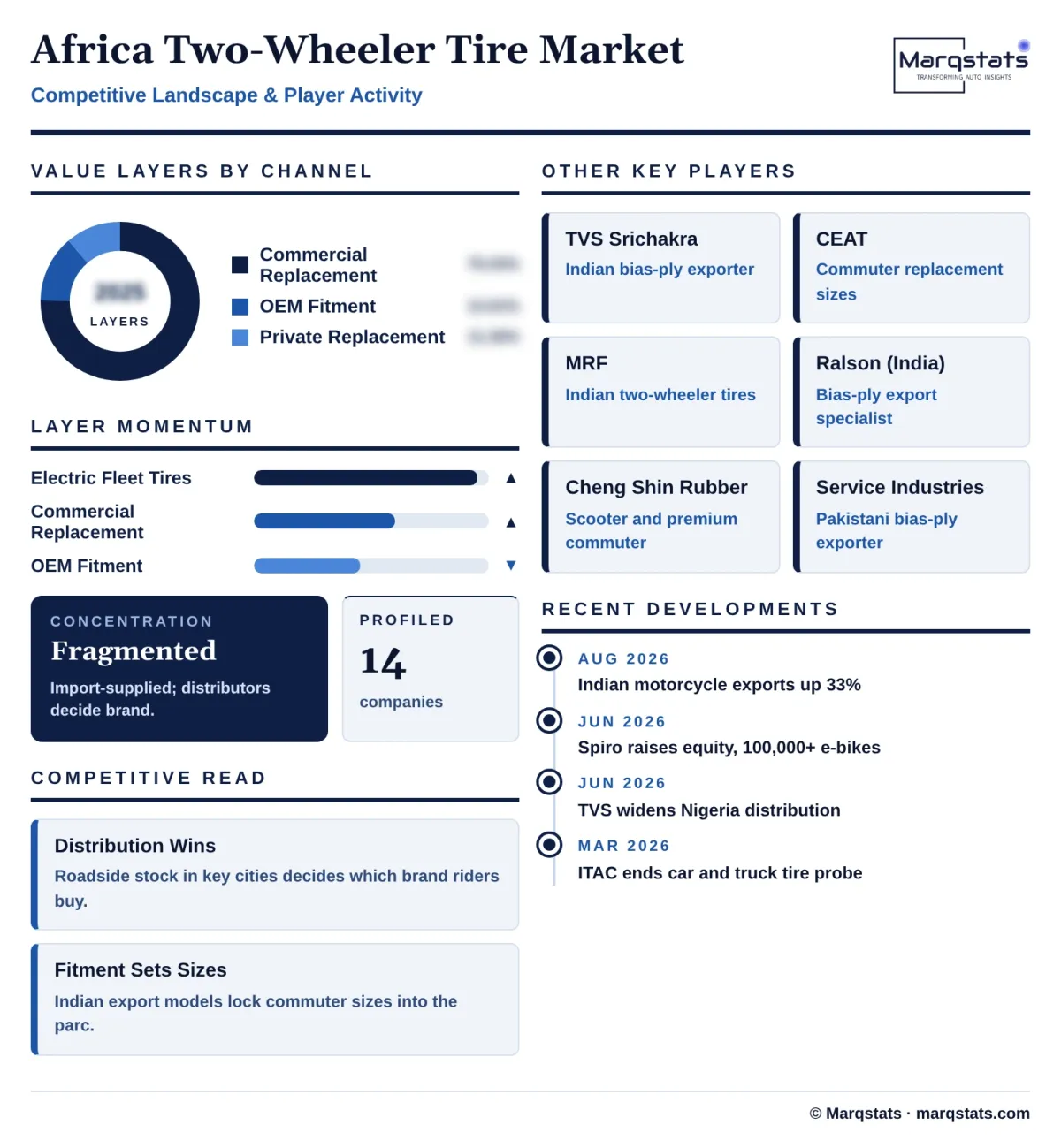
The market is fragmented and no supplier publishes an African two-wheeler tire share, so Marqstats describes competition by layer. Indian bias-ply makers, led by TVS Srichakra Limited, CEAT Limited, MRF Limited and Ralson (India) Limited, hold the strongest position in commuter replacement sizes because they also supply fitment tires to the Indian motorcycles that dominate the parc. Chinese makers such as Zhongce Rubber Group Co., Ltd. compete on price in the same sizes, and Taiwanese, Thai and Indonesian exporters, including Cheng Shin Rubber Ind. Co., Ltd., Kenda Rubber Industrial Company, Ltd., Vee Rubber Corporation Ltd. and PT Gajah Tunggal Tbk, cover scooter and premium commuter sizes. Service Industries Limited of Pakistan ships bias-ply tires into the same distributor networks.
Suppliers compete on tread life per shilling or naira, availability of the right size at a roadside stall, and resistance to cuts and punctures on unpaved roads. Price matters, but a tire that fails at half the expected distance costs a taxi rider more than a premium tire, and riders learn that quickly. In the fleet channel the axis shifts to warranty terms and cost per kilometre, which favours brands that can document performance.
Structure is set by the distribution layer, not by manufacturing capacity. With almost all tires imported, the importer that holds stock in Lagos, Kano, Nairobi, Kampala and Dar es Salaam controls which brand a rider sees. Premium radial makers, including Compagnie Générale des Établissements Michelin SCA, Pirelli & C. S.p.A., Bridgestone Corporation and Continental AG, serve the South African leisure segment and a thin layer of higher-displacement bikes elsewhere; their share of continental value is small.
Companies Covered
Companies covered in the report include:
Recent Market Activity
Table of Contents
Coverage & Segmentation
Included: new pneumatic rubber tires for motorcycles, scooters and mopeds (HS 4011.40), petrol and electric, sold as replacement tires or fitted to new two-wheelers entering use in the 54 African countries, valued at landed import (CIF) or ex-factory price in constant 2025 US dollars. Excluded: inner tubes (HS 4013), bicycle tires (HS 4011.50), three-wheeler and tuk-tuk tires, retreaded and used tires, fitting labour, distributor and retail margin and local VAT. Retail-level value would be roughly twice the figure on this page; the difference is a boundary choice, not a disagreement about volume.
Sibling boundaries: fitment tire value (USD 81.20 million in 2025) is already embedded in the vehicle value of the Marqstats Africa two-wheeler market page (USD 4.05 billion) and the Africa electric two-wheeler market page (USD 108.5 million); do not add it to either. Three-wheeler tires belong with the Africa three-wheeler market page; do not add. The US motorcycle tire market (USD 470.45 million in 2025) is a separate geography measured at dealer and maker purchase price and is a comparison point, not a sum. Regional splits for 2030 are Marqstats estimates built from parc growth and electric fleet concentration.