Market Snapshot
The Vietnam EV charging station market size is estimated at USD 106.39 million in 2025 and is projected to reach USD 402.01 million by 2030, growing at a CAGR of 30.46% over 2026 – 2030. Paid charging sessions grow fastest as VinFast free charging ends on 30 June 2027.
Marqstats defines the market as four layers: EVSE hardware, installation and commissioning, charging station management system (CSMS) software, and public charging-session revenue. Hardware covers AC and DC chargers for cars, buses, trucks and e-motorbikes installed in Vietnam. Session revenue is counted at the amounts drivers and fleets are billed, so sessions given free under VinFast programmes count at zero. Battery-swap cabinets, battery storage, solar canopies, land and grid works upstream of the meter are excluded.
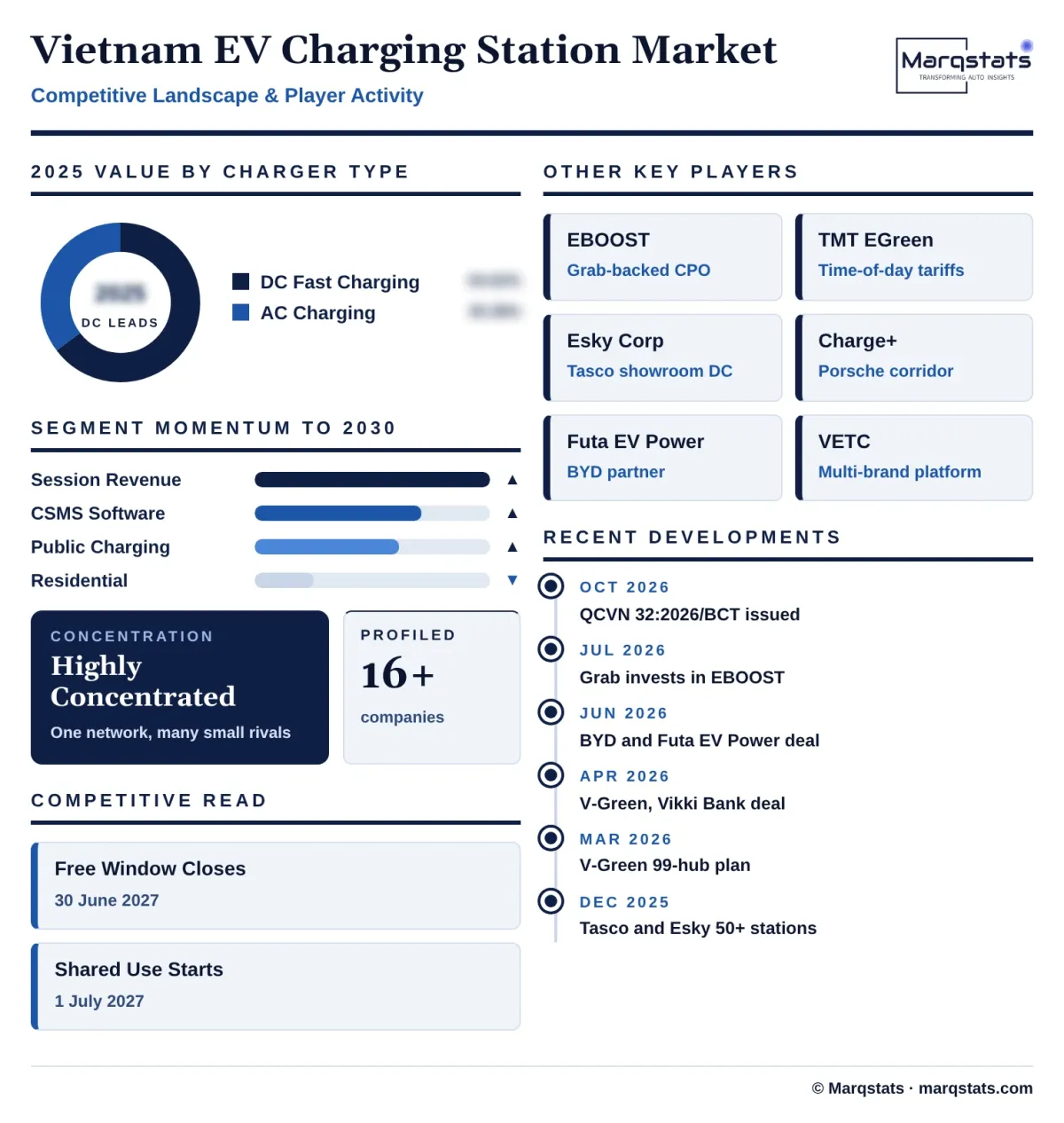
EVSE hardware is the largest layer at 59.51% of 2025 value, DC fast charging holds 64.62% and public charging 59.52%. Southern Vietnam leads with 43.20% of value. Session revenue rises from 14.58% to 40.65% of the market by 2030, a 60.15% CAGR.
Key Takeaways
Market Overview & Analysis
Report Summary
Marqstats sizes the Vietnam EV charging station market as the money spent each year on charging equipment, its installation, the software that runs it and the public charging sessions it sells. The definition is the same one Marqstats uses for its Saudi Arabia, UAE and GCC charging station studies: EVSE hardware, installation and commissioning, CSMS software, and public charging-session revenue. Hardware is valued at landed or ex-works prices before VAT. Session revenue is valued at what drivers and fleet operators are billed, not at the energy dispensed, which matters a great deal in Vietnam.
One company built most of the network. V-Green Global Charging Station Development Joint Stock Company (V-Green), the charging affiliate of VinFast controlled by Vingroup founder Pham Nhat Vuong, reports about 150,000 charging points for electric cars and e-motorbikes across 34 provinces and cities, and targets 500,000. Those stations primarily serve VinFast vehicles. The multi-brand network is far smaller: about 620 public car charging stations were listed on the EV Station app in April 2026, and the VETC platform of the Tasco group said in July 2026 that its 350 connected stations were about half of the multi-brand network.
Vehicle demand is the reason the network exists. VinFast Auto Ltd. delivered 175,099 electric vehicles in Vietnam in 2025 and 137,697 in the first seven months of 2026. Electric two-wheeler sales reached 501,453 units in 2025 on Marqstats estimates, and Vietnamese buyers took 513,742 electric motorcycles in January to July 2026, up 97.2%, about 27.7% of all two-wheeler sales. Vietnam had about 6.7 million cars on the road in late 2026, around 3% electric, and about 70 million motorcycles, around 4.3% electric.
Most of that charging is not paid for at the plug. VinFast announced on 24 December 2024 that all individual owners of VinFast cars could charge free at V-Green stations until 30 June 2027, and that transport businesses, including the Xanh SM operator Green and Smart Mobility Joint Stock Company, would charge free from 22:00 to 06:00 and at half price at other hours over the same period. The VinFast 2025 annual report on Form 20-F states that Mr. Pham has borne part of the cost of the free charging programme in Vietnam.
The market grew from an estimated USD 30.40 million in 2021 to USD 52.60 million in 2022, USD 61.80 million in 2023 and USD 78.90 million in 2024, then rose 34.84% to USD 106.39 million in 2025. The 2025 figure equals about VND 2,767 billion at the 2025 average rate of VND 26,009 per US dollar. The live Marqstats Vietnam electric vehicle market, USD 3.10 billion in 2025, counts vehicles and touches charging only at its edges; the two figures overlap in part and should not be added.
Vietnam EV Charging Station Market Size and Forecast
The Vietnam EV charging station market grows from USD 106.39 million in 2025 to USD 402.01 million in 2030, a CAGR of 30.46%. Hardware rises from USD 63.31 million to USD 162.93 million, installation from USD 25.97 million to USD 66.17 million, CSMS software from USD 1.60 million to USD 9.50 million and session revenue from USD 15.51 million to USD 163.41 million. The path is uneven: the market rises 66.50% in 2026 on the highway hub build, 25.84% in 2027 and 37.22% in 2028, when the first full year of paid VinFast charging lands.
The 2025 hardware value is built from units and prices. Marqstats estimates about 50,000 home and private AC wallboxes of 7.4 kW to 11 kW at about VND 8.5 million, 7,000 public and commercial AC posts at VND 20 million, 10,000 e-motorbike charging posts at VND 5 million, 1,500 DC chargers of 30 kW to 60 kW at VND 210 million, 900 DC chargers of 120 kW to 150 kW at VND 560 million and 250 depot DC chargers of 150 kW to 360 kW for buses, trucks and taxi fleets at VND 850 million. Installation adds 35% to 60% of hardware value depending on site type. The 120 kW units match the hardware V-Green used at its Minh Khai hub in Hanoi, which opened in July 2025 with 42 dual-gun DC chargers.
Session revenue is built from energy and billed prices. Marqstats estimates VinFast commercial fleets drew about 260 GWh from V-Green stations in 2025 at an effective billed price of about VND 965 per kWh, half the energy free at night and the rest at half the VND 3,858 tariff. Private VinFast owners drew about 70 GWh and paid nothing. Other brands bought about 20 GWh from multi-brand operators at about VND 5,000 per kWh, and e-motorbike riders about 15 GWh at public posts. Together these give session revenue of USD 15.51 million.
Growth to 2030 rests on two events. The first is the V-Green plan, announced on 17 March 2026, to build 99 ultra-fast hubs in 2026 with up to 100 guns of 150 kW each. Marqstats assumes about 2,600 dual-gun units are installed in 2026, 52.53% of the maximum 9,900 guns, with the rest of the VND 10 trillion going to storage, solar, land and grid works that sit outside the market. The second is the end of free charging on 30 June 2027. From the second half of 2027, Marqstats assumes private owners pay the VND 3,858 list price and fleets about VND 2,700, which lifts session revenue from USD 22.84 million in 2026 to USD 62.21 million in 2027 and USD 163.41 million in 2030.
Marqstats tracks four indicators to monitor the forecast: whether VinFast extends or ends free charging after 30 June 2027, the number of V-Green highway hubs commissioned against the 99 planned, monthly VinFast deliveries in Vietnam, and the count of multi-brand stations connected to the VETC and Grab platforms ahead of the 1 July 2027 shared-use date.
Market Dynamics
Key Drivers
Five forces lift spending on chargers, installation and paid charging in Vietnam, and most of them trace back to how fast Vietnamese drivers have switched to battery power.
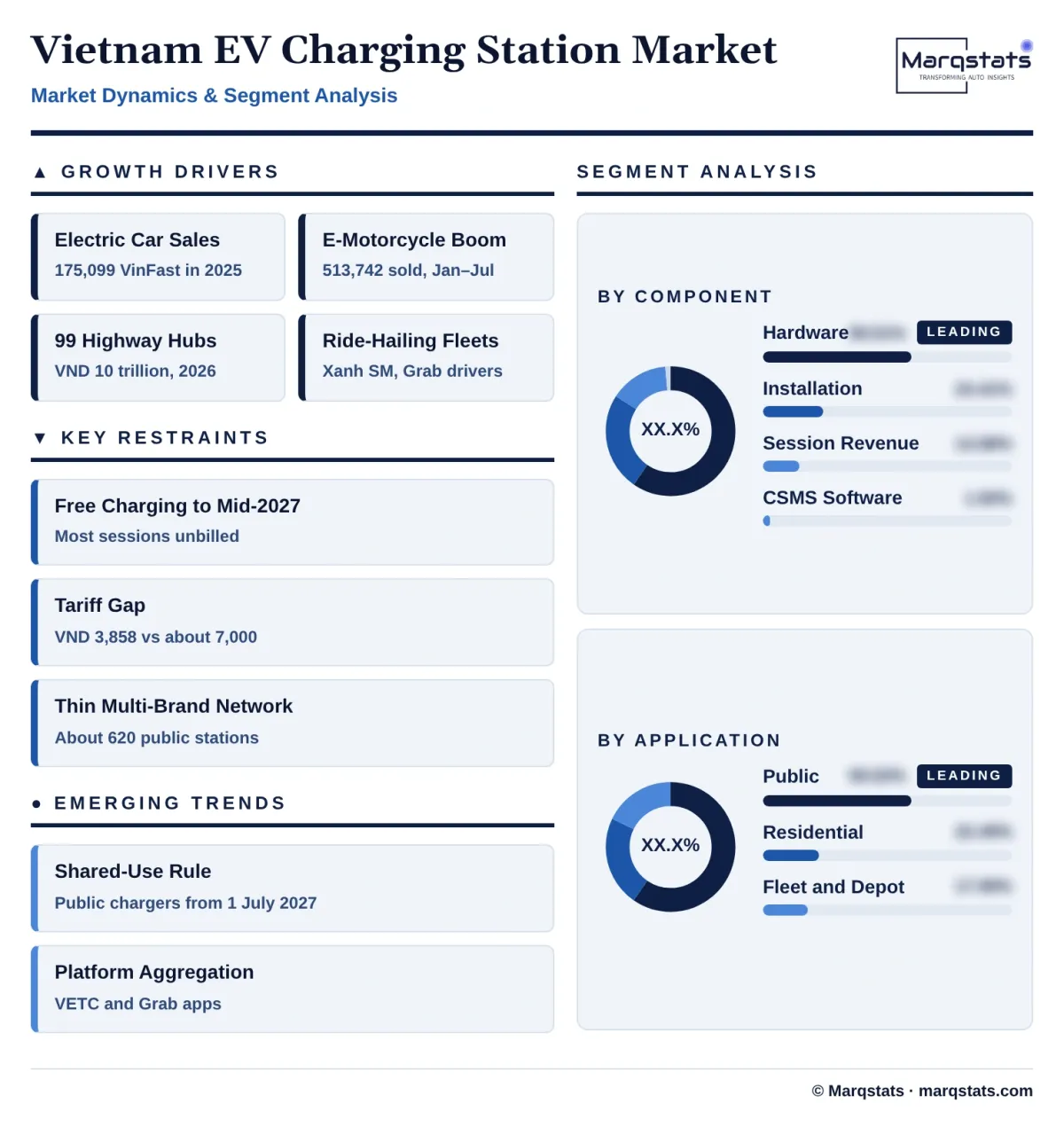
- Electric car sales keep climbing. VinFast delivered 175,099 electric vehicles in Vietnam in 2025 and 137,697 in January to July 2026, including 21,781 in July alone. Each new car adds home charging demand and, for the many owners in apartments, public charging demand, and VinFast has held the top spot in the Vietnamese car market for 24 consecutive months.
- Electric motorcycles are going mainstream. Sales of 513,742 electric motorcycles in January to July 2026, up 97.2% and about 27.7% of two-wheeler sales, create demand for public charging posts at shops, offices and apartment blocks, and Hanoi brought in time-based limits on petrol motorcycles inside its inner ring road from July 2026.
- The V-Green highway build is the largest single order. V-Green committed VND 10 trillion, about USD 384.48 million, on 17 March 2026 to 99 ultra-fast hubs across 34 provinces and cities, each with up to 100 guns of 150 kW, powered by wind and solar with VinFast battery storage. Even the share that goes to chargers and their installation roughly doubles 2025 DC hardware spending.
- Ride-hailing fleets charge many times more than private cars. Xanh SM runs only electric vehicles, VinFast delivered 27,127 Limo Green and 12,568 Herio Green cars in 2025, mainly for taxi and ride-hailing use, and Grab Vietnam has put EBOOST chargers into its Grab Driver app since April 2026. Marqstats estimates a ride-hailing car running about 200 km a day draws several times the public energy of a private car.
- New operators are bringing capital. TMT Motors planned 2,100 charging units in 2026, 750 each in Hanoi and Ho Chi Minh City, with a target of 30,000 stations by 2030; Tasco Auto and Esky Corp agreed in December 2025 to build more than 50 DC fast stations at Tasco showrooms; and Grab invested in EBOOST in July 2026 to reach more than 6,000 ports by early 2028.
Key Restraints
Four constraints keep the market smaller than the vehicle numbers suggest. Each one has a date or a figure attached, so the size of the drag can be tracked.
- Free charging suppresses session revenue until mid-2027. Individual VinFast owners pay nothing at V-Green stations until 30 June 2027 and transport businesses pay nothing at night, so the largest network in the country earns only a fraction of the value of the energy it dispenses, and independent operators cannot compete on price with free.
- Price gaps keep independent chargers underused. V-Green lists VND 3,858 per kWh, about USD 0.15, while Esky charges about VND 7,000, about USD 0.27, a premium of 81.44%, and TMT EGreen charges VND 7,436 at peak. Drivers who can use V-Green do, which leaves multi-brand stations with low utilisation and slow payback.
- The multi-brand network is thin. About 620 public car charging stations were listed on the EV Station app in April 2026, against about 150,000 V-Green charging points, so owners of BYD, Hyundai, Wuling and other brands face gaps between cities, which slows non-VinFast sales and the chargers that would follow them.
- Apartment charging faces strict fire rules. Draft amendments to QCVN 04:2021/BXD prepared for the Ministry of Construction would cap each fire compartment at 20 car or 150 two-wheeler charging spots, separate car and motorbike zones and limit basement chargers to 22 kW without extra heat and noise controls, which raises the cost of charging in the high-rise buildings where many urban buyers live.
Key Trends
Four shifts are changing who builds chargers in Vietnam, who pays for a session and what a public charger must be able to do.
- Public chargers must serve every compatible car. MOIT Circular 61/2026/TT-BCT, reported in October 2026, issues QCVN 32:2026/BCT, which from 1 July 2027 requires chargers in public areas, car parks and rest stops to serve all compatible vehicles, to show price, energy and amount payable before and during each session, and to protect session data. Existing stations get six months to review safety and 24 months to fix gaps.
- Platforms aggregate the independents. VETC connected more than 350 stations in about a month in 2026 and added ChargeLink, NovaCharge and EBOOST as partners, and Grab lists EBOOST ports in its driver app, so independent operators reach drivers through apps they already use rather than through their own brands.
- Carmakers bundle charging with the car. BYD signed with Futa EV Power in late June 2026 so BYD owners can use Futa and Kim Long stations, Charge+ built 17 fast stations along a 1,700 km corridor with Porsche, and Tasco Auto gives buyers of its brands 35% off Esky charging fees.
- Charging moves into retail and banking sites. V-Green signed with Mobile World Investment Corporation on 15 September 2025 to place charging stations and battery-swap cabinets at The Gioi Di Dong and Dien May Xanh stores, and with Vikki Digital Bank on 1 April 2026 for sites and financing, which turns everyday locations into charging points.
Strategic Implications
- For independent operators, mid-2027 is the opening. When free V-Green charging ends on 30 June 2027 and shared-use rules start on 1 July 2027, the price gap with V-Green narrows from free against VND 7,000 to VND 3,858 against VND 5,000 to 7,000, so sites near taxi ranks, airports and highway exits become worth building now.
- For charger makers and importers, QCVN 32:2026/BCT compliance is the ticket to the 2027 order book. Units that display price and energy, store tamper-proof session records and pass the safety review will be specified in every public tender, and suppliers who certify early avoid the 24-month retrofit work on installed stations.
- For V-Green, the 2027 tariff decision sets the size of the market. Whether VinFast extends free charging, introduces subscriptions or charges the VND 3,858 list price decides whether the session layer reaches the USD 100 million range in 2028 or stays near its 2026 level.
- For fleet and depot owners, owning chargers becomes the better deal after 2027. Once night charging is no longer free, ride-hailing, delivery and bus operators with high daily mileage can cut energy cost by installing depot DC chargers on their own power contracts with Vietnam Electricity (EVN).
- For property developers, charging rules are now a design input. Draft QCVN 04 limits on charging spots per fire compartment and basement charger power mean charging bays are cheapest when planned at ground level from the start of a project.
Market Segmentation
EVSE hardware accounts for 59.51% of 2025 value, USD 63.31 million, and grows at 20.81% a year to USD 162.93 million. It covers about 69,650 AC and DC chargers installed in 2025, from VND 8.5 million home wallboxes to VND 850 million depot chargers, supplied by VinFast for V-Green and by importers of StarCharge, Autel and other brands for independent operators. Its share falls to 40.53% by 2030 as paid sessions catch up.
Installation and commissioning account for 24.41% of 2025 value, USD 25.97 million, and grow at 20.57% a year to USD 66.17 million. The layer covers cabling, foundations, canopies, low-voltage switchgear behind the meter and testing, at 35% of hardware value for home wallboxes and up to 60% for public AC posts, where civil works are a large share of a small charger.
CSMS software accounts for 1.50% of 2025 value, USD 1.60 million, and grows at 42.80% a year to USD 9.50 million. It counts licences and subscriptions bought by independent operators, fleets and site owners; V-Green runs its own software for its network, so that value is not sold in the market. QCVN 32:2026/BCT requirements for price display, fault monitoring and session records push every public charger onto a managed back office.
Charging-session revenue accounts for 14.58% of 2025 value, USD 15.51 million, and grows fastest, at 60.15% a year, to USD 163.41 million and 40.65% of the market. In 2025 VinFast commercial fleets paid about USD 9.65 million, other brands USD 3.84 million and e-motorbike riders USD 2.02 million, while private VinFast owners paid nothing. By 2030 private VinFast owners pay about USD 57.85 million.
AC charging accounts for 35.38% of 2025 value, USD 37.64 million, and grows at 21.25% a year to USD 98.64 million. AC units are the bulk of the count, about 67,000 in 2025 including home wallboxes and e-motorbike posts, but they are cheap and earn little session revenue because most AC energy is used at home.
DC fast charging accounts for 64.62% of 2025 value, USD 68.75 million, and grows at 34.57% a year to USD 303.37 million and 75.46% of the market. It includes about 2,650 DC chargers installed in 2025 and most paid sessions, since fleets and highway drivers buy fast energy, and the V-Green 150 kW hub programme sits entirely here.
Public charging accounts for 59.52% of 2025 value, USD 63.32 million, and grows fastest, at 36.85% a year, to USD 303.93 million and 75.60% of the market. It covers V-Green stations, multi-brand stations at showrooms, malls and highway stops, and all billed sessions, including fleet vehicles that charge at public stations.
Fleet and depot charging accounts for 17.99% of 2025 value, USD 19.14 million, and grows at 21.38% a year to USD 50.42 million. It covers private depot chargers for electric buses, trucks and taxi fleets, including VinBus, Futa and Kim Long bus depots, where the operator buys energy from Vietnam Electricity (EVN) and no session is sold.
Residential and workplace charging accounts for 22.49% of 2025 value, USD 23.93 million, and grows at 14.77% a year to USD 47.66 million. It is mostly home wallboxes bought with new cars; many VF 3 and VF 5 owners use the portable charger supplied with the car, so Marqstats assumes only about 27% of new electric car buyers install a wallbox.
By Geography
Southern Vietnam
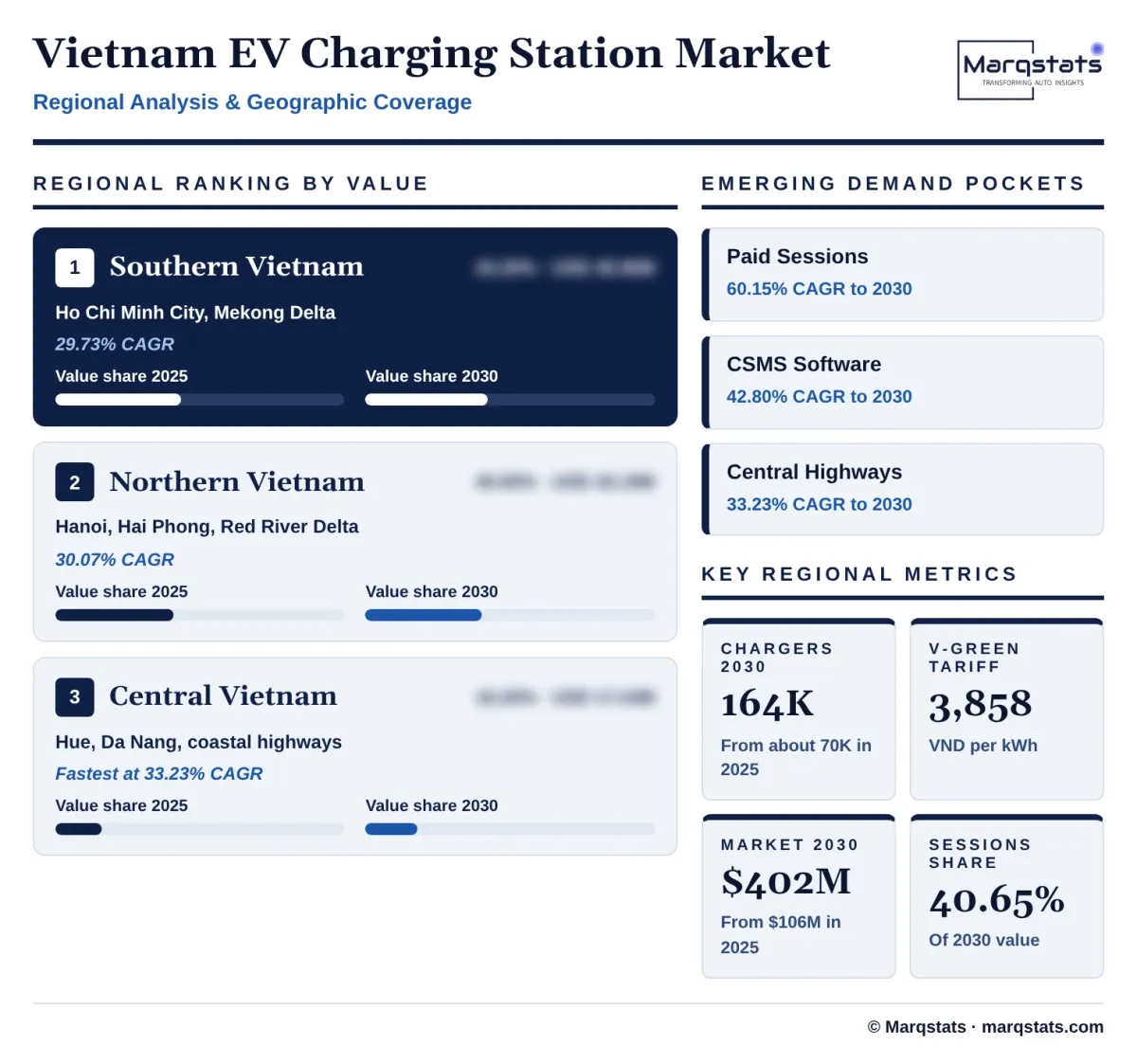
Southern Vietnam is the largest market because Ho Chi Minh City is the largest car and ride-hailing market in the country. The region accounts for 43.20% of 2025 value, USD 45.96 million, and grows at 29.73% a year to USD 168.85 million. TMT Motors plans 750 charging units in Ho Chi Minh City in 2026, TMT EGreen began in Ho Chi Minh City, An Giang, Kien Giang, Binh Thuan and Ninh Thuan and Xanh SM and Grab run their largest fleets in the city.
Northern Vietnam
Northern Vietnam is close behind because VinFast, V-Green and Xanh SM all started there. The region accounts for 40.60% of 2025 value, USD 43.19 million, and grows at 30.07% a year to USD 160.80 million. V-Green opened the largest fast-charging station in Hanoi in July 2025 with 42 dual-gun 120 kW chargers, Hanoi signed a cooperation agreement with Grab Vietnam in June 2026 covering nearly half of the 6,000 EBOOST ports planned, and TMT Motors plans 750 units in Hanoi in 2026.
Central Vietnam
Central Vietnam grows fastest because the highway hubs fill its gaps. The region accounts for 16.20% of 2025 value, USD 17.24 million, and grows at 33.23% a year to USD 72.36 million. Drivers on the North – South expressway need fast charging across the long central stretch, Charge+ built its 17 fast stations along a 1,700 km corridor, and Kim Long Motor, which is investing in Hue, adds electric bus depot demand.
How Competition Is Evolving
The market is highly concentrated at the network level and fragmented below it. Marqstats reads competition by layer rather than by company share, because V-Green and the independent operators report network size and station counts rather than sales. The three layers are network operators, platforms and fleet buyers, and hardware and software suppliers.
V-Green is the network. It reports about 150,000 charging points for cars and e-motorbikes in 34 provinces and cities, against about 620 multi-brand public car stations listed in April 2026, and it plans 99 highway hubs in 2026 and 500,000 points in all. Its VND 3,858 per kWh tariff is the price every other operator is measured against, and its free charging for VinFast owners until 30 June 2027 is the main reason independent sites earn so little.
Independents compete through partners. EBOOST is backed by Grab, TMT EGreen by TMT Motors and Wuling sales, Esky by Tasco Auto showrooms, Charge+ by Porsche, and Futa EV Power by BYD; EV One, EverCharge, ChargeLink, NovaCharge, Rabbit EVC and Bitcharge run smaller networks. The VETC platform, which says it connects about half of the multi-brand network, is becoming the shop window for all of them.
Hardware and software are supplied by importers and by VinFast itself. VinFast makes chargers and battery storage for V-Green sites; independent operators import from StarCharge, Autel and others, and use their own or licensed CSMS software. QCVN 32:2026/BCT will favour suppliers whose chargers already meet price display and data rules when public tenders resume in 2027.
Companies Covered
Companies covered in the report include:
Recent Market Activity
Table of Contents
Coverage & Segmentation
The study covers the Vietnam EV charging station market, with 2025 as the base year, 2021 – 2025 as the historical period and 2026 – 2030 as the forecast period. Marqstats defines the market as four layers: EVSE hardware, installation and commissioning, CSMS software, and public charging-session revenue. It is segmented by component, charger type, application and region, and dong figures use the 2025 average of VND 26,009 per US dollar.
Hardware covers AC and DC chargers for cars, buses, trucks and e-motorbikes installed in Vietnam, valued before VAT. Session revenue is counted at amounts billed to drivers and fleets; sessions given free under VinFast programmes count at zero, and energy used at private depots and homes is not a session. Battery-swap cabinets, battery storage, solar canopies, land, grid works upstream of the meter, portable and onboard chargers and electricity bought for home charging are excluded. The live Marqstats Vietnam electric vehicle market (USD 3.10 billion in 2025), Vietnam electric two-wheeler market and Vietnam electric bus market overlap this one in part; their figures should not be added to it.