Market Snapshot
The Saudi Arabia EV charging station market size is estimated at USD 92.09 million in 2025 and is projected to reach USD 361.36 million by 2030, growing at a CAGR of 31.45% over 2026 – 2030, driven by EVIQ fast-charging hubs, home wallboxes for a growing plug-in fleet and rising paid charging sessions.
Marqstats defines the market as spending on electric vehicle charging in Saudi Arabia across four parts: EVSE hardware, installation and commissioning, charging station management (CSMS) software, and revenue from public charging sessions. It covers home, destination, public fast, highway and fleet depot chargers. Values exclude value added tax, grid reinforcement carried by the Saudi Electricity Company, and the vehicles themselves.
Hardware accounts for 59.23% of 2025 value and installation for 36.61%, so 95.84% of the market is capital spending. Ultra-fast DC chargers of 150 kW and above account for 42.92% of value, public fast and highway sites for 57.59%, and Riyadh Province for 42.00%. Public charging sessions grow fastest, at 81.93% a year.
Key Takeaways
Market Overview & Analysis
Report Summary
Marqstats sizes the Saudi Arabia EV charging station market as the annual value of four activities: sales of charging hardware, installation and commissioning of that hardware, licences and subscriptions for charging station management software, and the revenue that operators collect from drivers at public chargers. Home, workplace, destination, public fast, highway and fleet depot chargers are all included, whether they use alternating current wallboxes or direct current fast chargers. The same four-part definition is used in the Marqstats reports on the UAE and the Gulf Cooperation Council, so the Saudi figures can be compared directly.
The market is small but grows fast because the vehicle base is starting from almost nothing. The International Energy Agency reported, in figures published by Arab News on 27 May 2026, that electric vehicle sales in the Middle East reached about 75,000 in 2025, up 40%, and that Saudi Arabia and Qatar together accounted for nearly 45% of regional demand. Marqstats estimates from these figures that about 30,400 new battery electric and plug-in hybrid light vehicles were registered in Saudi Arabia in 2025, about 3.55% of the 857,247 light vehicles sold, and that the plug-in fleet reached about 43,369 vehicles at year end.
Public charging is led by a state-backed operator. EVIQ is a joint venture of the Public Investment Fund (PIF) and the Saudi Electricity Company (SEC), set up to install more than 5,000 fast chargers at 1,000 locations by 2030. Its chief executive, Mohammad Gazzaz, said on 3 November 2025 that 20 stations were operating in Riyadh, seven in Jeddah and five in Dammam, three more were complete and 60 would be finished by the end of 2025. Electromin, the mobility arm of Petromin Corporation, launched what it calls the first nationwide charging network in 2022, and fuel retailers SASCO, Apsco and Darb Fuel now host EVIQ chargers at their forecourts.
Counts of public chargers differ by definition. The network map published on the Al-Futtaim BYD Saudi site in 2026 listed more than 200 locations, more than 400 chargers and more than 600 charging points operated by EVIQ, Electromin, E-FILL and smaller operators, including 56 DC fast locations. The live Marqstats Middle East EV Charging Station report counts about 4,500 publicly accessible connectors in Saudi Arabia in 2025, because it also counts destination AC chargers in hotels, malls, dealerships and brand networks such as the more than 100 free chargers Lucid has installed. Marqstats uses the wider count of about 4,500 public connectors at the end of 2025.
The market grew from an estimated USD 55 million in 2024 to USD 92.09 million in 2025, or SAR 345.34 million, as new plug-in registrations rose from about 11,200 to 30,400. Marqstats expects USD 124.11 million in 2026, a rise of 34.77%, with plug-in registrations growing to about 33,000 as BYD and other Chinese brands widen their showroom networks, even though the March 2026 shipping disruption in the Strait of Hormuz cut Saudi light vehicle sales by 26.9% in January to August 2026. Charging projects already under contract keep building, and the fleet on the road grows by about three quarters.
Saudi Arabia EV Charging Station Market Size and Forecast
The Saudi Arabia EV charging station market grows from USD 92.09 million in 2025 to USD 361.36 million in 2030, a CAGR of 31.45%. Capital spending still dominates in 2030, but its weight falls: hardware and installation are 95.84% of value in 2025 and 83.60% in 2030, while session revenue rises from 2.75% to 13.95% and software from 1.41% to 2.45%.
The 2025 base is built bottom-up from installations and prices. Marqstats estimates about 15,000 home wallboxes at about USD 1,050 for hardware and USD 650 for installation, 1,000 destination and workplace AC connectors at USD 2,500 plus USD 1,700, 220 DC fast chargers of 50 to 149 kW at USD 35,000 plus USD 23,000, 280 ultra-fast chargers of 150 kW and above at USD 85,000 plus USD 50,000, and 140 DC and 400 AC depot chargers for fleets. Prices are before value added tax and exclude grid reinforcement paid by the Saudi Electricity Company.
Session revenue is built from the fleet. An average of about 28,234 plug-in vehicles were on the road in 2025, each using about 2,800 kWh a year, and Marqstats estimates that 12% of that energy was bought at public chargers at a blended price of about SAR 1.00 per kWh. That gives about 9.49 GWh and USD 2.53 million. By 2030, with about 309,965 vehicles on the road on average and a public share of 20%, public energy reaches about 189.08 GWh and session revenue USD 50.42 million.
Unit prices fall while volumes rise. Marqstats expects the installed cost of an ultra-fast charger to fall from about USD 135,000 in 2025 to USD 110,000 in 2030 as Smart Mobility and other local assemblers ramp up and Chinese power modules compete with European cabinets, and ultra-fast additions to rise from 280 to 1,300 a year. About 4,580 ultra-fast chargers are added from 2025 to 2030 by all operators, short of the 5,000 fast chargers EVIQ alone has targeted, because highway sites need grid connections that take longer to deliver.
Marqstats tracks four indicators to monitor the forecast: EVIQ station openings by region and on the three named highway routes, monthly registrations of battery electric and plug-in hybrid vehicles as sales recover from the 2026 disruption, the start of Ceer production and the Hyundai Motor Manufacturing Middle East plant at King Abdullah Economic City, and any change in the electricity tariff that charging operators pay.
Market Dynamics
Key Drivers
Five forces push spending on chargers ahead of the number of electric cars on Saudi roads.
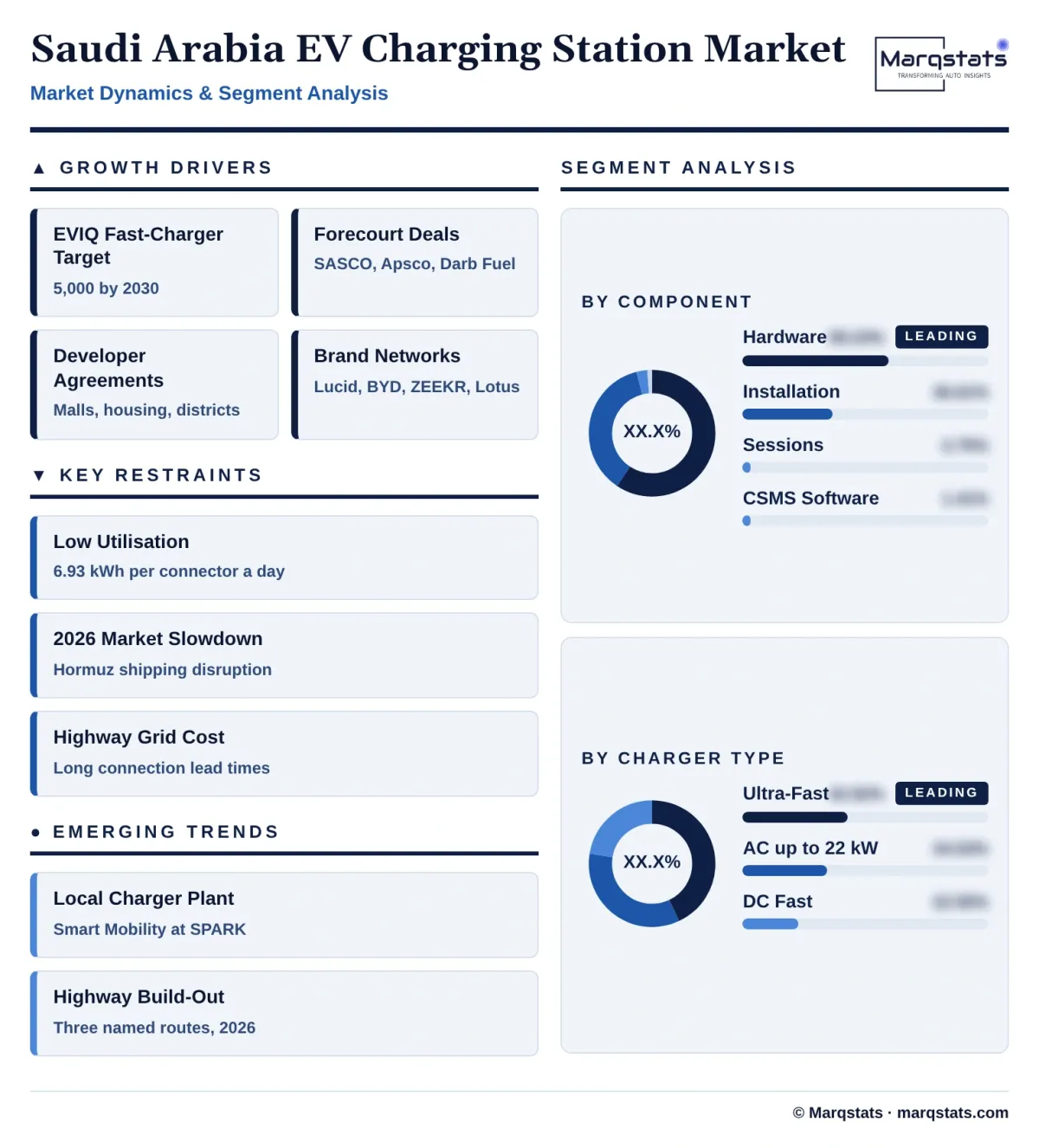
- A national operator has a fixed target. EVIQ, owned by PIF and SEC, aims for more than 5,000 fast chargers at 1,000 locations by 2030. Its chief executive said 60 stations would be complete by the end of 2025 and that 2026 would focus on highways, giving equipment makers and installers a single large buyer with a published goal.
- Fuel retailers are turning forecourts into charging sites. EVIQ signed with SASCO for its first highway station at SASCO Aljazeera on the Riyadh to Qassim road on 23 March 2025, with the Arabian Petroleum Supply Company (Apsco) on 23 October 2025 and with Darb Fuel Company on 12 January 2026. Each agreement brings a ready network of sites with power, land and traffic.
- Real estate developers build charging into new projects. EVIQ signed with Remat Al-Riyadh Development on 23 February 2025, Cenomi Centers on 13 February 2025, Al-Othaim Investment Company for 11 malls in 10 cities and the National Housing Company on 18 November 2025, and New Murabba Development Company on 2 March 2026. Housing and mall projects add destination AC chargers in large batches.
- Vehicle brands are building their own networks. Lucid Group has installed more than 100 free public chargers in the Kingdom, Al-Futtaim Electric Mobility, the BYD distributor, signed with EVIQ on 27 January 2025, and EVIQ has agreements with ZEEKR, Lotus and Ceer. Brands pay for chargers because a missing charger costs them a car sale.
- The capital has a clear electric target. Saudi Arabia aims for 30% of vehicles in Riyadh to be electric by 2030, and Lucid assembles cars at King Abdullah Economic City, where its plant can build 5,000 vehicles a year in its first phase and up to 155,000 when complete. A growing local supply of electric cars needs home and public chargers to go with it.
Key Restraints
Four constraints hold back how fast that spending turns into charging revenue.
- Utilisation is low. Marqstats estimates that public chargers delivered about 6.93 kWh per connector per day in 2025, less than a quarter of one full charge, so operators earn little from each charger and rely on state, landlord or brand capital to build ahead of demand.
- The wider car market fell back in 2026. The shipping disruption in the Strait of Hormuz from March 2026 cut Saudi light vehicle sales by 26.9% in January to August 2026. Marqstats still expects plug-in registrations to grow to about 33,000 in 2026, but slower overall sales and tighter dealer stock delay the point at which public chargers become busy.
- Highway sites need costly grid connections. Ultra-fast charging hubs between cities draw several hundred kilowatts per charger and sit far from strong distribution lines, so site works, cabling and transformers raise installed cost. Installation accounts for 36.61% of 2025 market value, and highway projects wait on Saudi Electricity Company connections.
- Heat raises equipment cost and wear. Summer temperatures above 45°C push operators toward liquid-cooled cables, shaded bays and cabinets rated for high ambient heat, which raises the price of each high-power charger and the cost of keeping it running, and suppliers that cannot certify equipment to standards of the Saudi Standards, Metrology and Quality Organization (SASO) are shut out.
Key Trends
Four shifts are changing who builds chargers in Saudi Arabia, where and with what equipment.
- Charger production is moving into the Kingdom. Smart Mobility, a joint venture of Foxconn Interconnect Technology and Saleh Suleiman Alrajhi and Sons, inaugurated an EV charger plant at the King Salman Energy Park (SPARK) in the Eastern Province on 9 December 2025, with SASO-certified AC and DC chargers, and signed a memorandum with Al-Bassami Transport Group for fleet charging.
- Highways become the main build area. The Roads General Authority signed an agreement with EVIQ on 21 January 2026 to choose charging sites together and align designs with the Saudi Road Code, and EVIQ named the Jeddah to Madinah, Riyadh to Dammam and Riyadh to Qassim routes as its 2026 focus.
- City transport bodies bring in private operators. Jeddah Transport Company signed a memorandum with Petromin on 9 September 2025 for new Electromin charging stations in Jeddah, and EVIQ has signed with Blacklane, the chauffeur service, to charge premium fleets in the main cities.
- Fleets electrify first. Logistics, chauffeur and ride-hailing fleets with predictable routes charge at their own depots, and Marqstats expects fleet depot spending to grow from USD 8.39 million in 2025 to USD 46.76 million in 2030, faster than public destination charging.
Strategic Implications
- For charger makers, the route into Saudi Arabia runs through SASO certification and a local assembly or service partner. Smart Mobility now builds certified AC and DC chargers at SPARK, so importers that cannot match its delivery times or local content need a channel through EVIQ, Electromin or a fuel retailer.
- For charging operators, the business case rests on site rent and partner capital, not on sessions, until late in the forecast. With about 6.93 kWh per connector per day in 2025, operators that secure fuel forecourts, malls and housing projects now will own the busy sites when use rises toward 23.28 kWh per connector per day by 2030.
- For real estate developers and mall owners, chargers are becoming part of the building, not an extra. New Murabba, the National Housing Company, Al-Othaim and Cenomi have already signed with EVIQ, and developers that wire parking for chargers at construction avoid far higher retrofit costs later.
- For vehicle brands and distributors, home charging decides sales. Most owners charge at villas, so bundling a wallbox and installation with each car, as Lucid and Al-Futtaim Electric Mobility already do through their charging programmes, keeps the buyer inside the brand and turns home installations into a growing service line.
- For fleet operators and investors, depot charging offers the clearest returns. Fleets know their routes and charge overnight at their own sites, so depot chargers earn their cost faster than public sites, and the Saudi Arabia Fleet Depot Charging market covers that layer in more detail.
Market Segmentation
Charging hardware accounts for 59.23% of 2025 value, USD 54.55 million, and grows at 26.87% a year to USD 179.28 million. It covers home and destination AC wallboxes, DC fast chargers and ultra-fast cabinets with liquid-cooled cables. Ultra-fast cabinets make up more than two fifths of hardware value in 2025, and falling unit prices as local assembly grows keep the segment growing more slowly than the market as a whole.
Installation and commissioning account for 36.61% of 2025 value, USD 33.71 million, and grow at 29.51% a year to USD 122.80 million. The segment covers site design, civil works, cabling, metering, shading and commissioning, but not grid reinforcement on the utility side. Highway and ultra-fast sites carry the highest installation cost, at about USD 50,000 per charger in 2025.
Charging station management software accounts for 1.41% of 2025 value, USD 1.30 million, and grows at 46.79% a year to USD 8.86 million. Operators pay licences or subscriptions of about USD 300 per managed connector a year for remote monitoring, payment, roaming and load control, and the managed base grows from about 4,320 to about 32,220 connectors on average across the year.
Revenue from public charging sessions accounts for 2.75% of 2025 value, USD 2.53 million, and grows fastest, at 81.93% a year, to USD 50.42 million and 13.95% of the market by 2030. It is driven by the plug-in fleet and by the share of energy bought away from home, which Marqstats expects to rise from 12% to 20% as owners without villa parking and intercity drivers rely on public chargers.
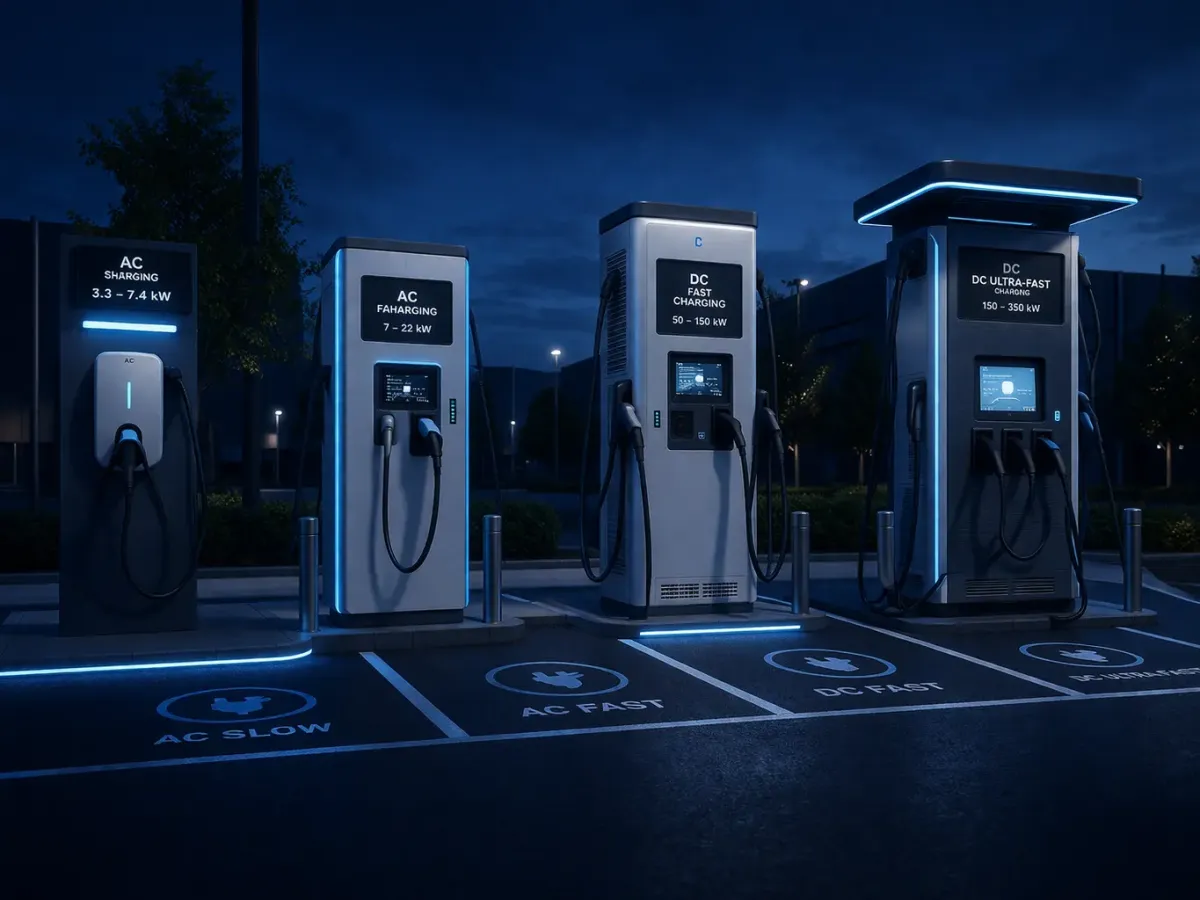
AC chargers account for 34.53% of 2025 value, USD 31.80 million, and grow at 28.35% a year to USD 110.78 million. They include home wallboxes, destination chargers in malls, hotels and offices, and AC depot chargers, together with the sessions and software that run on them. Home wallboxes are by far the largest part.
DC fast chargers of 50 to 149 kW account for 22.55% of 2025 value, USD 20.77 million, and grow at 30.17% a year to USD 77.63 million. They serve city fast-charging sites, dealerships and most fleet depots, where vehicles stay parked for an hour or more and a lower power rating keeps grid cost down.
Ultra-fast chargers of 150 kW and above account for 42.92% of 2025 value, USD 39.52 million, the largest charger type, and grow at 34.34% a year to USD 172.95 million and 47.86% of the market. EVIQ hubs, forecourt sites of SASCO, Apsco and Darb Fuel, and brand networks use them, and they take the largest share of session revenue because intercity drivers pay the highest prices.
Residential charging accounts for 27.69% of 2025 value, USD 25.50 million, and grows at 24.08% a year to USD 75.00 million. Marqstats estimates that about half of new plug-in buyers install a fixed wallbox, rising to about 45% by 2030 as more cars go to private buyers rather than company and government fleets.
Destination and workplace charging accounts for 5.61% of 2025 value, USD 5.17 million, and grows at 40.78% a year to USD 28.59 million. Malls, hotels, offices and housing projects install AC chargers, often under agreements with EVIQ such as those with Al-Othaim, Cenomi Centers, the National Housing Company and New Murabba.
Public fast and highway charging accounts for 57.59% of 2025 value, USD 53.03 million, the largest application, and grows at 31.81% a year to USD 211.01 million. It covers city fast hubs and intercity sites on the routes EVIQ has named for 2026, and it holds most of the session revenue in the market.
Fleet depot charging accounts for 9.11% of 2025 value, USD 8.39 million, and grows fastest, at 41.00% a year, to USD 46.76 million. Logistics, chauffeur, ride-hailing, government and bus fleets charge at their own sites, and Marqstats counts depot chargers here at the same level of the stack as the live Saudi Arabia Fleet Depot Charging report, so the two figures should not be added.
By Geography
Riyadh Province
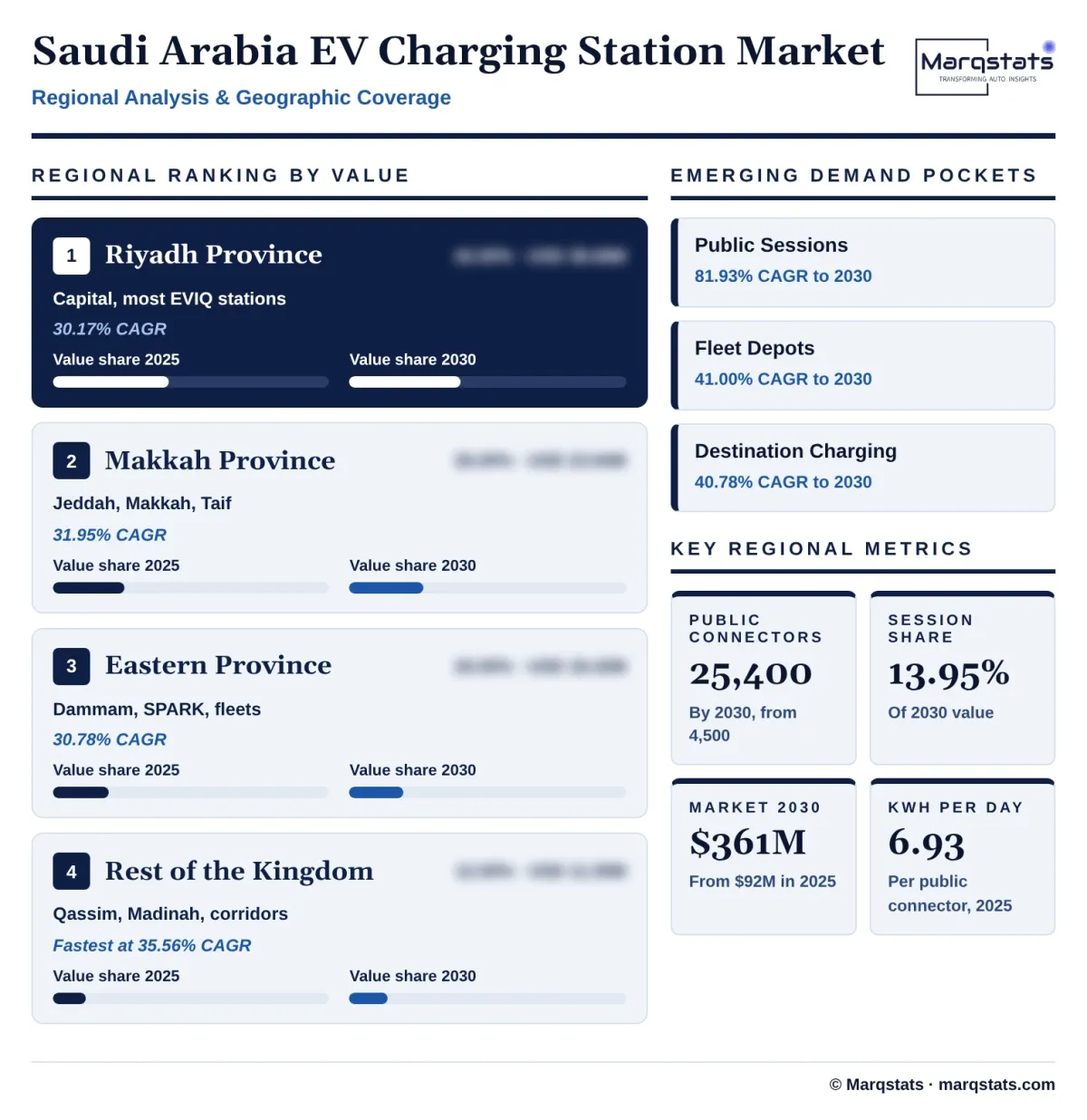
Riyadh Province accounts for 42.00% of 2025 value, USD 38.68 million, and grows at 30.17% a year to USD 144.54 million. The capital has the largest share of EVIQ stations, 20 of the 32 operating in November 2025, most head offices and government fleets, and a target of 30% electric vehicles by 2030. Agreements with Remat Al-Riyadh, New Murabba and the National Housing Company will add chargers in new districts, so Riyadh stays the largest region even as its share eases to 40.00%.
Makkah Province
Makkah Province, including Jeddah, Makkah and Taif, accounts for 26.00% of 2025 value, USD 23.94 million, and grows at 31.95% a year to USD 95.76 million. Jeddah had seven EVIQ stations operating in November 2025, Jeddah Transport Company has signed with Petromin for Electromin stations, and the Jeddah to Madinah highway is one of the three routes EVIQ named for 2026. King Abdullah Economic City, home of the Lucid plant, lies on the same coast.
Eastern Province
The Eastern Province accounts for 20.00% of 2025 value, USD 18.42 million, and grows at 30.78% a year to USD 70.47 million. Dammam had five EVIQ stations operating in November 2025, Smart Mobility makes chargers at SPARK, and the Riyadh to Dammam highway is a 2026 priority. Industrial and logistics fleets around Dammam, Al Khobar and Jubail make depot charging important here.
Rest of the Kingdom
The Rest of the Kingdom, including Madinah, Qassim, Asir, Tabuk, Hail and Jazan, accounts for 12.00% of 2025 value, USD 11.05 million, and grows fastest, at 35.56% a year, to USD 50.59 million and 14.00% of the market. The first EVIQ highway station opened at SASCO Aljazeera on the Riyadh to Qassim road in March 2025, and the highway agreement with the Roads General Authority and forecourt deals with Darb Fuel and Apsco carry chargers to towns between the main cities.
How Competition Is Evolving
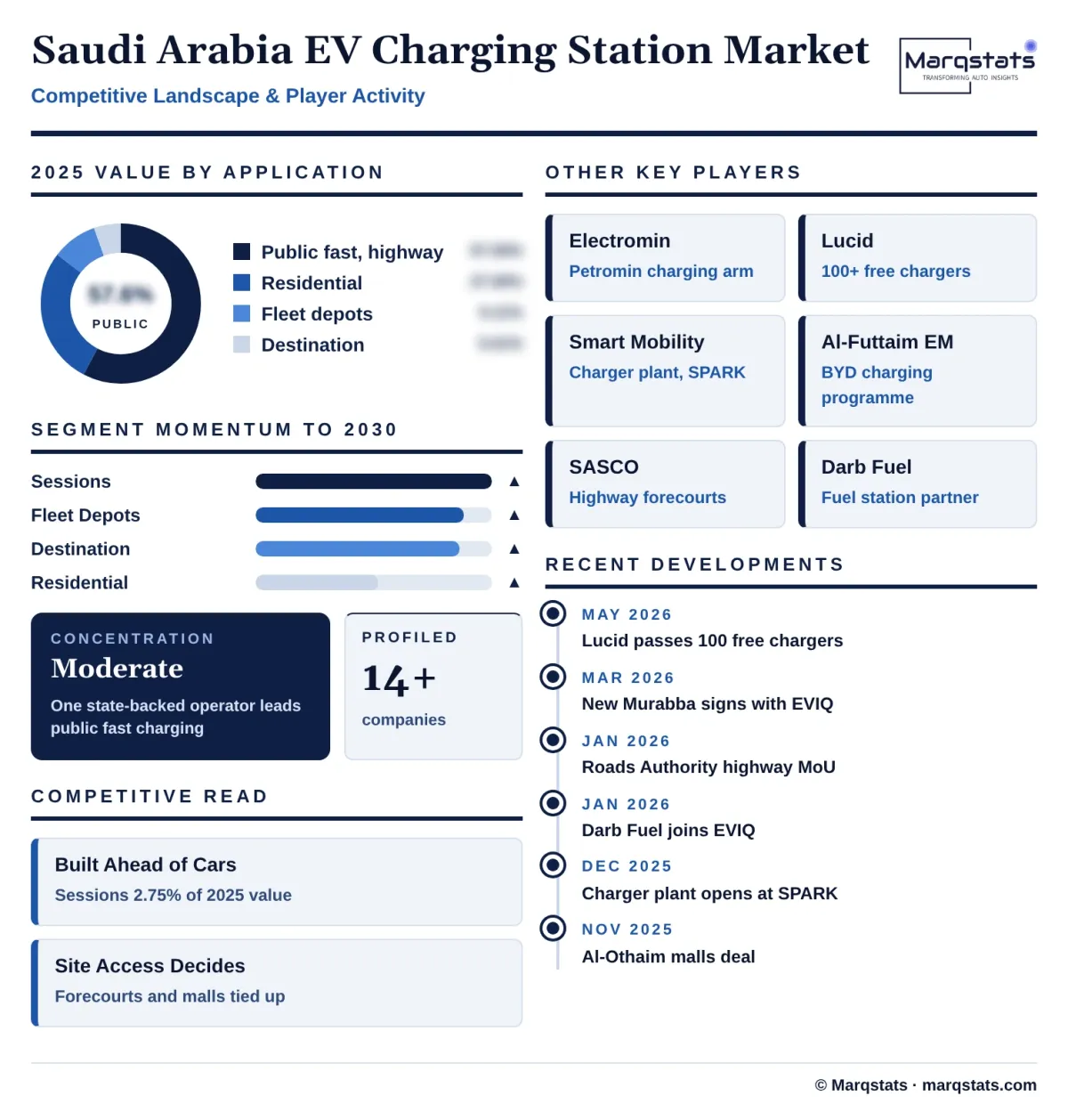
The public network is led by one state-backed operator, while hardware supply and installation are open. EVIQ is the largest buyer of fast chargers and holds agreements with fuel retailers, developers, mall owners and brands, while Electromin, E-FILL, Tesla, Lucid and dealer networks run smaller public and destination networks. No operator reports a full connector count, so Marqstats describes competition by layer and by dated agreements rather than by operator share.
In value terms the market is concentrated by application. Public fast and highway sites hold 57.59% of 2025 value and residential charging 27.69%, so the two largest buyers are the operators building fast hubs and the households and brands paying for home wallboxes. Destination charging holds 5.61% and fleet depots 9.11%.
Hardware supply is shifting from imports to local assembly. ABB and Siemens have supplied chargers to Electromin, Chinese suppliers dominate AC wallboxes and power modules, and Smart Mobility, backed by Foxconn Interconnect Technology and Saleh Suleiman Alrajhi and Sons, began making SASO-certified chargers in the Eastern Province in December 2025. Local content gives suppliers an edge in tenders run by state-linked buyers.
Competition is moving from equipment price to site access. Fuel forecourts of SASCO, Apsco and Darb Fuel, malls of Al-Othaim and Cenomi, and new districts of New Murabba and the National Housing Company are tied to EVIQ, so independent operators look to hotels, dealerships, workplaces and fleets, where a landlord or fleet owner pays for the charger.
Companies Covered
Companies covered in the report include:
Recent Market Activity
Table of Contents
Coverage & Segmentation
The study covers the Saudi Arabia EV charging station market, with 2025 as the base year, 2021 – 2025 as the historical period and 2026 – 2030 as the forecast period. The market is defined as EVSE hardware, installation and commissioning, CSMS software and public charging-session revenue, segmented by component, charger type, application and region. Values are in US dollars before value added tax, and riyal figures use the fixed rate of SAR 3.75 per US dollar.
Grid reinforcement and substations paid for by the Saudi Electricity Company, solar canopies and stationary batteries sold separately, electricity bought for home charging, battery swapping, portable chargers supplied with vehicles and the vehicles themselves are excluded. The live Marqstats Middle East EV Charging Station report is a regional parent that counts publicly accessible connectors, and the live Saudi Arabia Fleet Depot Charging and Saudi Arabia Wireless EV Charging reports cover layers that overlap with this market, so their figures should not be added to it.