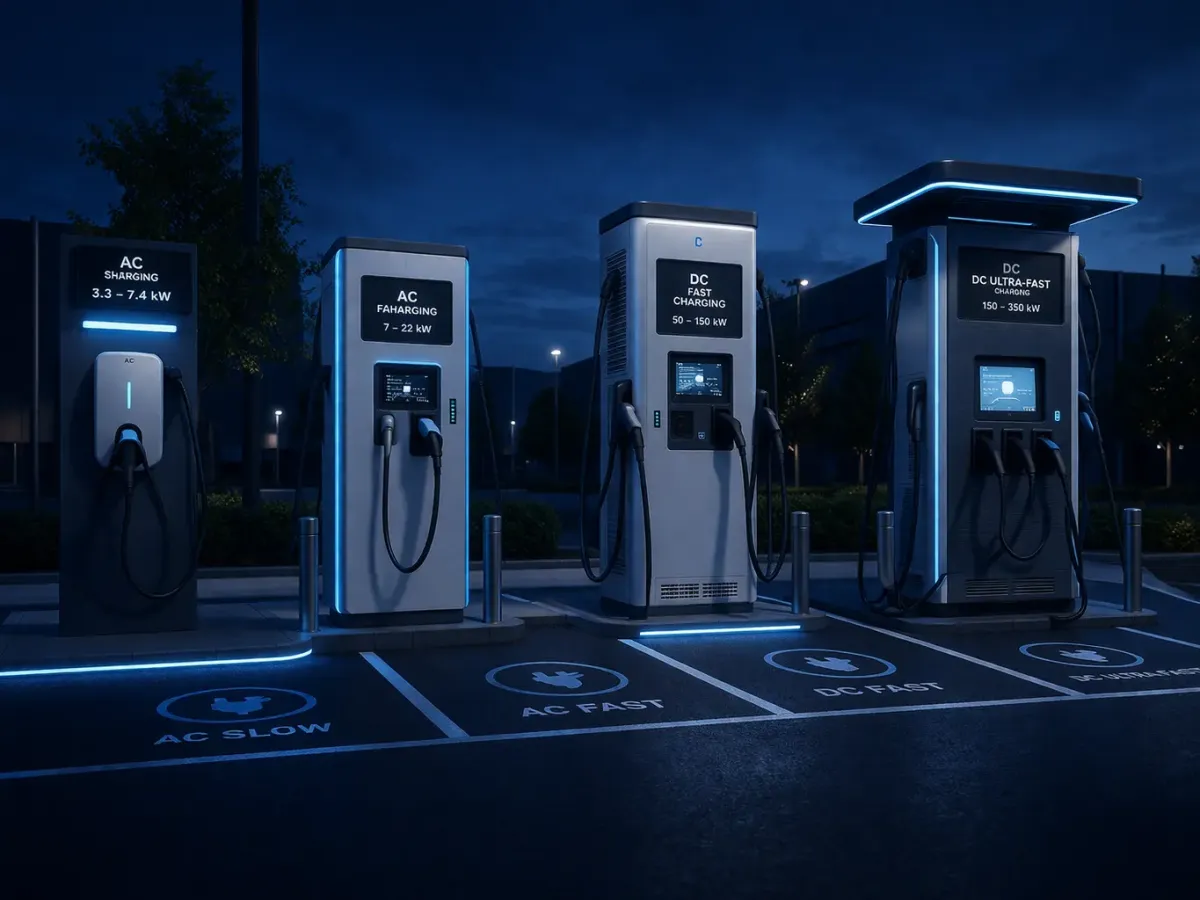
Market Snapshot
The UAE EV charging station market size is estimated at USD 99.97 million in 2025 and is projected to reach USD 290.87 million by 2030, growing at a CAGR of 23.81% over 2026 – 2030. New charge points installed each year rise from about 16,890 to 39,500, and the public and semi-public network grows from about 4,500 to 24,000 points.
Marqstats defines the market as annual spending on EV supply equipment (EVSE) hardware, installation including civil works and grid connection, charging station management system (CSMS) software, and public charging-session revenue in the United Arab Emirates. It covers home wallboxes, workplace and destination chargers, fleet depots and public and highway stations. Dirham values convert at the fixed peg of AED 3.6725 per US dollar.
Charging hardware accounts for 54.00% of 2025 value and public and highway charging for 61.25%. High-power DC chargers above 150 kW are the largest charger class at 43.52%. Dubai leads with 56.00% of value, while public charging-session revenue grows fastest, at 45.16% a year, as paid tariffs replace free charging.
Key Takeaways
Market Overview & Analysis
Report Summary
Marqstats sizes the UAE EV charging station market as the money spent each year on charging electric vehicles beyond the electricity a household pays for at home. It counts four layers: the hardware of AC wallboxes, AC pedestals and DC chargers; installation, which includes cabling, civil works, transformers and utility connection; CSMS software that runs networked chargers; and revenue from public charging sessions sold at the tariffs set for the country. Electricity bought for home charging on a residential meter, vehicle sales, battery swapping and wireless charging are excluded.
The country moved from free to paid public charging in 2025. Cabinet Resolution No. 81 of 2024 set fees of AED 1.20 per kWh for express charging and AED 0.70 per kWh for slow charging, both plus VAT, and UAEV began charging these rates in January 2025. Minister of Energy and Infrastructure Suhail Al Mazrouei said on 16 January 2025 that only fast and super-fast chargers would be introduced from then on, which shifts each new public site towards DC hardware and higher installation cost.
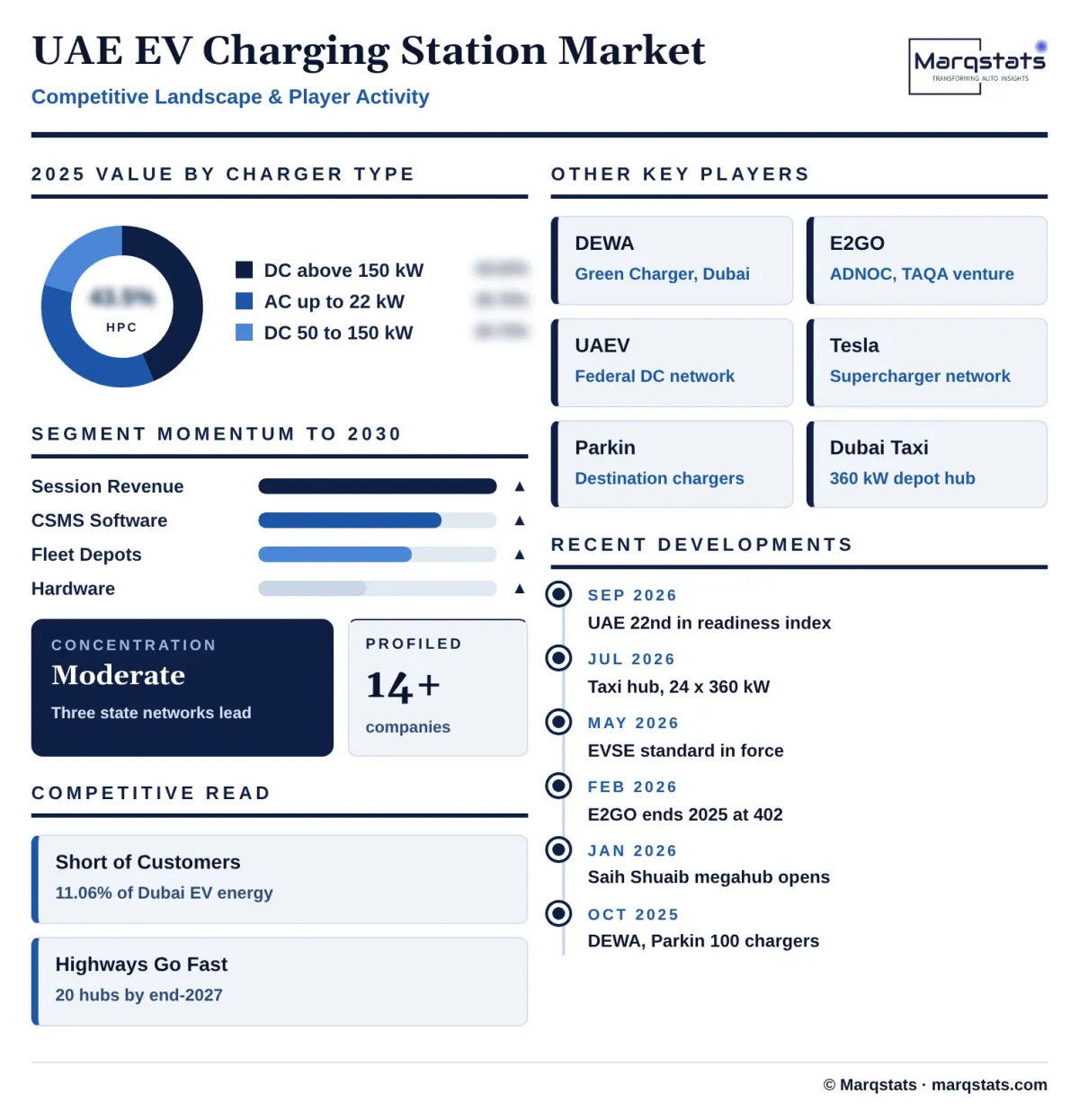
Three state-linked networks carry most of the public build-out. DEWA reported more than 1,860 charging points in Dubai on 19 January 2026, including stations licensed with public and private partners, and 23,600 registered Green Charger users. E2GO, the joint venture of ADNOC Distribution and the Abu Dhabi National Energy Company (TAQA), ended 2025 with 402 charging points after adding 182, and targets up to 750 by 2028. UAEV, the federal network, targets more than 1,000 DC chargers by 2030.
Vehicle demand is rising quickly. Dubai had 47,944 registered EVs at the end of 2025, up 27.9%, and Gulf News reported in September 2026 that EVs took about 9% of UAE new vehicle sales in 2025. Marqstats estimates about 30,300 plug-in electric cars were sold in 2025, consistent with its UAE Passenger Car estimate, and about 66,000 by 2030, with a national plug-in parc of about 76,000 at the end of 2025.
The market grew from an estimated USD 56.92 million in 2024 to USD 99.97 million in 2025, a rise of 75.63%, as Dubai, E2GO and UAEV added about 1,650 public points, home wallbox installations rose with plug-in sales and session revenue began under the new tariffs. Marqstats expects USD 141.40 million in 2026, when the DEWA and Dubai Taxi Company hub, the E11 megahub and 15 E2GO highway hubs come into service.
UAE EV Charging Station Market Size and Forecast
The UAE EV charging station market grows from USD 99.97 million in 2025 to USD 290.87 million in 2030, a CAGR of 23.81%. The number of new charge points installed each year rises at 18.52% a year, from about 16,890 to 39,500, and the mix shifts towards DC chargers, which carry far higher hardware and installation cost per point than the home wallboxes that dominate unit counts.
The 2025 value is built bottom-up. Marqstats estimates that 1,650 public points were added in 2025: 900 AC points at about USD 2,800 of hardware and USD 2,200 of installation each, 450 DC points of 50 to 150 kW at about USD 26,000 and USD 14,000, and 300 points above 150 kW at about USD 60,000 and USD 40,000. Private installations added about 13,600 home wallboxes at about USD 900 plus USD 800 of installation, 1,500 workplace and destination AC points, and 140 fleet depot DC points.
Software and sessions complete the base. CSMS fees average about USD 330 per networked point a year in 2025 across about 4,000 public and 4,100 private networked points, giving USD 2.59 million. Public energy sold is estimated at about 30 GWh at a blended AED 0.92 per kWh before VAT, giving USD 7.52 million; the blend sits below the AED 1.20 express rate because AC sessions are billed at AED 0.70 and some destination sites still offer free charging.
Prices fall but the mix rises. Marqstats expects hardware prices per point to fall by about 18% to 23% between 2025 and 2030 as Chinese and European DC suppliers compete, while public additions rise to 5,200 points in 2030, including 1,000 above 150 kW, and fleet depot additions rise to 600 points as taxi and delivery fleets electrify. The public and semi-public base reaches about 24,000 points by the end of 2030, a 39.77% annual rate.
Marqstats tracks four indicators to monitor the forecast: DEWA's quarterly charger and energy figures, ADNOC Distribution's E2GO point count against its 750 target, UAEV's progress towards 1,000 DC chargers, and fleet charging tenders from Dubai Taxi Company and the Roads and Transport Authority (RTA). A slower fleet programme or a return to free charging would cut session revenue first.
Market Dynamics
Key Drivers
Five forces are turning UAE charging from a free public service into a paid, growing infrastructure market.
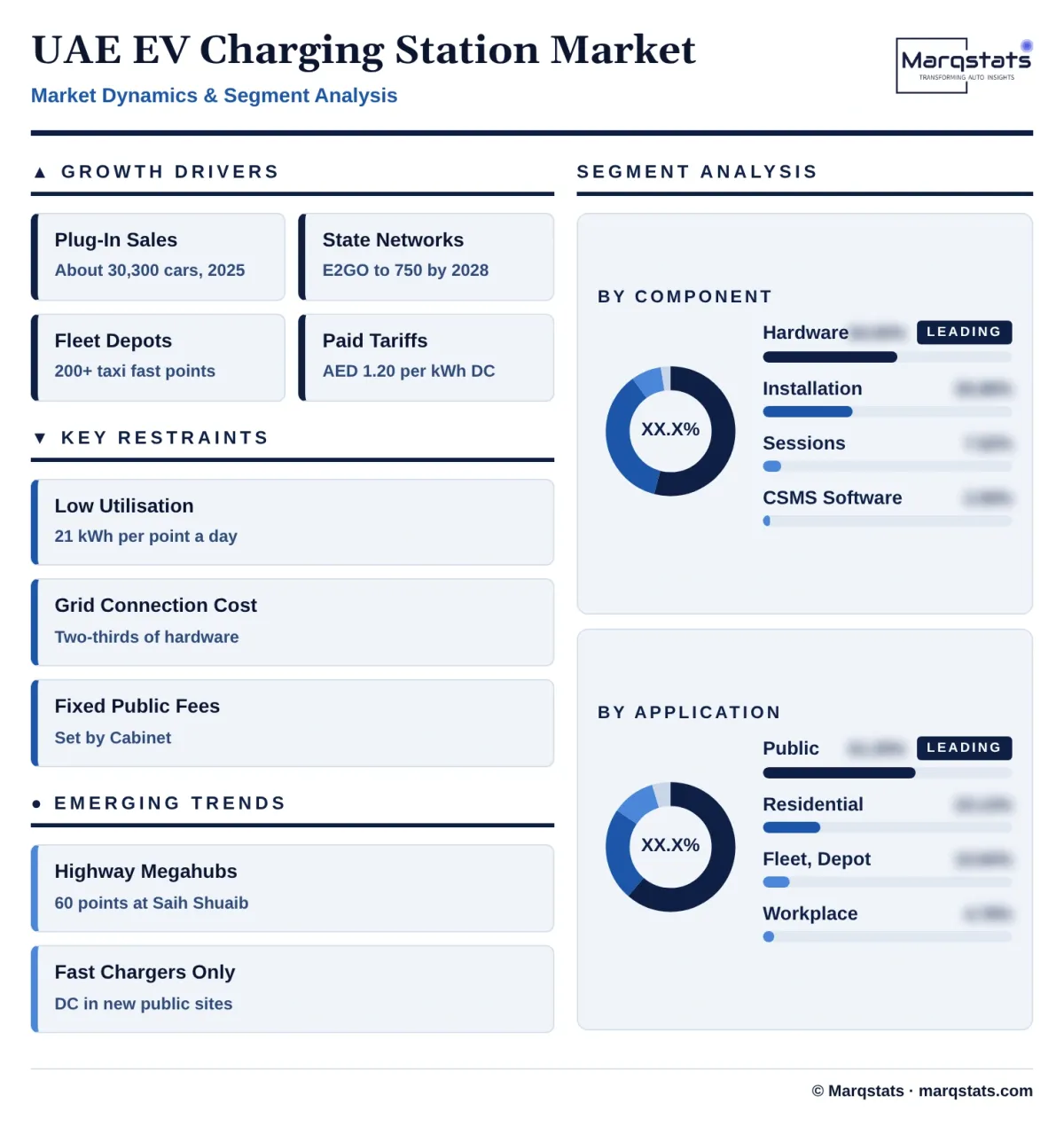
- Plug-in sales are rising. Marqstats estimates about 30,300 plug-in electric cars were sold in 2025 and about 66,000 in 2030, and Dubai alone added about 10,500 registered EVs in 2025 to reach 47,944. Each new car adds a likely home wallbox and adds energy demand to public and highway chargers.
- State networks are expanding on firm targets. E2GO added 182 fast and super-fast points in 2025, plans 50 to 60 more in 2026 and targets up to 750 by 2028, while UAEV targets more than 1,000 DC chargers by 2030 and Charge AD plans 1,000 charging stations at 400 locations in Abu Dhabi.
- Fleets are electrifying. DEWA and Dubai Taxi Company agreed at WETEX 2025 to build more than 200 ultra-fast charging points for the taxi fleet, and the first 24 chargers of 360 kW opened at Muhaisnah 4 on 9 July 2026, able to charge a taxi in about 35 minutes. Taxi and delivery depots buy the most expensive chargers per point.
- Paid tariffs create a revenue market. Cabinet Resolution No. 81 of 2024 set AED 1.20 per kWh for express and AED 0.70 per kWh for slow charging before VAT, and UAEV began charging in January 2025, so operators can earn a return on a public charger for the first time across the country.
- Technical rules are now national. Cabinet Resolution No. 175 of 2025 introduced a unified technical standard for EV supply equipment, in force from May 2026, which lowers approval risk for suppliers and gives site owners one specification to buy against.
Key Restraints
Four constraints hold spending below what the vehicle numbers alone would suggest.
- Public chargers are lightly used. Marqstats calculates that DEWA's network sold about 21.35 kWh per point a day in the first half of 2026, and that public charging covered only about 11.06% of the energy Dubai's EVs need, so private operators face long paybacks on stand-alone public sites.
- Grid connection drives cost. Marqstats estimates installation at about USD 40,000 per point for chargers above 150 kW in 2025, two-thirds of the hardware price, because multi-charger hubs need new transformers and utility feeders; a site owner pays this whatever the later utilisation.
- Tariffs are set, not competed. Public charging fees follow Cabinet Resolution No. 81 of 2024, and the largest networks belong to DEWA, UAEV and E2GO, so independent operators cannot price above the state networks and must win on location and service.
- Supply chains run through the Gulf. The March 2026 Hormuz shipping shock saw Maersk and Hapag-Lloyd suspend transits and Asia to Gulf freight rates rise about 40% in a week, and charger cabinets, cables and transformers are imported, which raises delivered cost and delays projects.
Key Trends
Four shifts are changing where chargers go, how fast they are and who owns them.
- Highway megahubs replace single chargers. ADNOC Distribution opened a 60-point EV megahub at Saih Shuaib on the E11 between Abu Dhabi and Dubai in January 2026, and plans 15 highway hubs by the end of 2026 and 20 by the end of 2027 to cover the core national highways.
- Only fast chargers in new public sites. Following the minister's January 2025 statement, new public investment concentrates on DC chargers, so Marqstats expects DC points to rise from 750 of the 1,650 public points added in 2025 to 2,600 of the 5,200 added in 2030, while DC unit prices fall by about one-fifth.
- Roaming and parking apps join networks. DEWA lists its points on its website, smart app and 14 other digital platforms, and Parkin delivers the 100 charger first phase with DEWA through its parking app, so drivers can find and pay for chargers without a separate account for each network.
- Fuel stations become energy hubs. ADNOC Distribution launched six Hub by ADNOC sites in 2025 that combine fuel, EV charging and car care, targets 30 by 2030, and ended 2025 with 567 UAE service stations that can host fast chargers.
Strategic Implications
- For charger makers, the volume is in home and destination AC, but the value is in DC above 150 kW. Suppliers need a UAE-certified DC range under Cabinet Resolution No. 175 of 2025 and installers who can handle transformers and utility approvals, because installation adds about two-thirds to the hardware bill.
- For independent charge point operators, a stand-alone public site at today's utilisation pays back slowly. Partnering with a parking operator such as Parkin, a mall or a fleet gives a guaranteed load, and the Dubai Taxi Company hub shows that a dedicated fleet can keep a 360 kW charger busy.
- For DEWA, UAEV and E2GO, the next step is utilisation, not more points. Rising session revenue depends on drivers who now charge at home choosing public chargers on highways and in apartment districts, so pricing, roaming and reliability matter more than headline counts.
- For property developers and building managers, apartment residents without parking-bay chargers are the main gap. Pre-wiring bays and adding managed AC chargers lets buildings capture CSMS and session revenue that would otherwise go to public networks.
- For investors, the market is driven by state targets with dates, from E2GO's 750 points by 2028 to UAEV's 1,000 DC chargers by 2030, which makes the equipment and installation pipeline easy to track but leaves session margins capped by the national tariff.
Market Segmentation
Hardware accounts for 54.00% of 2025 value, USD 53.98 million, and grows at 20.38% a year to USD 136.46 million, while its share falls to 46.92%. It covers AC wallboxes and pedestals, DC chargers of 50 to 150 kW and high-power chargers above 150 kW, including the 360 kW units installed at the Dubai Taxi Company hub. Public chargers above 150 kW are about one-third of hardware value although they are under 2% of the points installed.
Installation, civil works and grid connection account for 35.89% of 2025 value, USD 35.88 million, and grow at 21.33% a year to USD 94.33 million. Hub sites such as Saih Shuaib need transformers, switchgear and new feeders, and Marqstats estimates installation at about USD 40,000 per point above 150 kW against about USD 800 for a home wallbox.
Charging station management software accounts for 2.59% of 2025 value, USD 2.59 million, and grows at 34.99% a year to USD 11.61 million. It runs authentication, billing, roaming and remote monitoring for networked public, workplace and fleet chargers, and grows with the number of networked points rather than with new additions.
Public charging-session revenue accounts for 7.52% of 2025 value, USD 7.52 million, and grows fastest, at 45.16% a year, to USD 48.47 million and 16.66% of the market. It counts energy sold at public chargers at the AED 1.20 and AED 0.70 per kWh fees, before VAT, and rises with public energy from about 30 GWh in 2025 to 178 GWh in 2030.
Public and highway charging accounts for 61.25% of 2025 value, USD 61.23 million, and grows at 26.27% a year to USD 196.58 million and 67.59% of the market. It includes DEWA, UAEV, E2GO, Tesla Supercharger and destination networks in malls, parking and hotels, and carries all session revenue.
Home charging accounts for 23.13% of 2025 value, USD 23.12 million, and grows at 13.24% a year to USD 43.06 million. Marqstats estimates about 13,600 home wallboxes were installed in 2025 and about 29,700 in 2030, mostly in villas and townhouses; its share falls as falling wallbox prices offset rising volumes.
Private workplace and destination charging accounts for 4.78% of 2025 value, USD 4.78 million, and grows at 21.43% a year to USD 12.62 million. It covers AC chargers in offices, residential towers, hotels and community car parks that are not open to the public, with their share of CSMS fees.
Fleet and depot charging accounts for 10.84% of 2025 value, USD 10.84 million, and grows fastest among applications, at 28.92% a year, to USD 38.61 million. Taxi, ride-hailing, delivery and bus depots buy 120 to 360 kW chargers, and the DEWA and Dubai Taxi Company programme of more than 200 ultra-fast points sets the pace.
AC charging accounts for 35.75% of 2025 value, USD 35.74 million, and grows at 17.83% a year to USD 81.18 million. It covers home wallboxes, workplace and destination chargers and public AC posts, most of the CSMS base and slow-charging sessions at AED 0.70 per kWh.
DC fast charging of 50 to 150 kW accounts for 20.73% of 2025 value, USD 20.72 million, and grows at 25.47% a year to USD 64.44 million. These chargers serve malls, city sites and fuel stations where cars stop for 30 to 60 minutes.
High-power DC charging above 150 kW accounts for 43.52% of 2025 value, USD 43.51 million, and grows fastest, at 27.26% a year, to USD 145.25 million and 49.94% of the market. It covers highway megahubs, the Tesla Supercharger network and fleet depot chargers of 360 kW, and holds the largest share of value from 2025.
By Geography
Dubai
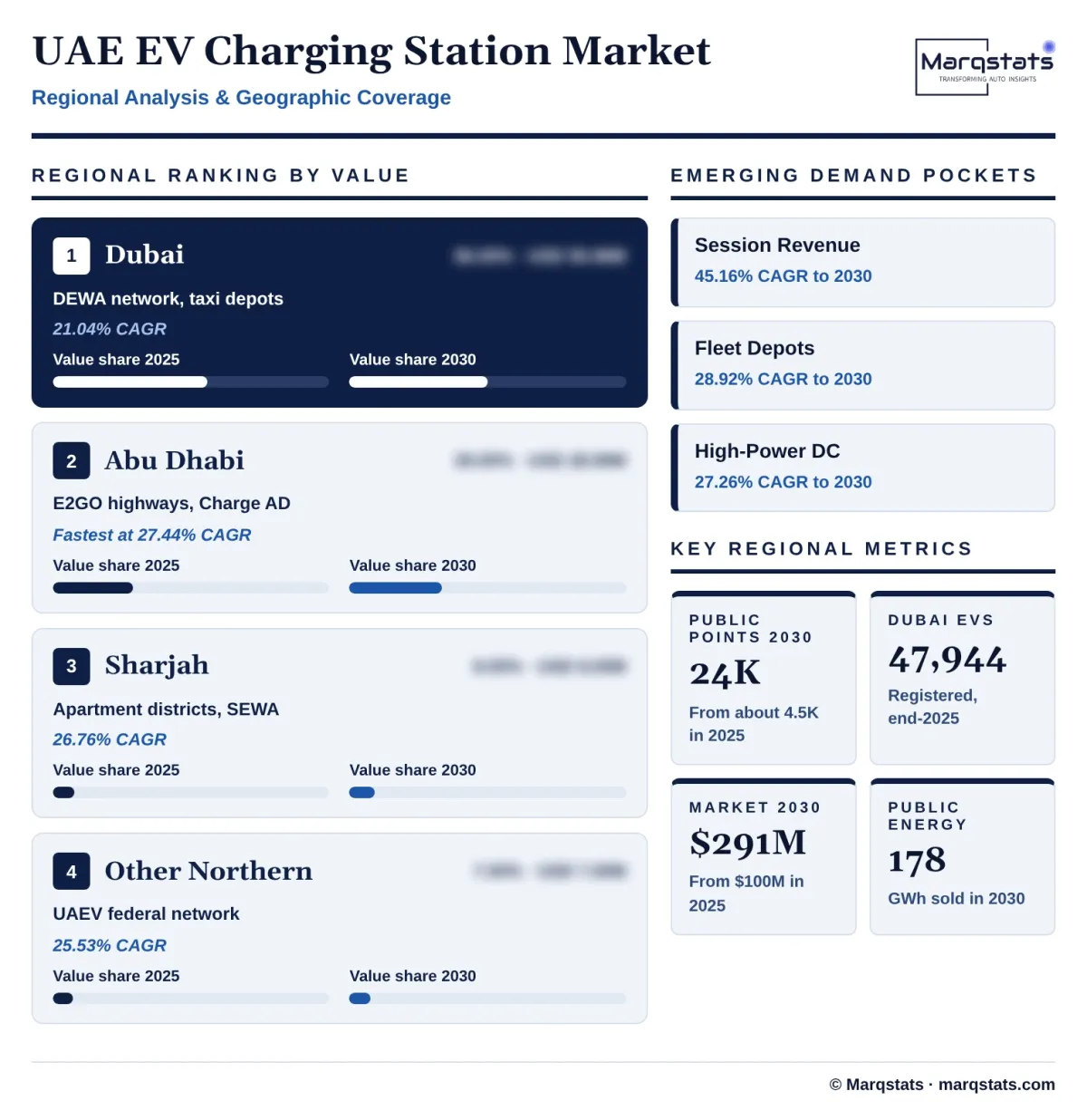
Dubai matters because it sets the country's charging habits: DEWA has run public charging since 2014 and now licenses partner networks. It accounts for 56.00% of 2025 value, USD 55.98 million, and grows at 21.04% a year to USD 145.43 million, while its share falls to 50.00% by 2030. Dubai holds about 63% of the national plug-in parc on Marqstats estimates, the 1,860-plus DEWA points, the Dubai Taxi Company depot programme and the Parkin destination chargers.
Abu Dhabi
Abu Dhabi matters because it owns the highway network that links the emirates. It accounts for 29.00% of 2025 value, USD 28.99 million, and grows fastest, at 27.44% a year, to USD 97.44 million and 33.50% by 2030. E2GO's Saih Shuaib megahub, the plan for 20 highway hubs by the end of 2027 and Charge AD's 1,000 planned charging stations across Abu Dhabi Island, Al Ain and Al Dhafra drive spending.
Sharjah
Sharjah matters because many Dubai commuters live there without dedicated parking. It accounts for 8.00% of 2025 value, USD 8.00 million, and grows at 26.76% a year to USD 26.18 million. The Sharjah Electricity, Water and Gas Authority (SEWA) and UAEV sites serve apartment districts, where public charging replaces the home wallbox that villa owners in Dubai and Abu Dhabi install.
Ajman, Ras Al Khaimah, Fujairah and Umm Al Quwain
The other northern emirates matter because they are where UAEV's federal network does most of its work. Together they account for 7.00% of 2025 value, USD 7.00 million, and grow at 25.53% a year to USD 21.82 million. Etihad Water and Electricity serves these emirates, and highway chargers on the routes to Ras Al Khaimah and Fujairah make long trips possible for EV owners.
How Competition Is Evolving
The market is moderately concentrated in public charging and fragmented in equipment. Three state-linked networks, DEWA in Dubai, E2GO in Abu Dhabi and on the highways, and the federal UAEV network, own most public fast chargers, while the hardware they buy comes from a wide set of international suppliers, and home and workplace installations go through dealers, electrical contractors and developers.
DEWA leads by size. It reported more than 1,860 points in January 2026, including stations licensed with public and private partners, and 2,223 charging stations, more than 62,000 MWh supplied since 2014 and 23,600 registered users in June 2026. It also builds for others: the 100 charger first phase with Parkin, announced at WETEX in October 2025, and the more than 200 ultra-fast points for Dubai Taxi Company.
E2GO leads on highways. ADNOC Distribution reported 402 E2GO points at the end of 2025, up 83%, and opened the 60-point Saih Shuaib megahub in January 2026, which it described as the largest superfast charging site in the Middle East, Africa and Turkey. UAEV, created by the Ministry of Energy and Infrastructure with Etihad Water and Electricity, charges the national tariff and targets more than 1,000 DC chargers by 2030.
Competition is moving from point counts to sites that are used. Tesla, Inc. runs its own Supercharger network, Al-Futtaim Electric Mobility sells BYD cars with chargers, and parking, mall and hotel owners add destination chargers. Because tariffs are fixed by Cabinet Resolution No. 81 of 2024, operators compete on location, reliability and roaming rather than on price, and hardware suppliers compete on heat-tolerant DC chargers, service and delivery time.
Companies Covered
Companies covered in the report include:
Recent Market Activity
Table of Contents
Coverage & Segmentation
The study covers the UAE EV charging station market, with 2025 as the base year, 2021 – 2025 as the historical period and 2026 – 2030 as the forecast period. It measures annual spending on EVSE hardware, installation including civil works and grid connection, CSMS software, and public charging-session revenue, segmented by component, application, charger type and emirate. Values are in US dollars, converted from dirhams at the fixed peg of AED 3.6725 per US dollar, and exclude VAT.
Electricity for home charging billed on residential meters, vehicle sales, battery swapping, wireless charging, hydrogen refuelling and utility transmission upgrades are excluded. The live Marqstats Middle East EV Charging Station report is the regional parent and counts publicly accessible points only; its figures and those of the UAE Electric Vehicle report should not be added to this market. The same definition is used for the Saudi Arabia, Vietnam and GCC charging station studies.