Market Snapshot
The GCC EV charging station market size is estimated at USD 211.09 million in 2025 and is projected to reach USD 698.86 million by 2030, growing at a CAGR of 27.05% over 2026 – 2030. The UAE and Saudi Arabia account for 90.98% of 2025 value, and public charging-session revenue grows fastest as networks fill.
Marqstats defines the market as the annual value of EV supply equipment (EVSE) hardware, installation and commissioning, charging station management system (CSMS) software and public charging-session revenue across Saudi Arabia, the United Arab Emirates, Qatar, Oman, Kuwait and Bahrain. It covers public, highway, destination, workplace, residential and fleet depot chargers, both AC and DC. Electric vehicles, utility grid assets upstream of the connection point and electricity sold to private home and depot users are excluded.
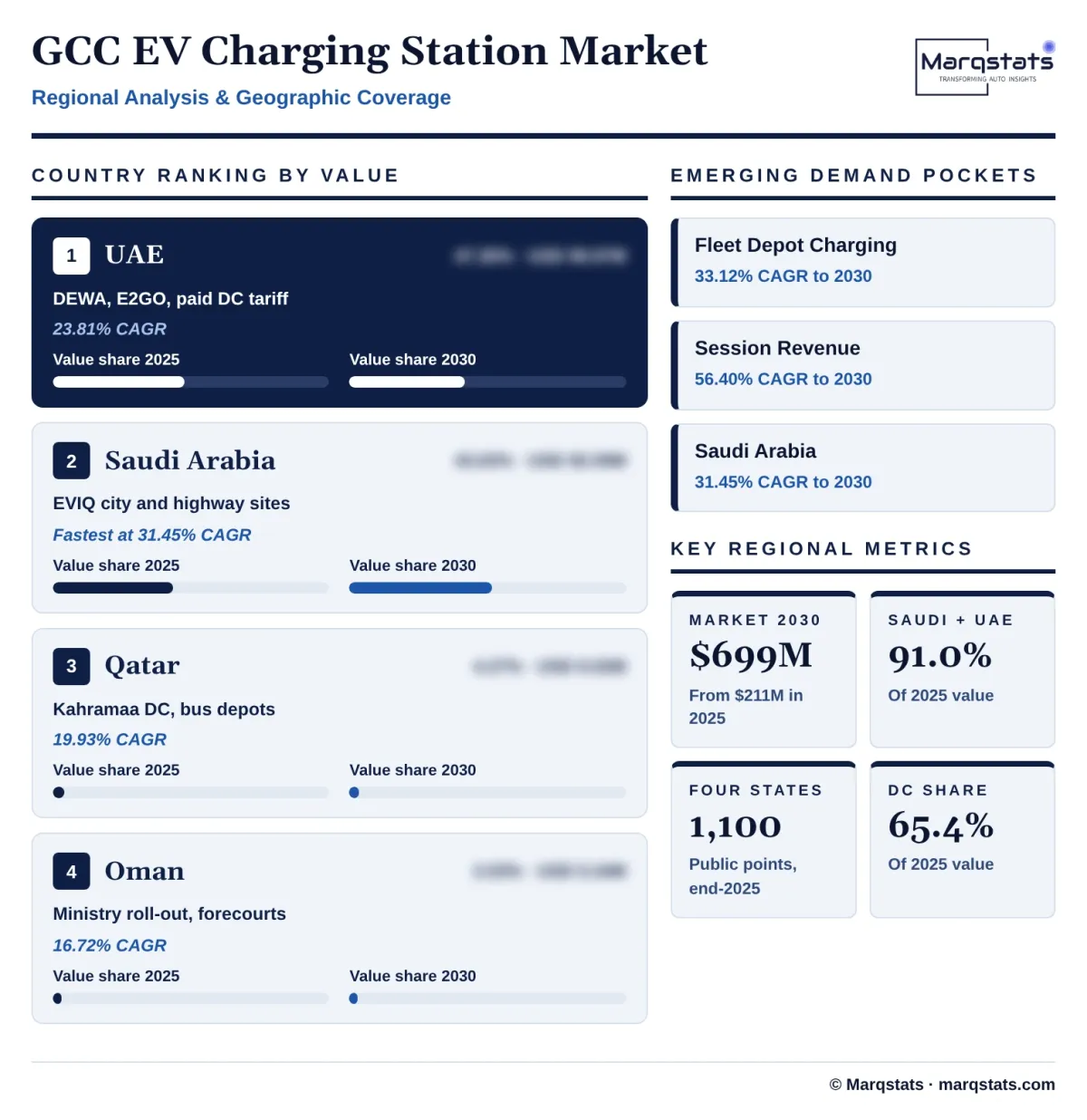
EVSE hardware accounts for 57.06% of 2025 value, public and highway charging for 56.40% and DC charging for 65.41%. The UAE is the largest national market at 47.35% of value, while Saudi Arabia grows fastest at 31.45% a year as networks extend from cities to intercity highways.
Key Takeaways
Market Overview & Analysis
Report Summary
Marqstats sizes the GCC EV charging station market as the annual value that flows through chargers in the six member states of the Gulf Cooperation Council. Four streams are counted: EVSE hardware sold in the year, installation and commissioning of that hardware, CSMS software subscriptions paid by charge point operators and site owners, and revenue from public charging sessions. The same definition is used in the Marqstats country studies of the Saudi Arabia and UAE charging markets, whose totals form the Saudi and UAE slices of the GCC total.
Electric vehicle demand in the region is growing quickly from a small base. The International Energy Agency reports about 75,000 electric car sales in the Middle East in 2025, up about 40%, with the UAE accounting for about half. Saudi Arabia and Qatar together took about 45% of regional sales, and Marqstats estimates about 3,350 electric vehicle sales in Qatar. In Oman the Oman Net Zero Centre at the Ministry of Energy and Minerals cited about 5,800 electric vehicles in June 2026 and a target of 8,000 by the end of 2026, while in Bahrain about 800 electric vehicles ran among 794,677 licensed vehicles at the end of 2025.
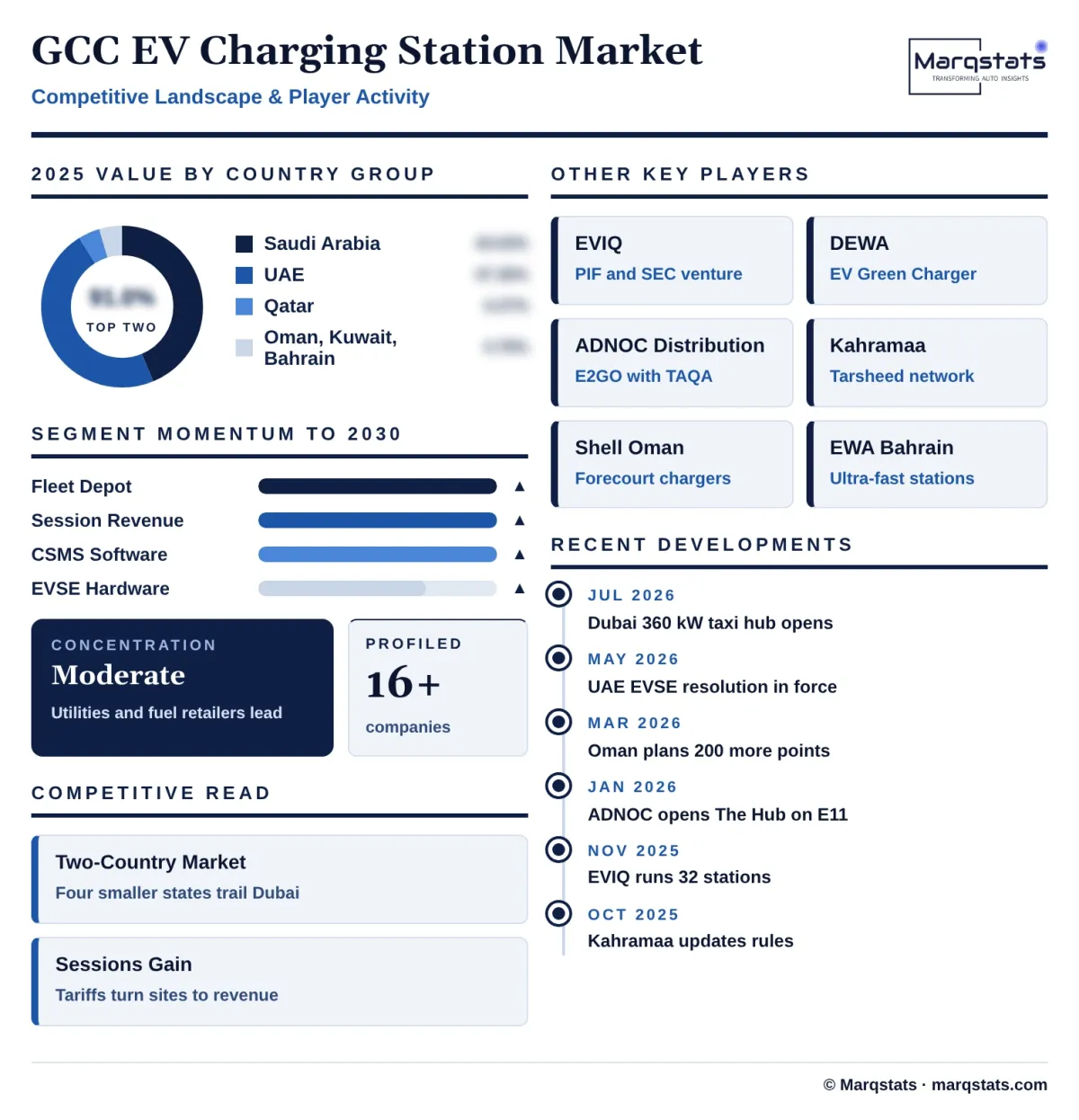
Charging networks are being built by state utilities, sovereign-backed joint ventures and national fuel retailers rather than by independent operators. The Electric Vehicle Infrastructure Company (EVIQ), a joint venture of the Public Investment Fund and Saudi Electricity Company, had 32 stations operating in Riyadh, Jeddah and Dammam in November 2025, planned 60 by the end of 2025 and targets 5,000 charging stations across the Kingdom. The Dubai Electricity and Water Authority (DEWA) and its licensed partners ran more than 1,860 charging points in Dubai in January 2026 through the EV Green Charger initiative, ADNOC Distribution ran 402 points through E2GO, its joint venture with TAQA, at the end of 2025, and Qatar General Electricity and Water Corporation (Kahramaa) passed 300 fast chargers in July 2025.
The smaller states are at an earlier stage. The Ministry of Transport, Communications and Information Technology in Oman installed 160 chargers across the governorates in 2025, plans 200 more charging points in 2026 and 350 charging stations by 2027. Bahrain had 12 public EV charging stations in June 2026, 10 of them ultra-fast, after the Electricity and Water Authority opened five ultra-fast stations in October 2025. Kuwait has had charger installation regulations since October 2022, limiting home chargers in private housing to AC units of no more than 22 kW, and its public network of about 250 points is the second smallest in the GCC after Bahrain.
Policy now sets the rules of entry. Under Cabinet Resolution No. 81 of 2024 the UAE applied national charging tariffs of AED 1.20 per kWh for DC and AED 0.70 per kWh for AC, plus VAT, from January 2025, and Cabinet Resolution No. 175 of 2025 on EV supply equipment took effect in May 2026. Kahramaa updated its installation procedures on 29 October 2025 to require prior approval and connection of every charger to its smart platform, and Bahrain issued its first comprehensive charging framework, Decision No. 1 of 2025. Marqstats values all figures in US dollars at the 2025 peg rates of SAR 3.75, AED 3.6725, QAR 3.64, OMR 0.3845, BHD 0.376 and KWD 0.3068 per US dollar.
GCC EV Charging Station Market Size and Forecast
The GCC EV charging station market grows from USD 211.09 million in 2025 to USD 698.86 million in 2030, a CAGR of 27.05%. Saudi Arabia grows from USD 92.09 million to USD 361.36 million, a 31.45% CAGR, and the UAE from USD 99.97 million to USD 290.87 million, a 23.81% CAGR. Together the two account for 90.98% of 2025 value and 93.33% of 2030 value.
The four smaller markets are built bottom-up. Qatar is valued at USD 9.02 million in 2025, Oman at USD 5.34 million, Kuwait at USD 2.65 million and Bahrain at USD 2.02 million. For each, Marqstats multiplies public DC and AC charger additions, home wallbox fittings and fleet depot chargers by installed prices, adds CSMS fees per networked point, and adds public session revenue from estimated energy dispensed and realised prices per kWh. A public DC charger of about 120 kW is valued at about USD 32,000 for hardware and USD 14,000 for installation in 2025.
The value structure shifts from building to operating. Hardware and installation account for 92.66% of 2025 value and 81.72% of 2030 value, while session revenue grows from 5.37% to 15.18%. In the four smaller markets DC hardware prices are assumed to fall by about 19% between 2025 and 2030, so unit additions rise faster than hardware value.
The market is larger than the public-network figure on the live Marqstats Middle East EV Charging Station page because the definition is wider. That page values equipment, installation and network services for public points across the Gulf, Jordan, Iraq and Lebanon at USD 0.21 billion in 2025. Excluding residential wallboxes (USD 52.96 million) and public session revenue (USD 11.34 million), the GCC figure here is USD 146.79 million. The regional page also covers Jordan, Iraq and Lebanon and values its connector base at a higher average installed price, so it sits above this GCC layer. The two figures should not be added.
Marqstats tracks five indicators for the forecast: EVIQ station openings against its 5,000-station target, the E2GO roll-out toward up to 750 points, Kahramaa progress toward 1,000 charging stations by 2030, Oman progress toward 350 stations by 2027, and monthly electric vehicle registrations in Saudi Arabia and the UAE, which set utilisation and session revenue.
Market Dynamics
Key Drivers
Five forces are lifting spending on charging across the six Gulf Cooperation Council states.
- Electric vehicle sales are doubling from a small base. The International Energy Agency reports about 75,000 electric car sales in the Middle East in 2025, up about 40%, and Saudi Arabia and Qatar together took about 45% of those sales. Each new vehicle adds a home wallbox in many villas and raises demand for public fast charging in apartments and on highways.
- Sovereign-backed operators are funding networks ahead of demand. EVIQ, owned by the Public Investment Fund and Saudi Electricity Company, targets 5,000 charging stations, and said in November 2025 that 2026 would focus on highway coverage between Jeddah and Madinah, Riyadh and Dammam, and Riyadh and Qassim. In the UAE, UAEV, the federal network of the Ministry of Energy and Infrastructure and Etihad Water and Electricity, extends chargers into the Northern Emirates.
- Fuel retailers are turning forecourts into charging hubs. ADNOC Distribution opened The Hub, a 60-chargepoint site at Saih Shuaib on the E11 between Abu Dhabi and Dubai, in January 2026, with about 20 more hubs planned by the end of 2027. DEWA signed a contract with ENOC Group in October 2025 to add fast chargers at ENOC stations in Dubai, and Shell Oman Marketing Company and Porsche Centre Oman plan 133 charging points in Oman by the end of 2026.
- National targets fix a floor for spending. Qatar plans more than 1,000 charging stations by 2030 and 4,000 by 2035, Oman plans 350 stations by 2027, and the UAE aims for electric vehicles to make up 50% of cars on its roads by 2050. Utilities buy chargers to meet these targets even where utilisation is still low.
- Tariffs make public charging a revenue business. The UAE national tariff of AED 1.20 per kWh for DC and AED 0.70 for AC, applied from January 2025, put public charging on one paid national tariff, and Bahrain lets public operators set prices freely within fair market rules. Paid sessions give operators a reason to add CSMS software, payment and roaming.
Key Restraints
Four constraints keep charging spend below what announced targets imply.
- Utilisation is still low. On Marqstats estimates, a public DC charger in Oman or Kuwait dispensed about 30 kWh a day in 2025, a small fraction of its capacity, so session revenue does not yet repay hardware outside the busiest Dubai, Abu Dhabi and Riyadh sites.
- Electricity is cheap and heavily subsidised in some states. Kuwait sells power to households at very low regulated prices, so home charging costs drivers almost nothing and public operators cannot charge much for sessions, which keeps the Kuwaiti market dependent on hardware sales.
- Grid connection sets the pace. Every new site needs utility approval: Kahramaa requires prior approval through its service system, Bahrain prohibits connecting any charger without EWA approval, and highway hubs need new transformers and medium-voltage feeders that take months to deliver and energise.
- Heat and dust raise costs. Summer temperatures above 45 °C force operators to buy chargers with liquid cooling and sealed enclosures, shade canopies and more frequent maintenance, which adds to the installed cost of each DC point in the Gulf compared with milder markets.
Key Trends
Four shifts are changing who builds, runs and earns from Gulf charging networks.
- Highways become the new frontier. EVIQ, ADNOC Distribution and the Oman Ministry of Transport, Communications and Information Technology are moving from city sites to intercity corridors, which raises the share of ultra-fast DC chargers in new orders.
- Utilities hand networks to commercial operators. DEWA is working with ENOC, Kahramaa with Qatar Fuel (Woqod) and Bahrain with licensed operators, so state networks are opening to operators who earn from sessions and software.
- Platforms and payments unify. Qatar launched the second version of the Tarsheed smart charging platform in March 2025, and Oman runs the Shahin platform that lets drivers find and pay for chargers on several networks with one login, which raises demand for CSMS software and roaming.
- Fleets electrify first. Qatar reports that 73% of its public buses are electric, about 19% of the Dubai taxi and limousine fleet is electric in 2026, and delivery operators trial electric vans, so fleet depots become the fastest-growing application for high-power chargers.
Strategic Implications
- For charge point operators, the profitable sites are paid DC sessions in the UAE and the busiest Saudi cities. Operators that win host agreements with fuel retailers and malls in Dubai, Abu Dhabi and Riyadh can earn from AED 1.20 per kWh DC sessions, while those building in Kuwait or rural Oman should expect hardware-led returns for several years.
- For hardware suppliers, the order book is in DC. DC charging accounts for most of the market, and utilities and fuel retailers buy liquid-cooled 150 kW to 400 kW units for highways and hubs, so suppliers need Gulf-rated enclosures, local service teams and approval from each national utility.
- For software and payment providers, every national platform is a gate. Kahramaa requires chargers on its smart platform, Oman runs Shahin and the UAE sets national tariffs, so CSMS vendors that integrate with each utility and offer roaming across borders will win the operator contracts.
- For fleet operators, depot charging is a separate investment from public charging. Bus, taxi and delivery fleets that plan depot chargers, grid connections and charging software early avoid paying public DC tariffs for every kilowatt-hour.
- For investors, the four smaller states are option value, not volume. Qatar, Oman, Kuwait and Bahrain together hold a small share of GCC value, so entry there pays only as part of a regional supply, software or roaming deal centred on Saudi Arabia and the UAE.
Market Segmentation
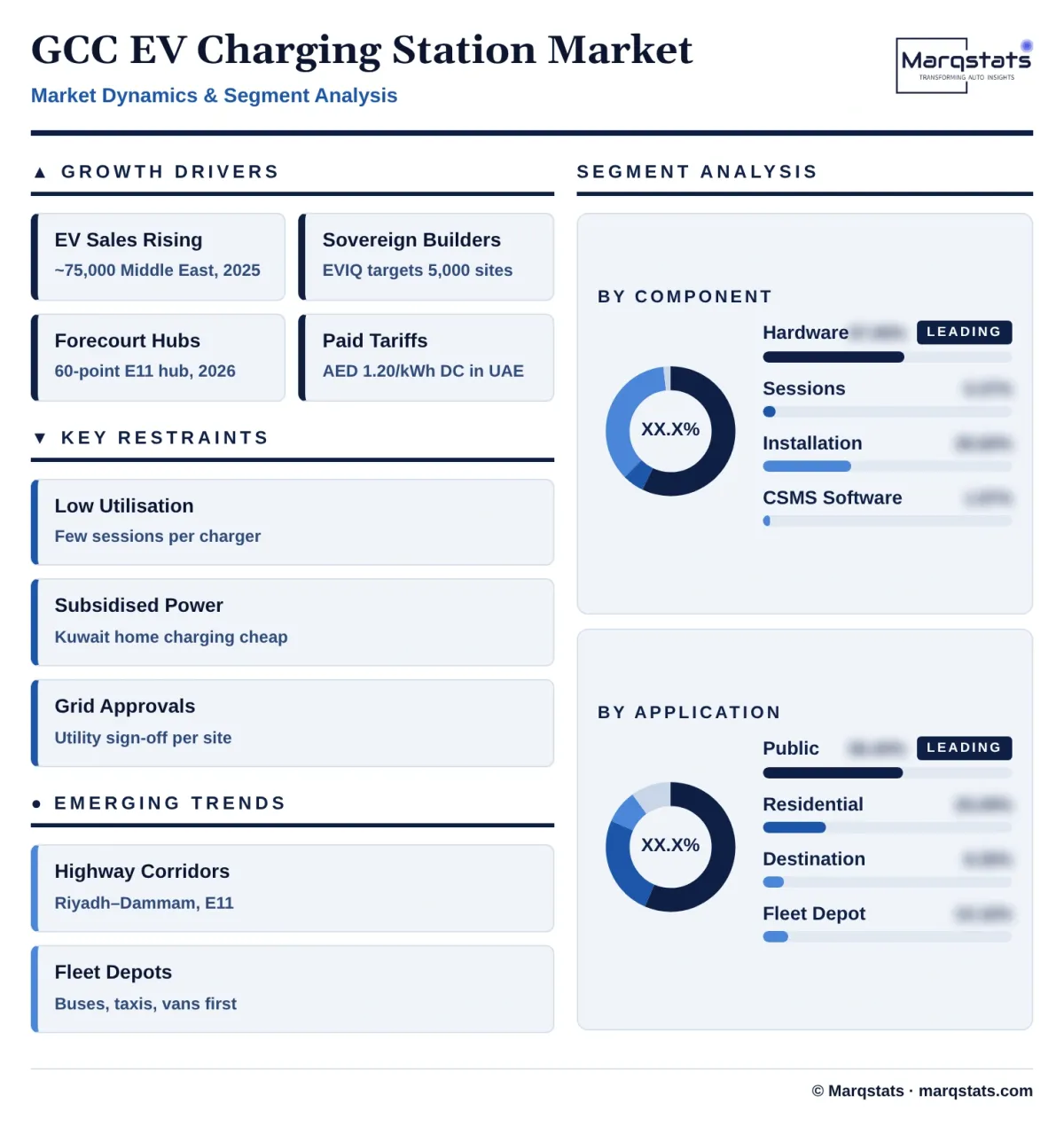
EVSE hardware accounts for 57.06% of 2025 value, USD 120.45 million, and grows at 23.13% a year to USD 340.86 million. It covers AC posts and wallboxes, DC fast and ultra-fast chargers and depot chargers, supplied by ABB E-mobility, Siemens, Schneider Electric, Tesla and Chinese makers. Its share falls to 48.78% as DC prices fall and sessions grow.
Installation and commissioning account for 35.60% of 2025 value, USD 75.15 million, and grow at 25.10% a year to USD 230.23 million. Civil works, cabling, transformers inside the site boundary, canopies and testing make up a large part of each DC site, and Gulf heat and highway locations add to that cost.
CSMS software accounts for 1.97% of 2025 value, USD 4.15 million, and grows at 39.16% a year to USD 21.66 million. Operators pay per networked point for monitoring, billing, payments and roaming, and national rules such as Kahramaa's requirement to connect every charger to its smart platform make software mandatory.
Public charging-session revenue accounts for 5.37% of 2025 value, USD 11.34 million, and grows fastest, at 56.40% a year, to USD 106.11 million and 15.18% of the market. It is the price paid by drivers at public chargers, and it is largest in the UAE, where DC sessions are charged at AED 1.20 per kWh.
Public and highway charging accounts for 56.40% of 2025 value, USD 119.06 million, and grows at 28.43% a year to USD 415.93 million. It includes city fast-charging sites, fuel station forecourts and intercity hubs such as ADNOC Distribution's The Hub on the E11, and EVIQ's planned highway corridors in Saudi Arabia.
Destination and workplace charging accounts for 8.35% of 2025 value, USD 17.63 million, and grows at 28.57% a year to USD 61.93 million. Malls, hotels, offices and car parks install AC posts and some DC units, such as the 125 Porsche Destination Chargers planned in Oman and chargers at hotels in Jabal Akhdar.
Residential charging accounts for 25.09% of 2025 value, USD 52.96 million, and grows at 19.93% a year to USD 131.38 million. Villa owners buy AC wallboxes with each new electric vehicle; Qatar and Kuwait both cap residential chargers at AC units of up to 22 kW, so this segment is hardware and installation only.
Fleet depot charging accounts for 10.16% of 2025 value, USD 21.44 million, and grows fastest, at 33.12% a year, to USD 89.62 million and 12.82% of the market. Electric bus depots in Qatar, taxi and limousine operators in Dubai and delivery van fleets buy high-power DC chargers on private sites.
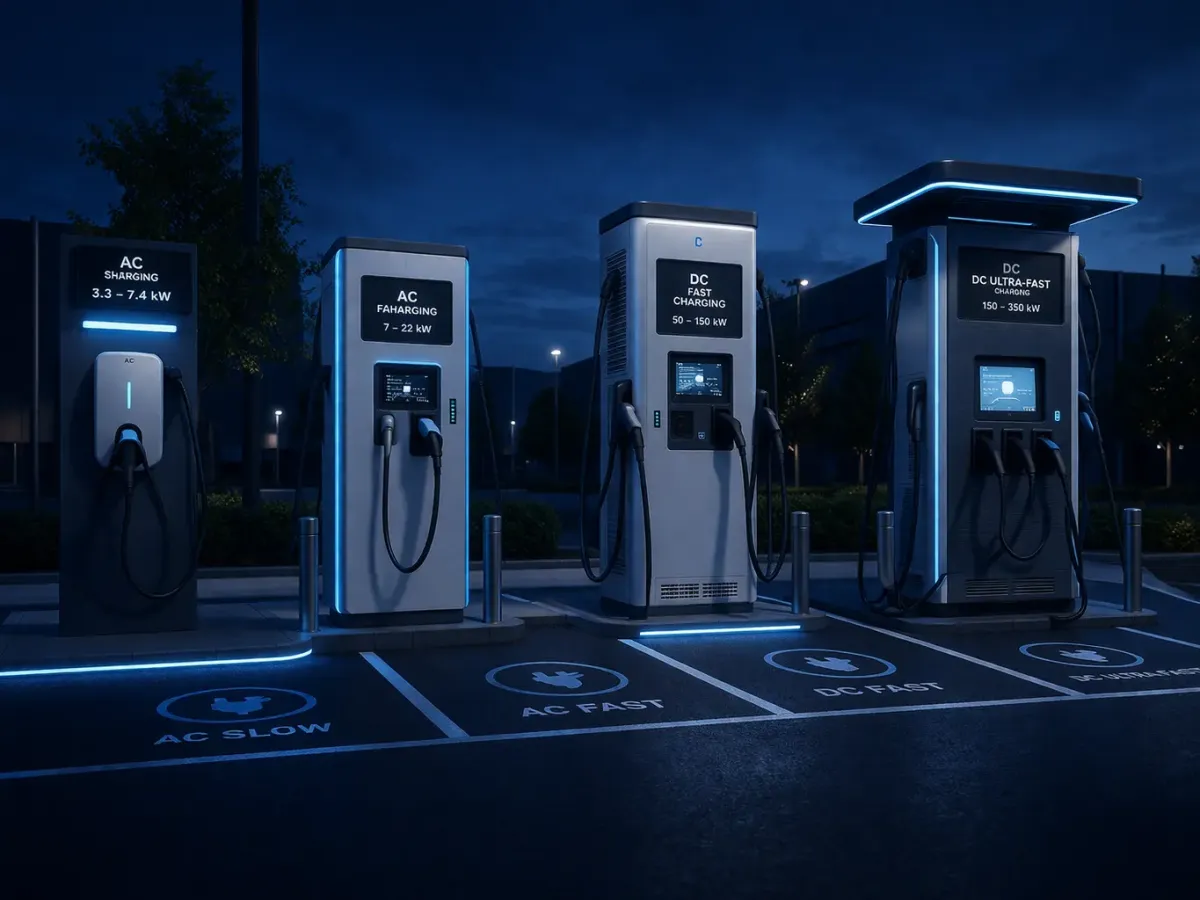
DC charging accounts for 65.41% of 2025 value, USD 138.07 million, and grows at 28.88% a year to USD 490.90 million and 70.24% of the market. It includes DC hardware, installation, software and sessions at fast, ultra-fast and depot chargers, and dominates because Gulf utilities and fuel retailers build mostly DC networks.
AC charging accounts for 34.59% of 2025 value, USD 73.02 million, and grows at 23.28% a year to USD 207.96 million. It covers home wallboxes, destination posts and workplace chargers, which are cheap per point but numerous, and AC sessions priced at AED 0.70 per kWh in the UAE.
By Geography
Saudi Arabia
Saudi Arabia accounts for 43.63% of 2025 GCC value, USD 92.09 million, and grows at 31.45% a year to USD 361.36 million and 51.70% by 2030. EVIQ is the central builder, with 32 stations operating in Riyadh, Jeddah and Dammam in November 2025 and a target of 5,000 charging stations, and Electromin, owned by Petromin Corporation, runs a commercial network. Marqstats counts about 4,500 public charging points at the end of 2025, and the Saudi slice equals the total of the Marqstats Saudi Arabia EV charging station study.
United Arab Emirates
The UAE accounts for 47.35% of 2025 GCC value, USD 99.97 million, and grows at 23.81% a year to USD 290.87 million and 41.62% by 2030. DEWA and its licensed partners ran more than 1,860 charging points in Dubai in January 2026, E2GO ran 402 points at the end of 2025 and plans up to 750, and UAEV covers the Northern Emirates. National tariffs of AED 1.20 per kWh for DC and AED 0.70 for AC make the UAE the largest market for session revenue, and the UAE slice equals the total of the Marqstats UAE EV charging station study.
Qatar
Qatar accounts for 4.27% of 2025 GCC value, USD 9.02 million, and grows at 19.93% a year to USD 22.38 million and 3.20% by 2030. Kahramaa passed 300 fast chargers in July 2025 and plans more than 1,000 charging stations by 2030. About 80.71% of Qatari value is DC, including depot chargers for an electric bus fleet that makes up 73% of public buses, and Marqstats estimates about 3,350 electric vehicle sales in 2025.
Oman
Oman accounts for 2.53% of 2025 GCC value, USD 5.34 million, and grows at 16.72% a year to USD 11.57 million and 1.66% by 2030. The Ministry of Transport, Communications and Information Technology installed 160 chargers in 2025, plans 200 more charging points in 2026 and 350 stations by 2027. Shell Oman Marketing Company, Oman Oil Marketing Company and Porsche Centre Oman add forecourt and destination chargers, and the Shahin platform links networks for drivers.
Kuwait
Kuwait accounts for 1.26% of 2025 GCC value, USD 2.65 million, and grows at 23.00% a year to USD 7.46 million and 1.07% by 2030. The Ministry of Electricity and Water issued charger installation regulations in October 2022, and private housing may install only AC chargers of up to 22 kW. Very low regulated electricity prices keep public session revenue small, so the market is led by home and destination hardware.
Bahrain
Bahrain accounts for 0.96% of 2025 GCC value, USD 2.02 million, and grows at 20.91% a year to USD 5.22 million and 0.75% by 2030. The Electricity and Water Authority opened five ultra-fast stations in October 2025 and ran 12 public stations, 10 of them ultra-fast, in June 2026. About 800 electric vehicles ran among 794,677 licensed vehicles at the end of 2025, and the 2025 charging framework lets public operators set their own prices.
How Competition Is Evolving
The market is moderately concentrated and led by state-linked builders. Utilities, sovereign-backed joint ventures and national fuel retailers own most public chargers in every GCC state: EVIQ and Saudi Electricity Company in Saudi Arabia, DEWA, ADNOC Distribution with TAQA through E2GO, ENOC and UAEV in the UAE, Kahramaa with Qatar Fuel (Woqod) in Qatar, the Electricity and Water Authority in Bahrain, and the Oman ministry with Shell Oman Marketing Company and Oman Oil Marketing Company in Oman. Operator shares are left out because operators do not disclose sessions or revenue.
Hardware is a separate competition. ABB E-mobility, Siemens, Schneider Electric, Kempower, Alpitronic, Tesla and Chinese suppliers compete for utility and fuel retailer tenders, and a contract manufacturer began charger production in Saudi Arabia in 2026, which gives local content an edge in Saudi procurement. Prices for DC chargers are falling, so suppliers compete on liquid cooling, heat tolerance, uptime guarantees and local service.
Software and operations are opening to private firms. As utilities sign operating contracts with fuel retailers and licensed operators, CSMS vendors and payment platforms compete to connect chargers to national systems such as Kahramaa's smart platform and Oman's Shahin, and roaming between networks becomes a source of revenue.
Competition is shifting from building sites to filling them. With tariffs in place in the UAE and planned in other states, operators that place chargers where taxis, ride-hailing and fleets charge every day will earn session revenue, while those that built for coverage will depend on hardware subsidies and state budgets.
Companies Covered
Companies covered in the report include:
Recent Market Activity
Table of Contents
Coverage & Segmentation
The study covers the GCC EV charging station market in Saudi Arabia, the United Arab Emirates, Qatar, Oman, Kuwait and Bahrain, with 2025 as the base year, 2021 – 2025 as the historical period and 2026 – 2030 as the forecast period. Market value is the annual sum of EVSE hardware, installation and commissioning, CSMS software and public charging-session revenue, segmented by component, application, charger type and country. Values are in US dollars at the 2025 peg rates of SAR 3.75, AED 3.6725, QAR 3.64, OMR 0.3845, BHD 0.376 and KWD 0.3068 per US dollar.
Electric vehicles, batteries, utility transmission and distribution assets upstream of the connection point, electricity sold to homes and private depots, parking fees and wireless and battery-swap systems are excluded. The Saudi Arabia and UAE slices equal the totals of the Marqstats Saudi Arabia and UAE EV charging station studies. The live Marqstats Middle East EV Charging Station report uses a narrower public-network definition across a wider geography, and the live Saudi Arabia Fleet Depot Charging and Saudi Arabia Wireless EV Charging reports cover sub-markets that overlap with this one; their figures should not be added.