Market Snapshot
Middle bar: base-year value × (1 + CAGR), rounded to two decimals. This is a calculated illustration, not a separately researched annual estimate.
The United States robotaxi market size is estimated at USD 281.00 million in 2025 and is projected to reach USD 5,440.00 million by 2030, growing at a CAGR of 80.87% over 2026 – 2030. Paid driverless trips rise from about 15.19 million to 340 million a year, an 86.20% annual rate, while the active commercial fleet grows from about 2,700 vehicles to 68,000.
Marqstats defines the market as gross passenger fares from paid, point-to-point ride-hailing services that run at SAE Level 4 with no human driver in the vehicle. It covers fares paid through operator apps such as Waymo One and through ride-hailing platforms such as Uber, including base fares, distance and time charges and dynamic pricing. Taxes, airport surcharges and tips are excluded, as are autonomous trucking, consumer driver-assistance systems such as Tesla FSD Supervised, privately owned Level 3 cars, unpaid testing and vehicle or sensor sales.
Fares booked through operators' own apps account for an estimated 88.00% of 2025 revenue and urban surface-street trips for 95.00%. California accounts for 62.31% of 2025 revenue and Arizona for 28.47%. The study segments the market by booking channel, trip type and state.
Key Takeaways
Market Overview & Analysis
Report Summary
Marqstats sizes the US robotaxi market as gross passenger fares from paid Level 4 ride-hailing with no safety driver on board. In 2025 the market was worth an estimated USD 281.00 million from about 15.19 million paid trips, of which Waymo carried about 15 million. The remaining trips came from pilots such as Zoox in Las Vegas and May Mobility microtransit services.
Commercial service needs two kinds of approval. Vehicles must be allowed to operate without a driver under state motor vehicle law, and operators must hold authority to carry paying passengers. In California this means a driverless deployment permit from the Department of Motor Vehicles and a driverless deployment authorisation from the California Public Utilities Commission. Arizona allows driverless operation under a light-touch executive framework, Texas preempts local rules and since 28 May 2026 requires commercial operators to hold an authorisation from the Texas Department of Motor Vehicles, and Nevada licenses operators through its motor vehicle and taxi authorities.
Operations started small. Waymo began fully driverless rides in Phoenix in 2020 and paid driverless service in San Francisco in August 2023, after which statewide driverless trips in California grew by about 15% a month. Cruise, once the second-largest operator, halted its driverless service in late 2023 after a pedestrian incident in San Francisco, and General Motors ended its robotaxi business in December 2024.
The market grew from about USD 4.50 million in 2021 to USD 16.80 million in 2022, USD 68.50 million in 2023 and USD 95.00 million in 2024. Waymo quadrupled paid trips in 2025, lifting the market to USD 281.00 million, and Marqstats expects USD 471.20 million in 2026 as Waymo adds cities and Zoox and Tesla begin paid service.
The market is tiny compared with human ride-hailing. Uber alone reported USD 193.5 billion of global gross bookings and 13.6 billion trips in 2025, so robotaxis carried only a small fraction of US ride-hailing trips. The gap shows both how early the market is and how much demand driverless services can address if costs fall.
Service models differ by operator. Waymo runs its own app in most cities and sells rides through Uber in Austin and Atlanta, with fleet partners such as Moove handling vehicle cleaning, charging and maintenance in some markets. Zoox runs a vertically integrated model, designing, building and operating its own vehicle and app. Tesla runs its own app with Model Y vehicles and Cybercab, and May Mobility runs shared microtransit services with public agencies and Lyft. These differences shape fares, margins and how quickly each operator can enter new cities.
Remote assistance is part of every service. Operators keep staff who advise vehicles that encounter unusual situations, such as blocked lanes or emergency scenes, and the ratio of vehicles to remote staff is a key cost. As software improves and fleets grow, each remote assistant supports more vehicles, lowering the cost per trip and helping operators move toward profitability.
United States Robotaxi Market Size and Forecast
The United States robotaxi market grows from USD 281.00 million in 2025 to USD 5,440.00 million in 2030, a CAGR of 80.87%. Marqstats expects USD 471.20 million in 2026, USD 962.00 million in 2027, USD 1,890.00 million in 2028 and USD 3,315.00 million in 2029.
Trips drive growth. Marqstats estimates paid trips of about 24.8 million in 2026, 52 million in 2027, 105 million in 2028, 195 million in 2029 and 340 million in 2030. Waymo alone reported about 400,000 paid rides a week in February 2026 and about 500,000 by mid-2026, and targets one million a week by the end of 2026.
Fleet growth supports trips. The active commercial fleet grows from about 2,700 vehicles at the end of 2025 to 68,000 in 2030, a 90.65% annual rate. Waymo had about 2,500 vehicles in November 2025, spread across San Francisco, Los Angeles, Phoenix, Austin and Atlanta, and roughly 3,500 by July 2026.
Fares ease over time. Marqstats estimates an average fare of about USD 18.50 per trip in 2025, based on base fares of about USD 2.75, distance charges of about USD 3.15 per passenger mile and time charges, over an average trip of about 4.1 miles. The average falls to about USD 16.00 by 2030 as freeway, airport and suburban trips grow and operators price closer to human ride-hailing.
Utilisation is the swing factor. Marqstats estimates that each USD 1.00 change in the average 2025 fare moves the base-year market by about USD 15.19 million, or 5.41%, and that each additional two paid trips per vehicle per day adds about USD 13,500 of annual revenue per vehicle.
The mix of revenue changes over the forecast. Ride-hailing platforms rise from 12.00% to 55.00% of fares, freeway and airport trips from 5.00% to 30.00%, and states outside California and Arizona from 9.21% to 53.49%. California remains the single largest state, but its share falls from 62.31% to 31.99% as Texas, Florida, Georgia, Nevada and Colorado add large fleets.
Vehicle types shift too. In 2025 all paid trips used converted passenger vehicles, mainly Jaguar I-PACE SUVs with Waymo sensors. By 2030 Marqstats expects about 50,000 of the 68,000 active vehicles, about 73.53%, to be purpose-built robotaxis such as the Zeekr-built Waymo Ojai, the Zoox vehicle and Tesla Cybercab, with converted vehicles making up the remaining 18,000. Lower vehicle costs let operators price closer to human ride-hailing while improving margins.
Market Dynamics
Key Drivers
Five forces are expanding paid driverless ride-hailing in the United States.
- Safety evidence builds public trust. Swiss Re's study with Waymo and research by the Insurance Institute for Highway Safety in 2026 found Waymo vehicles crash less often than human drivers, supporting regulators' approvals and riders' willingness to use the service.
- City expansion. Waymo operated in 11 US metros by May 2026, including Phoenix, San Francisco, Los Angeles, Austin, Atlanta, Miami, Dallas, Houston, San Antonio and Orlando, began fully driverless operations in Las Vegas in July 2026 and plans Denver, San Diego, Tampa, Nashville, Washington and Detroit.
- Capital is available. Waymo raised USD 16 billion in February 2026 at a valuation of about USD 126 billion, and Amazon funds Zoox, giving leading operators money to buy vehicles and expand.
- Ride-hailing platforms add demand. Uber and Lyft partner with robotaxi operators so new services can fill vehicles from day one, and Uber says it aims to become the largest facilitator of autonomous trips in the world.
- Purpose-built vehicles cut costs. Waymo moved about 300 Zeekr-built Ojai vehicles into paid service in August 2026, Zoox runs its own bidirectional vehicle, and Tesla began public Cybercab rides in Austin in September 2026, lowering vehicle cost per mile compared with converted luxury SUVs.
- Labour savings. A human ride-hailing trip pays the driver most of the fare, while a robotaxi replaces the driver with remote assistance, depot staff and software. As vehicle and remote-assistance costs fall, operators can match human ride-hailing prices and still improve margins, which supports investment in more vehicles and cities.
Key Restraints
Four constraints limit how fast US robotaxi revenue can scale.
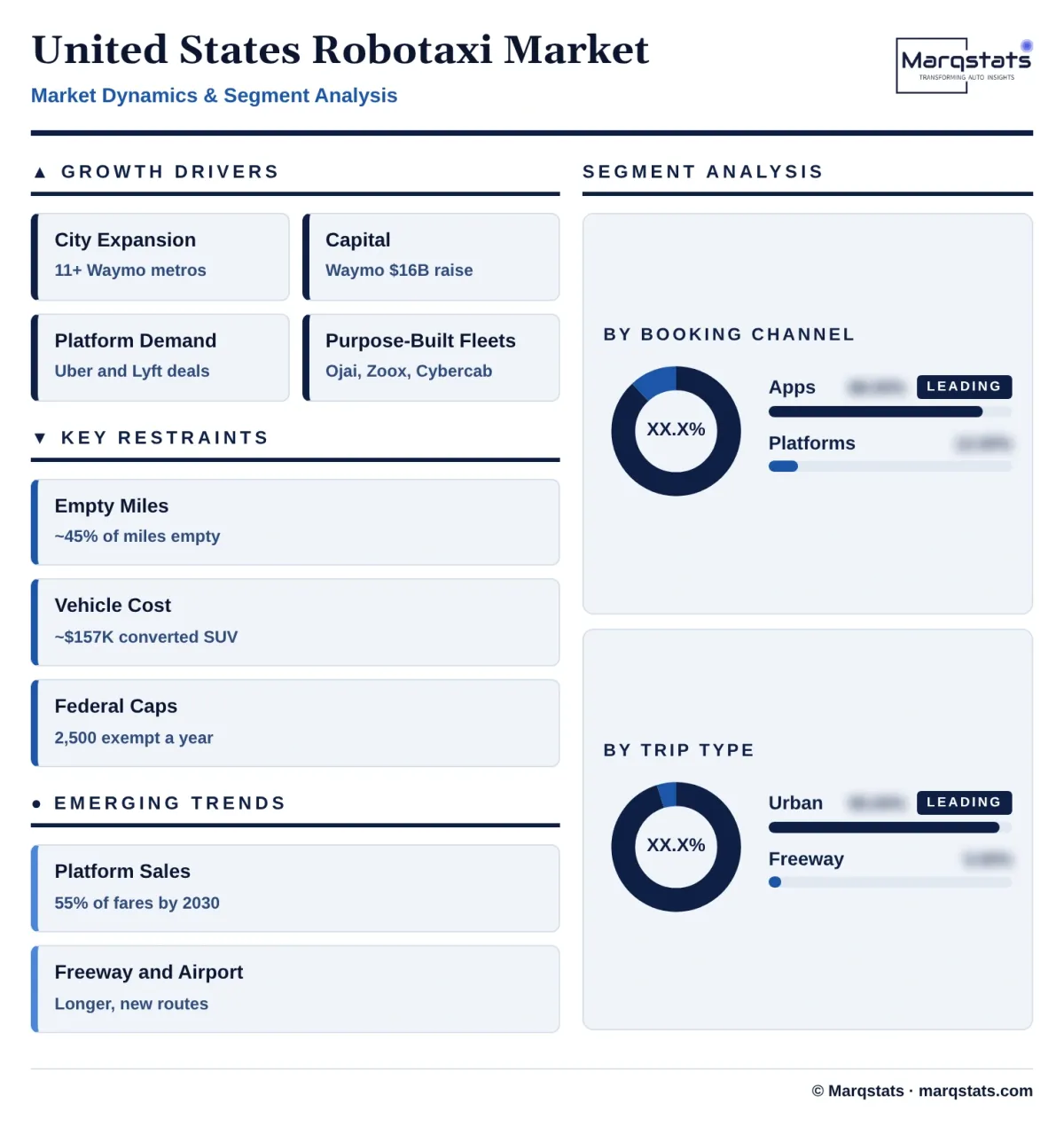
- Empty miles. Robotaxis drive roughly 45% of their miles without passengers, adding energy, depreciation and congestion costs that limit how much each vehicle can earn.
- Vehicle cost. Marqstats estimates a converted Jaguar I-PACE with sensors and computers costs about USD 157,000, giving depreciation of about USD 0.24 per mile over 350,000 miles, more than the cost of electricity.
- Federal limits on vehicles without controls. Part 555 exemptions are capped at 2,500 vehicles a year per manufacturer, and NHTSA opened an audit in September 2026 into how Tesla certified Cybercab as meeting federal safety standards.
- Local resistance and enforcement. California cities sought local control through Senate Bill 915, which did not pass, and from 1 July 2026 Assembly Bill 1777 lets police issue notices of noncompliance to robotaxi companies and requires a 24-hour line for emergency responders.
- Demand limits inside service areas. California filings show statewide monthly trips flattening in mid-2026 after rapid growth, suggesting that fixed service areas reach a ceiling until operators add freeways, airports and suburbs.
Key Trends
Four shifts are changing how US robotaxi services are built, sold and run.
- From own apps to platforms. Operators increasingly sell trips through Uber and Lyft in new cities, trading some margin for faster utilisation.
- Freeway and airport trips. Waymo began freeway rides in the San Francisco Bay Area, Los Angeles and Phoenix in late 2025 and serves airports such as Phoenix Sky Harbor and San Jose, raising average trip length and opening higher-value routes.
- Purpose-built fleets. Operators are moving from converted SUVs to vehicles designed for driverless service, including the Zeekr-built Waymo Ojai, the Zoox robotaxi and Tesla Cybercab.
- State authorisation regimes. Texas now requires commercial operators to hold a state authorisation, and California has added citation and emergency-response rules, so operators need compliance teams in every state they enter.
- Safety reporting and transparency. Operators report crashes to NHTSA under its Standing General Order and publish safety data, and these records are increasingly used by regulators, insurers and cities when deciding where services may expand.
Strategic Implications
- For operators, utilisation matters more than fleet size. Cutting empty miles through better dispatch, platform partnerships and denser service areas lifts revenue per vehicle faster than adding vehicles.
- For ride-hailing platforms, robotaxis are a new supply source. Platforms that integrate several operators can offer driverless rides in more cities without owning vehicles, while sharing fare revenue with operators.
- For vehicle makers, purpose-built supply is the opportunity. Operators need vehicles designed for 400,000-plus miles, easy sensor cleaning and high utilisation, at a much lower cost than converted luxury SUVs.
- For cities and states, data and enforcement rules matter. Clear authorisation, incident reporting and curb-access rules let services expand while giving local agencies tools to manage congestion and emergencies.
- For insurers and investors, high liability limits and a concentrated market mean exposure is tied closely to the performance of a few operators, so data access and safety records are central to underwriting and valuation.
- For energy and charging providers, robotaxi depots are a growing load. Fleets of thousands of vehicles need large charging depots near dense service areas, creating demand for grid connections, depot charging and maintenance facilities in every metro where operators expand.
- For transit agencies, robotaxis can complement buses and rail. Shared or pooled driverless rides can serve first- and last-mile trips and low-density areas, and agencies that set data-sharing terms early can use robotaxi trip data to plan routes and curb space.
Market Segmentation
Trips booked through operators' own apps, mainly Waymo One, account for an estimated 88.00% of 2025 revenue, USD 247.28 million, rising to USD 2,448.00 million by 2030, a 58.17% CAGR, while their share falls to 45.00%. Operators keep the full fare and control customer data, but must pay to attract riders in each new city.
Trips booked through Uber, Lyft and other platforms account for an estimated 12.00% of 2025 revenue, USD 33.72 million, and grow fastest, at 145.25% a year, to USD 2,992.00 million and 55.00% of revenue by 2030. Waymo serves Austin and Atlanta through Uber and plans Nashville with Lyft, and other operators rely on platforms to fill vehicles from launch.
Trips on city streets within geofenced service areas account for an estimated 95.00% of 2025 revenue, USD 266.95 million, rising to USD 3,808.00 million by 2030, a 70.16% CAGR, while their share falls to 70.00%.
Trips that use freeways or serve airports account for an estimated 5.00% of 2025 revenue, USD 14.05 million, and grow at 158.83% a year to USD 1,632.00 million and 30.00% of revenue by 2030, as Waymo extends freeway service and airport pickups and Zoox serves Las Vegas resort and airport corridors.
By Geography
California
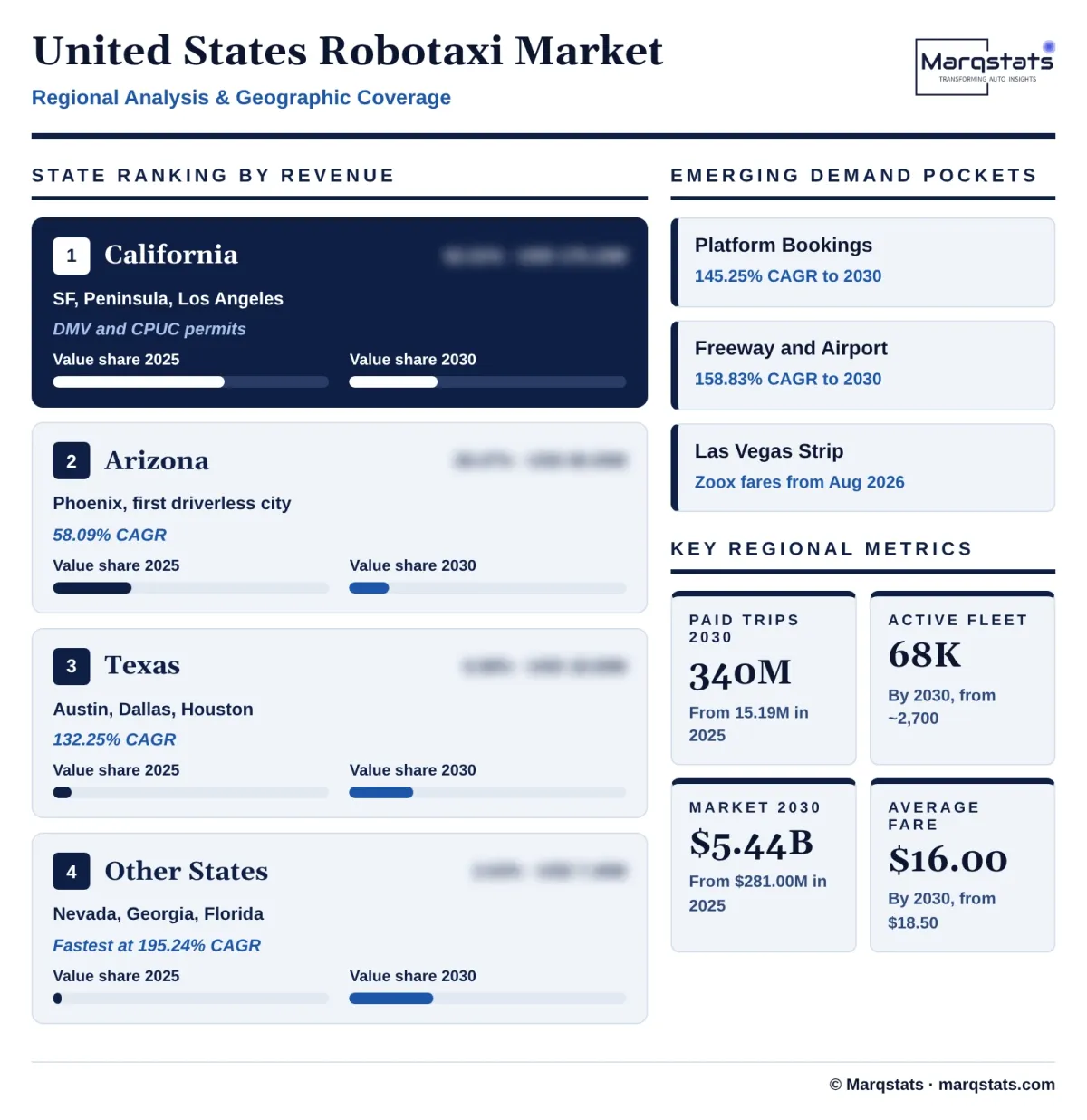
California is the largest market, with an estimated 62.31% of 2025 revenue, USD 175.10 million from about 9.46 million trips, rising to USD 1,740.00 million by 2030, a 58.29% CAGR, while its share falls to 31.99%. Waymo serves San Francisco, the Peninsula and Los Angeles under DMV and CPUC permits, and statewide driverless trips passed one million a month in 2025. Assembly Bill 1777, in force from 1 July 2026, lets police issue notices of noncompliance to operators.
Arizona
Arizona accounts for an estimated 28.47% of 2025 revenue, USD 80.00 million, rising to USD 790.00 million by 2030, a 58.09% CAGR. Phoenix was the first US city with fully driverless paid rides and has about 500 Waymo vehicles, including service to Phoenix Sky Harbor airport. Light state regulation allowed Phoenix to become the testing ground for driverless operations, and the metro's wide roads, dry weather and suburban layout support longer trips and freeway service.
Texas
Texas accounts for an estimated 6.58% of 2025 revenue, USD 18.50 million, and grows at 132.25% a year to USD 1,250.00 million and 22.98% of revenue by 2030. State law bars cities from regulating automated vehicles, and from 28 May 2026 commercial operators need a Texas Department of Motor Vehicles authorisation. Waymo serves Austin with Uber and has added Dallas, Houston and San Antonio, and Tesla registered 42 robotaxis in Texas by June 2026.
Other States
Nevada, Georgia, Florida and other states account for an estimated 2.63% of 2025 revenue, USD 7.40 million, and grow fastest, at 195.24% a year, to USD 1,660.00 million and 30.51% of revenue by 2030. Waymo runs paid service in Atlanta and Miami and began driverless operations in Las Vegas in July 2026, and Zoox began charging fares on the Las Vegas Strip in August 2026. Florida and Georgia allow driverless operation under state law without local permits, and Waymo has announced further launches in Denver, San Diego, Nashville, Washington and Detroit, so the share of revenue from states outside California, Arizona and Texas rises steadily through 2030. Each new metro adds a period of free or discounted rides before fares reach full levels.
How Competition Is Evolving
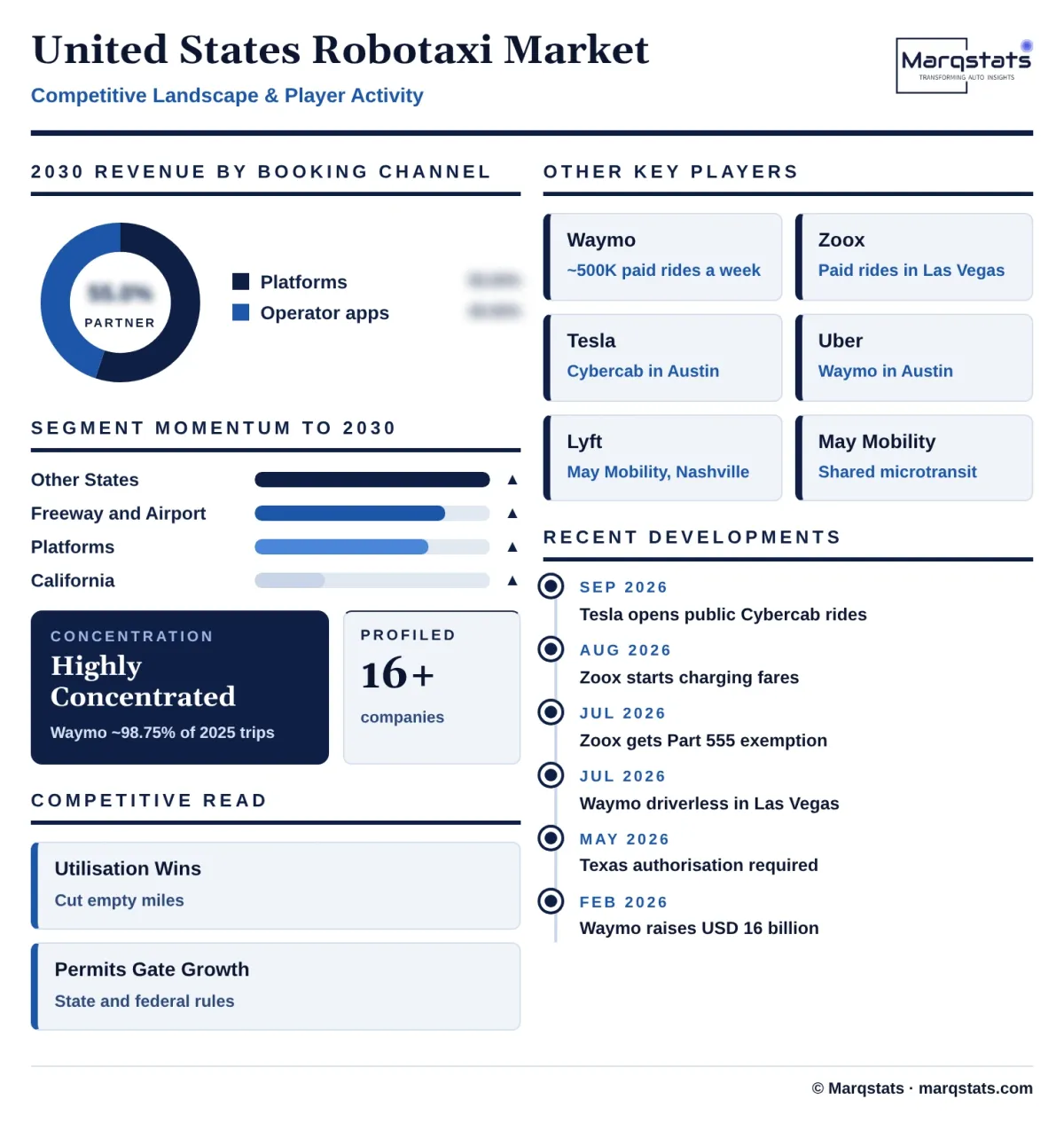
The US robotaxi market is highly concentrated. Waymo carried about 98.75% of paid driverless trips in 2025 and by mid-2026 ran roughly 3,500 vehicles in more than ten metros, with more than 20 million lifetime rides.
Challengers are entering paid service. Zoox, owned by Amazon, began charging fares in Las Vegas on 10 August 2026 after carrying about one million riders in free service in Las Vegas, San Francisco, Austin and Miami. Tesla launched a robotaxi service in Austin in June 2025, began unsupervised rides in January 2026 and had 42 vehicles registered in Texas by June 2026, before opening public Cybercab rides in September 2026.
Platforms shape distribution. Uber works with Waymo in Austin and Atlanta and with other operators, and announced in July 2025 a plan with Lucid and Nuro to deploy robotaxis on its network. Lyft has partnered with May Mobility and with Waymo for Nashville.
Competition will be decided by cost per mile, utilisation and approvals. Operators that cut vehicle costs, reduce empty miles and secure permits in many states will capture most of the growth.
Financial backing differs sharply. Waymo sits in Alphabet's Other Bets segment, which reported about USD 1.5 billion of revenue and an operating loss of about USD 7.5 billion in 2025, and raised outside capital in 2026. Zoox depends on Amazon, and Tesla funds its robotaxi programme from its car business. Smaller operators rely on partnerships with carmakers, platforms and transit agencies, and several earlier entrants, including Cruise, have exited.
Partnerships with carmakers will matter more as fleets grow. Waymo works with Zeekr, Hyundai and Magna on vehicle supply and integration, Lyft and May Mobility build on Toyota vehicles, and Uber, Lucid and Nuro plan a dedicated robotaxi fleet, so access to low-cost, high-durability vehicles becomes a competitive advantage.
Companies Covered
Companies covered in the report include:
Recent Market Activity
Table of Contents
Coverage & Segmentation
The study covers the United States robotaxi market, with 2025 as the base year, 2021 – 2025 as the historical period and 2026 – 2030 as the forecast period. Values are gross passenger fares in US dollars. The market is segmented by booking channel, trip type and state.
Taxes, airport surcharges, tips, autonomous freight, consumer driver-assistance systems, privately owned Level 3 vehicles, unpaid testing and vehicle and sensor sales are excluded. Fare, trip, fleet, channel and state splits are Marqstats estimates built on operator disclosures, state permit data, published research on California operations and ride-hailing price benchmarks.