Market Snapshot
Middle bar: base-year value × (1 + CAGR), rounded to two decimals. This is a calculated illustration, not a separately researched annual estimate.
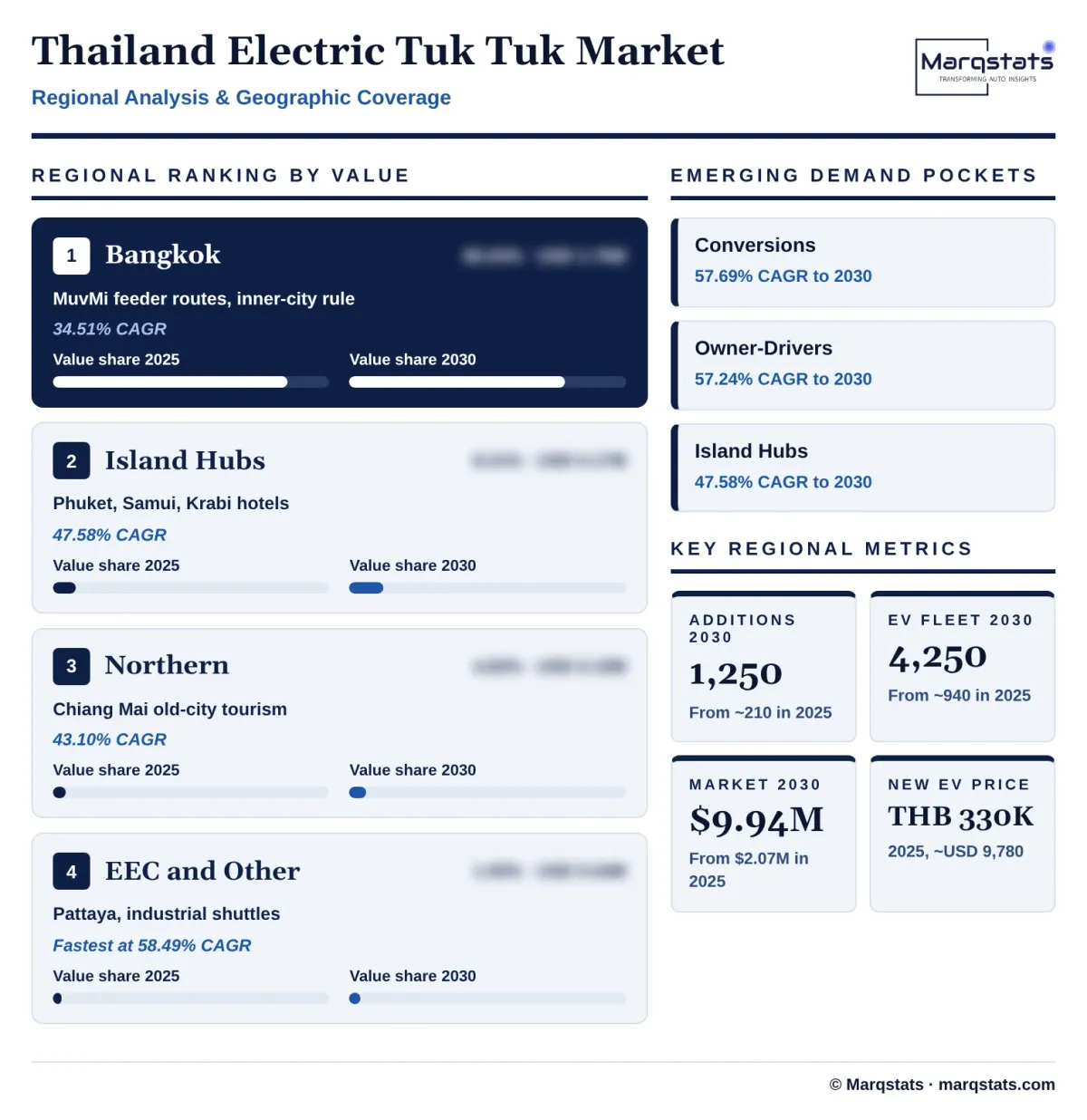
The Thailand electric tuk tuk market size is estimated at USD 2.07 million in 2025 and is projected to reach USD 9.94 million by 2030, growing at a CAGR of 36.86% over 2026 – 2030. Annual additions of road-legal electric tuk-tuks, including certified conversions of petrol and LPG vehicles, rise from about 210 units to 1,250, a 42.87% annual rate, while the electric fleet on the road grows from about 940 to 4,250 vehicles.
Marqstats defines the market as the value of new purpose-built electric tuk-tuks sold to fleets and drivers, certified conversions of combustion tuk-tuks to battery electric power, and replacement traction batteries for the electric fleet, at ex-factory and installed prices. Only three-wheelers that meet Department of Land Transport rules for public tricycles, including a top speed of at least 45 km/h, are counted. Low-speed resort and farm tricycles, electric motorcycles, cars, buses, charging services and fare revenue are excluded. Values are converted at THB 33.74 per USD, the 2025 annual average.
Purpose-built vehicles account for an estimated 82.61% of 2025 value, platform and corporate fleets buy 80.19% of it, and the Bangkok Metropolitan Area holds 85.03%. The study segments the market by product, buyer type and region.
Key Takeaways
Market Overview & Analysis
Report Summary
Marqstats sizes the Thailand electric tuk tuk market as spending on new purpose-built electric tuk-tuks, certified conversions of combustion tuk-tuks and replacement traction batteries. In 2025 about 210 electric tuk-tuks were added to Thai roads, about 175 purpose-built vehicles and about 35 conversions, and about 89 replacement battery packs were fitted, for a market of about THB 69.7 million, or USD 2.07 million at THB 33.74 per USD.
The tuk-tuk is one of Thailand's best-known vehicles but a small part of its fleet. Motorised three-wheelers replaced pedal rickshaws from the 1960s, moved from two-stroke petrol engines to LPG in the 1990s, and more than 8,500 were registered in Bangkok at the end of June 2026, most of them between 10 and 50 years old. Tuk-tuks make up only about 0.04% of Thailand's registered vehicles, and new registrations have been flat or falling for years because public tricycle licences are restricted by area.
Electric tuk-tuks entered through ride-pooling, not individual drivers. MuvMi, a Chulalongkorn University spin-off operated by Urban Mobility Tech, launched app-booked shared rides in six-seat electric tuk-tuks in Bangkok and grew from about 350 vehicles in January 2023 to more than 600 in 12 neighbourhoods by early 2024 and more than 800 with about 700 drivers by August 2025. Roughly 1,000 electric tuk-tuks were on Thai roads in 2026, most of them MuvMi vehicles.
Registrations have been uneven. Marqstats estimates about 80 electric tuk-tuks were added in 2021, about 240 in 2022 as MuvMi scaled up, about 230 in 2023 and about 155 in 2024, before a recovery to about 210 in 2025. Market value followed, from USD 0.76 million in 2021 to USD 2.37 million in 2022, USD 2.30 million in 2023 and USD 1.57 million in 2024, a 28.47% annual rate over 2021 to 2025 despite the 2023 and 2024 dip.
The national plan aims much higher. Targets in the 2025 – 2035 e-mobility action plan prepared with Asian Development Bank support call for 500 electric tuk-tuks in 2025 and 2,200 registrations in 2030. Marqstats expects 1,250 additions in 2030, below the target but more than five times the 2025 level, because the inner Bangkok restriction on combustion tuk-tuks and fleet financing only partly offset slow licensing and limited driver capital.
Rules shape which vehicles count. The Department of Land Transport registers electric tricycles for public use only if they meet minimum motor power and a top speed of at least 45 km/h, which excludes most imported low-speed electric tricycles sold for resorts, farms and factories. Public tuk-tuk licences are also limited by area, so most growth comes from replacing or converting existing licensed vehicles rather than from new licences.
Policy has moved from pilots to restrictions. Early support came from university conversion projects and development finance, but in July 2026 the Department of Land Transport proposed keeping combustion tuk-tuks out of inner Bangkok. Electric tuk-tuks would be exempt, and alternatives such as a gradual switch or limits only at rush hour were also discussed. The outcome is the single biggest influence on demand to 2030.
Thailand Electric Tuk Tuk Market Size and Forecast
The Thailand electric tuk tuk market grows from USD 2.07 million in 2025 to USD 9.94 million in 2030, a CAGR of 36.86%. Marqstats estimates USD 2.48 million in 2026, USD 3.75 million in 2027, USD 5.43 million in 2028 and USD 7.52 million in 2029. Annual additions rise from about 210 vehicles in 2025 to 260 in 2026, 420 in 2027, 640 in 2028, 920 in 2029 and 1,250 in 2030.
Purpose-built vehicles remain the core of the market. Sales of new electric tuk-tuks rise from about 175 units and USD 1.71 million in 2025 to about 875 units and USD 7.78 million in 2030, a 35.39% CAGR. Their share of market value eases from 82.61% to 78.27% as conversions grow faster.
Prices ease as batteries get cheaper. Marqstats estimates the average ex-factory or fleet price of a purpose-built six-seat electric tuk-tuk with a 72 V lithium iron phosphate pack falls from about THB 360,000 in 2021 and THB 330,000, about USD 9,780, in 2025 to THB 300,000, about USD 8,890, in 2030. A certified conversion costs about THB 150,000 in 2025, falling to THB 140,000 by 2030 as kits are standardised.
The fleet on the road grows faster than sales value. The electric tuk-tuk fleet rises from about 940 vehicles at the end of 2025 to about 1,185 in 2026, 2,195 in 2028 and 4,250 in 2030, a 35.22% annual rate. Replacement battery demand follows the fleet, with Marqstats estimating about 12% of the previous year's fleet needs a new pack each year, worth USD 0.20 million in 2025 and USD 0.60 million in 2030.
The baht forecast tracks the dollar forecast at a constant exchange rate. The market grows from about THB 69.7 million in 2025 to THB 335.2 million in 2030. A stronger or weaker baht would move dollar values but not baht values or unit volumes.
Marqstats tracks four indicators to monitor the forecast: the outcome of the inner Bangkok ministerial regulation, new registrations of electric public tricycles by the Department of Land Transport, MuvMi fleet growth against the 1,500 vehicles financed under the ADB loan, and the number of certified conversion workshops.
The mix of buyers changes over the forecast. Platform and corporate fleets fall from 80.19% to 61.97% of value, independent owner-drivers rise from 14.98% to 29.98% and hotels, resorts and institutions from 4.83% to 8.05%. Bangkok's share eases from 85.03% to 77.97% as tourist islands, northern cities and the Eastern Economic Corridor grow faster from small bases.
Growth is back-loaded. Additions rise by only about 50 vehicles in 2026 because the inner Bangkok regulation is still under review, then accelerate from 2027 as Marqstats assumes a phased restriction, more conversion workshops and further fleet financing. If the restriction is dropped, growth would depend mainly on MuvMi and tourist operators.
Market Dynamics
Key Drivers
Five forces are pushing Thailand's tuk-tuk fleet toward electric power.
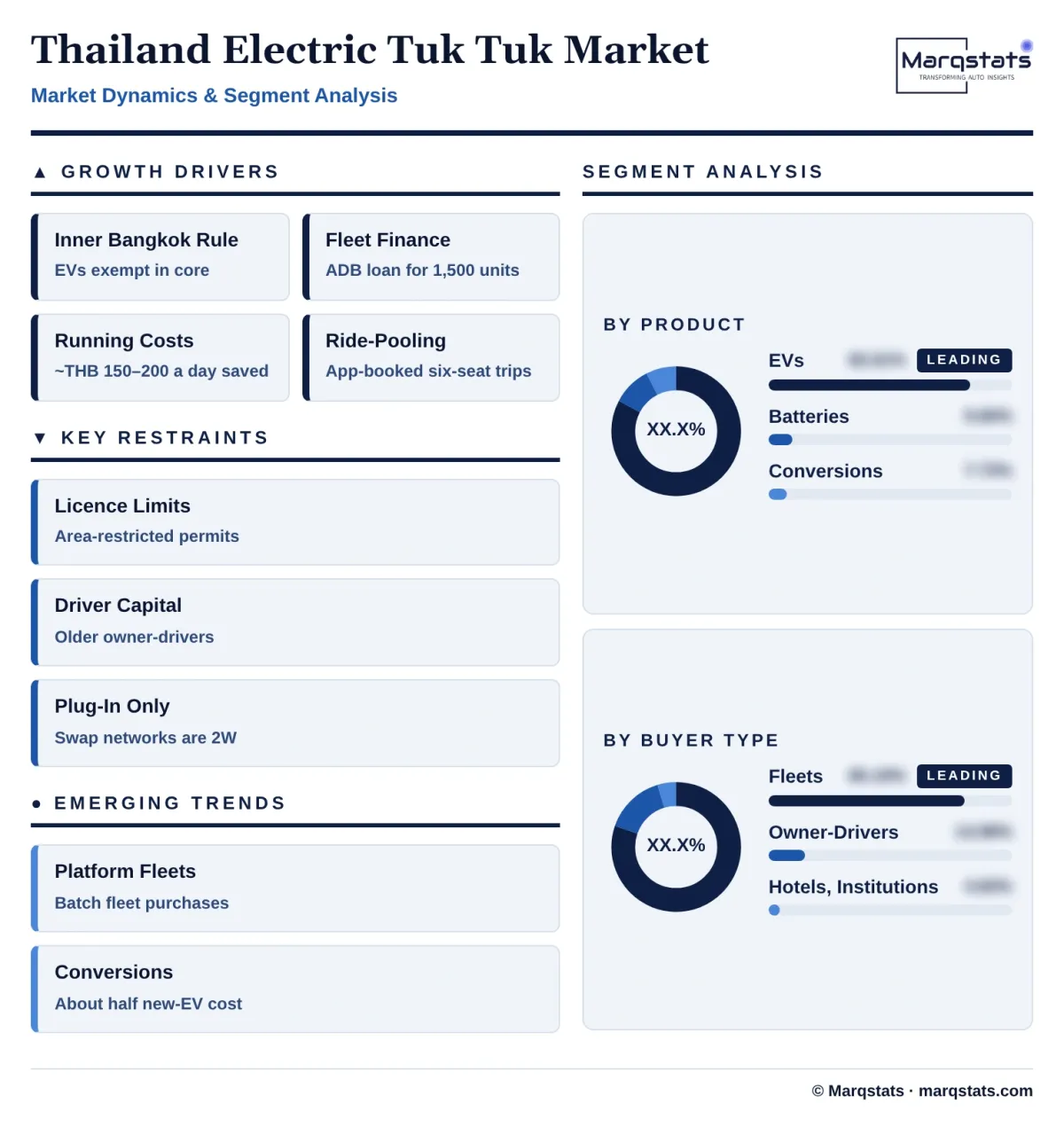
- Inner Bangkok restrictions on combustion tuk-tuks. The Department of Land Transport draft ministerial regulation would bar petrol and LPG three-wheeled taxis from inner Bangkok, home to the Grand Palace, the Temple of the Emerald Buddha and other royal temples, unless they operate during periods announced by traffic officers. Electric tuk-tuks would be exempt, giving owners a direct reason to switch.
- Fleet financing from development lenders. The Asian Development Bank signed a THB 2.4 billion loan with BANPU in January 2024 that supports financing for 1,500 six-seat electric tuk-tuks for the MuvMi service and related chargers, alongside a concessional loan of up to USD 10.7 million from the Clean Technology Fund.
- Lower running costs. An electric tuk-tuk avoids LPG or petrol and engine servicing. Marqstats estimates that a high-mileage tuk-tuk saves about THB 150 to 200 a day in energy and maintenance, which repays the cost of a certified conversion in two to three years.
- Ride-pooling demand. App-booked shared rides fill six seats on short trips between mass transit stations, offices, universities and markets. MuvMi has carried several million passengers since 2018, showing steady demand for short electric feeder trips.
- Tourism and noise. Hotels, resorts and tour operators in Bangkok, Phuket, Samui and Chiang Mai want quiet, clean vehicles for guest transfers and historic districts, and the inner Bangkok proposal is framed around noise and air pollution in tourist areas.
- Licensed fleet replacement. Most of Bangkok's combustion tuk-tuks are 10 to 50 years old, so even without a ban, owners face rising repair costs and need replacement vehicles or engines, which favours conversion to electric power.
Key Restraints
Four constraints keep electric tuk-tuk sales small despite strong policy interest.
- Restricted public tricycle licences. Public tuk-tuk registrations are limited by area, which keeps the total fleet small and means a new electric tuk-tuk usually replaces an existing licence rather than adding demand.
- Driver capital. Many tuk-tuk owners are older drivers with paid-off vehicles. A driver interviewed in October 2026 said he had paid THB 500,000 for his motorised tuk-tuk and that converting it was beyond his means, so a ban without support would hurt incomes rather than speed adoption.
- Charging access. Thailand's motorcycle battery swapping networks, including Swap & Go, are built for electric motorcycles, so electric tuk-tuks rely on plug-in charging at depots, homes and public stations.
- Policy uncertainty. The inner Bangkok regulation was still undecided in October 2026, with alternatives such as a gradual switch or rush-hour-only limits under discussion, and a proposed national vehicle trade-in scheme was reportedly shelved in June 2026.
- Small volumes raise unit costs. With only a few hundred electric tuk-tuks built each year, builders and converters cannot spread engineering, certification and tooling costs over large runs, keeping prices high relative to used combustion tuk-tuks.
Key Trends
Four shifts are changing how electric tuk-tuks are built, financed and operated in Thailand.
- Platform-owned fleets. Corporate operators that own vehicles, chargers and booking apps add vehicles in large batches and control most of the electric fleet, unlike the owner-driver model of combustion tuk-tuks.
- Certified conversions. Conversion kits that replace an LPG engine with an electric motor and lithium iron phosphate pack let owners keep their licensed vehicle and its classic body, at about half the cost of a new electric tuk-tuk.
- Lithium iron phosphate packs. 72 V LFP packs are becoming standard because they handle heat and daily cycling well, and falling cell prices lower vehicle and replacement battery costs.
- Depot charging with solar support. Operators are pairing overnight depot charging with solar power, including BANPU's mobile solar charging trailer shown with MuvMi vehicles in January 2025.
- Multi-mode mobility apps. MuvMi added canal taxi-boat bookings on the Phadung Krung Kasem canal in February 2026, showing how electric tuk-tuk operators are becoming wider urban mobility platforms.
Strategic Implications
- For tuk-tuk builders and converters, certification is the gateway. Workshops that can deliver Department of Land Transport approved conversions at a predictable price will capture owners facing the inner Bangkok restriction.
- For platform operators, fleet scale depends on finance. The ADB-backed loan shows that development lenders will fund electric tuk-tuks where an operator owns the vehicles and controls revenue, a model operators in Phuket, Chiang Mai and Pattaya can copy.
- For policymakers, support for owner-drivers decides whether a ban speeds electrification or removes tuk-tuks. Conversion grants, low-interest loans or licence transfers would let existing drivers switch rather than leave the trade.
- For battery and component suppliers, the market is small but growing quickly from a low base. Standard 72 V LFP packs, motors and controllers that fit both purpose-built vehicles and conversion kits offer the best volume.
- For charging providers, depot charging matters more than public stations. Overnight charging at fleet depots and drivers' homes, with fast charging at key ranks, fits how tuk-tuks are used.
- For investors, the market is a niche with a clear policy trigger. Values are small, but a confirmed inner Bangkok restriction would create steady demand for conversions, vehicles, batteries and depot charging across a licensed fleet of more than 8,500 tuk-tuks in Bangkok alone.
Market Segmentation
New electric tuk-tuks account for 82.61% of 2025 value, USD 1.71 million and about 175 vehicles, rising to USD 7.78 million and about 875 vehicles by 2030, a 35.39% CAGR, while their share eases to 78.27%. Six-seat vehicles with 72 V lithium iron phosphate packs and app-based dispatch, such as those used by MuvMi, dominate.
Conversions of petrol and LPG tuk-tuks to battery electric power account for 7.73% of 2025 value, USD 0.16 million and about 35 vehicles, and grow fastest, at 57.69% a year, to USD 1.56 million, about 375 vehicles and 15.69% of the market by 2030, as owners in inner Bangkok seek to keep their licensed vehicles in service.
Replacement battery packs for the electric fleet account for 9.66% of 2025 value, USD 0.20 million and about 89 packs, rising to USD 0.60 million and about 368 packs by 2030, a 24.57% CAGR. Pack prices fall from about THB 75,000 to THB 55,000, so value grows more slowly than the fleet.
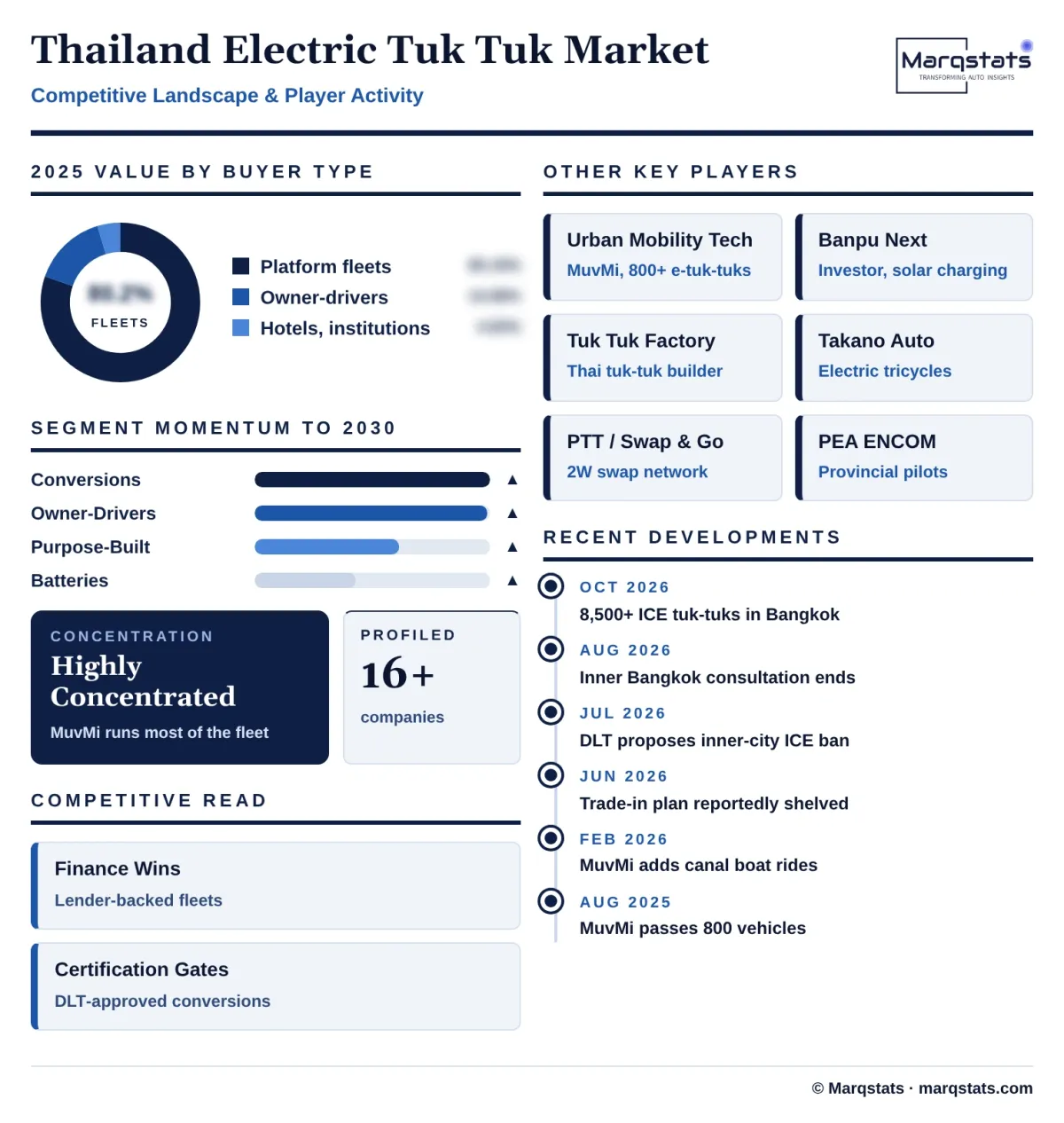
Ride-pooling platforms and corporate fleet owners account for 80.19% of 2025 value, USD 1.66 million, led by MuvMi, and grow at 29.99% a year to USD 6.16 million, 61.97% of the market by 2030.
Owner-drivers and drivers' cooperatives account for 14.98% of 2025 value, USD 0.31 million, and grow at 57.24% a year to USD 2.98 million and 29.98% of 2030 value, mainly through conversions of existing licensed tuk-tuks.
Hotels, resorts, universities and tour operators account for 4.83% of 2025 value, USD 0.10 million, rising to USD 0.80 million and 8.05% of the market by 2030, a 51.57% CAGR, as tourist areas favour quiet guest transport.
By Geography
Bangkok Metropolitan Area
Bangkok is the largest market, with 85.03% of 2025 value, USD 1.76 million, rising to USD 7.75 million by 2030, a 34.51% CAGR, while its share eases to 77.97%. Most electric tuk-tuks run MuvMi routes feeding BTS and MRT stations, Chulalongkorn University and business districts, and the proposed inner Bangkok restriction on combustion tuk-tuks applies here first. More than 8,500 combustion tuk-tuks were registered in Bangkok at the end of June 2026.
Island and Beach Tourist Hubs
Phuket, Samui, Krabi and other beach destinations account for 8.21% of 2025 value, USD 0.17 million, and grow at 47.58% a year to USD 1.19 million and 11.97% of the market by 2030, as hotels, resorts and tour operators replace combustion tricycles for guest transfers and short trips.
Northern Region
Chiang Mai, Chiang Rai and other northern cities account for 4.83% of 2025 value, USD 0.10 million, and grow at 43.10% a year to USD 0.60 million by 2030, supported by old-city tourism, local electricity authority pilots and red-truck and tuk-tuk operators looking to cut fuel costs.
Eastern Economic Corridor and Other Regions
Chonburi, Rayong, Pattaya and other provinces account for 1.93% of 2025 value, USD 0.04 million, and grow fastest, at 58.49% a year, to USD 0.40 million and 4.02% of the market by 2030, as Pattaya tourism, industrial estate shuttles and provincial operators adopt electric three-wheelers from a very small base.
How Competition Is Evolving
The Thailand electric tuk tuk market is highly concentrated. Urban Mobility Tech, which runs MuvMi and counts BANPU's e-mobility arm Banpu Next as an investor, operated more than 800 of about 940 electric tuk-tuks on Thai roads in 2025, and its fleet purchases make up most purpose-built vehicle sales.
Vehicle supply is fragmented. Electric tuk-tuks are built by small Thai body builders and assemblers, often using imported motors, controllers and battery cells, and conversions are carried out by specialist workshops working with universities such as King Mongkut's Institute of Technology Ladkrabang on certified designs.
Energy and charging companies play a growing role. BANPU and Banpu Next provide finance, batteries and solar charging, the state electricity authorities and their subsidiaries support provincial pilots, and charging network operators provide public and depot charging.
Competition will be decided by finance and certification. Operators that can fund large fleets and converters that can win Department of Land Transport approval at a low price will capture the demand created by the inner Bangkok restriction.
Barriers to entry are licensing rather than technology. Electric drivetrains for three-wheelers are widely available, but public tricycle licences are limited by area, so new entrants must buy or convert licensed vehicles or partner with licence holders.
MuvMi's growth path is funded. The company grew from about 350 vehicles in January 2023 to more than 800 by August 2025, and the ADB-backed BANPU loan supports financing for 1,500 vehicles, so its fleet purchases will continue to set purpose-built vehicle volumes in Bangkok through the forecast period.
Companies Covered
Companies covered in the report include:
Recent Market Activity
Table of Contents
Coverage & Segmentation
The study covers the Thailand electric tuk tuk market, with 2025 as the base year, 2021 – 2025 as the historical period and 2026 – 2030 as the forecast period. Values are in US dollars converted at a constant THB 33.74 per USD, the 2025 annual average, and are also given in Thai baht. Volumes are annual additions of road-legal electric tuk-tuks and replacement battery packs. The market is segmented by product, buyer type and region.
Low-speed electric tricycles used only on private resort, farm or factory grounds, electric motorcycles, cars, vans and buses, charging services, battery swapping and fare revenue are excluded. Electric tuk-tuks are not separately reported in the Marqstats Thailand Electric Vehicle and Thailand Electric Two-Wheeler reports, so this market adds detail rather than double counting. Unit, price, segment and regional splits are Marqstats estimates built on registration data, operator disclosures, lender documents, policy targets and price benchmarks.