Market Snapshot
Middle bar: base-year value × (1 + CAGR), rounded to two decimals. This is a calculated illustration, not a separately researched annual estimate.
The global electric reverse trike market size is estimated at USD 138.82 million in 2025 and is projected to reach USD 729.30 million by 2030, growing at a CAGR of 39.34% over 2026 – 2030. Annual production rises from about 9,640 vehicles to 42,900, a 34.80% annual rate, while the average ex-factory price rises from about USD 14,400 to USD 17,000 as enclosed passenger autocycles take a larger share.
Marqstats defines the market as the ex-factory wholesale value of factory-built, road-legal electric vehicles with two steered front wheels and one rear wheel, the tadpole or 2F1R layout. It covers passenger autocycles approved under US federal motorcycle rules and state autocycle laws, European L5e-A passenger and L5e-B commercial tricycles, L2e three-wheeled mopeds, and narrow-track tilting three-wheelers. Petrol reverse trikes such as the Polaris Slingshot and Can-Am Spyder and Ryker, single-front-wheel electric rickshaws, pedal-assisted cargo cycles, quadricycles, off-road vehicles and aftermarket canopies are excluded.
Rigid wide-track vehicles account for an estimated 62.00% of 2025 value, fully enclosed cabins for 68.00% and last-mile commercial logistics for 48.00%. Europe accounts for 44.00% of 2025 value and North America for 34.00%. The study segments the market by chassis architecture, cabin enclosure, application and region.
Key Takeaways
Market Overview & Analysis
Report Summary
Marqstats sizes the electric reverse trike market as the ex-factory value of factory-built, road-legal electric three-wheelers with two front wheels and one rear wheel. In 2025 about 9,640 vehicles were built worldwide, worth an estimated USD 138.82 million at an average ex-factory price of about USD 14,400.
The reverse trike layout puts two wheels at the front, where most braking and cornering forces fall. Compared with a single-front-wheel delta trike or rickshaw, it resists rollover in fast corners and stays stable under hard braking, which makes it suitable for arterial roads and highways rather than only for slow urban streets. The trade-off is width: a stable wide-track trike is close to the width of a small car, while narrow tilting designs lean into corners like a motorcycle.
The market has three distinct groups of buyers. Parcel and food delivery fleets in European cities buy enclosed L5e-B cargo trikes such as the Scoobic Light to keep serving centres closed to diesel vans. Commuters in North America reserve enclosed autocycles such as the Aptera, which combines a lightweight composite body with solar panels that add up to about 40 miles of driving a day. Riders worldwide buy recreational roadsters such as the Vanderhall Edison2 and tilting three-wheel scooters such as the Doohan iTank for urban trips.
Regulation shapes every design. In the United States a three-wheeler is a motorcycle under federal safety standards, so it does not have to pass passenger car crash tests, and most states treat enclosed models with a steering wheel and seat belts as autocycles that can be driven with a standard licence. In the European Union, Regulation (EU) No 168/2013 classifies three-wheelers as L5e tricycles only when the front wheels are at least 460 mm apart; narrower tilting designs are L3e motorcycles.
The market grew from about 2,150 vehicles in 2021, worth USD 24.50 million, to 3,420 in 2022, 4,890 in 2023 and 6,850 in 2024, worth USD 94.50 million, through delivery fleet trials, boutique roadsters and tilting scooters. Marqstats expects about 13,400 vehicles worth USD 198.50 million in 2026.
Several early companies have failed. Arcimoto, which built the FUV in Oregon, halted production in 2023, Carver in the Netherlands went bankrupt in July 2024, and ElectraMeccanica ended its SOLO programme before being acquired by Xos in 2024. Their experience shows that low-volume vehicle production cannot survive without either outside contract manufacturing or a clear commercial customer base.
Prices vary widely across the market. Marqstats estimates tilting electric three-wheel scooters sell for under USD 6,000 at the factory gate, enclosed L5e-B cargo trikes for about USD 12,000 to 14,000, recreational roadsters for USD 25,000 to 35,000, and enclosed passenger autocycles for about USD 30,000 to 40,000 at retail. The volume-weighted average was about USD 14,400 in 2025.
Electric models remain a small part of reverse trike sales. Marqstats estimates the global reverse trike market across all powertrains at about USD 1.68 billion in 2025, dominated by petrol models such as the Can-Am Spyder and Ryker, the Polaris Slingshot and leaning scooters such as the Piaggio MP3 and Yamaha Tricity. Electric models account for about 8.26% of that value.
Global Electric Reverse Trike Market Size and Forecast
The global electric reverse trike market grows from USD 138.82 million in 2025 to USD 729.30 million in 2030, a CAGR of 39.34%. Marqstats expects production of about 18,200 vehicles worth USD 285.00 million in 2027, 24,500 worth USD 402.00 million in 2028 and 32,800 worth USD 545.00 million in 2029, before reaching 42,900 vehicles in 2030.
Average prices rise rather than fall. The average ex-factory price increases from about USD 11,400 in 2021 to USD 14,400 in 2025 and USD 17,000 in 2030 because enclosed passenger autocycles and well-equipped cargo trikes, which cost USD 12,000 to USD 35,000, grow faster than open tilting scooters. Value therefore grows at 39.34% a year while volume grows at 34.80%.
Growth was strong in the historical period. Value rose at 54.28% a year between 2021 and 2025, from a small base of prototype and pilot vehicles. Growth slows over the forecast as the base gets larger, from about 43% in 2026 to about 34% in 2030.
Batteries and the front axle drive cost. Marqstats estimates that in an enclosed tilting trike the battery pack and battery management system account for about 32.5% of material cost, the chassis and front suspension for 23.0%, the composite body for 18.5%, the motor and inverter for 14.0% and the interior and displays for 12.0%. Tilting front suspensions add an estimated 18% to 24% to front-axle cost compared with rigid wide-track designs.
Commercial fleets and US launches set the pace. Marqstats tracks four indicators to monitor the forecast: the spread of zero-emission zones for urban freight in Europe, fleet orders from parcel carriers, the start of US customer deliveries of enclosed autocycles, and the cost of lithium iron phosphate battery packs for light vehicles.
The mix of vehicles changes over the forecast. Fully enclosed cabins rise from 68.00% to 74.00% of value and last-mile logistics from 48.00% to 52.00%, while recreational models fall from 17.00% to 12.00%. Europe remains the largest region, but its share eases from 44.00% to 43.00% as North America rises from 34.00% to 37.00%.
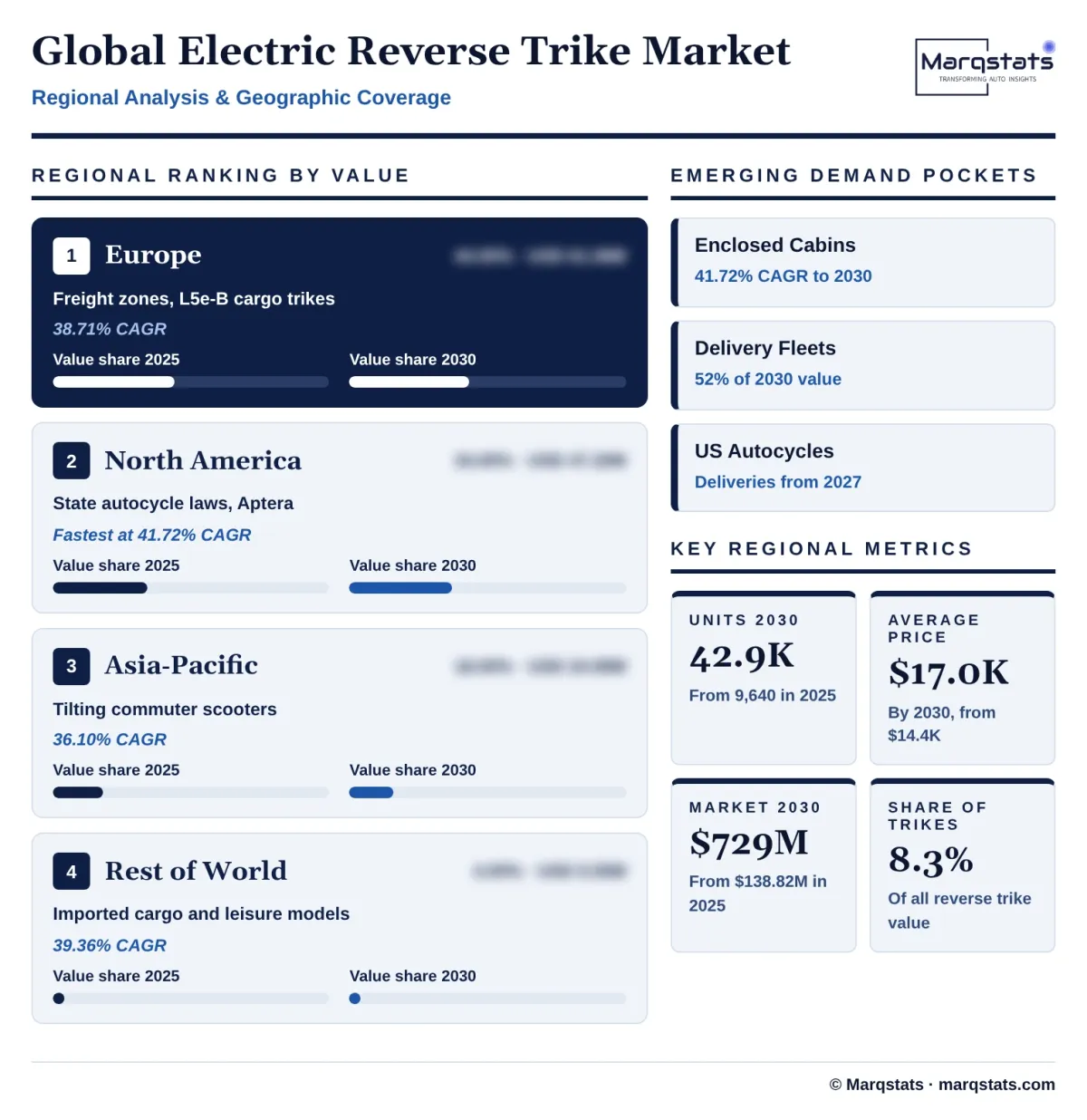
Regional growth differs by buyer type. Europe grows at 38.71% a year on commercial fleet demand, North America at 41.72% as passenger autocycles start deliveries, Asia-Pacific at 36.10% on tilting commuter scooters and the Rest of World at 39.36% from a small base.
Market Dynamics
Key Drivers
Five forces are lifting demand for electric reverse trikes in cities and on the open road.
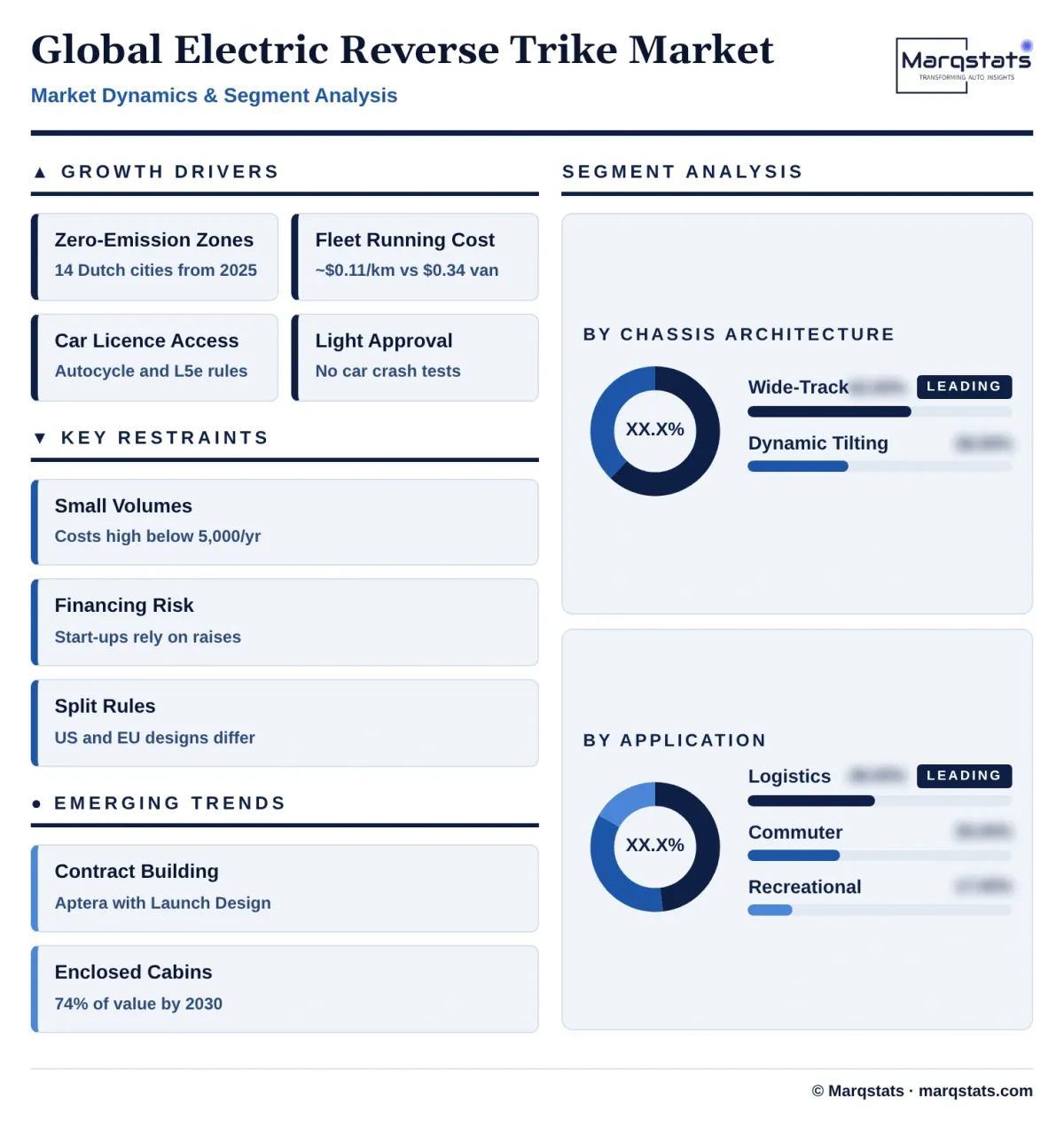
- Zero-emission zones for urban freight. Fourteen Dutch cities opened zero-emission zones for vans and trucks on 1 January 2025, with more joining, and cities in France, Spain and other countries are tightening access rules. Enclosed cargo trikes give couriers a cheap way to keep serving these centres.
- Lower operating cost for delivery fleets. Marqstats estimates an enclosed L5e-B cargo trike costs about USD 0.11 per kilometre to run, against about USD 0.34 for an electric delivery van, because it uses less energy, costs less to buy and can park closer to the door.
- Car licence access. Enclosed autocycles in most US states and wide-track L5e tricycles in Europe can be driven with a standard car licence, giving manufacturers access to far more drivers than motorcycles reach.
- Light-vehicle approval routes. Motorcycle and L-category approval avoids passenger car crash-test programmes, sharply reducing the money needed to bring a vehicle to market.
- Efficiency and solar charging. Light, aerodynamic two-seat bodies use far less energy than cars; the Aptera claims up to about 40 miles of daily driving from its built-in solar panels.
Key Restraints
Four constraints slow the move from hand-built prototypes to series production.
- Small production volumes. Producing a few thousand vehicles a year leaves material and assembly costs well above target prices, and several makers, including Arcimoto and Carver, failed before reaching scale.
- Financing risk. Start-up makers depend on equity raises; Aptera reported a going-concern warning and USD 10.1 million of cash at the end of June 2026, and its customer deliveries are subject to financing.
- Different rules in each region. A European L5e-B tricycle needs changes to brakes, lighting and parking brakes to meet US rules, and US autocycles need redesigns for European approval, so platforms cannot easily cross markets.
- Competition from four-wheel microcars and cargo bikes. L6e and L7e quadricycles such as the Citroën Ami offer enclosed seating, and electric cargo bikes are cheaper for light parcels.
Key Trends
Four shifts are changing how electric reverse trikes are designed, built and sold.
- Contract manufacturing. Start-ups now buy tooling, subassemblies and pilot production from engineering partners instead of building full plants, as Aptera did with Launch Design in August 2026.
- Enclosed cabins. Both cargo trikes and passenger autocycles are moving from open cockpits to sealed cabins with heating, glazing and secure storage.
- Wider front tracks in Europe. Designers keep the front wheels at least 460 mm apart so vehicles qualify as L5e tricycles that car licence holders can drive.
- Lithium iron phosphate batteries. Fleets favour LFP packs for long cycle life and safety in heavy daily stop-start use.
Strategic Implications
- For new vehicle makers, contract manufacturing is the safest route to market. Buying tooling, bodies and chassis from established partners keeps capital needs low enough to reach production before cash runs out.
- For parcel and food delivery fleets, enclosed cargo trikes are a practical answer to zero-emission zones. They carry around 250 kg and 1,400 litres, use a car licence in Europe and cost far less to run than a van.
- For established powersports makers, electrifying existing reverse trike lines protects their customer base. BRP launched its first Can-Am electric motorcycles in 2025 and Polaris builds the petrol Slingshot, giving both a dealer network that start-ups lack.
- For battery and component suppliers, light-vehicle packs and front suspension modules are the growth items. Parts certified for both US and EU rules allow one platform to serve both markets.
- For investors, financing structure matters as much as the product. Equipment leases, supplier warrants and milestone-based funding lower the risk of backing makers before they reach volume.
- For city authorities, cargo trikes are a way to clean up deliveries without banning them. Clear access rules and loading space for L-category vehicles in zero-emission zones encourage fleets to switch from vans to smaller vehicles.
Market Segmentation
Non-tilting vehicles with widely spaced front wheels account for 62.00% of 2025 value, USD 86.07 million, and grow at 40.23% a year to USD 466.75 million and 64.00% of 2030 value. Enclosed autocycles such as the Aptera and cargo trikes such as the Scoobic Light use this layout, which keeps them stable without a complex tilting mechanism and qualifies them as L5e tricycles in Europe.
Vehicles whose front wheels lean into corners account for 38.00% of 2025 value, USD 52.75 million, and grow at 37.85% a year to USD 262.55 million. Electric three-wheel scooters such as the Doohan iTank and narrow tilting commuters lead this segment; their tilting front suspension adds an estimated 18% to 24% to front-axle cost, and narrow models count as motorcycles in Europe.
Vehicles with a fully enclosed body account for 68.00% of 2025 value, USD 94.40 million, and grow fastest, at 41.72% a year, to USD 539.68 million and 74.00% of 2030 value. Delivery fleets need dry, lockable cargo space and commuters want heating, glazing and weather protection.
Open roadsters, scooters and semi-enclosed models account for 32.00% of 2025 value, USD 44.42 million, and grow at 33.68% a year to USD 189.62 million. Recreational roadsters such as the Vanderhall Edison2 and tilting scooters dominate this segment.
Delivery trikes for parcels, groceries and food account for 48.00% of 2025 value, USD 66.63 million, and grow at 41.60% a year to USD 379.24 million and 52.00% of 2030 value, driven by zero-emission freight zones in European cities and by lower operating costs than vans.
Commuter vehicles account for 35.00% of 2025 value, USD 48.59 million, and grow at 40.13% a year to USD 262.55 million, led by tilting scooters in Europe and Asia and, from 2027, by enclosed solar autocycles in the United States.
Leisure roadsters and touring trikes account for 17.00% of 2025 value, USD 23.60 million, and grow at 29.97% a year to USD 87.51 million; their share falls to 12.00% because most recreational buyers still choose petrol models.
By Geography
Europe
Europe is the largest market, with 44.00% of 2025 value, USD 61.08 million and about 4,240 vehicles, rising to USD 313.60 million by 2030, a 38.71% CAGR, while its share eases to 43.00%. Fourteen Dutch cities opened zero-emission zones for urban freight on 1 January 2025, and Spain, France and Germany have growing low-emission zones. The L5e-B category gives cargo trikes a clear approval route, and Spain-based Scoobic is one of the main suppliers. Registrations cluster in the Netherlands, Spain, France and Germany, partly because fleets register vehicles through central leasing companies.
North America
North America accounts for 34.00% of 2025 value, USD 47.20 million and about 2,750 vehicles, and grows fastest, at 41.72% a year, to USD 269.84 million and 37.00% of the market by 2030. Federal rules classify three-wheelers as motorcycles, and most states let enclosed autocycles be driven with a standard licence. Aptera, which listed on Nasdaq in October 2025, holds about 49,300 reservations and expects first customer deliveries in early 2027. Registrations cluster in California, Florida and Arizona, where the climate suits open and solar-charged vehicles.
Asia-Pacific
Asia-Pacific accounts for 18.00% of 2025 value, USD 24.99 million and about 2,250 vehicles, and grows at 36.10% a year to USD 116.69 million. China's Zhejiang province is a production hub for tilting electric three-wheel scooters, and demand clusters in congested cities such as Shanghai and Tokyo, where narrow vehicles move easily through traffic. The large single-front-wheel electric rickshaw markets of India and Southeast Asia are outside the scope.
Rest of World
The Rest of World accounts for 4.00% of 2025 value, USD 5.55 million, and grows at 39.36% a year to USD 29.17 million, through imports of cargo trikes and leisure models into the Middle East, Latin America and Africa, often approved under national special-vehicle rules.
How Competition Is Evolving
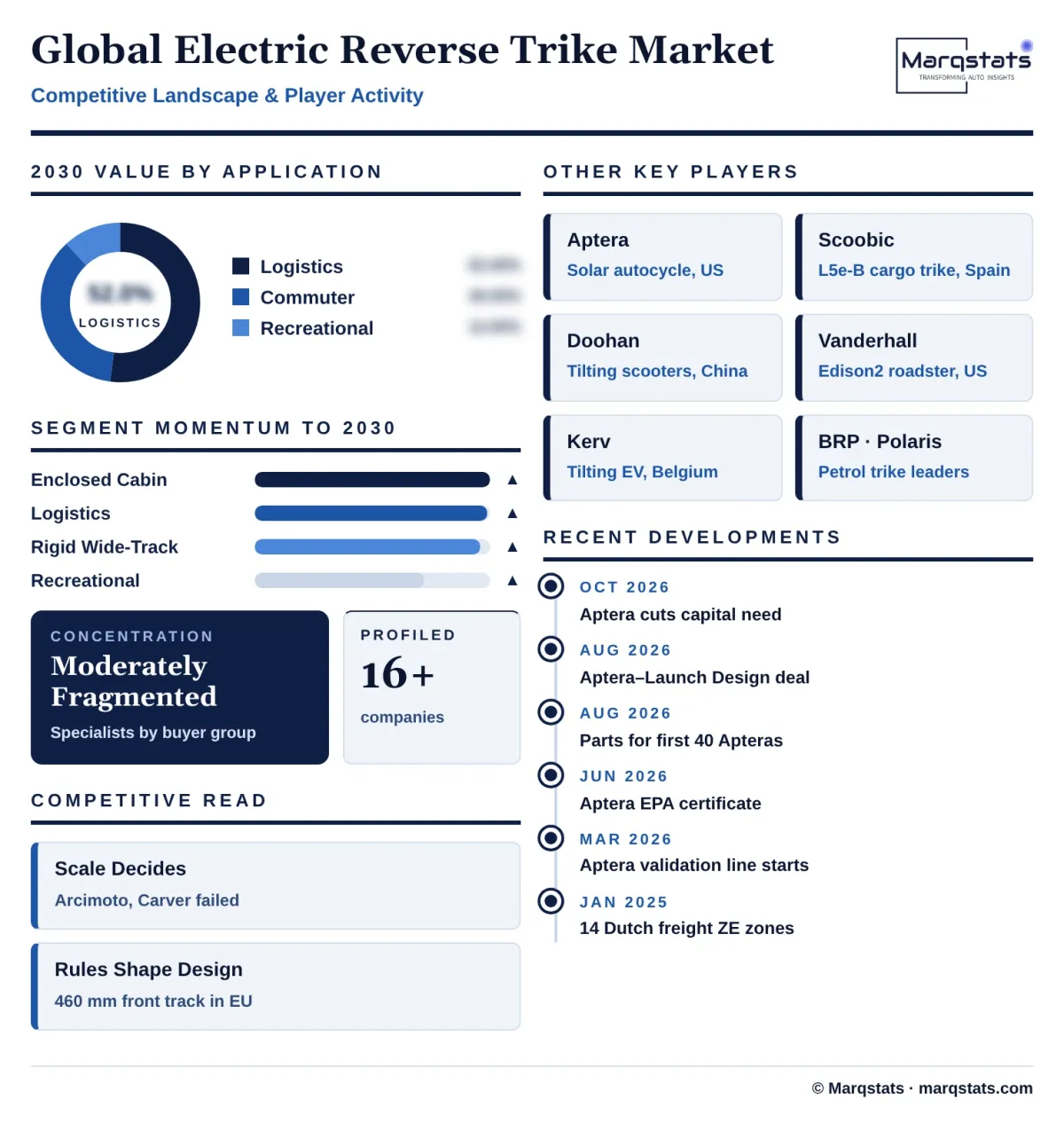
The electric reverse trike market is moderately fragmented. No single maker leads across all three buyer groups: Scoobic and other European specialists supply delivery fleets, Aptera and Vanderhall target US passenger and leisure buyers, and Chinese makers such as Doohan supply tilting scooters.
Start-ups and established powersports groups compete differently. Start-ups bring new designs such as solar bodies and enclosed cargo cabins but depend on outside finance and contract manufacturing. BRP, Polaris, Piaggio and Yamaha dominate petrol reverse trikes and leaning scooters and have dealer networks, but have not yet launched electric reverse trikes in volume.
Suppliers shape costs. Battery makers such as LG Energy Solution, drive suppliers such as Bosch and Schaeffler, brake specialists such as Brembo, and engineering partners such as Launch Design determine most of the vehicle cost and much of the production timing.
Survival will depend on volume and finance. Makers that reach several thousand units a year through fleet contracts or contract manufacturing will lower costs fastest, while small hand-built programmes remain exposed to the failures seen at Arcimoto and Carver.
Aptera is the most closely watched programme. It received an EPA Certificate of Conformity in June 2026, ordered bodies and chassis for its first 40 production vehicles in August 2026 and signed an agreement worth up to about USD 44 million with Launch Design for fixtures, tooling, testing and production support, with final assembly in Carlsbad, California.
European cargo trike makers compete on payload, volume and approval. The Scoobic Light carries about 250 kg in a 1,400 litre box within an L5e-B approval, letting couriers drive with a car licence, and competes with Chinese-built cargo trikes sold under European brands and with electric cargo bikes for lighter loads.
Companies Covered
Companies covered in the report include:
Recent Market Activity
Table of Contents
Coverage & Segmentation
The study covers the global electric reverse trike market, with 2025 as the base year, 2021 – 2025 as the historical period and 2026 – 2030 as the forecast period. Values are in US dollars at ex-factory wholesale prices, converted at 2025 average exchange rates, and volumes are annual production of factory-built road-legal vehicles. The market is segmented by chassis architecture, cabin enclosure, application and region.
Petrol and hybrid reverse trikes, single-front-wheel electric rickshaws and cargo tricycles, pedal-assisted cargo cycles under EN 15194, L6e and L7e quadricycles, off-road vehicles, sidecar outfits, aftermarket canopies and municipal sweepers are excluded. This market overlaps with Marqstats country reports on electric three-wheelers, which mainly cover single-front-wheel rickshaws; the figures should not be added together. Segment and regional splits are Marqstats estimates built on company disclosures, type-approval rules, fleet announcements and price benchmarks.