Market Snapshot
Middle bar: base-year value × (1 + CAGR), rounded to two decimals. This is a calculated illustration, not a separately researched annual estimate.
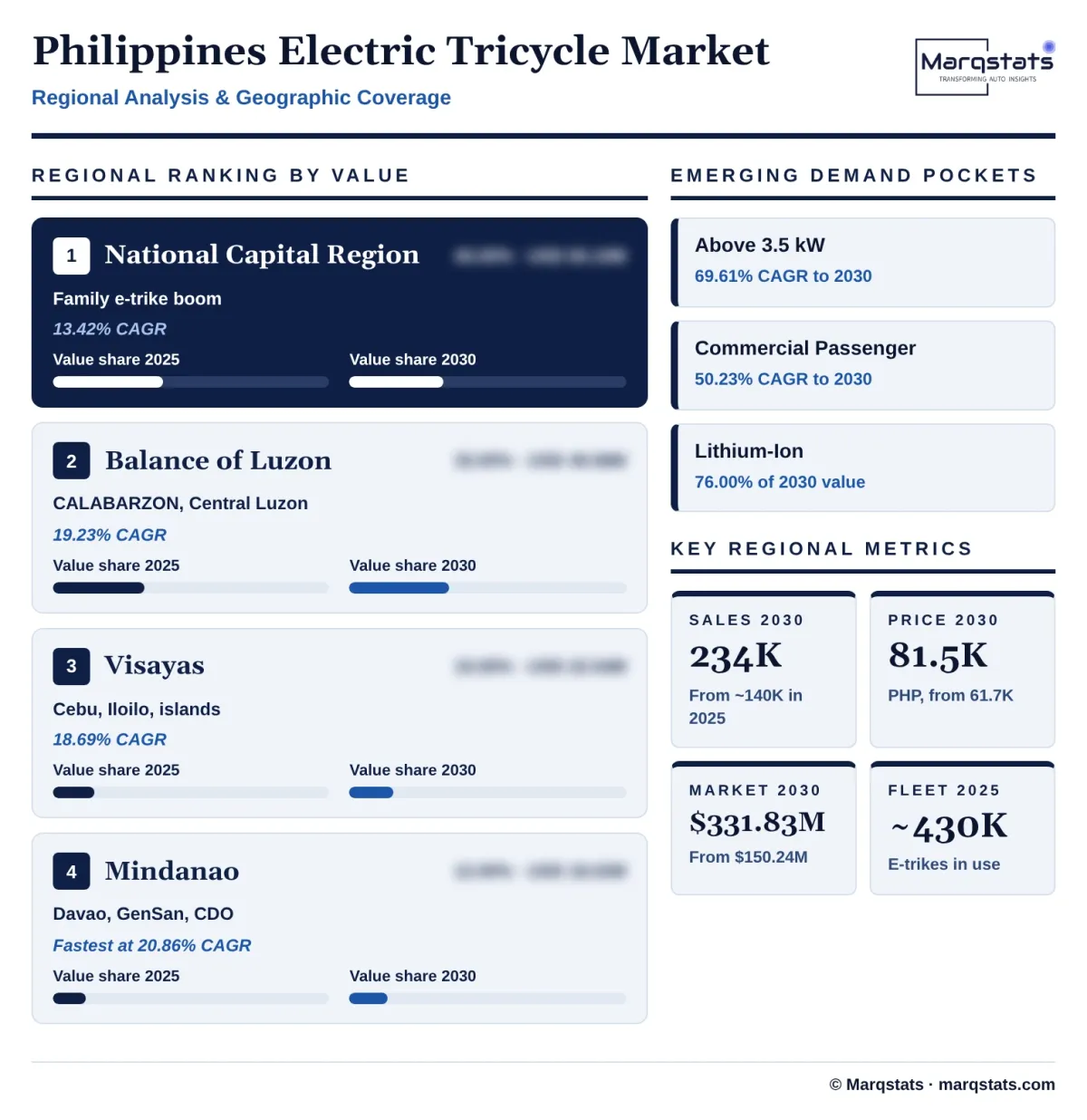
The Philippines electric tricycle market size is estimated at USD 150.24 million in 2025 and is projected to reach USD 331.83 million by 2030, growing at a CAGR of 17.17% over 2026 – 2030. Annual sales of new electric tricycles (e-trikes) rise from about 140,000 units to 234,000, a 10.82% annual rate, while the average selling price climbs from about PHP 61,700 to PHP 81,500 as commercial passenger and cargo models with lithium batteries take a larger share of sales.
Marqstats defines the market as the value of new battery electric three-wheelers with one front wheel and two rear wheels, or a motorcycle with a fixed sidecar, sold in the Philippines for personal, passenger and goods transport. It covers low-speed family e-trikes sold without plates, Land Transportation Office (LTO) Category L4 and L5 passenger e-trikes used by Tricycle Operators and Drivers Associations (TODAs) and local governments, and cargo e-trikes used by vendors, delivery businesses and utilities. Petrol tricycles, electric two-wheelers, electric quadricycles, two-front-wheel reverse trikes, electric jeepneys, battery swapping fees and charging equipment are excluded. Values are in US dollars at PHP 57.50 per USD, the Marqstats 2025 average rate, held constant across the forecast.
Light personal e-trikes under 1 kW account for an estimated 67.42% of 2025 value, lead-acid batteries for 59.00% and the National Capital Region (NCR) for 40.00%. The study segments the market by vehicle type, battery chemistry, motor power and region.
Key Takeaways
Market Overview & Analysis
Report Summary
Marqstats sizes the Philippines electric tricycle market as the value of new e-trikes sold for personal, passenger and goods transport. About 140,000 e-trikes were sold in 2025, worth an estimated PHP 8.64 billion, or USD 150.24 million, at an average price of about PHP 61,700.
The tricycle is the most common form of public transport in Philippine towns and barangays. Most are 125 cc to 150 cc motorcycles with a sidecar, operated under local government franchises by members of TODAs on short routes that jeepneys and buses do not serve. Local governments regulate fares, routes and franchise numbers, while the LTO registers the motorcycles and licenses the drivers.
Electric tricycles first arrived through government projects. The Department of Energy (DOE) and the Asian Development Bank (ADB) planned to distribute 20,000 e-trikes nationwide from 2011 and later raised the goal to 100,000 within five years, but the project fell well short and many early units were idle within a few years because of battery failures and weak after-sales support. Manila received e-trikes under the program from 2016 and Pasig took 200 lithium-ion e-trikes in 2019.
The real growth came from households. From 2021, low-cost e-trikes imported as kits from China and assembled locally by brands such as NWOW, Jonson, Yadea, HATASU and many smaller dealers spread rapidly through Metro Manila and nearby provinces. They cost PHP 37,000 to PHP 90,000, need no driver's license or plates when used privately, seat a driver and two to four passengers, run at about 25 km/h and charge from a household socket. Families use them for school runs, market trips and short errands that would otherwise need a motorcycle or a paid tricycle ride.
The boom outpaced regulation. One estimate put the number of e-trikes in Metro Manila at about 165,000 by May 2024, and Caloocan alone had about 18,000 by early 2024, yet the LTO recorded only about 120 three-wheeled electric vehicles among 43,441 electric two- and three-wheelers in 2024 because most e-trikes were never registered. Marqstats estimates that about 430,000 e-trikes were in use nationwide at the end of 2025, allowing for lead-acid models scrapped after three to five years.
Regulators have tried to catch up. The MMDA banned e-bikes and e-trikes from major Metro Manila roads from April 2024. The LTO issued rules requiring registration and licenses for L-category electric vehicles but suspended them in October 2024 after public objections, because EVIDA exempts light electric vehicles used only for private purposes from registration. In late 2025 the LTO announced that light electric vehicles would be barred from all national roads and highways, ran an information drive from 1 December 2025 and began apprehending and impounding violators from 2 January 2026. Commercial passenger e-trikes used for fare-paying service must still be registered with the LTO and franchised by the local government.
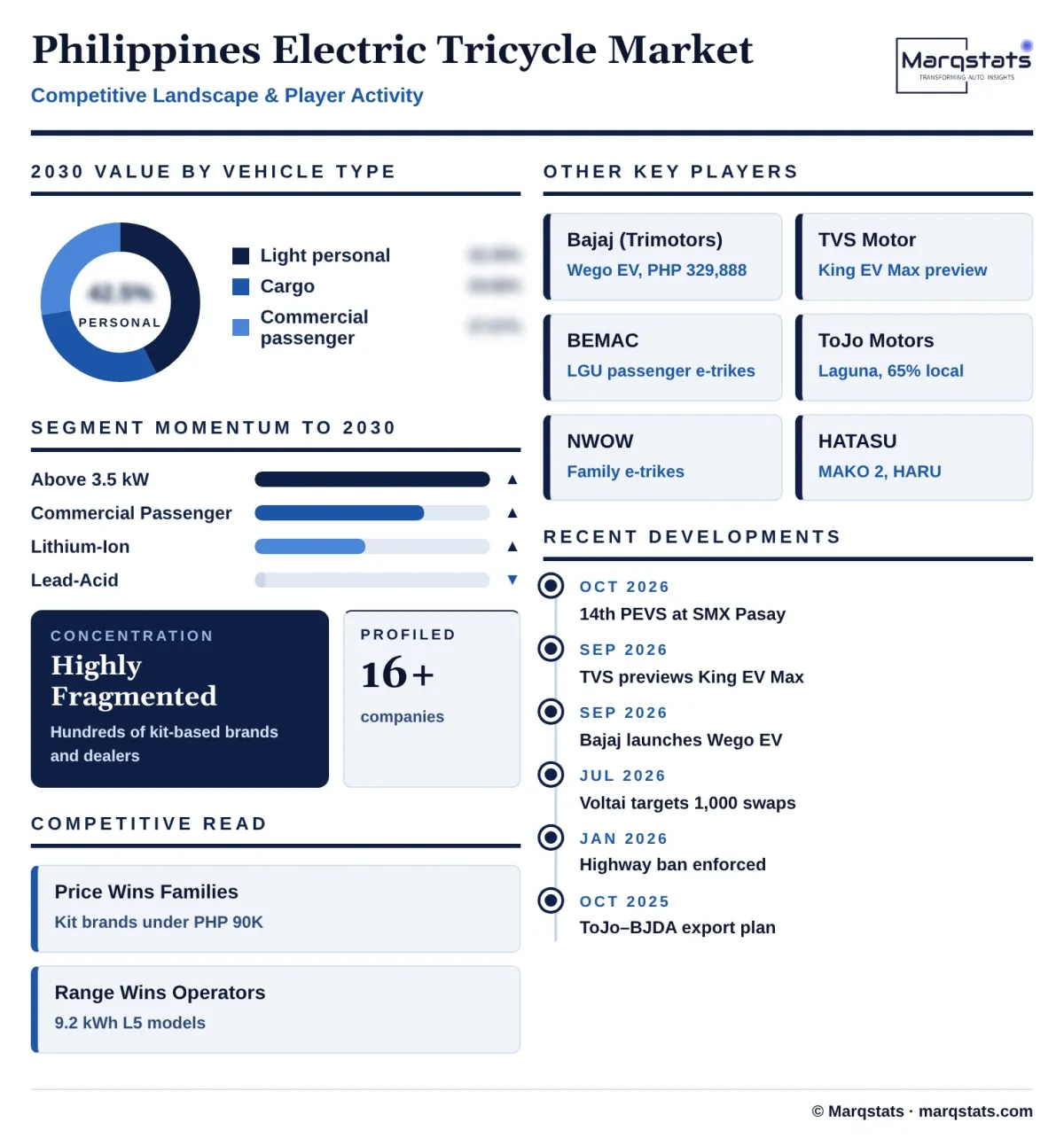
Three types of supplier serve the market. Family brands such as NWOW, Yadea, HATASU and Jonson sell low-speed e-trikes assembled from imported Chinese kits. Local manufacturers such as BEMAC, ToJo Motors and Gerweiss supply lithium passenger e-trikes to local governments, tourism operators and TODAs. Indian three-wheeler makers Bajaj and TVS, which dominate petrol three-wheeler sales in many Asian markets, are now bringing purpose-built electric models to the Philippines. Cargo e-trikes come from Chinese makers such as Jinpeng and Zongshen and from local assemblers.
Philippines Electric Tricycle Market Size and Forecast
The Philippines electric tricycle market grows from USD 150.24 million in 2025 to USD 331.83 million in 2030, a CAGR of 17.17%. Marqstats expects sales of about 142,400 vehicles worth USD 161.98 million in 2026, 158,900 worth USD 190.48 million in 2027, 179,500 worth USD 226.92 million in 2028 and 205,000 worth USD 274.42 million in 2029, before reaching 234,000 vehicles in 2030.
Sales grew quickly from 2021 and slowed in 2025. About 31,700 e-trikes were sold in 2021, worth USD 33.39 million, rising to 57,500 in 2022, 93,900 in 2023 and 125,400 in 2024, worth USD 130.02 million. Growth slowed to about 12% in 2025 as Metro Manila restrictions on national roads, talk of registration and licensing rules and a crowded dealer market cooled demand for family models.
Sales flatten in 2026 and recover after. Enforcement of the national highway ban from January 2026 cuts light personal e-trike sales by about 4% in 2026, but commercial passenger and cargo models keep growing, so total value still rises by about 8%. From 2027 growth returns to 10% to 14% a year in volume as lithium models, provincial demand and TODA replacement take over from first-time family buyers.
The average price rises because the mix changes. Light personal e-trikes average about PHP 52,000 in 2025, cargo e-trikes PHP 85,000 and commercial passenger e-trikes PHP 230,000. As commercial and cargo models rise from 20% to 36% of units, the overall average price climbs from about PHP 61,700 in 2025 to PHP 81,500 in 2030, so value grows at 17.17% a year while volume grows at 10.82%.
Marqstats tracks four indicators to monitor the forecast: monthly imports of e-trike kits and complete vehicles, the number of L5 e-trikes registered for TODA use, local government tricycle franchise conversion programs, and the price gap between lithium and lead-acid battery packs.
The mix changes over the forecast. Light personal e-trikes fall from 67.42% to 42.45% of value, commercial passenger e-trikes rise from 7.99% to 27.67% and cargo e-trikes from 24.59% to 29.88%. Lithium batteries rise from 41.00% to 76.00% of value. NCR remains the largest single region until the rest of Luzon overtakes it by 2030, as its share falls from 40.00% to 34.00%.
Running costs explain why operators switch once they can afford the vehicle. Marqstats models a TODA route of 80 km a day over 300 days a year. A 150 cc petrol tricycle uses about 3.2 litres a day at PHP 65 per litre, about PHP 208, plus PHP 45 for maintenance, or PHP 253 a day. A commercial lithium e-trike uses about 4.8 kWh a day at PHP 11.50 per kWh, about PHP 55, plus PHP 15 for maintenance, or about PHP 70 a day. The saving of about PHP 183 a day, or PHP 54,800 a year, repays the price gap between a PHP 230,000 e-trike and a PHP 130,000 petrol tricycle in under two years, and within three years after allowing for financing costs.
Market Dynamics
Key Drivers
Five forces are pushing Filipino households, tricycle operators and small businesses towards electric tricycles.
- Low running costs. An e-trike uses about 6 kWh per 100 km, so a commercial e-trike covering 80 km a day costs about PHP 55 a day in electricity at PHP 11.50 per kWh, against about PHP 208 in petrol for a 150 cc tricycle. For households, a full charge of a family e-trike costs as little as PHP 20.
- Cheap vehicles and easy access. Family e-trikes sell for PHP 37,000 to PHP 90,000, often on installment, and need no license or plates for private use under EVIDA, making them the cheapest motorised transport for many households.
- EVIDA fleet targets and local programs. EVIDA, Republic Act No. 11697, requires at least 5% of public transport, government and corporate fleets to be electric, and cities such as Quezon City and Pasig have run e-trike programs for TODAs and local services.
- Zero import duties. The government extended zero tariffs to battery e-tricycles and quadricycles, electric motorcycles and e-bikes in May 2024, with zero duty on most electric vehicle lines and kits until 2028, keeping imported kits and complete e-trikes cheap.
- Purpose-built commercial models. Bajaj launched the Wego electric three-wheeler in September 2026 with a 9.2 kWh battery and up to 212 km of range, and TVS previewed the King EV Max, giving TODA operators e-trikes that match the payload and daily distance of petrol tricycles.
- Growing goods transport. Market vendors, water and gas delivery businesses, parcel couriers and local utilities use cargo e-trikes with 300 kg to 600 kg payloads for short urban trips, where they cost less to run than small vans or petrol motorcycles.
- Charging is getting easier. The DOE counted 1,876 public charging points in September 2026, including 528 battery swapping stations, and most e-trikes charge overnight from ordinary household or terminal sockets without new connections.
Key Restraints
Four constraints limit how fast electric tricycles replace petrol tricycles and grow beyond family use.
- Road bans. The Metropolitan Manila Development Authority (MMDA) banned e-bikes and e-trikes from major Metro Manila roads from April 2024 with a PHP 2,500 fine, and the LTO began enforcing a ban on national roads and highways from 2 January 2026, with impounding of violators.
- Battery life and quality. Lead-acid packs in low-cost e-trikes often need replacement after one to two years at PHP 7,000 to PHP 20,000, and poor after-sales support for imported kits undermines buyer confidence.
- Regulatory uncertainty. The LTO suspended its registration and licensing rules for light electric vehicles in October 2024, leaving the line between private, unregistered e-trikes and registered L4 and L5 vehicles unclear for buyers and local governments.
- High cost of commercial models. A purpose-built commercial e-trike costs PHP 200,000 to PHP 330,000, two to three times a new petrol tricycle, and most TODA members have limited access to bank credit.
- Safety concerns. Officials linked nearly 1,000 road crashes in 2023 to light electric vehicles, and unlicensed drivers, overloading and minors at the wheel keep pressure on local governments to restrict family e-trikes.
Key Trends
Five shifts are changing how electric tricycles are built, powered, sold and regulated.
- Shift to lithium. Brands are moving family and cargo e-trikes from lead-acid to lithium iron phosphate packs, and commercial models such as the Bajaj Wego and TVS King EV Max use 9.2 kWh lithium batteries.
- Bigger, faster commercial models. New commercial e-trikes have 4.5 kW to 10 kW motors and top speeds of 50 to 60 km/h, meeting LTO L5 rules and handling loaded passengers on hilly provincial routes.
- Local assembly and exports. ToJo Motors in Laguna reports 65% local content and plans, with Chinese partner BJDA, to export e-trikes to South Asia, while most family brands assemble imported kits locally.
- Battery swapping. Voltai, backed by AboitizPower, launched battery swapping for electric two-wheel fleets in Pasig in October 2025 and targets about 1,000 stations, building a model that cargo and passenger e-trike fleets can follow.
- Local road rules. With national roads closed to light electric vehicles, local governments are writing their own ordinances on e-trike routes, speed, age limits and parking, shaping where the vehicles can operate.
- Online and installment sales. A growing share of family e-trikes is sold through online marketplaces and mall showrooms with installment plans, widening access beyond traditional motorcycle dealers.
Strategic Implications
- For vehicle brands, the commercial segment is the growth market. Registered L5 passenger and cargo e-trikes with lithium batteries, warranties and service outside Metro Manila will capture most new value as family sales slow.
- For TODA operators, financing decides the switch. Lease-to-own plans that link payments to daily fuel savings let drivers move to electric without a large down payment.
- For local governments, franchise conversion is the main lever. Cities that reserve new tricycle franchises for e-trikes, build charging at terminals and set clear local road rules will see the fastest conversion.
- For battery and charging providers, e-trikes need simple power. Shared charging at TODA terminals and swapping for cargo fleets can lower operating costs without large grid upgrades.
- For policymakers, a clear registration path matters more than bans. Simple registration for commercial e-trikes, safety standards for family models and battery recycling rules will protect users without stopping a market that serves hundreds of thousands of households.
- For investors, the market is large but changing. Family e-trike sales are big but slowing, while commercial passenger and cargo models, lithium batteries and services such as financing, charging and battery recycling offer faster growth.
Market Segmentation
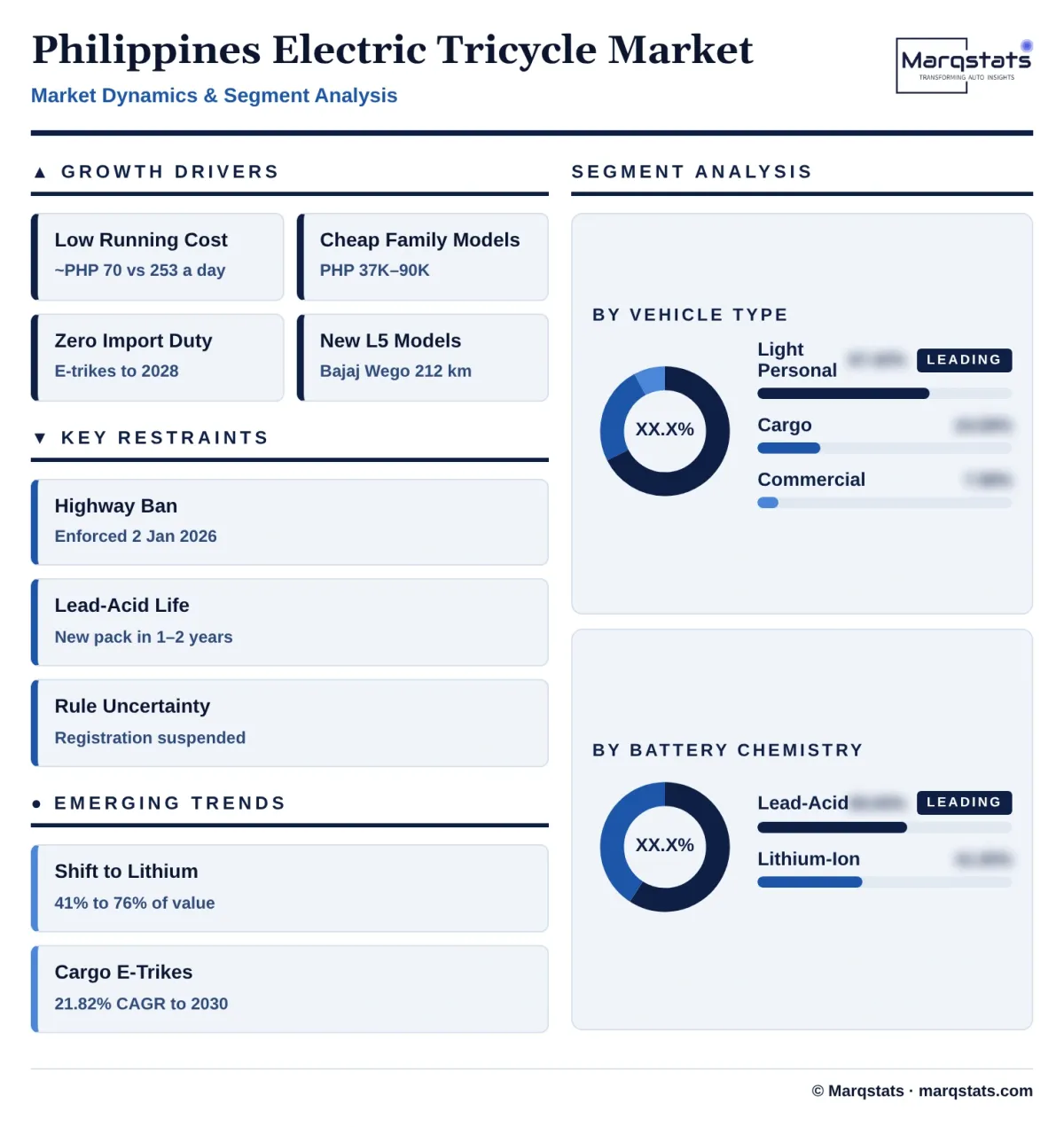
Low-speed family e-trikes with motors under 1 kW account for 67.42% of 2025 value, USD 101.29 million, and grow at 6.82% a year to USD 140.87 million by 2030, while their share falls to 42.45%. About 112,000 were sold in 2025 at an average of about PHP 52,000. They seat a driver and two to four passengers, run at about 25 km/h and are used privately without plates, which keeps them off national roads from January 2026. Growth slows because Metro Manila, where the boom started, is saturated, and because new buyers increasingly choose lithium models in the commercial and cargo segments instead.
Cargo e-trikes with open beds or closed boxes account for 24.59% of 2025 value, USD 36.95 million, and grow at 21.82% a year to USD 99.13 million and 29.88% of the market by 2030. Vendors, water and gas refill shops, couriers and utilities buy them to carry 300 kg to 600 kg on short urban routes.
Registered L4 and L5 passenger e-trikes used by TODAs, local governments and tourist destinations account for 7.99% of 2025 value, USD 12.00 million, and grow fastest, at 50.23% a year, to USD 91.83 million and 27.67% of the market by 2030. Sales rise from about 3,000 to 24,000 vehicles as purpose-built models from Bajaj, TVS, BEMAC and ToJo Motors reach the franchise replacement market.
Lead-acid batteries account for 59.00% of 2025 value, USD 88.64 million, falling to USD 79.64 million and 24.00% of the market by 2030, a decline of 2.12% a year. They keep entry prices low for family e-trikes but need replacement every one to two years.
Lithium-ion batteries, mainly lithium iron phosphate, account for 41.00% of 2025 value, USD 61.60 million, and grow at 32.57% a year to USD 252.19 million and 76.00% of the market by 2030, as commercial and cargo buyers choose packs that last 2,000 cycles or more.
Models under 1 kW, the low-speed family segment, account for 67.42% of 2025 value, USD 101.29 million, and grow at 6.82% a year to USD 140.87 million by 2030.
Models from 1 kW to 3.5 kW, covering most cargo e-trikes and many commercial passenger models, account for 30.15% of 2025 value, USD 45.30 million, and grow at 25.27% a year to USD 139.73 million and 42.11% of the market by 2030.
Models above 3.5 kW, such as the 4.5 kW Bajaj Wego and the TVS King EV Max, account for 2.43% of 2025 value, USD 3.65 million, and grow fastest, at 69.61% a year, to USD 51.23 million and 15.44% of the market by 2030, as operators need power for loaded passengers and hills.
By Geography
National Capital Region
NCR is the largest region, with 40.00% of 2025 value, USD 60.10 million, rising to USD 112.82 million by 2030, a 13.42% CAGR, while its share falls to 34.00%. Metro Manila built the family e-trike boom, but bans on national roads and on MMDA-supervised roads limit where the vehicles can run, slowing growth in light personal models.
Balance of Luzon
The rest of Luzon, led by CALABARZON and Central Luzon, accounts for 33.00% of 2025 value, USD 49.58 million, and grows at 19.23% a year to USD 119.46 million, overtaking NCR by 2030. Dense suburbs in Cavite, Laguna, Bulacan and Rizal, local assembly plants and long tricycle feeder routes support demand.
Visayas
The Visayas account for 15.00% of 2025 value, USD 22.54 million, and grow at 18.69% a year to USD 53.09 million. Metro Cebu, Iloilo and tourist islands such as Boracay, which uses e-trikes on its island routes, lead adoption.
Mindanao
Mindanao accounts for 12.00% of 2025 value, USD 18.02 million, and grows fastest, at 20.86% a year, to USD 46.46 million by 2030, as Davao, General Santos and Cagayan de Oro convert tricycle routes and dealer networks expand south.
How Competition Is Evolving
The Philippines electric tricycle market is highly fragmented. Hundreds of dealers sell e-trikes assembled from imported Chinese kits under dozens of brands, while a smaller group of local manufacturers and Indian three-wheeler makers compete for commercial passenger and fleet orders. No supplier holds a dominant share of units.
Family brands compete on price and dealer reach. NWOW, Jonson, Yadea, HATASU and many smaller brands sell low-speed e-trikes from about PHP 37,000 to PHP 90,000 through showrooms, malls and online marketplaces, often with installment plans. HATASU sells three-wheel models such as the MAKO 2 and HARU and reported about 10,000 two- and three-wheelers sold in its first year of local operations.
Commercial models compete on range and durability. Bajaj Philippines, part of Trimotors Technology Corporation, launched the Wego electric three-wheeler at PHP 329,888 in September 2026 with a 4.5 kW motor, a 9.2 kWh battery, about 212 km of range and a charging time of about 4.5 hours. TVS Motor previewed the King EV Max at the Wheeltek 50th anniversary exhibition in September 2026, with a 9.2 kWh battery and up to 179 km of range in its Indian specification.
Local builders focus on local governments and tourism. BEMAC Electric Transportation Philippines, ToJo Motors in Laguna, Gerweiss Motors and other local makers supply lithium e-trikes to local governments, island destinations and TODAs, competing on local content, service and experience with government procurement.
Competition will move to lithium, finance and service. As family sales slow, brands that offer lithium packs with multi-year warranties, financing linked to fuel savings and parts outside Metro Manila will take the largest share of new value.
Chinese supply sets the price floor. Electric tricycle exports from Xuzhou, the main Chinese production hub, rose 87.2% to RMB 168 million in the first four months of 2026, and zero Philippine import duty on battery e-tricycles until 2028 keeps imported kits and complete vehicles cheap, so local assemblers compete mainly on dealer reach, warranties and after-sales service.
Infrastructure players are moving in. Voltai, backed by AboitizPower, runs battery swapping for electric two-wheel fleets and plans about 1,000 stations, while Meralco and other utilities offer EV charging services. Fleet e-trike operators can use these networks as they expand beyond two-wheelers.
Companies Covered
Companies covered in the report include:
Recent Market Activity
Table of Contents
Coverage & Segmentation
The study covers the Philippines electric tricycle market, with 2025 as the base year, 2021 – 2025 as the historical period and 2026 – 2030 as the forecast period. Values are in US dollars at PHP 57.50 per USD, held constant, and volumes are annual sales of new vehicles. The market is segmented by vehicle type, battery chemistry, motor power and region.
Petrol tricycles, electric two-wheelers and e-bikes, electric quadricycles, two-front-wheel reverse trikes, electric jeepneys, used vehicles, battery replacement and swapping fees and charging equipment are excluded. Registered electric three-wheelers are also counted in the Marqstats Philippines Electric Vehicle Market report, and those values should not be added; most family e-trikes are unregistered and fall outside that report's registration data. Segment and regional splits are Marqstats estimates built on LTO, DOE and local government data, brand and dealer disclosures, trade data and price benchmarks.